 Egyptian Arabic
| Key Takeaways |
| Egyptian Arabic is the most widely understood Arabic dialect across the Arab world, making it uniquely practical for learners in the UAE. |
| Egyptian Arabic differs from MSA and Gulf dialects in vocabulary, verb conjugation patterns, and distinctive pronunciation of certain consonants. |
| Learners in the UAE can reach conversational Egyptian Arabic in 4–6 months with structured, consistent weekly instruction targeting spoken skills. |
| The UAE’s large Egyptian expatriate community provides abundant real-world practice opportunities unavailable in most other Arabic-learning environments. |
| Building an MSA foundation before or alongside Egyptian Arabic significantly accelerates overall Arabic literacy and comprehension. |
If you live or work in the UAE and want to connect with Arabic speakers beyond formal settings, Egyptian Arabic may be the most strategically valuable dialect you can learn. It is the most widely understood spoken Arabic variety across the Arab world — including here in the UAE — largely because of decades of Egyptian film, television, and music that have made it familiar to Arabic speakers everywhere. Learning it here is not just possible; the UAE’s diverse population makes it one of the best places in the world to practice it daily.
The good news for learners in the UAE is that Egyptian Arabic is genuinely accessible. Its phonology is less complex than Gulf dialects for many non-native speakers, its learner resources are the most abundant of any Arabic dialect, and the UAE’s significant Egyptian community means authentic conversation partners are close by. This guide gives you a clear, practical path to learning Egyptian Arabic from scratch — structured specifically for your life in the UAE.
What Is Egyptian Arabic?
Egyptian Arabic, known in Arabic as العامية المصرية (Al-Ammiya Al-Masriya), is the spoken vernacular used by Egypt’s roughly 105 million people in daily conversation, entertainment, and informal communication.
Egyptian Arabic belongs to the Semitic language family and shares the same root-based morphological system as all Arabic varieties.
However, it has absorbed significant vocabulary from Coptic, Turkish, French, Italian, and English over centuries — which actually makes it more accessible to many international learners.
How Is Egyptian Arabic Different from MSA?
Modern Standard Arabic (Al-Fusha) is the formal written and broadcast standard used across the Arab world. Egyptian Arabic diverges from MSA in several important ways:
| Feature | MSA | Egyptian Arabic |
| “I want” | أريد (Ureed) | عايز (Aayiz) |
| “What?” | ماذا (Matha) | إيه (Eeh) |
| The letter ق (Qaf) | Pronounced as /q/ | Pronounced as a glottal stop /’/ |
| The letter ج (Jim) | Pronounced as /dʒ/ | Pronounced as hard /g/ in Egypt |
| Dual verb forms | Fully used | Largely absent in speech |
| Case endings (I’rab) | Present and functional | Dropped entirely in speech |
These differences mean that studying MSA alone will not give you spoken Egyptian Arabic — and vice versa. Effective learners address both tracks intentionally.
How Does Egyptian Arabic Compare to Emirati Arabic?
For learners in the UAE, this comparison is especially relevant. Emirati Arabic retains the /q/ sound in Qaf, uses Gulf-specific vocabulary influenced by Bedouin and coastal traditions, and includes sounds — like the voiced Jim /dʒ/ — that Egyptian Arabic replaces with a hard /g/.
For example, the word for “heart” (qalb) is pronounced ‘alb in Egyptian Arabic (with a glottal stop), while Emirati speakers retain the /q/ sound.
If you have already studied Emirati Arabic at Abjad Academy, you will notice these distinctions immediately — and your existing Arabic phonological awareness will accelerate Egyptian Arabic acquisition considerably.
1. Build Your Arabic Alphabet Foundation First
Before attempting Egyptian Arabic conversation, you must be able to read and write Arabic script. Egyptian Arabic is spoken, not standardized in writing, but all learning materials — including transliterations, vocabulary lists, and grammar explanations — are anchored in the Arabic alphabet. Without script literacy, your learning speed will be significantly limited from the start.
This is the most common mistake adult learners in the UAE make: attempting to learn spoken Egyptian Arabic exclusively through transliteration (writing Arabic sounds in Latin letters). Transliteration is a crutch that creates a ceiling. It slows reading speed, distorts pronunciation, and makes grammar patterns invisible.
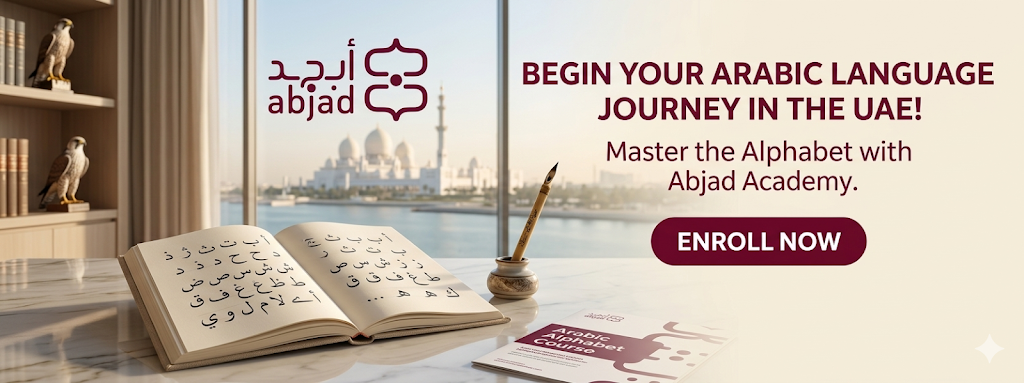
The Arabic alphabet has 28 letters, each with up to four positional forms. For most learners in UAE-based structured programs, reaching functional script reading takes approximately 4–6 weeks of consistent daily practice — not months.
At Abjad Academy, our Arabic alphabet course provides systematic, structured instruction in Arabic script specifically designed for non-native speakers in the UAE, with personalized follow-up to ensure no letter or positional form is skimmed over.
Start learning Arabic letters with a FREE trial class
2. Learn the Core Characteristics of Egyptian Arabic Pronunciation
Egyptian Arabic has a distinct sound profile that separates it immediately from Gulf and Levantine dialects. The two most notable features are the pronunciation of ج (Jim) as a hard /g/ sound — so جمل (jamal, camel) becomes gamal — and the pronunciation of ق (Qaf) as a glottal stop, so قلب (qalb, heart) becomes ‘alb. These two features alone mark your speech as distinctly Egyptian.
Other phonological characteristics include:
- The -sh negation suffix: Egyptian Arabic negates verbs using a circumfix: ما + verb + شَ (ma…sh). So “I don’t know” is مش عارف (mish aarif) or ما أعرفش (ma-a’rafsh) — a pattern absent from MSA entirely.
- Vowel shifts: Certain MSA long vowels are shortened in Egyptian Arabic, giving the dialect a faster, more clipped rhythm than Gulf Arabic.
- Stress patterns: Egyptian Arabic places stress on specific syllables in ways that differ from both MSA and Emirati Arabic — and getting these wrong is one of the most audible markers of a foreign accent.
The most consistent observation I make with expat learners who come to Egyptian Arabic after Gulf exposure is that they overpronounce the /q/ sound and under-stress the right syllables. It takes focused drilling — not just passive listening — to override those established habits.
Shots Videos from Our Courses
Begin Your Arabic Journey in the UAE
Join Abjad Institute for a professional and immersive Arabic language experience tailored to your goals.
Book Your Free Trial3. Master the Essential Egyptian Arabic Grammar Patterns
Egyptian Arabic grammar is significantly simpler than MSA grammar in several areas — there are no case endings (I’rab), no dual verb forms in practice, and far fewer formal grammatical categories to track. However, Egyptian Arabic grammar has its own structures that must be learned explicitly, particularly the negation system, the use of بتاع (bita’) for possession, and the present-tense verb prefix ب (bi-).
The ب (Bi-) Present Tense Prefix
In MSA, present tense verbs are already marked. In Egyptian Arabic, the prefix ب signals ongoing or habitual action — the equivalent of “I am doing” or “I do.” Without it, the verb refers to future or non-specific action.
بيتكلم (biyitkallim) — “He speaks / He is speaking” يتكلم (yitkallim) — “He will speak / Let him speak”
This distinction is not explained in most beginner resources, and learners who miss it produce grammatically confusing Egyptian Arabic.
Possession with بتاع (Bita’)
MSA uses the Idafa construction or possessive pronouns for ownership. Egyptian Arabic uses بتاع (bita’) as a standalone possessive particle:
الكتاب بتاعي (El-kitab bita’i) — “My book” (literally: “The book belonging to me”)
This structure is used constantly in daily Egyptian Arabic conversation and sounds natural to every Egyptian speaker. Learners who use the MSA Idafa in conversation instead are understood — but they sound formal to the point of being unusual.
Abjad Academy’s Arabic grammar course addresses these dialect-specific grammatical structures alongside formal MSA foundations, giving learners the ability to move fluidly between registers as their professional and social needs in the UAE require.
Book your FREE trial class in our Arabic grammar course
4. Build Your Egyptian Arabic Vocabulary Systematically
Egyptian Arabic vocabulary acquisition is most efficient when organized by domain rather than frequency alone. Start with three domains: daily social interaction, household and neighborhood language, and professional communication.
These three domains cover the most common real-world scenarios UAE-based learners will encounter with Egyptian colleagues, neighbors, and service providers.
Here is a starter comparison of key Egyptian Arabic vocabulary alongside MSA equivalents:
| Meaning | MSA | Egyptian Arabic |
| Now | الآن (al-an) | دلوقتي (dilwa’ti) |
| A lot | كثير (katheer) | أوي (awi) |
| Good / Fine | جيد (jayyid) | كويس (kwayyes) |
| Come | تعال (ta’al) | تعالى (ta’ala) |
| See you | إلى اللقاء (ila al-liqa’) | مع السلامة (ma’a el-salama) |
| Want (m.) | يريد (yureed) | عايز (aayiz) |
Notice that several Egyptian terms — like مع السلامة (ma’a el-salama) — are also used in the UAE, which makes them doubly valuable for learners living here.
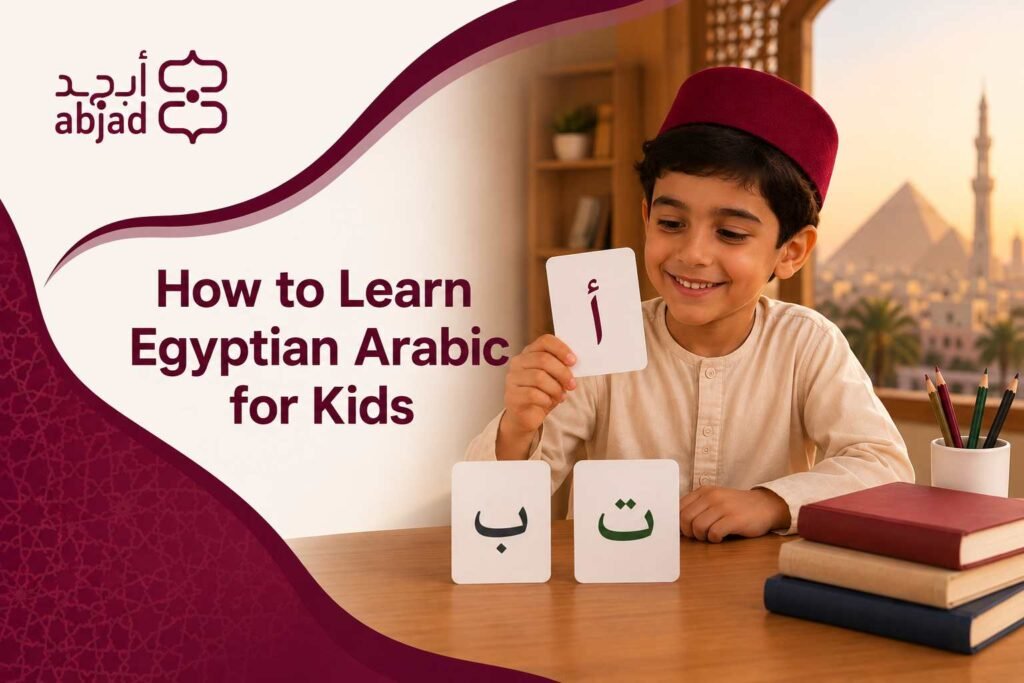
Read also: How To Learn Egyptian Arabic For Kids?
Begin Your Arabic Journey in the UAE
Join Abjad Institute for a professional and immersive Arabic language experience tailored to your goals.
Book Your Free Trial5. Use the UAE’s Egyptian Community as a Living Classroom
The UAE hosts one of the largest Egyptian expatriate populations outside Egypt itself, concentrated particularly in Dubai, Abu Dhabi, and Sharjah. This means that Egyptian Arabic is not a “foreign” dialect in the UAE — it is spoken daily in offices, restaurants, clinics, and neighborhoods.
Learners who engage this community intentionally accelerate their progress at a rate no app or textbook can match.
Practical strategies for immersion within the UAE:
A. Request Egyptian Arabic at service counters
Many pharmacists, supermarket staff, and administrative workers in the UAE are Egyptian. A simple opener like “ممكن نتكلم عربي؟” (Mumkin nitkallim ‘arabi? — “Can we speak Arabic?”) opens the door.
B. Watch Egyptian media with Arabic subtitles
Egyptian television drama (مسلسلات) and film are widely available on streaming platforms. Subtitles in Arabic script — not transliteration — reinforce reading while training your ear.
C. Use Egyptian Arabic in appropriate professional settings
If your workplace has Egyptian colleagues, brief informal conversation in Egyptian Arabic is an immediate relationship-builder that formal MSA cannot replicate.
For learners looking to deepen spoken skills through structured practice with native instruction, our Arabic speaking course at Abjad Academy provides interactive sessions specifically designed for the UAE learner’s social and professional environment.
Start speaking Arabic with a FREE trial session
6. Choose the Right Learning Resources and Avoid Common Pitfalls
The most effective Egyptian Arabic learning resources combine structured audio-based input, explicit grammar instruction, and regular spoken output practice.
The worst approach — and the most common among self-directed learners in the UAE — is relying exclusively on apps that teach isolated vocabulary without grammar context or pronunciation feedback.
What actually Works:
Structured courses with native Arabic speakers
Instructor feedback on pronunciation cannot be replicated by self-study. Egyptian Arabic has specific sounds — particularly the hard /g/ and glottal stop — that require guided correction to internalize correctly.
Curated vocabulary in context
Flashcard apps can supplement learning but should not drive it. Vocabulary learned in grammatical context (inside a sentence, with a verb conjugation) is retained significantly longer than isolated word lists.
Consistent short sessions over infrequent long ones
Three 30-minute sessions per week outperform one 90-minute session in language acquisition. Frequency matters more than duration at beginner and intermediate levels.
What Slows Learners Down
- Transliteration dependency (avoid after the first two weeks of alphabet study)
- Mixing Egyptian Arabic and Emirati Arabic vocabulary without awareness of the differences
- Avoiding speaking until feeling “ready” — output practice is not a reward for reaching a level; it is the mechanism for reaching the next one
For those balancing busy UAE professional schedules, Abjad Academy’s Arabic from scratch course offers flexible scheduling with native Arabic instructors and structured progress tracking designed for adult learners.
Begin Your Arabic Journey in the UAE
Join Abjad Institute for a professional and immersive Arabic language experience tailored to your goals.
Book Your Free TrialWhat Are the Benefits of Learning Egyptian Arabic?
Learning Egyptian Arabic delivers four concrete advantages for UAE residents:
A. Cross-dialect intelligibility:
Egyptian Arabic is understood by Arabic speakers from Morocco to Oman — no other dialect offers this reach
B. Professional relationship depth:
Direct Arabic communication with Egyptian colleagues and clients builds trust that English-only interaction cannot
C. Media access:
Egypt produces more Arabic-language film, television, and music than any other Arab country — fluency unlocks an enormous content library
D. MSA acceleration:
Egyptian Arabic learners who study grammar explicitly find that Modern Standard Arabic comprehension — needed for UAE official documents and signage — develops faster alongside dialect study than through MSA alone
How Long Does It Take to Learn Egyptian Arabic?
Most adult learners in the UAE reach basic conversational Egyptian Arabic within 4–6 months of structured instruction at two to three sessions per week.
Functional professional comfort — holding informal workplace conversations with Egyptian colleagues without switching to English — typically arrives between 8–12 months. These are instructional estimates based on UAE classroom observation.
Native language background, practice frequency outside sessions, and prior Arabic exposure all affect individual timelines meaningfully.
One practical benchmark I use with learners: Can you sustain a two-minute conversation with an Egyptian shopkeeper or colleague without switching to English? That milestone, for most UAE-based learners in structured programs, arrives around months 3–4. It is a meaningful marker — not fluency, but functional independence.
Where Can You Learn Egyptian Arabic in the UAE?
In the UAE, the most effective path is structured instruction through a qualified Arabic language academy with native Eguptian instructors experienced in dialect-specific teaching. Abjad Academy offers personalized Egyptian Arabic instruction with flexible scheduling across the UAE, designed specifically for expat professionals and families.
Supplementing formal study with the UAE’s large Egyptian expatriate community — in workplaces, neighborhoods, and daily interactions — provides the real-world practice that accelerates progress beyond the classroom.
Our Students Reviews
Begin Your Arabic Journey in the UAE
Join Abjad Institute for a professional and immersive Arabic language experience tailored to your goals.
Book Your Free TrialRead Also: Arabic Writing Practice in the UAE
Start Learning Egyptian Arabic with Abjad Academy in the UAE
Egyptian Arabic is a practical, learnable skill that opens real doors in UAE professional and social life. The path is clear: alphabet foundation, pronunciation mastery, grammar structures, systematic vocabulary, and consistent spoken practice with native speakers.
Abjad Academy provides:
- Native Arabic instructors, including native Egyptian teachers with deep dialect expertise
- Curriculum built specifically for the UAE learner’s cultural and professional context
- Personalized follow-up and individualized attention across every level
- Flexible scheduling designed for busy professionals and families
- An elite learning community connecting expats and UAE residents
Book your free trial session today and take the first structured step toward confident Egyptian Arabic.
Check out our top Arabic courses for UAE residents:
- Arabic Alphabet Course
- Arabic Grammar Course
- Arabic writing course
- Arabic Speaking Classes
- Arabic from Scratch
- Business Arabic Course UAE
- Kids’ Arabic Grammar Course
- Arabic Conversation for Kids
Book your free trial session today

Conclusion
Egyptian Arabic learners in the UAE sit at a genuine advantage: the dialect is everywhere, the community is accessible, and structured instruction through Abjad Academy means no learner has to navigate the path alone.
Alphabet literacy, pronunciation accuracy, and grammar awareness form the foundation — and consistent spoken practice with the UAE’s vibrant Egyptian community builds everything above it.
The practical payoff — stronger professional relationships, broader Arabic comprehension, and the ability to connect authentically across the UAE’s diverse Arabic-speaking population — makes Egyptian Arabic one of the most high-return language investments available to UAE residents.
Begin Your Arabic Journey in the UAE
Join Abjad Institute for a professional and immersive Arabic language experience tailored to your goals.
Book Your Free TrialRead Also: How to Write in Arabic in the UAE?
Frequently Asked Questions About Learning Egyptian Arabic in the UAE
Is Egyptian Arabic easy to learn for English speakers?
Egyptian Arabic is considered one of the more accessible Arabic dialects for English speakers. Its phonology is less complex than Gulf dialects, its grammar drops several formal MSA structures, and its vocabulary includes more loanwords from European languages. Most English-speaking learners in structured UAE programs reach basic conversational ability within four to five months of consistent study.
Is Learning Egyptian Arabic Worth It in the UAE?
Yes — for most UAE residents, Egyptian Arabic is the highest-return Arabic dialect investment available. It is the only Arabic dialect that speakers from all other Arab regions, including Emiratis, consistently understand due to decades of Egyptian media exposure. In the UAE specifically, Egyptian Arabic fluency strengthens professional relationships in healthcare, retail, logistics, construction, and corporate sectors where Egyptian professionals are heavily represented. It also functions as a gateway to broader Arabic comprehension across dialects.
How Do You Learn Egyptian Arabic Fast?
The fastest path to Egyptian Arabic combines three elements simultaneously: structured sessions with a native Arabic instructor for grammar and pronunciation correction, daily immersion through Egyptian media (television drama and film with Arabic subtitles), and consistent real-world conversation practice with Egyptian speakers in the UAE. Learners who add even 15 minutes of daily Egyptian Arabic listening to twice-weekly structured lessons consistently outpace those who rely on classroom time alone. Avoiding transliteration dependency from week three onward also removes a ceiling that slows many self-directed learners.
Can learning Egyptian Arabic help me with other Arabic dialects?
Yes — meaningfully so. Egyptian Arabic provides a strong phonological and grammatical foundation that transfers to other dialects more readily than MSA alone does. Because most Arabic speakers already understand Egyptian Arabic passively, learners also gain a practical communication tool with Syrian, Jordanian, Saudi, and Emirati speakers from day one. Combining Egyptian Arabic with MSA study — as offered in structured UAE programs — produces the most versatile Arabic learner profile.
Related Articles
Egyptian Arabic





Leave a Reply