 Quran
Quran
Millions of Muslims around the world carry the same goal — to read the Quran in the language it was revealed in. Yet for most non-Arabic speakers, the unfamiliar script, throat sounds that don’t exist in English, and layered recitation rules make the starting point feel unclear.
Here is the clarifying truth: reading Quranic Arabic is a phonetic skill, not a language-fluency challenge. You are learning to decode and pronounce a sacred script — not to hold a conversation in Arabic. With the right sequence and consistent daily practice, most beginners read basic Quranic Arabic accurately within three to four months.
Reading Quranic Arabic is built on three sequential layers: letter recognition, vowel marks (Harakat), and recitation rules (Tajweed). Each layer depends on the one before it. Skipping any one creates gaps that surface later and are far harder to correct than to prevent.
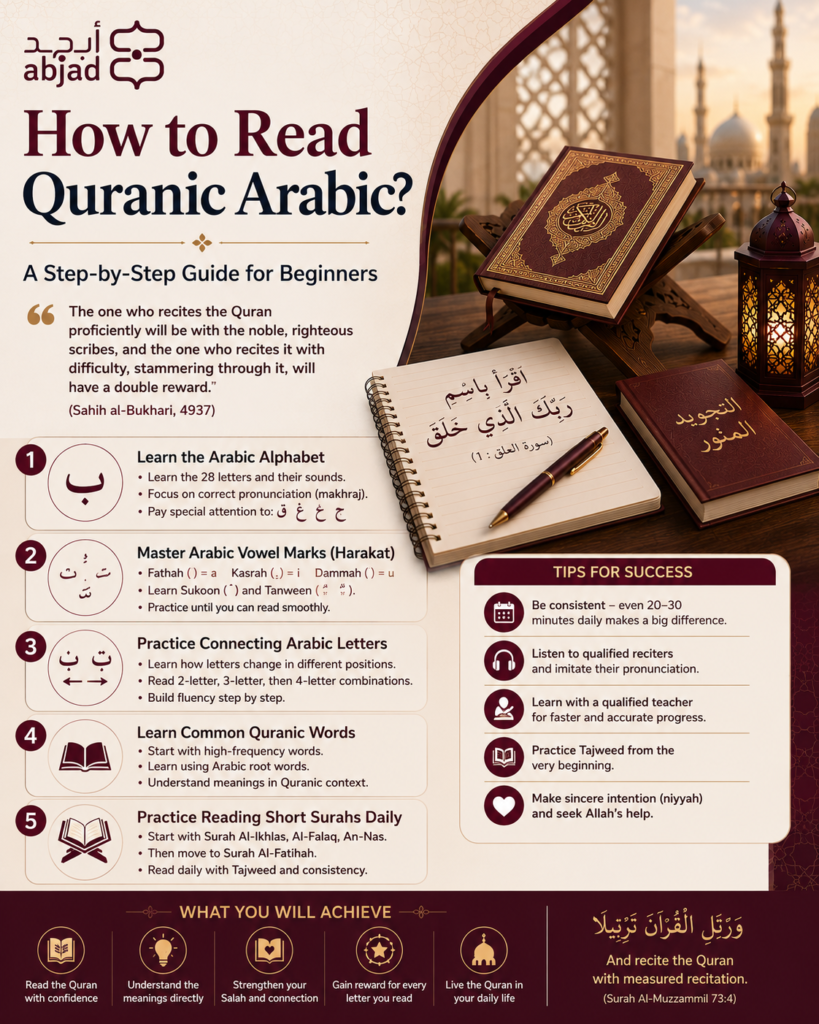
The Prophet ﷺ said:
“The one who recites the Quran proficiently will be with the noble, righteous scribes, and the one who recites it with difficulty, stammering through it, will have a double reward.”
مَثَلُ الَّذِي يَقْرَأُ الْقُرْآنَ وَهُوَ حَافِظٌ لَهُ مَعَ السَّفَرَةِ الْكِرَامِ الْبَرَرَةِ، وَمَثَلُ الَّذِي يَقْرَأُ وَهُوَ يَتَعَاهَدُهُ وَهُوَ عَلَيْهِ شَدِيدٌ فَلَهُ أَجْرَانِ
(Sahih al-Bukhari, 4937 — reported by ‘Aishah رضي الله عنها)
Struggling through this process is not failure — it is rewarded effort. Begin in the right order and the struggle shortens dramatically.
1. Learn the Arabic Alphabet First
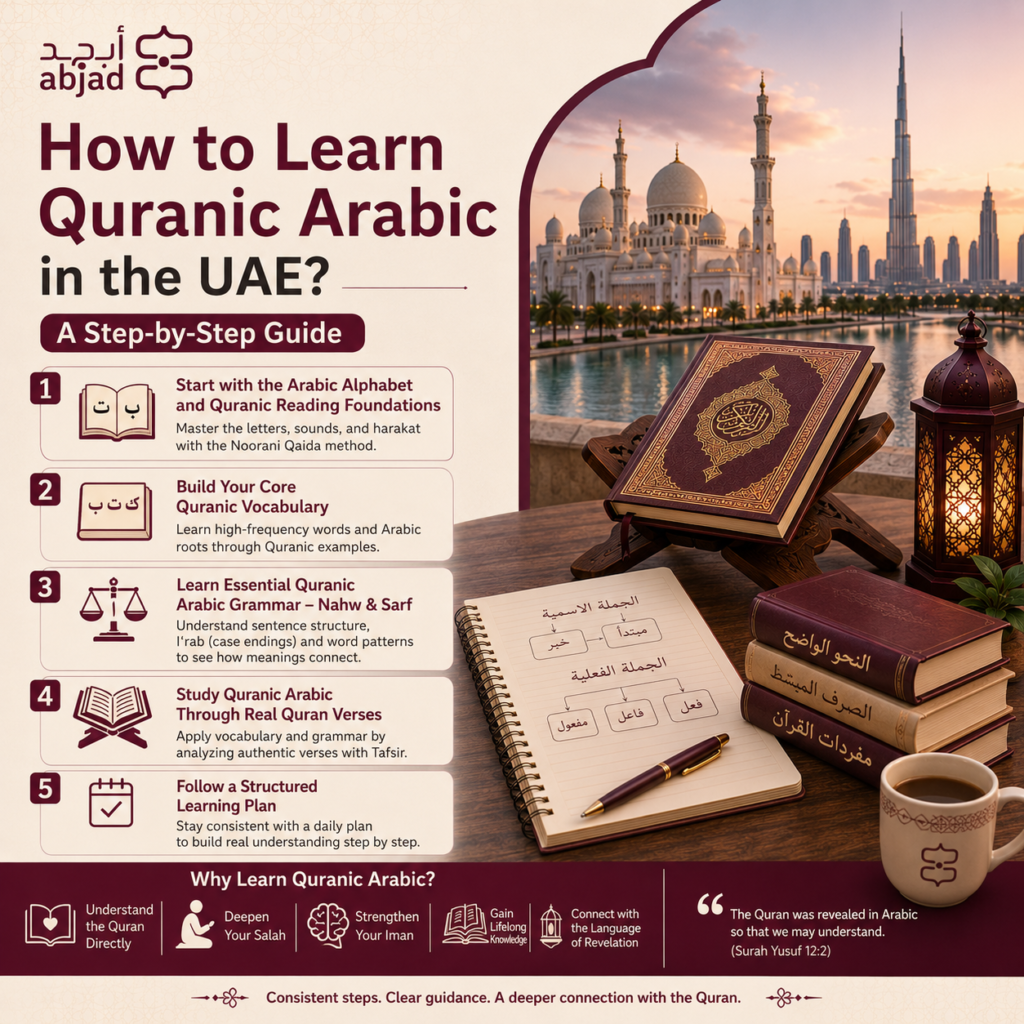
The Arabic alphabet contains 28 letters, each with a unique sound produced from a precise articulation point (makhraj) — a specific location in the mouth, throat, or lips. This is where every learner must begin, without exception.
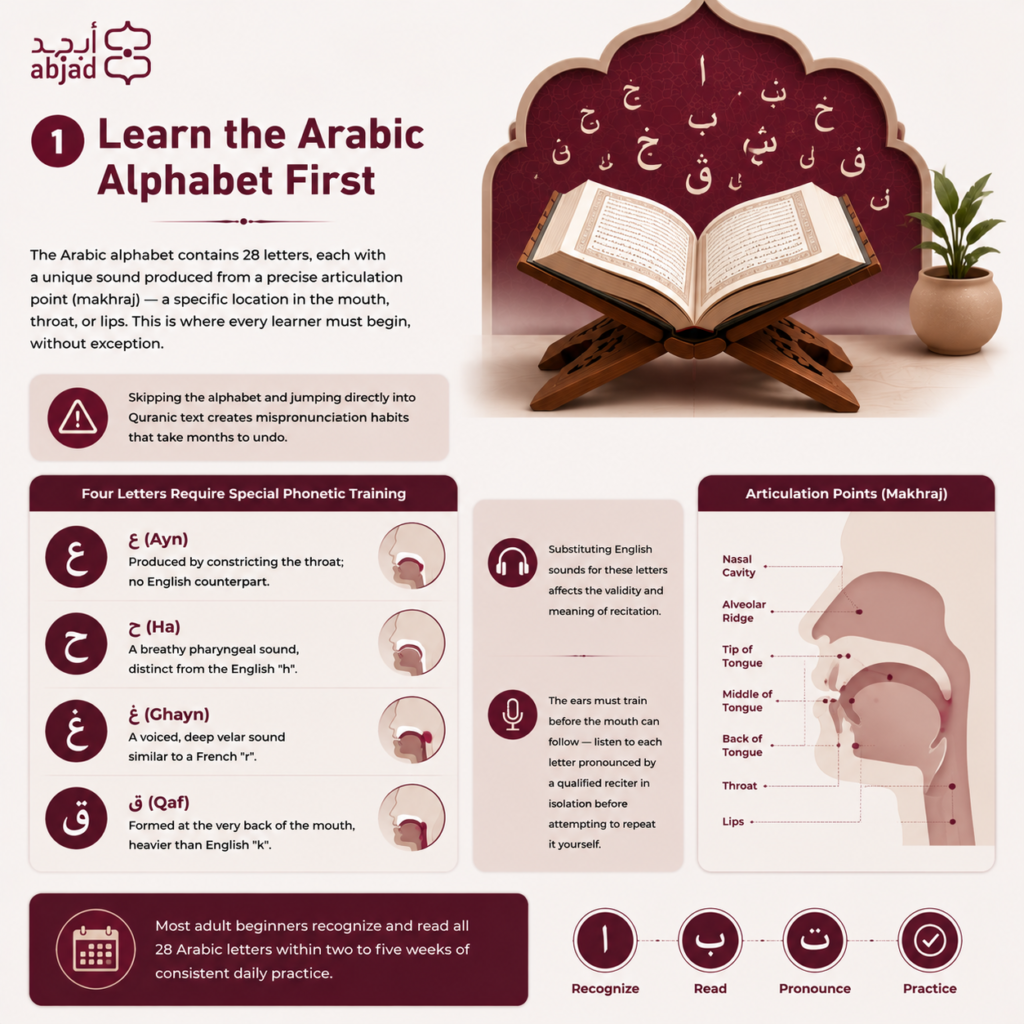
Skipping the alphabet and jumping directly into Quranic text creates mispronunciation habits that take months to undo. Four letters in particular require deliberate phonetic training because they have no English equivalent:
- ع (Ayn) — produced by constricting the throat; no English counterpart
- ح (Ha) — a breathy pharyngeal sound, distinct from the English “h”
- غ (Ghayn) — a voiced, deep velar sound similar to a French “r”
- ق (Qaf) — formed at the very back of the mouth, heavier than English “k”
Substituting English sounds for these letters affects the validity and meaning of recitation. The ears must train before the mouth can follow — listen to each letter pronounced by a qualified reciter in isolation before attempting to repeat it yourself.
Most adult beginners recognize and read all 28 Arabic letters within two to five weeks of consistent daily practice.
2. Master Arabic Vowel Marks (Harakat)
Harakat are the short vowel marks written above and below Arabic letters in the Quran. They tell you exactly how each letter is pronounced — transforming the Arabic script from an ambiguous consonant skeleton into a fully readable phonetic system.
A learner who cannot read Harakat automatically cannot read the Quran. Practice Harakat recognition until you can see a mark and produce the correct sound in under one second — that automaticity is what separates decoding from reading.
3. Practice Connecting Arabic Letters
Arabic is a connected cursive script. Most letters change shape depending on whether they appear at the beginning, middle, or end of a word — or in isolation. Recognizing all four positional forms is what makes it possible to identify letters inside actual Quranic words.
| Letter | Isolated | Initial | Medial | Final |
| Ba (ب) | ب | بـ | ـبـ | ـب |
| Ayn (ع) | ع | عـ | ـعـ | ـع |
| Meem (م) | م | مـ | ـمـ | ـم |
| Ha (ه) | ه | هـ | ـهـ | ـه |
Once you know positional forms, practice reading connected letter groups — two, then three, then four letters joined into syllabic units. This is how reading fluency is built in any language: sounds → syllables → words → sentences.
A practical daily sequence at this stage: read 5–10 two-letter combinations aloud, move to three-letter combinations with mixed Harakat, then introduce Sukoon. Accuracy is the goal — not speed. When you can read a new combination correctly without pausing to decode it, you are ready to move forward.
If you are working through the Arabic courses, this phonetic groundwork is built into the early curriculum precisely because it cannot be skipped.
Start Your Arabic Learning Journey with a FREE Trial Class

Read more: How to Learn Quranic Arabic in the UAE?
4. Learn Common Quranic Words
Once connected-letter reading is stable, begin building recognition of high-frequency Quranic words — words that appear repeatedly across Surahs. This is not vocabulary study in the traditional sense; it is pattern recognition that makes reading smoother and faster.
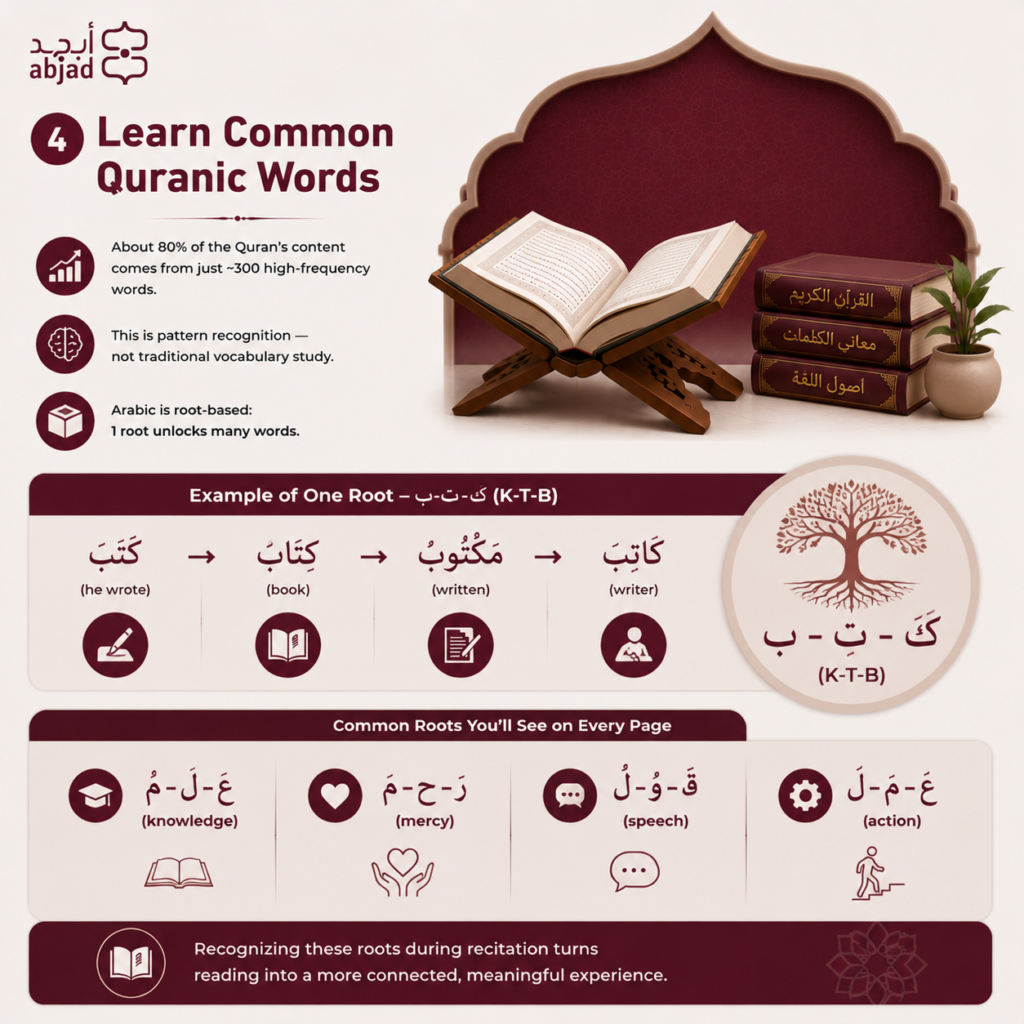
Approximately 80% of the Quran’s content can be accessed through mastery of around 300 high-frequency words. More efficiently, Arabic is a root-based language — the three-letter root ك-ت-ب (K-T-B) gives you كَتَبَ (he wrote), كِتَاب (book), مَكْتُوب (written), and كَاتِب (writer). Learning one root unlocks four or more words simultaneously.
Common roots that appear on nearly every page of the Quran — ع-ل-م (knowledge), ر-ح-م (mercy), ق-و-ل (speech), ع-م-ل (action) — are the ideal starting point. Recognizing these during recitation transforms reading from pure decoding into a more connected, meaningful experience.
Read also: How Long Does It Take to Learn Quranic Arabic in the UAE?
Inside Our Live Classes
Don’t just take our word for it—see for yourself! Click below to watch short clips from our live classes and meet the instructors who will guide your learning journey.
Begin Your Arabic Journey in the UAE
Join Abjad Institute for a professional and immersive Arabic language experience tailored to your goals.
Book Your Free Trial5. Practice Reading Short Surahs Daily
With your letters, Harakat, and basic Tajweed established, begin reading complete Quranic verses — starting with the shortest, most familiar Surahs.
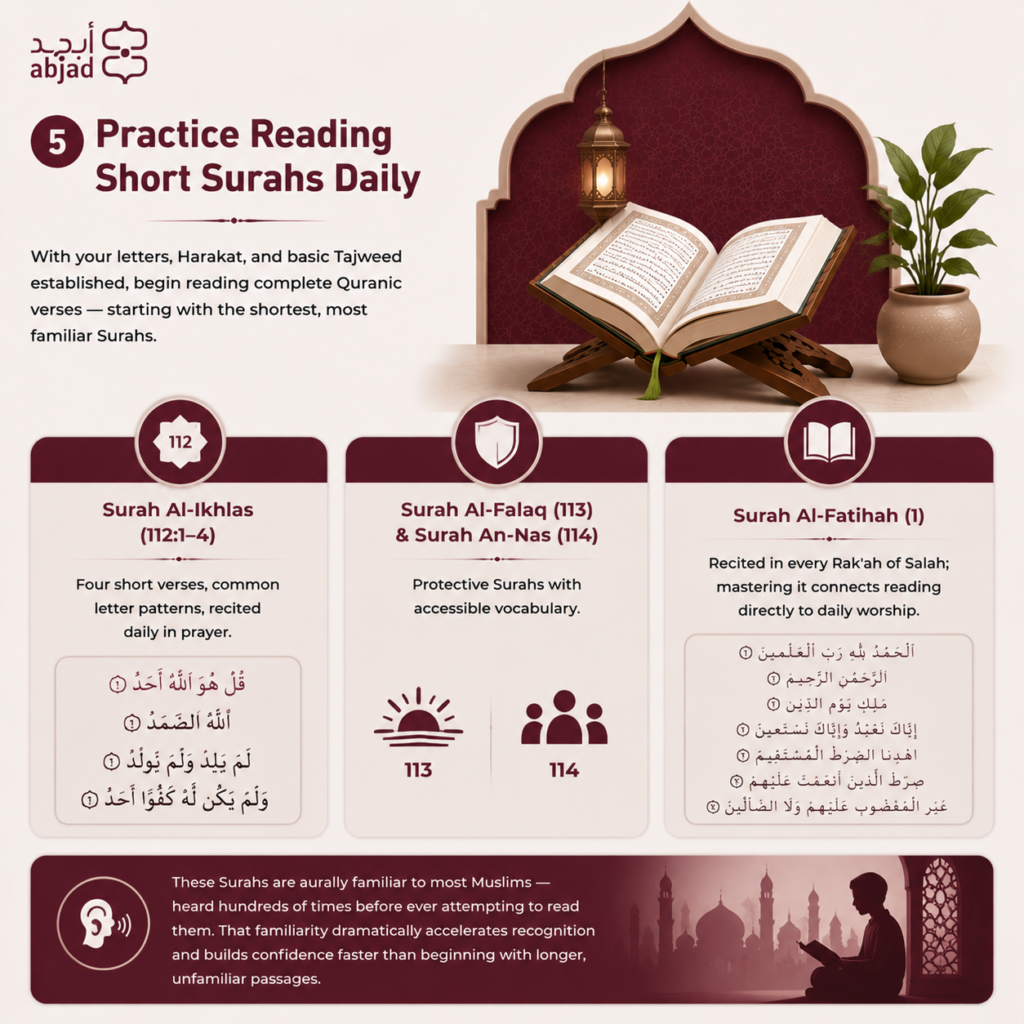
The recommended sequence:
- Surah Al-Ikhlas (112:1–4) — four short verses, common letter patterns, recited daily in prayer
- Surah Al-Falaq (113) and Surah An-Nas (114) — protective Surahs with accessible vocabulary
- Surah Al-Fatihah (1) — recited in every Rak’ah of Salah; mastering it connects reading directly to daily worship
These Surahs are aurally familiar to most Muslims — heard hundreds of times before ever attempting to read them. That familiarity dramatically accelerates recognition and builds confidence faster than beginning with longer, unfamiliar passages.
6. Listen to Reciters and Learn With a Qualified Quran Teacher
Active listening and guided correction are two essential steps in developing accurate Quranic Arabic reading skills. Following along in the Mushaf while a qualified reciter reads trains your pronunciation, recitation rhythm, and Tajweed application at the same time. Unlike passive listening, this method helps you connect the written words with their correct sounds and makes your ear familiar with proper Quranic pronunciation.
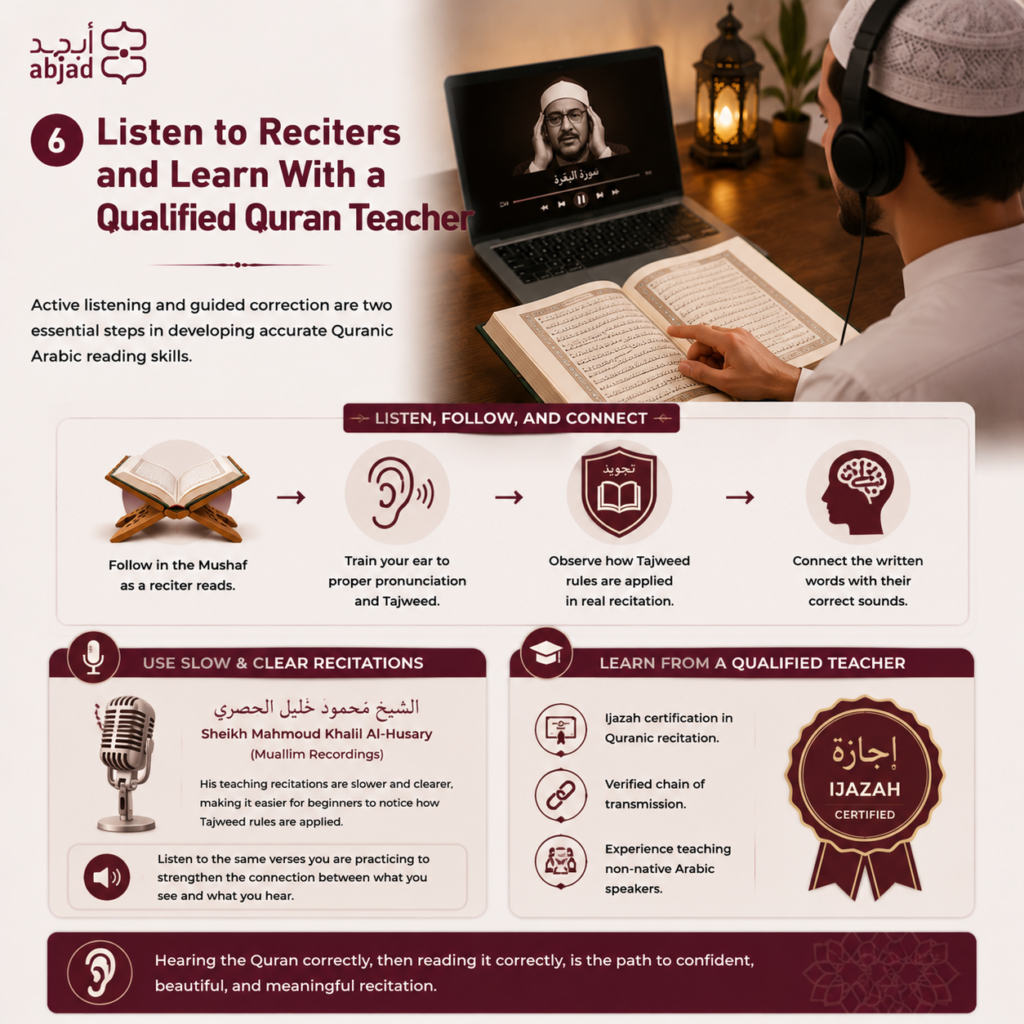
For beginners, Sheikh Mahmoud Khalil Al-Husary’s Muallim (teaching) recordings are especially helpful because they use a slower pace that allows learners to notice how Tajweed rules are applied. Listening to the same verses you are currently practicing strengthens the connection between what you see and what you hear, helping your reading become more natural over time.
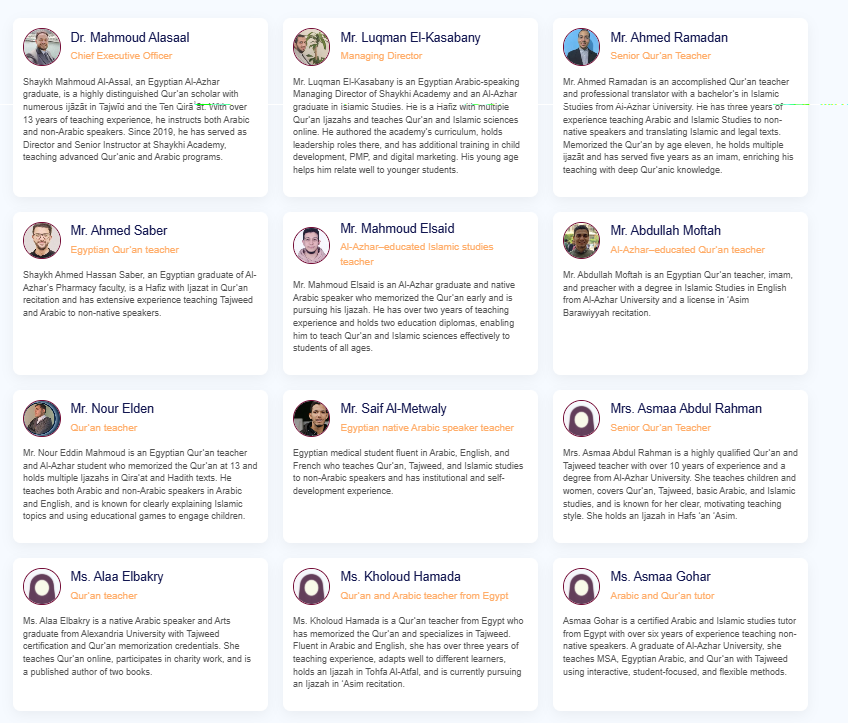
A qualified Quranic Arabic teacher for non-native speakers should have Ijazah certification in recitation — a verified chain of transmission — and proven experience teaching students whose first language is not Arabic.
Our Teachers
Read also: How to Learn Quranic Arabic in the UAE? A Step-by-Step Guide
7. Understand Basic Tajweed Rules
Tajweed is the science governing how each letter of the Quran is pronounced, how long vowels are held, and how adjacent letters interact. Many beginners assume Tajweed is advanced. It is not — foundational Tajweed rules apply from the very first word of the Quran.
Allah says:
“And recite the Quran with measured recitation.”
وَرَتِّلِ الْقُرْآنَ تَرْتِيلًا
The five rules every beginner must know before reading full verses:
Madd (Elongation): Long vowels — represented by Alif (ا), Waw (و), and Ya (ي) — are held for two counts minimum. Cutting them short changes sounds and meanings.
Ghunnah (Nasalization): When Noon (نّ) or Meem (مّ) carry a Shadda, a nasal resonance held for two counts is obligatory. The sound originates in the nasal cavity, not the mouth.
Qalqalah (Echo Sound): Five letters — ق، ط، ب، ج، د — produce a slight bouncing echo when they carry a Sukoon. Reading them flatly is a recitation error.
Ikhfa (Concealment): When a Noon Sakinah or Tanween is followed by one of 15 specific letters, the Noon is hidden — sounding between a full Noon and a Ghunnah. This rule appears on almost every page of the Quran.
Idgham (Merging): When a Noon Sakinah is followed by specific letters, it merges into the following letter. Letters of Idgham with Ghunnah: ي، ن، م، و. Letters of Idgham without Ghunnah: ل، ر.
Learning these five rules early means you read correctly from the start rather than spending months relearning later. For learners who want to go deeper into grammar alongside Tajweed, the Arabic Grammar course covers classical Nahw and Sarf — the structural foundation that explains why Quranic words take the forms they do.

8. Build Your Quranic Vocabulary Gradually
Reading and understanding are two separate goals — reading comes first, and understanding deepens the experience once reading is stable. Once your phonetic reading is accurate and flowing, begin pairing recitation with simple vocabulary study.
Start with the highest-frequency roots in the Quran: ر-ح-م (mercy) appears in البسملة that opens every Surah. ع-ل-م (knowledge/knowing) appears over 850 times across the Quran. ق-و-ل (speech/saying) runs through narratives of every Prophet. These roots are not just vocabulary — they are the recurring conceptual pillars of the Quran’s message.
Learners who build vocabulary alongside reading consistently report a qualitative shift in their recitation experience — moving from decoding letters to connecting with meaning. The grammar courses for kids show how this vocabulary-first approach works even for young learners, anchoring words in meaning before introducing formal grammar rules.
Start Your Child’s Arabic Grammar Journey With a FREE Trial Today

Read more: How Long Does It Take to Learn Quranic Arabic in the UAE?
9. Stay Consistent With Your Practice
Consistency outperforms intensity at every stage of Quranic reading. Twenty minutes of daily practice produces faster and more durable results than a two-hour session once a week — because the brain consolidates phonetic skills during rest periods between practice sessions, not during the sessions themselves.
A practical daily structure for beginners:
| Time | Activity | Duration |
| Morning | Review yesterday’s letters or verses | 5 minutes |
| Afternoon | New material with teacher or course | 15 minutes |
| Evening | Listen to a reciter reading the same portion | 10 minutes |
| Before sleep | Repeat new verses aloud | 5 minutes |
The most common reason learners plateau is not difficulty — it is irregular practice. A missed week at the beginner stage requires two weeks to recover the same fluency. Protect your daily habit as you would any act of worship, because that is precisely what it is.
Watch Our Classes in Action
Curious what a real session looks like? Take a peek inside our interactive classrooms and see how our expert instructors bring the Arabic language to life. Watch a sample lesson below!
Begin Your Arabic Journey in the UAE
Join Abjad Institute for a professional and immersive Arabic language experience tailored to your goals.
Book Your Free TrialMaster Quranic Arabic Reading With Expert Guidance From Abjad Institute
Whether your goal is to read the Quran with confidence, understand Quranic Arabic, or build a strong foundation in Arabic, learning with qualified teachers makes the journey easier and more effective.
At Abjad Institute, our structured Quranic Arabic programs help non-Arabic speakers progress step by step — from learning Arabic letters and pronunciation basics to applying Tajweed rules and developing accurate Quran reading skills.
Our programs include:
- Arabic alphabet and reading foundations
- Quranic Arabic for beginners
- Tajweed and proper Quran recitation
- Reading, writing, and pronunciation practice
- Interactive online classes
- Personalized guidance from qualified instructors
Start your Quranic Arabic journey today and take the first step toward reading the Quran with greater confidence and understanding.

Discover Our Arabic Courses
- Arabic Course for Kids
- Arabic Conversation for Kids
- Arabic Qaida for Kids
- Beginner Arabic for Kids
- Arabic Grammar for Kids
- Teen Arabic Summer Course
- Arabic Kids Camps
- UAE Kindergarten Arabic Classes
- Modern Standard Arabic Course
- Fusha Arabic Course
- Classical Arabic Course
- Emirati Arabic Course
- Gulf Arabic Course
- Learn Saudi Arabic
- Business Arabic Course UAE
- Arabic Language Classes for Professionals in UAE
- Quranic Arabic Course
Begin Your Arabic Journey in the UAE
Join Abjad Institute for a professional and immersive Arabic language experience tailored to your goals.
Book Your Free TrialConclusion
Learning to read Quranic Arabic is not a matter of talent or background — it is a matter of sequence. Learn the 28 Arabic letters and their positional forms. Master Harakat until vowel marks are automatic. Practice connecting letters into syllables before tackling full words. Layer in foundational Tajweed rules early. Start reading short Surahs daily. Listen actively to qualified reciters. Learn with a teacher who corrects you in real time. Build vocabulary through Quranic roots. And protect your daily practice habit above everything else.
Every letter of the Quran you read correctly carries its own reward — and every letter read with difficulty carries a double reward. The path is clear. The only step that matters now is the first one.
Frequently Asked Questions About How to Read Quranic Arabic
Still have questions about learning to read Quranic Arabic? Here are answers to the most common questions beginners ask about starting and improving their Quran reading journey.
Can I learn to read Quranic Arabic without knowing spoken Arabic?
Yes. Reading Quranic Arabic is a phonetic skill entirely separate from conversational ability. Millions of non-Arabic speakers recite the Quran accurately without speaking Arabic. You are learning to decode a script and apply recitation rules — not to hold a conversation. Spoken Arabic and Quranic reading are two different goals with two different learning paths.
What is the very first thing I should learn to read Quranic Arabic?
The first step is the 28 Arabic letters and their correct articulation points (makharij). Without accurate letter recognition and pronunciation, every subsequent step carries errors forward. Letter mastery — including all four positional forms (isolated, initial, medial, final) — is the non-negotiable foundation of everything that follows.
Do I need Tajweed from the very beginning?
Yes — at the foundational level. Rules like Madd, Ghunnah, Qalqalah, Ikhfa, and Idgham appear on the very first pages of the Quran. Learning them early means you read correctly from the start. Advanced Tajweed covering every contextual variation can be built gradually after basic reading fluency is established.
How long does it take to read Quranic Arabic accurately?
Most beginners practicing 20–30 minutes daily with a qualified teacher can read basic Quranic Arabic accurately within three to four months. Fluent, Tajweed-accurate recitation across a full Juz typically develops over six to twelve months, depending primarily on consistency of practice and quality of instruction.
Is a teacher necessary, or can I learn from apps alone?
A teacher is strongly recommended, especially at the beginner stage. Apps and recordings cannot hear your pronunciation and cannot correct a makhraj error in real time. Errors formed in the first weeks become difficult habits. A qualified instructor catches and corrects them before they compound — significantly reducing total learning time and preventing the frustration of relearning.
What is the easiest Surah to start reading in Quranic Arabic?
Surah Al-Ikhlas (112:1–4) is the recommended starting point — four short verses, common letter patterns, and recited multiple times daily in prayer. Surah Al-Fatihah (1) should be learned immediately after, as it is recited in every Rak’ah of Salah. Starting with these two Surahs connects reading practice to daily worship from the first week.





Leave a Reply