 Learn Arabic
| Key Takeaways |
| Possessive pronouns in Arabic are suffixes attached to the end of a noun, never separate words placed before it as in English. |
| Modern Standard Arabic uses twelve possessive suffixes covering singular, dual, and plural owners, with gender distinctions in both the second and third person. |
| The suffix agrees with the owner, not with the possessed noun, so سَيّارَتُهُ (sayyāratuhu) means “his car” even though سَيّارة is feminine. |
| A noun ending in ة changes that letter to ت before any suffix, which is the single most common spelling error learners make. |
Arabic learners usually meet possessive pronouns in Arabic during their first few weeks of study, and the system looks unfamiliar at first glance. Ownership is not expressed with a separate word. It is built directly into the noun itself.
That single difference explains why “my book” and “your book” look like one word in Arabic rather than two. Once the pattern becomes visible, the twelve suffixes behave with almost perfect regularity across nouns, prepositions, and even verbs.
This guide covers the function of these suffixes, their defining characteristics, a full chart, every form with its own examples, the spelling changes they trigger, how they differ from object pronouns, and graded exercises with a complete answer key.
How Possessive Pronouns in Arabic Show Ownership
Possessive pronouns in Arabic, known as ضمائر الملكية (ḍamāʾir al-milkiyyah, pronouns of ownership), are attached endings that join a noun to show who owns it. They are called attached pronouns because they cannot stand alone.
English separates the possessor from the thing possessed. Arabic fuses them into a single written word, so the noun and its owner arrive together in one unit.
كِتاب (kitāb, book) becomes كِتابي (kitābī, my book) with the addition of a single letter. The base noun does not change; only the ending carries the new information.
The structure is fixed and predictable:
- Begin with the bare noun, such as بَيْت (bayt, house).
- Identify the owner by person, gender, and number.
- Attach the matching suffix to the end of the noun.
- Adjust the spelling if the noun ends in ة or a long vowel.
Function of Arabic Possessive Pronouns in Sentences
Arabic possessive pronouns answer one question above all others: who does this belong to? They mark ownership, but they also mark relationship, origin, and association in ways English possessives do not always cover.
A suffix on أَب (ab, father) signals family connection rather than property. A suffix on مَدينة (madīnah, city) signals belonging to a place. The grammatical mechanism stays identical in every case.
These are the functions carried by the suffixes:
- Ownership of a physical object, as in قَلَمي (qalamī, my pen).
- Family or personal relationship, as in أُخْتُها (ukhtuhā, her sister).
- Professional or institutional connection, as in مُديرُنا (mudīrunā, our manager).
- Association with a place, as in بَلَدُهُم (baladuhum, their country).
- Abstract attribution, as in رَأْيُكَ (raʾyuka, your opinion).
Because the suffix carries so much information in so few letters, a sentence in Arabic can express a full possessive relationship without any extra words.
مُعَلِّمُنا يَشْرَحُ الدَّرْسَ بِوُضوح
(Muʿallimunā yashraḥu ad-darsa biwuḍūḥ)
“Our teacher explains the lesson clearly.”
Core Characteristics of Arabic Possessive Pronouns
Four features separate these suffixes from English possessive words, and each one creates a different kind of learner error. Reviewing them before memorizing the chart makes the forms far easier to retain.
| Characteristic | What It Means | Example |
| Attached, never free | The suffix is written joined to the noun | كِتابي (kitābī, my book) |
| Agrees with the owner | Gender follows the possessor, not the noun | سَيّارَتُهُ (sayyāratuhu, his car) |
| Marks three numbers | Singular, dual, and plural owners each have forms | بَيْتُكما (baytukumā, your house, two people) |
| Alters the host noun | Some endings change before the suffix attaches | مَدْرَسة → مَدْرَسَتي (madrasatī, my school) |
The second row is the one that causes the most confusion. In سَيّارَتُهُ the noun سَيّارة (sayyārah, car) is grammatically feminine, yet the suffix is masculine because the owner is male.
Arabic also makes the possessed noun definite automatically.
كِتابُها (kitābuhā) means “her book,” and no definite article is ever added in front of it.
Read also: Arabic Sentence Structure Explained With Clear Examples
Arabic Possessive Pronouns Chart With Transliteration
The Arabic possessive pronouns chart below lists all twelve Modern Standard Arabic suffixes attached to the model noun كِتاب (kitāb, book). Keep it beside you while working through the sections that follow.
| Owner | Suffix | Full Word | Meaning |
| I | ـي | كِتابي (kitābī) | My book |
| You, masculine singular | ـكَ | كِتابُكَ (kitābuka) | Your book |
| You, feminine singular | ـكِ | كِتابُكِ (kitābuki) | Your book |
| He | ـهُ | كِتابُهُ (kitābuhu) | His book |
| She | ـها | كِتابُها (kitābuhā) | Her book |
| We | ـنا | كِتابُنا (kitābunā) | Our book |
| You, dual | ـكما | كِتابُكما (kitābukumā) | Your book |
| They, dual | ـهما | كِتابُهما (kitābuhumā) | Their book |
| You, masculine plural | ـكم | كِتابُكم (kitābukum) | Your book |
| You, feminine plural | ـكنَّ | كِتابُكنَّ (kitābukunna) | Your book |
| They, masculine plural | ـهم | كِتابُhum (kitābuhum) | Their book |
| They, feminine plural | ـهنَّ | كِتابُهنَّ (kitābuhunna) | Their book |
Notice that every singular suffix ends in a vowel sound, while the plural suffixes end in a consonant or a doubled ن. That contrast alone makes the two groups easier to separate by ear.
Abjad Academy teaches this chart inside a structured Arabic Grammar Course where each suffix is drilled with live correction until the forms become automatic in speech and writing.
Try a Free Grammar Lesson With a Native Tutor
Singular Possessive Suffixes With Arabic Examples
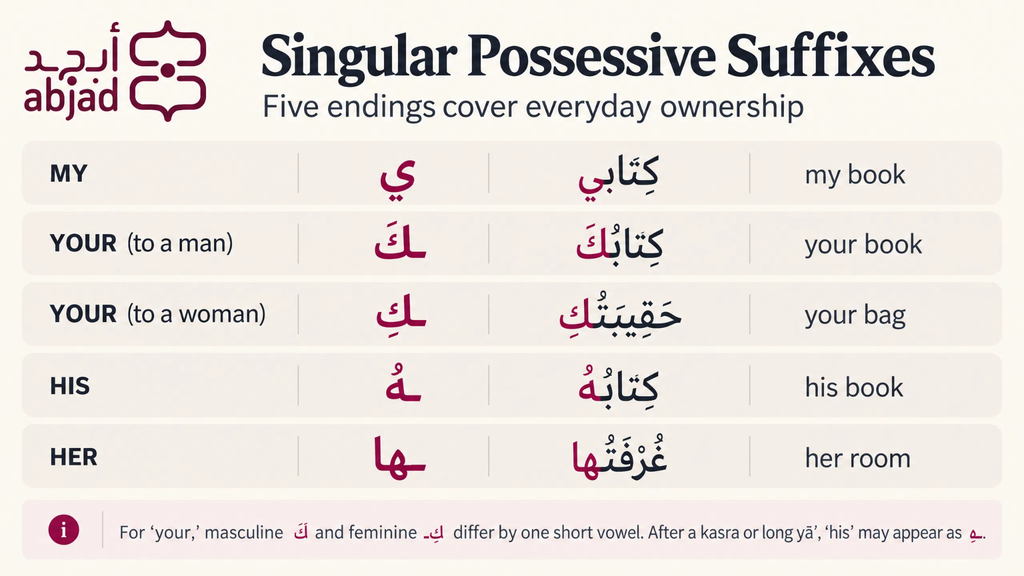
Five suffixes cover the singular owners, and they account for the overwhelming majority of possessives in everyday speech. Each one is treated separately below with its own examples.
My in Arabic With the Suffix ـي
The suffix ـي marks first-person ownership and stays identical whether the noun is masculine or feminine. It also pulls the final vowel of the noun into a kasra sound.
- كِتابي (kitābī, my book).
- قَلَمي (qalamī, my pen).
- بَيْتي (baytī, my house).
- أُمّي (ummī, my mother).
- عَمَلي (ʿamalī, my work).
بَيْتي قَريبٌ مِنَ المَدْرَسَة
(Baytī qarībun mina al-madrasah)
“My house is near the school.”
Your Masculine Singular With the Suffix ـكَ
Use ـكَ when speaking to one male. The vowel is a short fatha, and lengthening it or softening it changes the meaning to the feminine form.
- كِتابُكَ (kitābuka, your book).
- قَلَمُكَ (qalamuka, your pen).
- صَديقُكَ (ṣadīquka, your friend).
- عَمَلُكَ (ʿamaluka, your work).
هَلْ هذا كِتابُكَ
(Hal hādhā kitābuka)
“Is this your book?”
Your Feminine Singular With the Suffix ـكِ
Addressing one female requires ـكِ with a short kasra. Only the vowel distinguishes it from the masculine, which is why careful listening matters more here than anywhere else in the system.
- كِتابُكِ (kitābuki, your book).
- حَقيبَتُكِ (ḥaqībatuki, your bag).
- سَيّارَتُكِ (sayyāratuki, your car).
- أُخْتُكِ (ukhtuki, your sister).
حَقيبَتُكِ جَميلَةٌ جِدًّا
(Ḥaqībatuki jamīlatun jiddan)
“Your bag is very beautiful.”
His in Arabic With the Suffix ـهُ
The suffix ـهُ refers to a single male owner. After a kasra or a long yāʾ, the vowel shifts to ـهِ for ease of pronunciation.
- كِتابُهُ (kitābuhu, his book).
- بَيْتُهُ (baytuhu, his house).
- رَأْيُهُ (raʾyuhu, his opinion).
- مَكْتَبُهُ (maktabuhu, his office).
عَمَلُهُ مُهِمٌّ لِلشَّرِكَة
(ʿAmaluhu muhimmun lish-sharikah)
“His work is important to the company.”
Her in Arabic With the Suffix ـها
A single female owner takes ـها, and this suffix never changes shape regardless of the gender of the noun it joins. Its long final vowel makes it one of the easiest forms to recognize.
- كِتابُها (kitābuhā, her book).
- غُرْفَتُها (ghurfatuhā, her room).
- سَيّارَتُها (sayyāratuhā, her car).
- صَديقَتُها (ṣadīqatuhā, her friend).
غُرْفَتُها مَلِيئَةٌ بِالكُتُب
(Ghurfatuhā malīʾatun bil-kutub)
“Her room is full of books.”
See Us in Action!
Curious about what our online classrooms look like? Watch the short clips below to see how our interactive, one-on-one sessions bring learning to life with real-time feedback and engaging teaching methods.
Begin Your Arabic Journey in the UAE
Join Abjad Institute for a professional and immersive Arabic language experience tailored to your goals.
Book Your Free TrialDual and Plural Possessive Suffixes in Arabic
Arabic marks exactly two owners with a dedicated dual form, a category English does not have at all. Seven suffixes cover shared and group ownership.
Our in Arabic With the Suffix ـنا
The suffix ـنا means “our” and works identically for every speaker, with no gender variation at any point. It is the most frequent plural possessive in conversation.
- بَيْتُنا (baytunā, our house).
- دَرْسُنا (darsunā, our lesson).
- بَلَدُنا (baladunā, our country).
- فَريقُنا (farīqunā, our team).
بَيْتُنا واسِعٌ وَهادِئ
(Baytunā wāsiʿun wa hādiʾ)
“Our house is spacious and quiet.”
Dual Forms With the Suffixes ـكما and ـهما
Both dual suffixes share the ending ما, which serves as a built-in signal that exactly two people are involved. Use ـكما when addressing two people and ـهما when referring to two.
- كِتابُكما (kitābukumā, your book, speaking to two).
- بَيْتُهما (baytuhumā, their house, belonging to two).
- صَديقُكما (ṣadīqukumā, your friend, speaking to two).
- أَخوهُما (akhūhumā, their brother, belonging to two).
Masculine Plural Forms ـكم and ـهم
These two suffixes cover groups of three or more males, and they also serve mixed-gender groups. They appear constantly in formal writing, speeches, and media.
- مَشْروعُكم (mashrūʿukum, your project).
- مُدَرِّسُكم (mudarrisukum, your teacher).
- فَريقُهُم (farīquhum, their team).
- أَوْلادُهُم (awlāduhum, their children).
أَوْلادُهُم يَلْعَبونَ في الحَديقَة
(Awlāduhum yalʿabūna fī al-ḥadīqah)
“Their children are playing in the garden.”
Feminine Plural Forms ـكنَّ and ـهنَّ
Reserved for groups where every member is female, these forms carry a doubled ن marked with shadda. They belong mainly to formal registers, classical texts, and news broadcasts.
- جُهودُكنَّ (juhūdukunna, your efforts).
- بَيْتُكنَّ (baytukunna, your house).
- قِصَّتُهنَّ (qiṣṣatuhunna, their story).
- آراؤُهنَّ (ārāʾuhunna, their opinions).
Abjad Academy covers the full dual and plural system in a Modern Standard Arabic Course built around formal texts, media language, and the written registers where these endings appear most.
Start Modern Standard Arabic With Certified Tutors
Spelling Changes When Suffixes Attach to Arabic Nouns
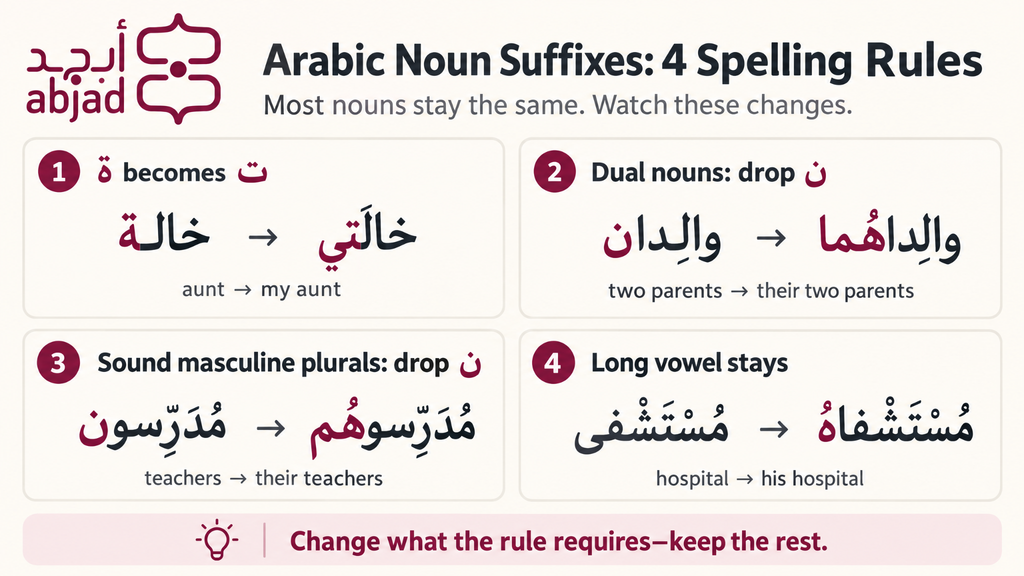
Four nouns in five accept a suffix with no change at all. The exceptions follow strict rules, and knowing them prevents the spelling errors that mark a text as learner-written.
Taa Marbuta Changes to ت Before a Suffix
Any noun ending in ة converts that letter to a full ت once a suffix attaches. The sound becomes audible instead of silent.
| Base Noun | With Suffix | Meaning |
| خالة (khālah, aunt) | خالَتي (khālatī) | My aunt |
| سَيّارة (sayyārah, car) | سَيّارَتُكَ (sayyāratuka) | Your car |
| مَدْرَسة (madrasah, school) | مَدْرَسَتُنا (madrasatunā) | Our school |
| عائِلة (ʿāʾilah, family) | عائِلَتُها (ʿāʾilatuhā) | Her family |
Dual Nouns Drop the Final ن
Dual nouns ending in ـان or ـين lose that final ن before a possessive suffix joins. The long vowel before it stays in place.
- والِدان (wālidān, two parents) becomes والِداهُما (wālidāhumā, their two parents).
- يَدان (yadān, two hands) becomes يَداهُ (yadāhu, his two hands).
- مُعَلِّمان (muʿallimān, two teachers) becomes مُعَلِّماكُم (muʿallimākum, your two teachers).
Sound Masculine Plurals Drop the Final ن
The same deletion applies to sound masculine plurals ending in ـون or ـين. This form belongs mostly to written and formal Arabic.
- مُدَرِّسون (mudarrisūn, teachers) becomes مُدَرِّسوهُم (mudarrisūhum, their teachers).
- مُهَنْدِسون (muhandisūn, engineers) becomes مُهَنْدِسوهُ (muhandisūhu, his engineers).
- مُوَظَّفون (muwaẓẓafūn, employees) becomes مُوَظَّفونا (muwaẓẓafūnā, our employees).
Nouns Ending in a Long Vowel Keep the Vowel
When a noun already ends in a long alif or yāʾ, that vowel is preserved and the suffix simply follows it. Nothing is deleted.
- مُسْتَشْفى (mustashfā, hospital) becomes مُسْتَشْفاهُ (mustashfāhu, his hospital).
- فَتى (fatā, young man) becomes فَتاها (fatāhā, her young man).
- مُحامي (muḥāmī, lawyer) becomes مُحاميهِ (muḥāmīhi, his lawyer).
Possessive Suffixes After Common Arabic Prepositions
Exactly the same endings attach to prepositions, where they translate as “me,” “him,” or “us” rather than “my” or “his.” No new forms need to be learned for this.
A preposition plus a suffix is how Arabic expresses many ideas that English builds with verbs, including possession in the sense of “having.”
| Preposition | With Suffix | Meaning |
| مَع (maʿa, with) | مَعي (maʿī) | With me |
| في (fī, in) | فيها (fīhā) | In it or in her |
| لِـ (li, for) | لَهُ (lahu) | For him |
| عِنْد (ʿinda, at) | عِنْدَنا (ʿindanā) | We have |
| مِن (min, from) | مِنْهُم (minhum) | From them |
عِنْدي سُؤالٌ عَنِ الدَّرْس
(ʿIndī suʾālun ʿani ad-dars)
“I have a question about the lesson.”
Practicing nouns and prepositions in the same study session builds the pattern faster, because the learner sees one set of endings serving two grammatical roles.
Read also: Types of Sentences in Arabic With Examples and Rules
Possessive Pronouns vs. Object Pronouns in Arabic
The suffixes themselves are shared across categories, so the host word decides the grammatical role. Two comparisons clarify where possessives sit inside the wider Arabic pronoun system.
Possessive Suffixes vs. Object Pronoun Suffixes
Attached to a noun, the suffix signals ownership. Attached to a verb, the identical suffix becomes the direct object of that verb.
| Suffix | On a Noun | On a Verb |
| ـهُ | كِتابُهُ (kitābuhu, his book) | رَأَيْتُهُ (raʾaytuhu, I saw him) |
| ـها | بَيْتُها (baytuhā, her house) | سَأَلْتُها (saʾaltuhā, I asked her) |
| ـهُم | فَريقُهُم (farīquhum, their team) | زُرْتُهُم (zurtuhum, I visited them) |
One exception exists. First person possessive is ـي, while the first person object form on a verb is ـني, as in ساعَدَني (sāʿadanī, he helped me).
Possessive Suffixes vs. Arabic Subject Pronouns
Subject pronouns such as أَنا (anā, I) and هُوَ (huwa, he) are independent words that begin a sentence. Possessive suffixes can never function this way.
| Role | Form | Example |
| Subject | هُوَ (huwa, he) | هُوَ مُعَلِّم (huwa muʿallim, he is a teacher) |
| Possessive | ـهُ (-hu, his) | مُعَلِّمُهُ (muʿallimuhu, his teacher) |
The practical test is simple. If the pronoun stands alone as its own word, it is a subject pronoun; if it is written joined to another word, it is attached.
Standard Arabic and Emirati Arabic Possessive Forms
Possessive suffixes survive intact in spoken Gulf Arabic, but their vowels shorten and some endings merge. Learners living in the UAE hear both registers daily, one in schools and media, the other in markets and conversation.
| Meaning | Standard Arabic | Emirati Arabic |
| My house | بَيْتي (baytī) | بيتي (bēti) |
| Your house, masculine | بَيْتُكَ (baytuka) | بيتك (bētik) |
| Your house, feminine | بَيْتُكِ (baytuki) | بيتچ (bētich) |
| His book | كِتابُهُ (kitābuhu) | كتابه (kitāba) |
| Our house | بَيْتُنا (baytunā) | بيتنا (bētna) |
| Their house | بَيْتُهُم (baytuhum) | بيتهم (bēthum) |
The dual suffixes ـكما and ـهما disappear almost entirely from everyday Emirati speech, replaced by the plural forms. The feminine plural endings follow the same pattern.
A distinctive Gulf feature is the shift of ـكِ to a “ch” sound, so أُخْتُچ (ukhtich, your sister) is heard across Dubai, Sharjah, and Abu Dhabi where the Standard form would be أُخْتُكِ.
Abjad Academy offers an Emirati Arabic Course that trains learners in the pronunciation shifts and everyday expressions used across the UAE, taught by tutors who speak the dialect natively.
Book a Free Emirati Arabic Session Today
Arabic Possessive Pronouns Exercises With Answers
Three graded exercises follow, moving from recognition to production. Attempt all of them before checking the answer key at the end of this section.
Exercise 1 Choose the Correct Possessive Suffix
Select the suffix that matches the owner given in parentheses.
- حَقيبَة___ جَديدة (the owner is “she”).
- مَكْتَب___ كَبير (the owner is “they,” masculine plural).
- سَيّارَة___ سَريعة (the owner is “you,” feminine singular).
- دَرْس___ سَهْل (the owner is “we”).
- هاتِف___ قَديم (the owner is “he”).
Exercise 2 Change the Owner of the Noun
Rewrite each word so that it belongs to the new owner shown in parentheses.
- كِتابي (kitābī, my book) to “his.”
- بَيْتُها (baytuhā, her house) to “our.”
- قَلَمُكَ (qalamuka, your pen) to “my.”
- مَدْرَسَتُهُ (madrasatuhu, his school) to “your,” feminine singular.
- سَيّارَتُنا (sayyāratunā, our car) to “their,” masculine plural.
Exercise 3 Complete the Phrase After a Preposition
Add the suffix that produces the English meaning given.
- مَع___ meaning “with us.”
- لِـ___ meaning “for him.”
- عِنْد___ meaning “I have.”
- في بَيْت___ meaning “in her house.”
- مِن___ meaning “from you,” masculine plural.
Answer Key for All Three Exercises
Compare your answers carefully, paying attention to the vowel on each suffix rather than the consonant alone.
| Exercise | Answers |
| Exercise 1 | حَقيبَتُها، مَكْتَبُهُم، سَيّارَتُكِ، دَرْسُنا، هاتِفُهُ |
| Exercise 2 | كِتابُهُ، بَيْتُنا، قَلَمي، مَدْرَسَتُكِ، سَيّارَتُهُم |
| Exercise 3 | مَعَنا، لَهُ، عِنْدي، في بَيْتِها، مِنْكُم |
Errors clustered in Exercise 1 point back to gender agreement. Errors in Exercise 2 usually trace to the ة spelling rule covered earlier.
Inside Our Virtual Classrooms
We believe in full transparency and proven quality. Take a look at these actual snippets from our live classes to experience our modern learning platform, patient instructors, and interactive student participation.
Begin Your Arabic Journey in the UAE
Join Abjad Institute for a professional and immersive Arabic language experience tailored to your goals.
Book Your Free TrialCommon Mistakes With Arabic Possessive Suffixes
Five errors account for most of the corrections tutors make on learner writing. Each one has a clear fix once the underlying rule is visible.
- Matching the suffix to the noun instead of the owner, producing سَيّارَتُها for a male owner when سَيّارَتُهُ is required.
- Leaving ة unchanged, writing مَدْرَسَةي instead of the correct مَدْرَسَتي (madrasatī, my school).
- Adding the definite article, writing الكِتابي when كِتابي (kitābī, my book) is already definite on its own.
- Confusing ـي with ـني, so ساعَدَي appears instead of ساعَدَني (sāʿadanī, he helped me).
- Keeping the final ن on dual and plural nouns, writing والِدانِهِما rather than والِداهُما (wālidāhumā, their two parents).
Abjad Academy addresses these errors through Arabic Classes for Adults where written work is corrected line by line and grammar rules are retaught through the learner’s own sentences.
Join an Adult Arabic Class With a Free Trial
Begin Your Arabic Journey in the UAE
Join Abjad Institute for a professional and immersive Arabic language experience tailored to your goals.
Book Your Free TrialLearn Arabic Possessive Pronouns With Abjad Academy
Abjad Academy teaches Arabic grammar through live one-on-one sessions with native tutors based in the UAE, with lesson times arranged around Gulf Standard Time and the working week in the Emirates.
Every learner is placed after a spoken assessment, so suffix drills begin at the right level rather than at a fixed starting point.
What sets Abjad Academy apart:
- Native Arabic tutors who correct pronunciation and vowel endings in real time during each session.
- A placement assessment before the first paid lesson to set the correct grammar starting point.
- Flexible scheduling across UAE time zones for working adults, university students, and families.
- Separate tracks for Modern Standard Arabic, Classical Arabic, and Gulf dialects under one curriculum.
Our Arabic Courses
- Arabic Grammar Course.
- Modern Standard Arabic Course.
- Arabic Classes for Adults.
- Emirati Arabic Course.
- Arabic Speaking Course.
- Online Arabic Classes for Kids.
Conclusion
Possessive pronouns in Arabic replace the separate words English uses with twelve attached suffixes that join directly to the noun. They cover singular, dual, and plural owners, with gender distinctions in the second and third person.
Agreement follows the owner rather than the possessed noun, and a small set of spelling rules governs nouns ending in ة, dual endings, sound masculine plurals, and final long vowels. Learning those four rules removes most written errors immediately.
The same suffixes reappear on prepositions and verbs, so every hour spent on this chart pays off across the rest of Arabic grammar. Regular practice with familiar nouns turns recognition into fluent, accurate production.
FAQs
What Are Possessive Pronouns in Arabic?
Possessive pronouns in Arabic are suffixes attached to the end of a noun to show ownership. Instead of a separate word, Arabic joins the ending directly to the noun, so كِتاب (kitāb, book) becomes كِتابي (kitābī, my book).
How Many Possessive Suffixes Does Arabic Have?
Modern Standard Arabic has twelve possessive suffixes. Five cover singular owners, two cover dual owners, and five cover plural owners. Spoken dialects usually reduce this to around seven by dropping the dual and feminine plural forms.
Do Arabic Possessive Pronouns Change With the Noun’s Gender?
No, the suffix agrees with the owner only.
سَيّارَتُهُ (sayyāratuhu, his car) uses a masculine suffix even though سَيّارة is a feminine noun, because the person who owns the car is male.
What Is the Difference Between ـكَ and ـكِ?
Only the vowel differs. The suffix ـكَ addresses one male, as in كِتابُكَ (kitābuka, your book), while ـكِ addresses one female, as in كِتابُكِ (kitābuki, your book). Using the wrong vowel addresses the wrong person.
Can Possessive Suffixes Attach to Verbs in Arabic?
Yes, but the role changes. On a verb the same suffix becomes an object pronoun, so رَأَيْتُهُ (raʾaytuhu) means “I saw him,” not “his.” The first person form also shifts from ـي to ـني.
Are Possessive Pronouns Used in Emirati Arabic?
Yes, with shorter vowels and some merged forms.
بَيْتُكَ (baytuka) becomes بيتك (bētik), and the feminine ـكِ shifts to a “ch” sound, giving أُخْتُچ (ukhtich, your sister) across the UAE.






Leave a Reply