 Learn Arabic
| Key Takeaways |
| Children aged 4–10 learn Arabic fastest through structured play, phonics-based alphabet instruction, and consistent daily exposure. |
| Starting with the Arabic alphabet using letter sounds — not names — reduces confusion and accelerates early reading readiness in kids. |
| Emirati children and expat kids require different learning pathways; dialect exposure should follow, not precede, MSA foundation work. |
| Short, frequent Arabic sessions of 15–20 minutes daily outperform longer weekly lessons for children under age 10. |
| Structured courses with native Arabic instructors significantly accelerate children’s progress compared to app-only or self-directed learning. |
Children in the UAE are surrounded by Arabic every single day — on road signs, in shops, in school, and in conversations with Emirati friends and neighbors. Yet many parents, both expat and Emirati, find themselves asking the same question: where do we actually start?
Teaching Arabic to kids works best when it follows a structured sequence: alphabet recognition first, then phonics, then simple vocabulary and conversation, then reading and writing. Children who begin with a certified instructor and a curriculum built for their age group progress measurably faster than those piecing together apps and YouTube videos alone.
Step 1: Begin with the Arabic Alphabet
The single most important first step in teaching Arabic to kids is correct alphabet instruction — and most families start it the wrong way. Children should learn Arabic letters by their sounds, not their names.
Teaching a child that the letter ب is called “baa” is far less effective than teaching them that it makes the sound /b/. This phonics-first approach connects directly to early reading ability.
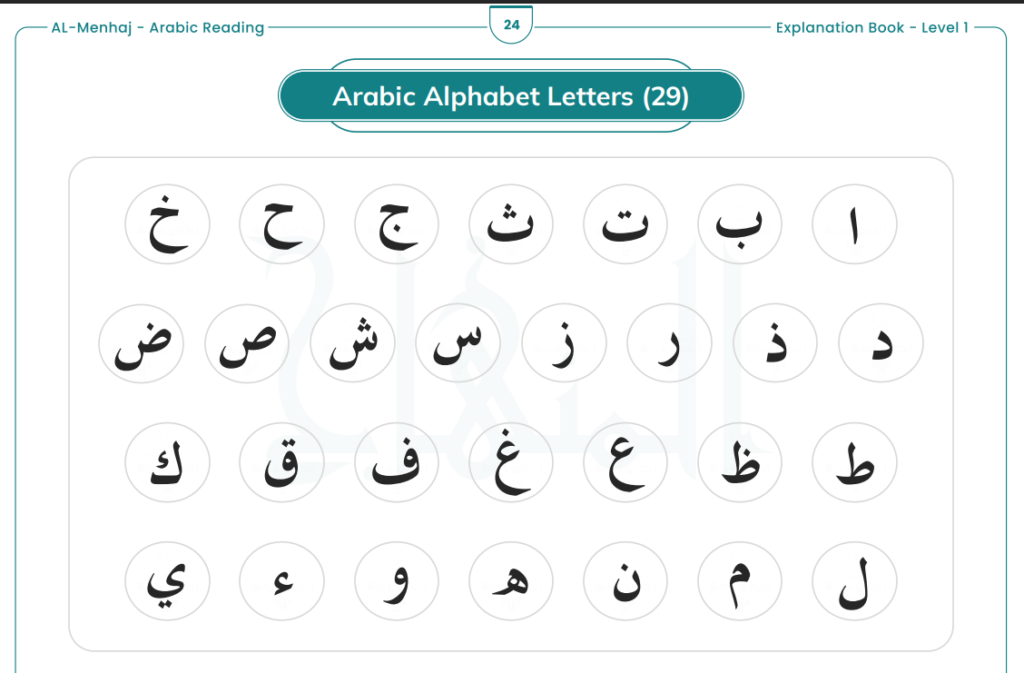
The Arabic alphabet has 28 letters, each with up to four written forms depending on its position in a word.
This can feel overwhelming, but structured instruction breaks it into manageable clusters — typically 3–4 letters per week for young learners.
Should You Teach All 28 Letters Before Moving On?
Not necessarily. The most effective approach groups letters by similar shapes — such as ب، ت، ث — so children build visual pattern recognition alongside phonemic awareness. This reduces confusion and builds confidence early.
At Abjad Academy, our Arabic for Kids — Beginner Course introduces the alphabet through a structured, shape-grouped sequence specifically designed for children aged 4 and above, with visual aids and interactive exercises that hold young attention spans.
Begin your kid’s Arabic learning path with a FREE trial class
Step 2: Build Phonemic Awareness Before Reading Full Words
Once children recognize individual Arabic letters, the next step is phonemic awareness — the ability to hear, identify, and manipulate the sounds in spoken Arabic before reading them.
This step is frequently skipped in informal home-learning attempts, which is why so many children can name the letters but cannot decode a simple Arabic word.
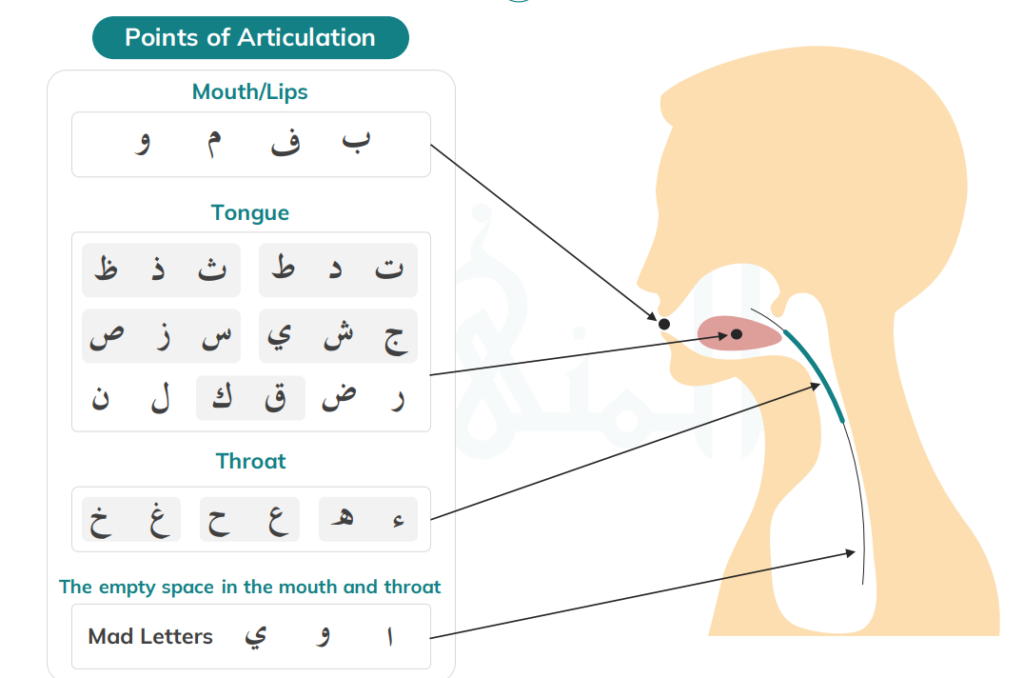
Arabic has short and long vowels, as well as sounds that do not exist in English — such as ع (‘ayn), غ (ghayn), خ (kha), and ح (ha). These require specific oral muscle training.
What Are the Hardest Arabic Sounds for Non-Arabic-Speaking Kids?
The most consistent challenge I observe in young expat learners is distinguishing between ح and ه — both are “h” sounds, but one is produced deep in the throat and the other is a soft glottal release.
Without explicit phonemic instruction, children default to the English /h/ for both, which creates errors that persist into later reading and writing.
Targeted ear-training exercises — repeating minimal pairs like حال (hal, condition) vs. هال (hal, cardamom) — resolve this efficiently when practiced consistently over 3–4 weeks.
Step 3: Introduce Core Vocabulary Through Themed Categories
After establishing phonemic grounding, children are ready to build functional vocabulary. The most effective structure for young learners is thematic grouping — not random word lists.
Themes such as family members, colors, animals, food, and classroom objects give children immediate, usable Arabic connected to real life.
A well-designed thematic vocabulary sequence for kids typically follows this progression:
- أسرتي (usrati) — My Family
- الألوان (al-alwaan) — Colors
- الحيوانات (al-hayawanaat) — Animals
- الطعام (al-ta’aam) — Food
- المدرسة (al-madrasa) — School
How Many Arabic Words Should a Child Learn Per Week?
For children aged 5–8, UAE-based instructors typically recommend 5–8 new words per week, reviewed with spaced repetition across at least three sessions.
Children aged 9–12 can comfortably absorb 10–15 words per week within a structured classroom format. Overloading vocabulary without review produces fast forgetting and frustration.
Shots Videos from Our Courses
Begin Your Arabic Journey in the UAE
Join Abjad Institute for a professional and immersive Arabic language experience tailored to your goals.
Book Your Free TrialStep 4: Develop Listening and Speaking Skills Through Structured Conversation
Arabic speaking confidence in children does not develop through passive exposure alone. Children need structured, low-pressure speaking practice — short dialogues, question-and-answer routines, and interactive games that require Arabic output, not just recognition.
A practical exchange children should master early:
مرحباً، ما اسمك؟
Marhaban, ma ismuka?
Hello, what is your name?
اسمي ليلى
Ismī Laylā.
My name is Layla
Why Do Kids Freeze When Asked to Speak Arabic?
The most common reason young learners go silent when asked to speak Arabic spontaneously is output anxiety — they have absorbed vocabulary passively but have never been required to produce it under light conversational pressure.
The solution is routine, not repetition. Short daily exchanges — even 5-minute structured dialogues — build the neural pathways for spontaneous Arabic speech far more effectively than longer, infrequent sessions.
Abjad Academy’s Arabic Conversation Course for Kids is structured specifically around these speaking routines, delivered by native Arabic instructors who apply consistent low-pressure dialogue methods tailored to each child’s confidence level.
Enroll your kids in our conversation course in the UAE
Step 5: Introduce Arabic Reading with Vowelized Text (Tashkeel)
Once children have phonemic awareness and basic vocabulary, they are ready to begin reading Arabic text. The critical rule here: always begin with fully vowelized text — text that includes tashkeel (short vowel markings such as fatha, kasra, and damma).
Unvowelized Arabic text — which is what adults read in newspapers and most books — removes all short vowel markings and requires the reader to infer correct pronunciation from context.
Young learners are not equipped for this yet. Beginning with unvowelized text is the single most common mistake made in informal Arabic home instruction.
| Text Type | Vowel Markings | Suitable For |
| Fully Vowelized (مُشَكَّل) | All short vowels marked | Beginners, children aged 4–9 |
| Partially Vowelized | Key vowels marked | Intermediate readers aged 9–12 |
| Unvowelized | No short vowels | Advanced readers, adults |
How Long Until a Child Can Read Basic Arabic Text?
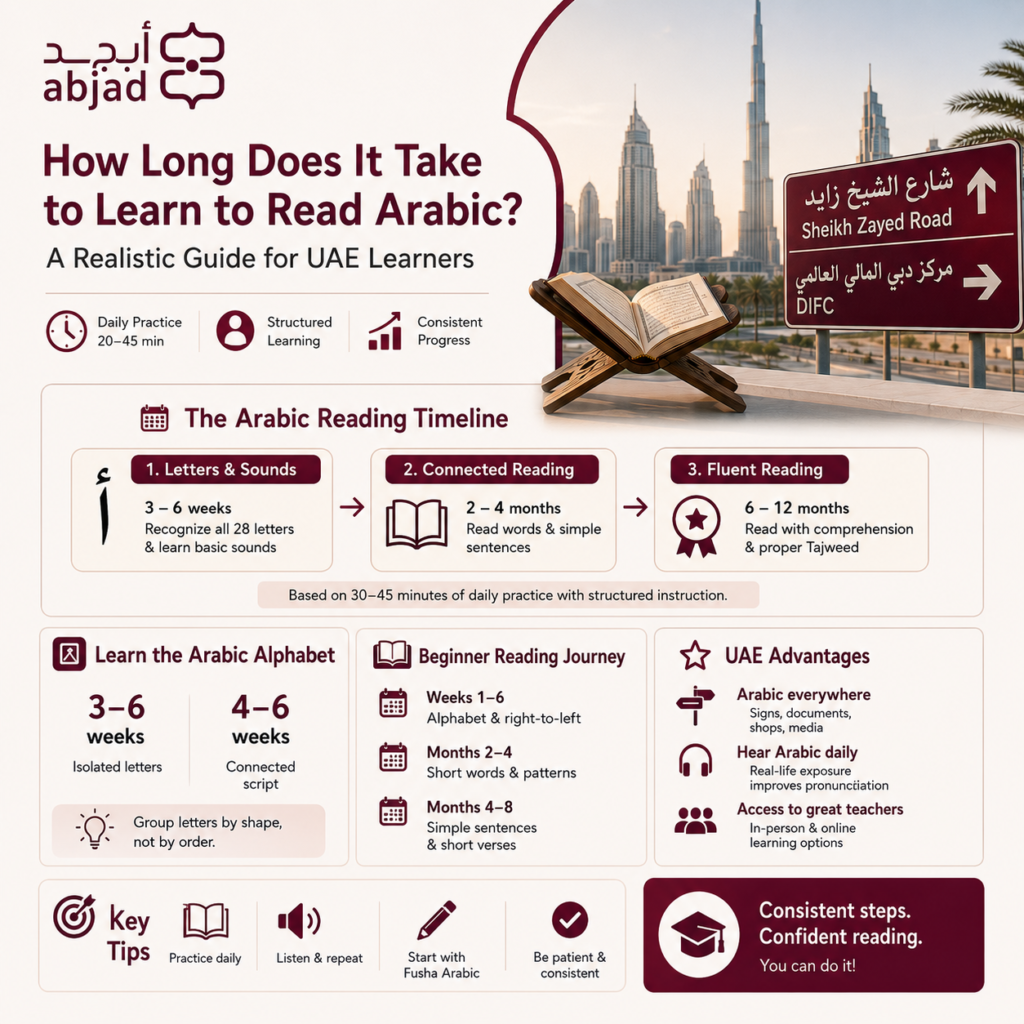
With consistent structured instruction — typically two to three sessions per week — most children aged 6–8 reach basic vowelized reading fluency within 4–6 months. Children who start at age 9 or above often reach the same milestone in 2–3 months, as their cognitive development accelerates pattern recognition.
Step 6: Begin Arabic Writing with Proper Letter Formation
Arabic writing is taught simultaneously with reading — but it requires its own dedicated instruction. Children must learn letter formation strokes correctly from the start, because incorrectly formed letters are extremely difficult to unlearn once habituated.
Arabic is written right to left, which requires an initial adjustment period for children who have already learned to write in English or another left-to-right script.
This transition typically takes 2–3 weeks of consistent guided practice before it becomes natural.
What Is the Correct Stroke Order for Arabic Letters?
Arabic letters are generally formed with a right-to-left baseline stroke, followed by dots and diacritics added afterward.
For example, the letter ب is formed with a baseline curve first, then the single dot is placed beneath. Teaching dots as afterthoughts — rather than integral parts of the letter — helps children maintain writing speed while developing accuracy.
Abjad Academy’s Arabic Writing Course provides systematic letter formation instruction for learners of all ages, including structured worksheets and instructor-guided feedback sessions that prevent the formation of bad habits early.
Start reading and writing Arabic with a FREE trial class

Step 7: Introduce Basic Arabic Grammar in a Child-Friendly Way
Many parents assume Arabic grammar is too complex for young children. In practice, children absorb grammatical patterns intuitively when instruction is structured through patterns and examples, not abstract rules.
The formal metalanguage — mubtada, khabar, fi’l, ism — is introduced gradually and only once children have sufficient vocabulary to contextualize it.
The first grammatical concept children should learn is gender agreement — Arabic nouns are either masculine (mudhakkar) or feminine (mu’annath), and adjectives must match. This is introduced naturally through vocabulary work long before it is formally named.
كتاب كبير (kitaab kabeer) — “a big book” (masculine) مدرسة كبيرة (madrasa kabeera) — “a big school” (feminine)
At What Age Should Kids Start Learning Arabic Grammar Formally?
Structured grammar instruction is most effective from age 8 onward, when children have sufficient metalinguistic awareness to understand rules as rules.
Before age 8, grammar is best taught through pattern exposure and correction — not explicit rule explanation. Abjad Academy’s Arabic Grammar Course for Kids introduces grammar through age-appropriate scaffolding, building from pattern recognition toward formal rule application progressively.
Enroll your child in Abjad’s Arabic grammar course for kids in the UAE
Step 8: Build Consistency Through a Structured Weekly Learning Plan
The single most reliable predictor of children’s Arabic progress is not talent or starting age — it is consistency. Short, frequent sessions with structured content and a native Arabic instructor produce measurably stronger results than any other variable.
A practical weekly structure for children aged 6–12:
| Day | Activity | Duration |
| Monday | Alphabet / phonics review | 15–20 minutes |
| Wednesday | Vocabulary and conversation practice | 20–25 minutes |
| Friday | Reading or writing reinforcement | 20 minutes |
| Weekend | Arabic stories, songs, or media exposure | 15–20 minutes |
How Do You Keep Kids Motivated to Learn Arabic?
The most consistent motivational pattern I observe in young Arabic learners in the UAE is visible progress recognition.
Children who receive specific, accurate praise — “you read that letter perfectly, the shadda was exact” — maintain engagement significantly longer than children who receive generic encouragement.
Progress charts, short-term milestones, and family reinforcement between sessions all compound this effect meaningfully.
Read Also: How to Learn Egyptian Arabic in the UAE?
Our Students Reviews
Begin Your Arabic Journey in the UAE
Join Abjad Institute for a professional and immersive Arabic language experience tailored to your goals.
Book Your Free TrialRead Also: How to Learn Arabic?
Start Your Child’s Arabic Learning Journey with Abjad Academy
Learning Arabic opens real doors for children growing up in the UAE — in school, in social life, and in future opportunities across the Arab world. The steps above give your child a structured, expert-designed path from first letter to confident communication.
Abjad Academy offers specialized Arabic Courses for Kids taught by native Arabic instructors, including native Emirati teachers, with curricula built specifically for children in the UAE context.
- Native instructors — including native Emirati teachers for authentic dialect exposure
- Personalized follow-up — individualized attention at every stage
- UAE-specific curriculum — content relevant to your child’s daily environment
- Flexible scheduling — designed to fit school and family routines
- Elite learning community — connecting expat and Emirati families
Book your child’s free trial session today and see the difference structured instruction makes from the very first class.
Check out our top Arabic courses for UAE residents:
- Arabic Alphabet Course
- Arabic Grammar Course
- Arabic writing course
- Arabic Speaking Classes
- Arabic from Scratch
- Business Arabic Course UAE
- Emirati classes
- Kids’ Arabic Grammar Course
- Arabic Conversation for Kids
Book your free trial session today and take the first step toward functional Arabic fluency in the UAE.

Frequently Asked Questions About Learning Arabic for Kids
What Is the Best Age for a Child to Start Learning Arabic?
Children can begin structured Arabic learning as early as age 4, starting with the alphabet and basic phonics. The 4–7 age window offers strong phonemic flexibility, meaning children acquire Arabic sounds more naturally. That said, children who begin at ages 8–10 with structured instruction often catch up quickly due to stronger cognitive development.
How Long Does It Take for a Child to Learn Arabic?
With two to three structured sessions per week, most children aged 6–8 reach basic conversational Arabic within 12–18 months. Reading fluency with vowelized text typically develops within 4–6 months of alphabet completion. Progress depends heavily on session consistency, instructor quality, and reinforcement at home between lessons.
Should Kids Learn Modern Standard Arabic or Emirati Dialect First?
Modern Standard Arabic (MSA) should come first. MSA provides the grammatical foundation and literacy base that makes dialect acquisition faster and more accurate. Emirati dialect exposure is introduced most effectively once children have basic MSA reading and speaking competency — typically after 6–9 months of structured MSA instruction.
Can Expat Children Learn Arabic Even If It Is Not Spoken at Home?
Yes — and many do successfully. The key condition is structured instruction with a qualified instructor, as home exposure alone is insufficient without grammatical scaffolding. At Abjad Academy, a significant portion of our young students come from non-Arabic-speaking homes and reach functional Arabic literacy within their first year through consistent weekly instruction.
Are Arabic Learning Apps Enough for Kids?
Apps are useful for vocabulary reinforcement and listening exposure, but they are not sufficient as a primary learning method. They lack the grammatical correction, phonemic feedback, and structured progression that children need to build real Arabic literacy. Apps work best as a supplement to instructor-led sessions, not a replacement.





Leave a Reply