 Quran
Quran

| Key Takeaways |
| Arabic has two main forms — Modern Standard Arabic (MSA) and spoken dialects — and UAE learners need both for full daily and professional functioning. |
| Starting with the Arabic alphabet before attempting vocabulary or phrases prevents persistent pronunciation errors that are difficult to correct later. |
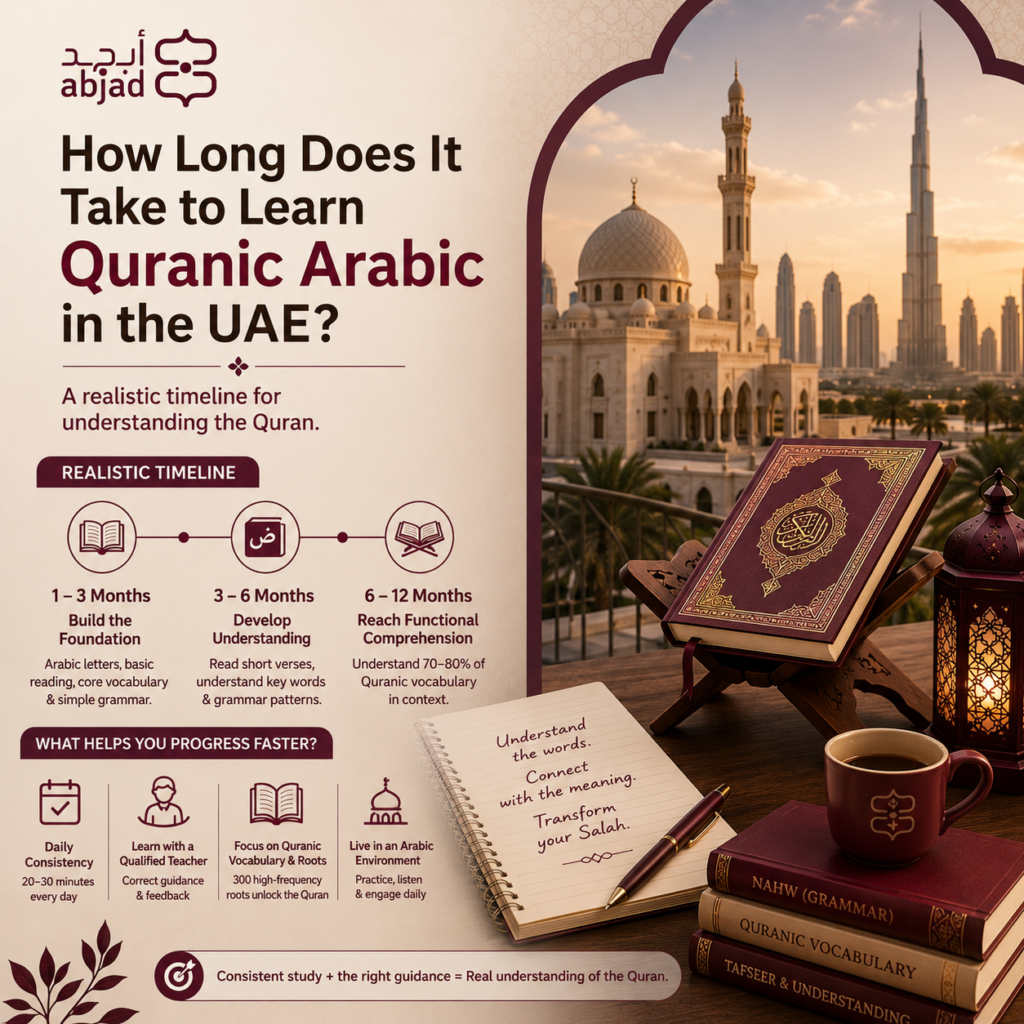
| Most adult expat learners in the UAE reach basic conversational Arabic within 3–6 months of structured weekly instruction with a qualified native instructor. |
| Emirati Arabic dialect differs significantly from MSA and Gulf Arabic — mastering it requires dedicated instruction beyond standard Arabic courses. |
| Professional Arabic in UAE government and corporate contexts follows fixed formal registers that must be learned separately from everyday spoken Arabic. |
Living and working in the UAE without Arabic is manageable — but learning it transforms your experience entirely. The single most effective way to learn Arabic in the UAE is through structured instruction that addresses both Modern Standard Arabic and locally spoken Emirati dialect from the beginning.
Most learners who struggle with Arabic attempt it without a clear methodology — collecting apps, YouTube videos, and phrase books without a coherent sequence. This guide gives you that sequence: a practitioner-developed, UAE-specific path that takes you from zero Arabic knowledge to confident, functional communication, in the shortest realistic timeframe.
Step 1: Understand What Type of Arabic You Actually Need
To learn Arabic effectively in the UAE, you first need to identify which form of Arabic serves your specific goals. Modern Standard Arabic (MSA) is the formal written and broadcast language used across Arab countries. Emirati Arabic dialect is what you will hear daily in homes, markets, and informal professional settings.
Most UAE residents need both — and the proportion depends on whether your context is professional, personal, or academic.
Confusing these two forms at the start is the most common mistake I see among new learners at Abjad Academy.
Adult expats often begin with MSA phrase books and then feel completely lost when an Emirati colleague responds in rapid local dialect. The two registers are related — but not mutually intelligible at a beginner level.
What Is the Difference Between MSA and Emirati Arabic?
MSA follows strict grammatical rules codified in classical Arabic, uses the full I’rab (case-ending vowel system), and is primarily written and formal.
Emirati Arabic drops most case endings, incorporates loanwords from Persian, Hindi, and English, and uses distinct vocabulary items entirely absent from MSA textbooks.
| Feature | Modern Standard Arabic (MSA) | Emirati Arabic Dialect |
| Use context | Written, formal, broadcast | Daily speech, informal meetings |
| Grammar complexity | Full I’rab system | Simplified, no case endings |
| “How are you?” | كيف حالك؟ (Kayfa haluka?) | شحالك؟ (Shkhalak?) |
| “What do you want?” | ماذا تريد؟ (Maadha turid?) | وش تبي؟ (Wesh tabi?) |
| Learner priority | Government, writing, education | Social, networking, daily life |
If your goals are primarily social and cultural — understanding neighbours, speaking at markets, building genuine relationships with Emirati colleagues — explore Abjad Academy’s Emirati Arabic Course, taught by native instructors who bring authentic dialect exposure into every session.
Book your FREE trial Emirati class
Step 2: Master the Arabic Alphabet Before Anything Else
Learning the Arabic alphabet is not optional — it is the single most important investment a beginner can make. Every learner who skips straight to phrases and transliterations eventually hits a ceiling they cannot break through.
The Arabic script encodes pronunciation rules, grammatical relationships, and word roots that no transliteration system can replicate accurately.
Arabic has 28 letters, all consonants, written right to left. Each letter has four forms depending on its position in a word — initial, medial, final, and isolated.
This is a different cognitive challenge from learning a new alphabet like Greek or Cyrillic, and it requires dedicated attention before vocabulary study begins.
How Long Does It Take to Learn the Arabic Alphabet?
Most adult learners with consistent daily practice master Arabic letter recognition and basic writing within 3–4 weeks.
Connecting letters fluently and reading short words accurately typically takes another 2–3 weeks. This is an instructional estimate based on learner patterns in structured UAE classroom settings — individual pace varies.
What Are the Most Common Alphabet Errors UAE Learners Make?
The letters ع (‘Ain) and غ (Ghain) consistently challenge non-native speakers because they have no equivalent in European languages.
Similarly, ح (Ha) — a deep pharyngeal sound — is frequently mispronounced as a simple h, which distorts both pronunciation and meaning in ways that affect comprehension.
Abjad Academy’s Arabic Alphabet Course uses the Al-Menhaj Book, a specialized instructional resource that builds Quranic reading readiness alongside general Arabic literacy, ensuring beginners develop accurate letter formation and pronunciation from the very first lesson.
Start learning Arabic letters with a FREE trial class

Step 3: Build Your Arabic Foundation with Core Vocabulary and Pronunciation
After alphabet mastery, the next step is building a functional core vocabulary alongside accurate pronunciation habits. In Arabic, pronunciation is not just aesthetic — it is grammatically and semantically significant.
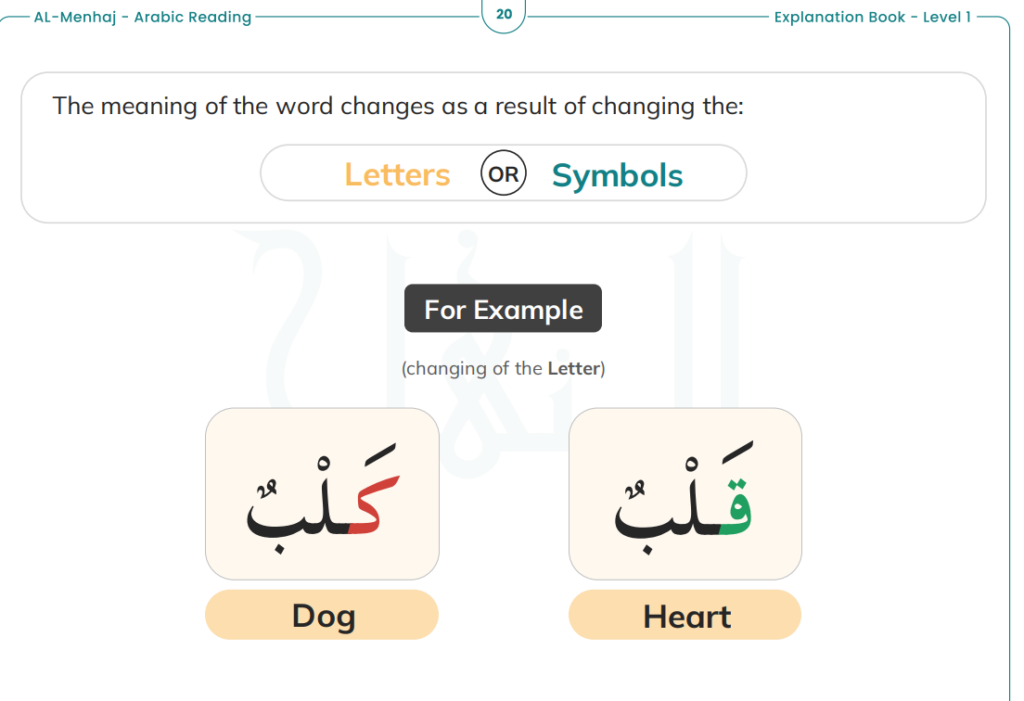
The difference between قَلْب (qalb, “heart”) and كَلْب (kalb, “dog”) is a single letter. Mispronouncing it creates confusion at best and offense at worst.
Focus initial vocabulary on three practical domains: greetings and social interaction, numbers and time, and everyday objects and locations.
These cover the highest-frequency situations UAE residents encounter daily — from taxi conversations to supermarket interactions to office greetings.
Which Arabic Pronunciation Sounds Are Hardest for English Speakers?
The emphatic consonants — ص (Sad), ض (Dad), ط (Ta), ظ (Dha) — are the sounds that most consistently resist self-study.
They require a backed, pharyngealized articulation that must be heard and corrected in real time by a trained instructor. No app currently provides reliable feedback on these sounds.
صباح الخير
Sabah al-khayr
“Good morning”
Shots Videos from Our Courses
Begin Your Arabic Journey in the UAE
Join Abjad Institute for a professional and immersive Arabic language experience tailored to your goals.
Book Your Free TrialStep 4: Learn Arabic Grammar Systematically
Arabic grammar is rich and logical — but it must be taught in the right sequence. Beginning with overwhelming complexity discourages learners unnecessarily.
The most effective starting point is the Mubtada-Khabar structure — the nominal sentence — which allows learners to construct meaningful statements immediately without mastering verb conjugation first.
المدرسة كبيرة
Al-madrasa kabeera
“The school is big”
(literally: “The school [is] big” — Arabic omits the verb “to be” in present tense nominal sentences)
What Arabic Grammar Concepts Should Beginners Learn First?
The recommended beginner grammar sequence for UAE learners covers:
(1) definite article ال (Al) and Sun vs. Moon letter assimilation,
(2) Mubtada-Khabar nominal sentences,
(3) basic Idafa (possessive construction), and
(4) present-tense verb conjugation using the Fi’l Mudari’ form. This sequence builds productive output quickly without requiring mastery of the full I’rab system.
How Does Arabic Grammar Differ from English Grammar?
Arabic is a root-based, templatic language — most words derive from three-consonant roots.
The root ك-ت-ب (k-t-b) generates كَتَبَ (kataba, “he wrote”), كِتَاب (kitab, “book”), مَكْتَب (maktab, “office/desk”), and كَاتِب (katib, “writer”).
Recognizing roots dramatically accelerates vocabulary acquisition once this pattern becomes intuitive.
Abjad Academy’s Arabic Grammar Course breaks these structures into digestible lessons, building confidence in constructing accurate Arabic sentences from the beginning of instruction.
Book your FREE trial class in our Arabic grammar course

Step 5: Develop Arabic Speaking Skills Through Structured Conversation Practice
Grammar knowledge and speaking ability are different skills — and the gap between them is where most self-study learners stall. Active speaking practice must begin early, run in parallel with grammar study, and be structured around realistic UAE communication scenarios. Waiting until you feel “ready” to speak almost always delays fluency unnecessarily.
The most productive speaking practice for UAE residents focuses on three contexts: professional greetings and small talk, service interactions (government offices, medical appointments, retail), and social invitations and relationship-building with Emirati and Arab colleagues.
How Can You Practice Arabic Speaking in the UAE?
Beyond formal instruction, UAE residents have exceptional daily Arabic immersion opportunities. Commit to opening every professional interaction — however brief — with the Arabic greeting:
السلام عليكم
As-salamu alaykum
“Peace be upon you”
This single practice habit, done consistently, accelerates spoken Arabic progress faster than most structured exercises. Emirati professionals notice and appreciate it.
At Abjad Academy, our Arabic Speaking Classes with native instructors help students master conversational flow through interactive 1-on-1 sessions tailored specifically to UAE residence needs — from government office interactions to corporate meeting openings.
Start speaking Arabic with a FREE trial session
Step 6: Learn Written Arabic for Professional and Daily Communication
Written Arabic follows MSA conventions strictly — even in informal digital communication among educated speakers.
Emails, official correspondence, forms, and professional documents in UAE government and corporate sectors require a level of written Arabic distinct from spoken dialect and inaccessible through conversation practice alone.
The fundamental challenge in Arabic writing is not the script — it is register and formula. UAE government correspondence opens with fixed ceremonial phrases rooted in Classical Arabic that must be learned as fixed expressions, not constructed from grammar rules.
Before learning these formulas, most learners default to direct English translation, which reads as culturally illiterate to native readers.
What Is the Correct Opening Formula for a Formal Arabic Email in the UAE?
A standard formal Arabic email in a UAE professional context opens:
بسم الله الرحمن الرحيم
Bismillah al-rahman al-raheem
“In the name of God, the Most Gracious, the Most Merciful”
Followed by:
معالي / سعادة / فضيلة [title] Ma’ali / Sa’adat / Fadheelat [title] “His Excellency / His Highness / His Eminence [title], Respected”
Choosing the wrong honorific — or omitting the opening formula entirely — signals unfamiliarity with UAE professional Arabic norms.
Abjad Academy’s Learn to Write Arabic Course provides systematic instruction in Arabic script and professional written communication, including these context-specific formulas.
Start reading and writing Arabic with a FREE trial class

Step 7: Progress to Business Arabic or Emirati Dialect Based on Your Professional Goals
Once foundational Arabic is established — alphabet, core vocabulary, basic grammar, and elementary speaking — the path splits based on your professional context.
UAE residents working in federal government entities, semi-government corporations, or Arabic-medium education need to develop formal Business Arabic.
Those working in community-facing roles, sales, healthcare, or social services benefit most from deepening their Emirati dialect fluency.
Professionals in these contexts who develop functional written and spoken Business Arabic gain measurable career advantages over peers who rely solely on English.
What Arabic Is Required for UAE Government and Corporate Contexts?
Business Arabic in UAE federal settings requires command of formal MSA honorifics, meeting-opening phrases, written correspondence formulas, and the ability to follow Arabic-language presentations and formal discussions.
It does not require native-level fluency — functional professional Arabic is a realistic and valuable target.
| Context | Arabic Register Required | Estimated Timeline |
| UAE Federal Government | Formal MSA + honorifics | 6–9 months structured study |
| Corporate (private sector) | Semi-formal MSA + some dialect | 4–6 months structured study |
| Community / social contexts | Emirati dialect + basic MSA | 3–5 months structured study |
| Academic / education sector | MSA reading and writing focus | 6–12 months structured study |
Our Business Arabic Course UAE at Abjad Academy is designed for professionals working in government and corporate sectors, helping you navigate formal Arabic correspondence and meetings with confidence.
Enroll in Abjad’s Business Arabic Course and get a FREE trial

Step 8: Maintain Progress with a Consistent Arabic Learning System
Consistency outperforms intensity in Arabic language learning. A learner who studies Arabic for 30 focused minutes daily will outperform one who studies for three hours once a week — this is a consistent instructional observation, not a casual opinion. Arabic’s root-based structure requires repeated, spaced exposure to consolidate vocabulary and grammar patterns into long-term memory.
The most sustainable system for UAE-based adult learners combines weekly structured sessions with a qualified instructor and daily micro-practice of 20–30 minutes using vocabulary review, reading short Arabic texts, or listening to UAE Arabic media.
What Is the Most Effective Daily Arabic Practice Routine?
A productive 30-minute daily Arabic practice routine for intermediate UAE learners includes: 10 minutes of vocabulary review using root-pattern groupings, 10 minutes of reading a short Arabic news excerpt from a UAE-based Arabic outlet, and 10 minutes of writing practice — either Arabic script reinforcement or composing short messages in MSA.
This structure addresses all four language skills without overwhelming a busy professional schedule.
For learners starting completely from scratch, Abjad Academy’s Arabic Classes From Scratch provide a structured progressive curriculum with personalized follow-up that keeps momentum between sessions — particularly valuable for adult learners without prior exposure to any Semitic language.
Enroll in Abjad’s Arabic from Scratch Course and get a FREE trial
Our Students Reviews
Begin Your Arabic Journey in the UAE
Join Abjad Institute for a professional and immersive Arabic language experience tailored to your goals.
Book Your Free TrialRead Also: How to Learn Arabic for Kids
Start Your Arabic Learning in the UAE with Abjad Academy
Learning Arabic in the UAE is one of the most professionally and personally rewarding investments a resident can make. The structured eight-step path above — from alphabet through business communication — gives you a proven sequence.
Abjad Academy offers:
- Native Arabic instructors, including native Emirati teachers, for authentic dialect exposure
- Interactive curriculum built specifically for the UAE context
- Personalized follow-up and individualized attention in every course
- Courses for all levels — from complete beginners to advanced professional learners
- Flexible scheduling designed for busy professionals, expat families, and children
- An elite learning community connecting UAE expats and locals
Book your free trial session today and take the first step toward functional Arabic fluency in the UAE.
Check out our top Arabic courses for UAE residents:
- Arabic Alphabet Course
- Arabic Grammar Course
- Arabic writing course
- Arabic Speaking Classes
- Arabic from Scratch
- Business Arabic Course UAE

REad Also: How to Speak Arabic Language in the UAE?
Frequently Asked Questions About How to Learn Arabic
How long does it take to learn Arabic from scratch?
Most adult learners in the UAE with consistent structured weekly instruction reach basic conversational ability in 3–6 months. Professional-level Arabic — reading formal correspondence and conducting meetings in MSA — typically requires 9–18 months of dedicated study. Timelines vary significantly based on session frequency, daily practice, and prior language learning experience.
Is Modern Standard Arabic or Emirati dialect more useful for UAE residents?
Both forms serve distinct purposes for UAE residents. MSA is essential for written communication, government services, and professional correspondence. Emirati dialect is more valuable for daily social interaction and building genuine relationships with Emirati colleagues and neighbours. Most instructors recommend beginning with MSA structure while introducing Emirati dialect vocabulary and phrases in parallel from an early stage.
Can adults learn Arabic effectively without prior language learning experience?
Yes — adult learners without prior experience can reach strong functional Arabic ability with the right instructional approach. Adults actually benefit from metalinguistic awareness that children lack, which helps in understanding Arabic grammar logic. The primary challenge for adults is pronunciation of unfamiliar sounds, which is best addressed early with a native instructor providing real-time feedback.
What is the best way to learn Arabic for UAE government work?
Professionals working in UAE federal entities benefit most from a combined approach: foundational MSA grammar and vocabulary, formal written correspondence formulas, professional meeting Arabic, and UAE-specific honorific systems. Structured instruction with a qualified instructor who understands UAE government culture — rather than generic Arabic courses — produces the most relevant and applicable results.
At what age should children start learning Arabic in the UAE?
Children in the UAE benefit from beginning structured Arabic instruction as early as age 4–5, when language acquisition is most natural. For expat children in Arabic-medium or bilingual schools, early alphabet and reading instruction is particularly valuable. Abjad Academy’s Arabic Courses for Kids are structured for different age groups, from beginner readers through conversational and grammar development.



Leave a Reply