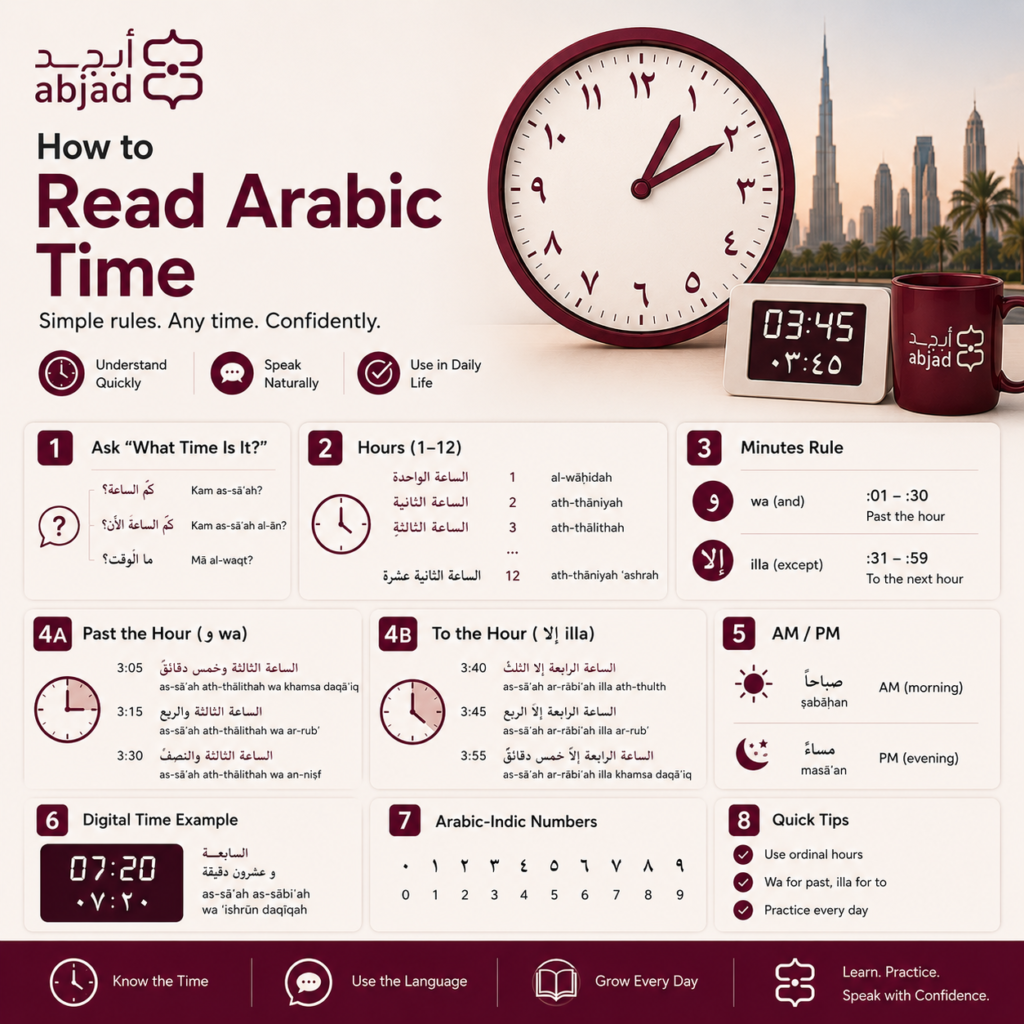
 Speak Arabic

| Key Takeaways |
| Speaking Arabic in the UAE means learning both Modern Standard Arabic and some Emirati dialect phrases. |
| Starting with the Arabic alphabet and phonetics is non-negotiable — Arabic pronunciation patterns don’t exist in English and must be trained deliberately. |
| Most adult expat learners in structured UAE-based programs can hold basic Arabic conversations within four to six months of consistent weekly instruction. |
| Emirati Arabic differs from MSA and other dialects — learning it separately, after MSA foundations, produces far better results. |
You can get by in the UAE speaking only English. But the moment you greet an Emirati colleague in Arabic, open a government meeting with a proper phrase, or respond naturally to a local — everything changes.
Speaking Arabic in the UAE requires a structured sequence: alphabet and phonetics first, then Modern Standard Arabic grammar foundations, then conversational practice, then Emirati dialect as a specialized layer.
Skipping any step creates gaps that slow learners down significantly later. This guide walks through exactly how to build that sequence — practically, realistically, and with the UAE context in mind.
1. Understand Which Arabic You Are Actually Learning
To speak Arabic in the UAE, you need to understand that “Arabic” refers to at least two distinct systems used in daily life here. Modern Standard Arabic (MSA) is the formal, written, and broadcast language — used in government, media, education, and formal meetings. Emirati Arabic dialect is the spoken vernacular used in casual conversation among Emiratis and long-term residents.
Most successful learners start with MSA as their structural foundation, then layer Emirati dialect expressions on top.
Attempting Emirati dialect without MSA grammar foundations is a common mistake — and one that consistently produces learners who can mimic phrases without understanding them.
Why Does MSA Come First for UAE Learners?
MSA provides the grammatical logic — the verb conjugation system, noun case endings (I’rab), and sentence structure (Mubtada and Khabar) — that makes Emirati dialect patterns coherent.
Without it, dialect phrases remain isolated sounds rather than productive language building blocks.
What Does Emirati Arabic Add Later?
Once your MSA base is solid, Emirati dialect fills in the social layer. Phrases like شحالك؟ (Shkhalak? — “How are you?”) or وين رايح؟ (Wayn rayeh? — “Where are you going?”) signal cultural belonging in ways that formal MSA never will in casual settings.
Shots Videos from Our Courses
Begin Your Arabic Journey in the UAE
Join Abjad Institute for a professional and immersive Arabic language experience tailored to your goals.
Book Your Free Trial2. Master the Arabic Alphabet
The Arabic alphabet is the foundation of everything — pronunciation, reading, writing, and ultimately speaking with accuracy. Arabic has 28 letters, all consonants, and is written right to left.
No learner becomes a confident Arabic speaker without first internalizing the script.
This step is non-negotiable. Learners who skip the alphabet and rely on transliteration alone consistently plateau at a beginner level, unable to read signs, menus, government forms, or text messages — all of which are Arabic-script in UAE daily life.
The Arabic Sounds That Don’t Exist in English
Arabic contains several phonemes with no English equivalent. These include:
- ع (‘ayn) — a voiced pharyngeal fricative produced deep in the throat
- غ (ghayn) — similar to a French “r,” produced at the back of the palate
- خ (kha) — a guttural sound like clearing the throat softly
- ح (ha) — a breathy, constricted “h” from the throat, distinct from the regular ه
- ق (qaf) — a “k” sound produced at the very back of the throat
Mispronouncing these doesn’t just sound foreign — it can change word meaning entirely. قَلْب (qalb — “heart”) and كَلْب (kalb — “dog”) are distinguished only by qaf versus kaf. Precision matters.
At Abjad Academy, students work through the Arabic alphabet using the Al-Menhaj Book, a specialized resource for Arabic alphabet mastery and foundational reading, under the guidance of native Arabic instructors who train pronunciation from the first session — not after months of self-study.
You can explore the Arabic alphabet course in the UAE at Abjad Academy to see how this foundational step is structured for non-native speakers in the UAE.
Start learning Arabic letters with a FREE trial class
3. Build Your MSA Grammar Foundation Systematically
Grammar is not optional for speaking Arabic — it is the engine. Arabic grammar determines word order, verb agreement, noun definiteness, and sentence meaning. Without it, communication is fragmented and frequently misunderstood.
The good news is that Arabic grammar is highly logical and rule-governed. Once core patterns are internalized, they apply consistently across thousands of words and sentences.
The Grammar Patterns UAE Learners Need First
| Grammar Concept | Arabic Term | Why It Matters for Speaking |
| Sentence subject | المبتدأ (Al-Mubtada) | Every statement begins here |
| Sentence predicate | الخبر (Al-Khabar) | Completes meaning of subject |
| Definite article | ال (Al-) | Changes noun meaning entirely |
| Verb conjugation | الفعل (Al-Fi’l) | Agrees with subject in gender and number |
| Possessive construction | الإضافة (Al-Idafa) | Links nouns — used constantly in UAE workplace Arabic |
| Nunation | التنوين (Al-Tanwin) | Marks indefinite nouns in formal speech |
The Most Common Grammar Mistake UAE Expats Make
The most consistent error adult expat learners make in UAE Arabic classes is applying direct English word order to Arabic sentences. In Arabic, the verb frequently precedes the subject in formal constructions — ذهب الرجل (Dhahaba al-rajul — “The man went,” literally “Went the man”). Correcting this instinct early is essential.
Abjad Academy’s Arabic grammar course in the UAE breaks these structures into digestible, sequenced lessons — building confidence in constructing accurate Arabic sentences from the first weeks of study.
Book your FREE trial class in our Arabic grammar course
4. Start Speaking from Day One with Guided Conversation Practice
Grammar knowledge and speaking ability are not the same skill. Many learners study Arabic grammar accurately on paper but freeze when speaking. The solution is structured speaking practice that begins alongside — not after — grammar instruction.
In UAE-based instruction, the most effective approach pairs grammar input with immediate speaking output. Every new structure is used in a spoken exchange within the same session it is introduced.
Core Spoken Arabic Phrases for UAE Daily Life
Begin with high-frequency phrases tied to UAE daily contexts:
أهلاً وسهلاً Ahlan wa sahlan “Welcome” / “Hello” (warm, formal greeting)
كيف حالك؟ Kayfa haluka? (to a male) / Kayfa haluki? (to a female) “How are you?” (MSA)
شكراً جزيلاً Shukran jazeelan “Thank you very much”
من فضلك Min fadlak (to a male) / Min fadliki (to a female) “Please”
إلى اللقاء Ila al-liqa’ “Goodbye” (formal — appropriate for UAE professional settings)
Speaking Practice That Actually Works
Effective speaking practice in the UAE context includes:
- Role-play scenarios set in UAE locations (government offices, corporate meetings, residential communities)
- Shadowing native speaker audio with immediate repetition
- Recorded self-review to identify pronunciation patterns to correct
- Weekly conversational sessions with a native Arabic instructor
At Abjad Academy, our Arabic speaking course in the UAE with native instructors help students move from passive grammar knowledge to active spoken fluency through interactive 1-on-1 sessions tailored specifically to UAE residence and workplace needs.
Start speaking Arabic with a FREE trial session
5. Develop Arabic Listening Skills Tuned to UAE Contexts
Speaking Arabic fluently requires hearing it accurately. Listening comprehension and speaking ability develop together — weak listening creates speaking gaps that learners cannot self-correct, because they cannot hear what they are mispronouncing.
In the UAE specifically, learners are exposed to a wide mix of Arabic accents — Emirati, Egyptian, Levantine, and Gulf Arabic appear regularly in workplaces, retail, and media. Training your ear for this variation is a practical skill, not a theoretical one.
What to Listen to in the UAE
- UAE state television (Abu Dhabi TV) — broadcasts in MSA with UAE-dialect segments, ideal for dual exposure
- Dubai Eye and other UAE radio stations — mix of Arabic and English with natural UAE-context vocabulary
- Arabic-language podcasts for learners — structured input at controlled speed before moving to native-speed content
- Conversations with Emirati colleagues and neighbors — unscripted, high-value exposure
The critical listening skill is distinguishing MSA phonology from Gulf dialect phonology. For example, the qaf (ق) sound is pronounced as a hard “g” in many Emirati dialect words — قهوة (gahwa in Emirati, qahwa in MSA — “coffee”). This shift surprises many learners who studied only MSA pronunciation.
Read also: Egyptian Arabic Lessons for Children
Begin Your Arabic Journey in the UAE
Join Abjad Institute for a professional and immersive Arabic language experience tailored to your goals.
Book Your Free Trial6. Learn Emirati Arabic Dialect as a Dedicated Layer
Emirati Arabic is a Gulf Arabic dialect with distinct vocabulary, phonological patterns, and cultural expressions that differ meaningfully from MSA and from other Arabic dialects.
Learning it as a separate, dedicated layer — after MSA foundations — is the most effective approach for UAE residents seeking genuine local connection.
Adult expat learners in Dubai and Abu Dhabi who attempt Emirati dialect before MSA almost always face a specific challenge: they acquire a set of social phrases but cannot extend them, ask follow-up questions, or adapt to unexpected responses.
MSA grammar gives the structural flexibility that makes dialect learning productive.
Key Emirati Dialect Features
| Feature | MSA Form | Emirati Dialect Form |
| “What?” | ماذا (Madha) | إيش (Eysh) |
| “How are you?” | كيف حالك (Kayfa haluk) | شحالك (Shkhalak) |
| “I want” | أريد (Ureed) | أبي (Abi) |
| “Now” | الآن (Al-an) | الحين (Al-heen) |
| “Good / OK” | جيد (Jayyid) | زين (Zayn) |
Working with native Emirati instructors at Abjad Academy through our Emirati Arabic course provides authentic exposure to local expressions and cultural nuances that no textbook or app can replicate — with flexible scheduling to fit your professional lifestyle in the UAE.
Book your FREE trial Emirati class
7. Apply Arabic in Professional and Government Contexts in the UAE
As of 2026, with the UAE’s growing emphasis on Arabic in federal government services and corporate communication, functional professional Arabic is increasingly expected in senior and client-facing roles.
Speaking Arabic in a meeting, reading a government document, or writing a formal Arabic email carries real professional weight.
Business Arabic in UAE government contexts requires formal MSA with specific honorifics absent from everyday speech.
Greetings, address forms, and closing phrases follow conventions that must be learned deliberately — they are not intuitive extensions of conversational Arabic.
Professional Arabic Phrases for UAE Workplaces
حضرة المدير / حضرة الدكتور Hadrat al-mudeer / Hadrat al-duktoor “Honorable Director / Honorable Doctor” — formal address used in UAE meetings and correspondence
بارك الله فيك Baraka Allahu feek “May God bless you” — appropriate closing in formal UAE professional exchanges
يسعدني التعاون معكم Yus’iduni al-ta’awun ma’akum “It is my pleasure to cooperate with you” — standard formal business Arabic opening
Before learning the formal Arabic opening formula for UAE government emails, most students default to direct translation from English, which reads as blunt and culturally tone-deaf to Emirati recipients. The Al-Idafa possessive construction and specific honorific address forms must be internalized as distinct formulas, not improvised.
Our Business Arabic course at Abjad Academy is designed specifically for professionals working in UAE government and corporate sectors, helping you navigate formal Arabic correspondence and meetings with genuine confidence.
Enroll in Abjad’s Business Arabic Course and get a FREE trial
Read Also: Arabic Writing Practice in the UAE
8. Build Consistency with a Structured Weekly Learning Plan
Consistency is the single most decisive variable in Arabic speaking progress for adult learners in the UAE. Learners who attend two structured sessions per week, combined with 20–30 minutes of daily practice, progress measurably faster than those relying on occasional intensive sessions.
In structured weekly instruction at UAE-based programs, most adult expat professionals can hold basic formal Arabic exchanges within four to six months.
Reaching functional conversational fluency — sustained, spontaneous exchanges — typically requires nine to twelve months of consistent work. These are instructional estimates based on common learner trajectories, not guaranteed timelines.
A Realistic Weekly Arabic Practice Structure
| Day | Activity | Duration |
| Monday | Instructor-led lesson (grammar + speaking) | 60 min |
| Tuesday | Listening practice + vocabulary review | 20 min |
| Wednesday | Speaking drill — self-recorded | 15 min |
| Thursday | Instructor-led lesson (conversation focus) | 60 min |
| Friday | Emirati dialect phrases + cultural context review | 20 min |
| Saturday | Free practice — real-world interaction | Ongoing |
| Sunday | Rest or light review | Optional |
The learners who progress fastest are not those with the most natural aptitude — they are those who build a non-negotiable weekly routine and treat each session as an investment with compounding returns.
Read Also: How to Write in Arabic in the UAE?
Our Students Reviews
Begin Your Arabic Journey in the UAE
Join Abjad Institute for a professional and immersive Arabic language experience tailored to your goals.
Book Your Free TrialRead Also: How to Learn Arabic for Kids?
Begin Speaking Arabic in the UAE with Abjad Academy
Speaking Arabic in the UAE is a structured, achievable skill — not a distant aspiration. The path from zero to functional speaking is clear: alphabet, grammar foundation, speaking practice, listening development, Emirati dialect, and professional application.
Abjad Academy offers:
- Native Arabic instructors, including native Emirati teachers, for authentic UAE-context learning
- Personalized, structured curriculum built for non-native speakers in the UAE
- Flexible scheduling for professionals, families, and students
- Individual follow-up and progress tracking after every session
- An elite learning community connecting expats and Emirati families across the UAE
Book a free trial session and take the first step toward Arabic fluency in the UAE — with instruction built around your life, your goals, and your UAE context.
Check out our top Arabic courses for UAE residents:
- Arabic Alphabet Course
- Arabic Grammar Course
- Arabic writing course
- Arabic Speaking Classes
- Arabic from Scratch
- Business Arabic Course UAE
- Kids’ Arabic Grammar Course
- Arabic Conversation for Kids
Book your free trial session today
Conclusion
Speaking Arabic in the UAE opens professional doors, deepens community belonging, and signals a level of cultural investment that English alone never can. The eight steps above — from alphabet to professional application — reflect the genuine sequence experienced Arabic instructors use with UAE-based learners.
The learners who succeed are those who treat Arabic as a long-term professional and personal asset, commit to structured weekly instruction, and engage with the language in real UAE contexts from the earliest stages. Consistent, guided effort over six to twelve months produces results that are both measurable and lasting.
Begin Your Arabic Journey in the UAE
Join Abjad Institute for a professional and immersive Arabic language experience tailored to your goals.
Book Your Free TrialRead Also: How to Learn Arabic?
Frequently Asked Questions About How to Speak Arabic in the UAE
How long does it take to learn to speak Arabic in the UAE?
Most adult learners in structured UAE-based programs reach basic conversational Arabic within four to six months of consistent weekly instruction. Functional professional Arabic — usable in formal meetings and government contexts — typically develops within nine to twelve months. These timelines assume two instructor-led sessions per week combined with daily self-practice.
Is Modern Standard Arabic or Emirati dialect more useful for speaking in the UAE?
Both serve distinct purposes in the UAE. MSA is essential for professional, government, and formal settings — and provides the grammar foundation for all Arabic learning. Emirati dialect is valuable for social connection and cultural integration. Starting with MSA and layering Emirati dialect as a secondary skill produces the best practical outcomes for UAE residents.
Can I learn to speak Arabic in the UAE without learning to read the script?
Technically possible for basic phrase memorization — but not for genuine speaking ability. Without Arabic script, learners cannot access UAE-language signage, government documents, text messages, or authentic learning materials. Learners who skip the script consistently plateau early. Alphabet mastery accelerates overall speaking progress significantly.
Leave a Reply