 Learn Arabic
Have you been reciting the Quran for years without truly understanding what you’re reading? You’re not alone — millions of Muslims across the UAE read Arabic fluently in terms of letters and sounds, yet the meanings of the words remain out of reach. The good news is that you can start to change that today, and much of what you need to begin is completely free.
The UAE is one of the best places in the world to learn Quranic Arabic. Between mosque halaqas, Islamic centres, and a growing number of quality online platforms, both residents and citizens have more access to structured Quranic education than ever before. Whether you’re in Dubai, Abu Dhabi, or Sharjah, a free starting point exists — and a clear path forward from there.
This guide shows you exactly what you can learn for free, where to find the best free resources in the UAE and online, the common mistakes to avoid, and when structured lessons become the smarter investment.
Can You Learn Quranic Arabic for Free in the UAE?
Yes — you can build a genuine foundation in Quranic Arabic for free, both locally and online. The UAE’s strong Islamic infrastructure means free resources are not hard to find; the challenge is knowing how to use them in the right order.
1. Skills You Can Build Through Free Learning
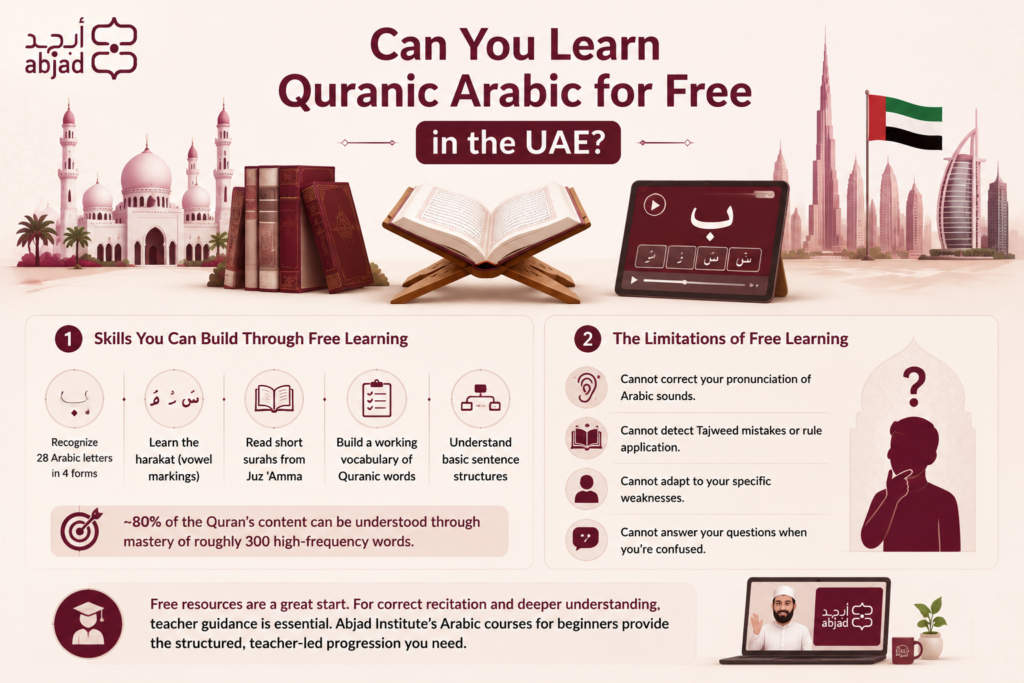
A well-structured free approach can take a complete beginner through the Arabic alphabet, basic Quranic vocabulary, and simple reading of short surahs. Specifically, free resources allow you to:
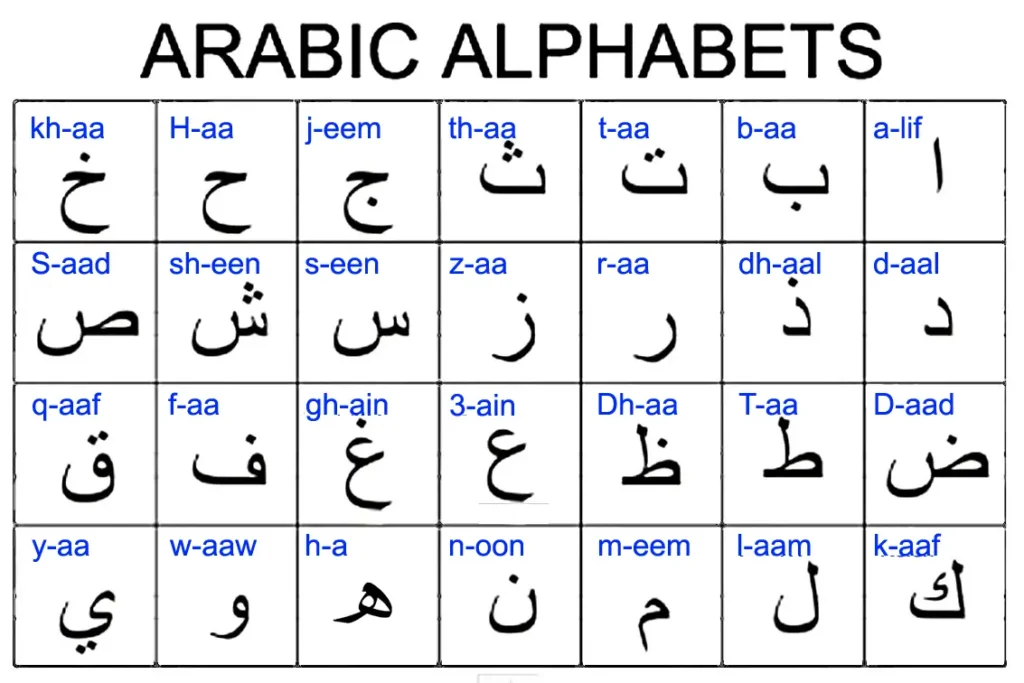
- Recognize all 28 Arabic letters in their four positional forms
- Learn the harakat (vowel markings): fatha, damma, kasra, and sukoon
- Read short surahs from Juz ‘Amma with audio support
- Build a working vocabulary of the most frequent Quranic words
- Understand basic sentence structures — nominal and verbal
One important milestone to hold onto: approximately 80% of the Quran’s content can be understood through mastery of roughly 300 high-frequency words. That is a concrete, achievable target — far less overwhelming than it sounds.
2. The Limitations of Free Learning Resources
This is where most self-study guides go silent, and it’s worth being direct. Free apps, PDFs, and YouTube videos cannot:
- Correct your pronunciation of sounds that don’t exist in English — letters like ع، ح، خ، غ، and ق require trained ears and real-time correction
- Detect whether you are applying a Tajweed rule correctly or just approximating it
- Adapt to your specific weaknesses as a learner
- Answer questions when you’re confused about a grammatical structure
If you want to read the Quran correctly — not just approximately — teacher correction eventually becomes essential. But for building your foundation and learning to recognise Quranic vocabulary, free learning in the UAE is a completely legitimate and productive starting point. When you’re ready to go further, Abjad Institute’s Arabic courses for beginners provide exactly the structured, teacher-led progression that free resources can’t.
Start Your Arabic Learning Journey With a FREE Trial Today

Free Ways to Learn Quranic Arabic in the UAE
The UAE provides several opportunities for learners who want to start learning Quranic Arabic for free. One of the most accessible options is joining local Quran learning circles where students can practice reading, improve pronunciation, and learn directly from qualified teachers. Many mosques and Quran centers across the UAE organize Quran classes and halaqas for different age groups and learning levels.
1. Join Quran Learning Circles at UAE Mosques
Many mosques across the UAE offer Quran learning circles (halaqas) where students can learn Quran recitation, improve their reading skills, and receive guidance from experienced teachers. These circles provide a structured learning environment where beginners can start with Arabic letters and gradually progress toward reading Quranic verses correctly.
2. Enroll in Free Quran Programs Through Islamic Centers
Islamic centers and Quran education programs in the UAE provide opportunities for children and adults to study Quran recitation, memorization, and basic Quranic skills. These programs allow learners to benefit from qualified instructors and learn in a supportive community setting.
3. Participate in Community Quran Activities
Throughout the UAE, Quran competitions, educational events, and community programs encourage people of different ages to improve their Quran reading and understanding. Joining these activities can help learners stay motivated, practice regularly, and connect with other students on the same learning journey.
If you’re ready to complement these tools with structured instruction, Abjad Institute’s basic Arabic course offers a teacher-guided pathway that works alongside your free self-study.
Begin Your Arabic Learning Journey With a FREE Trial Today
Watch Our Classes in Action
Curious what a real session looks like? Take a peek inside our interactive classrooms and see how our expert instructors bring the Arabic language to life. Watch a sample lesson below!
Begin Your Arabic Journey in the UAE
Join Abjad Institute for a professional and immersive Arabic language experience tailored to your goals.
Book Your Free TrialRead more: How to Learn Quranic Arabic in the UAE?
How to Learn Quranic Arabic Free Online in the UAE?
Learning Quranic Arabic online for free is possible for beginners in the UAE through consistent practice and the right learning approach. Whether you are living in Dubai, Abu Dhabi, Sharjah, or any other emirate, online resources can help you build a strong foundation in Quranic reading from the comfort of your home.
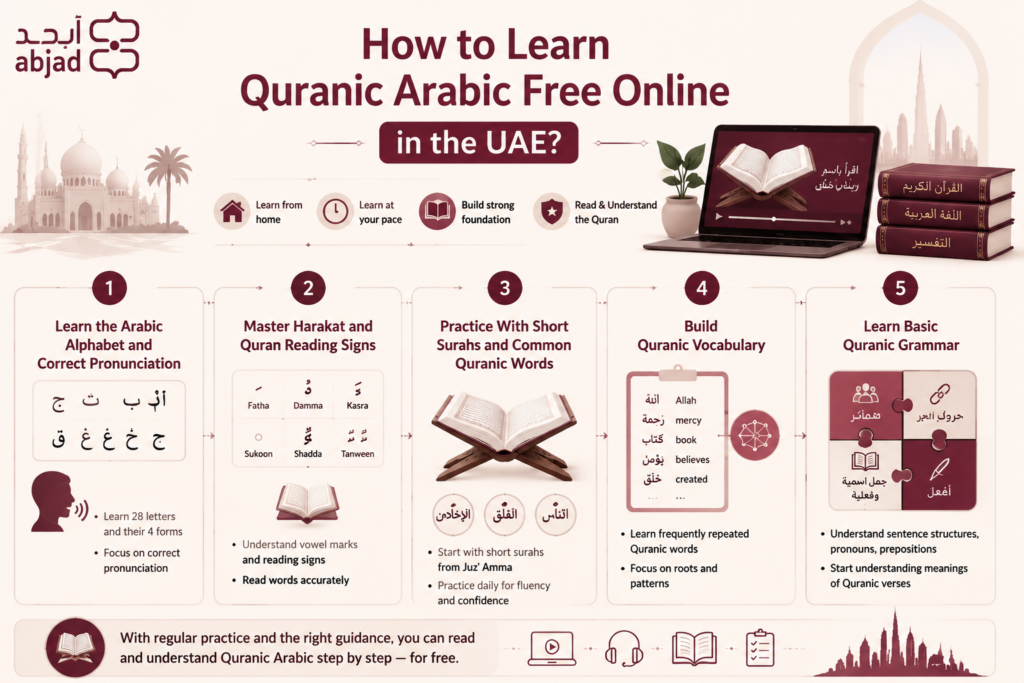
The best approach is to follow a gradual learning path — starting with Arabic letters and pronunciation, then moving to Quranic words, vocabulary, and basic grammar.
Step 1 — Learn the Arabic Alphabet and Correct Pronunciation
Begin by learning the 28 Arabic letters and their different forms: isolated, initial, medial, and final. This step is especially important for non-Arabic speakers in the UAE because accurate pronunciation is the foundation of correct Quran reading.
Focus on mastering the sounds of each letter, particularly Arabic sounds that may not exist in other languages, such as ع، ح، خ، غ، and ق. Daily practice with reading and writing exercises will help you recognize letters and pronounce them correctly.
Step 2 — Master Harakat and Quran Reading Signs
After learning the letters, the next step is understanding Arabic vowel marks (Harakat), including:
- Fatha (َ)
- Damma (ُ)
- Kasra (ِ)
- Sukoon (ْ)
- Shadda (ّ)
- Tanween (ً ٍ ٌ)
These signs allow beginners to read Quranic words accurately and gradually develop fluency.
Step 3 — Practice With Short Surahs and Common Quranic Words
Start with shorter surahs commonly memorized by Muslims in the UAE, especially from Juz’ Amma. Reading familiar verses makes it easier to connect the Arabic text with the sounds you already know from daily prayers.
Step 4 — Build Quranic Vocabulary
Learning frequently repeated Quranic words helps you understand more while reading. Instead of memorizing random vocabulary, focus on common words and Arabic roots that appear throughout the Quran.
Step 5 — Learn Basic Quranic Grammar
After developing reading confidence, begin studying basic grammar concepts such as sentence structures, pronouns, prepositions, and common verb patterns. This helps you move beyond pronunciation and start understanding the meanings of Quranic verses.
With regular practice and the right guidance, learners in the UAE can gradually develop the skills needed to read and understand Quranic Arabic.
Free vs. Structured Quranic Arabic Learning in the UAE
Both free resources and structured classes can help UAE learners start their Quranic Arabic journey, but they offer different levels of guidance, support, and progress. Understanding the differences can help you choose the learning approach that best matches your goals and learning style.
| Free Learning | Structured Classes | |
| Cost | Free | Varies |
| Starting point | Good for building foundations | Suitable for different levels |
| Pronunciation correction | Limited self-correction | Real-time feedback from a teacher |
| Tajweed accuracy | Depends on personal practice | Guided and corrected by an instructor |
| Progress speed | Self-directed and usually slower | More structured and consistent |
| Accountability | Depends on self-discipline | Built into the learning process |
| Best for | Beginners exploring the basics | Learners seeking steady progress and accurate results |
The best approach is often a combination of both. Free resources can help you build your foundation, while structured classes provide the guidance and correction needed to develop accurate Quranic Arabic reading skills.
For learners looking to go further with Arabic grammar, Arabic speaking course bridges grammar knowledge into active comprehension.
Begin Your Arabic Speaking Journey With a FREE Trial Today

Common Mistakes When Learning Quranic Arabic Alone
Learning Quranic Arabic through self-study can be rewarding, but many beginners fall into common mistakes that slow their progress or create incorrect learning habits. Understanding these challenges early helps you build a more effective study plan and avoid spending time on methods that do not lead to real improvement.
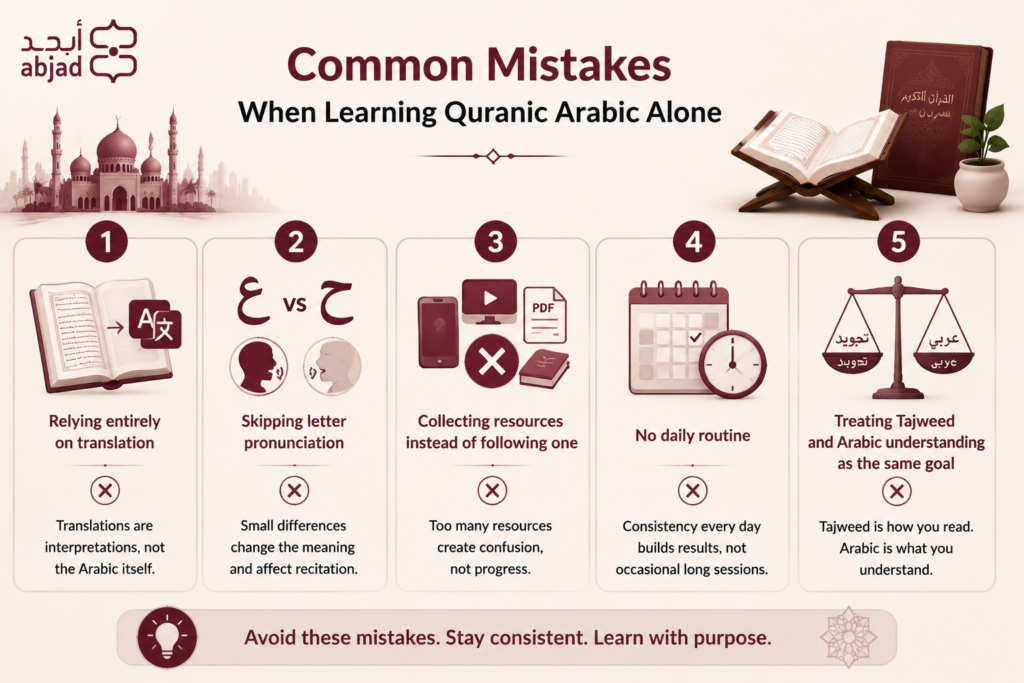
1. Relying entirely on translation
Reading a translation of the Quran is valuable, but it is not the same as learning Quranic Arabic. Translations are interpretations — they cannot carry the grammatical nuance, rhetorical precision, or word-level meaning of the Arabic text.
2. Skipping letter pronunciation
Many UAE learners who grew up with Arabic around them assume they can already pronounce letters correctly. In reality, distinguishing ح from ه, or ع from أ, at the level required for correct recitation takes conscious practice and external correction. Assuming you are right when you may not be is one of the most common and costly mistakes.
3. Collecting resources instead of following one
Downloading five apps, watching videos from three different teachers, and switching between PDFs creates the feeling of studying without real progress. Choose one structured path and follow it completely before adding anything else.
4. No daily routine
Fifteen focused minutes after Fajr, maintained consistently, produces measurable progress within weeks. Three hours once a week produces significantly less. Frequency matters more than session length in language acquisition.
5. Treating Tajweed and Arabic understanding as the same goal
Tajweed is the science of correct recitation — how to articulate letters, elongate sounds, and apply rules. Quranic Arabic is the study of vocabulary, grammar, and meaning. Both are important, but confusing them leads to a fragmented study plan.
Read more: How to Read Quranic Arabic?
How Long Does It Take to Learn Quranic Arabic Free in the UAE?
Timelines depend heavily on consistency and prior Arabic exposure. For a UAE resident with no Arabic background, here is a realistic breakdown:
| Stage | Goal | Timeframe |
| Letters and basic reading | Read Arabic syllables and simple words | 1–2 months |
| Quranic reading + harakat | Read short surahs with confidence | 2–4 months |
| Core vocabulary (300 words) | Understand 80% of Quranic content vocabulary | 4–8 months |
| Basic grammar comprehension | Follow sentence structure in verses | 6–12 months |
For learners with Gulf Arabic exposure or some prior Quranic reading ability, these timelines compress by 30–40%. The consistent thread across all levels: daily practice of even 15–20 minutes outperforms longer but irregular sessions.
Inside Our Live Classes
Don’t just take our word for it—see for yourself! Click below to watch short clips from our live classes and meet the instructors who will guide your learning journey.
Begin Your Arabic Journey in the UAE
Join Abjad Institute for a professional and immersive Arabic language experience tailored to your goals.
Book Your Free TrialStart Your Quranic Arabic Journey with Abjad Institute
Free resources are the right place to start — and this guide gives you everything you need to begin. When you’re ready to move from foundation to fluency, Abjad Institute is built for exactly that transition.
Our qualified instructors work with UAE-based students at every level, from complete beginners learning the alphabet to advanced learners deepening their Quranic comprehension. Every course is structured around your level, your schedule, and your goal — whether that’s reading the Quran with understanding, applying Tajweed correctly, or building the grammar base to study Tafsir.
Whether you need a beginner Arabic course, a professional Arabic program, or something in between, Abjad Institute has a structured path designed for you.
Book your free trial session today and take your first step toward understanding the words of Allah.

Discover Our Arabic Courses
- Arabic Course in the UAE
- Arabic Intensive Course
- Learn Arabic from Scratch Course
- Madinah Arabic Course
- Arabic Classes for Adults
- Arabic Classes for Beginners
- Self-Paced Arabic Course
- Basic Arabic Course
- Arabic Speaking Classes
- Learn to Write Arabic Course
- Arabic Grammar Course
- Learn Arabic Alphabet Course
Begin Your Arabic Journey in the UAE
Join Abjad Institute for a professional and immersive Arabic language experience tailored to your goals.
Book Your Free TrialConclusion
Learning Quranic Arabic free in the UAE is not only possible — it is a well-supported starting point with genuine resources both locally and online. The key is sequence: letters before words, words before grammar, grammar before verse analysis. Mosque halaqas, Quran.com, Noorani Qaida, and structured vocabulary systems can take you from zero to meaningful Quranic recognition without spending anything.
The important thing to hold onto is the 300-word milestone: a manageable, concrete vocabulary target that unlocks comprehension of the majority of Quranic content. Reach that, and the Quran begins to speak to you in a different way. Free tools will take you most of the way there. A qualified teacher will take you the rest.
Frequently Asked Questions
Many learners have similar questions when starting their Quranic Arabic journey, especially about free learning options, study timelines, and whether teacher guidance is necessary. Below are answers to the most common questions beginners ask before choosing the right learning approach.
Can I learn Quranic Arabic for free in the UAE?
Yes. Between mosque halaqas run by UAE Awqaf, platforms like Quran.com and Quranicaudio.com, and free apps like Tarteel AI, a complete beginner in the UAE can build a solid foundation in Quranic Arabic at no cost. For pronunciation correction and Tajweed accuracy, teacher guidance eventually becomes necessary.
Is there a free Quranic Arabic course I can take online?
Several free online options exist, including YouTube-based Noorani Qaida courses, Quran.com’s word-by-word tool, and free vocabulary apps like Quran Companion. These are genuine learning tools, not just introductions — though they work best when followed in a structured sequence rather than used randomly.
How to learn Quranic Arabic free online if I’m a complete beginner?
Start with the Arabic alphabet using free Noorani Qaida videos. Once you can read basic syllables, move to Quran.com’s word-by-word mode to connect sounds to meanings. Build your vocabulary using the 300 most frequent Quranic words, then add basic grammar. This five-step sequence, applied with daily 15–20 minute sessions, produces real results within months.
Is Quranic Arabic the same as Modern Standard Arabic?
No. Quranic Arabic and Modern Standard Arabic share the same grammatical foundations, but Quranic Arabic uses classical vocabulary, rhetorical structures, and layered meanings that MSA does not replicate. Learning MSA first is not necessary and often adds time for learners whose goal is Quran comprehension specifically.
How long does it take to learn Quranic Arabic?
A learner with no prior Arabic background who studies 15–20 minutes daily can typically read Arabic letters within 1–2 months, read short surahs within 3–4 months, and build the 300-word core vocabulary for broad Quranic comprehension within 6–8 months. Prior Arabic exposure in UAE residents shortens these timelines considerably.
Do I need a teacher to learn Quranic Arabic?
Not to start. Free resources are sufficient to build your foundation. However, once you begin reading aloud and applying Tajweed rules, a qualified teacher becomes important — particularly for sounds like ع، ح، خ، and غ that do not exist in English and cannot be self-corrected reliably through apps alone.




Leave a Reply