 Learn Arabic
If you’ve typed “how to read Arabic in English letters” into a search bar, you’ve probably already tried sounding out a word like marhaban or shukran and wondered if you were saying it right.
The good news is that reading Arabic using English letters is a real, structured skill — not a shortcut, and not guesswork. At Abjad Academy, this is one of the very first skills we teach new students, because it builds the bridge between the sounds you already know and the Arabic script you’re learning to read.
This guide walks you through exactly how to read Arabic in English letters, step by step, from the alphabet itself to the vowel marks that most beginners skip by mistake. You’ll also find free tools you can start with today, plus the point where transliteration stops being helpful and full Arabic reading needs to take over.
Step 1: Learn The Arabic Alphabet By Sound, Not By Name
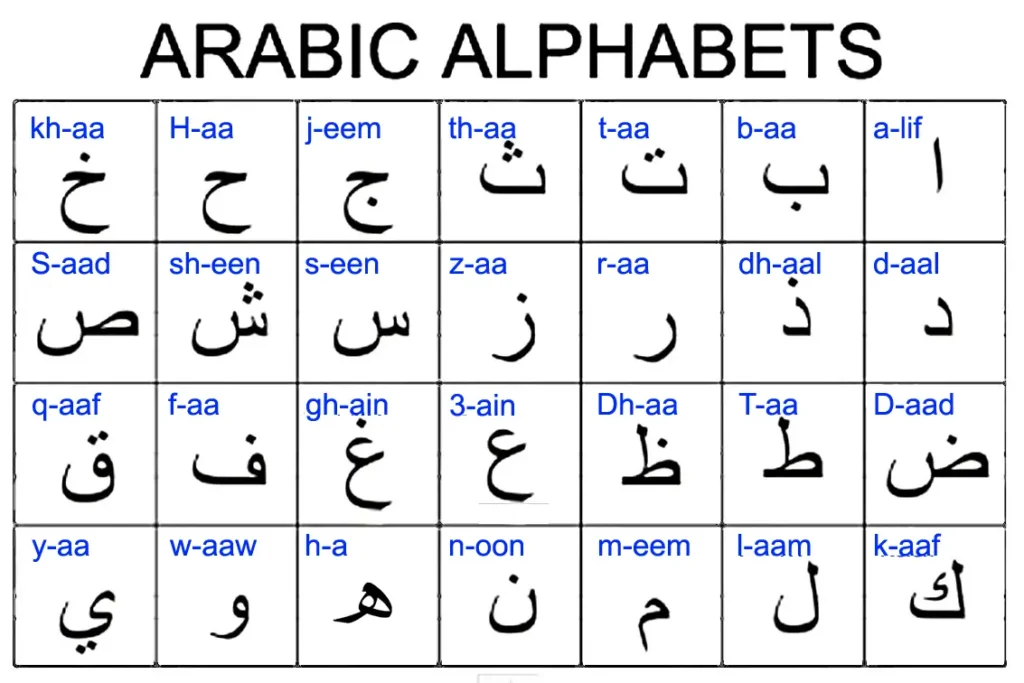
The Arabic alphabet is a system of 28 letters, each representing one consistent sound. That single fact is what makes learning how to read Arabic in English letters more manageable than it first looks: unlike English, where “c” sounds different in “cat” and “city,” an Arabic letter sounds the same every time you see it.
The mistake most beginners make is memorizing the letters like a song — reciting “alif, baa, taa” in order without connecting each one to an actual sound. This is really the starting point of how to read Arabic in English letters for beginners: learn each letter as a sound first and a name second, then build outward from there.
Arabic Letters That Sound Like Letters You Already Know
Several Arabic letters map almost directly onto English sounds, which makes them the easiest starting point:
- ب (Baa) sounds like the “b” in “book”
- ت (Taa) sounds like the “t” in “top”
- م (Meem) sounds like the “m” in “moon”
- ن (Noon) sounds like the “n” in “net”
- ل (Laam) sounds like the “l” in “love”
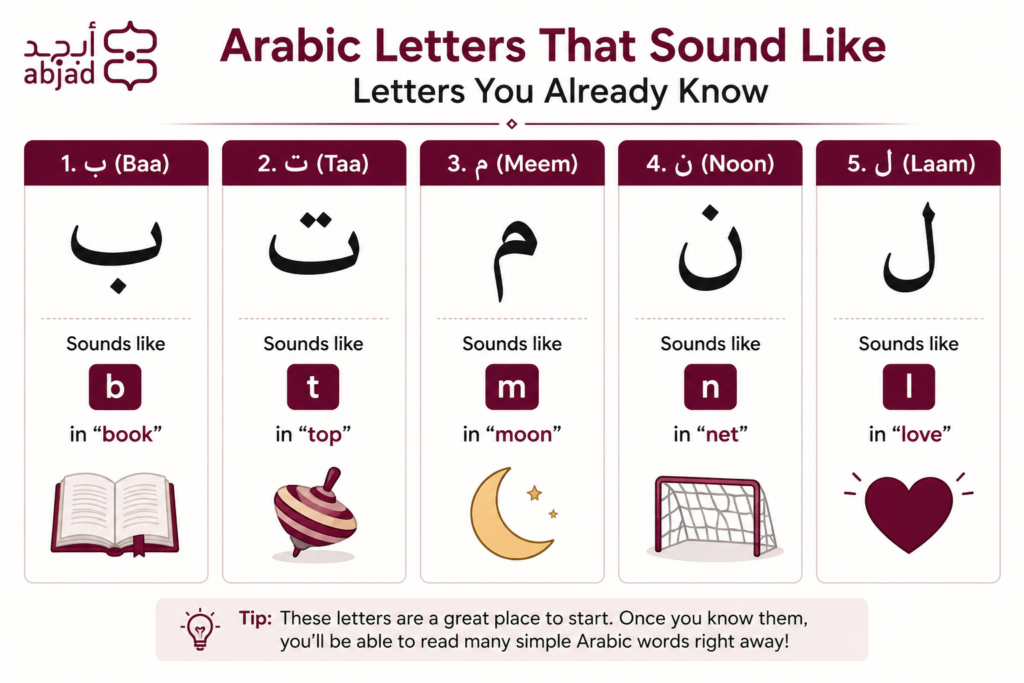
Starting with these five or six letters lets you form your first simple combinations within the same day, which is exactly how Abjad Academy structures its beginner sessions — small wins early, so the alphabet stops feeling abstract.
Step 2: Match Every Arabic Letter To Its Closest English Equivalent (A To Z)
Once the easy letters feel familiar, the next step in learning how to read Arabic in English letters a to z is working through the full alphabet in order, from Alif to Yaa.
Arabic is written right to left, and most letters change shape slightly depending on whether they appear at the beginning, middle, or end of a word. That’s a separate skill from sound — for now, focus only on matching each letter to an English sound.
The Full Arabic Alphabet in English Letters
Here is every Arabic letter in order, from Alif to Yaa, alongside the closest English sound for each. Use this as your core reference while practicing Steps 1 through 3 — you’ll come back to it often as the sounds start to stick.
- Alif (ا) — a glottal stop, close to the “a” in “apple”
- Baa (ب) — “b” as in “book”
- Taa (ت) — “t” as in “top”
- Thaa (ث) — “th” as in “think”
- Jeem (ج) — “j” as in “jam”
- Haa (ح) — a breathy “h,” deeper than English
- Khaa (خ) — a rough “kh,” like the “ch” in the Scottish “loch”
- Daal (د) — “d” as in “door”
- Dhaal (ذ) — “th” as in “that”
- Raa (ر) — a rolled “r”
- Zay (ز) — “z” as in “zoo”
- Seen (س) — “s” as in “sun”
- Sheen (ش) — “sh” as in “shoe”
- Saad (ص) — an emphatic “s,” heavier than English
- Daad (ض) — an emphatic “d”
- Taa (ط) — an emphatic “t”
- Zaa (ظ) — an emphatic “th” sound
- Ain (ع) — a voiced throat sound with no English equivalent
- Ghain (غ) — similar to a French “r”
- Faa (ف) — “f” as in “fish”
- Qaaf (ق) — a deep “k” sound from the back of the throat
- Kaaf (ك) — “k” as in “kite”
- Laam (ل) — “l” as in “love”
- Meem (م) — “m” as in “moon”
- Noon (ن) — “n” as in “net”
- Haa (ه) — “h” as in “house”
- Waaw (و) — “w” as in “wow,” or a long “oo” sound
- Yaa (ي) — “y” as in “yes,” or a long “ee” sound
Letters That Don’t Exist in English
A handful of these letters — ع, غ, ح, خ, ق, and the emphatic letters ص، ض، ط، ظ — don’t have a true English equivalent.
English transliteration gets you close, but it can’t replace hearing the sound. This is exactly the gap a live instructor closes, which is why students working through the Learn Arabic Alphabet Course at Abjad Academy get direct correction on these sounds from the first lesson rather than guessing from a chart alone.
Read Also: How To Learn To Read Arabic In 21 Days? A Step-By-Step Plan
Step 3: Learn Harakat — The Short Vowels That Make Or Break Your Reading
This is the step where most self-taught beginners get stuck, and it’s the real answer to how to read Arabic in English letters correctly rather than approximately.
Everyday Arabic writing — newspapers, books, street signs — usually leaves out the short vowels. But when you’re learning to read, those vowels are marked using small symbols called harakat, placed above or below each letter. Skip them, and you’re only ever guessing at half the word.
The Three Short Vowels
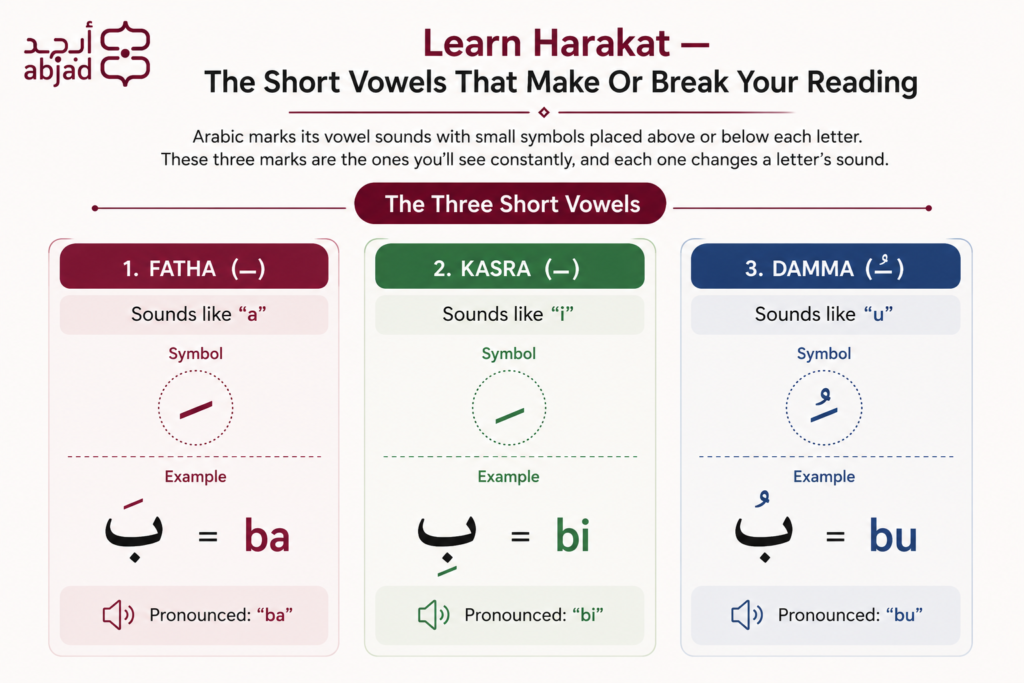
Arabic marks its vowel sounds with small symbols placed above or below each letter, rather than with separate vowel letters the way English does. These three marks are the ones you’ll see constantly, and each one changes a letter’s sound in a specific, predictable way.
Fatha (ـَ) — sounds like “a.” Example: بَ = ba
- Kasra (ـِ) — sounds like “i.” Example: بِ = bi
- Damma (ـُ) — sounds like “u.” Example: بُ = bu
Sukoon and Shadda
Beyond the three short vowels, two more marks show up in almost every text you’ll read, and both change how a letter is pronounced rather than adding a new vowel sound.
- Sukoon (ـْ) means the letter carries no vowel sound at all.
- Shadda (ـّ) doubles the letter’s sound, so بَّ is pronounced “bba,” not “ba.”
The difference a single haraka makes is not small.
كَتَبَ (kataba) means “he wrote,” while كُتِبَ (kutiba) means “it was written” — same three letters, different meaning, purely because the vowel marks changed. That’s why any real answer to how to read Arabic in English letters has to include harakat, not just the alphabet.
Read also:Helping Children Learn Arabic Reading in the UAE
Step 4: Blend Letters Into Words
Once you can recognize a letter and its vowel mark together, the next skill is blending — reading letter by letter without pausing, until the sounds merge into a word.
A Simple Blending Example:
Take the word كَتَبَ (kataba, “he wrote”):
- Start from the right: ك with a fatha = “ka”
- Next letter: ت with a fatha = “ta”
- Next letter: ب with a fatha = “ba”
- Blend them without stopping: ka-ta-ba → kataba
Read also:Top Arabic Activities for Kids in the UAE
The same logic works for two-letter combinations, like ب + ا = با (ba), and it scales up to full sentences once it becomes automatic.
Reading aloud during this stage matters more than reading silently — it trains your ear and your eye at the same time, which is a habit we build into every level at Abjad Academy rather than treating it as optional practice.
Watch Our Classes in Action
Curious what a real session looks like? Take a peek inside our interactive classrooms and see how our expert instructors bring the Arabic language to life. Watch a sample lesson below!
Begin Your Arabic Journey in the UAE
Join Abjad Institute for a professional and immersive Arabic language experience tailored to your goals.
Book Your Free TrialStep 5: Use Free Online Tools To Practice Reading
You don’t need paid materials to start. Learning how to read Arabic in English letters online free is realistic for the first stage of practice, and a few tool types cover most of what a beginner needs.
Free Charts, Flashcards, And Apps
Before turning to paid instruction, most beginners can build a solid reading foundation with free resources alone. The tools below cover the three things you actually need at this stage: seeing the letters, hearing them, and testing yourself.
- Printable alphabet charts with English transliteration next to each letter
- Digital or paper flashcards, with the Arabic letter on one side and the sound on the other
- Pronunciation apps that let you hear a native speaker say each letter and repeat it back
- Beginner reading sheets that include harakat, rather than plain consonant text
Searching “how to read Arabic in English letters online” will surface dozens of these, and rotating between two or three formats — visual, audio, and writing — tends to work better than sticking to one.
Free resources are genuinely useful for the first two to four weeks. Where they run out of road is correction: a chart can’t tell you that your ع sounded too much like an “a,” and an app can’t adjust its pace to how you personally learn.
That’s the point where structured instruction closes the gap — the Arabic Classes for Beginners at Abjad Academy are built specifically for this transition, moving you from transliteration into confident, independent reading of the script itself.
Read Also: How Hard Is It to Read Arabic in the UAE? 7 Real Challenges Explained
Step 6: Avoid The Mistakes That Stall Most Beginners
A few recurring mistakes account for most of the frustration beginners report, and each one has a direct fix.
A. Relying on English Letters Forever
Transliteration is a training tool, not a destination. Students who never move past reading Arabic in English letters typically hit a wall once they reach real texts — Qur’anic verses, road signs, or menus — where no transliteration is provided.
A useful decision rule here: treat the first two to four weeks as an English-transliteration phase, then deliberately shift your primary reading practice to the Arabic script with harakat. Keep transliteration as a backup reference, not the main text you read from.
Call this the Sound-Shape-Blend method — learn the sound first (Step 1-3), attach it to the shape of the script, then blend directly in Arabic rather than through English letters. Beginners who skip the “shift” step are the ones who plateau; the ones who make the switch on schedule read fluently within a few months.
B. Skipping the Harakat
As covered in Step 3, leaving out the vowel marks is the single most common reason beginners misread simple words. Start with fully vowelled texts, and only move to unvowelled text once whole words feel automatic, not effort-driven.
C. Confusing Similar-Looking Letters
Letters like ب, ت, and ث differ only by the number and placement of dots. The fix isn’t memorizing them separately — it’s studying them side by side from day one, so your eye learns the contrast rather than the shape in isolation.
D. Ignoring the Heavy (Emphatic) Letters
Letters such as ص, ض, ط, and ظ pull the surrounding vowel sound to be heavier and deeper than a light letter would. A beginner who reads them exactly like their light counterparts (س, د, ت, ذ) will be understood, but the word will sound noticeably off to a native ear.
Practicing these in contrasting pairs — ص next to س, for example — trains the distinction faster than reading them in isolation ever will.
Step 7: Build A Daily Reading Routine
Consistency outperforms long, occasional study sessions. A short daily routine compounds faster than a two-hour weekend cram.
A Simple 15-20 Minute Daily Plan:
- 5 minutes: alphabet and sound review
- 5 minutes: harakat practice on single letters
- 5 minutes: reading simple, fully vowelled words
- 5 minutes: reading aloud, even if it’s just three or four words
Most learners following a routine like this recognize the full alphabet within one to two weeks, read simple words within a month, and manage short sentences within about three months.
Progress here tracks consistency far more closely than natural ability — showing up daily matters more than any single “good” study session.
If you’d rather follow a guided version of this routine with weekly milestones and a teacher checking your pronunciation, the Self-Paced Arabic Course and the Basic Arabic Course at Abjad Academy are both structured around exactly this kind of daily progression.
Read Also: Learn to Read Arabic App – The Best Options in 2026
Inside Our Live Classes
Don’t just take our word for it—see for yourself! Click below to watch short clips from our live classes and meet the instructors who will guide your learning journey.
Start Reading Arabic With Confidence
Reading Arabic in English letters is a genuine first step, not a workaround — but a chart and an app can only take you so far before you need someone to tell you, in real time, whether your ع actually sounded right.
Abjad Academy’s live instructors build your reading skills from the alphabet through full sentences, correcting pronunciation as you go instead of leaving you to guess.

Whether you’re starting completely from zero with the Learn Arabic from Scratch Course, want a faster pace through the Arabic Intensive Course, or you’re an adult learner looking for a course built around your schedule through Arabic Classes for Adults, there’s a structured path waiting for you.
Discover Our Arabic Courses:
- Arabic Intensive Course
- Learn Arabic from Scratch Course
- Madinah Arabic Course
- Arabic Classes for Adults
- Arabic Classes for Beginners
- Self-Paced Arabic Course
- Basic Arabic Course
- Arabic Speaking Classes
- Learn to Write Arabic Course
- Arabic Grammar Course
- Learn Arabic Alphabet Course
Begin Your Arabic Journey in the UAE
Join Abjad Institute for a professional and immersive Arabic language experience tailored to your goals.
Book Your Free Trial
Conclusion
Learning how to read Arabic in English letters comes down to a clear sequence: learn the alphabet by sound, match each letter to its closest English equivalent, master the harakat that most beginners skip, then blend letters into full words through daily, consistent practice.
Free tools can carry you through the earliest stage, but the shift from transliteration into real Arabic reading is where most self-taught learners lose momentum — and where structured guidance makes the biggest difference.
Arabic’s sounds are unfamiliar at first, but the system behind them is logical and entirely learnable with the right steps and enough repetition.
Read Also: Is It Compulsory to Read Quran in Arabic?

Frequently Asked Questions
Here are quick answers to the questions beginners ask most often when they start learning how to read Arabic in English letters.
1. Can I really learn to read Arabic using only English letters?
Yes, for the first few weeks. English transliteration is a solid starting point for learning sounds and simple words, but it should transition into reading the Arabic script with harakat once you’re comfortable with the alphabet.
2. What is the fastest way to read Arabic in English letters for beginners?
The fastest path is learning letters by sound rather than name, practicing the three short vowels (fatha, kasra, damma) immediately, and reading a few words aloud every day rather than studying in long, infrequent sessions.
3. Are there Arabic letters with no English equivalent?
Yes. Letters like ع, غ, ح, خ, and ق, along with the emphatic letters ص، ض، ط، ظ, don’t have a direct English sound. They require listening to native pronunciation and practicing separately from the more familiar letters.
4. How long does it take to read simple Arabic words?
Most beginners recognize the full alphabet within one to two weeks, read simple vowelled words within about a month, and manage short sentences within roughly three months, assuming daily practice.
5. Do I need to learn harakat if I’m only reading Arabic in English letters?
Yes. Harakat determine the vowel sounds in every word, and skipping them is the most common reason beginners misread even simple, familiar words.
6. Is Modern Standard Arabic the best starting point for reading practice?
Yes, for most learners. Modern Standard Arabic uses consistent rules across regions, while spoken dialects vary widely — starting with MSA gives you a stable foundation before adapting to any regional accent.
Related Articles
Learn Arabic





Leave a Reply