 Speak Arabic
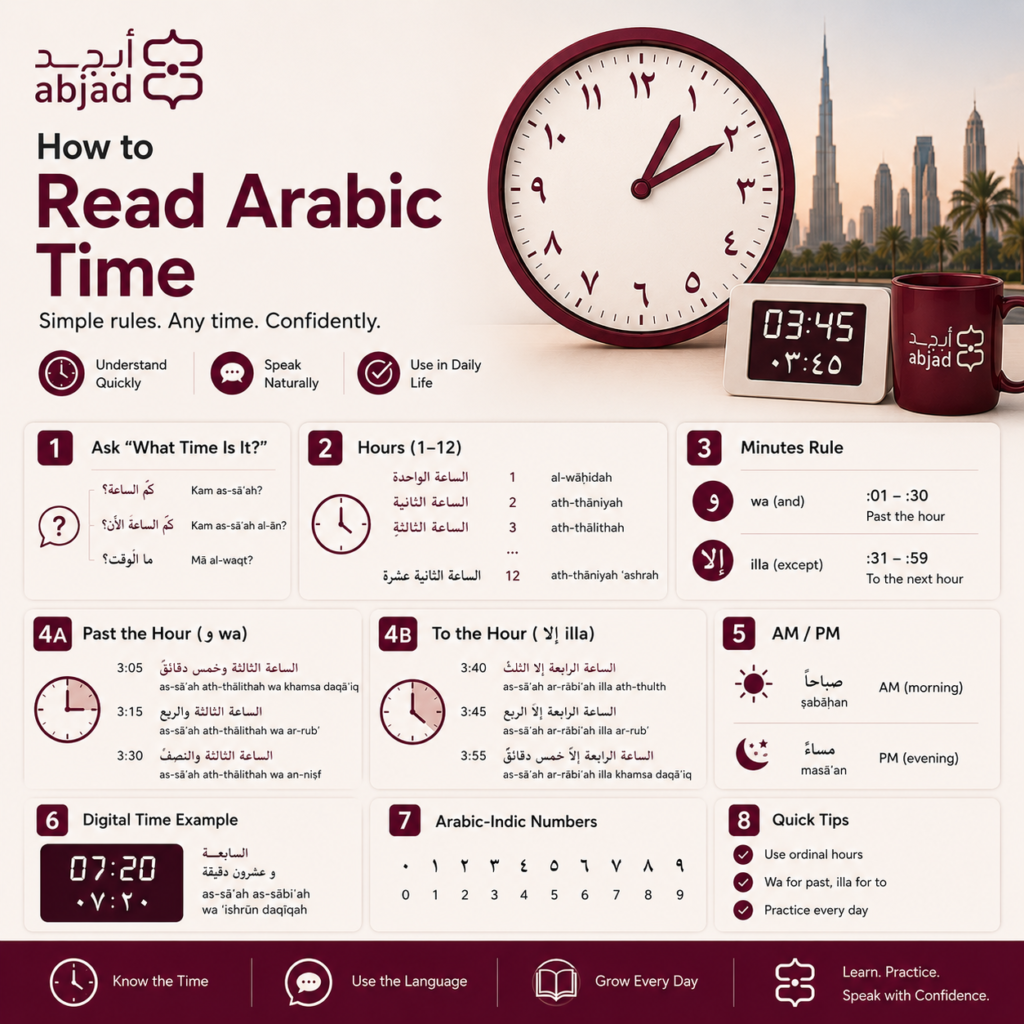
Most Arabic learners pick up greetings and basic vocabulary quickly — but the moment someone asks Kam as-saa’ah? and expects a real answer, they freeze. They know what time it is. They just can’t say it in Arabic.
The system isn’t complicated. Arabic tells time through a fixed, logical structure: ordinal hour names, two prepositions for minutes, and a simple AM/PM marker. Once you see how those pieces connect, you can read and tell any time on the clock — in conversation, on a digital display, or on a clock face using Arabic-Indic numerals.
This guide walks you through every step, with full coverage of clock time in Arabic, time in Arabic numbers, how to read Arabic-Indic time in English, how to tell Arabic time, and more.
1. Understand How Arabic Time Works
Before learning how to tell time in Arabic, it is important to understand the basic structure. Arabic uses ordinal numbers for hours, meaning it says “the second hour” instead of simply “two o’clock.”
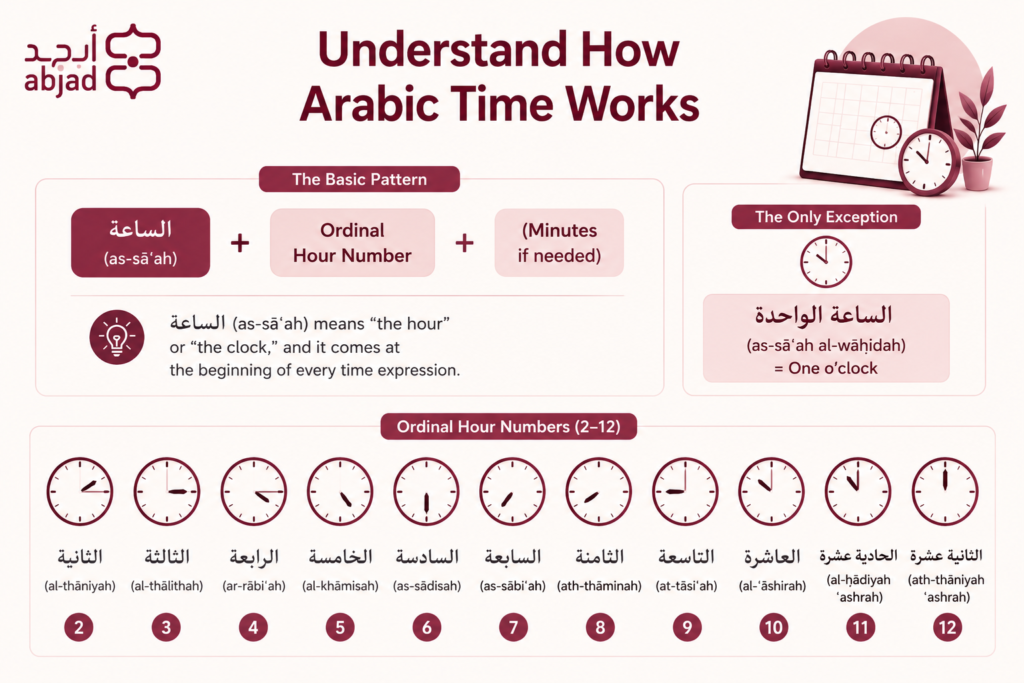
The basic pattern is:
الساعة + Ordinal Hour Number + (Minutes if needed)
الساعة (as-sāʿah) means “the hour” or “the clock,” and it comes at the beginning of every time expression.
The only exception is one o’clock, which uses:
الساعة الواحدة (as-sāʿah al-wāḥidah)
For the other hours, Arabic uses ordinal numbers from two to twelve. Understanding this pattern makes reading and saying Arabic time much easier.
Understanding why Arabic grammar works this way — why ordinal numbers take feminine endings in time expressions — is part of a broader grammatical system. Learners who build that foundation through Modern Standard Arabic (Fusha) absorb time expressions faster and retain them longer, because the pattern isn’t isolated — it connects to everything else in the language.
Unlock the Power of Fusha Arabic with a FREE Trial Class in the UAE

2. Learn How to Ask “What Time Is It?” in Arabic
Before you can tell Arabic time, you need the question that triggers the exchange. Three versions are used across different contexts:
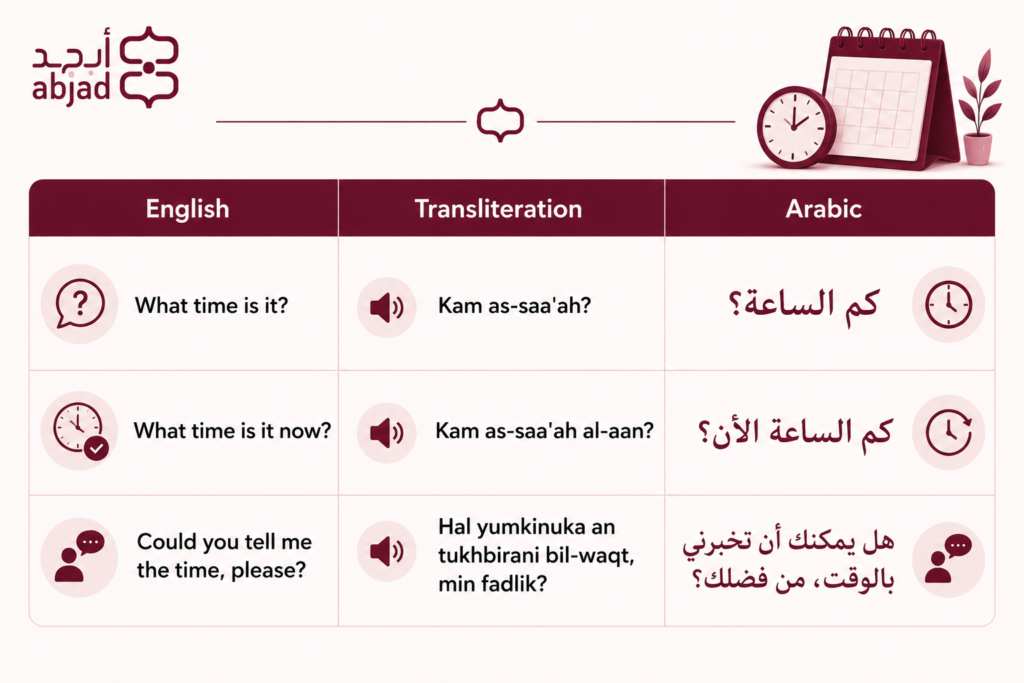
The most common phrase in everyday conversation is:
كم الساعة الآن؟ (Kam as-sāʿah al-ān?)
because adding الآن (al-ān) meaning “now” makes the meaning clearer.
The more polite form is usually used in formal situations or when speaking respectfully to someone.
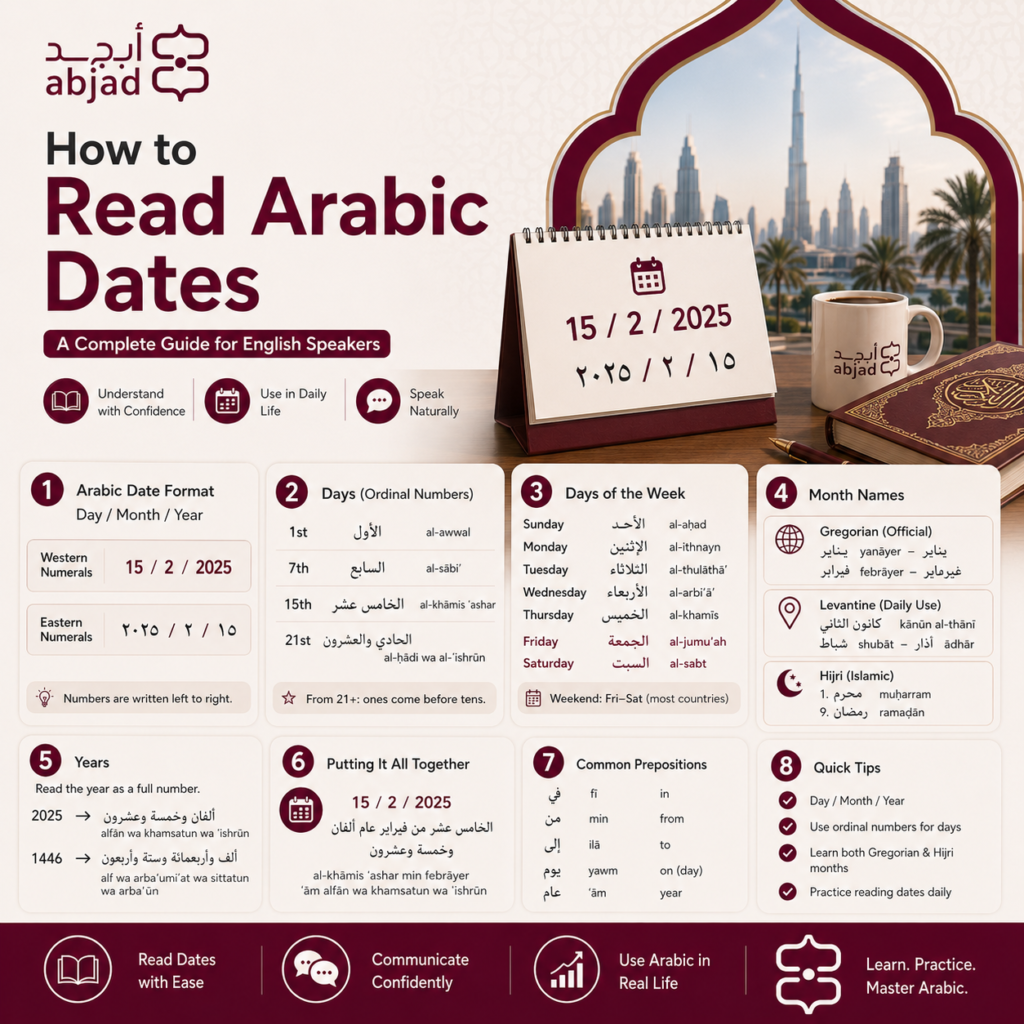
Read More: How to Read Arabic Dates
3. Master Clock Time in Arabic: Every Hour from One to Twelve
This is the core of clock time in Arabic. Each hour has a fixed ordinal name — memorize these twelve, and you can anchor every time expression you’ll ever need.
| English | Transliteration | Arabic |
| One o’clock | As-saa’ah al-waahidah | الساعة الواحدة |
| Two o’clock | As-saa’ah ath-thaaniyah | الساعة الثانية |
| Three o’clock | As-saa’ah ath-thaalithah | الساعة الثالثة |
| Four o’clock | As-saa’ah ar-raabi’ah | الساعة الرابعة |
| Five o’clock | As-saa’ah al-khaamisah | الساعة الخامسة |
| Six o’clock | As-saa’ah as-saadisah | الساعة السادسة |
| Seven o’clock | As-saa’ah as-saabi’ah | الساعة السابعة |
| Eight o’clock | As-saa’ah ath-thaaminah | الساعة الثامنة |
| Nine o’clock | As-saa’ah at-taasi’ah | الساعة التاسعة |
| Ten o’clock | As-saa’ah al-‘aashirah | الساعة العاشرة |
| Eleven o’clock | As-saa’ah al-haadiyah ‘ashrah | الساعة الحادية عشرة |
| Twelve o’clock | As-saa’ah ath-thaaniyah ‘ashrah | الساعة الثانية عشرة |
How do you say 12 o clock in Arabic language?
12 o’clock in Arabic is As-saa’ah ath-thaaniyah ‘ashrah | الساعة الثانية عشرة. The phrase literally means “the twelfth hour.” Eleven and twelve are compound ordinals — al-haadiyah ‘ashrah means “the first-ten” and ath-thaaniyah ‘ashrah means “the second-ten.” This compound pattern is a fixed feature of Arabic ordinal grammar above ten, and it appears in dates, measurements, and other number expressions beyond clock time.
Watch Our Classes in Action
Curious what a real session looks like? Take a peek inside our interactive classrooms and see how our expert instructors bring the Arabic language to life. Watch a sample lesson below!
Begin Your Arabic Journey in the UAE
Join Abjad Institute for a professional and immersive Arabic language experience tailored to your goals.
Book Your Free Trial4. Learn the Two-Preposition Rule for Minutes
This is the single most important rule for how to tell Arabic time — and the one most learners get wrong first. Arabic uses two prepositions to express minutes on the clock:
- و (wa) — meaning “and” — for minutes past the hour (:01 to :30)
- إلا (illa) — meaning “except” — for minutes to the next hour (:31 to :59)
The dividing line is the half-hour mark. From :01 to :30, you add minutes onto the current hour using wa. From :31 to :59, you name the next hour and subtract using illa.
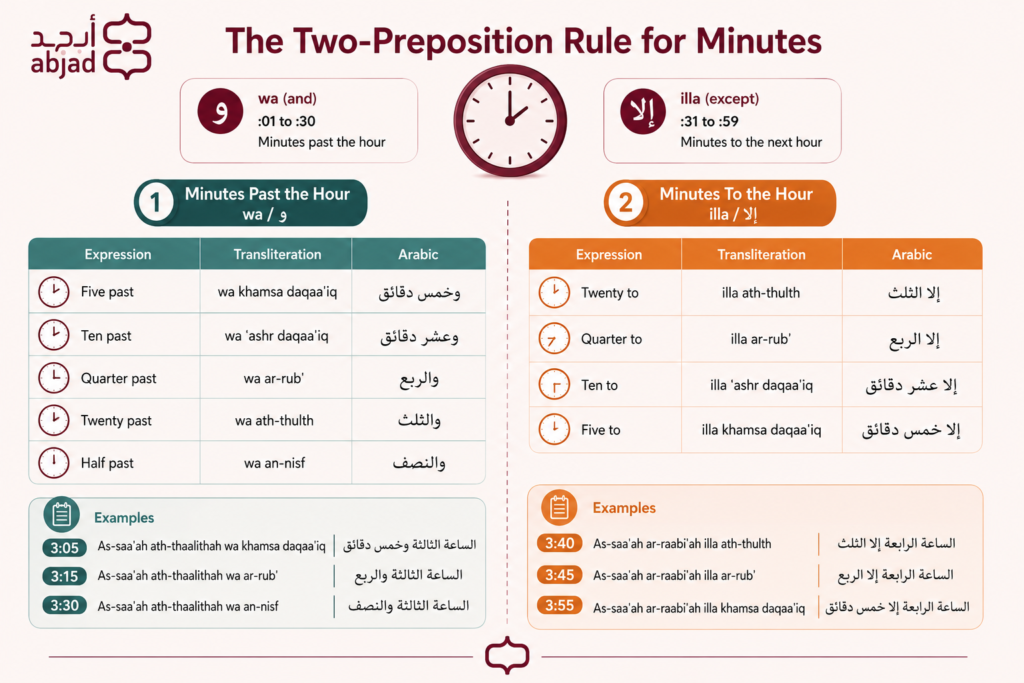
A. Minutes Past the Hour (wa / و)
In Arabic, when talking about the minutes past the hour, we typically use the conjunction “و” (wa) to add the minutes onto the current hour. This pattern is consistent and easy to remember, and it appears in everyday conversations whenever specifying exact times. The table below shows the most common expressions and how to read them:
| Expression | Transliteration | Arabic |
| Five past | wa khamsa daqaa’iq | وخمس دقائق |
| Ten past | wa ‘ashr daqaa’iq | وعشر دقائق |
| Quarter past | wa ar-rub’ | والربع |
| Twenty past | wa ath-thulth | والثلث |
| Half past | wa an-nisf | والنصف |
Examples:
- 3:05 → As-saa’ah ath-thaalithah wa khamsa daqaa’iq | الساعة الثالثة وخمس دقائق
- 3:15 → As-saa’ah ath-thaalithah wa ar-rub’ | الساعة الثالثة والربع
- 3:30 → As-saa’ah ath-thaalithah wa an-nisf | الساعة الثالثة والنصف
B. Minutes To the Hour (illa / إلا)
In Arabic, when expressing minutes to the next hour, we use the preposition “إلا” (illa), which literally means “except.” This means we reference the upcoming hour and subtract the minutes. This structure may feel different at first, but it is consistent and appears in everyday conversation. The table below shows the most common expressions and examples:
| Expression | Transliteration | Arabic |
| Twenty to | illa ath-thulth | إلا الثلث |
| Quarter to | illa ar-rub’ | إلا الربع |
| Ten to | illa ‘ashr daqaa’iq | إلا عشر دقائق |
| Five to | illa khamsa daqaa’iq | إلا خمس دقائق |
Examples:
- 3:40 → As-saa’ah ar-raabi’ah illa ath-thulth | الساعة الرابعة إلا الثلث
- 3:45 → As-saa’ah ar-raabi’ah illa ar-rub’ | الساعة الرابعة إلا الربع
- 3:55 → As-saa’ah ar-raabi’ah illa khamsa daqaa’iq | الساعة الرابعة إلا خمس دقائق
The illa construction is where most beginners stumble — because at 3:45, you’re not saying “three forty-five,” you’re saying “four except a quarter.” The mental shift to the next hour takes deliberate practice but becomes instinctive within a week of daily use. Learners who study Arabic from scratch in a structured course typically encounter wa and illa early as part of preposition training — which is why they internalize the time system faster than self-study learners who meet it in isolation.
Master Arabic Step by Step from Scratch with a FREE Trial Class in the UAE

Read More: How to Read Arabic in the UAE?
5. Add AM and PM in Arabic Correctly
Arabic places the AM/PM marker after the full time expression — not before the numbers like English sometimes does. Two adverbs handle this:
- صباحاً (sabahan) — morning / AM
- مساءً (masaa’an) — evening / PM
| English | Transliteration | Arabic |
| 7:00 AM | As-saa’ah as-saabi’ah sabahan | الساعة السابعة صباحاً |
| 7:00 PM | As-saa’ah as-saabi’ah masaa’an | الساعة السابعة مساءً |
| 10:15 AM | As-saa’ah al-‘aashirah wa ar-rub’ sabahan | الساعة العاشرة والربع صباحاً |
| 5:30 PM | As-saa’ah al-khaamisah wa an-nisf masaa’an | الساعة الخامسة والنصف مساءً |
In formal Arabic contexts — airports, hospitals, government schedules — the 24-hour clock is standard, removing the need for sabahan and masaa’an entirely. When reading official Arabic timetables, 13:00 through 23:59 signals afternoon and night hours with no additional marker needed.
6. Read Arabic-Indic Time on Clock Faces
This step answers a question most guides skip entirely: what do you do when the clock in front of you doesn’t use the numbers 1–12 you grew up with?
Arabic-Indic numerals — also called Eastern Arabic numerals — appear on clock faces, price tags, newspapers, and official documents throughout the Arab world, particularly in Egypt, the Gulf, and parts of North Africa. They look unfamiliar at first, but the time-reading system behind them is completely identical to Western numerals. Only the visual symbols differ.
How to Read Arabic Indic Time in English?
To read time in English from Arabic-Indic numerals, you just match each symbol to its Western equivalent. The table below shows each numeral, its Arabic-Indic form, and its pronunciation.
| Western | Arabic-Indic | Name |
| 0 | ٠ | sifr |
| 1 | ١ | waahid |
| 2 | ٢ | ithnayn |
| 3 | ٣ | thalaathah |
| 4 | ٤ | arba’ah |
| 5 | ٥ | khamsah |
| 6 | ٦ | sittah |
| 7 | ٧ | sab’ah |
| 8 | ٨ | thamaaniyah |
| 9 | ٩ | tis’ah |
When you see ٧:٣٠ on an Arabic clock, read it as 7:30 — the time expression in Arabic is exactly the same: As-saa’ah as-saabi’ah wa an-nisf. The numeral symbols change; the language does not.
Three Arabic-Indic digits consistently trip up English readers:
- ٤ resembles a backwards “3” — it is 4
- ٦ resembles a “7” — it is 6
- ٧ resembles a “V” — it is 7
A practical drill: write out ١ through ١٢ on paper and practice reading them as clock hours. Most learners recognize all ten digits automatically within three to four days of regular exposure. Arabic-Indic numeral fluency also transfers directly to reading prices, street numbers, and dates — making it one of the highest-return skills an Arabic learner can build early. For learners who want to read classical texts and manuscripts that use Arabic-Indic numerals throughout, Abjad Institute’s Classical Arabic course develops that full reading competence systematically.
Start Your Classical Arabic Learning Journey with a FREE Trial Class in the UAE

7. Learn the Parts of the Day in Arabic
Knowing how to divide the day in Arabic lets you speak naturally about time without always specifying a precise hour. These divisions also correspond to the five daily Islamic prayer times, which is why they are instantly recognized by every Arabic speaker regardless of region.
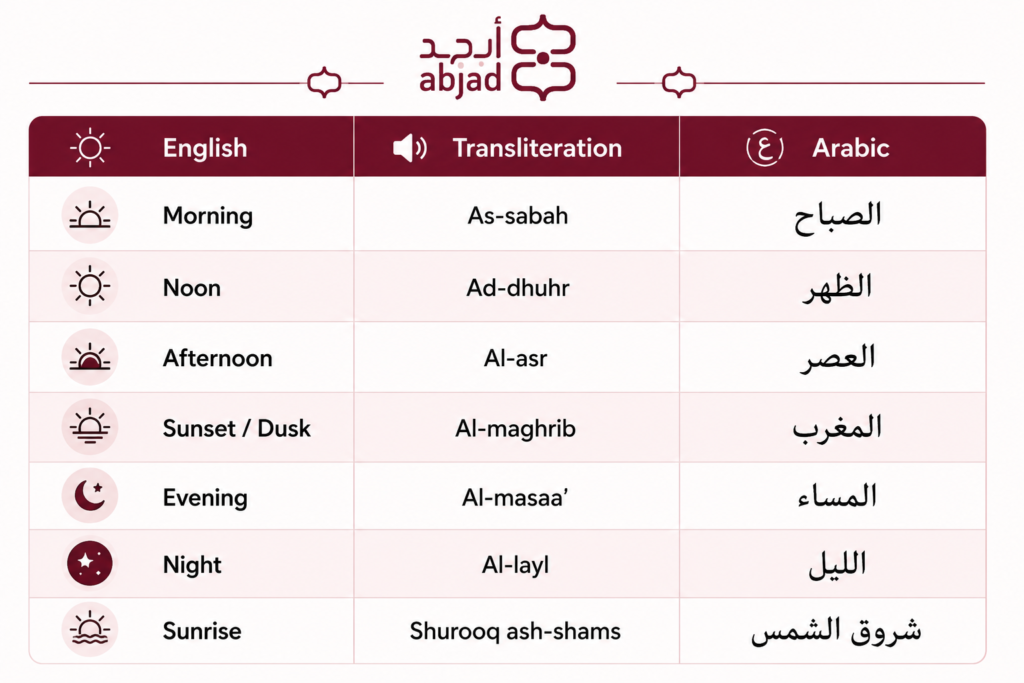
In casual conversation, Arabic speakers often use these terms instead of precise clock times — “let’s meet after al-maghrib” is perfectly natural in Gulf Arabic. Knowing them gives you access to a layer of Arabic time expression that no clock-reading guide covers.
Read more: How to Read Quranic Arabic?
8. Use Time in Arabic Numbers and Phrases in Real Conversation
Reading time on a clock is one skill, but using it naturally in conversation is another. The following Essential Time Vocabulary in Arabic covers the words and phrases you’ll encounter most often when talking about time in real-life situations:
| English | Transliteration | Arabic |
| Time | Waqt | وقت |
| Hour | Saa’ah | ساعة |
| Minute | Daqeeqah | دقيقة |
| Second | Thaniyah | ثانية |
| Half | Nisf | نصف |
| Quarter | Rub’ | ربع |
| Now | Al-aan | الآن |
| Soon | Qareeban | قريبًا |
| Early | Baakiran | باكراً |
| Late | Muta’akhir | متأخر |
Practical Time Phrases
- It’s late – Al-waqt muta’akhir | الوقت متأخر
- It’s early – Al-waqt baakir | الوقت باكر
- How long does it take? – Kam yastaghriq min al-waqt? | كم يستغرق من الوقت؟
- In a short while – Ba’d qaleel | بعد قليل
- A few moments ago – Mundhu lahazhaat | منذ لحظات
- What time does it start? – Mata yabda’? | متى يبدأ؟
- What time does it end? – Mata yantahi? | متى ينتهي؟
Inside Our Live Classes
Don’t just take our word for it—see for yourself! Click below to watch short clips from our live classes and meet the instructors who will guide your learning journey.
Begin Your Arabic Journey in the UAE
Join Abjad Institute for a professional and immersive Arabic language experience tailored to your goals.
Book Your Free TrialStart Reading Arabic Time in the UAE with Abjad Institute
Mastering how to read Arabic time in the UAE requires the right sequence — not just memorization. Abjad Institute offers structured, UAE-context Arabic time instruction with experienced Arabic instructors, including native Emirati teachers, delivering:
- Personalized follow-up and live correction at every stage
- Curriculum built for UAE daily life and professional contexts
- Flexible scheduling for busy professionals and families
- An interactive learning community connecting learners across the UAE
Explore our Arabic time course or book a free trial session to begin.
- Arabic Course for Kids
- Arabic Conversation for Kids
- Arabic Qaida for Kids
- Beginner Arabic for Kids
- Arabic Grammar for Kids
- Teen Arabic Summer Course
- Arabic Kids Camps
- UAE Kindergarten Arabic Classes
- Modern Standard Arabic Course
- Fusha Arabic Course

Begin Your Arabic Journey in the UAE
Join Abjad Institute for a professional and immersive Arabic language experience tailored to your goals.
Book Your Free TrialConclusion
Reading Arabic time comes down to eight steps: understand that Arabic uses ordinal hour names, know how to ask for the time, memorize the twelve hour names, apply wa for minutes past and illa for minutes to, add sabahan or masaa’an for AM and PM, recognize Arabic-Indic numerals on clock faces, learn the parts of the day, and use the whole system in real conversation.
Arabic time is more consistent than English time. There is one structure, two prepositions, and a fixed pattern that never changes. Once it clicks, it applies to every clock you will ever read and every time-related conversation you will ever have in Arabic.
Frequently Asked Questions
How do you say “What time is it?” in Arabic?
The standard phrase is Kam as-saa’ah? | كم الساعة؟. The preferred everyday version is Kam as-saa’ah al-aan? | كم الساعة الآن؟ — adding al-aan (now) clarifies that you’re asking about time, not price, since kam can mean both in Arabic.
How do you read Arabic time in numbers?
Arabic clock time uses ordinal numbers for hours — the second hour, the fifth hour — preceded by as-saa’ah (الساعة). Minutes are added with wa (و) for past and illa (إلا) for to. So 5:15 is as-saa’ah al-khaamisah wa ar-rub’ and 5:45 is as-saa’ah as-saadisah illa ar-rub’.
How do you read Arabic-Indic time in English?
Read Arabic-Indic numerals on a clock the same way you read Western ones — the system is identical, only the digit symbols differ.
٧:٣٠ is 7:30. The key is memorizing the ten Eastern Arabic digits (٠–٩). Most learners recognize all ten automatically within a few days of regular exposure.
What is the difference between how to read Arabic time and how to read Arabic Eastern time?
“Arabic Eastern time” refers to the time zone — Eastern European Time (UTC+2) used in Egypt and parts of the Levant, or Gulf Standard Time (UTC+4) used in the UAE and Saudi Arabia. The language and method for telling the time in Arabic is identical across all regions and time zones. Only the clock setting differs, not the Arabic time expressions themselves.
How do you say AM and PM when telling Arabic time?
Place sabahan (صباحاً) after the time expression for AM, and masaa’an (مساءً) for PM. Example: 8:00 AM is as-saa’ah ath-thaaminah sabahan | الساعة الثامنة صباحاً. In formal and official contexts across the Arab world, the 24-hour clock is common and removes the need for these markers entirely.
How do you say “quarter past” and “quarter to” in Arabic?
“Quarter past” is wa ar-rub’ (والربع), placed after the hour name — 4:15 is as-saa’ah ar-raabi’ah wa ar-rub’. “Quarter to” is illa ar-rub’ (إلا الربع), used with the next hour — 4:45 is as-saa’ah al-khaamisah illa ar-rub’ (a quarter to five).






Leave a Reply