 Speak Arabic
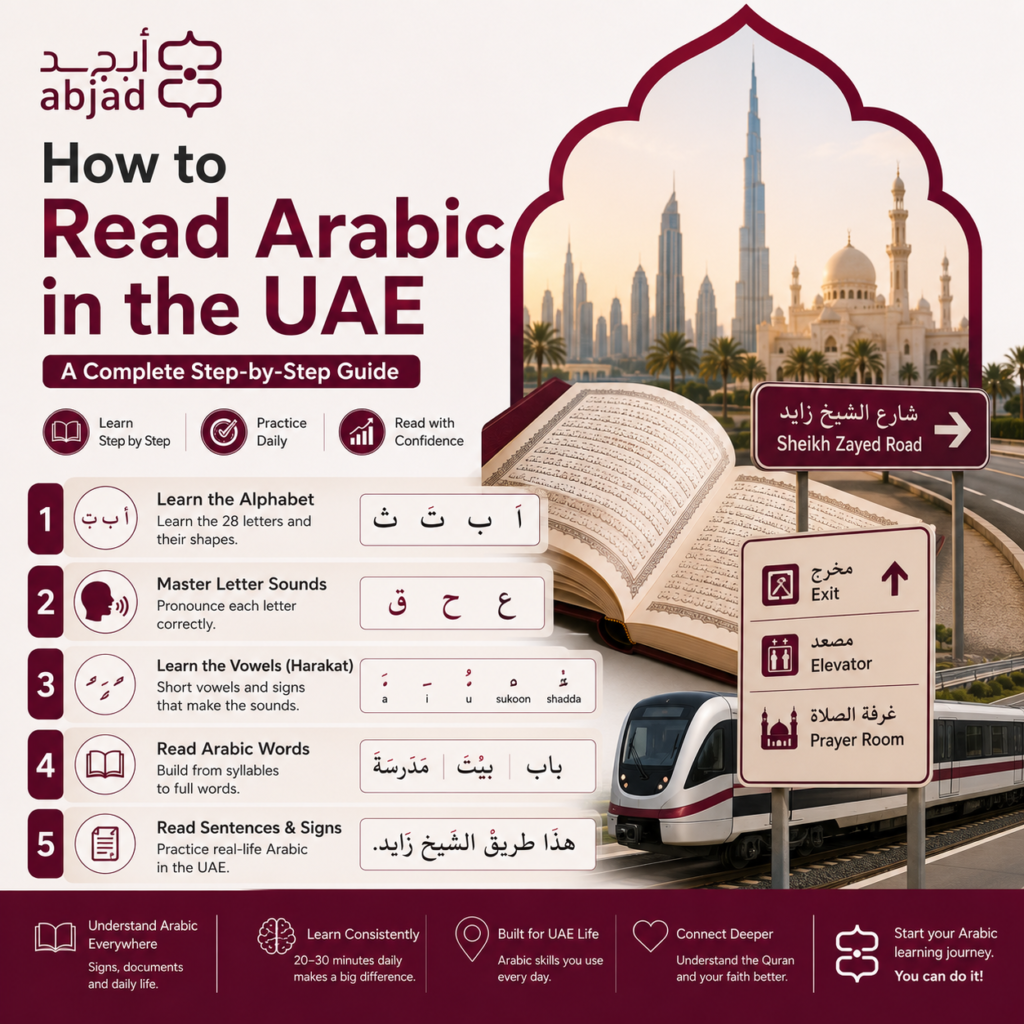
You’ve been in Dubai, Abu Dhabi, or Sharjah for months — maybe years — and Arabic is everywhere around you. The metro signs at Union Station. The government forms at GDRFA. The road signs on Sheikh Zayed Road. The tenancy contract your landlord just sent. You recognize the script. You just can’t read it.
That gap is smaller than you think. If you want to learn how to read Arabic in the UAE, you are not starting from scratch on an entire language — you are building one specific skill in a clear, structured sequence. Most UAE residents who practice 20–30 minutes daily move from zero to reading basic Arabic text within 4 to 8 weeks.
Arabic is the UAE’s official language. Modern Standard Arabic (MSA) is the written form that appears on every official document, government portal, and public sign — from your DEWA bill and Emirates ID correspondence to TAMM service centers and RTA app screens. Gulf Arabic is what people speak in daily life, but both use the same script. Learn to read the script, and you unlock both.
Step 1: Learn the Arabic Alphabet — The Foundation of How to Read the Arabic Language
Every Arabic word on every sign, document, and screen in the UAE is built from 28 letters. There is no method that bypasses this step. If you want to learn how to read Arabic words, you start here.
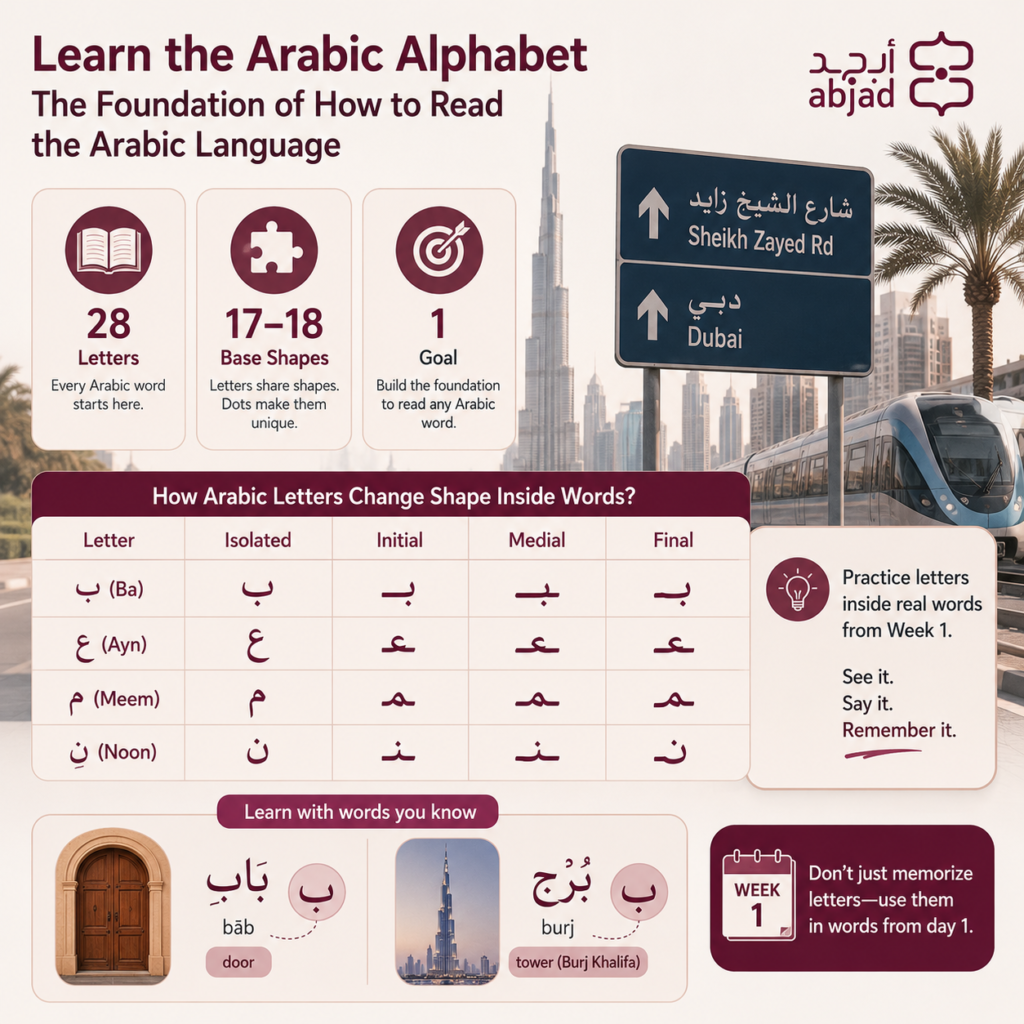
The most efficient approach is to group letters by shared base shapes. The letters ب (Ba), ت (Ta), and ث (Tha) all share one base shape — they differ only in the number and position of dots. Across all 28 letters, there are roughly 17–18 base shapes. You are not memorizing 28 unrelated symbols; you are learning 17 shapes with minor variations.
How Arabic Letters Change Shape Inside Words?
Arabic is a connected, cursive script. Most letters take a different form depending on whether they appear at the start, middle, or end of a word — or in isolation. This is where most self-study learners first get stuck: a letter they recognize in isolation suddenly looks different inside a word.
| Letter | Isolated | Initial | Medial | Final |
| ب (Ba) | ب | بـ | ـبـ | ـب |
| ع (Ayn) | ع | عـ | ـعـ | ـع |
| م (Meem) | م | مـ | ـمـ | ـم |
| ن (Noon) | ن | نـ | ـنـ | ـن |
The practical fix: from Week 1, practice letters inside real words — not just in isolation. When you learn ب (Ba), immediately read it inside بَاب (door) and بُرْج (tower, as in Burj Khalifa). Connecting letters to UAE vocabulary you already know makes the shape-shifts click faster.
Step 2: Master Arabic Letter Sounds and Pronunciation
Recognizing a letter’s shape is a different skill from producing its sound correctly. Arabic has several sounds with no English equivalent, and mispronouncing them early builds habits that take real effort to correct — often months of remedial work.
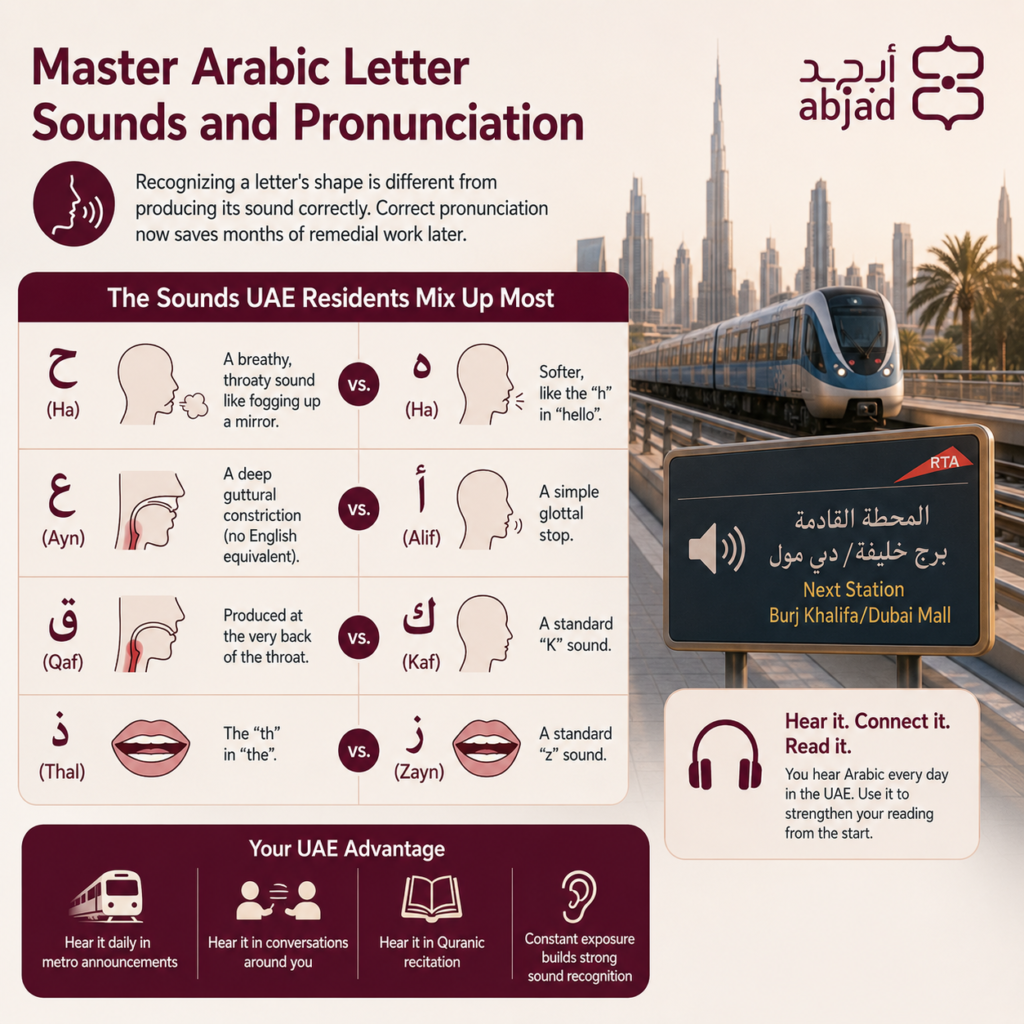
The Sounds UAE Residents Mix Up Most
These pairs cause consistent confusion for English speakers learning how to read the Arabic language in the UAE:
- ح (Ha) vs.
ه (Ha) — ح is a breathy, throaty sound like fogging up a mirror; ه is softer, like the “h” in “hello” - ع (Ayn) vs.
أ (Alif) — ع is a deep guttural constriction with no English equivalent; أ is a simple glottal stop - ق (Qaf) vs.
ك (Kaf) — ق is produced at the very back of the throat; ك is a standard “k” - ذ (Thal) vs.
ز (Zayn) — ذ is the “th” in “the”; ز is a standard “z”
You will hear these sounds daily in the UAE — in metro announcements, in conversations around you, in Quranic recitation during Ramadan. That constant audio exposure is a genuine advantage UAE residents have over learners elsewhere. When you hear a word on the RTA announcement system, connect it to the letters.
Getting pronunciation right requires hearing a qualified instructor produce the correct sound and correcting you in real time. No app or video can do this reliably. If you want to build correct pronunciation from the start, Abjad Institute’s adult Arabic courses provide live instructor correction from your very first lesson.
Step 3: Learn Arabic Vowels (Harakat) Before Reading UAE Signs
Once you know the 28 letters and their sounds, the next step is harakat (حركات) — the short vowel marks written above or below letters that determine pronunciation. This is where most UAE beginners make their costliest mistake: they skip harakat and jump straight to reading public signs, which carry no vowel marks at all.
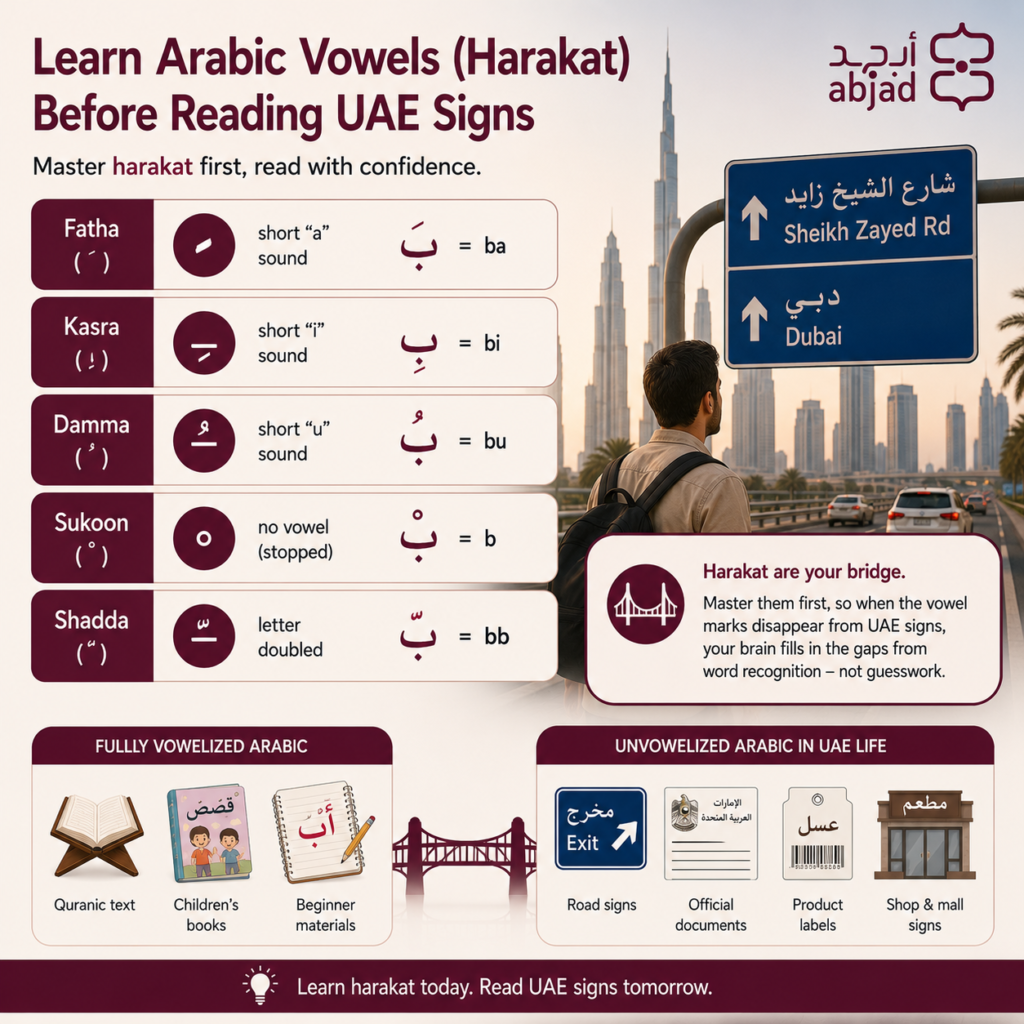
The five harakat every Arabic reader must know:
- Fatha (َ ) — short “a” sound, written above the letter: بَ = “ba”
- Kasra (ِ ) — short “i” sound, written below the letter: بِ = “bi”
- Damma (ُ ) — short “u” sound, written above the letter: بُ = “bu”
- Sukoon (ْ ) — no vowel follows this letter: بْ = “b” (stopped)
- Shadda (ّ ) — the letter is doubled: بّ = “bb”
Fully vowelized Arabic appears in Quranic text, children’s books, and beginner learning materials. Most Arabic in UAE public life — road signs, official documents, product labels — is unvowelized. Harakat are your bridge: master them first, so that when the vowel marks disappear from UAE signage, your brain fills in the gaps from word recognition rather than guesswork.
Read More: How to Read Arabic Quran in the UAE?
Step 4: Learn How to Read Arabic Words — Build from Syllables Up
Reading Arabic words is where your foundational knowledge of letters, sounds, and harakat comes together. In this step, you move beyond individual letters and syllables to start recognizing complete words. By focusing first on familiar words that you encounter daily in the UAE, you build confidence, reduce cognitive load, and strengthen the connection between the script and its meaning. This stage sets the stage for fluent reading and prepares you for more complex sentences.
The Noorani Qaida Method
The structured method used in most formal Arabic reading curricula is the Noorani Qaida — a phonetic primer designed specifically for non-native readers who want to learn how to read Arabic words correctly from the start. It builds syllable reading before word reading, in this sequence:
- CV pattern (consonant + vowel): بَ، كِ، مُ
- CVC pattern (consonant + vowel + stopped consonant): كِتْ، بَيْت
- Full words: بَاب (door), كِتَاب (book), مَطَار (airport)
UAE-Relevant Arabic Words to Start With
One of the most underused advantages of learning to read Arabic words in the UAE is that you already know what many of them mean — because you see their English translations beside them every day. Use this as your first vocabulary bank:
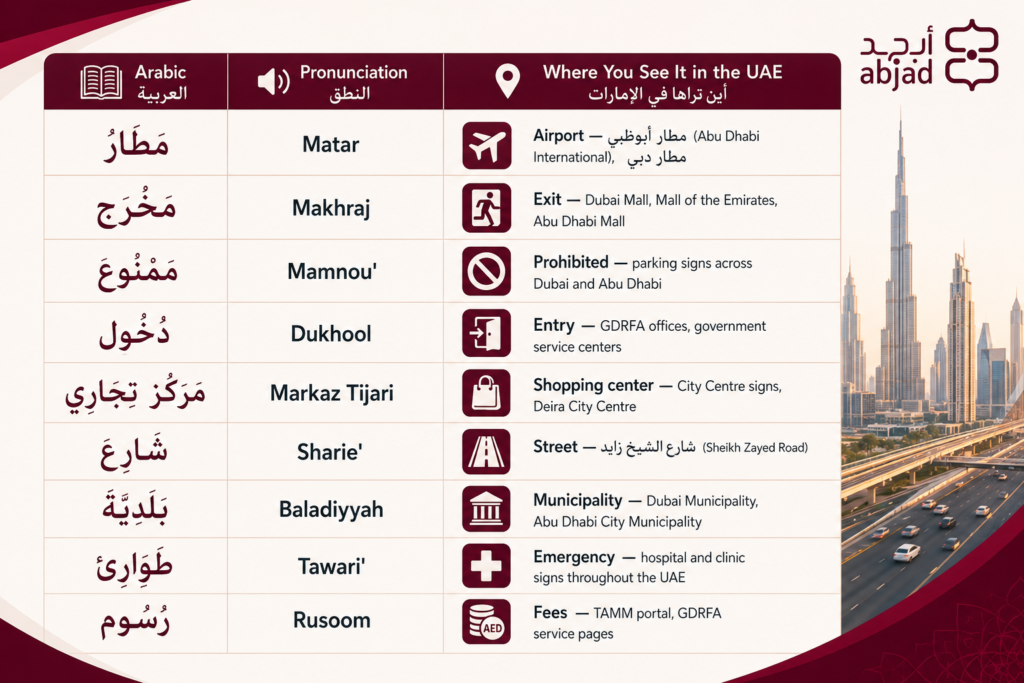
Reading Arabic words you already know the meaning of removes one layer of cognitive load: you are decoding script, not learning vocabulary simultaneously. This approach is particularly powerful for UAE residents working with government services across Dubai, Abu Dhabi, Sharjah, Ajman, Ras Al Khaimah, Fujairah, and Umm Al Quwain.
Watch Our Classes in Action
Curious what a real session looks like? Take a peek inside our interactive classrooms and see how our expert instructors bring the Arabic language to life. Watch a sample lesson below!
Begin Your Arabic Journey in the UAE
Join Abjad Institute for a professional and immersive Arabic language experience tailored to your goals.
Book Your Free TrialStep 5: Learn How to Read Arabic Sentences
Arabic Word Order Is Different from English Before you can read Arabic sentences fluently, understand one key structural difference: Arabic uses Verb-Subject-Object (VSO) order in verbal sentences, and adjectives follow the nouns they describe — the opposite of English.
- English: “The boy went to school”
- Arabic: ذَهَبَ الوَلَدُ إِلَى المَدْرَسَةِ — literally: “Went the-boy to the-school”
This means your eye moves through Arabic sentences in a different logical sequence. Knowing this prevents the habit of mentally translating word by word, which is the main reason Arabic sentence reading feels slow for English speakers early on.
Practical Arabic Sentences for UAE Daily Life
Start with sentences that have immediate value in the UAE context:
- أَيْنَ مَحَطَّة المِتْرُو؟ — Where is the metro station?
- كَمْ سِعْرُ هَذَا؟ — How much does this cost?
- مَمْنُوعُ الوُقُوف — No parking (seen on hundreds of Dubai and Abu Dhabi streets)
- يُرْجَى التَّبَرُّعُ — Donations welcome (seen at mosques and community centers)
- الرَّجَاء الضَّغْطُ عَلَى الزِّرّ — Please press the button (elevator signage)
Reading sentences you encounter in your real UAE environment — rather than invented textbook examples — builds retention significantly faster. Every trip on the Dubai Metro, every visit to a government service center in Abu Dhabi, and every walk through Deira or Bur Dubai is a reading practice session waiting to happen.
For learners who want structured sentence-reading practice alongside a curriculum, Abjad Institute’s self-paced Arabic courses build from word-level to sentence-level reading within a clear progression you control.
Read More: How to Learn to Read Arabic Online for Free?
How to Learn to Read Arabic Fast?
The best way to learn to read Arabic fast is not intensity — it is structure combined with daily consistency. This plan is designed for UAE working adults with 20–30 minutes available each day.
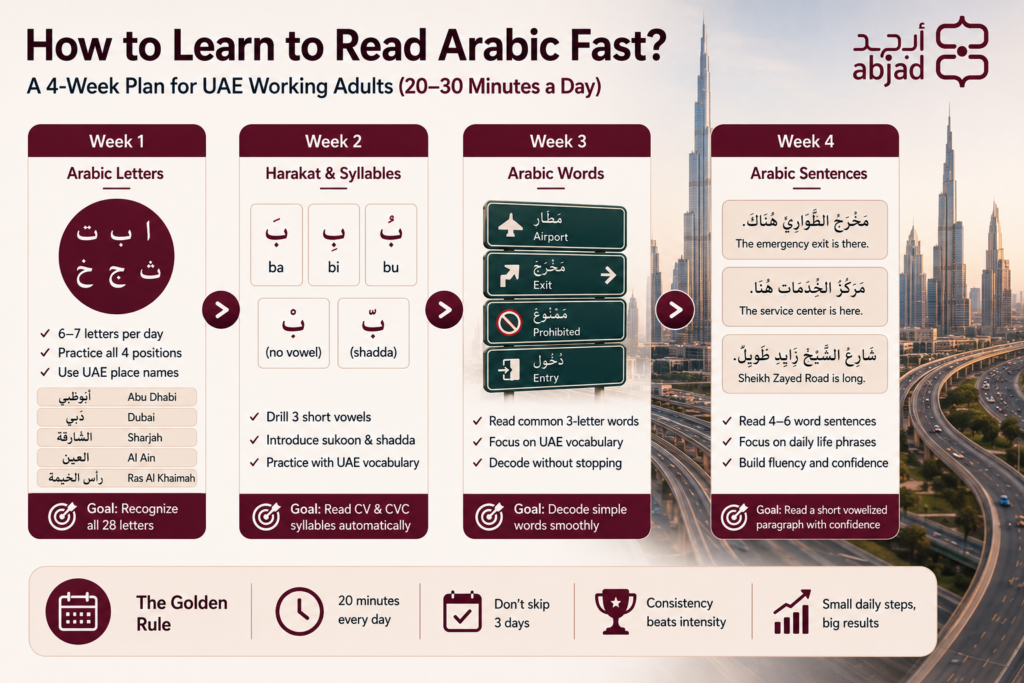
1. Week 1 — Arabic Letters
Learn 6–7 letters per day, grouped by shape family. Practice writing each in all four positional forms. Use UAE place names as your practice words — أبوظبي (Abu Dhabi), دبي (Dubai), الشارقة (Sharjah), العين (Al Ain), رأس الخيمة (Ras Al Khaimah). By the end of Week 1: recognize all 28 letters.
2. Week 2 — Harakat and Syllables
Drill each letter with all three short vowels: بَ / بِ / بُ. Introduce sukoon and shadda. Practice with UAE vocabulary from the table in Step 4. By the end of Week 2: read CV and CVC syllables automatically without pausing on individual letters.
3. Week 3 — Arabic Words
Read common three-letter vowelized words. Focus on UAE-relevant vocabulary — government service terms, food labels, road sign language. By the end of Week 3: decode simple vowelized words without stopping at individual letters.
4. Week 4 — Arabic Sentences
Read short 4–6 word sentences. Focus on UAE daily life phrases and public signage. By the end of Week 4: read a short fully vowelized Arabic paragraph aloud at a reasonable pace.
The single most important variable is not the method — it is daily consistency. Learners who miss three days in Week 2 typically need to restart Week 1. Twenty minutes every day beats two hours on weekends, every time.
How to Read Arabic Faster?
Most UAE beginners read Arabic slowly because they decode letters one by one and have limited exposure to high-frequency word shapes. To read faster, focus on recognizing entire word shapes at a glance instead of sounding out each letter. Practice with common words and phrases you encounter daily in the UAE, such as street signs, government documents, and product labels. Daily exposure and repetition help train your brain to process words as units, dramatically increasing reading speed and fluency.
1. Stop Spelling, Start Chunking
When you see مَدِينَة (city, as in Madinat Jumeirah), your target is to recognize that whole word shape — not to internally recite م-دِ-ي-نَ-ة. Speed in reading Arabic faster comes from training your visual system to process whole word shapes at a glance, which only happens through repetition.
2. Use Timed Reading Sessions
Set a timer for 2 minutes. Read a short Arabic paragraph aloud. Count how many words you complete. Do this with the same passage daily for one week. The word count will increase without deliberate effort — the time pressure activates pace-building that patient, careful study does not.
3. Read UAE Signs Before Looking at the English
This is the UAE-specific technique for how to read Arabic faster that has no equivalent for learners living elsewhere. Every bilingual sign in the UAE — and there are thousands — is a timed reading challenge. Before your eye moves to the English, force it to decode the Arabic first. Road signs on Al Khail Road, department names at Dubai Health Authority, floor directories at Abu Dhabi Mall, service counters at GDRFA Oud Metha — all of these are reading speed drills hiding in plain sight.
If cost is the primary barrier, look for academies offering free trial lessons. Abjad Institute’s Arabic writing and reading courses include structured reading progression where instructor feedback replaces the guesswork that free-only learners accumulate over months.
Read more: Learn Quranic Arabic Free in the UAE
How to Read Arabic Fluently for Beginners — Mistakes to Avoid
These are the errors that most consistently hold UAE residents back:
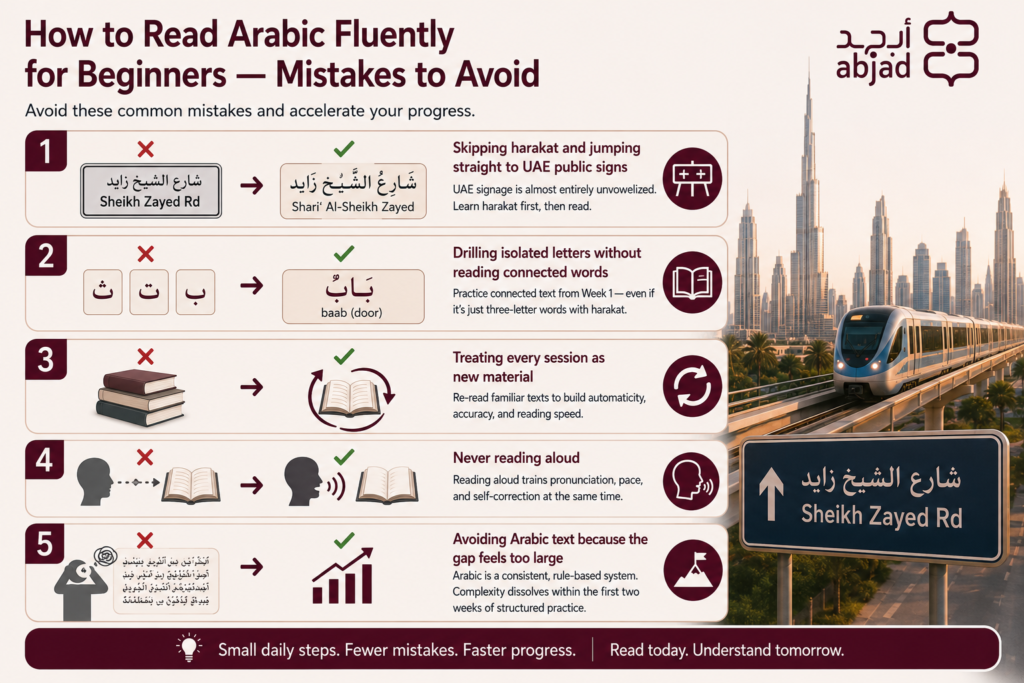
1. Skipping harakat and jumping straight to UAE public signs
UAE signage is almost entirely unvowelized. If you skip harakat practice and try to read signs from Week 1, you are guessing — not reading. The unvowelized world of UAE Arabic is the destination, not the starting point.
2. Drilling isolated letters without reading connected words
Letter recognition and word reading are different cognitive skills. Learners who spend weeks on letter flashcards but never read actual words consistently report the same result: they can name every letter but cannot read a simple word. Practice connected text from Week 1 — even if it is just three-letter words with harakat.
3. Treating every session as new material
How to read Arabic fluently for beginners is less about covering new ground and more about building automaticity. Re-reading familiar Arabic texts with a focus on pace and accuracy is one of the most underused reading techniques. Think of it the way a musician practices scales — the goal is automaticity, not novelty.
4. Never reading aloud
Reading Arabic silently trains recognition. Reading aloud trains pronunciation, pace, and self-correction simultaneously. If you never read aloud, you will never know whether your reading is accurate or fluent.
5. Avoiding Arabic text because the gap feels too large
This is the most common barrier for UAE expats. The script looks complex from the outside. Inside, it is a consistent, rule-based system where each letter maps to a specific sound — and that complexity dissolves within the first two weeks of structured practice.
Inside Our Live Classes
Don’t just take our word for it—see for yourself! Click below to watch short clips from our live classes and meet the instructors who will guide your learning journey.
Begin Your Arabic Journey in the UAE
Join Abjad Institute for a professional and immersive Arabic language experience tailored to your goals.
Book Your Free TrialStart Reading Arabic in the UAE with Abjad Institute
Most UAE residents who want to learn how to read Arabic in the UAE spend months searching for the right starting point. Abjad Institute removes that friction entirely.
Their Arabic courses for adults in the UAE follow exactly the sequence in this guide — letters, harakat, words, sentences, fluency — taught by qualified instructors who provide the real-time correction that apps and free resources cannot offer.
Whether you are a complete beginner, a heritage speaker who understands Arabic but cannot read it, or someone who started years ago and needs to rebuild correctly, there is a structured course for your level.
Sessions are flexible and designed around the schedules of UAE working adults — no commute, no fixed classroom, no wasted time.
Book your free trial at Abjad Institute
- Classical Arabic Course
- Emirati Arabic Course
- Gulf Arabic Course
- Learn Saudi Arabic
- Business Arabic Course UAE
- Arabic Language Classes for Professionals in UAE
- Quranic Arabic Course

Begin Your Arabic Journey in the UAE
Join Abjad Institute for a professional and immersive Arabic language experience tailored to your goals.
Book Your Free TrialConclusion
Learning how to read Arabic in the UAE is one of the most practically valuable skills a resident can build — and the path is clearer than most people expect.
It starts with 28 letters organized by shape families, moves through harakat and syllable reading, builds into Arabic words and sentences, and develops into reading speed and fluency through daily practice with real UAE text.
The three-stage progression — vowelized to partially vowelized to unvowelized — is the reliable route from beginner to functional reader of the Arabic that actually appears on UAE signs, portals, and documents.
The learners who reach fluency are not the ones who study hardest in the first week. They are the ones who practice consistently for 8 to 12 weeks, read aloud daily, and get their pronunciation corrected before errors become habits.
The UAE environment gives you a genuine advantage no classroom abroad can replicate: Arabic is on every sign, screen, and document around you — on Sheikh Zayed Road, at Dubai Metro stations, in your GDRFA correspondence, on the shelves of every Carrefour — waiting to be read.
Frequently Asked Questions
To help you get started with reading Arabic in the UAE, here are answers to the most common questions beginners ask. These cover timelines, practical tips, free resources, and the best strategies to progress from letters to fluent reading.
How long does it take to learn how to read Arabic in the UAE as a complete beginner?
Most adult beginners who practice 20–30 minutes daily reach basic vowelized reading within 4 to 8 weeks. Reading unvowelized Arabic — the form most UAE public signs, government portals, and official documents use — typically takes 3 to 6 months of consistent practice. Having a qualified instructor correct pronunciation errors early shortens this timeline significantly.
How can I learn to read Arabic free online as a UAE resident?
Free resources — Noorani Qaida PDFs, YouTube channels, and apps like Quran.com — can take you through the early stages. The UAE itself adds a free practice layer available nowhere else: bilingual metro signs, government portals like TAMM and RTA, product labels at Carrefour and Lulu, and mall directories all provide daily real-world reading practice at zero cost. The gap free tools cannot fill is pronunciation correction — for that, periodic sessions with a qualified instructor remain essential.
What is the best way to learn to read Arabic fast for beginners?
The best way combines three elements: a structured sequence (letters → harakat → words → sentences), daily oral reading practice rather than silent study, and real-time pronunciation correction from a qualified instructor. Learners who follow this approach consistently progress two to three times faster than those who self-study without feedback.
How do I learn to read Arabic words and sentences without harakat?
Reading unvowelized Arabic relies on word recognition built through extensive practice with vowelized text first. You recognize familiar word shapes rather than decoding them letter by letter — the same way a fluent English reader does not sound out every word. This develops through Stage 1 and Stage 2 practice and should not be your starting point.
How long does it take to read Arabic fluently?
Reading Arabic fluently — meaning unvowelized text at natural pace without pausing — typically takes 3 to 6 months of consistent daily practice for UAE residents who follow a structured sequence. Learners who skip the harakat stage or never practice reading aloud consistently take longer, regardless of how many hours they study.
Where can I find structured Arabic reading courses designed for UAE residents?
Abjad Institute offers adult Arabic courses built specifically for UAE residents at all levels — from complete beginners to those rebuilding from an incomplete foundation. Self-paced options are available for learners who need flexibility around UAE working hours, alongside structured reading and writing courses for those progressing from decoding toward fluent reading.





Leave a Reply