 Learn Arabic
If you’ve ever sat in a mosque in Dubai or Abu Dhabi and watched children reading Quranic verses fluently while you stumbled over the first line, you’ve felt that particular motivation to finally start learning. The question most people ask next is the honest one: How long will this actually take?
The answer depends on what “reading Arabic” means to you — and in the UAE, the answer matters more than it does almost anywhere else. Whether your goal is reading the Quran independently, getting your child started before they begin formal Arabic schooling, or simply navigating everyday written Arabic in a country where the language surrounds you, the timelines are different, and so is the approach.
What’s the Realistic Timeline for Learning to Read Arabic in the UAE?
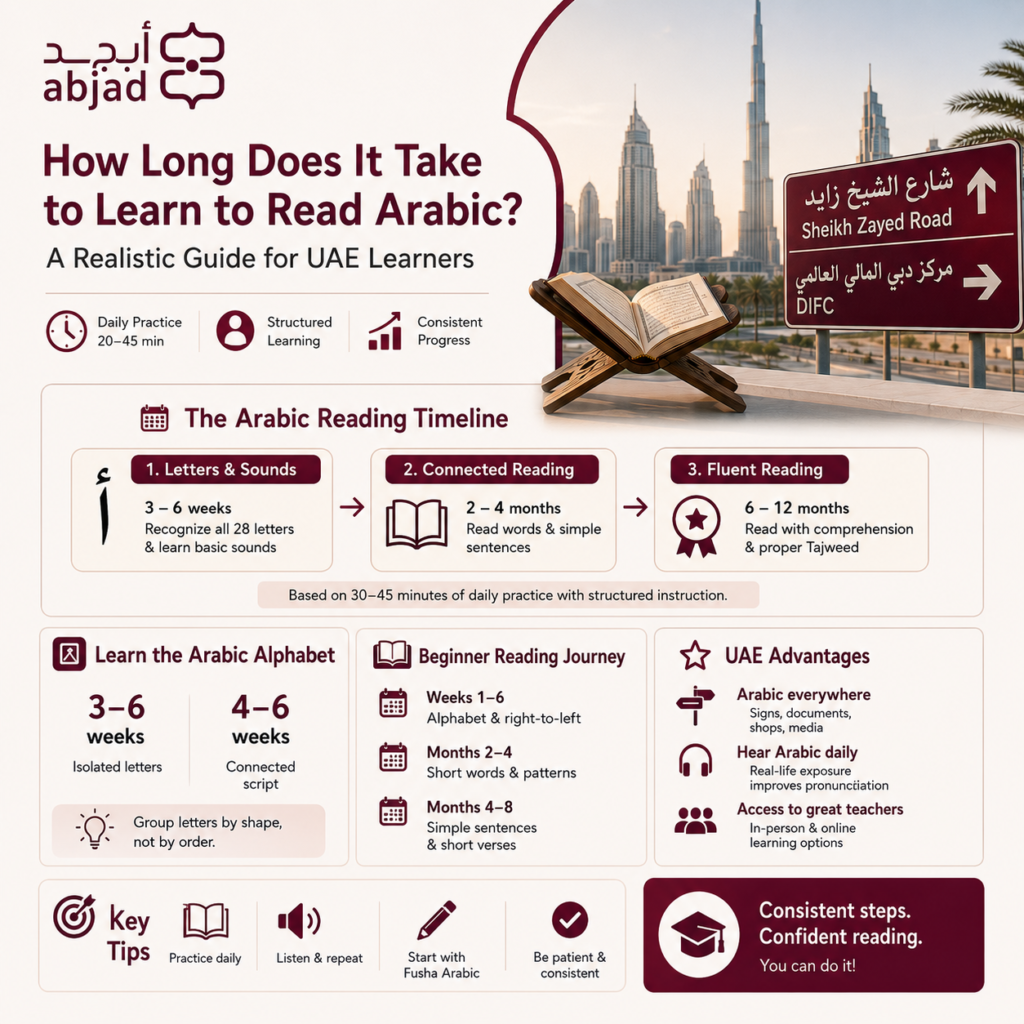
Learning to read Arabic is not a single skill — it is a progression of three increasingly demanding abilities: recognizing letters, decoding connected text, and reading with comprehension and Tajweed.
Confusing these three stages is exactly why so many learners in the UAE either give up early (expecting too much too soon) or feel stuck after the alphabet (not knowing what comes next). Each stage has its own timeline and its own skills to build before the next stage becomes accessible.
Here is an honest stage-by-stage breakdown for a motivated adult studying 30–45 minutes daily with structured instruction:
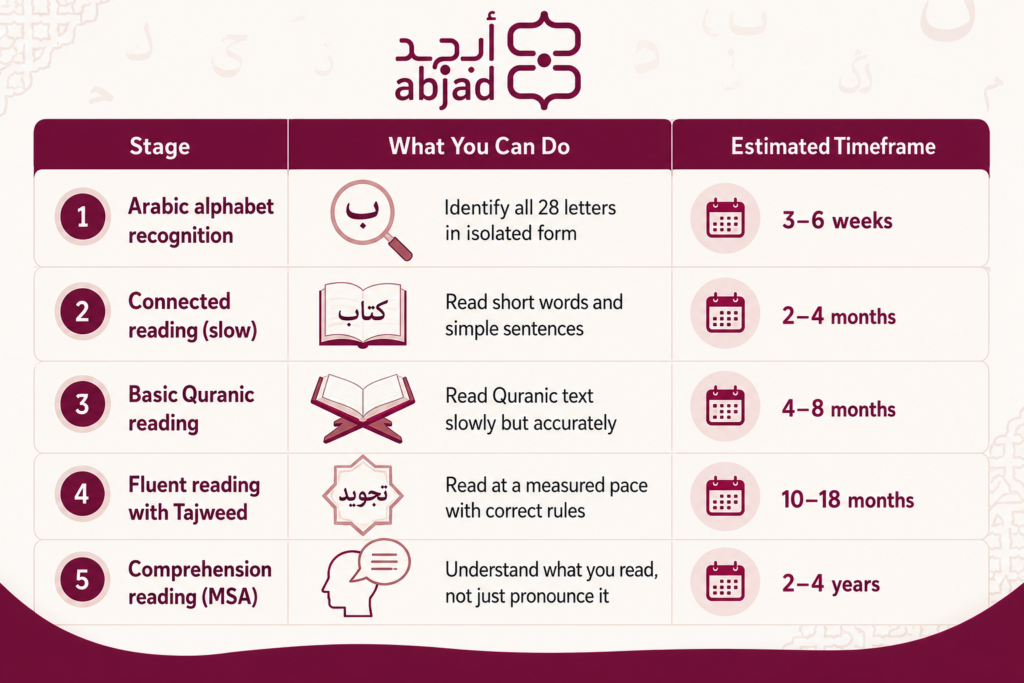
These are practitioner-observed averages, not theoretical projections. Learners who skip structured instruction — particularly in the early weeks — tend to pick up pronunciation errors that slow every later stage significantly.
Read also: Learn How to Write and Read Arabic for Beginners
How Long Does It Take to Learn the Arabic Alphabet in the UAE?
The Arabic alphabet is the most encouraging first milestone — and UAE residents reach it with one advantage that learners elsewhere simply don’t have: the letters are already around them every day.
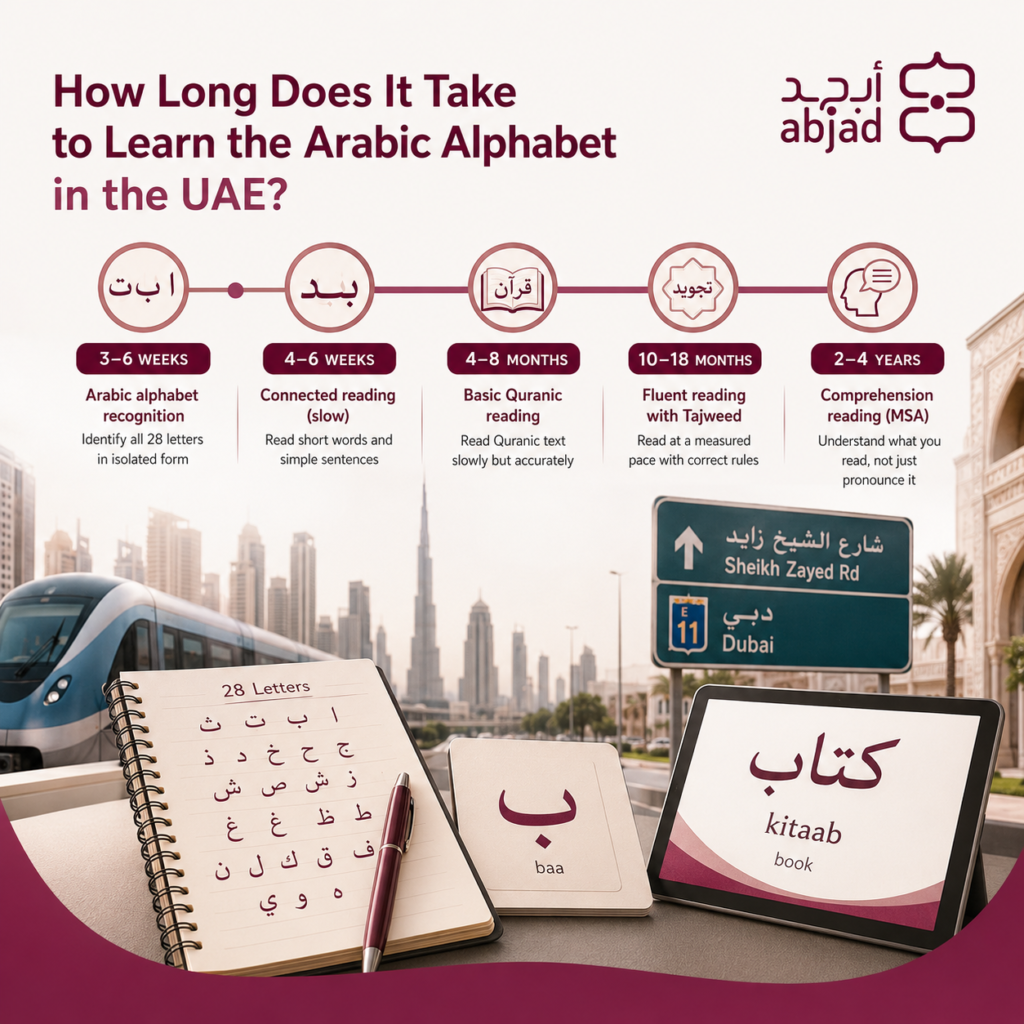
Most adult beginners recognize all 28 Arabic letters in their isolated forms within 3–6 weeks of 20–30 minutes of daily practice. Moving from isolated letter recognition to reading connected script — where the same letter changes shape depending on its position in a word — typically takes another 4–6 weeks.
Why Does Arabic Connected Script Take Extra Time?
The genuine difficulty is not the number of letters. Twenty-eight is comparable to the English alphabet. The real challenge is that Arabic is written right to left in a connected cursive script, and each letter has up to four forms: isolated, initial, medial, and final. A letter you recognize perfectly on a Dubai Metro sign in isolation may look entirely different in the middle of a word in a Quranic text.
The most effective technique at this stage: group letters by shape family, not alphabetical order. Arabic has roughly 17–18 base shapes. Letters like ب، ت، ث share one base shape and differ only by dot placement. Learning them as a group cuts recognition time substantially — a detail most general guides skip entirely.
UAE residents have a built-in supplement here that learners elsewhere pay for: the Arabic script is visible on every road sign, government building, food label, and business name across the Emirates. Simply making a habit of noticing and sounding out Arabic text during your daily commute in Dubai or Abu Dhabi accelerates letter recognition in ways that classroom practice alone cannot replicate.
For children starting early — particularly those who will be entering Arabic schooling in the UAE — Abjadinstitute’s Arabic for kids grammar course builds alphabet recognition through structured, age-appropriate methods designed for young learners.
Read More: How to Read Arabic Calligraphy?
What Does the Arabic Reading Journey Look Like for Beginners in the UAE?
The beginner stage — from zero to basic connected reading — is where most new learners get the most confused about timelines, because “beginner” covers a wide range of actual ability.
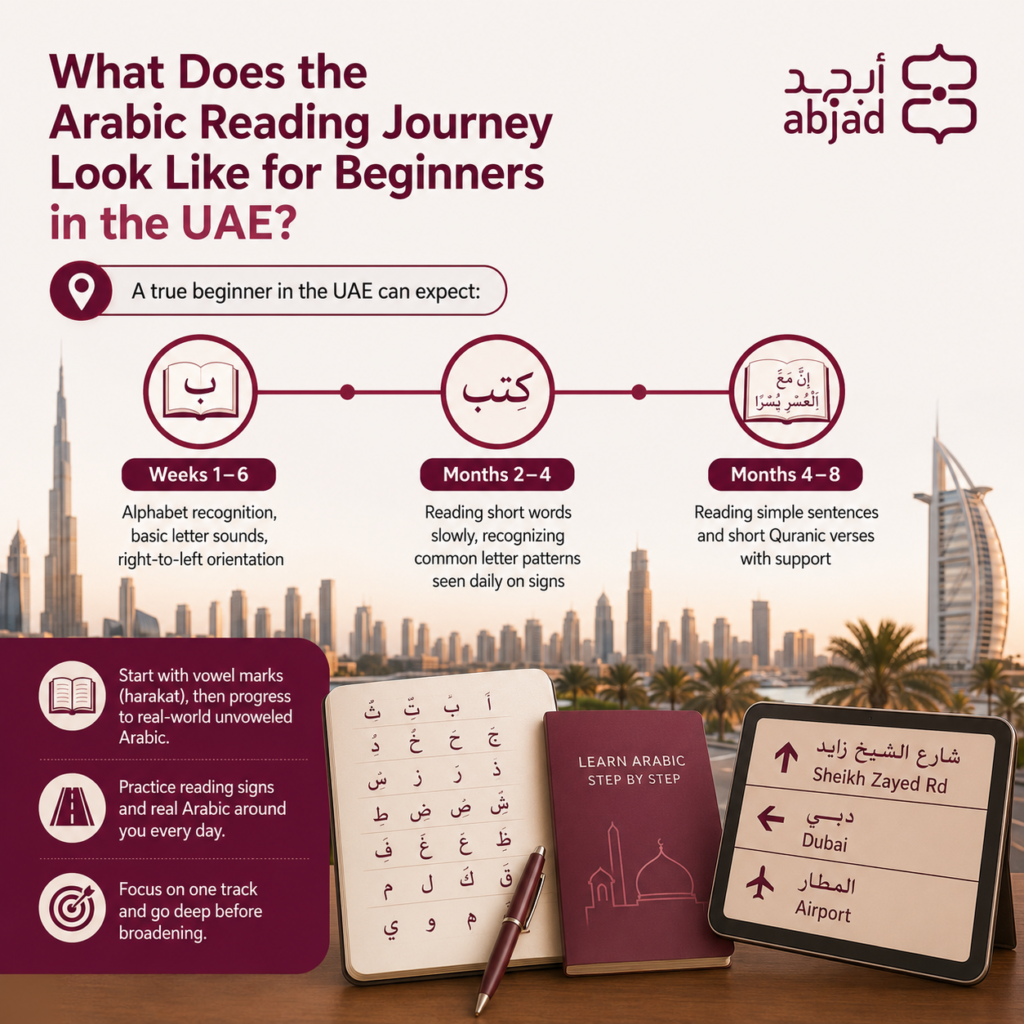
A true beginner in the UAE who has never studied Arabic formally can expect:
- Weeks 1–6: Alphabet recognition, basic letter sounds, right-to-left orientation
- Months 2–4: Reading short words slowly, recognizing common letter patterns seen daily on signs
- Months 4–8: Reading simple sentences and short Quranic verses with support
The critical variable at this stage is whether you are practicing with vowel marks (harakat) or without them. All beginner-level Arabic texts include full vowel markings. Authentic Arabic text — the road signs in Dubai, the newspaper in Abu Dhabi, most government communications — omits them entirely, expecting the reader to supply correct vowels from context and grammar knowledge.
This is why UAE residents who progress well in class sometimes still can’t read a sign on Sheikh Zayed Road at full speed. Structured instruction must introduce unvoweled reading progressively from early on — not save it as an “advanced” skill.
Two patterns that consistently slow beginners: studying grammar rules before building comfort with sounds, and trying to learn Gulf Arabic dialect and Modern Standard Arabic simultaneously. In the UAE’s rich multilingual environment, the temptation to absorb multiple Arabic varieties at once is understandable — but unfocused exposure produces confusion, not fluency. Pick one track and go deep before broadening.
Watch Our Classes in Action
Curious what a real session looks like? Take a peek inside our interactive classrooms and see how our expert instructors bring the Arabic language to life. Watch a sample lesson below!
Begin Your Arabic Journey in the UAE
Join Abjad Institute for a professional and immersive Arabic language experience tailored to your goals.
Book Your Free TrialWhat Specific Advantages Do UAE Residents Have When Learning to Read Arabic?
Living in the UAE creates accelerators for Arabic reading progress that learners in non-Arabic environments simply cannot replicate — and they are worth naming explicitly so you can use them deliberately.
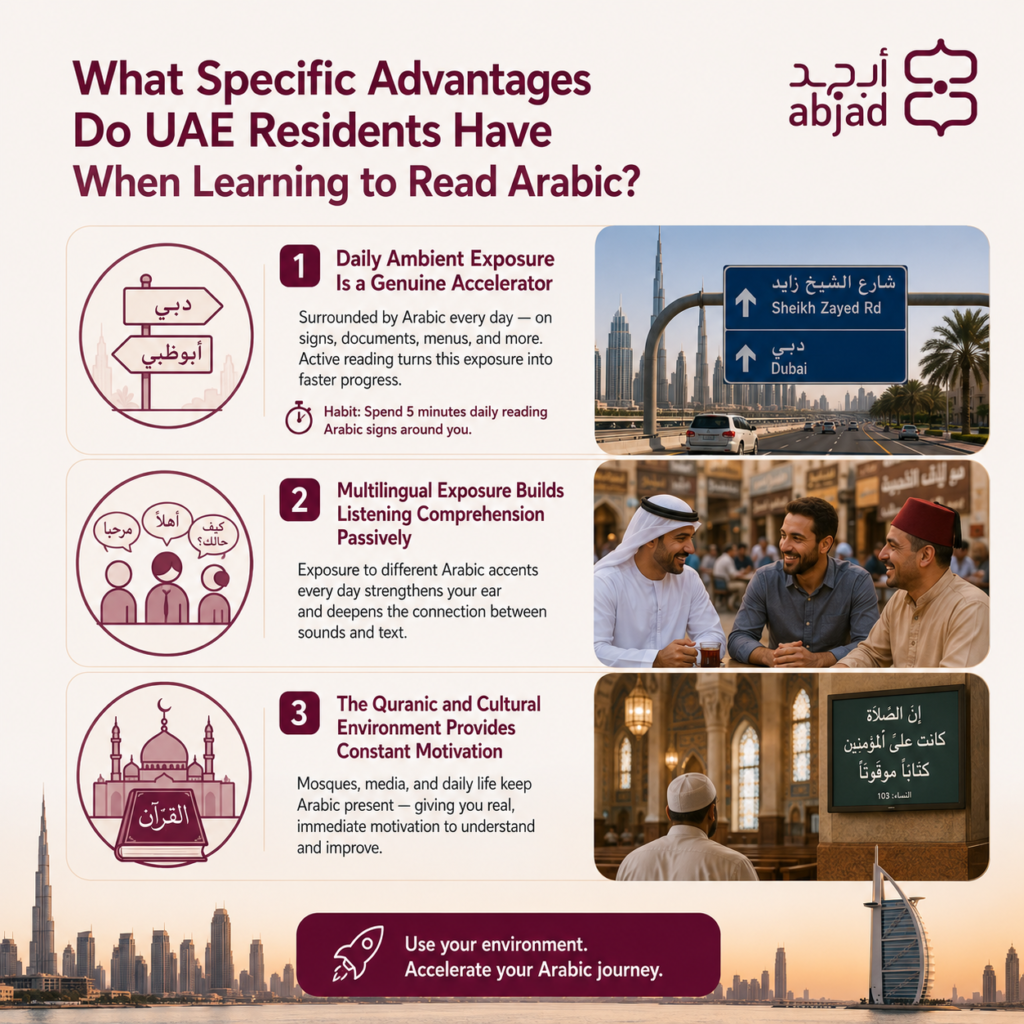
1. Daily Ambient Exposure Is a Genuine Accelerator
Arabic text surrounds UAE residents in ways that make passive familiarity a real head start. Every road sign in Dubai and Abu Dhabi is bilingual. Every government document, Emirates ID, and visa is in Arabic. Every supermarket aisle, every restaurant menu, every mall directory has Arabic text. Learners who make a conscious habit of attempting to read this ambient text — even slowly, even imperfectly — build letter recognition and vocabulary familiarity that self-study learners abroad pay months of study time to develop.
A practical habit: spend 5 minutes on your commute actively reading Arabic signs around you. After 3–4 months of structured study alongside this habit, the reading milestones arrive noticeably faster.
2. Multilingual Exposure Builds Listening Comprehension Passively
The UAE hosts Arabic speakers from Egypt, the Levant, North Africa, and the Gulf in unusually high concentration. For the Arabic learner, this means informal exposure to multiple spoken varieties without traveling anywhere. Listening comprehension — the skill that most self-study learners neglect most — builds passively in the UAE in a way that accelerates the reading-to-sound connection at every stage.
3. The Quranic and Cultural Environment Provides Constant Motivation
UAE mosques deliver khutbas and prayers in Arabic. UAE media, including Dubai-based channels, broadcasts in Arabic. The country’s official language policy and cultural identity keeps Arabic present in a way that provides constant, real motivation to progress — not the abstract motivation of “I want to learn a language,” but the immediate motivation of “I want to understand what’s being said around me.”
Read More: How to Read Arabic Time?
How Long Does It Take to Read Arabic in the UAE Context?
UAE residents typically reach basic Arabic reading ability within 3–5 months of structured daily practice — roughly 4–6 weeks faster than the global average for learners in non-Arabic environments. The reason is simple: ambient exposure does real work here that deliberate study has to replace elsewhere.
The advantages are real. Arabic surrounds you daily — on road signs, menus, government communications, and in nearly every public space. This ambient exposure creates passive familiarity that accelerates recognition in ways that home-country learners simply don’t have. UAE residents who make even minimal effort to notice Arabic text around them build a reading vocabulary that self-study learners often take months to develop.
The pressures are also real. Many expat children in the UAE begin formal Arabic instruction in school, meaning parents who want to support their children at home need at least functional literacy themselves. And for Muslim families, the additional goal of Quranic reading — which the UAE’s educational and cultural environment reinforces continuously — adds both motivation and a specific skill target.
One practical advantage UAE residents have that is rarely discussed: dialect exposure. Because the UAE hosts Arabic speakers from Egypt, the Levant, North Africa, and the Gulf, learners here gain informal exposure to multiple varieties of spoken Arabic — which accelerates listening comprehension even before reading fluency is established.

What Factors Speed Up or Slow Down Arabic Reading Progress?
Two learners studying the same number of hours can reach very different reading levels. The variables below explain most of that gap.
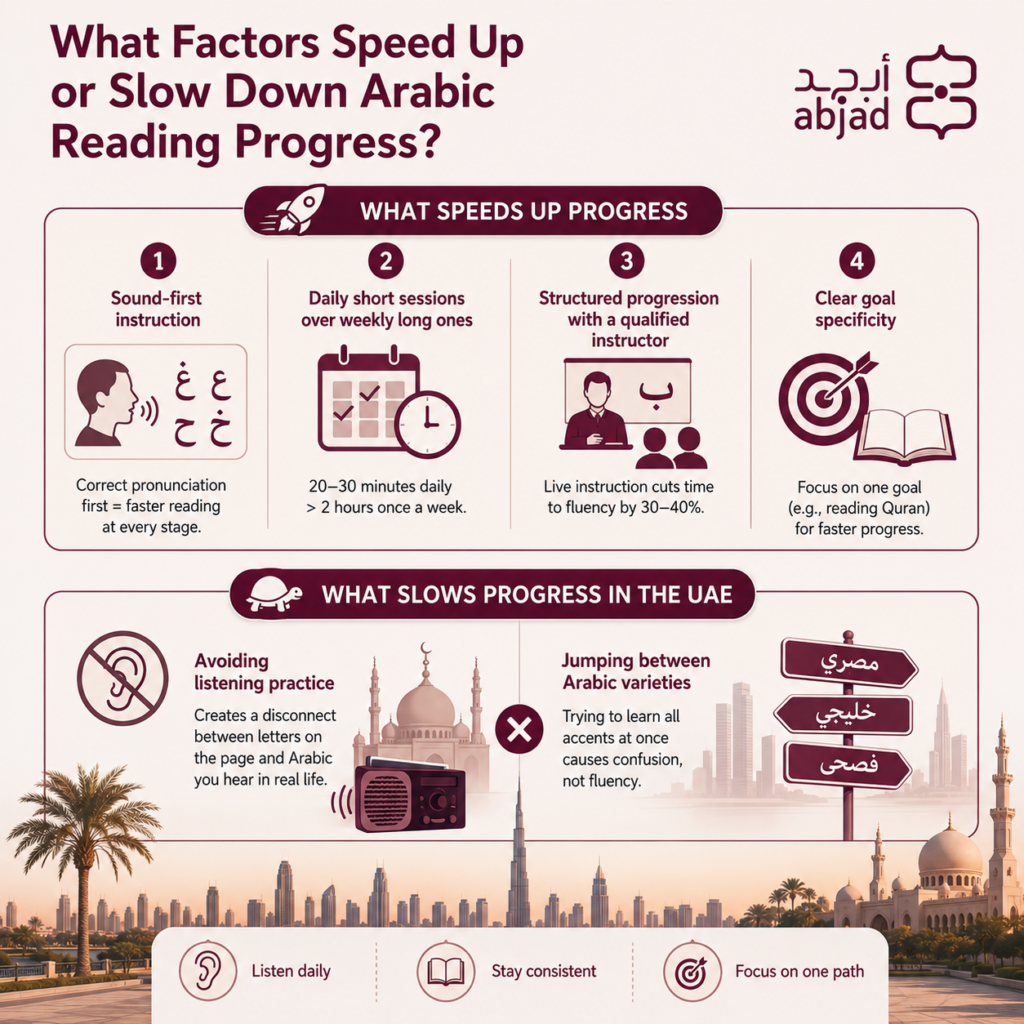
1. Sound-first instruction
learners who develop correct Arabic pronunciation before focusing on reading progress faster at every subsequent stage. Arabic has phonemes with no English equivalent: ع (Ayn), غ (Ghayn), ح (Ha), خ (Kha). Mispronouncing these letters early creates a habit that slows reading accuracy for years.
2. Daily short sessions over weekly long ones
20–30 minutes daily produces faster progress than two hours once a week. Language retention depends on regular neural reinforcement, not intensive cramming.
3. Structured progression with a qualified instructor
self-study through apps and YouTube provides valuable supplementary exposure but cannot correct pronunciation errors in real time or diagnose where a learner is stalling. Live instruction cuts the time to basic reading fluency by an estimated 30–40% compared to self-study alone.
4. Clear goal specificity
a learner whose goal is reading Quran will progress faster than one trying to achieve both conversational fluency and Quranic reading simultaneously. Quranic Arabic has a more contained vocabulary, and 80% of the Quran’s content is accessible through approximately 300 high-frequency words.
What Slows Progress in the UAE Specifically?
Avoiding listening practice is the most common bottleneck. Learners who focus entirely on reading without engaging their ears develop a disconnect between the letters they recognize on the page and the Arabic they hear at the mosque, on the radio, or in public spaces across the Emirates.
Jumping between Arabic varieties — the Egyptian Arabic heard at one colleague’s desk, the Gulf Arabic overheard in a government office, the MSA in a formal communication — is the second major stall point. The UAE’s multicultural environment is a listening asset, but it can become a focus liability if you try to absorb all varieties at once. Settle on one track first.
Read More: How to Read Arabic Quran in the UAE?
How Long Does It Take for Children to Learn to Read Arabic?
Children’s timelines differ meaningfully from adults’, and in the UAE context this question comes up constantly among parents with school-age children.
The advantages children have: greater phonetic flexibility (young brains adapt more readily to unfamiliar sounds), more total exposure time as part of school curriculum, and game-based learning approaches that sustain motivation more effectively than adult study methods.
The typical child starting structured Arabic reading instruction at age 5–7 can:
- Recognize the Arabic alphabet within 4–8 weeks with consistent guided practice
- Read short voweled words and sentences within 3–6 months
- Read basic Quranic surahs accurately within 6–12 months
- Develop independent reading ability at 1–2 years of structured instruction
The most common mistake parents make at this stage: expecting children to progress on the same schedule as adult learners. Children need more repetition, shorter sessions, and more variety in learning formats. Progress that looks slower week by week often accelerates significantly at the 3–6 month mark once foundational patterns click.

Inside Our Live Classes
Don’t just take our word for it—see for yourself! Click below to watch short clips from our live classes and meet the instructors who will guide your learning journey.
Begin Your Arabic Journey in the UAE
Join Abjad Institute for a professional and immersive Arabic language experience tailored to your goals.
Book Your Free TrialStart Your Arabic Reading Journey with Abjad Institute
Reading Arabic fluently — whether for Quran, for daily life across the Emirates, or to support your child before UAE school — is a measurable, achievable goal. The timeline is not as long as most people fear, and the early milestones arrive faster than you expect with the right structure in place.
Abjad Institute is the UAE’s premier Arabic academy, offering structured reading programs for children and adults across Dubai, Abu Dhabi, Sharjah, and Ajman. Every course is taught by native Arabic instructors — including native Emirati teachers — with curriculum built specifically for learners living in the Gulf context.
- Native Emirati instructors — authentic dialect exposure from day one
- UAE-specific curriculum — content aligned with your child’s school environment and Ministry of Education standards
- Hybrid learning — structured sessions that fit around UAE school terms and executive schedules
- Dedicated academic advisor — weekly progress tracking so you always know where you stand
- Elite learning community — connecting expat and Emirati families across all seven emirates
Book your free trial session at Abjad Institute
Discover Our Arabic Courses
- Arabic Course in the UAE
- Arabic Intensive Course
- Learn Arabic from Scratch Course
- Madinah Arabic Course
- Arabic Classes for Adults
- Arabic Classes for Beginners
- Self-Paced Arabic Course
- Basic Arabic Course
- Arabic Speaking Classes
- Learn to Write Arabic Course
- Arabic Grammar Course
- Learn Arabic Alphabet Course

Begin Your Arabic Journey in the UAE
Join Abjad Institute for a professional and immersive Arabic language experience tailored to your goals.
Book Your Free TrialConclusion
Learning to read Arabic in the UAE is both more accessible and more motivated than almost anywhere else. The language is visible on every street and in every public space. The cultural and religious environment reinforces the goal daily. And quality structured instruction is available online without adding commute time to an already full schedule.
The realistic timeline: most adults in the UAE reach basic Arabic reading ability within 4–8 months of consistent daily practice. Children typically achieve the same milestone within 6–12 months of guided instruction. Full fluency — reading authentic Arabic text without vowel marks, with comprehension — takes 2–4 years for adults, and somewhat faster for children who begin early with structured guidance.
What separates learners who reach these milestones from those who plateau indefinitely at the alphabet stage is not talent. It is daily consistency, sound-first instruction, and a clearly defined goal. The UAE’s environment gives you a head start that learners elsewhere don’t have. The alphabet is achievable in weeks. Connected reading follows within months. Everything else builds from there — one session at a time.
Frequently Asked Questions
The questions below are the ones UAE-based learners ask most often before starting — and the ones that come up again at every stage of the journey. Each answer is direct and based on what structured learning actually produces, not what sounds encouraging.
How long does it take to learn to read Arabic in the UAE?
Most adult learners in the UAE reach basic Arabic reading ability — recognizing letters and reading short voweled text — within 3–6 months of structured daily practice. Fluent reading with Tajweed, sufficient for independent Quran recitation, typically takes 10–18 months. The UAE’s daily Arabic exposure through signage, media, and community significantly supports the learning process.
How long does it take to learn the Arabic alphabet?
Most adult beginners recognize all 28 Arabic letters in their isolated forms within 3–6 weeks of 20–30 minutes daily practice. Moving from letter recognition to reading connected script — where letters change shape by position in a word — typically takes an additional 4–6 weeks. Children may take slightly longer, though visual and game-based instruction often accelerates the process.
Is it harder to learn to read Arabic than to speak it?
Reading and speaking Arabic develop somewhat independently. Many learners find spoken Arabic more immediately useful, while reading Arabic requires mastering a new script system and vowel logic. For Quran-focused learners, reading is often prioritized first. For conversational purposes, speaking can progress faster. Ideally, both develop together with a structured curriculum.
How long does it take for a child to learn to read Arabic?
A child starting structured Arabic reading instruction at age 5–7 typically recognizes the alphabet within 4–8 weeks and reads basic voweled sentences within 3–6 months.
Independent reading ability at a functional level usually develops between 1–2 years of consistent instruction. Intensive programs such as Arabic summer camps in the UAE can accelerate these milestones significantly.
Can adults learn to read Arabic without living in an Arabic-speaking country?
Yes — and UAE residents have a significant advantage over learners in non-Arabic environments. Daily exposure to written Arabic on signs, menus, and public communications accelerates letter recognition and vocabulary familiarity even without dedicated study. Formal instruction, however, remains essential for pronunciation accuracy and structured reading progression.





Leave a Reply