 Speak Arabic
Most people stop at admiring Arabic calligraphy. They see it on mosque walls, book covers, or framed art — and they recognize it’s beautiful, but they have no idea what it says or how to begin reading it.
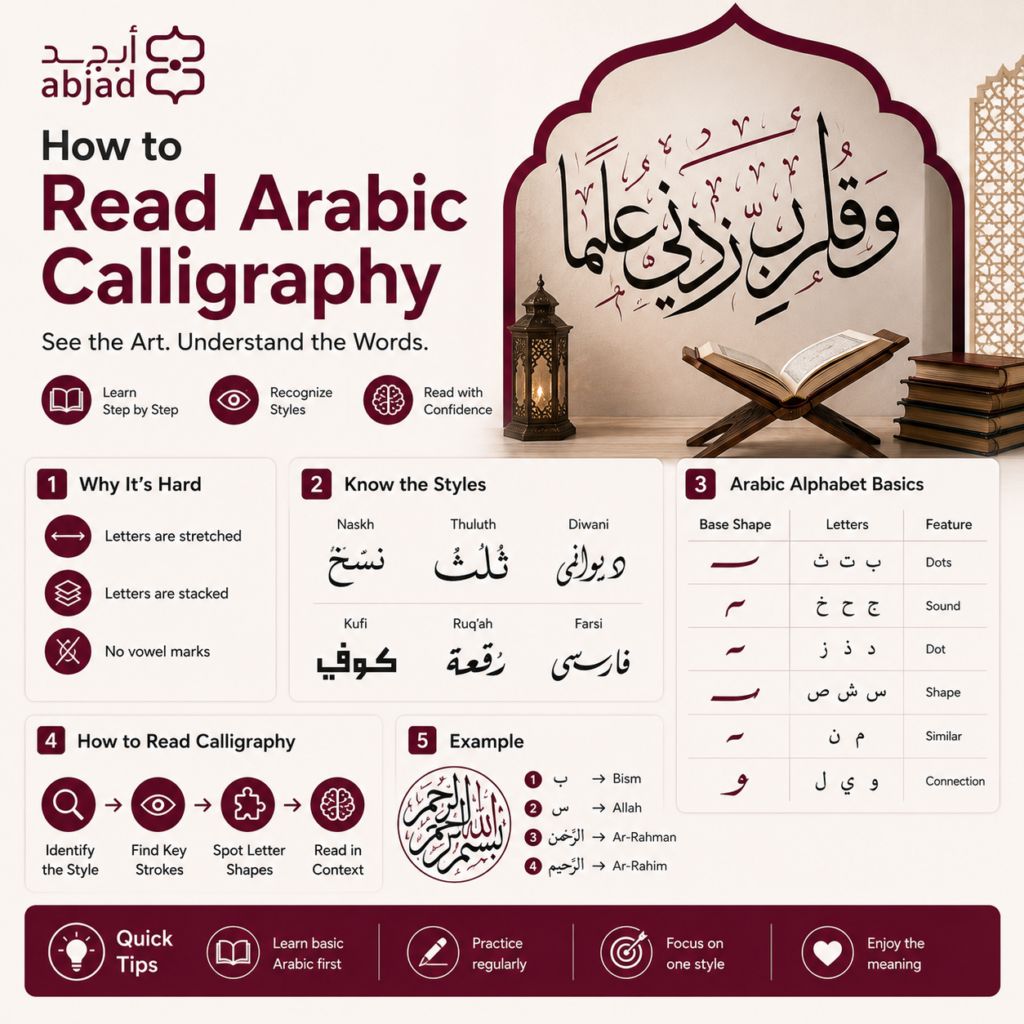
Reading Arabic calligraphy is a learnable skill. It requires understanding the Arabic script basics, recognizing which calligraphy style you’re looking at, and knowing how each style distorts or decorates standard letter forms. Once you know what to look for, the words start to emerge from the art.
This guide walks you through every step — how to read Arabic calligraphy for beginners, the main Arabic calligraphy script types, how to read the Arabic calligraphy alphabet, and real examples of Arabic calligraphy with explanations.
Step 1 — Understand Why Arabic Calligraphy Is Difficult to Read
Before learning how to read Arabic calligraphy, it helps to understand exactly what makes it harder to read than standard Arabic text.
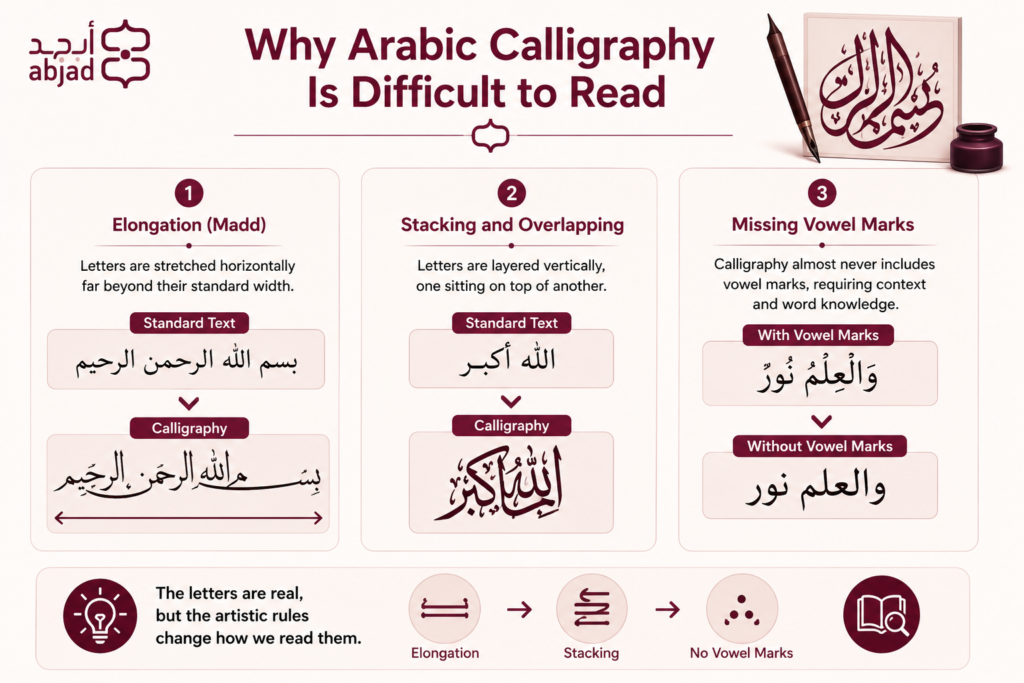
Arabic calligraphy is not simply decorative handwriting. It is a visual art form in which letter shapes are intentionally stretched, compressed, interlocked, rotated, or ornamented to create aesthetic compositions. The words are real — the letters are real — but their proportions and arrangements follow artistic rules, not just linguistic ones.
Three specific features cause most reading difficulties:
A. Elongation (Madd):
Letters are stretched horizontally far beyond their standard width, especially in Thuluth and Diwani styles. A single letter can span several centimeters, making it unrecognizable at first glance.
B. Stacking and overlapping:
In some styles, letters are layered vertically — one sitting on top of another — rather than running in a horizontal line. This is common in Thuluth compositions and in large architectural inscriptions.
C. Missing vowel marks:
Standard Arabic text for learners includes short vowel marks (harakat) above and below letters. Calligraphy almost never includes them, requiring the reader to infer vowels from context and word knowledge.
Knowing these three obstacles in advance is itself a reading tool — when you encounter something unreadable, you now know which of these three features is likely causing the confusion. Learners who build strong foundational Arabic reading skills first — through a structured course like Abjad Institute’s Quranic Arabic course — develop the letter-recognition and vowel-inference skills that transfer directly to reading calligraphy.
Start Your Quranic Arabic Learning Journey with a FREE Trial Class in the UAE

Step 2 — Learn the Arabic Calligraphy Script Types
How to read Arabic calligraphy depends heavily on which script type you are looking at. Each style distorts the standard alphabet differently, so identifying the style first gives you a reading framework before you attempt individual letters.
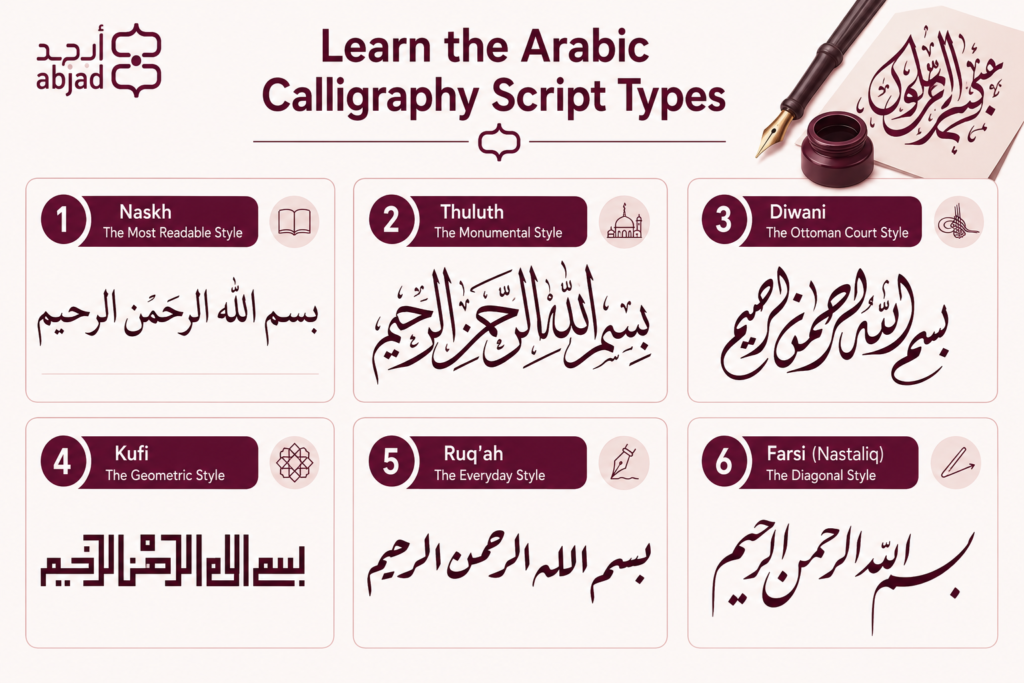
These are the six main Arabic calligraphy script types:
A. Naskh — The Most Readable Style
Naskh is the closest calligraphy style to modern printed Arabic. Letters are clear, proportionate, and minimally decorated. It is the style used in the Quran, in most books, and in newspapers. For anyone learning how to read Arabic calligraphy for beginners, Naskh is the correct starting point — reading it feels close to reading standard Arabic text, which makes it the ideal bridge between script literacy and calligraphy reading.
B. Thuluth — The Monumental Style
Thuluth is characterized by long, sweeping vertical strokes and heavily curved letter endings. It appears most often in mosque architecture, Quranic headings, and formal decorative panels. Letters are elongated significantly, and stacking is common. Reading Thuluth requires identifying the vertical anchor strokes first, then working outward to find connecting letters.
C. Diwani — The Ottoman Court Style
Diwani was developed during the Ottoman Empire for royal correspondence and official decrees. It is the most cursive of the major styles — letters flow into each other in tight, rounded loops, with almost no sharp angles. Spacing between letters is minimal, and the baseline curves rather than running straight. Diwani is considered the most difficult script type to read, even for native Arabic speakers.
D. Kufi — The Geometric Style
Kufi is the oldest Arabic calligraphy style, characterized by angular, geometric letter forms with almost no curves. It appears frequently in early Islamic manuscripts, coins, and architectural tile work. Reading Kufi requires a different visual approach than other styles — letters are built from horizontal and vertical strokes, with right angles dominating the composition.
E. Ruq’ah — The Everyday Style
Ruq’ah is the style most Arabs use for everyday handwriting. It is simple, fast, and compact, with minimal decoration. While not considered a formal calligraphy style in the traditional sense, recognizing Ruq’ah is practically important because it is what handwritten Arabic — on signs, notes, and informal documents — actually looks like.
F. Farsi (Nastaliq) — The Diagonal Style
Farsi calligraphy, also called Nastaliq, is characterized by a strong diagonal movement — letters and words slope downward from right to left. It is widely used in Persian, Urdu, and some Arabic literary contexts. The diagonal baseline is the visual signature that identifies this style immediately.
Read also: Basic Arabic Reading Practice In The UAE – 10 Proven Methods
Inside Our Live Classes
Don’t just take our word for it—see for yourself! Click below to watch short clips from our live classes and meet the instructors who will guide your learning journey.
Begin Your Arabic Journey in the UAE
Join Abjad Institute for a professional and immersive Arabic language experience tailored to your goals.
Book Your Free TrialRead More: How to Read Arabic Time?
Step 3 — Learn the Arabic Calligraphy Alphabet
To read Arabic calligraphy, you must first be able to recognize each of the 28 Arabic letters in their standard forms — then learn how calligraphy stretches, decorates, or obscures them.
The Arabic Calligraphy Alphabet: Core Letter Groups
Arabic letters are most efficiently learned in shape families — groups of letters that share the same base form and differ only in the number and position of dots.
| Base Shape | Letters | Distinguishing Feature |
| One-curve base | ب / ت / ث | 1, 2, or 3 dots below or above |
| Hook base | ج / ح / خ | No dot, dot below, dot above |
| Diagonal base | د / ذ | No dot, one dot above |
| Curved hook | ر / ز | No dot, one dot above |
| Double curve | س / ش | No dots, 3 dots above |
| Oval base | ص / ض | No dot, one dot above |
| Vertical stroke | ط / ظ | No dot, one dot above |
| Eye shape | ع / غ | No dot, one dot above |
| Open hook | ف / ق | One dot above, two dots above |
| Palm shape | ك / ل / م / ن | Distinct connecting forms |
| Loop | ه / و | Distinct isolated forms |
| Vertical | ا / ي | Simplest and most modified in calligraphy |
How Calligraphy Modifies These Letters?
In calligraphic scripts, the base shapes above are preserved — but their proportions change dramatically. The key reading principle is: dots are your anchor. In almost every calligraphy style, the dots above and below letters remain recognizable even when the base shape is heavily modified. When a letter becomes unreadable, locate the dots first — they will tell you which letter family you are looking at.
One practical note for beginners: the letters alif (ا) and lam (ل) appear together so frequently in Arabic — in the definite article al- (ال) — that recognizing this combination in any calligraphy style is one of the fastest reading shortcuts available. Once you can spot alif-lam at a glance, you can anchor your position in any Arabic calligraphy text.
Learning to write these letter forms — not just recognize them — builds the fastest reading ability. Abjad Institute’s Arabic writing course develops letter formation from the foundations through connected script, covering exactly the positional forms (initial, medial, final, isolated) that calligraphy modifies most heavily.
Master Arabic Writing Step by Step with a FREE Trial Class in the UAE

Read More: How to Read Arabic in the UAE?
Step 4 — Read Arabic Calligraphy for Beginners
How to read Arabic calligraphy for beginners is not about decoding everything at once. It is about applying a consistent method each time you encounter a piece — working from the large scale down to individual letters.
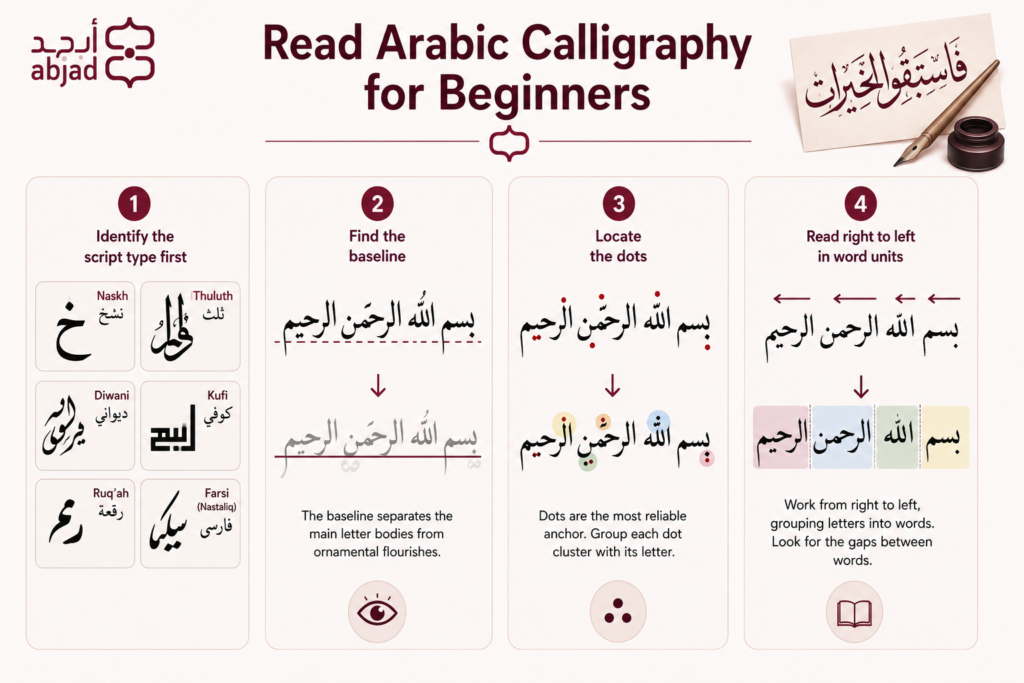
A. Identify the script type first
Before reading any letters, decide which of the six script types you are looking at. Angular and geometric? Kufi. Heavy vertical strokes with curves? Thuluth. Tight flowing loops? Diwani. This identification shapes everything that follows.
B. Find the baseline
Every Arabic calligraphy piece has a baseline — the invisible horizontal (or diagonal, in Nastaliq) line on which the main letter bodies sit. Finding it lets you separate the main letter strokes from the decorative descenders and ornamental flourishes that hang below.
C. Locate the dots
Scan the composition for dots — above and below letter bodies. As noted in Step 3, dots are the most reliable reading anchor in any calligraphy style. Group each dot cluster with the letter body nearest to it, and use that pairing to identify the letter.
D. Read right to left in word units
Arabic reads right to left, and calligraphy is no exception. Work across the composition from right to left, grouping connected letters into word units. In Naskh and Ruq’ah this is straightforward. In Thuluth and Diwani, letters within a word may be stacked or overlapping — look for the gaps between words, which are almost always preserved even in highly decorative compositions.
A common beginner mistake is trying to read Arabic calligraphy letter by letter from the start. Experienced readers scan for word shapes first — the overall silhouette of a word — and use that pattern recognition to confirm letter identification. This is a skill that develops with exposure, not just instruction. Learners who build vocabulary through structured Arabic study — such as Abjad Institute’s Madinah Arabic course — develop word-shape recognition much faster, because they have already encountered those words hundreds of times in readable form before meeting them in calligraphy.
Discover Madinah Arabic Today with a FREE Trial Class in the UAE
Step 5 — Study Examples of Arabic Calligraphy to Build Recognition
Reading theory builds a foundation. Reading actual examples of Arabic calligraphy builds fluency. The most effective practice method is to work through known texts in calligraphic form — where you already know what the words say — and train yourself to find the letters within the decorative forms.
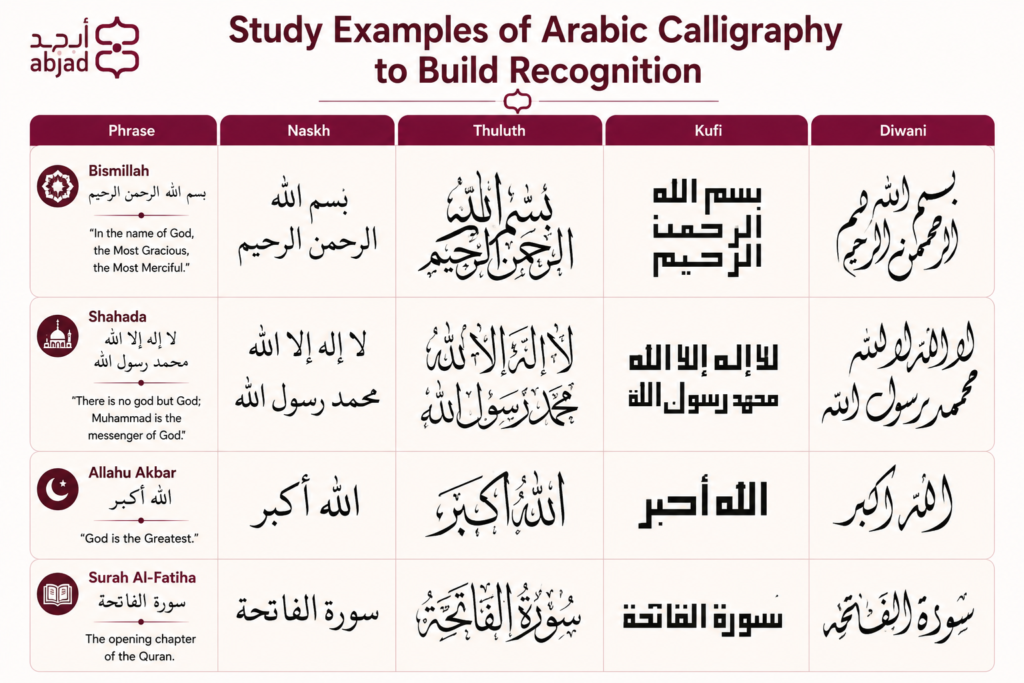
Start with phrases you know, then gradually move to unfamiliar verses. Your brain first recognizes the shape of letters and words, not just the meaning, which builds faster fluency in reading decorative scripts.
Read more: How to Learn Quranic Arabic Free Online in the UAE?
Step 6 — Practice Reading Arabic Calligraphy Daily
Reading Arabic calligraphy becomes automatic through daily exposure, not through occasional study sessions. These four habits build recognition faster than any other approach.
A. Read one calligraphic piece every day
Choose a single piece — from a museum archive, an Islamic art database, or a photograph — and apply the four-step method from Step 4. Even five minutes of focused reading practice daily produces measurable improvement within two to three weeks.
B. Start with Naskh, then expand
Spend your first two to three weeks exclusively on Naskh calligraphy, which is closest to standard Arabic script. Only move to Thuluth or Diwani once you can read Naskh compositions confidently. Jumping directly to ornate styles is the most common beginner mistake — it creates discouragement without building real skill.
C. Write the letters yourself
The fastest route to reading calligraphy is learning to write it. When you form a letter with a pen, you understand its structure in a way that passive observation cannot replicate. You notice which strokes are structural and which are decorative — and that distinction is exactly what reading calligraphy requires.
D. Compare the same text across multiple styles
Take one known phrase — Bismillah is ideal — and find five different calligraphic renditions of it in five different styles. Reading the same words in Naskh, Thuluth, Kufi, Diwani, and Ruq’ah simultaneously is the single most efficient exercise for building cross-style recognition.
Watch Our Classes in Action
Curious what a real session looks like? Take a peek inside our interactive classrooms and see how our expert instructors bring the Arabic language to life. Watch a sample lesson below!
Begin Your Arabic Journey in the UAE
Join Abjad Institute for a professional and immersive Arabic language experience tailored to your goals.
Book Your Free TrialMaster Arabic Calligraphy with Abjad Institute
Reading Arabic calligraphy goes hand in hand with mastering the Arabic script. At Abjad Institute, our structured courses strengthen your letter recognition, vocabulary, and reading fluency, making calligraphy not just beautiful to admire, but truly readable.
Whether you are starting from scratch or building on existing knowledge, Abjad Institute offers courses tailored to your level, helping you develop confidence and skill in reading Arabic calligraphy step by step.
Book your free trial at Abjad Institute
Discover Our Arabic Courses
- Arabic Course in the UAE
- Arabic Intensive Course
- Learn Arabic from Scratch Course
- Madinah Arabic Course
- Arabic Classes for Adults
- Arabic Classes for Beginners
- Self-Paced Arabic Course
- Basic Arabic Course
- Arabic Speaking Classes
- Learn to Write Arabic Course
- Arabic Grammar Course
- Learn Arabic Alphabet Course

Begin Your Arabic Journey in the UAE
Join Abjad Institute for a professional and immersive Arabic language experience tailored to your goals.
Book Your Free TrialConclusion
Learning how to read Arabic calligraphy comes down to six steps: understand what makes calligraphy harder to read than standard script, identify which of the six Arabic calligraphy script types you are looking at, learn the Arabic calligraphy alphabet through shape families and dot anchoring, apply the four-step reading method consistently, practice on known examples of Arabic calligraphy, and build daily reading habits that turn recognition into fluency.
Arabic calligraphy is not a secret code. It is the same 28-letter alphabet you find in any Arabic text — stretched, decorated, and composed according to centuries-old artistic conventions. Once you understand those conventions, the words emerge from the art. That moment — when a piece you once saw as pure decoration suddenly becomes readable text — is what makes this skill worth building.
Frequently Asked Questions
Learning Arabic calligraphy can seem challenging at first, but with the right approach, beginners can build recognition, understand different styles, and read beautifully composed texts. Below are answers to the most common questions to help you get started and make steady progress in your calligraphy journey.
How do you read Arabic calligraphy for beginners?
Start by identifying the script type — Naskh is the most readable and the correct starting point for beginners. Then find the baseline of the composition, locate the dots above and below letter bodies to anchor letter identification, and read right to left in word units. Practice on known phrases like Bismillah, where you already know the words, so you can train yourself to find the letters within the decorative forms.
What are the main Arabic calligraphy script types?
The six main Arabic calligraphy script types are Naskh (clear and readable, closest to printed Arabic), Thuluth (monumental with elongated vertical strokes), Diwani (flowing Ottoman court style with curved loops), Kufi (angular and geometric, the oldest style), Ruq’ah (simple everyday handwriting style), and Farsi/Nastaliq (diagonal baseline, common in Persian and Urdu contexts).
How do you read the Arabic calligraphy alphabet?
Read the Arabic calligraphy alphabet by learning letters in shape families — groups of letters that share a base form and differ only in their dots. In any calligraphy style, the dots above and below letters are the most reliable identification anchor, even when the base shape is heavily elongated or decorated.
What are good examples of Arabic calligraphy to practice reading?
The best examples of Arabic calligraphy for beginners to practice reading are Bismillah (بسم الله الرحمن الرحيم), the Shahada (لا إله إلا الله محمد رسول الله), Allahu Akbar (الله أكبر), and Surah Al-Fatiha.
These phrases are widely reproduced across all calligraphy styles, they are short enough to work through completely, and knowing what the words say lets you train letter recognition without the added difficulty of decoding unknown vocabulary.
How long does it take to learn to read Arabic calligraphy?
Most beginners who practice daily can read Naskh calligraphy comfortably within four to six weeks, given solid foundational Arabic script literacy. Reading Thuluth fluently typically takes three to six months of regular practice. Diwani — the most decorative style — can take a year or more to read reliably.
The single biggest factor is how strong your standard Arabic reading ability is before you start: learners who read printed Arabic fluently progress through calligraphy reading significantly faster than those who begin both skills simultaneously.
Can I learn to read Arabic calligraphy without knowing Arabic?
You can learn to recognize individual letter shapes in calligraphy without knowing Arabic — but you cannot read calligraphy meaningfully without understanding the language. Reading calligraphy means decoding words, not just identifying decorative shapes.
Building foundational Arabic reading ability first — through the alphabet, basic vocabulary, and script connection — makes calligraphy reading both faster to develop and far more rewarding once achieved.





Leave a Reply