 Speak Arabic
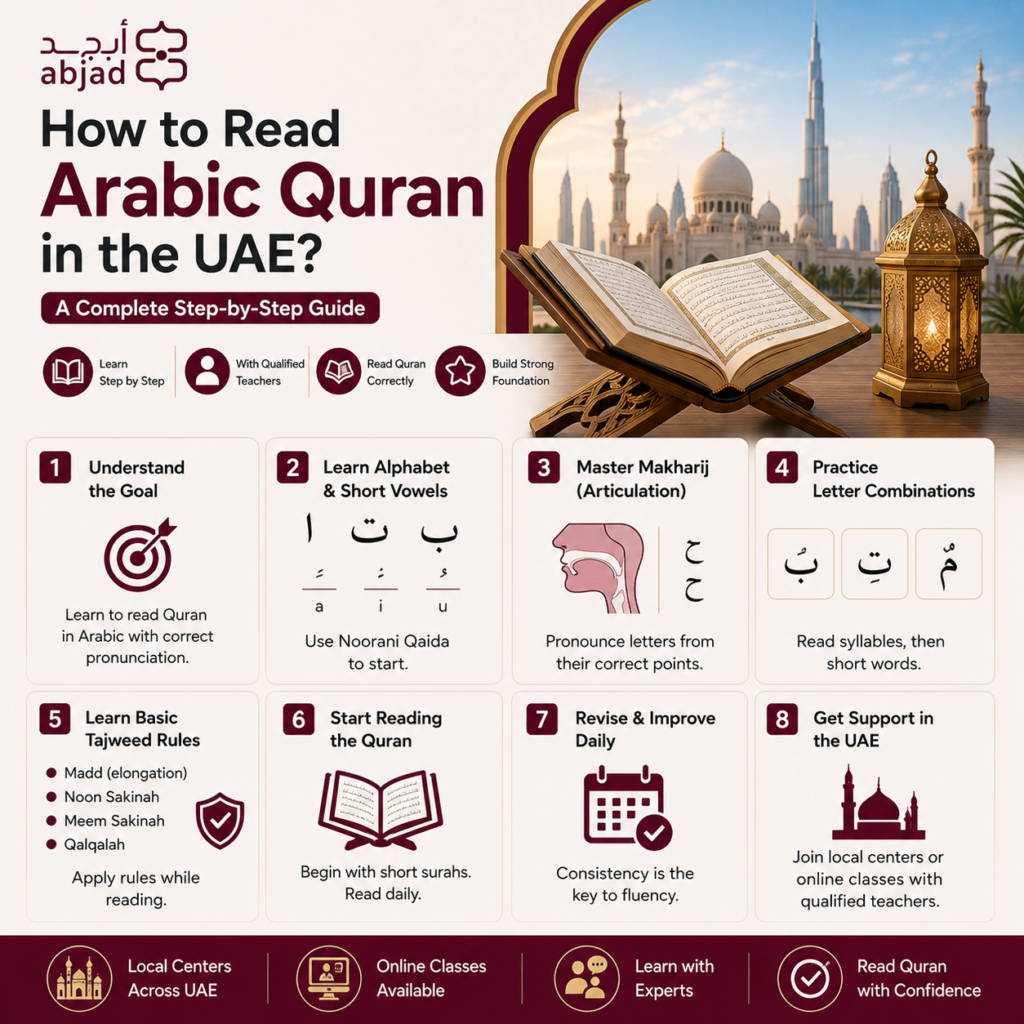
You live in the UAE. You pass mosques every day, hear the Quran recited at prayer times broadcast across Dubai, Abu Dhabi, and Sharjah — and you want to read it yourself in Arabic. But every time you sit down with the Mushaf, the letters blur together, the vowel marks confuse you, and you close it feeling further away than when you started.
Learning how to read the Arabic Quran in the UAE is more achievable here than almost anywhere else in the world. The Emirates has government-funded mosque programs, Islamic cultural centers in every emirate, and online academies built specifically for the UAE’s expat-majority Muslim community — people whose mother tongue is Urdu, Tagalog, English, Malayalam, or French, not Arabic. The infrastructure is here. What most learners are missing is a clear, sequential method that matches the UAE reality.
Step 1 — Understand What “How to Read Arabic in Quran” Actually Means
Learning how to read Arabic in the Quran is not the same as learning to speak or understand Arabic. It is a phonetic decoding skill — you are learning to look at a written letter, recognize it, and produce its correct sound. Millions of Muslims in the UAE and across the world recite the Quran accurately in Arabic without speaking a word of conversational Arabic.
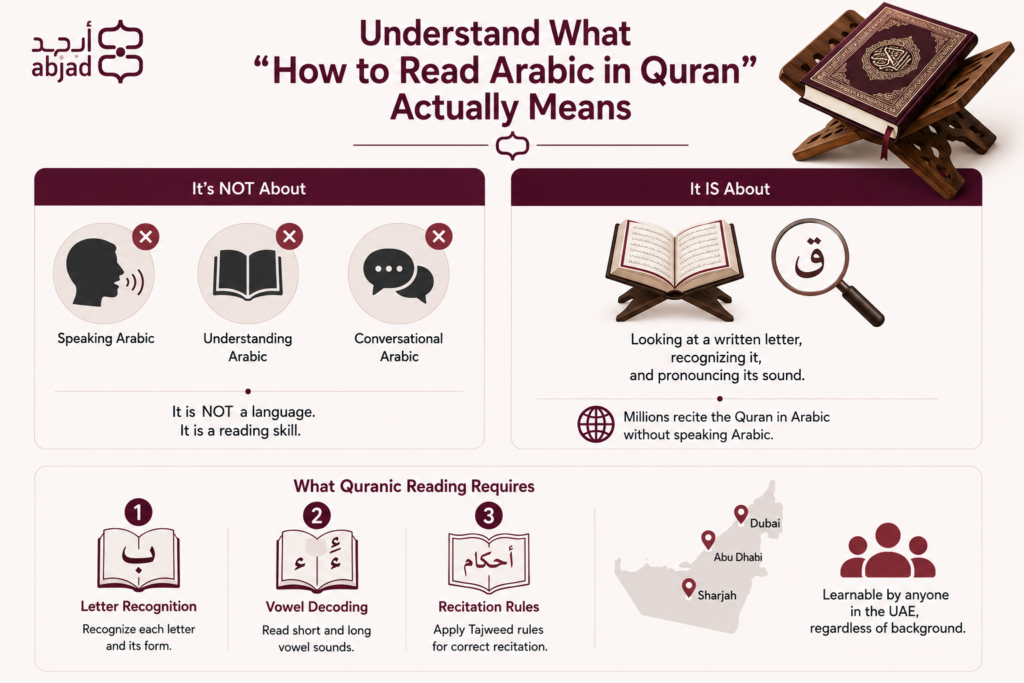
This distinction is especially important in the UAE, where over 88% of residents are expatriates. Most Muslims living in Dubai Marina, Abu Dhabi’s Khalidiyah district, or Sharjah’s Al Nahda area are native speakers of Urdu, English, Tagalog, Bengali, or Malayalam — not Arabic. They are not learning Arabic as a second language. They are learning to read one specific text in one specific script, and that is a completely learnable goal with the right method.
What Quranic reading requires is three things: letter recognition, vowel decoding, and recitation rules. These three skills can be built in sequence regardless of your Arabic background, your nationality, or how long you have lived in the UAE.
If you want to go beyond Quranic reading into understanding Arabic itself, Abjad Institute offers Arabic courses for adults that build on Quranic reading foundations and extend into full language comprehension — a natural progression once recitation fluency is established.
Unlock Your Arabic Speaking Skills Today with a FREE Trial Class in the UAE

Step 2 — Learn the Arabic Alphabet and Short Vowels (The Noorani Qaida)
The single most important step in learning how to read Arabic for the Quran is mastering the alphabet before touching the Mushaf. This is non-negotiable — and it is the step most UAE adult learners try to skip, usually because they feel embarrassed starting from scratch or because they assume they can pick up letters “along the way.”
They cannot. Every Quran teacher in Dubai, Abu Dhabi, and Sharjah will tell you the same thing: students who skip foundational alphabet training develop mispronunciation habits that take years to correct.
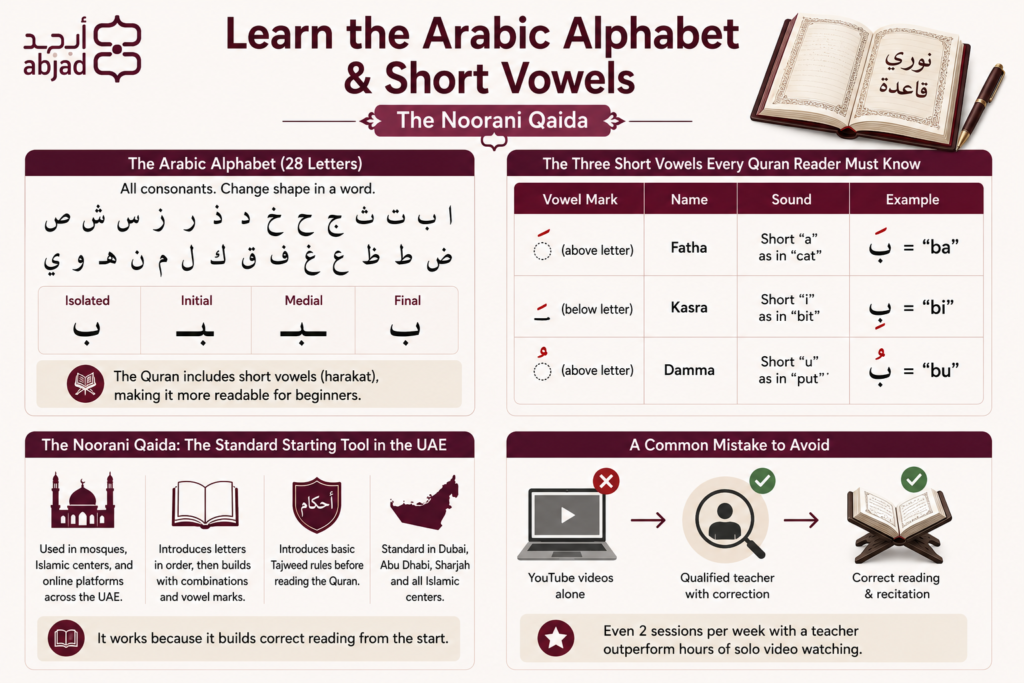
The Arabic alphabet has 28 letters — all consonants. Each letter changes shape depending on its position in a word: isolated, initial, medial, or final. In the Quran, short vowel marks called harakat are written above and below every letter, which actually makes the Quran more readable than everyday Arabic text where these marks are omitted. For a beginner learning to read Arabic for the Quran, this is a significant advantage.
The Three Short Vowels Every Quran Reader Must Know
To read the Quran correctly, every learner must understand the three short vowels: Fatha, Kasra, and Damma. These vowels form the foundation of proper pronunciation, making reading easier and preserving the beauty of recitation. Below is a table showing each vowel, its sound, and an example:
| Vowel Mark | Name | Sound | Example |
| َ (above letter) | Fatha | Short “a” as in “cat” | بَ = “ba” |
| ِ (below letter) | Kasra | Short “i” as in “bit” | بِ = “bi” |
| ُ (above letter) | Damma | Short “u” as in “put” | بُ = “bu” |
The Noorani Qaida: The Standard Starting Tool in the UAE
The Noorani Qaida is a structured phonetic primer used in mosque programs, Islamic centers, and online platforms across the UAE. It introduces Arabic letters in a specific sequence, builds through letter combinations and vowel markings, and introduces basic Tajweed rules — all before the student opens the Quran itself.
In practical UAE terms: if you enroll in a Quran reading circle at the Mohammed bin Rashid Centre for Islamic Culture in Dubai, the Zayed House for Islamic Culture in Abu Dhabi, or any of Sharjah’s Islamic centers, the first booklet they will hand you is the Noorani Qaida. It is the universal entry point, and for good reason — it works.
A common mistake among UAE professionals is trying to learn the alphabet from YouTube videos alone. Videos provide exposure but not correction. A qualified teacher watching you write and pronounce letters in real time catches errors before they become habits. Even two sessions per week with a teacher — online or in person — dramatically outperforms hours of solo video watching.
Watch Our Classes in Action
Curious what a real session looks like? Take a peek inside our interactive classrooms and see how our expert instructors bring the Arabic language to life. Watch a sample lesson below!
Begin Your Arabic Journey in the UAE
Join Abjad Institute for a professional and immersive Arabic language experience tailored to your goals.
Book Your Free TrialRead More: How to Learn to Read Arabic Online for Free?
Step 3 — Master Articulation Points (Makharij al-Huruf)
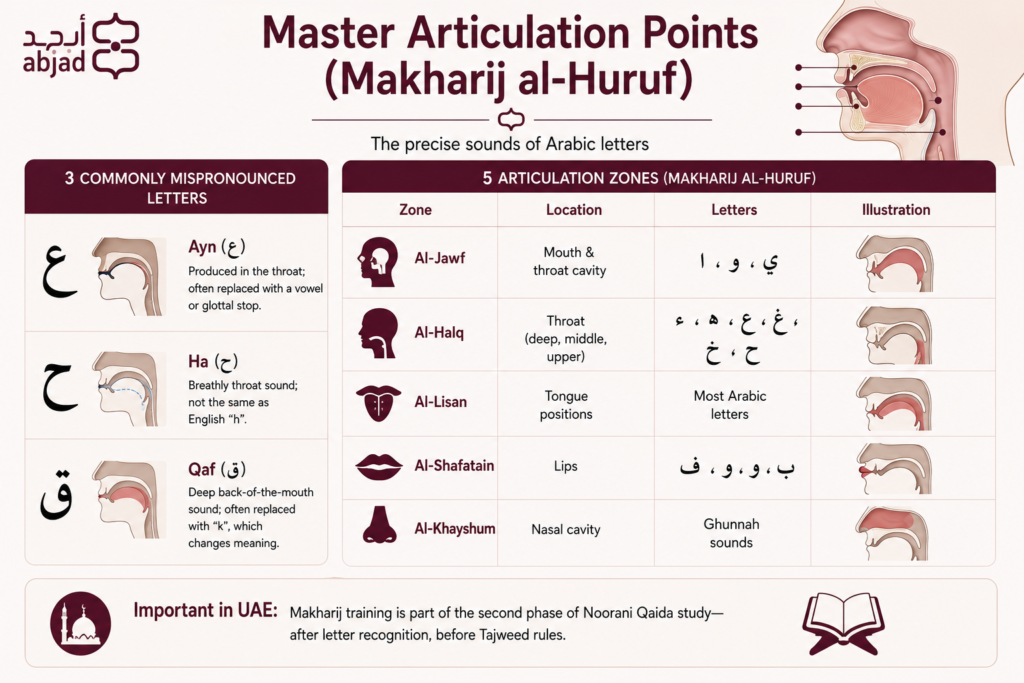
Makharij al-Huruf (مخارج الحروف) means the precise articulation points of each Arabic letter — the exact locations in the mouth, throat, and lips where each sound must originate. Arabic contains sounds that do not exist in English, Urdu, Tagalog, Hindi, or most other languages spoken across the UAE’s 200-nationality population. Without training these articulation points specifically, learners substitute familiar sounds from their native language for unfamiliar Arabic ones.
Three Commonly Mispronounced Letters
Some Arabic letters are tricky for beginners because they don’t exist in most other languages. Mastering these sounds is essential for correct Quranic recitation and to avoid changing the meaning of words.
- ع (Ayn): Produced in the throat; often replaced with a vowel or glottal stop.
- ح (Ha): Breathly throat sound; not the same as English “h”.
- ق (Qaf): Deep back-of-the-mouth sound; often replaced with “k”, which changes meaning.
Five Articulation Zones
To read Arabic letters correctly, it’s essential to know where each sound comes from in the mouth, throat, lips, and nose. The following table shows the five main articulation zones (Makharij al-Huruf) and the letters associated with each zone.
| Zone | Location | Letters |
| Al-Jawf | Mouth & throat cavity | ا، و، ي |
| Al-Halq | Throat (deep, middle, upper) | ء، ه، ع، غ، ح، خ |
| Al-Lisan | Tongue positions | Most Arabic letters |
| Al-Shafatain | Lips | ب، م، و، ف |
| Al-Khayshum | Nasal cavity | Ghunnah sounds |
In UAE mosque programs, Makharij training is integrated into the second phase of Noorani Qaida study — after letter recognition is established but before full Tajweed rules are introduced. This sequence is deliberate and should not be rearranged.
Read More: Learn How to Write and Read Arabic for Beginners
Step 4 — Study Tajweed Rules to Read the Arabic Quran Easy and Correctly
Tajweed (تجويد) is the science of Quranic recitation — the rules governing how letters are pronounced, how long vowels are held, and how adjacent letters interact. It is not optional or advanced. It is the standard to which all Quranic recitation is held, and learning its foundational rules is considered an obligation (fard) for every Muslim who recites the Quran aloud.
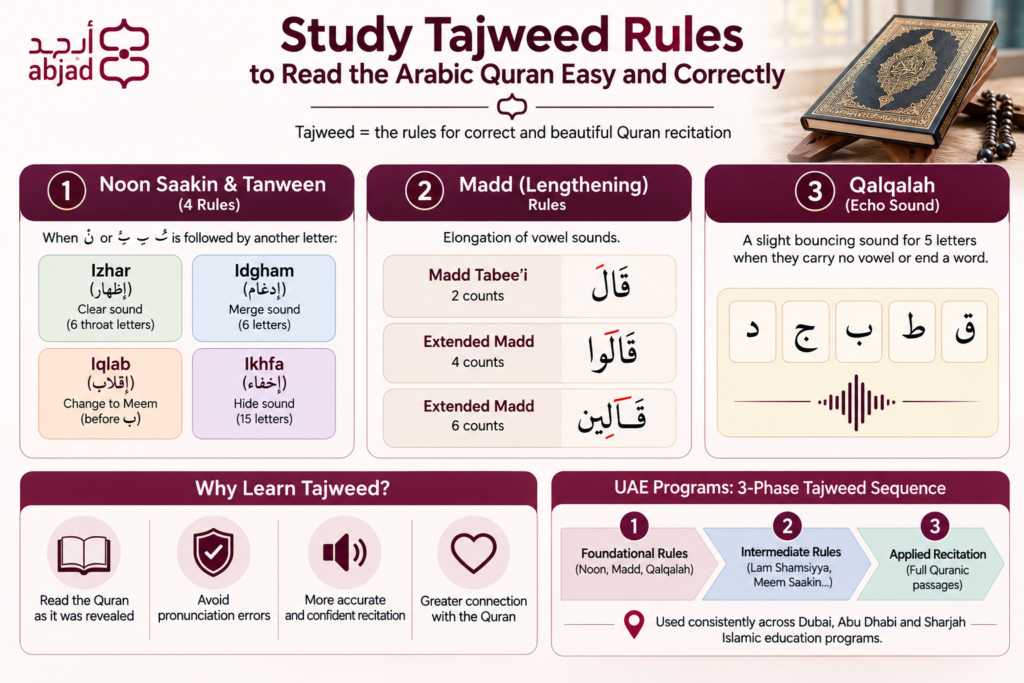
Learning Tajweed is also what makes reading the Arabic Quran easy in the long run. Learners who skip Tajweed and read “by ear” hit a ceiling — their recitation becomes inconsistent, they cannot identify their own errors, and they need to unlearn habits before they can progress. Learners who build Tajweed correctly from the start find that the rules make recitation more automatic, not less, because every letter follows a predictable, rule-governed pattern.
Before diving into Tajweed, it’s important to focus on the core rules that every Quran learner must master first. These rules form the foundation of proper recitation, helping you pronounce letters correctly, elongate vowels accurately, and produce the unique sounds of the Quran.
A. Noon Saakin and Tanween — the four rules:
When a Noon with no vowel (نْ) or a double vowel mark (Tanween) appears before another letter, one of four rules applies:
- Izhar (إظهار): Clear pronunciation before the six throat letters (ء، ه، ع، غ، ح، خ)
- Idgham (إدغام): Merging — the Noon sound merges into one of six letters (ي، ر، م، ل، و، ن)
- Iqlab (إقلاب): Conversion — the Noon converts to a Meem sound before ب
- Ikhfa (إخفاء): Hiding — the Noon is partially concealed before the remaining 15 letters
B. Madd (Lengthening) Rules:
Madd refers to the elongation of vowel sounds, measured in counts. The natural Madd (Madd Tabee’i) holds a vowel for two counts. Extended Madd rules stretch this to four or six counts depending on what follows. Getting Madd wrong is the most audible Tajweed error in recitation — and the one most commonly heard in UAE halaqat where learners have not received structured instruction.
C. Qalqalah (Echo Sound):
Five letters — ق، ط، ب، ج، د — produce a slight bouncing echo when they carry no vowel or appear at the end of a word. This rule is unique to Quranic recitation and has no parallel in everyday spoken Arabic.
How UAE Programs Sequence Tajweed Instruction?
Across Dubai, Abu Dhabi, and Sharjah, structured Tajweed courses follow a three-phase approach: foundational rules (Noon Saakin, Madd, Qalqalah) first; intermediate rules (Lam Shamsiyya, Meem Saakin, heavy and light letters) second; applied recitation of full Quranic passages third. Whether the program runs in English, Urdu, or Arabic, this three-phase structure is consistent across UAE Islamic education institutions.
Step 5 — Practice With Qualified Tutors and Programs Available in the UAE
Knowing Tajweed rules is necessary. Applying them correctly under qualified, real-time guidance is what converts knowledge into actual recitation ability. No app, YouTube channel, or audio recording can replace a teacher who hears your mistakes and corrects them immediately.
A. Government Mosque Programs:
The UAE’s Ministry of Tolerance and Coexistence and the General Authority of Islamic Affairs and Endowments (Awqaf) coordinate free Quran reading programs in mosques across all seven emirates. Classes run after Fajr, Maghrib, and Isha prayers and are open to all UAE residents — Emirati and expat alike. Gender-separated classes are standard, with dedicated groups for English, Urdu, and Arabic speakers in major mosques across Dubai and Abu Dhabi.
B. Islamic Cultural Centers:
The Islamic Cultural Centre in Abu Dhabi (Zayed House for Islamic Culture) and the Mohammed bin Rashid Centre for Islamic Culture in Dubai offer structured Quran reading courses with formal enrollment, level assessments, and completion certificates. These centers are particularly suited to UAE professionals who need a structured program with measurable progress rather than informal mosque attendance.
C. Online Platforms Serving UAE Residents:
Several online Quran academies specifically serve the UAE market — classes timed for Gulf Standard Time, instructors with Egyptian and Saudi Ijazah certification, and course structures designed for adult working professionals in Dubai and Abu Dhabi. This format suits the UAE’s professional expat community, where shift patterns, commute times, and family schedules make fixed mosque attendance difficult.
For children of UAE residents — whether Emirati families or expat households in Dubai’s Jumeirah, Abu Dhabi’s Khalidiyah, or Sharjah’s Al Nahda — Abjad Institute’s Arabic courses for kids integrate Quranic reading readiness with age-appropriate Arabic language building, combining what mosque programs and language schools usually deliver separately.
Start Your Child’s Arabic Learning Journey with a FREE Trial Class in the UAE
Read more: 12 Benefits of Learning Quranic Arabic
Step 6 — Build Daily Habits That Fit the UAE Lifestyle
Learning how to read Arabic Quran easy and fluently is not about studying more — it is about studying consistently. The UAE lifestyle — long working hours, commutes between emirates, shift-based professions in hospitality and healthcare, and family commitments — makes large daily study blocks unrealistic for most residents. The solution is not longer sessions but smarter anchoring.
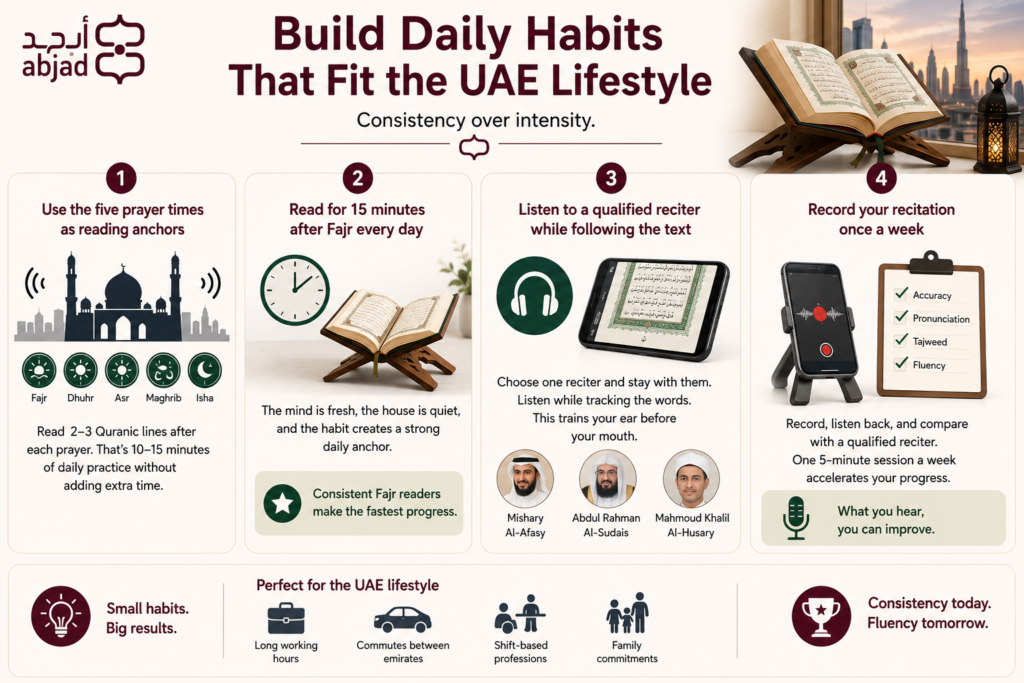
A. Use the five prayer times as reading anchors
The UAE broadcasts Adhan across every city five times daily. Most UAE residents hear it whether they are at home, in the office, or in a mall. Reading even two to three Quranic lines after each prayer — without opening a course book, without reviewing rules, just reciting — adds up to ten to fifteen minutes of daily practice without requiring any additional time in your schedule.
B. Read for fifteen minutes after Fajr every day
Fajr is the prayer UAE Quran teachers most consistently recommend for Quranic practice. The mind is fresh, the house is quiet before school and work begin, and the habit creates a clean daily anchor that does not compete with evening fatigue. Learners in UAE mosque halaqat who adopt this single habit consistently outperform those who study for longer periods at irregular times.
C. Listen to a qualified reciter while following the text
Choose one reciter and stay with them — Sheikh Mishary Rashid Al-Afasy (widely followed across the Gulf), Sheikh Abdul Rahman Al-Sudais (Imam of the Grand Mosque in Mecca), or Sheikh Mahmoud Khalil Al-Husary (the standard for learning recitation) are the three most used in UAE programs. Listen while tracking the words on the page. This trains your ear to correct sounds before your mouth attempts to produce them.
D. Record your recitation once a week
This is the habit UAE Quran teachers recommend most and students resist most. Recording your own recitation and comparing it to a qualified reciter makes errors audible that you cannot hear in real time. One five-minute recording session per week — played back immediately after — accelerates progress faster than any additional lesson.
For learners who want to explore the full range of structured Arabic learning options available through Abjad Institute — from Quranic reading foundations through to conversational and classical Arabic — the complete Arabic courses page gives a clear overview of every available pathway and level.
Enroll in the UAE’s Best Arabic Course and Begin with a FREE Trial Class

Inside Our Live Classes
Don’t just take our word for it—see for yourself! Click below to watch short clips from our live classes and meet the instructors who will guide your learning journey.
Begin Your Arabic Journey in the UAE
Join Abjad Institute for a professional and immersive Arabic language experience tailored to your goals.
Book Your Free TrialRead the Quran Correctly and Confidently with Abjad Institute
Whether you are a Dubai professional with an hour a week to spare, an Abu Dhabi parent learning alongside your children, or a Sharjah resident who has been meaning to start for years — structured guidance from qualified teachers is what makes the difference between slow, uncertain progress and measurable, consistent improvement.
At Abjad Institute, courses are built for exactly the learner profile that defines the UAE: adults and children from non-Arabic backgrounds who want to read the Quran correctly, with teachers who correct you in real time and a structure that fits around your life.
Book your free trial at Abjad Institute
- Classical Arabic Course
- Emirati Arabic Course
- Gulf Arabic Course
- Learn Saudi Arabic
- Business Arabic Course UAE
- Arabic Language Classes for Professionals in UAE
- Quranic Arabic Course

Begin Your Arabic Journey in the UAE
Join Abjad Institute for a professional and immersive Arabic language experience tailored to your goals.
Book Your Free TrialConclusion
Learning how to read the Arabic Quran in the UAE comes down to six steps: understand that Quranic reading is a phonetic skill that does not require conversational Arabic, master the alphabet and short vowels through the Noorani Qaida, train articulation points (Makharij) that self-study learners consistently skip, study Tajweed rules starting with Noon Saakin and Madd, practice under qualified tutors available through UAE mosques, Islamic centers, and online platforms, and build daily habits anchored to the UAE’s prayer time structure and lifestyle realities.
The UAE offers more structured Quranic reading support than almost anywhere else in the world. Government mosque programs, Islamic cultural centers, and online platforms all serve the Emirates’ uniquely diverse Muslim community — a population where the majority are learning to read the Quran in a script that is not their native one. The resources are here. The method is clear. The only remaining step is beginning.
Frequently Asked Questions
If you’re wondering how to read the Arabic Quran in the UAE, you’re not alone. Whether you’re a complete beginner or looking to improve your recitation, understanding the right sequence, daily habits, and guidance from qualified teachers is key. Below are the most frequently asked questions to help you start your Quranic journey with confidence.
How do you read the Arabic Quran in the UAE as a complete beginner?
Start with the Noorani Qaida — the phonetic primer used in mosque programs and Islamic centers across Dubai, Abu Dhabi, and Sharjah. It teaches the 28 Arabic letters, their positional forms, and short vowel marks before you approach the Quran itself. Most UAE mosque programs and online platforms serving Gulf residents use the Noorani Qaida as the universal entry point. Daily 15-minute practice sessions — ideally after Fajr — produce faster results than longer irregular sessions.
How do you learn to read Arabic in the Quran without knowing the language?
Reading Arabic in the Quran is a phonetic skill, not a language skill. You are learning to decode a script and produce its sounds correctly — not to understand Arabic grammatically or conversationally. Start with the Arabic alphabet and harakat (short vowel marks), train your articulation points (Makharij) for sounds that don’t exist in your native language, and practice Tajweed rules under a qualified teacher. Millions of UAE residents from South Asian, Southeast Asian, and Western backgrounds read the Quran fluently in Arabic without speaking the language.
How do you read the Arabic Quran easy for beginners?
The fastest route to reading the Arabic Quran easily is the correct sequence: alphabet and vowels first through the Noorani Qaida, articulation points second, Tajweed rules third, and supervised practice fourth. Skipping Makharij training — the most common mistake among UAE self-study learners — creates pronunciation errors that slow progress significantly later. Daily short sessions with a qualified teacher who corrects errors in real time is what makes Quranic reading feel easy rather than effortful.
Where can you learn to read the Arabic Quran in the UAE?
Options across all seven emirates include free government mosque programs run after prayer times by the General Authority of Islamic Affairs and Endowments (Awqaf), structured courses at the Zayed House for Islamic Culture in Abu Dhabi and the Mohammed bin Rashid Centre for Islamic Culture in Dubai, and online platforms with Gulf Standard Time-scheduled classes taught by Ijazah-certified instructors. Abjad Institute offers structured online courses accessible from anywhere in the UAE, with programs for both adults and children.
What is Tajweed and is it necessary to read the Quran in the UAE?
Tajweed is the science of Quranic recitation rules — governing letter pronunciation, vowel length, and how adjacent letters interact with each other. It is considered an obligation for every Muslim who recites the Quran, not an optional advanced topic. UAE mosque programs, Islamic cultural centers, and online platforms all include Tajweed as a core component of structured Quran reading courses. The foundational rules — Noon Saakin, Madd, and Qalqalah — are learnable within the first few months of consistent study.
How long does it take to learn to read the Arabic Quran in the UAE?
Most adult beginners in the UAE with no prior Arabic knowledge who practice consistently — 15 minutes daily with qualified guidance — can read basic Quranic Arabic within three to four months. Reaching fluent, Tajweed-accurate recitation typically takes six to twelve months. Children enrolled in structured programs generally progress faster. The two biggest factors are consistency of daily practice and quality of instruction — both more important than total hours accumulated.



Leave a Reply