 Learn Arabic
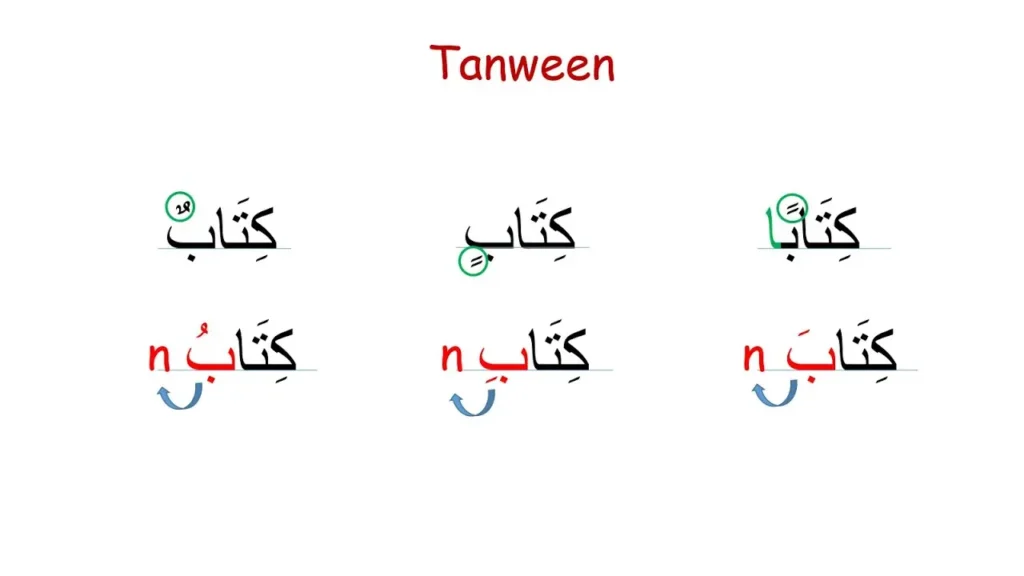
Walk into any Arabic class in the UAE and mention vowel markers, and tanween will come up within minutes. It is one of those features that unsettles beginners at first glance — two small strokes above or below the final letter of a word — but becomes entirely logical the moment someone explains what those strokes actually represent.
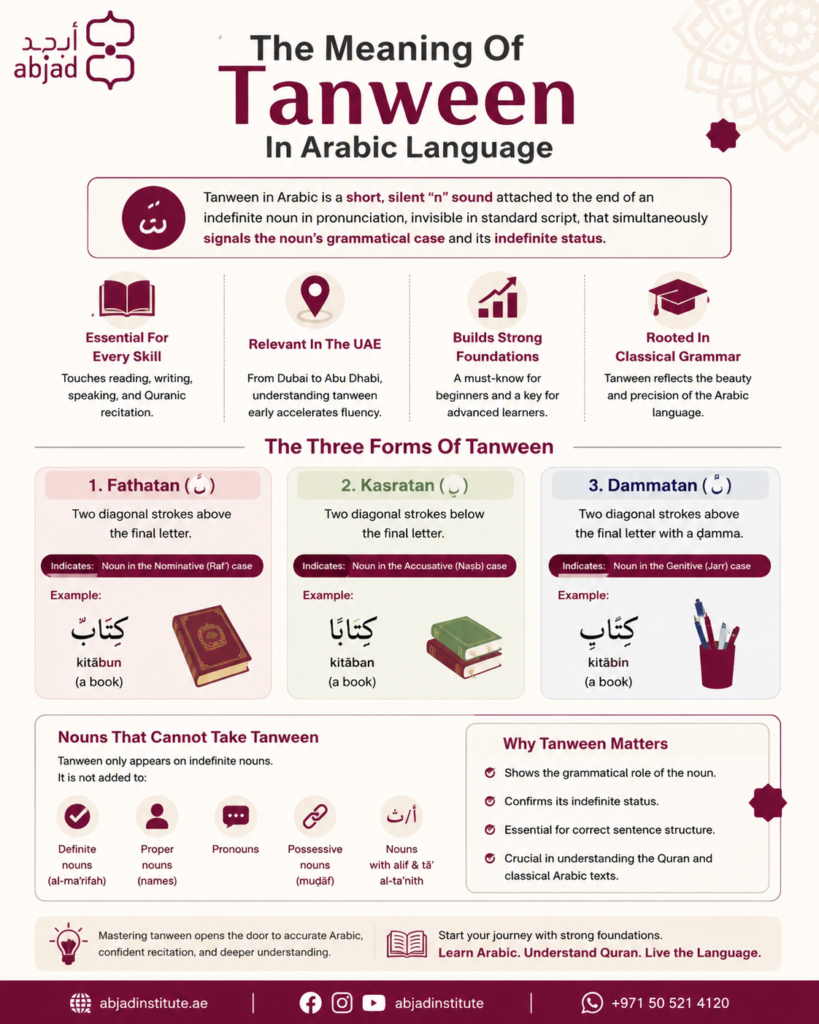
Tanween in Arabic is a short, silent “n” sound attached to the end of an indefinite noun in pronunciation, invisible in standard script, that simultaneously signals the noun’s grammatical case and its indefinite status.
For learners building their Arabic in Dubai, Abu Dhabi, or anywhere else across the UAE, grasping tanween early shortens the path to fluency considerably. It touches reading, writing, speaking, and Quranic recitation.
For anyone just starting out, a solid grounding in learn how to write and read Arabic for beginners gives the script foundation that makes tanween recognition far less daunting.
This guide covers exactly what is tanween in Arabic, how its three forms work, practical tanween in Arabic examples, the nouns that cannot take it, and the classical grammar categories that advanced learners should know.
What you will learn in this article
- What tanween is and why it is heard in speech but never written as a letter.
- The three types of tanween in Arabic and the grammatical case each one signals.
- Clear examples showing how tanween shifts form with the noun’s position in a sentence.
- The three structural conditions that block a noun from taking tanween.
- The four classical types of tanween recognised by Arab grammarians.
- How tanween appears in Quranic recitation and why it matters for tajweed.
What Is Tanween in Arabic and How Does It Work?
Tanween — التنوين in classical terminology — is defined by Arab grammarians as an extra silent nun (ن) that attaches to the end of a noun in pronunciation but never appears as a written letter.
Grammarians represented it by doubling the final vowel marker: two dammas (ٌ), two fathas (ً), or two kasras (ٍ). The word itself derives from the root nawwana (نَوَّنَ), meaning to add a nun-sound to a word.
The answer to the question of what is a tanween in Arabic is that it is an exclusive marker of nouns.
Verbs and particles cannot carry it. When you spot doubled diacritics on the last letter of a word, you know the word is a noun, that it is indefinite (the equivalent of the English articles “a” or “an”), and that it is a fully declinable word.
Before diving into the forms, learning how to read Arabic letters in the UAE gives you the script fluency to spot tanween markers immediately rather than puzzling over them line by line.
Start Your Arabic Course for Beginners UAE Today

A. Why Tanween Is Pronounced but Not Written as Noon
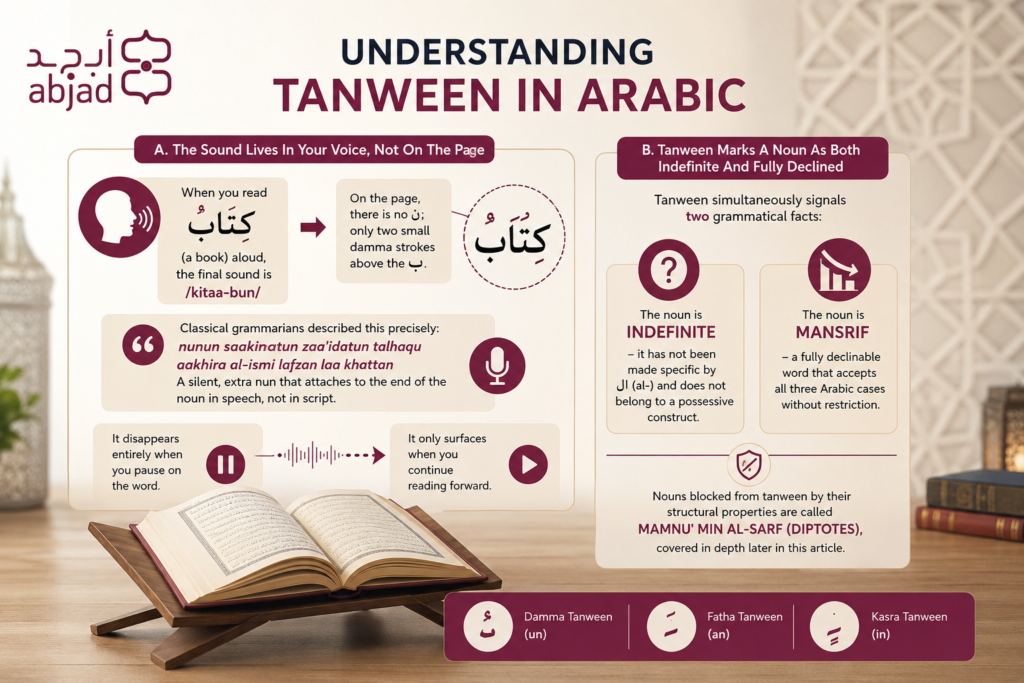
The phonetic reality of tanween catches many learners off guard. When you read كِتَابٌ (a book) aloud, the final sound is /kitaa-bun/ — the “un” is the tanween. Yet on the page, there is no ن; there are only two small damma strokes above the ب.
Classical grammarians described this precisely: nunun saakinatun zaa’idatun talhaqu aakhira al-ismi lafzan laa khattan — a silent, extra nun that attaches to the end of the noun in speech, not in script. It disappears entirely when you pause on the word; it only surfaces when you continue reading forward.
This gap between what is written and what is spoken is one of the defining features of Arabic diacritical notation.
Anyone who wants to understand how Arabic script encodes grammatical information at the letter level will find that exploring how to read Arabic script in the UAE opens that system in a practical, structured way.
Upgrade your life in the UAE and Start Your Arabic Writing Journey Now

B. How Tanween Marks Indefinite and Fully Declined Nouns
Tanween simultaneously signals two grammatical facts. First, the noun is indefinite, it has not been made specific by the article ال (al-) and does not belong to a possessive construct.
Second, the noun is mansrif, a fully declinable word that accepts all three Arabic cases without restriction.
Nouns blocked from tanween by their structural properties are called mamnu’ min al-sarf (diptotes), covered in depth later in this article.
The Three Types of Tanween and Their Grammatical Cases
The three forms of tanween correspond directly to the three Arabic grammatical cases: nominative (raf’), accusative (nasb), and genitive (jarr). The form changes to match the case, but the underlying meaning — an indefinite, declinable noun — stays constant.
These are the types of tanween in Arabic that every learner encounters first and uses most consistently throughout Modern Standard Arabic reading and writing.
1. Tanween Damm (ٌ): The “Un” Sound for the Nominative Case
Tanween damm places two damma strokes above the final letter of the noun, producing the sound /un/ in pronunciation.
It appears when the noun is in the nominative case — as a sentence subject, a predicate, or the nominative element in certain verbal structures.
| Arabic | Transliteration | Meaning | Role |
| كِتَابٌ | kitaabun | a book | subject |
| قَلَمٌ | qalamun | a pen | subject |
| طِفْلٌ | tiflun | a child | subject |
Example sentence: جَاءَ طَالِبٌ — A student came (Jaa’a taalibun).
Secure Your Place in the Fusha Arabic Course at Abjad Institute

2. Tanween Fath (ً): The “An” Sound and Extra Alif Rule
Tanween fath places two fatha strokes above the final letter and — in most words — adds a silent extra alif after the last root letter. It signals the accusative case and produces the sound /an/.
The extra alif is a visual convention, not a vowel; it carries no pronunciation value.
The extra alif is omitted in four specific situations:
- The word ends in taa’ marbuta (ة): e.g., مَدْرَسَةً (madrasatan)
- The word ends in a hamza preceded by alif: e.g., سَمَاءً (samaa’an)
- The word ends in an alif maqsura (ى): e.g., مُسْتَشْفىً (mustashfan)
- The word ends in a hamza written on the alif itself: e.g., مَبْدَأً (mabda’an)
| Arabic | Transliteration | Meaning |
| كِتَابًا | kitaaban | a book (direct object) |
| بَيْتًا | baytan | a house (direct object) |

Read also: The Meaning Of The Nominal Sentence In Arabic
3. Tanween Kasr (ٍ): The “In” Sound for the Genitive Case
Tanween kasr places two kasra strokes beneath the final letter, producing the sound /in/.
It signals the genitive case, which appears after prepositions and as the second element in a possessive construct when that noun is indefinite.
| Arabic | Transliteration | Meaning |
| فِي بَيْتٍ | fi baytin | in a house |
| مِنْ مَسْجِدٍ | min masjidin | from a mosque |
| بِقَلَمٍ | bi-qalamin | with a pen |
The same noun moving through all three cases: كِتَابٌ (subject) → كِتَابًا (direct object) → كِتَابٍ (after a preposition). The root never changes — only the tanween form shifts to reflect the noun’s role in the sentence.
Master Arabic Grammar Today at Abjad Academy

Watch Our Classes in Action
Curious what a real session looks like? Take a peek inside our interactive classrooms and see how our expert instructors bring the Arabic language to life. Watch a sample lesson below!
Begin Your Arabic Journey in the UAE
Join Abjad Institute for a professional and immersive Arabic language experience tailored to your goals.
Book Your Free TrialTanween Examples in Everyday Arabic Sentences
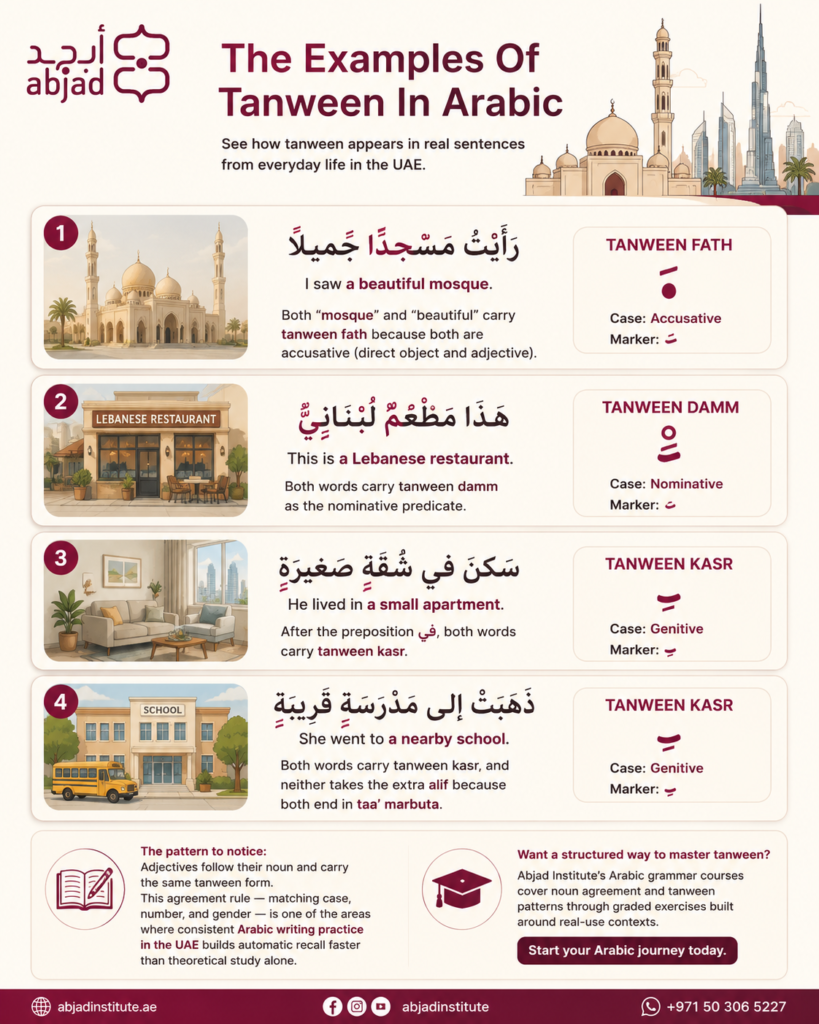
Abstract grammar rules land differently when connected to real sentences. Here are tanween in Arabic examples drawn from everyday contexts a UAE resident would readily recognise.
- رَأَيْتُ مَسْجِدًا جَمِيلًا — I saw a beautiful mosque. Both “mosque” and “beautiful” carry tanween fath because both are accusative (direct object and adjective).
- هَذَا مَطْعَمٌ لُبْنَانِيٌّ — This is a Lebanese restaurant. Both words carry tanween damm as the nominative predicate.
- سَكَنَ فِي شَقَّةٍ صَغِيرَةٍ — He lived in a small apartment. After the preposition في, both words carry tanween kasr.
- ذَهَبَتْ إِلَى مَدْرَسَةٍ قَرِيبَةٍ — She went to a nearby school. Both words carry tanween kasr, and neither takes the extra alif because both end in taa’ marbuta.
Adjectives follow their noun and carry the same tanween form. This agreement rule — matching case, number, and gender — is one of the areas where consistent Arabic writing practice in the UAE builds automatic recall faster than theoretical study alone.
When Arabic Nouns Cannot Take Tanween
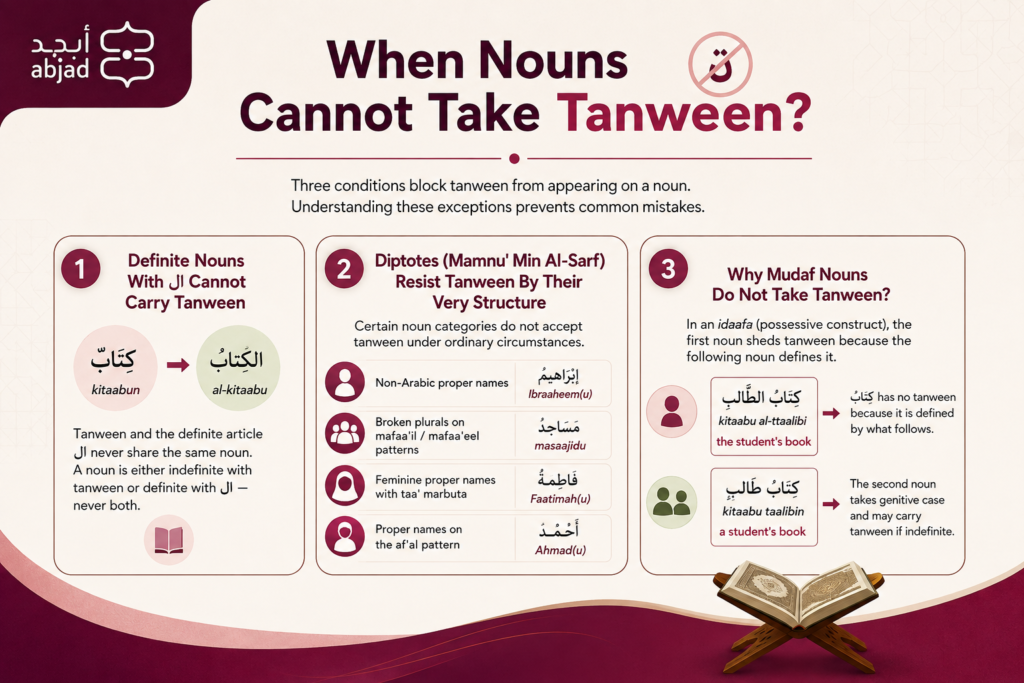
Knowing when tanween appears is half the picture; knowing when it disappears completes it. Three structural conditions block a noun from taking tanween, and confusing these with the regular pattern is one of the most consistent errors Arabic learners make.
1. Why Definite Nouns With ال Cannot Take Tanween
The rule is absolute: tanween and the definite article ال never share the same noun. A word is either indefinite with tanween or definite with ال — never both simultaneously.
كِتَابٌ becomes الكِتَابُ the moment ال is added; the double damma collapses to a single damma, and the “n” sound disappears entirely.
This is not arbitrary — tanween exists precisely to flag this noun has no specific reference yet, so as soon as the noun becomes specific, the signal becomes redundant and drops.
The same logic applies when a noun is made specific by being addressed by name or by context: a noun cannot simultaneously carry the indefinite marker while also being fully identified.
2. Why Diptotes (Mamnu’ Min Al-Sarf) Do Not Take Tanween
Certain noun categories — called mamnu’ min al-sarf or non-declinable nouns do not accept tanween under ordinary circumstances.
These include proper names of non-Arabic origin (إِبْرَاهِيمُ, يُوسُفُ, مَرْيَمُ), broken plural patterns on the mafaa’il and mafaa’eel templates (مَسَاجِدُ, مَنَاطِقُ), feminine proper names carrying taa’ marbuta (فَاطِمَةُ, عَائِشَةُ), and proper names on the af’al pattern (أَحْمَدُ, أَكْرَمُ).
In classical poetry, grammarians permitted tanween on diptotes as a licensed departure — tanween al-daruura (tanween of necessity) — to preserve metrical integrity. Outside poetry, the rule holds.
For UAE learners navigating the Quranic text, where diptotes appear frequently in proper names and certain plural forms, understanding how to read Arabic Quran in the UAE alongside grammar study makes these encounters far less confusing.

3. Why Mudaf Nouns Lose Tanween in Idafa
When a noun becomes the first element in an idaafa (possessive construct), it sheds its tanween because the following noun defines it.
كِتَابُ الطَّالِبِ (the student’s book) — كِتَاب carries no tanween because it has been made specific by what follows. The second noun in the construct takes the genitive case and may itself carry tanween if it is indefinite: كِتَابُ طَالِبٍ (a student’s book).
This three-way distinction — definite with ال, defined by construct state, or genuinely indefinite with tanween — is the core of Arabic noun definiteness, and getting comfortable with it is what separates fluid reading from halting, word-by-word decoding.
Types of Tanween in Arabic Grammar
Most learners only ever need the three grammatical tanween forms covered above.
But classical Arabic grammar — the tradition preserved in Ibn Malik’s Alfiyya and the foundational work of Sibawayhi — identified up to ten types of tanween depending on function.
For learners working toward scholarly Arabic or deep Quranic study, four types carry genuine practical relevance.
A. Tanween Al-Tamkin: The Standard Tanween for Declined Nouns
Tanween al-tamkin (تنوين التمكين), also called tanween al-sarf, is the form discussed throughout this article — the tanween that signals a noun is fully inflected, indefinite, and grammatically unrestricted.
The name tamkin comes from the root meaning “to be firmly established,” reflecting the idea that the noun is securely positioned within the nominal system: neither frozen like a particle, nor constrained like a diptote.
This is the tanween meant whenever any Arabic grammar source uses the term without further qualification.
It is also the form that appears on the vast majority of common nouns across Modern Standard Arabic texts, making it the first type any learner encounters and the one with the widest real-world application.
Read also: Arabic Harakat – 9 Essential Marks for Reading and Pronunciation
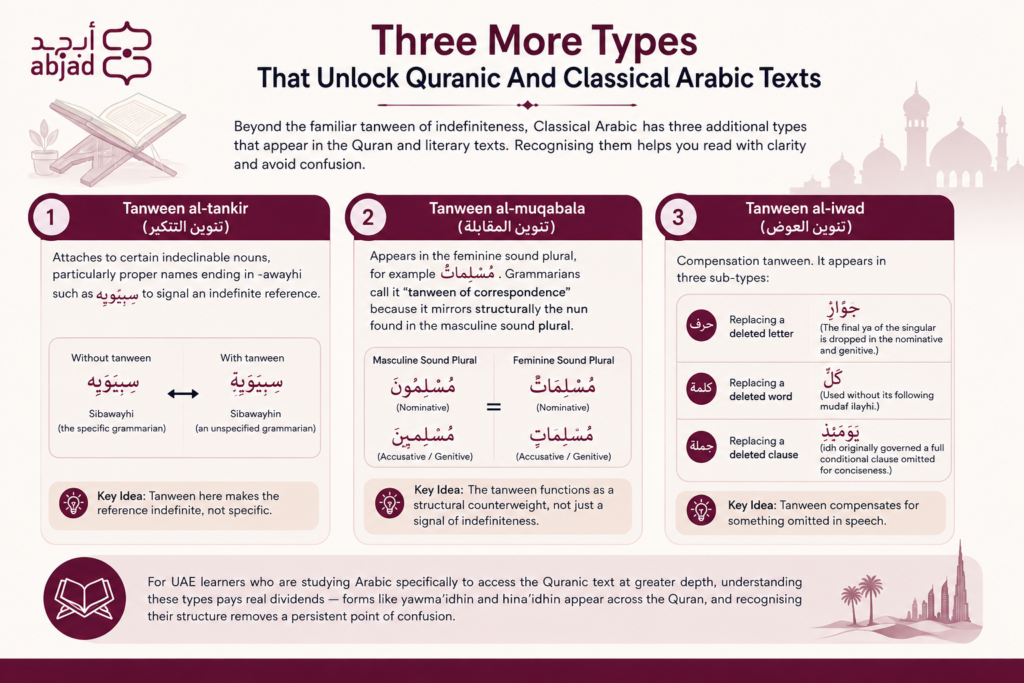
B. Tanween Al-Tankir, Al-Muqabala, and Al-Iwad Explained
Beyond tanween al-tamkin, classical Arabic grammar includes several other forms of tanween with specific grammatical functions.
The three most important for advanced learners are tanween al-tankir, tanween al-muqabala, and tanween al-iwad, each of which appears for a different reason.
1. Tanween Al-Tankir: Marking Indefiniteness
Tanween al-tankir (تنوين التنكير) attaches to certain indeclinable nouns, particularly proper names ending in -awayhi, such as سِيبَوَيهِ, to indicate an indefinite reference. Without tanween, Sibawayhi refers to the specific celebrated grammarian.
2. Tanween Al-Muqabala: Corresponding to the Masculine Plural Nun
Tanween al-muqabala (تنوين المقابلة) appears in the feminine sound plural, such as مُسْلِمَاتٌ. Grammarians call it “tanween of correspondence” because it structurally parallels the nun in the masculine sound plural (مُسْلِمُونَ / مُسْلِمِينَ).
3. Tanween Al-Iwad: Replacing Something Omitted
Tanween al-iwad (تنوين العوض) is a compensatory tanween that replaces something omitted from the original structure. It can replace a deleted letter, as in جَوَارٍ; a deleted word, as in كُلٌّ without its following mudaf ilayhi; or a deleted clause, as in يَوْمَئِذٍ.
Understanding these forms is especially useful for learners studying Quranic and Classical Arabic, where structures such as yawma’idhin and hina’idhin appear frequently.
Inside Our Live Classes
Don’t just take our word for it—see for yourself! Click below to watch short clips from our live classes and meet the instructors who will guide your learning journey.
Begin Your Arabic Journey in the UAE
Join Abjad Institute for a professional and immersive Arabic language experience tailored to your goals.
Book Your Free TrialBuild Your Arabic Foundation With Abjad Institute In The UAE
Abjad Institute is one of the UAE’s trusted Arabic language academies, delivering structured courses for children, teenagers, and adults across Dubai and Abu Dhabi.
Whether your goal is conversational fluency, Quranic recitation, classical grammar, or professional Arabic, Abjad’s qualified instructors build each student’s skills in a careful sequence.
The kind of foundation that makes grammar concepts like tanween feel intuitive rather than abstract. Courses run in-person and online, designed specifically for the UAE’s multilingual community.
Discover Our Arabic Courses:
- Arabic Classes for Beginners
- Arabic Course for Kids
- Arabic Conversation for Kids
- Arabic Qaida for Kids
- Beginner Arabic for Kids
- Arabic Grammar for Kids
- Teen Arabic Summer Course
- Arabic Kids Camps
- UAE Kindergarten Arabic Classes
- Modern Standard Arabic Course
- Fusha Arabic Course
- Classical Arabic Course
- Emirati Arabic Course
- Gulf Arabic Course
- Learn Saudi Arabic
- Business Arabic Course UAE
- Arabic Language Classes for Professionals in UAE

Conclusion
Tanween in Arabic rewards the effort put into understanding it. It is simultaneously a sound, a grammatical signal, and a writing convention, three distinct things packed into two diacritical strokes. The three core forms (damm, fath, kasr) map directly onto the three Arabic cases, making a tanween a built-in grammar guide that every declinable, indefinite noun carries automatically.
The conditions that block it — definite nouns, diptotes, and construct state nouns — follow logical structural patterns rather than arbitrary lists to memorise.
For learners in the UAE, where Arabic fills daily life on street signage, in media broadcasts, and in Quranic recitation at mosques, developing an ear for tanween accelerates both reading comprehension and spoken production.
The four classical types, tamkin, tankir, muqabala, and iwad; reveal how precisely Arab grammarians had mapped this system centuries before modern linguistics gave us formal frameworks to describe it. That precision is still built into every serious Arabic curriculum today.
Moving from knowing these rules to using them automatically takes consistent, structured practice. Learners who want to build that fluency in an environment designed for the UAE context will find resources focused on how to get better at reading Arabic in the UAE? offer practical methods that complement everything covered in this guide.
Read also: How Many Harakat In Arabic? A Complete Guide For UAE Learners
Frequently Asked Questions
What is tanween in Arabic?
Tanween is a silent extra “n” sound added to the end of an indefinite noun in Arabic pronunciation. It is represented in writing by doubling the final vowel marker — two dammas (ٌ), two fathas (ً), or two kasras (ٍ) — but no “n” letter is ever written out. It appears exclusively on nouns, signals indefiniteness, and changes form to match the noun’s grammatical case.
What is a Tanween in Arabic grammar, and how does it differ from a regular short vowel?
In Arabic grammar, tanween is a nun saakinah zaa’idah — a silent, extra nun that attaches to the last letter of a declinable noun in speech only. A regular short vowel (fatha, damma, or kasra) is a single diacritic marking one vowel sound. Tanween is a doubled diacritic representing a vowel sound followed by a silent “n”.
What are the three types of tanween in Arabic?
The three types are tanween damm (ٌ, producing the sound /un/ for the nominative case), tanween fath (ً, producing /an/ for the accusative case), and tanween kasr (ٍ, producing /in/ for the genitive case). All three signal that the noun is indefinite and fully declinable.
Can you give tanween in Arabic examples in full sentences?
قَرَأَ الطَّالِبُ كِتَابًا مُفِيدًا — The student read a useful book. Here كِتَابًا and مُفِيدًا both carry tanween fath (accusative) as the direct object and its adjective. هَذَا بَيْتٌ جَمِيلٌ — This is a beautiful house. Both بَيْتٌ and جَمِيلٌ carry tanween damm as nominative predicate and adjective.
Why does tanween fath sometimes come with an extra alif and sometimes without?
Tanween fath normally adds a silent extra alif after the final root letter of the noun — for example كِتَابًا. This alif is omitted in four cases: when the word ends in taa’ marbuta (ة), when it ends in an alif maqsura (ى), when the final hamza follows an alif (سَمَاءً), and when the hamza is written on the alif itself (مَبْدَأً).
Does tanween appear in Quranic Arabic?
Yes — tanween appears throughout the Quran on indefinite nouns across all three cases. Forms like يَوْمَئِذٍ (on that day) and حِينَئِذٍ (at that moment) carry tanween al-iwad, where the tanween substitutes for a deleted clause. Standard indefinite nouns carry tanween al-tamkin.







Leave a Reply