 Quran
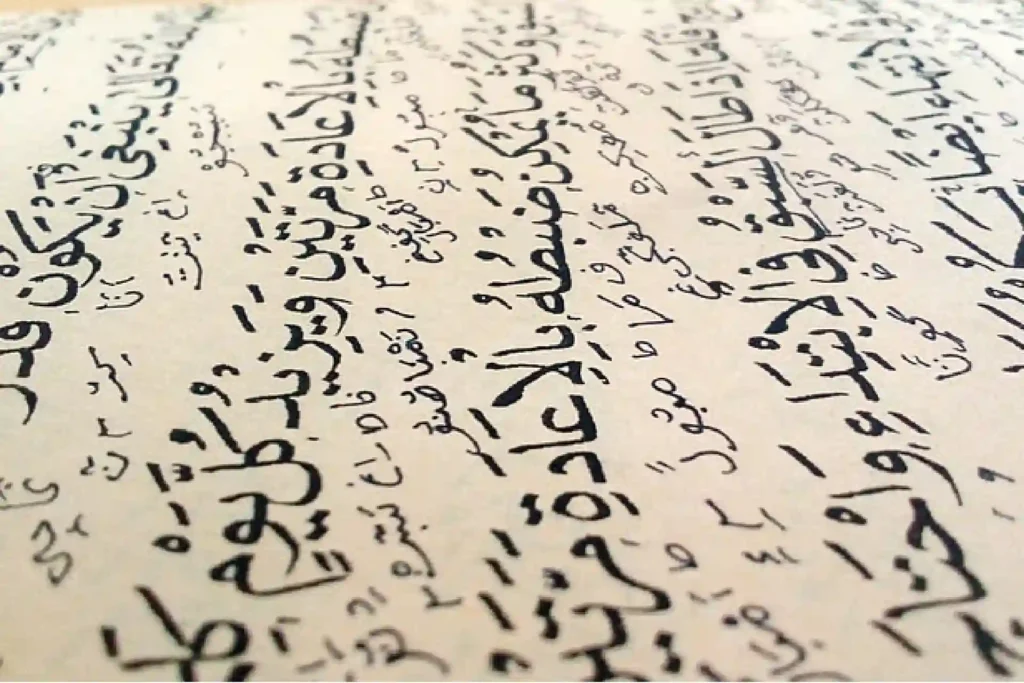
Arabic script surrounds you the moment you land in the UAE. Road signs carry it alongside English. Shop facades display it in elegant Naskh. Government buildings are inscribed with Kufic calligraphy that dates back centuries. And yet, for most expatriates and newcomers, those letters remain invisible — recognizable as Arabic, but entirely unreadable.
Whether you are a resident trying to navigate the Emirates more independently, a student of the Arabic language, or someone who simply wants to connect more deeply with the culture around them, the process is more structured — and more achievable — than most people expect.
Arabic script is a connected, right-to-left writing system built on 28 letters. Most of those letters change shape depending on where they appear in a word — at the start, in the middle, at the end, or standing alone.
This guide walks you through exactly how to read Arabic script in the UAE step by step, from the very first letter to reading connected words with confidence.

1. Understand The Direction And Structure Of How To Read Arabic Script In The UAE
Arabic is read and written from right to left. This is the first thing to rewire in your mind, especially if you are an English speaker accustomed to moving left to right across a page.
Beyond direction, Arabic is a cursive script by default. Letters within a word connect to each other, much like English cursive handwriting — except in Arabic, this is always the case, not a stylistic choice. Six letters (أ، د، ذ، ر، ز، و) only connect to letters on their right, never on their left. Every other letter connects on both sides when it appears in the middle of a word.
A practical tip for UAE residents: start noticing signs that carry both Arabic and English text — the bilingual format gives you an instant reference point for understanding what the Arabic section says before you can read it independently.
Start learning Arabic letters with a FREE trial class
2. Learn The 28 Arabic Letters In Their Isolated Form
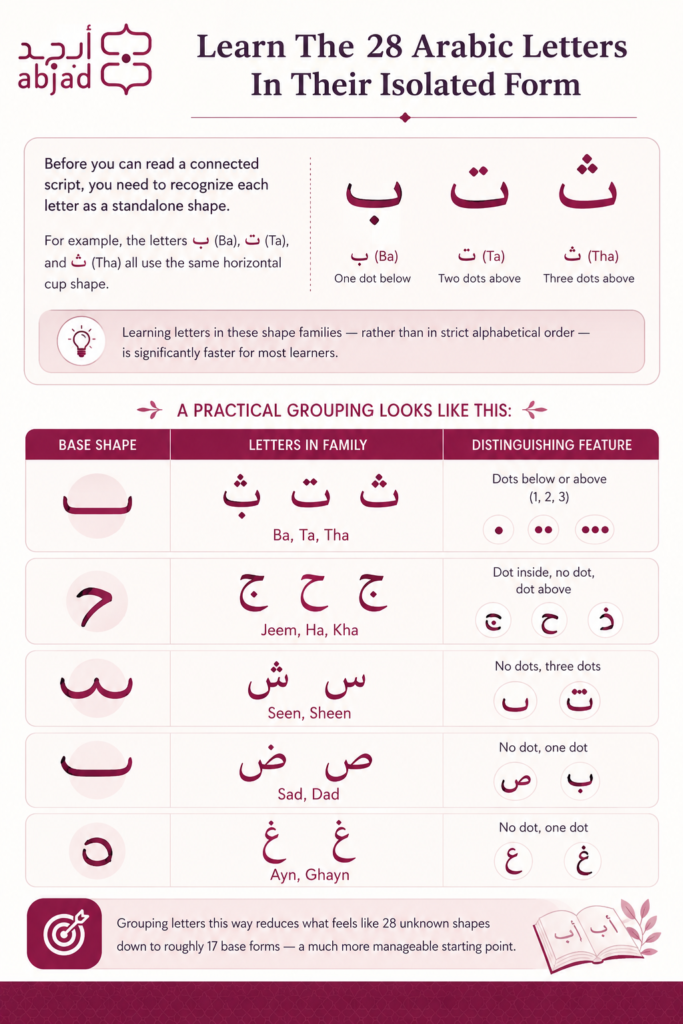
Before you can read a connected script, you need to recognize each letter as a standalone shape. Arabic has 28 letters, but they are not as visually distinct from each other as English letters are. Many share the same base shape and are differentiated only by the number and position of dots placed above or below.
For example, the letters ب (Ba), ت (Ta), and ث (Tha) all use the same horizontal cup shape. One dot below = Ba. Two dots above = Ta. Three dots above = Tha. Learning letters in these shape families — rather than in strict alphabetical order — is significantly faster for most learners.
A practical grouping looks like this:
| Base Shape | Letters in Family | Distinguishing Feature |
| ب ت ث | Ba, Ta, Tha | Dots below or above (1, 2, 3) |
| ج ح خ | Jeem, Ha, Kha | Dot inside, no dot, dot above |
| س ش | Seen, Sheen | No dots, three dots |
| ص ض | Sad, Dad | No dot, one dot |
| ع غ | Ayn, Ghayn | No dot, one dot |
Grouping letters this way reduces what feels like 28 unknown shapes down to roughly 17 base forms — a much more manageable starting point.
3. Learn The Four Positional Forms Of Each Arabic Letter
This is the step that most self-study guides underestimate, and it is the most common reason how to read Arabic script for beginners learning journeys stall.
Each Arabic letter has up to four different shapes depending on its position in a word: isolated (standing alone), initial (at the start of a word), medial (in the middle), and final (at the end). The core shape stays recognizable, but the extensions connecting it to neighboring letters change.
Take the letter م (Meem) as an example:
| Position | Shape | Context |
| Isolated | م | Standing alone |
| Initial | مـ | Beginning of a word |
| Medial | ـمـ | Middle of a word |
| Final | ـم | End of a word |
In the UAE, you will see Arabic in all four positional forms on every street, in every shop, and in every government document. Building visual fluency with positional forms is not optional — it is what allows you to decode the script you actually encounter in daily life, rather than just letters in a textbook.
Spend time each day identifying a single letter across different words and positions. Picking one letter per week and hunting for it on signs, menus, and packaging around Dubai or Abu Dhabi is one of the most effective real-world drills available.
Read also: How to Speak Arabic Language in the UAE?
4. Master The Short Vowel Marks (Harakat) Of Arabic
Arabic script, in its standard written form, does not write most vowels as separate letters. Short vowels are represented by small marks written above or below letters — these are called harakat (حركات). Printed books, children’s materials, the Quran, and many formal texts include them. Most everyday signage and adult reading material does not.
The three core harakat are:
- Fathah (َ) — written above a letter, produces an “a” sound (as in “bag”)
- Kasrah (ِ) — written below a letter, produces an “i” or “ee” sound
- Dammah (ُ) — written above a letter, produces a “u” or “oo” sound
Two additional marks complete the system:
- Sukoon (ْ) — indicates the letter carries no vowel sound
- Shaddah (ّ) — doubles the consonant, intensifying the sound
For reading Arabic in the UAE context — signs, menus, government notices — you will mostly encounter text without harakat. That means the faster you build vocabulary and contextual reading ability, the sooner you can read unvowelled text accurately. Think of it as moving from training wheels to independent cycling.
5. Recognize Which Arabic Script Styles Appear In The UAE
Not all Arabic text in the UAE looks the same. Different script styles (khutoot) appear in different contexts, and recognizing them helps you apply the right reading approach for each.
Naskh (نسخ) is the most common style in the UAE for printed materials, official documents, menus, books, and digital text. It is clear, balanced, and the closest to a neutral “standard” Arabic script — this is what you should learn to read Arabic script first.
Ruq’ah (رقعة) appears in handwritten notes, informal signage, and restaurant menus written by hand. The letters are smaller, more compact, and quicker to write than Naskh.
Kufic (كوفي) is the oldest and most geometric Arabic script style, and you will see it prominently on UAE government buildings, mosques, and cultural landmarks — including the famous façade of the Museum of the Future in Dubai. Kufic is beautiful but harder to read, as letters are highly stylized and sometimes interlocked.
Thuluth (ثلث) appears in mosque decoration, calligraphic art pieces, and commemorative inscriptions. Mastering Thuluth reading is a more advanced skill, but even basic recognition of its tall, sweeping letterforms helps you appreciate and navigate the visual culture of the UAE.
Start with Naskh. Everything else becomes readable with experience.
Book your FREE trial class in our Arabic grammar course
Read also: How To Read Arabic Without Harakat In The UAE? — A Complete Guide
Watch Our Classes in Action
Curious what a real session looks like? Take a peek inside our interactive classrooms and see how our expert instructors bring the Arabic language to life. Watch a sample lesson below!
Begin Your Arabic Journey in the UAE
Join Abjad Institute for a professional and immersive Arabic language experience tailored to your goals.
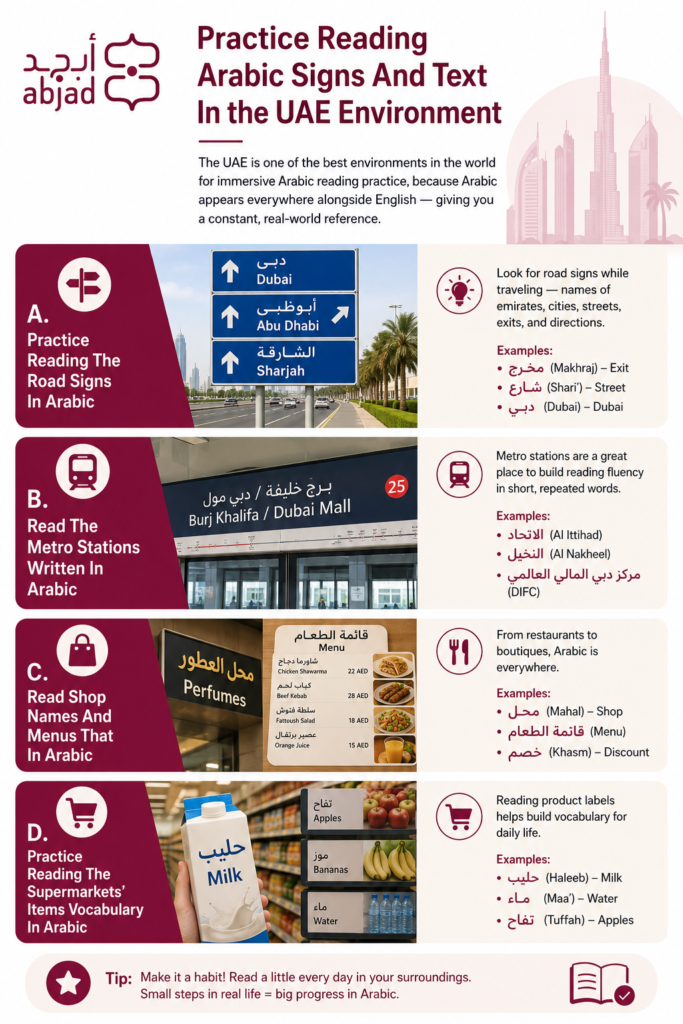
Book Your Free Trial6. Practice Reading Arabic Signs And Text In the UAE Environment
The UAE is one of the best environments in the world for immersive Arabic reading practice, because Arabic appears everywhere alongside English — giving you a constant, real-world reference. Practical UAE-specific practice points:
A. Practice Reading The Road Signs In Arabic
Most major signs on Sheikh Zayed Road and across Abu Dhabi carry Arabic and English side by side. Practice reading the Arabic while already knowing the English meaning — this reinforces letter patterns in context.
B. Read The Metro Stations Written In Arabic
Dubai Metro stations display Arabic station names in Naskh. Memorizing five or six station names in Arabic gives you immediate reading wins and builds visual confidence.
C. Read Shop Names And Menus That In Arabic
Cafés and restaurants in Deira, Al Karama, and Abu Dhabi’s older districts often display Arabic-dominant signage. Reading these is more challenging than bilingual signs, but highly rewarding.
D. Practice Reading The Supermarkets’ Items Vocabulary In Arabic
Arabic product labels use simple, high-frequency vocabulary — “fresh,” “natural,” “imported,” “price” — making them excellent material for vocabulary-building alongside script practice.
If you are also trying to understand how to read Arabic in the UAE in formal contexts — government letters, utility bills, or Emirates ID paperwork — you will encounter Modern Standard Arabic (MSA) in clean Naskh script, usually with full diacritics or very formal vocabulary that follows predictable patterns.
7. Learn Sun And Moon Letters To Read Arabic Words Correctly
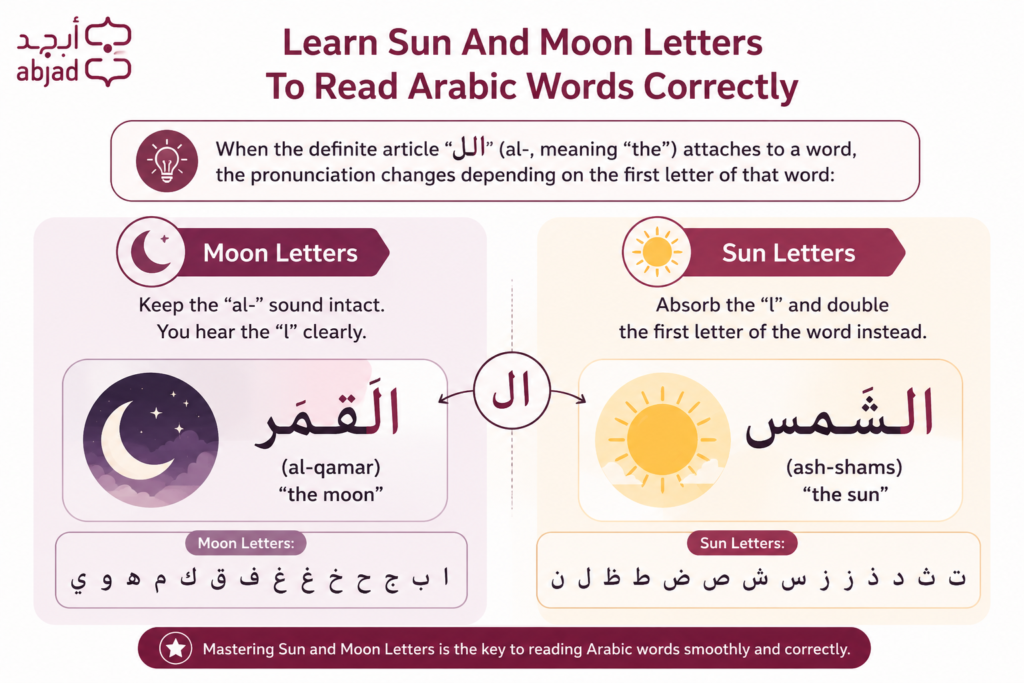
One of the most practically useful rules for reading Arabic script correctly — and one that most beginners skip — is the distinction between sun letters (حروف شمسية) and moon letters (حروف قمرية).
When the definite article “ال” (al-, meaning “the”) attaches to a word, the pronunciation changes depending on the first letter of that word:
- Moon letters keep the “al-” sound intact. Example: القمر (al-qamar, “the moon”) — you hear the “l” clearly.
- Sun letters absorb the “l” and double the first letter of the word instead. Example: الشمس (ash-shams, “the sun”) — the “l” disappears and the “sh” doubles.
In everyday UAE Arabic reading, you will constantly encounter “ال” attached to words on signs and in text. Knowing whether the following letter is a sun or moon letter determines whether you read “al-” or assimilate the sound. This single rule eliminates a significant source of reading errors for beginners.
The 14 sun letters are: ت، ث، د، ذ، ر، ز، س، ش، ص، ض، ط، ظ، ل، ن
Begin your kid’s Arabic learning path with a FREE trial class

8. Build Arabic Vocabulary Alongside Script Reading
Reading script and understanding what you read are two different skills, and developing them together accelerates both.
A common mistake among beginners is spending weeks on letters in isolation before connecting those letters to any meaning. This creates readers who can technically decode sounds but have no idea what they are reading — which quickly kills motivation.
A better approach: from your very first week, pair letter practice with 5–10 Arabic words that matter in your daily UAE context. Start with words you already see: مطار (mataar, airport), شارع (shaari’, street), سوبرماركت (sobermarket), مستشفى (mustashfa, hospital), خروج (khurooj, exit), دخول (dukool, entrance).
These high-frequency environment words give your letter recognition practice immediate purpose. By the time you know 50 common UAE vocabulary words, you will find yourself automatically reading signs you previously walked past without a second glance.
If you have young ones learning alongside you, structured Arabic courses for kids use this exact vocabulary-first approach to build reading fluency in children quickly and enjoyably.
Read also: How To Read Arabic For Beginners In The UAE? A Step-By-Step Guide
9. Understand Long Vowels Of Arabic And How They Change Words
Long vowels in Arabic are not marked by diacritic symbols — they are written as actual letters. There are three long vowels:
- Alif (ا) — represents a long “aa” sound (like “father”)
- Waw (و) — represents a long “oo” sound (like “moon”)
- Ya’ (ي) — represents a long “ee” sound (like “seen”)
These letters do double duty in Arabic: they function as consonants in some positions and as long vowels in others. Context determines which role they are playing in any given word.
This is particularly relevant when reading names and places in the UAE.
أبوظبي (Abu Dhabi) — the و after أبو is functioning as the long “oo” vowel.
دبي (Dubai) — the ي at the end carries the long “ee” sound.
دبي, incidentally, is a useful first word to decode for anyone learning to read Arabic in the UAE, since you already know exactly what it says.
Understanding long vowels also helps when reading how to read Arabic dates on formal documents, where the month names and year numerals follow consistent patterns once you know the vowel structure.
Read also: How To Read Arabic Letters In The UAE? A Step-By-Step Guide For Beginners
10. Progress To Reading Arabic Connected Text With Comprehension
Once you can recognize letters in all four positional forms, understand harakat, know the sun and moon letter rule, and have a working vocabulary of 100–150 words, you are ready to move from letter-by-letter decoding to reading connected text fluently.
The transition from decoding to reading requires consistent practice with actual texts — not just exercises. In the UAE context, excellent reading material for this stage includes:
- Arabic children’s picture books (widely available in UAE bookstores and libraries), which use full harakat and simple vocabulary
- The Arabic section of UAE government websites (government.ae, for example), which uses formal MSA in clean Naskh
- Arabic newspapers like Al Khaleej and Al Bayan, which require more vocabulary but expose you to real written Arabic as it appears in professional publishing
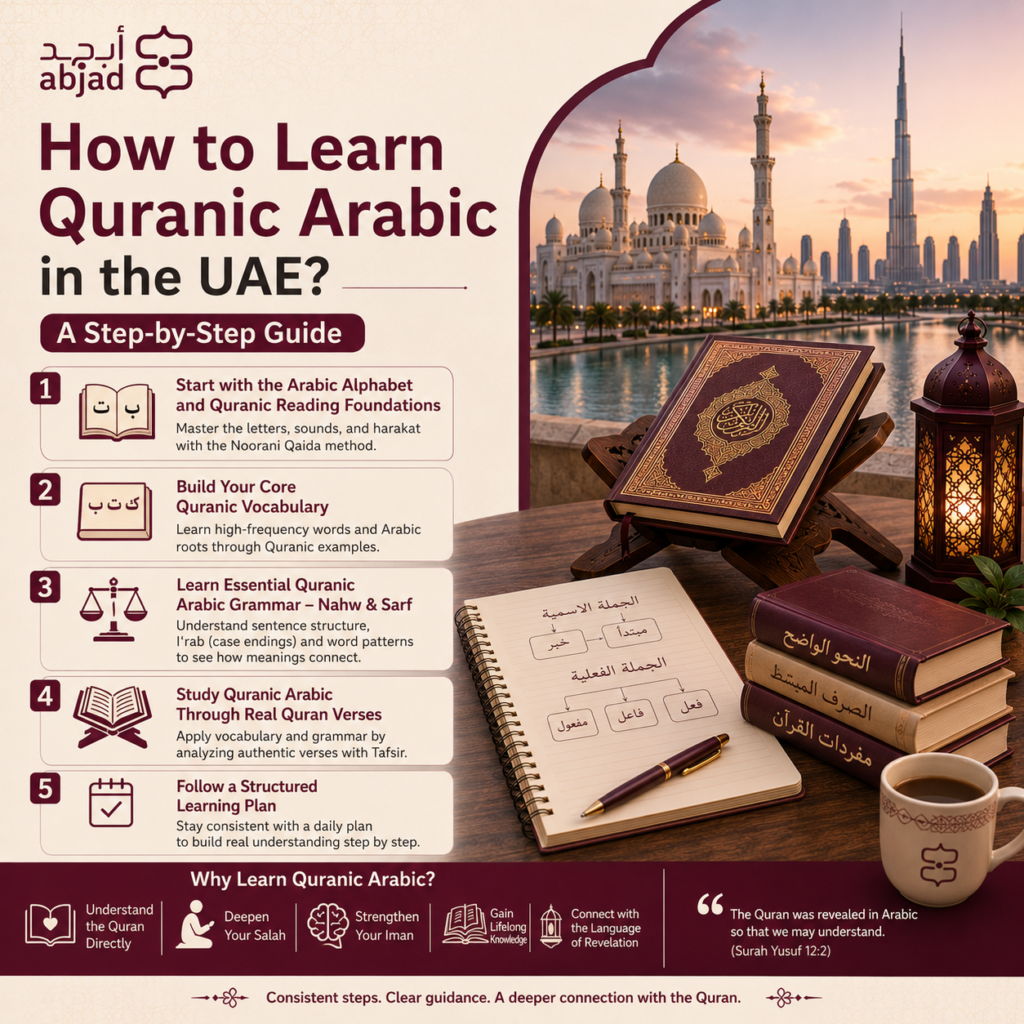
Some learners at this stage also explore how to read Quranic Arabic, which uses classical Arabic with full diacritical marks — making it in some ways easier to read phonetically than unvowelled modern text, even though the vocabulary requires dedicated study.
Similarly, once you read connected Arabic script confidently, moving to related writing skills — such as how to write in Arabic in the UAE — becomes a natural next step that reinforces everything you have learned through reading.
Inside Our Live Classes
Don’t just take our word for it—see for yourself! Click below to watch short clips from our live classes and meet the instructors who will guide your learning journey.
Start Learning Arabic Script At Abjad Institute In The UAE
Abjad Institute is one of the UAE’s leading Arabic language institutes, offering structured, results-driven Arabic courses for adults and children across all proficiency levels. Their curriculum is designed specifically for non-native speakers living and working in the UAE — meaning the vocabulary, examples, and cultural context used in lessons reflect real UAE life, not abstract textbook scenarios.
Students at Abjad Institute progress from zero knowledge of the script to confident reading within structured course timelines, with instructors who specialize in teaching Arabic to English speakers. Our Institute offers both in-person and flexible formats to accommodate the demanding schedules of UAE residents.
Check out our top Arabic courses for UAE residents:
- Arabic Course in the UAE
- Arabic Intensive Course
- Learn Arabic from Scratch Course
- Madinah Arabic Course
- Arabic Classes for Adults
- Arabic Classes for Beginners
- Self-Paced Arabic Course
- Basic Arabic Course
- Arabic Speaking Classes
- Learn to Write Arabic Course
- Arabic Grammar Course
- Learn Arabic Alphabet Course
Book your free trial session today
Begin Your Arabic Journey in the UAE
Join Abjad Institute for a professional and immersive Arabic language experience tailored to your goals.
Book Your Free Trial
Conclusion
Reading Arabic script is not a talent you either have or don’t — it is a skill built step by step, the same way any writing system is learned. The 28-letter alphabet becomes manageable when studied in shape families. Positional forms become automatic with consistent exposure. Vocabulary builds naturally from the UAE environment around you.
The key insight this guide offers is simple: the UAE is not just a place where Arabic exists — it is one of the richest immersive environments in the world for putting Arabic reading skills into immediate, daily use. Every road sign, shop front, metro station, and government document is a practice opportunity.
Work through the ten steps of how to read Arabic script step by step in sequence. Build vocabulary alongside script recognition from day one. Find structured instruction that grounds your practice in UAE-relevant context. The ability to read Arabic script in the UAE shifts the entire experience of living here — and it starts with a single letter.
Read also: How To Read Arabic For Beginners In The UAE? A Step-By-Step Guide
Frequently Asked Questions
How long does it take to learn to read Arabic script as a complete beginner?
Most adult beginners can recognize all 28 Arabic letters in their isolated forms within two to three weeks of 15–20 minutes of daily structured practice. Moving to basic connected reading — where you can decode simple words — typically takes another two to four weeks.
Is Arabic script hard to read for English speakers?
Arabic script is unfamiliar to English speakers, but not structurally complex. The 28 letters reduce to approximately 17 base shapes once grouped by visual family. The genuine difficulty lies in positional forms — letters changing shape based on their position in a word — and in learning to read without short vowel marks. Both challenges are overcome with structured practice rather than raw aptitude.
What is the easiest Arabic script style to start with?
Naskh is universally recommended as the starting point. It is the script used in most printed books, official documents, and digital text across the UAE and the broader Arab world. Its clear, proportional letterforms make it significantly easier to decode than Kufic, Ruq’ah, or Thuluth. Once you read Naskh confidently, other styles become recognizable with far less effort.
Can I learn to read Arabic script without learning to speak Arabic?
Yes. Reading and speaking Arabic are related but separable skills. Many learners in the UAE focus on reading first — particularly those studying Quranic Arabic or needing to navigate formal documents — and add spoken Arabic later. That said, pairing reading with even basic spoken vocabulary accelerates recognition, because you already know what common words sound like when you encounter them in script.
What Arabic script style is used on UAE government buildings and mosques?
Kufic calligraphy is the most common script on UAE government buildings, mosques, and official cultural landmarks. The Museum of the Future in Dubai, for instance, is covered in Kufic script inscriptions of Sheikh Mohammed bin Rashid Al Maktoum’s words. Thuluth is also widely used in mosque interiors and calligraphic art.
Does learn Arabic mean learning the same language used in the UAE?
The UAE uses Modern Standard Arabic (MSA) in formal writing, official communications, and print media, alongside Gulf Arabic as the spoken colloquial dialect. When you learn Arabic through structured courses, you typically begin with MSA — which is what you read on signs, documents, and formal correspondence.
Leave a Reply