 Learn Arabic
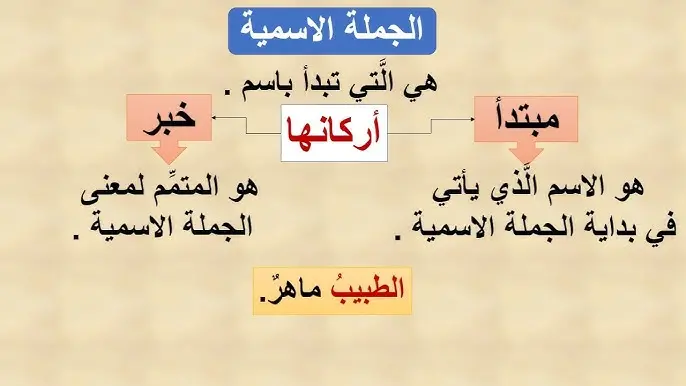
العلمُ نورٌ, Knowledge is light. السماءُ صافيةٌ, The sky is clear. These are not picked arbitrarily. They are the textbook illustrations of a nominal sentence in Arabic, and they persist because they do in four words what most grammar rules take paragraphs to explain.
The nominal sentence Arabic, الجملة الاسمية (al-jumlah al-ismiyyah) is one of two foundational sentence structures in the language. Every Arabic text you will ever read is built primarily from nominal and verbal sentences.
Understanding the nominal sentence is not an optional grammar detail; it is the point where Arabic stops feeling like a code and starts feeling readable.
This guide gives you the full picture: the definition, the two core components, every type of predicate, real Arabic nominal sentence examples with complete parsing, the four grammatical types, and the most common learner mistakes.
What You Will Learn in This Article:
- What a nominal sentence in Arabic is and how it is defined in classical Arabic grammar.
- The two obligatory components — subject and predicate — and the forms each can take.
- All three types of predicate, with clear examples.
- How to parse any nominal sentence step by step.
- The four grammatical types of nominal sentences.
- How nawasikh (grammatical copulas) transform the nominal sentence.
- The most common mistakes Arabic learners in the UAE make — and the practitioner fixes.
Secure Your Child’s Foundation in Arabic Grammar at Abjad Institute

What Is A Nominal Sentence In Arabic, And How Does It Stand On Its Own?
Arabic sentences fall into one of two structural families: the nominal sentence (الجملة الاسمية) and the verbal sentence (الجملة الفعلية). The dividing rule is simple. A nominal sentence is any sentence that begins with a noun. A verbal sentence begins with a verb.
For UAE residents encountering Arabic daily, this distinction is immediately practical. Most declarative Arabic text, official announcements, product labels, media headlines, school curricula, uses nominal sentence structure.
For learners still building their reading foundation, a focused guide on how to read Arabic letters in the UAE gives the script-level skills that make sentence-level comprehension possible.
One question that surprises many beginners: does Arabic read right to left? and the answer is yes, which affects how you identify the first word and determine whether a sentence is nominal or verbal.
1. The Two Pillars Every Nominal Sentence Stands On
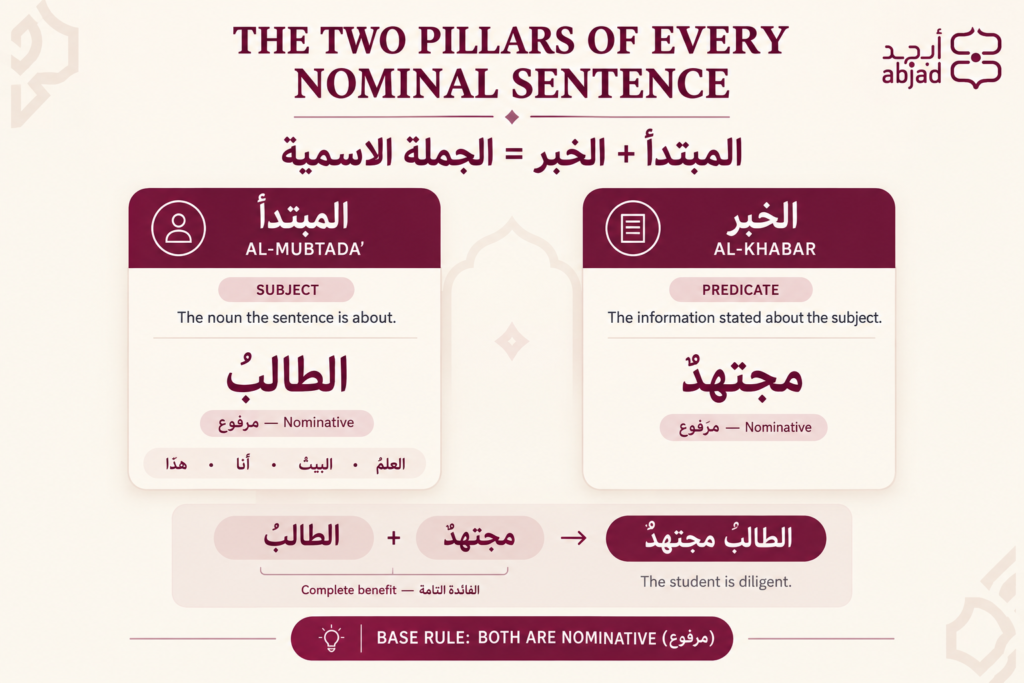
Every nominal sentence in Arabic rests on exactly two obligatory components. Both carry nominative case (مرفوع). Both are required for the sentence to be complete.
A. The Subject المبتدأ (al-mubtada’)
The mubtada’ is the noun that the sentence is about. It is almost always definite and always carries nominative case, marked by ḍammah (ُ) or its equivalent sign depending on the word type. The mubtada’ can appear in several forms:
- An explicit definite noun: العلمُ (knowledge), البيتُ (the house).
- A detached pronoun: أنا (I), هو (he), أنتِ (you — feminine).
- A demonstrative pronoun: هذا (this), تلك (that — feminine).
- A relative pronoun: الذي (he who), التي (she who).
- An interpreted verbal noun (maṣdar mu’awwal): أن تنجحَ خيرٌ لك — That you succeed is better for you.
B. The Predicate الخبر (al-khabar)
The khabar is the piece of information being stated about the mubtada’. It completes the meaning of the sentence; without it, the sentence is open and unsatisfying.
Together, mubtada’ and khabar deliver what Arabic grammarians call “the complete benefit” (الفائدة التامة): a statement that makes sense on its own.
The standard illustration:
الطالبُ مجتهدٌ — The student is diligent.
- الطالبُ: mubtada’, nominative, marked with ḍammah.
- مجتهدٌ: khabar, nominative, marked with tanwīn al-ḍamm.
Both are nominative always. That is the bedrock rule of the Arabic nominal sentence in its base form.
2. How To Tell A Nominal Sentence Apart From A Verbal One At First Glance?
The practical test takes two seconds: look at the first word. If it is a noun, a person, place, thing, concept, pronoun, or demonstrative, you have a nominal sentence.
If it is a verb, an action or state in past, present, or imperative form, you have a verbal sentence.
- Nominal: الجوُّ جميلٌ — The weather is beautiful. (First word: الجوّ, a noun.)
- Verbal: يَشتدُّ الحرُّ في الصيفِ — The heat intensifies in summer. (First word: يشتدّ, a verb.)
These two sentences express related ideas but belong to different grammatical families. Nominal sentences in Arabic tend to express static states, descriptions, and enduring truths.
Verbal sentences express events and actions. The choice between them carries stylistic and semantic weight.
One practitioner note worth internalising early: the predicate can precede the subject in certain grammatical conditions.
في الحديقةِ وردٌ (In the garden there is a rose) is still a nominal sentence, the prepositional phrase is the khabar and the indefinite noun وردٌ is the mubtada’.
Start learning Arabic letters with a FREE trial class

The Predicate Takes More Shapes Than Most Beginners Expect
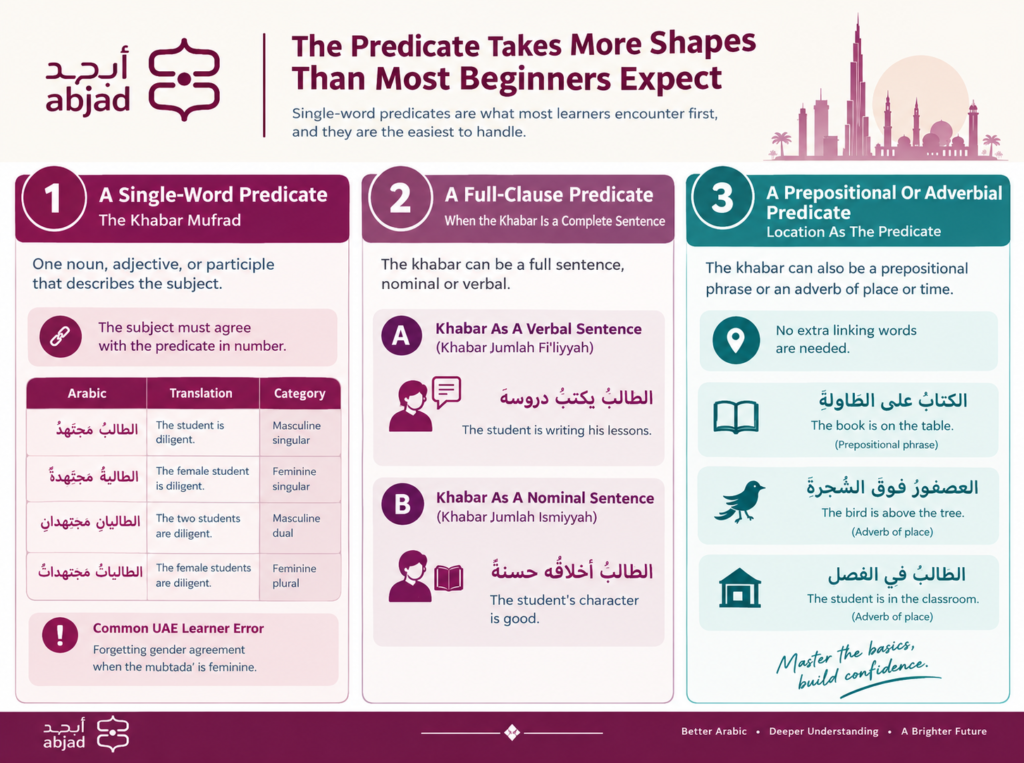
Single-word predicates are what most learners encounter first, and they are the easiest to handle. But Arabic nominal sentences allow three distinct types of predicate, each with its own construction rules.
Missing this is one of the main reasons learners stall at intermediate level. These three types are not advanced exceptions. They are standard Arabic structures that appear in everyday text, Quranic passages across the UAE.
1. A Single-Word Predicate, The Khabar Mufrad
The khabar mufrad (الخبر المفرد) is a single word — a noun, adjective, or participle that is not itself a clause.
Despite the name “mufrad” (literally: singular), it can be singular, dual, or plural. What makes it “mufrad” is that it functions as a single grammatical unit rather than a compound clause.
The khabar mufrad must agree with the mubtada’ in gender and number:
| Arabic | Translation | Category |
| الطالبُ مجتهدٌ | The student is diligent | Masculine singular |
| الطالبةُ مجتهدةٌ | The female student is diligent | Feminine singular |
| الطالبانِ مجتهدانِ | The two students are diligent | Masculine dual |
| الطلابُ مجتهدونَ | The students are diligent | Masculine sound plural |
| المعلماتُ مخلصاتٌ | The female teachers are dedicated | Feminine sound plural |
| الفلاحون مجدُّون | The farmers are industrious | Sound masculine plural — wāw in both |
The most common UAE learner error here: forgetting gender agreement when the mubtada’ is feminine. الحديقةُ جميلٌ is incorrect; الحديقةُ جميلةٌ is the correct form.
If the mubtada’ ends in tā’ marbūṭah (ة), the khabar usually should too. Getting this right from the start saves significant correction later.
2. A Full-Clause Predicate When The Khabar Is A Complete Sentence
The khabar can be an entire sentence either a nominal or a verbal sentence. This is called the khabar jumlah (خبر جملة). It always requires a linking pronoun (الرابط) that connects the inner clause back to the outer mubtada’.
A. Khabar As A Verbal Sentence (Khabar Jumlah Fi’liyyah):
The predicate is a verb-subject structure. The implied subject of the verb refers back to the mubtada’:
- الطالبُ يكتبُ دروسَه — The student is writing his lessons.
- الطالبُ: mubtada’.
- يكتبُ دروسَه: verbal sentence in predicate position; the implied “he” in يكتبُ refers back to الطالبُ.
B. Khabar As A Nominal Sentence (Khabar Jumlah Ismiyyah):
The predicate is itself a mubtada’-khabar pair. A linking pronoun (rābiṭ) connects it to the first mubtada’:
- الطالبُ أخلاقُه حسنةٌ — The student — his character is good.
- الطالبُ: first mubtada’.
- أخلاقُه: second mubtada’; the pronoun ه refers back to الطالبُ.
- حسنةٌ: predicate of the second mubtada’.
- The entire clause أخلاقُه حسنةٌ sits in the predicate position of الطالبُ.
Read also: The Meaning Of Tanween In Arabic Language
3. A Prepositional Or Adverbial Predicate, Location As The Predicate
The khabar can also be a quasi-sentence (شبه الجملة) — either a prepositional phrase (جار ومجرور) or an adverb of place or time (ظرف):
- الكتابُ على الطاولةِ — The book is on the table. (Prepositional phrase.)
- العصفورُ فوقَ الشجرةِ — The bird is above the tree. (Adverb of place.)
- الطالبُ في الفصلِ — The student is in the classroom.
No linking pronoun is needed for quasi-sentence predicates — they inherently relate to the mubtada’.
This structure accounts for a large share of the locative and positional statements that fill everyday Arabic text: signs, directions, notices, and descriptions of where things are.
Learn Basic Arabic Conversation at Abjad Institute in the UAE Today

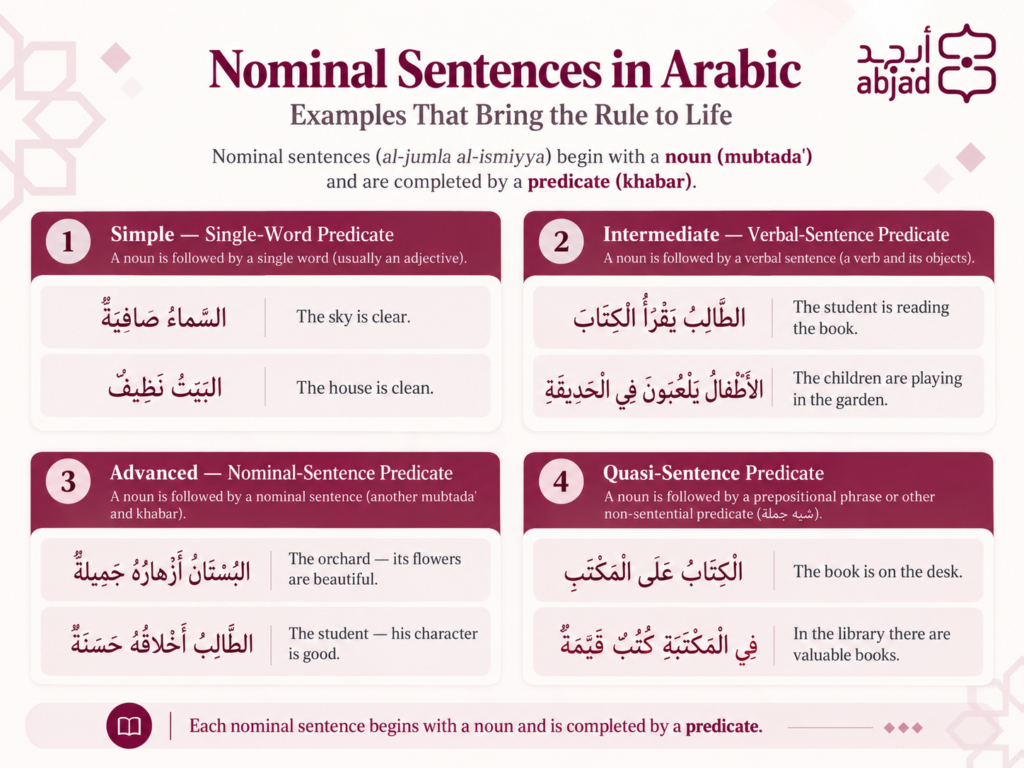
Nominal Sentences In Arabic Examples That Bring The Rule To Life
Seeing examples across varied levels of complexity is what moves grammar from definition to instinct.
The following cross-section of Arabic nominal sentences covers all three predicate types at different grammatical levels.
1. Simple — Single-Word Predicate
In the simplest form of a nominal sentence, the predicate consists of a single word that describes or identifies the subject.
| Arabic | Translation |
| السماءُ صافيةٌ | The sky is clear |
| الجوُّ معتدلٌ | The weather is moderate |
| البيتُ نظيفٌ | The house is clean |
| المهندسونَ ماهرونَ | The engineers are skilled |
| المعلماتُ مخلصاتٌ | The female teachers are dedicated |
2. Intermediate — Verbal-Sentence Predicate
Here, the predicate is a complete verbal sentence that tells us what the subject is doing.
| Arabic | Translation |
| الطالبُ يقرأُ الكتابَ | The student is reading the book |
| الفلاحُ يزرعُ الأرضَ | The farmer cultivates the land |
| الأطفالُ يلعبونَ في الحديقةِ | The children are playing in the garden |
3. Advanced — Nominal-Sentence Predicate
In this structure, the predicate itself is another nominal sentence that provides additional information about the original subject.
| Arabic | Translation |
| البستانُ أزهارُه جميلةٌ | The orchard — its flowers are beautiful |
| الطالبُ أخلاقُه حسنةٌ | The student — his character is good |
| العلمُ طريقُه طويلٌ | Knowledge — its path is long |
4. With Quasi-Sentence Predicate:
A quasi-sentence predicate usually consists of a prepositional or adverbial phrase that tells us where something is or to whom it relates.
| Arabic | Translation |
| الكتابُ على المكتبِ | The book is on the desk |
| الجائزةُ للمتفوِّقِ | The prize is for the top student |
| في المكتبةِ كتبٌ قيِّمةٌ | In the library there are valuable books |
Each sentence above is, by definition, a nominal sentence in Arabic example; it begins with a noun and pairs a mubtada’ with a khabar that completes the meaning.
The range of predicate types is what gives Arabic nominal sentences the flexibility to express any descriptive, locative, or characterising statement.
Four Types Of Nominal Sentences Worth Knowing By Name
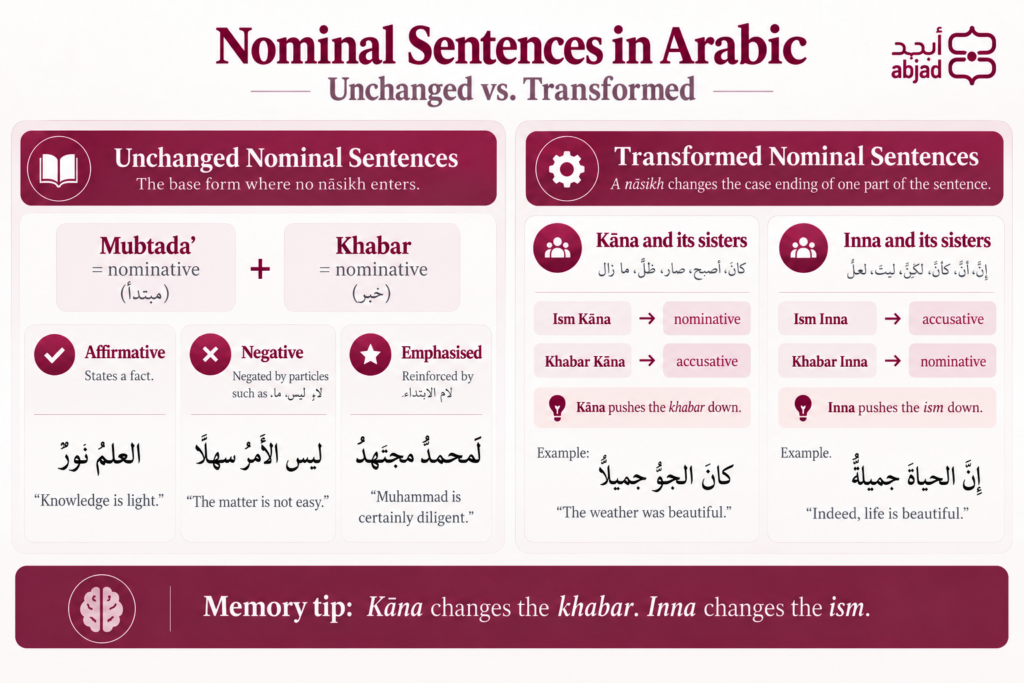
Arabic grammarians classify nominal sentences according to two structural questions: has a nāsikh (grammatical copula) entered and altered the case endings, and if not, is the sentence affirmative, negative, or emphasised?
This gives four named types that appear across all registers of formal Arabic from school textbooks to legal documents to classical poetry. The primary division is between unchanged nominal sentences (غير منسوخة) and transformed nominal sentences (منسوخة).
1. Unchanged Nominal Sentences
An unchanged nominal sentence (الجملة الاسمية غير المنسوخة) is one where no particle or auxiliary verb has entered to alter the case endings of either the mubtada’ or the khabar. This is the base form of the Arabic nominal sentence, and it comes in three subtypes.
A. Affirmative (al-muthbitah):
States a fact with no negation or emphasis. The mubtada’ and khabar both carry ḍammah or its equivalent.
- العلمُ نورٌ — Knowledge is light.
- الرياضةُ مفيدةٌ — Sport is beneficial.
B. Negative (al-manfiyyah):
A negation particle precedes the mubtada’. Particles that negate nominal sentences include: ليس، ما، لا، لات، إن.
- ليس الأمرُ سهلاً — The matter is not easy.
- ما العلمُ ضارٌّ — Knowledge is not harmful.
- لا طالبَ كسولٌ في هذا الفصلِ — No lazy student is in this classroom.
C. Emphasised (al-mu’akkadah):
An emphasis marker reinforces the statement. The most common marker in this category is لام الابتداء (the lām of beginning):
- لَمحمدٌ مجتهدٌ — Muhammad is certainly diligent.
Enroll Your Kid Now in Arabic Qaida Course

Read also: Arabic Harakat – 9 Essential Marks for Reading and Pronunciation
Watch Our Classes in Action
Curious what a real session looks like? Take a peek inside our interactive classrooms and see how our expert instructors bring the Arabic language to life. Watch a sample lesson below!
Begin Your Arabic Journey in the UAE
Join Abjad Institute for a professional and immersive Arabic language experience tailored to your goals.
Book Your Free Trial2. Transformed Nominal Sentences When Nawasikh Enter The Picture
A transformed nominal sentence (الجملة الاسمية المنسوخة) is one where a nāsikh has entered and changed the original case of the mubtada’, the khabar, or both. There are two families of nawasikh, and they operate in exactly opposite directions.
A. First Family — Kāna And Its Sisters (كان وأخواتها):
These incomplete verbs keep the mubtada’ nominative, now called “the name of kāna” (اسم كان), and push the khabar into accusative case — now called “the predicate of kāna” (خبر كان).
The kāna sisters: كان، أصبح، أضحى، أمسى، ظلَّ، بات، صار، ليس، ما زال، ما دام، ما انفكَّ، ما برح، ما فتئ.
Parsed examples:
- كانَ الجوُّ جميلاً — The weather was beautiful.
- الجوُّ: name of kāna, nominative, ḍammah.
- جميلاً: predicate of kāna, accusative, fatḥah tanwīn.
- أصبحَ الطالبُ نشيطاً — The student became active.
- ما زالَ الأملُ موجوداً — Hope still remains.
- ظلَّ العاملُ مجتهداً — The worker remained diligent.
B. Second Family — Inna And Its Sisters (إنَّ وأخواتها):
These particles do the reverse: they push the mubtada’ into accusative case — now called “the name of inna” (اسم إن) — and keep the khabar nominative (خبر إن).
The inna sisters: إنَّ، أنَّ، كأنَّ، لكنَّ، ليتَ، لعلَّ.
Parsed examples:
- إنَّ الحياةَ جميلةٌ — Indeed, life is beautiful.
- الحياةَ: name of inna, accusative.
- جميلةٌ: predicate of inna, nominative.
- كأنَّ القمرَ مصباحٌ — As if the moon were a lamp.
- لعلَّ النصرَ قريبٌ — Perhaps victory is near.
- ليتَ الشبابَ يعودُ — If only youth would return.
A practical memory device: kāna pushes the khabar down; inna pushes the ism down. They each flip one component, and they always flip opposite ones. Keep that distinction clear and the transformed nominal sentence becomes manageable.
If these structures feel like exactly what you need a guided course to practise, Abjad Institute‘s Arabic grammar curriculum covers the nominal sentence, its transformed variants, and the parsing rules that bring them together.

Read also: How Many Harakat In Arabic? A Complete Guide For UAE Learners
Parsing An Arabic Nominal Sentence From Start To Finish
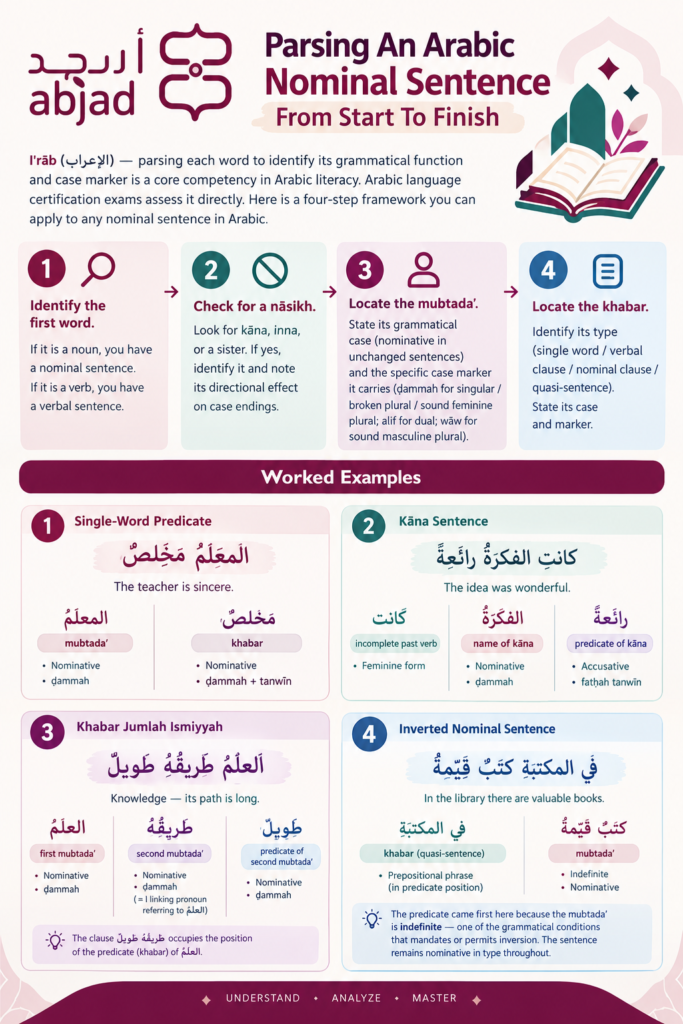
I’rāb (الإعراب) — parsing each word to identify its grammatical function and case marker is a core competency in Arabic literacy. Here is a four-step framework you can apply to any nominal sentences in Arabic:
- Identify the first word. If it is a noun, you have a nominal sentence. If it is a verb, you have a verbal sentence.
- Check whether a nāsikh has entered — kāna, inna, or a sister. If yes, identify it and note its directional effect on case endings.
- Locate the mubtada’. State its grammatical case (nominative in unchanged sentences) and the specific case marker it carries (ḍammah for singular / broken plural / sound feminine plural; alif for dual; wāw for sound masculine plural).
- Locate the khabar. Identify its type (single word / verbal clause / nominal clause / quasi-sentence). State its case and marker.
Worked Example — Single-Word Predicate:
المعلمُ مخلصٌ — The teacher is sincere.
- المعلمُ: mubtada’, nominative, ḍammah.
- مخلصٌ: khabar, nominative, ḍammah + tanwīn.
Worked Example — Kāna Sentence:
كانتِ الفكرةُ رائعةً — The idea was wonderful.
- كانت: incomplete past verb, feminine form.
- الفكرةُ: name of kāna, nominative, ḍammah.
- رائعةً: predicate of kāna, accusative, fatḥah tanwīn.
Worked Example — Khabar Jumlah Ismiyyah:
العلمُ طريقُه طويلٌ — Knowledge — its path is long.
- العلمُ: first mubtada’, nominative.
- طريقُه: second mubtada’, nominative; the ه is the linking pronoun referring back to العلمُ.
- طويلٌ: predicate of the second mubtada’, nominative.
- The clause طريقُه طويلٌ: occupies the position of the predicate (khabar) of العلمُ.
Worked Example — Inverted Nominal Sentence:
في المكتبةِ كتبٌ قيِّمةٌ — In the library there are valuable books.
- في المكتبةِ: khabar (quasi-sentence, prepositional phrase), in predicate position.
- كتبٌ قيِّمةٌ: mubtada’, indefinite, nominative.
The predicate came first here because the mubtada’ is indefinite — one of the grammatical conditions that mandates or permits inversion. The sentence remains nominative in type throughout.
Secure Your Spot in the Next Intensive Arabic Course at Abjad Institute

Common Mistakes Learners Make With Arabic Nominal Sentences
Most errors in constructing or identifying what is a nominal sentence in Arabic fall into a small set of recurring patterns. Knowing them ahead of time cuts months off the correction curve.
1. Gender Mismatch Between Mubtada’ And Khabar
The khabar mufrad must agree with the mubtada’ in gender. الحديقةُ جميلٌ is incorrect. الحديقةُ جميلةٌ is correct.
A feminine mubtada’ requires a feminine khabar — no exceptions for basic nominal sentences.
2. Forgetting The Rābiṭ In Clause-Type Predicates
When the khabar is a complete sentence, it must contain a pronoun connecting it to the mubtada’. الطالبُ الدرسُ مفيدٌ is grammatically incomplete or ambiguous. الطالبُ درسُه مفيدٌ is correct — the ه in درسُه is the rābiṭ.

3. Misreading Inverted Nominal Sentences
When the khabar precedes the mubtada’ — especially with quasi-sentence predicates — learners often parse the sentence backwards.
In على المكتبِ كتابٌ (On the desk is a book), على المكتبِ is the predicate and كتابٌ is the subject. Subject came second because it is indefinite.
4. Treating Inna (إنَّ) Sentences As Verbal Sentences
إنَّ is a particle, not a verb. A sentence that opens with إنَّ remains a nominal sentence in type. Only the case endings change — the mubtada’ moves to accusative as inna’s “name.”
5. Using Kāna Without Both Its Required Elements
Kāna and its sisters are incomplete verbs that cannot stand alone. كانَ الطالبُ is not a complete sentence.
You always need both the name (nominative) and the predicate (accusative): كانَ الطالبُ مجتهداً — The student was diligent.

The Nominal Sentence Is In Every Arabic Text You Encounter In The UAE
Living in the UAE means Arabic nominal sentences are part of the visual and communicative landscape every single day. الدخول مجاني (Entry is free). الخدمة على مدار الساعة (Service around the clock).
اللغة العربية لغة الضاد (Arabic is the language of the ḍad). Each of these is a nominal sentence subject followed by predicate, declarative and complete.
For learners who prefer to study independently before committing to a structured course, exploring how to learn to read Arabic online for free is a practical starting point.
Abjad Institute‘s structured Arabic courses are designed for exactly this progression from the first nominal sentence to full reading comprehension, with experienced UAE-based instructors who make grammar feel applicable, not academic.
The Nominal Sentence In The Quran And Classical Texts
A substantial proportion of the Quran’s verses are structured as nominal sentences including some of the most widely memorised passages in Islamic tradition.
اللهُ نورُ السماواتِ والأرضِ — Allah is the light of the heavens and the earth. (Surat al-Nur, 24:35)
This is a nominal sentence: اللهُ is the mubtada’, and نورُ السماواتِ والأرضِ is the khabar; a noun construct chain (iḍāfah) serving as the predicate. Recognising the structure lets you read the verse as a grammatically complete declaration.
Learners who commit to Quranic Arabic find that the nominal sentence is foundational, the Quran uses subject-predicate declarations extensively to state divine attributes, describe the Day of Judgement, and lay out ethical principles.
Abjad Institute‘s Quranic Arabic courses address the benefits of learning Quranic Arabic directly, and their curriculum includes the Quranic Arabic alphabet as well as the grammar structures.
Learn Quranic Arabic from the Basics at Abjad Institute in the UAE

Inside Our Live Classes
Don’t just take our word for it—see for yourself! Click below to watch short clips from our live classes and meet the instructors who will guide your learning journey.
Begin Your Arabic Journey in the UAE
Join Abjad Institute for a professional and immersive Arabic language experience tailored to your goals.
Book Your Free TrialAbjad Institute Where UAE Learners Build Arabic From The Ground Up
Abjad Institute is a UAE-based Arabic language academy with a clear specialisation: making Arabic grammar accessible, practical, and applicable to daily life in the Emirates.
Their courses cover Modern Standard Arabic, Quranic Arabic, and Arabic for children; each grounded in the grammatical structures that form the backbone of every Arabic sentence.
The nominal sentence is not taught in isolation at Abjad — it is placed within a logical grammatical framework that reveals Arabic as a coherent system rather than a collection of rules to be memorised.
For those starting entirely from the beginning, learn how to write and read Arabic for beginners offers a guided entry point.
Learners who prefer self-paced digital options before committing to a full course can explore a learn to read Arabic app to build initial confidence.
Book your FREE trial at Abjad Institute
Discover Our Arabic Courses
- Arabic Course in the UAE
- Arabic Intensive Course
- Learn Arabic from Scratch Course
- Madinah Arabic Course
- Arabic Classes for Adults
- Arabic Classes for Beginners
- Self-Paced Arabic Course
- Basic Arabic Course
- Arabic Speaking Classes
- Learn to Write Arabic Course
- Arabic Grammar Course
- Learn Arabic Alphabet Course

Conclusion
The nominal sentence in Arabic is not a technicality confined to grammar textbooks.
It is the structural pattern behind most of the descriptive and declarative Arabic you will ever encounter in official documents, signage, conversation, the news, and scripture.
Its logic is elegant: two elements, both nominative in their base form, one the subject and one the predicate, together delivering a complete and independently meaningful statement.
What makes Arabic nominal sentences particularly worth mastering is what happens when grammatical particles enter. Kāna shifts the predicate to accusative. Inna shifts the subject.
The learner who can parse الطالبُ مجتهدٌ correctly — and who can then extend that skill to كانَ الطالبُ مجتهداً and إنَّ الطالبَ مجتهدٌ — has a grammatical framework that transfers across every Arabic text they will ever read.
Frequently Asked Questions
What is a nominal sentence in Arabic?
A nominal sentence in Arabic (الجملة الاسمية) is any sentence that begins with a noun. It consists of two core components: the subject (mubtada’), which is the noun the sentence is about, and the predicate (khabar), which completes the meaning.
In an unchanged nominal sentence, both are in nominative case, marked by ḍammah or its equivalent.
What is the difference between a nominal sentence and a verbal sentence in Arabic?
The defining difference is the opening word. A nominal sentence begins with a noun — for example, العلمُ نورٌ (Knowledge is light).
A verbal sentence begins with a verb — for example, نجحَ الطالبُ (The student succeeded). The same idea can often be expressed in either structure, but they carry different grammatical and stylistic implications.
Can you give nominal sentences in Arabic examples with English translation?
Classic examples include: السماءُ صافيةٌ (The sky is clear), الجوُّ معتدلٌ (The weather is moderate), الكتابُ على الطاولةِ (The book is on the table), الطالبُ يكتبُ درسَه (The student is writing his lesson), and البستانُ أزهارُه جميلةٌ (The orchard — its flowers are beautiful).
Each is a nominal sentence because it begins with a noun and pairs a mubtada’ with a khabar.
What does “nominal in Arabic” mean in grammatical terms?
In Arabic grammar, “nominal” (اسمي) is the adjectival form of “noun” (اسم), meaning “of or relating to a noun.” A nominal sentence is one built on a noun structure rather than a verb. A nominal predicate is a predicate that takes the form of a noun or noun phrase.
The term is not used loosely — in Arabic grammar, “nominal” carries a precise structural meaning that separates an entire category of sentence, predicate, and grammatical relationship from its verbal counterpart.
What happens to Arabic nominal sentences when kāna (كان) enters them?
Kāna and its sisters (كان وأخواتها) are verbs that attach to a nominal sentence and alter it without destroying its noun-based structure. The مبتدأ becomes the اسم كان and takes the nominative case; the خبر becomes the خبر كان and shifts to the accusative.
The sentence كان الطالبُ مجتهداً — “The student was diligent” — is a transformed nominal sentence: its skeleton is still Subject + Predicate, but kāna has re-labelled and re-cased both parts.
How are Arabic nominal sentences used in the Quran?
Statements of divine attribute, affirmations of belief, and descriptions of the unseen are almost universally cast in this form because Arabic uses the nominal sentence to express permanent, timeless truths.
اللهُ نورُ السَّماواتِ والأرضِ (“Allah is the Light of the heavens and the earth,” An-Nur 24:35) is a nominal sentence: no verb, immediate equation, enduring fact.







Leave a Reply