 Learn Arabic
| Key Takeaways |
| Arabic has twelve nominative detached pronouns and eleven accusative ones, and every single form is indeclinable, meaning its ending never changes. |
| Detached pronouns stand alone as separate words, while attached pronouns must fuse onto a noun, verb, or preposition to carry meaning. |
| Arabic marks a dual category that English lacks, so أَنْتُمَا and هُمَا refer to exactly two people, never three or more. |
| Accusative detached pronouns are built on the particle إِيَّا and appear when the object is fronted before the verb for emphasis. |
Anyone starting Arabic meets أَنَا (anā), meaning “I,” within the first lesson. What usually goes unexplained is why that word behaves differently from the ـي ending in كِتَابِي (kitābī), meaning “my book.” Both are pronouns, yet they belong to separate systems.
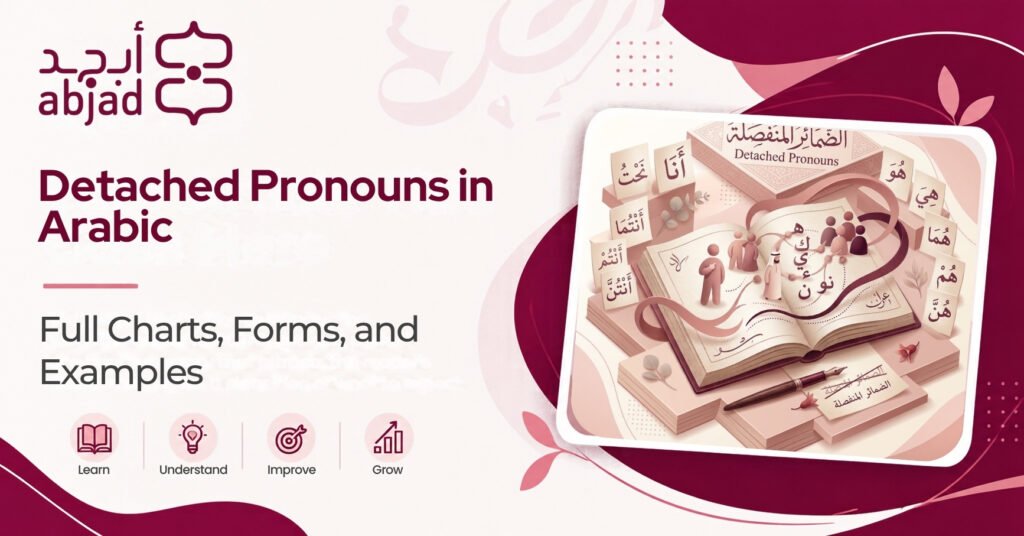
That split is the foundation of the whole pronoun chapter. Detached pronouns in Arabic are written as independent words, carry no case endings, and most often sit at the front of a sentence. Arabic grammarians call them الضَّمَائِر المُنْفَصِلَة (al-ḍamāʾir al-munfaṣilah).
This guide covers both families of separate pronouns, the complete charts with vowel marks, how gender and number reshape each form, how they work inside nominal and verbal sentences, and the errors that slow learners down most.
Detached Pronouns in Arabic Defined in Simple Terms
A detached pronoun is a pronoun written as its own complete word, with a space before it and a space after it. It never fuses onto the word beside it. That physical separation is what the term مُنْفَصِلَة (munfaṣilah), meaning “separated,” describes.
Compare two short examples. In هُوَ طَالِبٌ (huwa ṭālibun), meaning “he is a student,” the pronoun هُوَ stands alone. In كِتَابُهُ (kitābuhu), meaning “his book,” the ـهُ is glued to the noun and cannot be lifted off it.
That gives you a reliable first test. If the pronoun can be deleted and the remaining word still reads correctly, it was detached. If deleting it leaves a broken stem, it was attached and belongs to a different category.
One more property matters early. All Arabic pronouns are مَبْنِيّ (mabnī), meaning “indeclinable,” so their final vowels never shift with case. A noun moves between ـُ, ـَ, and ـِ depending on its role, but هُوَ stays هُوَ in every position.
Grammar books divide separate pronouns into two groups by function. The nominative set, ضَمَائِر الرَّفْع المُنْفَصِلَة (ḍamāʾir al-rafʿ al-munfaṣilah), fills subject slots. The accusative set, ضَمَائِر النَّصْب المُنْفَصِلَة (ḍamāʾir al-naṣb al-munfaṣilah), fills object slots.
Nominative Detached Pronouns and the Complete Chart
These are the twelve forms every beginner memorizes first. They work as the subject of a nominal sentence or as a clarifying subject placed before a verb, and they split across three persons, three numbers, and two genders.
| Arabic | Transliteration | Meaning | Person, Number, Gender |
| أَنَا | anā | I | First person singular |
| نَحْنُ | naḥnu | We | First person plural and dual |
| أَنْتَ | anta | You | Second person masculine singular |
| أَنْتِ | anti | You | Second person feminine singular |
| أَنْتُمَا | antumā | You two | Second person dual |
| أَنْتُمْ | antum | You all | Second person masculine plural |
| أَنْتُنَّ | antunna | You all | Second person feminine plural |
| هُوَ | huwa | He | Third person masculine singular |
| هِيَ | hiya | She | Third person feminine singular |
| هُمَا | humā | They two | Third person dual |
| هُمْ | hum | They | Third person masculine plural |
| هُنَّ | hunna | They | Third person feminine plural |
English collapses five of those into the single word “you” and three more into “they.” Arabic keeps every distinction visible, which is why translation alone never tells you which form to pick.
Read also: Sun and Moon Letters Arabic Rules Made Simple
First-Person Forms Ana and Nahnu
Arabic uses only two first-person detached pronouns, and neither one marks gender. A man and a woman both say أَنَا (anā), and a mixed group of any size says نَحْنُ (naḥnu).
That makes the first person the easiest entry point. In أَنَا مُهَنْدِسٌ (anā muhandisun), meaning “I am an engineer,” only the predicate changes for a woman, becoming أَنَا مُهَنْدِسَةٌ (anā muhandisatun).
Note that نَحْنُ covers the dual as well. Two speakers do not get a separate word, so نَحْنُ طَالِبَانِ (naḥnu ṭālibāni) means “we two are students,” with the dual carried by the noun ending.
Second-Person Forms for Male and Female Listeners
The second person is where most beginners first stumble, because five forms share one English translation. The difference sits entirely in the final vowel or the final syllable.
| Arabic | Transliteration | Addressed to |
| أَنْتَ | anta | One male |
| أَنْتِ | anti | One female |
| أَنْتُمَا | antumā | Exactly two people, any gender |
| أَنْتُمْ | antum | Three or more, males or mixed |
| أَنْتُنَّ | antunna | Three or more females |
The pair أَنْتَ and أَنْتِ differ by a single harakah. A fatḥah on the tāʾ signals a male listener; a kasrah signals a female one. Spoken carelessly, the two blur into each other and the sentence loses its addressee.
Agreement then spreads through the rest of the clause.
أَنْتَ مُجْتَهِدٌ (anta mujtahidun) means “you are hardworking” to a man, while أَنْتِ مُجْتَهِدَةٌ (anti mujtahidatun) says the same to a woman.
Abjad Academy teaches these agreement chains inside its Arabic Grammar Course, where every pronoun is drilled against a matching predicate until the endings stop feeling arbitrary.
Try a Live Grammar Session Free
Third-Person Forms for People Being Discussed
Third-person pronouns refer to someone absent from the conversation, which is why grammarians label this category الغَائِب (al-ghāʾib), meaning “the absent one.” Five forms cover every combination.
Singular is straightforward.
هُوَ مُعَلِّمٌ (huwa muʿallimun) means “he is a teacher,” and هِيَ مُعَلِّمَةٌ (hiya muʿallimatun) means “she is a teacher,” with the tāʾ marbūṭah marking the feminine predicate.
Plurals separate by gender. Use هُمْ (hum) for a group of men or a mixed group, and هُنَّ (hunna) only when every member is female, as in هُنَّ طَبِيبَاتٌ (hunna ṭabībātun), meaning “they are doctors.”
One pronunciation detail is worth storing now. When أَنْتُمْ or هُمْ is followed by a word carrying the definite article الـ, the final sukūn becomes a ḍammah, giving هُمُ الفَائِزُونَ (humu al-fāʾizūn), meaning “they are the winners.”
Accusative Detached Pronouns Built on Iyya
Not every separate pronoun acts as a subject. Arabic has a second family that functions as objects, and all of its members are built on the particle إِيَّا (iyyā) plus a pronoun ending.
| Arabic | Transliteration | Meaning |
| إِيَّايَ | iyyāya | Me |
| إِيَّانَا | iyyānā | Us |
| إِيَّاكَ | iyyāka | You, one male |
| إِيَّاكِ | iyyāki | You, one female |
| إِيَّاكُمَا | iyyākumā | You two |
| إِيَّاكُمْ | iyyākum | You all, masculine |
| إِيَّاكُنَّ | iyyākunna | You all, feminine |
| إِيَّاهُ | iyyāhu | Him |
| إِيَّاهَا | iyyāhā | Her |
| إِيَّاهُمْ | iyyāhum | Them, masculine |
| إِيَّاهُنَّ | iyyāhunna | Them, feminine |
Recognizing this group costs almost no effort. The إِيَّا opening is constant, and the ending that follows is the same pronoun suffix you already know from attached pronouns.
How Iyya Combines With Pronoun Endings
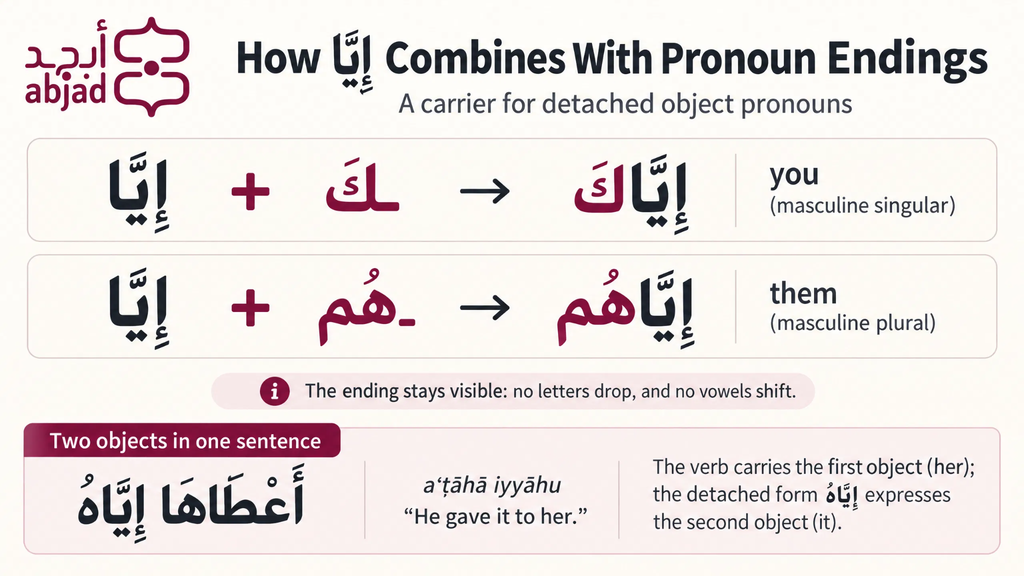
Think of إِيَّا as a carrier. On its own it means nothing; its job is to give an object pronoun a word of its own so it can be moved away from the verb.
The arithmetic is visible.
إِيَّا plus ـكَ produces إِيَّاكَ, and إِيَّا plus ـهُمْ produces إِيَّاهُمْ. No letters are dropped and no vowels shift, which makes this chart far easier than the nominative one.
Arabic also uses إِيَّا with verbs that take two objects. In أَعْطَاهَا إِيَّاهُ (aʿṭāhā iyyāhu), meaning “he gave it to her,” the second object has to appear as a detached form because the verb already carries the first.
Why Arabic Fronts the Object for Emphasis
Standard Arabic word order places the object after the verb. Moving it in front of the verb is a deliberate choice, and the object must then switch from an attached suffix to an إِيَّا form.
Compare the two.
نَعْبُدُكَ (naʿbuduka) means “we worship you” with neutral order.
إِيَّاكَ نَعْبُدُ (iyyāka naʿbudu) means “you alone we worship,” because fronting the object restricts the action to that object.
The particle also appears in warnings, where the verb is left unspoken.
إِيَّاكَ وَالْكَسَلَ (iyyāka wa-al-kasala) means “beware of laziness,” a fixed construction worth learning as a whole unit.
How Gender, Number, and Dual Forms Reshape Each Pronoun
Three variables decide which Arabic pronoun is correct, and all three must be settled before you speak. Person tells you who is involved, number tells you how many, and gender tells you which set applies.
Number is the variable English speakers underestimate. Arabic recognizes مُفْرَد (mufrad), meaning “singular,” مُثَنَّى (muthannā), meaning “dual,” and جَمْع (jamʿ), meaning “plural,” and the dual is never optional when exactly two people are involved.
| Number | Second person | Third person |
| Singular | أَنْتَ / أَنْتِ | هُوَ / هِيَ |
| Dual | أَنْتُمَا | هُمَا |
| Plural | أَنْتُمْ / أَنْتُنَّ | هُمْ / هُنَّ |
Notice that the dual neutralizes gender completely.
أَنْتُمَا addresses two men, two women, or one of each, and هُمَا works the same way, which reduces the memory load considerably.
Gender returns in full force at the plural. A single man inside a group of ninety women still triggers the masculine هُمْ, since Arabic treats the masculine plural as the default for mixed company.
See Us in Action!
Curious about what our online classrooms look like? Watch the short clips below to see how our interactive, one-on-one sessions bring learning to life with real-time feedback and engaging teaching methods.
Begin Your Arabic Journey in the UAE
Join Abjad Institute for a professional and immersive Arabic language experience tailored to your goals.
Book Your Free TrialUsing Arabic Detached Pronouns in Nominal Sentences
The most common home for a separate pronoun is الجُمْلَة الاسْمِيَّة (al-jumlah al-ismiyyah), meaning “the nominal sentence.” This sentence type opens with a noun or pronoun and contains no verb at all.
Arabic has no present-tense equivalent of “is,” “am,” or “are.” Placing a pronoun beside a noun is enough, so هُوَ طَبِيبٌ (huwa ṭabībun) is a complete sentence meaning “he is a doctor.”
Grammatically the pronoun occupies the مُبْتَدَأ (mubtadaʾ) slot, meaning “subject,” and the word after it fills the خَبَر (khabar) slot, meaning “predicate.” Together they form a full statement with nothing missing.
| Sentence | Transliteration | Meaning |
| أَنَا مُدَرِّسٌ | anā mudarrisun | I am a teacher |
| هِيَ مُهَنْدِسَةٌ | hiya muhandisatun | She is an engineer |
| نَحْنُ جِيرَانٌ | naḥnu jīrānun | We are neighbors |
| هُمْ تُجَّارٌ | hum tujjārun | They are merchants |
This is why pronouns are taught before verbs. A learner who controls these twelve forms can build hundreds of correct sentences without touching a single conjugation table.
Arabic detached pronouns also carry the weight of the sentence in questions.
هَلْ أَنْتِ جَاهِزَةٌ (hal anti jāhizatun), meaning “are you ready,” needs only the particle هَلْ added to the front.
Abjad Academy moves students from isolated charts to full sentences through its Arabic Course for Beginners, which builds nominal sentence patterns before introducing verb conjugation.

Book a Free Beginner Lesson Today
When Arabic Verbs Make a Subject Pronoun Optional
Arabic verbs conjugate for person, number, and gender, which means the subject is already encoded inside the verb form. A separate pronoun in front of it is therefore grammatically unnecessary.
The verb أَكْتُبُ (aktubu) already means “I write.” Adding the pronoun to produce أَنَا أَكْتُبُ (anā aktubu) does not change the dictionary meaning; it adds emphasis or contrast instead.
| Pronoun | Verb | Transliteration | Meaning |
| أَنَا | أَكْتُبُ | aktubu | I write |
| أَنْتَ | تَكْتُبُ | taktubu | You write, masculine |
| هُوَ | يَكْتُبُ | yaktubu | He writes |
| هِيَ | تَكْتُبُ | taktubu | She writes |
| نَحْنُ | نَكْتُبُ | naktubu | We write |
| هُمْ | يَكْتُبُونَ | yaktubūna | They write |
Two forms in that table are identical. Both أَنْتَ and هِيَ take تَكْتُبُ, so this is one case where adding the separate pronoun genuinely removes ambiguity rather than merely adding stress.
Use the pronoun deliberately, then.
أَنَا كَتَبْتُ الرِّسَالَةَ (anā katabtu al-risālata) means “I am the one who wrote the letter,” a contrastive reading that the bare verb would not supply.
Read also: Subject in Arabic Grammar Explained With Clear Examples
Detached vs Attached Pronouns Compared Side by Side
Learners rarely confuse the two systems once they are laid out together. The split is about form and position, not about English meaning, which is exactly where intuition misleads.
| Feature | Detached pronouns | Attached pronouns |
| Arabic name | الضَّمَائِر المُنْفَصِلَة | الضَّمَائِر المُتَّصِلَة |
| Written separately | Yes | No |
| Can open a sentence | Yes | No |
| Example form | هُوَ | ـهُ |
| Example in use | هُوَ طَالِبٌ | كِتَابُهُ |
| Typical roles | Subject or fronted object | Possession, object, after prepositions |
The same English word maps to both sides. “He” and “him” both translate the third masculine singular, yet Arabic assigns هُوَ to the subject slot and ـهُ to the object or possessive slot.
Watch one root move across three structures.
هُوَ مُعَلِّمٌ (huwa muʿallimun) means “he is a teacher,” كِتَابُهُ (kitābuhu) means “his book,” and رَأَيْتُهُ (raʾaytuhu) means “I saw him.”
Attached pronouns dominate running text for a practical reason. Once a sentence is underway, a pronoun almost always leans on the word before it, so the detached forms cluster at sentence openings and emphatic positions.
Abjad Academy covers both pronoun systems inside its Fusha Arabic Course, where Modern Standard Arabic grammar is practiced alongside reading and listening work.
Start Learning Fusha With a Free Class
Three Mistakes Learners Make With Separate Pronouns
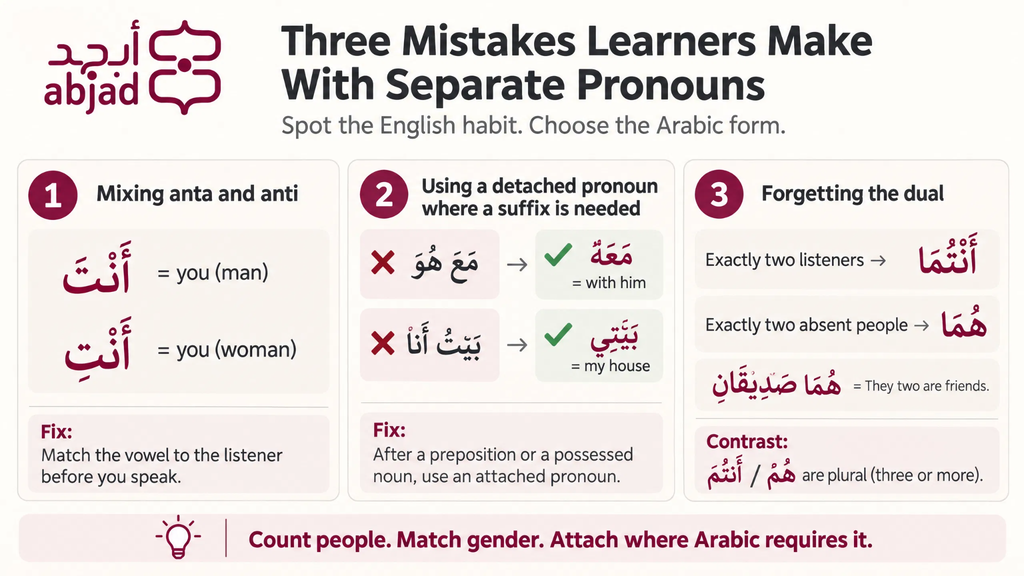
Certain errors appear in almost every beginner classroom, and each one traces back to a habit imported from English. Naming them early prevents them from hardening into permanent patterns.
Mixing Anta and Anti When Addressing One Person
Because English has one “you,” learners default to whichever form they heard most recently. Saying أَنْتَ to a woman is not a small slip; it addresses her with masculine grammar throughout the sentence.
Fix it by anchoring the vowel to the listener before you speak. Fatḥah for a man, kasrah for a woman, and the predicate ending follows automatically from that single decision.
Using a Detached Pronoun Where Arabic Needs an Attached One
Phrases like مَعَ هُوَ or بَيْتُ أَنَا are word-for-word translations of “with him” and “my house,” and both are ungrammatical. Prepositions and possessed nouns take suffixes only.
The correct forms are مَعَهُ (maʿahu), meaning “with him,” and بَيْتِي (baytī), meaning “my house.” Whenever a pronoun follows a preposition or a noun of possession, reach for the attached set.
Ignoring the Dual Forms Antuma and Humā
English speakers treat two people as a plural and reach for أَنْتُمْ or هُمْ. Arabic hears that as a group of three or more, so the sentence stops matching reality.
Count before choosing. Exactly two listeners require أَنْتُمَا, and exactly two absent people require هُمَا, as in هُمَا صَدِيقَانِ (humā ṣadīqāni), meaning “they two are friends.”
Inside Our Virtual Classrooms
We believe in full transparency and proven quality. Take a look at these actual snippets from our live classes to experience our modern learning platform, patient instructors, and interactive student participation.
Begin Your Arabic Journey in the UAE
Join Abjad Institute for a professional and immersive Arabic language experience tailored to your goals.
Book Your Free TrialPractice Exercises to Fix Arabic Pronoun Forms
Charts become usable only after you produce sentences from them. Work through the three short drills below on paper, then check each answer against the tables earlier in this guide.
Exercise one asks you to supply the correct nominative pronoun for each situation:
- Addressing your sister directly.
- Talking about two absent colleagues.
- Speaking about yourself and your brother together.
- Addressing a classroom of girls.
- Talking about one absent man.
Exercise two asks you to replace each attached pronoun with the matching إِيَّا form, keeping the meaning identical:
- سَأَلْتُهُ (saʾaltuhu), meaning “I asked him.”
- زَارَنَا (zāranā), meaning “he visited us.”
- كَافَأَكُمْ (kāfaʾakum), meaning “he rewarded you all.”
- سَاعَدَهَا (sāʿadahā), meaning “he helped her.”
Exercise three asks you to find and correct the error in each sentence:
- نَحْنُ ذَهَبْنَا مَعَ هُمْ.
- أَنْتَ طَالِبَةٌ مُجْتَهِدَةٌ.
- هُمْ مُعَلِّمَتَانِ فِي المَدْرَسَةِ.
- هَذَا بَيْتُ أَنَا.
Say every answer aloud rather than writing it silently. Arabic pronoun endings live in short vowels, and a learner who only reads them will keep dropping those vowels in speech.
Abjad Academy pairs this kind of drilling with live correction in its Arabic Speaking Course, where instructors catch vowel errors the moment they happen rather than weeks later.

Practice Speaking With a Native Tutor
Begin Your Arabic Journey in the UAE
Join Abjad Institute for a professional and immersive Arabic language experience tailored to your goals.
Book Your Free TrialLearn Arabic Grammar With Abjad Academy Instructors
Grammar charts are easy to download and hard to internalize alone. Abjad Academy runs one-on-one online lessons from the UAE with native instructors who correct pronunciation, agreement, and vowel endings in real time.
What sets Abjad Academy apart:
- Live one-on-one sessions scheduled around Gulf and international time zones.
- Native Arabic instructors trained to teach non-native speakers from zero.
- Structured tracks that move from alphabet to grammar to fluent conversation.
- Written progress feedback after every lesson, not just at the end of a term.
Our Arabic Courses
- Arabic Grammar Course
- Arabic Course for Beginners
- Arabic Speaking Course
- Fusha Arabic Course
- Arabic Courses for Kids
- Arabic Alphabet Course
Conclusion
Detached pronouns in Arabic form a closed set of twenty-three words across two families. Twelve nominative forms fill subject positions, and eleven accusative forms built on إِيَّا fill fronted object positions.
Their behavior is governed by three variables working together. Person identifies who is involved, number separates one from two from many, and gender splits the second and third persons into masculine and feminine tracks.
Treat these forms as sentence material rather than vocabulary. Build nominal sentences, front an object with إِيَّا for emphasis, and the surrounding topics of agreement, conjugation, and attached suffixes become far easier to absorb.
FAQs
What Are Detached Pronouns in Arabic?
Detached pronouns in Arabic are independent pronouns written as separate words, called الضَّمَائِر المُنْفَصِلَة. They never attach to another word and include أَنَا (anā) meaning “I,” أَنْتَ (anta) meaning “you,” and هُوَ (huwa) meaning “he.”
How Many Detached Pronouns Does Arabic Have?
Arabic has twenty-three detached pronouns in total. Twelve are nominative subject forms running from أَنَا to هُنَّ, and eleven are accusative object forms built on the particle إِيَّا, such as إِيَّاكَ and إِيَّاهُمْ.
What Is the Difference Between Detached and Attached Pronouns?
A detached pronoun stands alone as its own word, while an attached pronoun must fuse onto a noun, verb, or preposition.
هُوَ is detached and means “he,” whereas ـهُ in كِتَابُهُ is attached and means “his.”
Which Arabic Pronouns Are Used for Exactly Two People?
Arabic uses أَنْتُمَا (antumā) when addressing exactly two people and هُمَا (humā) when speaking about exactly two absent people. Both dual forms work for males, females, or mixed pairs without any gender change.
Can Arabic Detached Pronouns Act as Objects?
Yes, through the إِيَّا family. Forms such as إِيَّاكَ (iyyāka) and إِيَّاهَا (iyyāhā) serve as objects when the object is placed before the verb for emphasis, as in إِيَّاكَ نَعْبُدُ.
Do I Need a Pronoun Before an Arabic Verb?
No, the verb already carries its subject.
أَكْتُبُ (aktubu) means “I write” on its own, so adding أَنَا is optional and signals emphasis or contrast rather than changing the basic meaning.
Related Articles
Learn Arabic





Leave a Reply