 Learn Arabic
| Key Takeaways |
| Arabic grammar recognizes eight widely used types of Laam, each changing either the case of a noun, the mood of a verb, or the force of a statement. |
| Laam Al-Ta’rif is the only Laam that attaches to nouns as a definite article, and its sound disappears before the fourteen solar letters. |
| Laam Al-Amr forces the following present verb into the jussive mood, while Laam Al-Ta’leel forces it into the subjunctive mood. |
| Laam Al-Juhood never appears alone; it requires a negated form of kana before it, which is the fastest way to identify it in a sentence. |
The letter Laam looks like one of the simplest shapes in the Arabic alphabet, yet it carries more grammatical jobs than almost any other letter. Learning the types of Laam in Arabic grammar is what turns slow, uncertain reading into confident comprehension.
Most learners meet Laam first as the definite article in words such as الكتاب (al-kitaab), meaning “the book.” They then meet it again as a preposition, a command marker, an emphasis particle, and a negation tool, often without realizing it is the same letter doing different work.
This article walks through each kind of Laam separately, explains the rule that governs it, and gives short everyday examples with pronunciation and translation. Here are the eight forms you will meet most often in written and spoken Arabic.
What Laam Is in Arabic and How It Sounds
Laam (ل) is the twenty third letter of the Arabic alphabet and functions as a harf, meaning a particle rather than a noun or a verb. On its own it carries no meaning, but it reshapes the words attached to it.
A particle in Arabic works like a hinge. It cannot stand alone in a sentence, yet removing it changes ownership, purpose, command, or negation instantly.
Where Laam Sits Among Arabic Particles
Grammarians divide Laam into two broad families before dividing it further. The first family is Laam Al-Jarr, which pulls a following noun into the genitive case. The second is Laam Al-Jaazimah, which affects verbs.
Classical scholars such as Ibn Hisham counted far more than eight varieties, with some lists reaching thirty one entries. For practical reading, the eight below cover almost every occurrence you will meet in modern and classical texts.
How to Pronounce the Letter Laam Correctly
Laam is produced by placing the tip of the tongue against the gum ridge just behind the upper front teeth, then releasing the sound along the sides of the tongue. Listen to the short clip below before reading the examples.
Say لَ لِ لُ (la, li, lu) three times slowly. Keep the tongue tip high and the airflow steady, because a dropped tongue tip produces something closer to an English “l” at the back of the mouth.
1. Laam Al-Ta’rif Makes an Indefinite Noun Definite
Laam Al-Ta’rif (لام التعريف) is the definite article, equivalent to “the” in English. It attaches to the front of a noun together with the connecting hamzah, producing the familiar form الـ.
قَلَمٌ
(qalamun)
“a pen”
الْقَلَمُ
(al-qalamu)
“the pen”
The noun keeps its original grammatical case. Only its definiteness changes, which is why this Laam never affects the ending of the word it attaches to.
Solar Letters That Swallow the Laam Sound
When Laam Al-Ta’rif comes before one of the fourteen solar letters, the Laam is written but not pronounced. The following letter doubles instead and carries a shaddah.
الشَّمْسُ
(ash-shamsu)
“the sun”
The fourteen solar letters are: ت ث د ذ ر ز س ش ص ض ط ظ ل ن
Lunar Letters That Keep the Laam Audible
Before the remaining fourteen lunar letters, the Laam is pronounced clearly with a sukoon above it. Nothing merges and nothing doubles.
الْقَمَرُ
(al-qamaru)
“the moon”
| Noun | Pronunciation | Laam Type | Meaning |
| الشَّجَرَةُ | ash-shajaratu | Solar | the tree |
| الْبَيْتُ | al-baytu | Lunar | the house |
| الرَّجُلُ | ar-rajulu | Solar | the man |
| الْكُرْسِيُّ | al-kursiyyu | Lunar | the chair |
Learners across the UAE who study Arabic alongside daily English use often carry English stress patterns into this rule, which flattens the doubling on solar letters. Reading aloud daily with a tutor fixes it within two or three weeks.
Abjad Academy teaches this distinction with live correction inside its Arabic Grammar Course, where every rule is practiced out loud before it is memorized as theory.

Try a Free Arabic Grammar Lesson
2. Laam Al-Jarr Marks Ownership and Direction
Laam Al-Jarr (لام الجر) is a preposition meaning “for,” “to,” or “belonging to.” It places the noun after it into the genitive case, marked by a kasrah or a tanween kasrah.
This is the Laam you use for possession in everyday speech, from describing a book to naming the owner of a car.
Laam Al-Jarr Before a Noun
When Laam Al-Jarr precedes a noun, the Laam itself carries a kasrah and the noun takes a kasrah ending.
هَذَا الْكِتَابُ لِزَيْدٍ
(haadha al-kitaabu li-Zaydin)
“This book belongs to Zayd.”
Laam Al-Jarr Before an Attached Pronoun
When the same Laam joins an attached pronoun, it switches to a fathah, with one exception in the first person singular.
هَذَا الْقَلَمُ لَكَ
(haadha al-qalamu laka)
“This pen is yours.”
هَذَا الْبَيْتُ لِي
(haadha al-baytu lii)
“This house is mine.”
Notice that the meaning stays constant across both forms. Only the vowel on the Laam shifts, which is a detail many self study learners miss for years.
Read also: Arabic Broken Plurals And How Each Pattern Is Formed
3. Laam Al-Ta’leel Explains Purpose and Reason
Laam Al-Ta’leel (لام التعليل) answers the question “why.” It translates as “in order to” or “so that,” and it places the present verb after it into the subjunctive mood with a fathah ending.
ذَهَبْتُ إِلَى السُّوقِ لِأَشْتَرِيَ فَاكِهَةً
(dhahabtu ilaa as-suuqi li-ashtariya faakihatan)
“I went to the market in order to buy fruit.”
The Laam links two actions, turning the second into the motive for the first. Remove it and the sentence loses its logical spine.
أَدْرُسُ كُلَّ يَوْمٍ لِأَنْجَحَ
(adrusu kulla yawmin li-anjaha)
“I study every day so that I succeed.”
Because this Laam governs mood rather than case, learners who have not yet mastered verb endings confuse it with Laam Al-Amr constantly. The verb ending is the tiebreaker: fathah means purpose, sukoon means command.
Abjad Academy covers verb moods step by step in its Arabic Course for Beginners, so the subjunctive and jussive endings are learned as sounds first and labels second.

4. Laam Al-Amr Turns a Present Verb Into a Command
Laam Al-Amr (لام الأمر) converts a present tense verb into a third person command, translated as “let him,” “let her,” or “let them.” It is one of only four ways Arabic expresses a command.
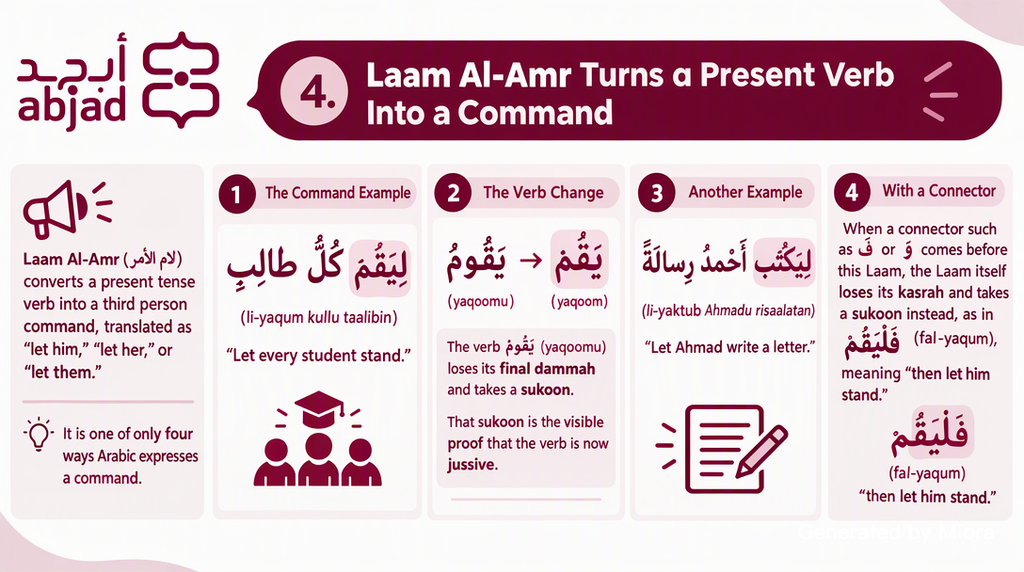
لِيَقُمْ كُلُّ طَالِبٍ
(li-yaqum kullu taalibin)
“Let every student stand.”
The verb يَقُومُ (yaqoomu) loses its final dammah and takes a sukoon. That sukoon is the visible proof that the verb is now jussive.
لِيَكْتُبْ أَحْمَدُ رِسَالَةً
(li-yaktub Ahmadu risaalatan)
“Let Ahmad write a letter.”
When a connector such as فَ or وَ comes before this Laam, the Laam itself loses its kasrah and takes a sukoon instead, as in فَلْيَقُمْ (fal-yaqum), meaning “then let him stand.”
See Us in Action!
Curious about what our online classrooms look like? Watch the short clips below to see how our interactive, one-on-one sessions bring learning to life with real-time feedback and engaging teaching methods.
Begin Your Arabic Journey in the UAE
Join Abjad Institute for a professional and immersive Arabic language experience tailored to your goals.
Book Your Free Trial5. Laam Al-Tawkid Strengthens a Statement
Laam Al-Tawkid (لام التوكيد) adds emphasis without changing the grammatical case of anything around it. Its job is purely rhetorical, giving the sentence weight and certainty.
It appears in two recognizable positions, each with its own name and its own vowel pattern.
Laam Al-Ibtida at the Start of a Sentence
This emphatic Laam opens a nominal sentence or sits before the predicate after إِنَّ. It carries a fathah and leaves the parsing untouched.
لَهِيَ أَجْمَلُ فَتَاةٍ
(la-hiya ajmalu fataatin)
“She is truly the most beautiful girl.”
Laam Al-Qasam in Oaths and Promises
In oaths, the Laam precedes the verb and usually pairs with a doubled noon of emphasis at the end of that verb.
لَأَجْتَهِدَنَّ فِي عَمَلِي
(la-ajtahidanna fii ‘amalii)
“I will certainly work hard in my job.”
The doubled noon is the signature of this construction. When you see it, the Laam before the verb is almost always an oath Laam rather than a purpose Laam.
6. Laam Al-Juhood Denies an Action Completely
Laam Al-Juhood (لام الجحود) expresses absolute denial, closer to “would never” than to a plain “did not.” The word juhood comes from the root ج ح د, meaning rejection.
This Laam cannot appear by itself. It requires a negated form of kana before it, such as مَا كَانَ or لَمْ يَكُنْ, and it places the following verb in the subjunctive.
مَا كَانَ الْكَرِيمُ لِيَبْخَلَ
(maa kaana al-kariimu li-yabkhala)
“A generous person would never be stingy.”
مَا كُنْتُ لِأَتْرُكَ صَدِيقِي
(maa kuntu li-atruka sadiiqii)
“I would never abandon my friend.”
The structure is fixed and easy to spot once you know it: negation, then kana, then subject, then Laam, then verb. Any sentence missing the negated kana is not using Laam Al-Juhood.
Abjad Academy explores these classical constructions in depth through its Classical Arabic Course, which trains students to parse older texts without relying on translation.

Start a Free Classical Arabic Trial
7. Laam Al-Aqibah Points to an Unintended Outcome
Laam Al-Aqibah (لام العاقبة) looks identical to Laam Al-Ta’leel but carries the opposite logic. Instead of naming an intended purpose, it names a result nobody planned.
خَرَجَ مِنْ بَيْتِهِ لِيَضِيعَ فِي الطَّرِيقِ
(kharaja min baytihi li-yadii’a fii at-tariiqi)
“He left his house only to get lost on the road.”
He did not leave in order to get lost. Getting lost was the consequence, which is exactly what separates this Laam from the Laam of purpose.
Context is the only reliable test here, since both types take a kasrah and both place the verb in the subjunctive. Ask whether the outcome was wanted or merely what happened.
8. Laam Al-Bu’d Marks Distance in Demonstratives
Laam Al-Bu’d (لام البعد) attaches to a demonstrative pronoun and pushes the reference further away in space or time. It is the difference between “this” and “that.”
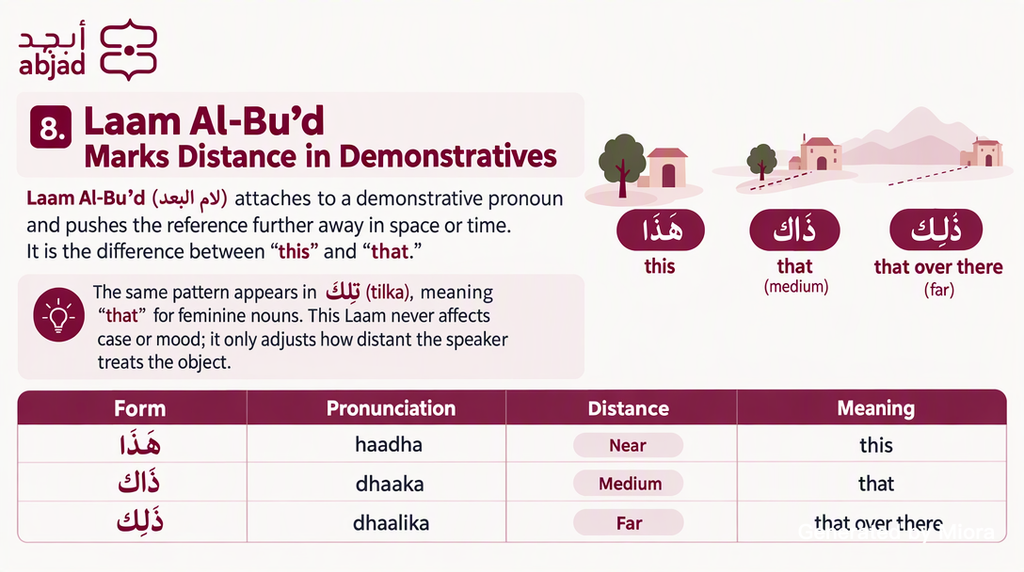
ذَاكَ
(dhaaka)
“that one, nearby”
ذَلِكَ
(dhaalika)
“that one, far away”
The same pattern appears in تِلْكَ (tilka), meaning “that” for feminine nouns. This Laam never affects case or mood; it only adjusts how distant the speaker treats the object.
| Form | Pronunciation | Distance | Meaning |
| هَذَا | haadha | Near | this |
| ذَاكَ | dhaaka | Medium | that |
| ذَلِكَ | dhaalika | Far | that over there |
Types of Laam in Arabic Grammar at a Glance
The table below gathers every form covered above into one reference you can return to while reading. Scan the grammatical effect column first, because that is what distinguishes one Laam from another in practice.
| Laam Type | Arabic Name | Grammatical Effect | Core Meaning |
| Definite article | لام التعريف | No case change | Makes a noun definite |
| Preposition | لام الجر | Genitive noun | Belonging to, for |
| Purpose | لام التعليل | Subjunctive verb | In order to |
| Command | لام الأمر | Jussive verb | Let him or her do |
| Emphasis | لام التوكيد | No case change | Truly, certainly |
| Denial | لام الجحود | Subjunctive verb | Would never |
| Consequence | لام العاقبة | Subjunctive verb | Only to end up |
| Distance | لام البعد | No case change | That, far away |
Read also: Connecting Arabic Letters Practice with Drills And Real Words
Common Mistakes Learners Make With Laam Types
Four errors appear again and again in beginner writing. Each one has a simple diagnostic that takes seconds to apply.
- Treating every Laam before a verb as a purpose Laam. Check the verb ending first: sukoon means command, fathah means purpose or denial.
- Pronouncing the Laam in solar words such as السَّمَاء (as-samaa’), meaning “the sky.” The Laam is written but silent there.
- Writing Laam Al-Juhood without a negated kana before it. Without that negation, the construction is simply ungrammatical.
- Giving the attached pronoun form a kasrah instead of a fathah, producing لِكَ rather than the correct لَكَ (laka), meaning “for you.”
Fixing these four habits early prevents months of corrective work later, especially for learners who read faster than they speak.
Abjad Academy builds that accuracy through its Fusha Arabic Course, where tutors correct particle vowels in real time instead of letting errors settle.

Claim Your Free Fusha Arabic Lesson
Inside Our Virtual Classrooms
We believe in full transparency and proven quality. Take a look at these actual snippets from our live classes to experience our modern learning platform, patient instructors, and interactive student participation.
Begin Your Arabic Journey in the UAE
Join Abjad Institute for a professional and immersive Arabic language experience tailored to your goals.
Book Your Free TrialStart Learning Arabic Grammar With Abjad Academy Tutors
Grammar particles are learned fastest when someone hears your reading and corrects the vowel before the habit sets. Abjad Academy pairs every student in the UAE and beyond with a native tutor for live, one-on-one sessions.
What sets Abjad Academy apart:
- Native Arabic tutors trained specifically to teach non-native speakers.
- Flexible scheduling built around Gulf and international time zones.
- Structured progression from the alphabet through advanced classical grammar.
Our Arabic Courses
- Arabic Grammar Course
- Arabic Course for Beginners
- Classical Arabic Course
- Fusha Arabic Course
- Arabic Course for Adults
- Arabic Writing Course

Conclusion
The types of Laam in Arabic grammar are not variations of one function. Each form carries a distinct job, from marking a noun as definite to denying an action outright, and each leaves a visible trace on the word that follows it.
Three signals identify any Laam you meet. Look at the word class after it, look at the vowel on the Laam itself, and look at the ending of the following noun or verb.
Once those three checks become automatic, reading unvocalized Arabic becomes far less intimidating. Consistent practice with a tutor who corrects you out loud is what moves this knowledge from recognition into fluent use.
FAQs
How Many Types of Laam Are There in Arabic Grammar?
Classical grammarians list between eight and thirty one types depending on how finely they classify. For practical reading and writing, the eight covered above account for the overwhelming majority of real usage in both classical and modern Arabic.
What Is the Difference Between Laam Al-Ta’leel and Laam Al-Juhood?
Laam Al-Ta’leel expresses purpose and means “in order to.” Laam Al-Juhood expresses absolute denial and means “would never.” The structural giveaway is that Laam Al-Juhood always follows a negated form of kana, such as maa kaana or lam yakun.
Why Does the Laam in الـ Sometimes Sound Silent?
It is not silent but fully assimilated. Before any of the fourteen solar letters, the Laam merges into the next letter, which then doubles with a shaddah. Before lunar letters it stays audible with a clear sukoon.
Does Laam Al-Amr Always Change the Verb Ending?
Yes. Laam Al-Amr is a jussive particle, so the present verb after it always takes a sukoon on its final letter. Verbs ending in a weak letter drop that letter instead, and the five special verbs drop their final noon.
Can One Sentence Contain More Than One Type of Laam?
Yes, and it happens frequently. A sentence may open with a command Laam, contain a definite article Laam on its object, and close with a purpose Laam explaining the motive behind the action.







Leave a Reply