 Learn Arabic
| Key Takeaways |
| “She” in Arabic is هي (hiya), an independent pronoun that stands alone and works as the subject of the sentence. |
| “Her” in Arabic is the suffix ـها (-hā), which joins verbs for objects, nouns for possession, and prepositions. |
| Arabic marks gender only in the second and third person; أنا (anā) and نحن (naḥnu) carry no gender at all. |
| A feminine subject forces agreement, so past verbs take ـتْ (-at) and adjectives take ة (tā’ marbūṭa). |
Learners meet she her pronouns in Arabic within their first few lessons, usually before they have any framework for grammatical gender. That single gap causes more sentence errors than vocabulary ever does.
Arabic assigns gender to people, animals, and objects alike. Pronouns, verbs, and adjectives then shift to match that gender, so one wrong vowel can turn a sentence addressed to a woman into one addressed to a man.
This guide covers every form you need, with transliteration and translation for every Arabic word. It moves from the two core forms هي and ـها to the full female set, the male set, neutral forms, agreement rules, and practice exercises.
How She Her Pronouns in Arabic Work
“She” in Arabic is هي (hiya), and “her” is ـها (-hā). The first stands alone as a subject. The second never stands alone and must attach to another word.
English keeps both forms as separate words. Arabic splits the job between an independent pronoun and a suffix, which is the single structural difference most beginners miss.
Look at one sentence that contains both:
هي تقرأ كتابها.
(Hiya taqra’u kitābahā.)
“She is reading her book.”
Three pieces carry the meaning here.
هي (hiya) is the subject “she”, كتاب (kitāb) means “book”, and the suffix ـها on the end turns it into “her book”.
| English | Arabic | Transliteration | Role |
| She | هي | hiya | Independent subject pronoun |
| Her (object) | ـها | -hā | Suffix on a verb |
| Her (possessive) | ـها | -hā | Suffix on a noun |
| To her | لها | lahā | Preposition plus suffix |
Gender Pronouns in Arabic Across Person and Number
Gender pronouns in Arabic change along four axes at once: person, number, gender, and whether the pronoun stands alone or attaches to another word. English only varies two of these.
Arabic also keeps a dual form for exactly two people, a category English dropped centuries ago. That gives the language twelve independent pronouns instead of the English seven.
Independent Pronouns That Stand Alone
Independent pronouns, called الضمائر المنفصلة (aḍ-ḍamā’ir al-munfaṣilah), work as subjects or as emphasis. They are written as separate words.
| Arabic | Transliteration | English | Gender | Number |
| أنا | anā | I | shared | singular |
| نحن | naḥnu | we | shared | plural |
| أنتَ | anta | you | masculine | singular |
| أنتِ | anti | you | feminine | singular |
| أنتما | antumā | you two | shared | dual |
| أنتم | antum | you all | masculine | plural |
| أنتنَّ | antunna | you all | feminine | plural |
| هو | huwa | he | masculine | singular |
| هي | hiya | she | feminine | singular |
| هما | humā | they two | shared | dual |
| هم | hum | they | masculine | plural |
| هنَّ | hunna | they | feminine | plural |
Attached Pronouns That Join Other Words
Attached pronouns, الضمائر المتصلة (aḍ-ḍamā’ir al-muttaṣilah), are suffixes. One single set covers objects and possession, and the word they attach to decides which meaning applies.
| Suffix | Transliteration | On a verb | On a noun |
| ـي / ـني | -ī / -nī | me | my |
| ـكَ | -ka | you (m.) | your (m.) |
| ـكِ | -ki | you (f.) | your (f.) |
| ـهُ | -hu | him | his |
| ـها | -hā | her | her |
| ـنا | -nā | us | our |
| ـهم | -hum | them (m.) | their (m.) |
| ـهنَّ | -hunna | them (f.) | their (f.) |
Compare رأيتُها (ra’aytuhā), “I saw her”, with كتابها (kitābuhā), “her book”. Identical suffix, two meanings, decided entirely by the host word.
Abjad Academy offers an Arabic Grammar Course that drills the independent and attached pronoun tables through guided sentence building until the forms become automatic.

Practice Arabic Pronouns With a Certified Tutor
Hiya as the Arabic Word for She
هي (hiya) refers to any feminine singular subject, whether a woman, a girl, a female animal, or a grammatically feminine object such as شمس (shams), meaning “sun”.
Three sentences show its range:
هي طالبة.
(Hiya ṭālibah.)
“She is a student.”
هي تعمل في دبي.
(Hiya taʿmalu fī Dubayy.)
“She works in Dubai.”
هي معلمة ماهرة.
(Hiya muʿallimah māhirah.)
“She is a skilled teacher.”
Pronunciation and Spelling of Hiya
هي is written with three letters: ه (hā’), ي (yā’), and the fatḥa vowel on the yā’. Say it as HEE-ya, with the stress on the first syllable.
Many beginners confuse هي (hiya) with هو (huwa), meaning “he”. Only the middle letter changes, so slow, deliberate repetition of the pair fixes the error faster than written drills do.
When Hiya Is Dropped From a Sentence
Standard usage in Arabic allows you to delete هي completely, because the verb already carries the subject.
تكتب (taktubu) on its own means “she writes”.
That same verb form also means “you write” when addressing a man. Keeping هي removes the ambiguity, so write it whenever the context does not already make the subject obvious.
Read also: Types of Laam in Arabic Grammar With Rules and Examples
Haa as the Arabic Suffix for Her
ـها (-hā) is the only form Arabic uses for “her”. It never appears as an independent word, and it attaches directly with no space and no linking letter.
Haa Attached to Verbs as an Object
On a verb, ـها marks the person receiving the action.
| Arabic | Transliteration | English |
| رأيتها | ra’aytuhā | I saw her |
| ساعدتها | sāʿadtuhā | I helped her |
| سألتها | sa’altuhā | I asked her |
| كلمتها | kallamtuhā | I spoke to her |
Haa Attached to Nouns to Show Possession
On a noun, the same suffix shows ownership and replaces the tanwīn, the double vowel that marks an indefinite noun.
| Arabic | Transliteration | English |
| كتابها | kitābuhā | her book |
| بيتها | baytuhā | her house |
| أمها | ummuhā | her mother |
| سيارتها | sayyāratuhā | her car |
Haa Attached to Prepositions
Prepositions take the suffix too, and the preposition decides the meaning of the whole phrase.
| Arabic | Transliteration | English |
| لها | lahā | to her, for her |
| منها | minhā | from her |
| معها | maʿahā | with her |
| عنها | ʿanhā | about her |
| إليها | ilayhā | toward her |
A full sentence puts all three uses together:
ذهبتُ معها إلى بيتها لأعطيها كتابها.
(Dhahabtu maʿahā ilā baytihā li-uʿṭiyahā kitābahā.)
“I went with her to her house to give her her book.”
Anti and Other Female Pronouns in Arabic
Female pronouns in Arabic cover five positions: you (singular), you (plural), she, they (plural), and the shared dual form أنتما (antumā) used for two people of either gender.
Detached Female Pronouns
| Arabic | Transliteration | English |
| أنتِ | anti | you (one female) |
| أنتنَّ | antunna | you all (females) |
| هي | hiya | she |
| هنَّ | hunna | they (females) |
Examples in context:
أنتِ طالبة مجتهدة.
(Anti ṭālibah mujtahidah.)
“You are a hardworking student.”
هنَّ معلمات.
(Hunna muʿallimāt.)
“They are female teachers.”
Attached Female Pronoun Suffixes
| Suffix | Transliteration | Example | Meaning |
| ـكِ | -ki | كتابكِ (kitābuki) | your book (to a female) |
| ـها | -hā | كتابها (kitābuhā) | her book |
| ـكنَّ | -kunna | كتابكنَّ (kitābukunna) | your book (female group) |
| ـهنَّ | -hunna | كتابهنَّ (kitābuhunna) | their book (female group) |
Emphatic Object Forms With Iyyaa
When the object needs emphasis or comes before the verb, Arabic uses a standalone object pronoun built on إيّا (iyyā).
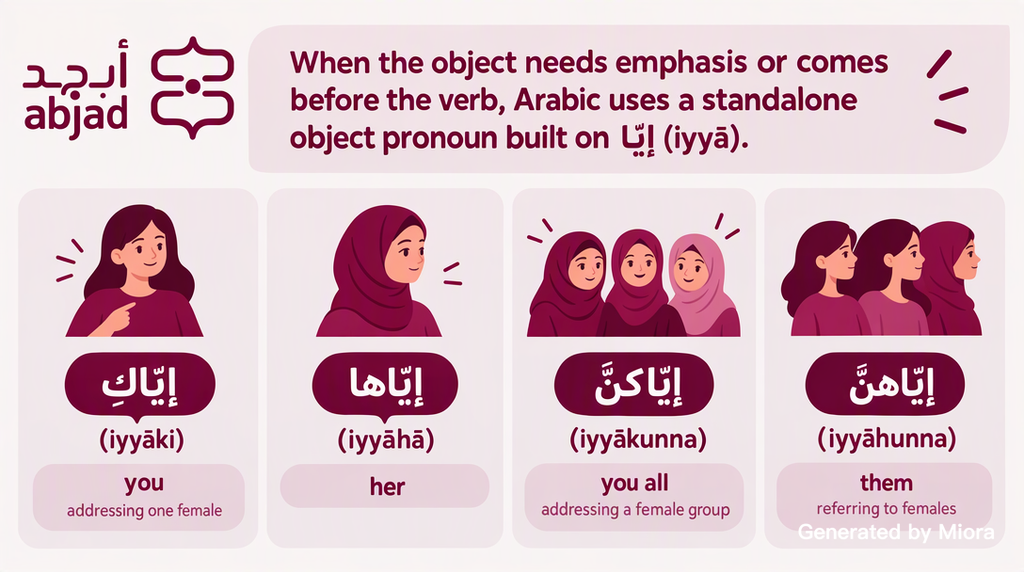
- إيّاكِ (iyyāki) means “you”, addressing one female.
- إيّاها (iyyāhā) means “her”.
- إيّاكنَّ (iyyākunna) means “you all”, addressing a female group.
- إيّاهنَّ (iyyāhunna) means “them”, referring to females.
Native speakers reserve these forms for emphasis, so beginners should recognize them in reading before trying to produce them in speech.
Abjad Academy offers an Arabic Course for Beginners that introduces female and male pronoun sets in a graded order, so learners never meet two conflicting patterns in the same lesson.

Book a Free Beginner Arabic Session
Male Pronouns in Arabic Compared With Female Forms
Male pronouns in Arabic mirror the female set position by position. In the singular, the difference is often a single vowel, which is why unvowelled text forces readers to rely on context.
| Function | Masculine | Feminine |
| You (singular) | أنتَ (anta) | أنتِ (anti) |
| He / She | هو (huwa) | هي (hiya) |
| They (plural) | هم (hum) | هنَّ (hunna) |
| His / Her | ـهُ (-hu) | ـها (-hā) |
| Your (singular) | ـكَ (-ka) | ـكِ (-ki) |
Notice أنتَ and أنتِ. Both are written أنت, and only the final vowel mark separates them, so vowelled texts matter enormously for new readers.
The contrast reaches the rest of the sentence as well:
هو سعيد.
(Huwa saʿīd.)
“He is happy.”
هي سعيدة.
(Hiya saʿīdah.)
“She is happy.”
One more rule governs groups. A mixed group of men and women takes the masculine plural هم (hum), while هنَّ (hunna) is reserved for groups that are entirely female.
See Us in Action!
Curious about what our online classrooms look like? Watch the short clips below to see how our interactive, one-on-one sessions bring learning to life with real-time feedback and engaging teaching methods.
Begin Your Arabic Journey in the UAE
Join Abjad Institute for a professional and immersive Arabic language experience tailored to your goals.
Book Your Free TrialGender Neutral Pronouns in Arabic and Shared Forms
Arabic has no singular gender neutral pronoun equivalent to the English singular “they”. Every third-person singular pronoun is either masculine or feminine, with no third option available.
Some forms are still neutral, though, and learners ask about gender neutral pronouns in Arabic often enough that the exceptions deserve a clear list.
| Form | Transliteration | Why it is neutral |
| أنا | anā | First person singular, identical for men and women |
| نحن | naḥnu | First person plural, identical for both |
| أنتما | antumā | Dual “you two”, one form for any pair |
| هما | humā | Dual “they two”, one form for any pair |
Neutrality stops at the pronoun. Whatever follows it still shows gender, as these two sentences prove:
أنا سعيد.
(Anā saʿīd.)
“I am happy.” (male speaker)
أنا سعيدة.
(Anā saʿīdah.)
“I am happy.” (female speaker)
Arabic also has no neutral “it”. Objects take هو or هي according to their grammatical gender, so السيارة (as-sayyārah), “the car”, is feminine and is referred to as هي.
Read also: 10 Most Used Sentences in Arabic With Pronunciation
Characteristics of Arabic Gender Pronouns
Four characteristics define how gender pronouns in Arabic behave. Each one creates a different kind of error for English speakers, so treat them as four separate habits to build.
1. Gender Marking in Second and Third Person Only
Arabic separates male from female whenever you address someone or talk about someone. It never does so when you speak about yourself or your group.
2. Three Number Levels Including the Dual
Singular, dual, and plural each take their own pronoun. Using هم (hum) for two men is a real error, because the correct form is هما (humā).
3. Pronouns Hidden Inside Arabic Verbs
Arabic verbs encode the subject in their prefixes and suffixes, so the pronoun is frequently invisible.
| Arabic verb | Transliteration | English |
| كتبتُ | katabtu | I wrote |
| كتبَ | kataba | he wrote |
| كتبتْ | katabat | she wrote |
| يكتب | yaktubu | he writes |
| تكتب | taktubu | she writes |
4. Agreement Control Over Verbs and Adjectives
A feminine pronoun forces matching endings across the sentence, a relationship Arabic grammarians call المطابقة (al-muṭābaqah), meaning “agreement”.
| Masculine | Feminine | English |
| كبير (kabīr) | كبيرة (kabīrah) | big |
| جميل (jamīl) | جميلة (jamīlah) | beautiful |
| ذكي (dhakiyy) | ذكية (dhakiyyah) | intelligent |
Function of Arabic Gender Pronouns in Sentences
Function in Arabic grammar means the job a pronoun performs inside the sentence. Gender pronouns in Arabic carry four jobs, and the form you pick depends entirely on which job applies.
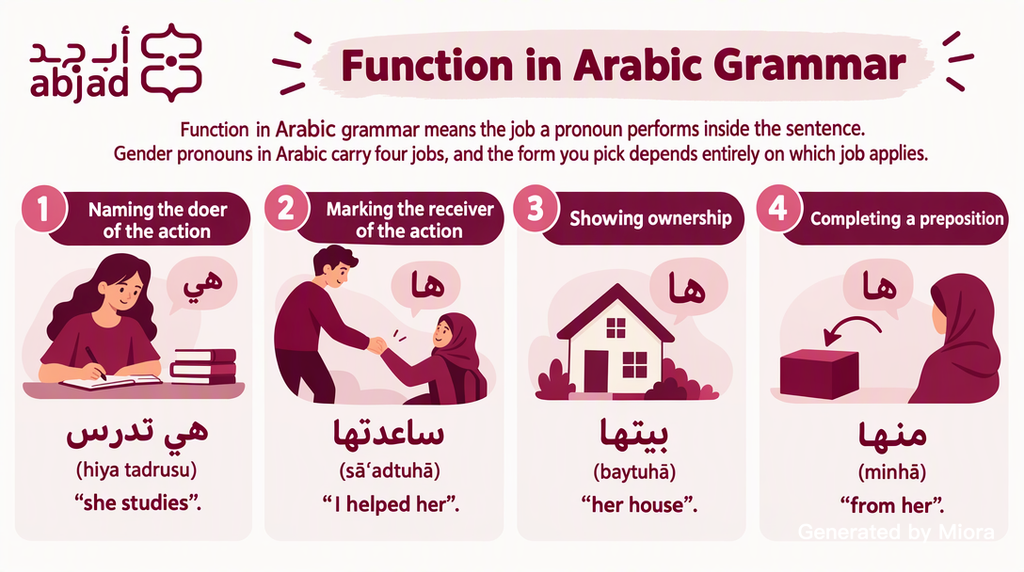
- Naming the doer of the action, as in هي تدرس (hiya tadrusu), “she studies”.
- Marking the receiver of the action, as in ساعدتها (sāʿadtuhā), “I helped her”.
- Showing ownership, as in بيتها (baytuhā), “her house”.
- Completing a preposition, as in منها (minhā), “from her”.
Emphasis adds a fifth job. Placing an independent pronoun before the verb shifts the focus onto the subject rather than the action:
هي كتبت الرسالة.
(Hiya katabat ar-risālah.)
“She wrote the letter.”
Each job also predicts where the pronoun appears. Subject pronouns come first or disappear into the verb, while object and possessive forms always sit at the end of the word they modify.
Abjad Academy offers a Modern Standard Arabic Course that teaches pronoun function inside full sentence structures rather than as isolated tables to memorize.

Start Your Modern Standard Arabic Training
Common Mistakes With Arabic She and Her Pronouns
Five errors account for most pronoun mistakes among English-speaking learners. Each has a quick correction once you know what to listen for.
| Mistake | What goes wrong | Correction |
| Saying أنتَ to a woman | Masculine form used in direct address | Use أنتِ (anti) with a final kasra |
| Writing هي منفصلة as “her” | Subject form used for an object | Use ـها (-hā) for “her” |
| Using هم for two people | Plural used where the dual belongs | Use هما (humā) |
| Forgetting ة on adjectives | Adjective fails to agree with هي | Add ة, as in جميلة (jamīlah) |
| Dropping ـتْ on past verbs | Masculine verb with a feminine subject | Use كتبتْ (katabat), not كتبَ |
In our teaching experience at Abjad Academy, learners across the UAE correct the أنتَ and أنتِ confusion fastest when they practice in pairs, hearing both forms back to back in the same minute.
Inside Our Virtual Classrooms
We believe in full transparency and proven quality. Take a look at these actual snippets from our live classes to experience our modern learning platform, patient instructors, and interactive student participation.
Begin Your Arabic Journey in the UAE
Join Abjad Institute for a professional and immersive Arabic language experience tailored to your goals.
Book Your Free TrialExercises on She Her Pronouns in Arabic
Three short exercises test the forms covered above. Work through all of them before checking the answers at the end of this section.
Exercise 1: Choose the correct pronoun.
- ___ طالبة مجتهدة. (“She is a hardworking student.”)
- ___ تذهبين إلى السوق. (“You, female, are going to the market.”)
- ___ طبيبات. (“They, females, are doctors.”)
- ___ تدرسان العربية. (“You two study Arabic.”)
Exercise 2: Add the correct suffix.
- كتاب____ جديد. (“Her book is new.”)
- سألت____ عن الدرس. (“I asked you, female, about the lesson.”)
- ذهبتُ مع____ (“I went with her.”)
- بيت____ قريب. (“Her house is nearby.”)
Exercise 3: Convert the verb to the feminine form.
- ذهبَ (dhahaba)
- كتبَ (kataba)
- يدرس (yadrusu)
- قرأ (qara’a)
Answers.
- Exercise 1: هي (hiya), أنتِ (anti), هنَّ (hunna), أنتما (antumā).
- Exercise 2: كتابها (kitābuhā), سألتكِ (sa’altuki), معها (maʿahā), بيتها (baytuhā).
- Exercise 3: ذهبتْ (dhahabat), كتبتْ (katabat), تدرس (tadrusu), قرأتْ (qara’at).
Abjad Academy offers an Arabic Speaking Course that turns written exercises like these into live conversation practice with instant correction from a native tutor.

Speak Arabic With a Native Tutor Today
Begin Your Arabic Journey in the UAE
Join Abjad Institute for a professional and immersive Arabic language experience tailored to your goals.
Book Your Free TrialStart Learning Arabic Grammar With Abjad Academy Tutors
Pronoun accuracy improves fastest when a trained ear catches the missing kasra or the dropped ـتْ in real time. Abjad Academy builds every session around that kind of immediate, spoken correction.
What sets Abjad Academy apart:
- One-on-one live sessions with native Arabic tutors, never pre-recorded lessons.
- Flexible scheduling built around UAE and international time zones.
- Structured levels that move from the alphabet to full sentence construction.
- Written and spoken practice combined in every single lesson.
Our Arabic Courses
- Arabic Grammar Course.
- Arabic Course for Beginners.
- Modern Standard Arabic Course.
- Arabic Speaking Course.
- Online Arabic Classes for Kids.
- Arabic Classes for Adults.
Conclusion
She her pronouns in Arabic rest on two forms that behave differently.
هي (hiya) stands alone as a subject, and ـها (-hā) attaches to verbs, nouns, and prepositions to mean “her”.
Around that core sits a complete system. Female pronouns in Arabic such as أنتِ (anti) and هنَّ (hunna) pair with male pronouns in Arabic like أنتَ (anta) and هم (hum), while the dual and first-person forms stay gender neutral.
Learn the forms, then watch what they force onto the rest of the sentence. Once verb endings and adjective agreement follow your pronoun automatically, Arabic sentences stop feeling like puzzles and start feeling like speech.
FAQs
What Are Her Pronouns in Arabic?
“Her” in Arabic is the suffix ـها (-hā). It attaches to verbs as an object, as in رأيتها (ra’aytuhā), “I saw her”, and to nouns as a possessive, as in كتابها (kitābuhā), “her book”.
How Do You Say She in Arabic?
“She” in Arabic is هي (hiya), pronounced HEE-ya. It is an independent subject pronoun used for women, girls, female animals, and grammatically feminine nouns such as شمس (shams), meaning “sun”.
What Is the Difference Between Hiya and Haa?
هي (hiya) is a standalone subject pronoun meaning “she”.
ـها (-hā) is a suffix meaning “her” that never appears alone. Compare هي تقرأ (hiya taqra’u), “she reads”, with رأيتها (ra’aytuhā), “I saw her”.
Are There Gender Neutral Pronouns in Arabic?
Arabic has no singular neutral pronoun like the English “they”. However, أنا (anā) meaning “I”, نحن (naḥnu) meaning “we”, and the dual forms أنتما (antumā) and هما (humā) carry no gender marking.
How Do Female Pronouns Change Arabic Verbs?
A feminine subject adds ـتْ (-at) to past tense verbs and تـ (ta-) to present tense verbs. So كتبَ (kataba) means “he wrote”, while كتبتْ (katabat) means “she wrote”.
Which Arabic Pronoun Do You Use for a Mixed Group?
Arabic uses the masculine plural هم (hum) for any group containing both men and women. The feminine هنَّ (hunna) applies only when every member of the group is female.





Leave a Reply