 Quran
Quran
Many Muslims and Arabic learners wonder: Is Quranic Arabic the same as the Arabic spoken today, or is it a completely different form of the language? This question is especially important for those who want to understand the Quran, study Islamic texts, or learn Arabic for communication.
The truth is that Quranic Arabic and modern Arabic share the same roots, alphabet, and grammatical foundation, but they differ in vocabulary, style, structure, and purpose. Quranic Arabic represents the original language of the Quran, known for its precision, depth, and unmatched eloquence, while Modern Standard Arabic and spoken dialects have developed to meet the needs of everyday communication.
Understanding these differences will help you choose the right learning path based on your goals—whether you want to comprehend the Quran word by word, improve your Arabic skills, or communicate confidently with Arabic speakers around the world.
What Is Quranic Arabic?
Quranic Arabic is the form of Classical Arabic in which Allah revealed the Quran. It preserves the original vocabulary, grammar, rhetoric, and eloquence of the divine revelation exactly as it has been transmitted for more than fourteen centuries.
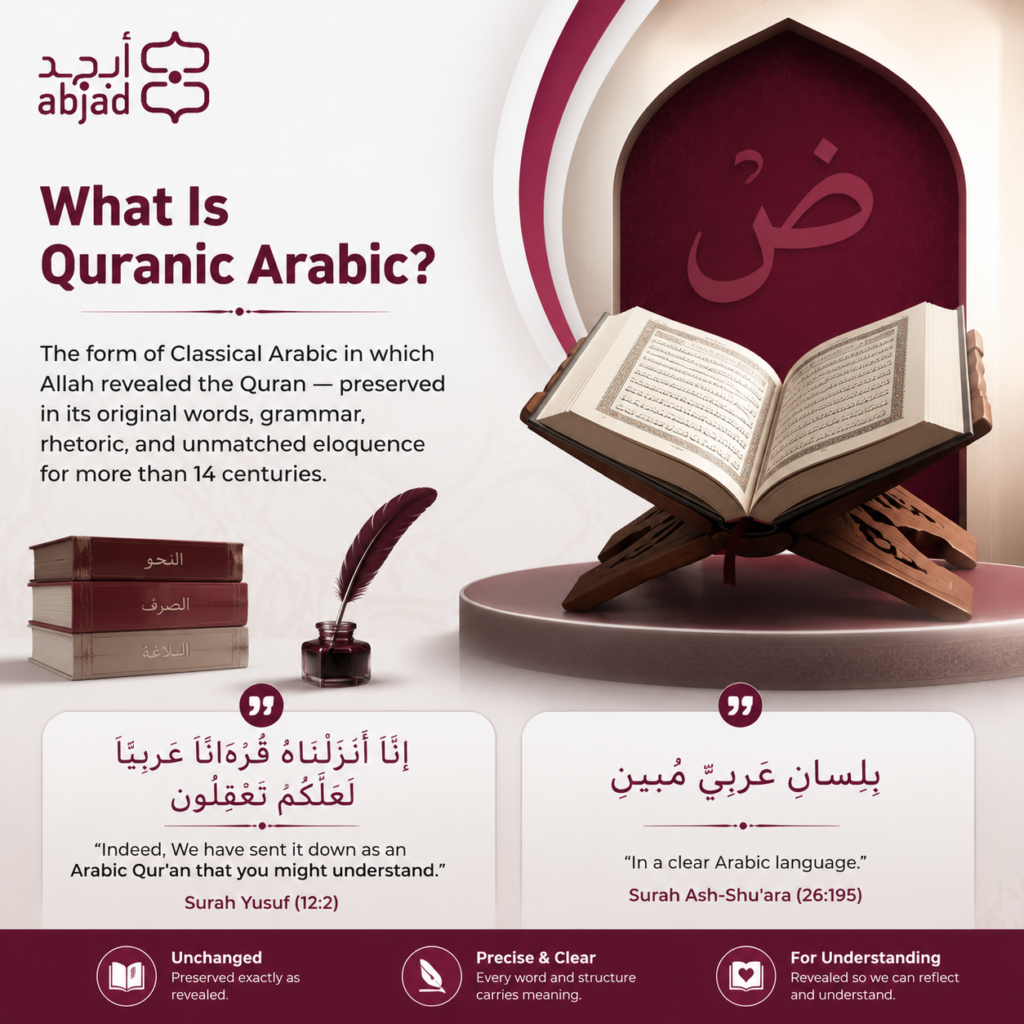
Unlike modern forms of Arabic that evolved to meet contemporary needs, Quranic Arabic remains unchanged. Every grammatical structure, word choice, and rhetorical style carries meaning that scholars have studied for centuries.
Allah says:
إِنَّا أَنزَلْنَاهُ قُرْآنًا عَرَبِيًّا لَعَلَّكُمْ تَعْقِلُون
“Indeed, We have sent it down as an Arabic Qur’an that you might understand.” Surah Yusuf (12:2)
This verse highlights that Allah intentionally chose Arabic as the language of revelation so people could reflect upon and understand His message. The emphasis is not merely on speaking Arabic but on comprehending its meanings.
Allah also says:
بِلِسَانٍ عَرَبِيٍّ مُبِينٍ
“In a clear Arabic language.” Surah Ash-Shu’ara (26:195)
This verse describes the Quran as being revealed in clear Arabic, emphasizing its precision, eloquence, and clarity.
Is Quranic Arabic the Same as Classical Arabic?
This is one of the biggest misconceptions among learners Quranic Arabic is Classical Arabic, but Classical Arabic is broader than Quranic Arabic.
Classical Arabic includes:
- The language of the Quran
- Early Islamic scholarship
- Classical poetry
- Literature written during the early centuries of Islam
Quranic Arabic represents the most authentic and perfectly preserved form of Classical Arabic because every letter, word, and expression has remained unchanged since its revelation. It is the language in which Allah revealed the Quran and serves as the linguistic foundation for understanding the Islamic sciences.
Classical Arabic is a broader category that includes not only Quranic Arabic but also pre-Islamic poetry, early Islamic literature, and the writings of classical scholars. In other words, every verse of the Quran is written in Classical Arabic, but not every Classical Arabic text is Quranic Arabic. The Quran is unique within Classical Arabic because of its divine origin, unmatched eloquence, and perfect preservation.
What Is “Normal Arabic”?
When people ask, “Is Quranic Arabic different from normal Arabic?”, they usually mean one of three things.
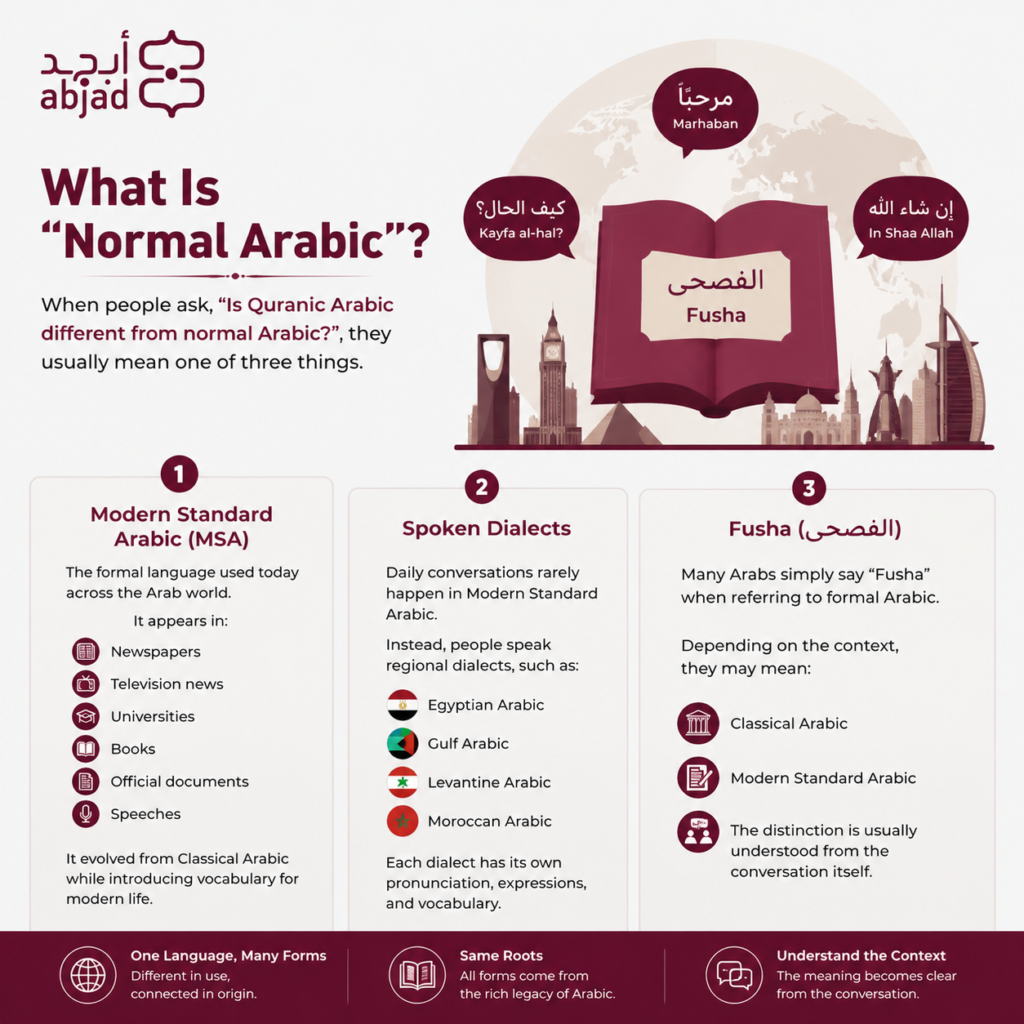
1. Modern Standard Arabic (MSA)
Modern Standard Arabic is the formal language used today across the Arab world.
It appears in:
- newspapers
- television news
- universities
- books
- official documents
- speeches
It evolved from Classical Arabic while introducing vocabulary for modern life.
2. Spoken Dialects
Daily conversations rarely happen in Modern Standard Arabic.
Instead, people speak regional dialects, such as:
- Egyptian Arabic
- Gulf Arabic
- Levantine Arabic
- Moroccan Arabic
Each dialect has its own pronunciation, expressions, and vocabulary.
3. Fusha (الفصحى)
Many Arabs simply say “Fusha” when referring to formal Arabic.
Depending on the context, they may mean:
- Classical Arabic
- Modern Standard Arabic
The distinction is usually understood from the conversation itself.
Read also: What Is Quranic Arabic? A Complete Guide
Watch Our Classes in Action
Curious what a real session looks like? Take a peek inside our interactive classrooms and see how our expert instructors bring the Arabic language to life. Watch a sample lesson below!
Begin Your Arabic Journey in the UAE
Join Abjad Institute for a professional and immersive Arabic language experience tailored to your goals.
Book Your Free TrialQuranic Arabic vs Modern Standard Arabic (MSA)
Although Modern Standard Arabic developed from Classical Arabic, it has been adapted for modern communication.
The similarities are significant, but so are the differences.
| Feature | Quranic Arabic | Modern Standard Arabic |
| Primary purpose | Understanding the Quran | Education, media, government |
| Vocabulary | Classical, Quranic | Modern terminology |
| Grammar | Rich and highly rhetorical | Slightly simplified |
| Style | Literary and eloquent | Functional and contemporary |
| Pronunciation | Governed by Tajweed during recitation | Standard pronunciation without Tajweed |
| Used in conversation | Rarely | Occasionally in formal situations |
One important point is that Modern Standard Arabic is not a different language. Rather, it is the modern continuation of Classical Arabic with updated vocabulary.
For example, Modern Standard Arabic includes words for:
- computers
- airplanes
- smartphones
- artificial intelligence
- economics
These concepts naturally did not exist during the time of revelation.
If your goal is professional communication or academic study, learning Modern Standard Arabic through structured Arabic Courses can provide a strong foundation before expanding into Quranic Arabic.
Start Your Arabic Learning Journey with a FREE Trial Class

Read more: The Quranic Arabic Alphabet
Is Quranic Arabic More Difficult Than Modern Arabic?
yes Quranic Arabic is often more challenging than Modern Standard Arabic because it contains older vocabulary, sophisticated sentence structures, advanced rhetorical devices, and precise grammatical constructions. Many verses also include expressions whose full meanings are best understood through Tafsir, historical context, and the explanations of classical scholars.
Despite these challenges, Quranic Arabic becomes increasingly accessible with consistent study. Its vocabulary is highly repetitive, and many words, roots, and grammatical patterns appear throughout the Quran. As learners become familiar with these recurring elements, their comprehension improves naturally. In addition, studying Quranic Arabic strengthens a learner’s understanding of Modern Standard Arabic since both share the same core grammar and linguistic foundations.
Is Tajweed Part of Quranic Arabic?
Not exactly This is another common misunderstanding Quranic Arabic is the language. Tajweed is the method of reciting that language correctly.
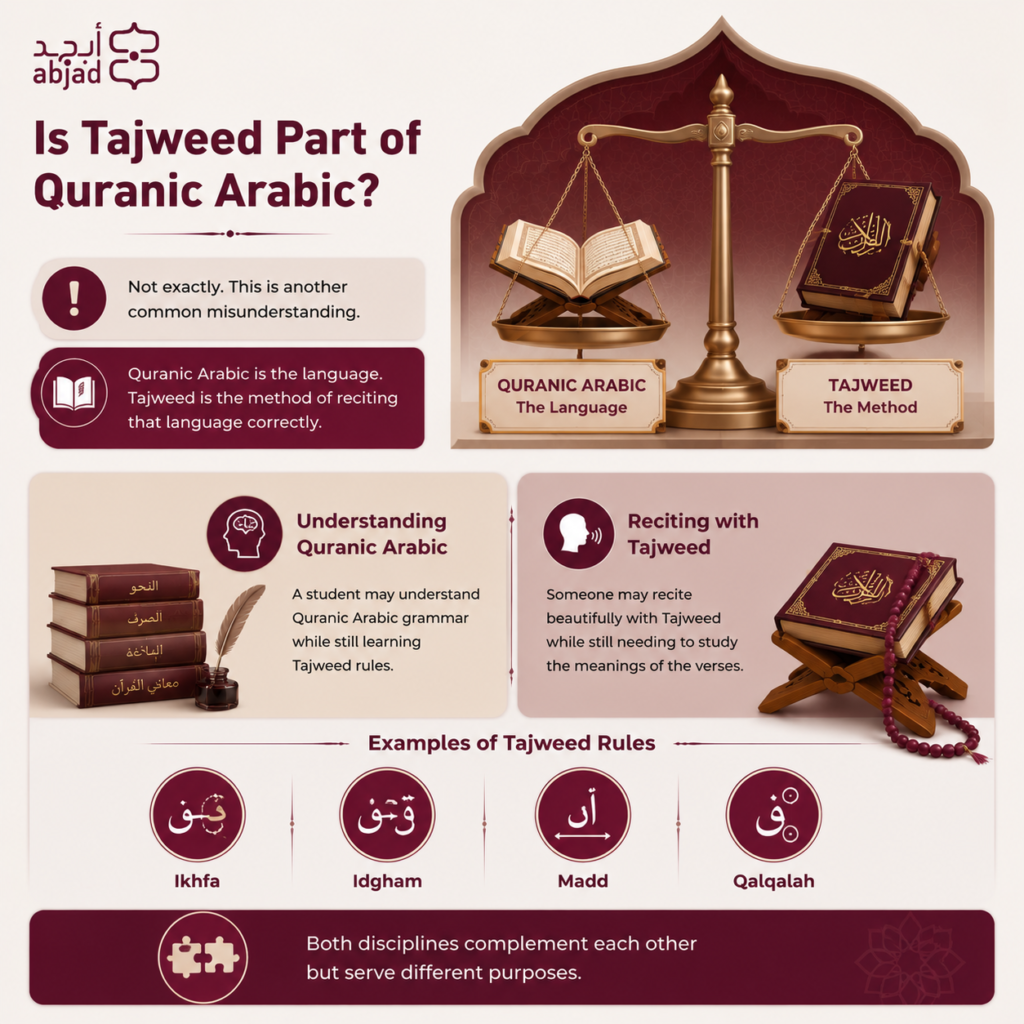
A student may understand Quranic Arabic grammar while still learning Tajweed rules such as:
- Ikhfa
- Idgham
- Madd
- Qalqalah
Likewise, someone may recite beautifully with Tajweed while still needing to study the meanings of the verses Both disciplines complement each other but serve different purposes.
The Difference Between the Main Types of Arabic
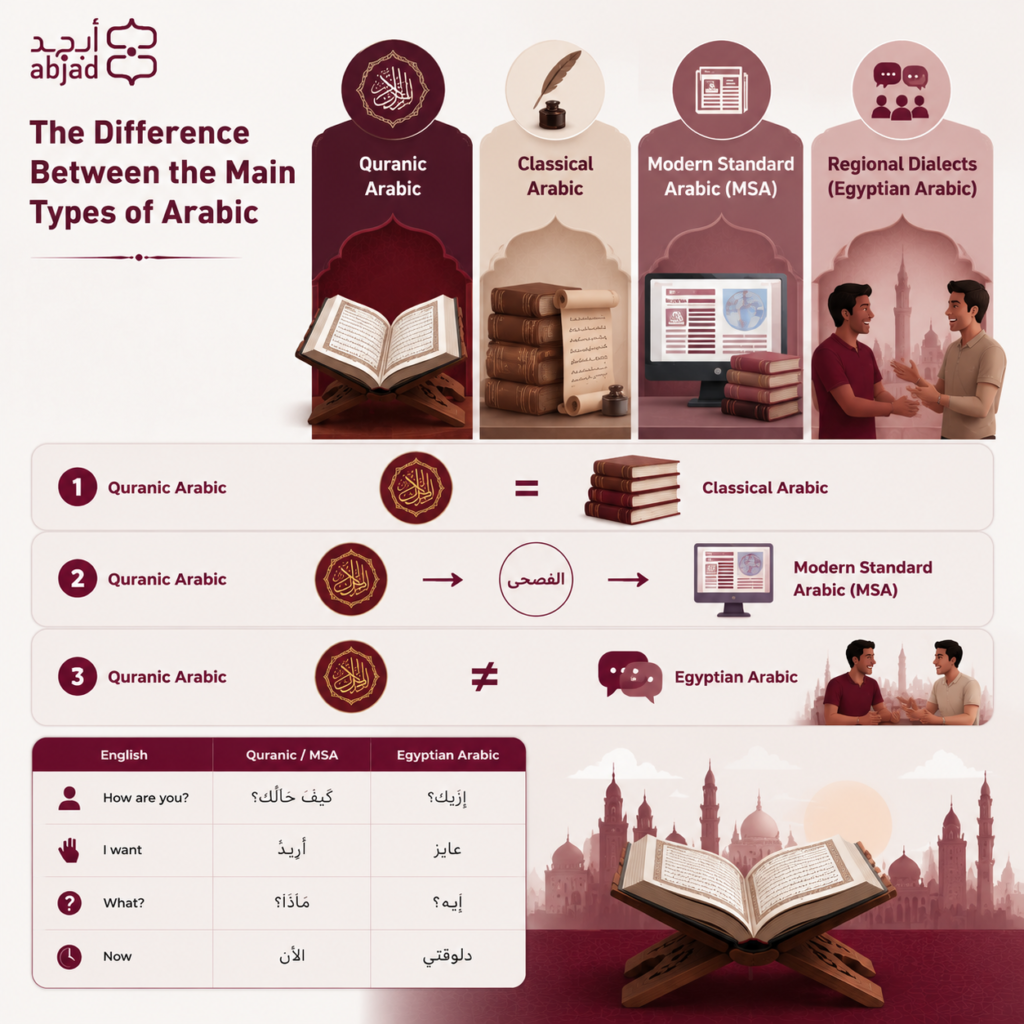
Many learners are surprised to discover that Arabic is not used in the same way in every context. Quranic Arabic, Classical Arabic, Modern Standard Arabic (MSA), and regional dialects such as Egyptian Arabic are all related, but each serves a different purpose. Understanding these distinctions can help you choose the right type of Arabic based on your learning goals.
1. Quranic Arabic vs Classical Arabic
Many people assume that Quranic Arabic and Classical Arabic are completely different languages, but that is not the case.
Quranic Arabic is the most authentic and perfectly preserved form of Classical Arabic. It is the language in which Allah revealed the Quran and serves as the foundation for understanding the Islamic sciences. At the same time, Classical Arabic is a broader category that also includes pre-Islamic poetry, early Islamic literature, Abbasid writings, historical texts, and the works of classical scholars.
Although these texts share the same grammatical system, they may contain vocabulary, expressions, and literary styles that do not appear in the Quran. In other words, every verse of the Quran is written in Classical Arabic, but not every Classical Arabic text is Quranic Arabic.
2. Quranic Arabic vs Fusha (الفصحى)
The term Fusha (الفصحى) simply means eloquent or formal Arabic, but its meaning depends on the context.
Some people use Fusha to refer to Classical Arabic, the language of the Quran and early Islamic scholarship. Others use it to mean Modern Standard Arabic (MSA), the formal Arabic taught in schools and used in books, newspapers, and television.
Technically, Modern Standard Arabic is the modern continuation of Classical Fusha. It preserves the same grammatical foundation while incorporating thousands of new words for contemporary life, technology, science, and politics.
3. Quranic Arabic vs Egyptian Arabic
The differences become much more noticeable when comparing Quranic Arabic with Egyptian Arabic, one of the most widely spoken Arabic dialects.
Unlike Quranic Arabic, Egyptian Arabic is a spoken dialect that developed naturally over centuries. While it is rooted in Arabic, it features its own pronunciation, simplified grammar, and many everyday expressions that are not found in Classical Arabic.
| English | Quranic / MSA | Egyptian Arabic |
| How are you? | كيف حالك؟ | إزيك؟ |
| I want | أريد | عايز |
| What? | ماذا؟ | إيه؟ |
| Now | الآن | دلوقتي |
An Egyptian speaker can certainly read the Quran, but they do not speak Quranic Arabic in everyday conversation. Likewise, someone who studies only Quranic Arabic will recognize many words in Egyptian Arabic but will still need additional practice to understand natural conversations.
Are the Differences Only Vocabulary?
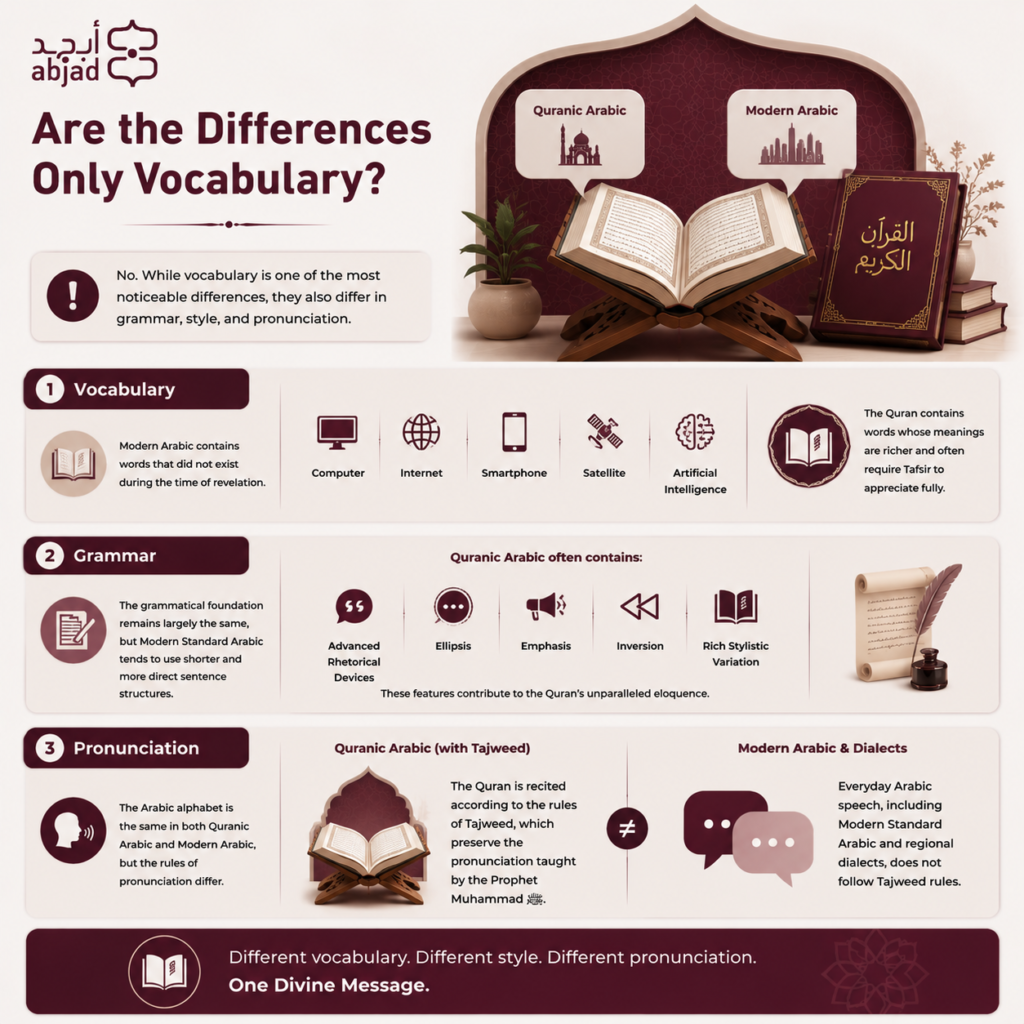
No. While vocabulary is one of the most noticeable differences between Quranic Arabic and Modern Arabic, they also differ in grammar, style, and pronunciation.
1. Vocabulary
Modern Arabic contains words that did not exist during the time of revelation.
Examples include:
- Computer
- Internet
- Smartphone
- Satellite
- Artificial Intelligence
Meanwhile, the Quran contains words whose meanings are richer and often require Tafsir to appreciate fully.
2. Grammar
The grammatical foundation remains largely the same, but Modern Standard Arabic tends to use shorter and more direct sentence structures.
Quranic Arabic often contains:
- advanced rhetorical devices
- ellipsis
- emphasis
- inversion
- rich stylistic variation
These features contribute to the Quran’s unparalleled eloquence.
3. Pronunciation
The Arabic alphabet is the same in both Quranic Arabic and Modern Arabic, but the rules of pronunciation differ.
The Quran is recited according to the rules of Tajweed, which preserve the pronunciation taught by the Prophet Muhammad ﷺ. Everyday Arabic speech, including Modern Standard Arabic and regional dialects, does not follow Tajweed rules, making Quranic recitation distinct from ordinary spoken Arabic.
Our Students Reviews
Read Also: Arabic Writing Practice in the UAE
Can Arabs Understand Quranic Arabic?
Yes—but with an important qualification. Most educated native Arabic speakers can understand a significant portion of the Quran because they are already familiar with Modern Standard Arabic and share the same grammatical foundation. This gives them an advantage over non-native learners when reading the Quran.
However, being a native Arabic speaker does not automatically mean someone fully understands every Quranic verse. The Quran contains words with multiple layers of meaning, unique rhetorical expressions, and linguistic features that are rarely used in modern Arabic. As a result, even native speakers often refer to Tafsir, classical Arabic dictionaries, and scholarly explanations to fully appreciate the intended meanings.
Allah says:
أَفَلَا يَتَدَبَّرُونَ الْقُرْآنَ
“Then do they not reflect upon the Qur’an?” Surah An-Nisa (4:82)
This verse emphasizes that understanding the Quran requires tadabbur (deep reflection) as well as knowledge of its language. In other words, knowing Arabic is valuable, but truly understanding the Quran involves studying its vocabulary, context, and the explanations provided by qualified scholars.
Can Someone Who Learns Quranic Arabic Speak Arabic?
Yes—but not immediately. Learning Quranic Arabic gives you an excellent grammatical foundation and a rich vocabulary, but everyday conversations use many modern expressions that do not appear in the Quran.
Think of it like learning Shakespearean English. You would understand many grammatical structures and advanced vocabulary, but everyday conversations would still require additional practice The same principle applies to Arabic.
Most learners who study Quranic Arabic first find it easier to learn Modern Standard Arabic afterward because they already understand:
- noun patterns
- verb conjugations
- sentence structure
- root-based vocabulary
If your long-term goal includes speaking Arabic confidently, combining Quranic Arabic with structured Arabic Courses for Adults is one of the most effective paths.
Join Our Adult Arabic Classes in the UAE — Start Your FREE Trial Today
Which Type of Arabic Should You Learn?
The answer depends entirely on your goal.
| Your Goal | Best Starting Point |
| Understand the Quran | Quranic Arabic |
| Study Tafsir or Hadith | Quranic Arabic |
| Memorize the Quran with understanding | Quranic Arabic |
| Work in an Arab country | Modern Standard Arabic |
| Study at an Arabic university | Modern Standard Arabic |
| Speak with Arabs from different countries | Modern Standard Arabic |
| Live in Egypt | Modern Standard Arabic + Egyptian Arabic |
There is no single “best” choice for everyone Instead, choose the variety of Arabic that matches your purpose. Many students eventually study both Quranic Arabic and Modern Standard Arabic because each complements the other.
Read more: 12 Benefits of Learning Quranic Arabic
Does Learning Quranic Arabic Help You Understand the Quran Better?
Absolutely Even learning a few hundred of the most frequently occurring Quranic words can significantly improve your understanding during recitation.
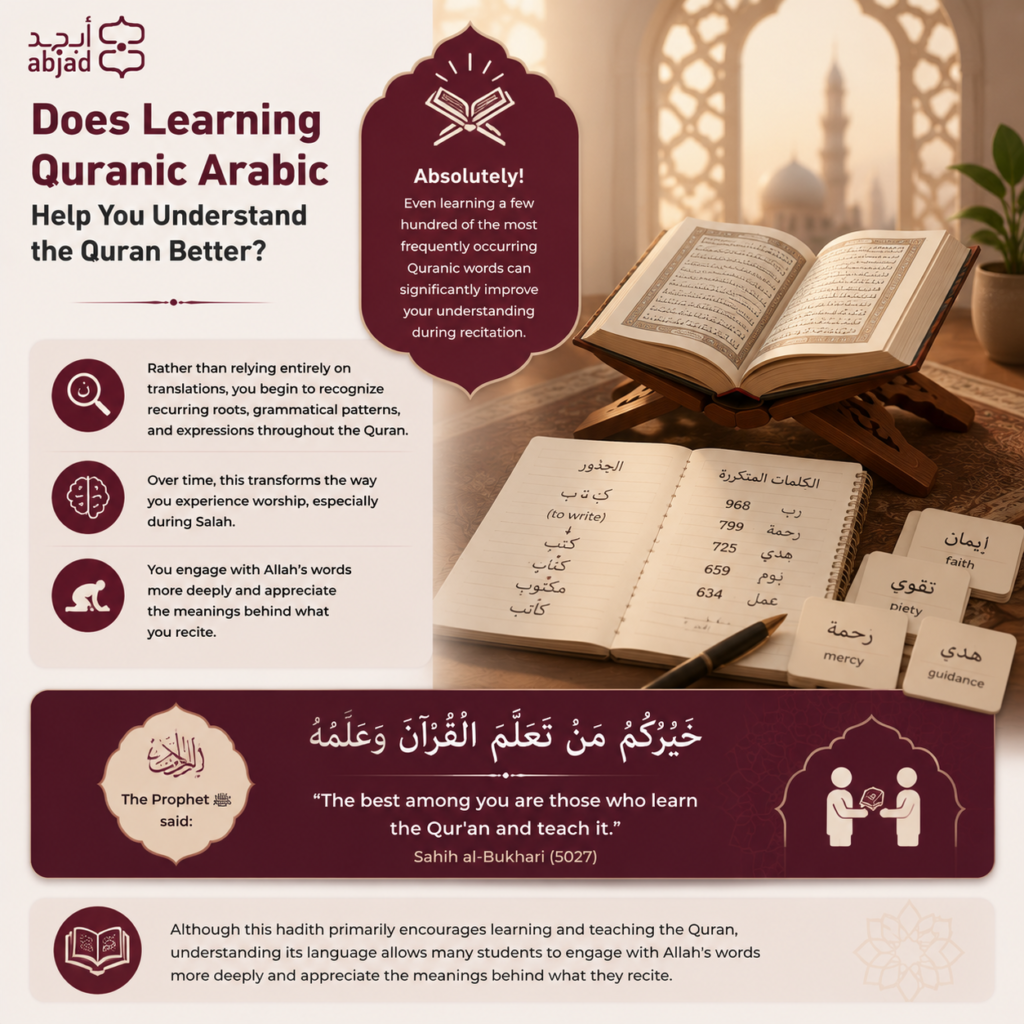
Rather than relying entirely on translations, you begin to recognize recurring roots, grammatical patterns, and expressions throughout the Quran. Over time, this transforms the way you experience worship, especially during Salah.
The Prophet ﷺ said:
خَيْرُكُمْ مَنْ تَعَلَّمَ الْقُرْآنَ وَعَلَّمَهُ
“The best among you are those who learn the Qur’an and teach it.” Sahih al-Bukhari (5027)
Although this hadith primarily encourages learning and teaching the Quran, understanding its language allows many students to engage with Allah’s words more deeply and appreciate the meanings behind what they recite.
Inside Our Live Classes
Don’t just take our word for it—see for yourself! Click below to watch short clips from our live classes and meet the instructors who will guide your learning journey.
Begin Your Arabic Journey in the UAE
Join Abjad Institute for a professional and immersive Arabic language experience tailored to your goals.
Book Your Free TrialStart Your Arabic Learning Journey with Abjad Institute
Whether your goal is to understand the Quran, communicate confidently in Arabic, or build a strong linguistic foundation, learning with qualified teachers makes the journey faster and more effective.
At Abjad Institute, our structured Arabic programs help learners progress step by step according to their individual goals.
Our programs include:
- Arabic for complete beginners
- Modern Standard Arabic (MSA)
- Quranic Arabic
- Reading, writing, listening, and speaking
- Interactive online classes
- Personalized instruction for children and adults
Book your free trial session today and take the first step toward mastering Arabic with confidence.

Discover Our Arabic Courses
- Arabic Course in the UAE
- Arabic Intensive Course
- Learn Arabic from Scratch Course
- Madinah Arabic Course
- Arabic Classes for Adults
- Arabic Classes for Beginners
- Self-Paced Arabic Course
- Basic Arabic Course
- Arabic Speaking Classes
- Learn to Write Arabic Course
- Arabic Grammar Course
- Learn Arabic Alphabet Course
Begin Your Arabic Journey in the UAE
Join Abjad Institute for a professional and immersive Arabic language experience tailored to your goals.
Book Your Free TrialConclusion
So, is Quranic Arabic different from normal Arabic? The answer is yes, but it is not a completely separate language. Quranic Arabic is the preserved form of Classical Arabic used in the Quran, while Modern Standard Arabic and spoken dialects have developed for contemporary communication.
Understanding these differences helps you choose the right path based on your goals. If you want to connect with the meanings of the Quran and explore its linguistic depth, learning Quranic Arabic is the ideal choice. If your goal is communication, study, or work in the Arab world, Modern Standard Arabic provides the practical foundation you need.
For many learners, studying both forms of Arabic creates the most complete learning experience—allowing them to appreciate the beauty of the Quran while building confidence in real-world Arabic communication.
Frequently Asked Questions
Still have questions about the differences between Quranic Arabic and modern forms of Arabic? Here are answers to the most common questions learners ask before starting their Arabic journey.
Is Quranic Arabic different from normal Arabic?
Yes. Quranic Arabic is the preserved form of Classical Arabic used in the Quran, while “normal Arabic” usually refers to Modern Standard Arabic or regional dialects spoken today.
Is Quranic Arabic the same as Classical Arabic?
Quranic Arabic is a form of Classical Arabic. However, Classical Arabic also includes early Islamic literature, poetry, and scholarly writings beyond the Quran.
Can I understand the Quran if I only learn Modern Standard Arabic?
Modern Standard Arabic helps you understand many words and grammatical structures, but Quranic Arabic and Tafsir are essential for fully appreciating the depth and precision of the Quran’s language.
Can I speak Arabic after learning Quranic Arabic?
You will gain a strong grammatical and vocabulary foundation, but you’ll still need to learn Modern Standard Arabic or a spoken dialect for everyday conversations.
Which Arabic dialect is closest to Quranic Arabic?
Modern Standard Arabic is much closer to Quranic Arabic than any regional dialect because both are based on Classical Arabic.
Is Egyptian Arabic useful for understanding the Quran?
Egyptian Arabic is excellent for communicating with Egyptians, but it is not suitable as a substitute for Quranic Arabic when studying the Quran.
Is Quranic Arabic difficult to learn?
It can be challenging at first because of its rich vocabulary and rhetorical style, but with consistent study and qualified instruction, learners gradually develop strong reading and comprehension skills.






Leave a Reply