 Learn Arabic
Have you ever stood in Salah, lips moving through Al-Fatiha, and felt the quiet ache of not knowing what you were saying to Allah? You were reciting His words — perfectly — but they were passing through you like water through a closed fist. That experience is precisely why Quranic Arabic matters, and why so many Muslims around the world are returning to it as adults.
Quranic Arabic is the language in which the Quran was revealed: a precise, layered, and linguistically extraordinary form of Classical Arabic that has been preserved unchanged for over 1,400 years. Learning it is not just an academic exercise. It is the difference between performing prayer and living it.
This guide covers everything you need to know — what Quranic Arabic is, what makes it different from other Arabic varieties, its grammatical foundations, its relationship with Tajweed, and how to start learning it in a structured way that actually works.
What Is Quranic Arabic?
Quranic Arabic is the variety of Classical Arabic in which Allah revealed the Quran to the Prophet Muhammad ﷺ over a period of approximately 23 years, beginning in 610 CE. It is not a dialect, not a simplified form, and not a language that evolved — it is the preserved, original text of divine revelation, unchanged in a single letter since its revelation.
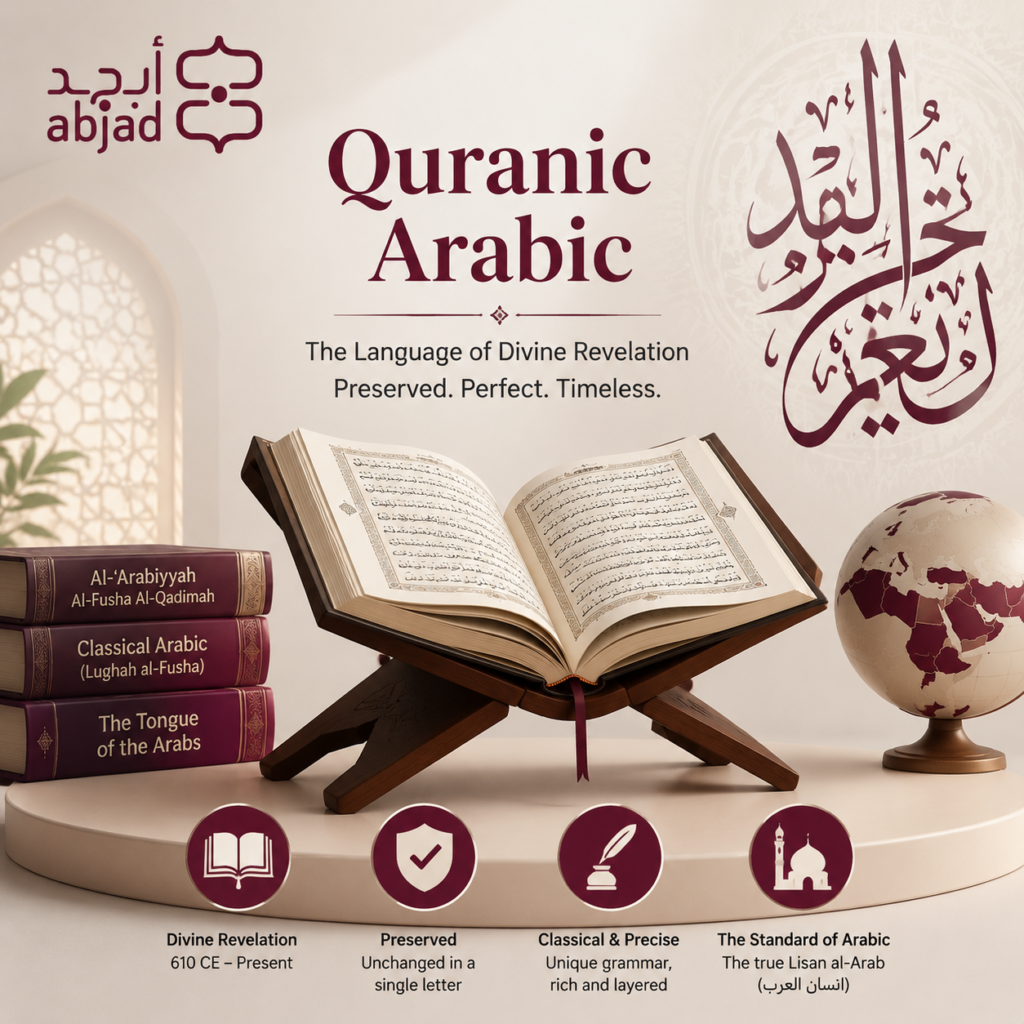
Linguists classify it formally as Al-‘Arabiyyah Al-Fusha Al-Qadimah — the ancient elevated Arabic — which stands apart from Modern Standard Arabic (MSA) and entirely separate from the spoken dialects used across the Arab world today. Its grammar is more precise, its vocabulary more layered, and its rhetorical register is unlike anything produced before or since in human literary history.
Quranic Arabic is also called Classical Arabic (Al-Lughah al-‘Arabiyyah al-Fusha / اللغة العربية الفصحى), or simply Fusha (فصحى). In academic contexts you may see it called Koranic Arabic or Qur’anic Arabic — all three spellings refer to the same linguistic register. When scholars speak of the “Lisan al-Arab” — the tongue of the Arabs — it is this form of the language they mean.
The History of Quranic Arabic: How It Was Formed and Preserved?
Quranic Arabic did not emerge from a single tribe or city. The Prophet ﷺ was raised in Mecca among the Quraysh, whose dialect was considered the most eloquent in Arabia — a judgment the other Arab tribes of the peninsula widely shared. The Quran was revealed primarily in this dialect, though classical scholars note that its language synthesized the finest linguistic registers of multiple Arabian tribes, which is part of what made its eloquence so devastating to its original audience.
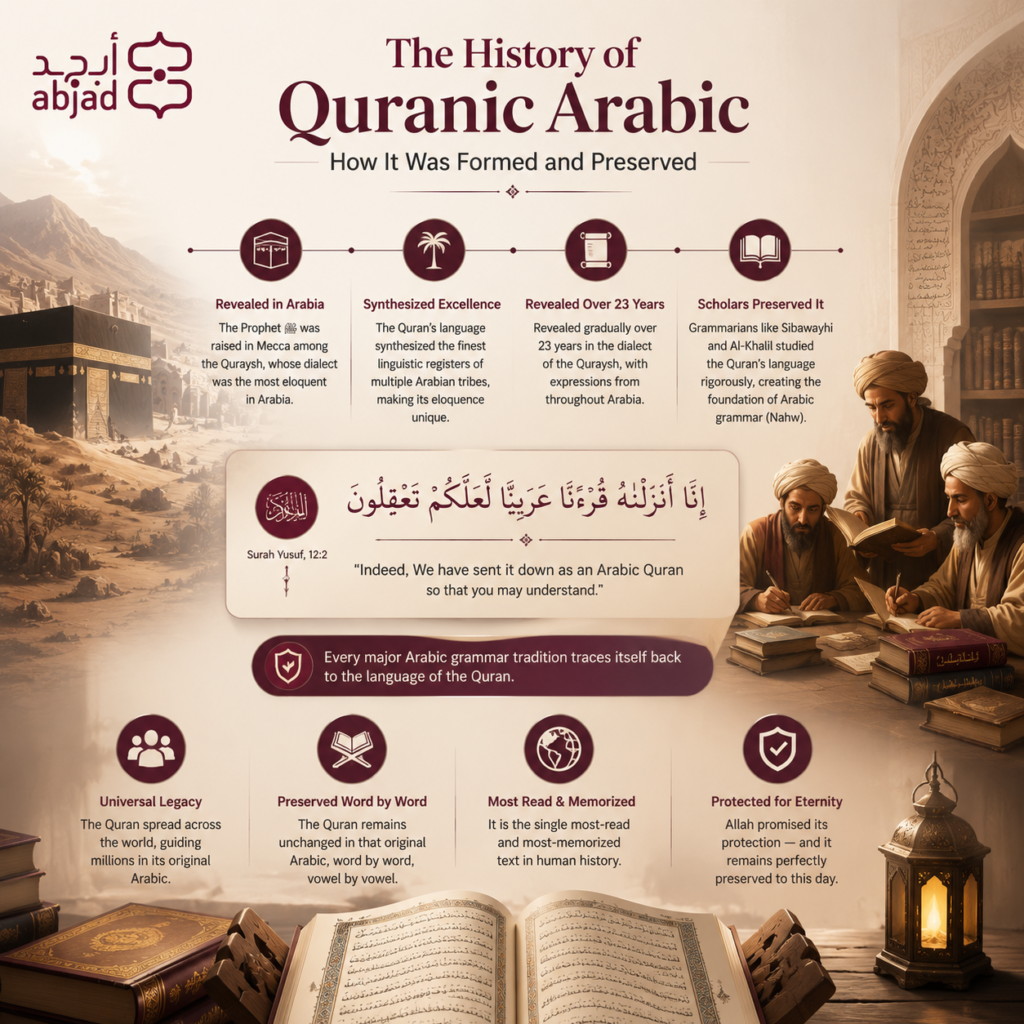
Allah says in Surah Yusuf, 12:2:
إِنَّآ أَنزَلۡنَـٰهُ قُرۡءَٰنًا عَرَبِيًّا لَّعَلَّكُمۡ تَعۡقِلُونَ
“Indeed, We have sent it down as an Arabic Quran so that you may understand.”
The first generation of Muslim scholars — grammarians like Sibawayhi, Al-Khalil ibn Ahmad Al-Farahidi, and Ibn Malik — studied the Quran’s language with extraordinary rigour and produced the foundational works of Arabic grammar (Nahw) specifically to protect Quranic language from corruption as Islam spread to non-Arab peoples. Every major Arabic grammar tradition traces itself back to the language of the Quran.
Today, the Quran remains the single most-read and most-memorized text in human history, preserved in that original Arabic, word by word, vowel by vowel.
Read more: Is Quranic Arabic Different from Normal Arabic?
Quranic Arabic vs. Modern Standard Arabic vs. Spoken Dialects
Arabic exists in different forms, and understanding the differences between them is essential for anyone who wants to study the Quran. While Modern Standard Arabic and spoken dialects share historical roots with Quranic Arabic, they differ in vocabulary, grammar, pronunciation, and usage. The following comparison highlights the key differences between these varieties and explains why Quranic Arabic requires dedicated study.
| Feature | Quranic Arabic | Modern Standard Arabic | Spoken Dialects |
| Case endings (I’rab) | Fully present and functional | Present mainly in formal writing | Mostly absent in speech |
| Grammar Structure | Preserves Classical Arabic grammar in full detail | Based on the same grammar with modern usage | Simplified grammar in many areas |
| Vocabulary | Classical Quranic lexicon | Updated contemporary vocabulary | Mixed with local expressions and borrowings |
| Verb System | Complete triliteral root system | Same system with modern adaptations | Simplified usage in many dialects |
| Rhetorical Style | Elevated, precise, and highly expressive | Formal and functional | Colloquial and informal |
If your goal is to understand the Quran, studying Quranic Arabic directly is more effective — and faster — than learning a dialect or Modern Standard Arabic first. It gives you direct access to the grammar, vocabulary, and linguistic structures that carry the meanings of the Quran.
If you want to explore a structured path to understanding the Quran’s language, Abjad Institute’s Quranic Arabic Course is designed precisely for this goal.
Build Your Quranic Arabic Skills Step by Step With a FREE Trial Today
The Arabic Alphabet and Its Role in Quranic Reading
Before Quranic vocabulary and grammar become accessible, learners must first develop a strong command of the Arabic script. Mastering the alphabet is the foundation of accurate Quran reading, and rushing through this stage is one of the main reasons beginners struggle with recitation later. The Arabic alphabet consists of 28 letters, and most letters change shape depending on their position in a word: initial, medial, final, or isolated form.
Along with the letters, learners must understand harakat (vowel markings) — including fathah, kasrah, dammah, sukoon, shaddah, and tanween. The Quran is fully voweled, meaning every word in the Mushaf contains these pronunciation markers. These markings are essential because they determine correct pronunciation, grammatical endings, and sometimes the meaning of words. For example, قَلْب (qalb) means “heart,” and changing the vowel pattern can change the pronunciation and meaning.
A practical way to learn the Arabic alphabet is by grouping letters with similar shapes, such as ب (ba), ت (ta), and ث (tha), which share the same base shape and differ only by their dots. However, reading the Quran requires more than recognizing letters; learners must also understand makharij al-huruf — the precise articulation points of each letter. For example, ح (ha), خ (kha), and ع (‘ayn) come from the throat but have different points of origin. Correct pronunciation of these sounds is essential to preserve the words and meanings of the Quran.
Inside Our Live Classes
Don’t just take our word for it—see for yourself! Click below to watch short clips from our live classes and meet the instructors who will guide your learning journey.
Begin Your Arabic Journey in the UAE
Join Abjad Institute for a professional and immersive Arabic language experience tailored to your goals.
Book Your Free TrialThe Importance of Quranic Arabic Grammar in Understanding the Quran
Quranic Arabic grammar is the framework that transforms isolated vocabulary into understood meaning. Without it, a learner recognises words but cannot assemble them into the sentences Allah is actually saying.
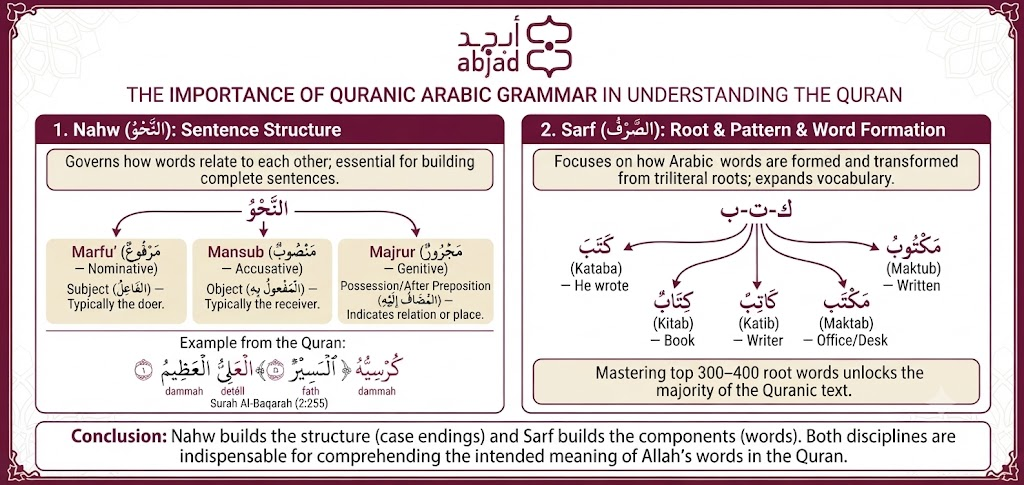
Arabic grammar is divided into two disciplines: Nahw (النحو) — syntax and case endings — and Sarf (الصرف) — morphology and word formation. Both are necessary for Quranic comprehension, though in different ways.
1. Nahw
Nahw governs how words relate to each other in a sentence, and its most distinctive feature is I’rab — the system of word-ending changes that indicate grammatical function. Every Arabic noun carries one of three cases:
- Marfu’ (مرفوع) — the nominative case, typically the subject of a sentence, ending in dammah (ـُ)
- Mansub (منصوب) — the accusative case, typically the object, ending in fathah (ـَ)
- Majrur (مجرور) — the genitive case, after prepositions or in possession constructions, ending in kasrah (ـِ)
This matters enormously in the Quran. When Allah says in Surah Al-Baqarah, 2:255 — Ayat al-Kursi — the case endings on كُرْسِيُّهُ and العَلِيُّ العَظِيمُ are not decorative. They tell you exactly the grammatical role of every word in Allah’s statement. A reader who understands I’rab reads the meaning structure, not just the sounds.
2. Sarf
Sarf (الصرف) focuses on how Arabic words are formed and transformed through the triliteral root system. Understanding word patterns allows learners to recognize connections between related Quranic words and expand their vocabulary more efficiently.
For example, the root ك-ت-ب (k-t-b), related to writing, produces:
- كَتَبَ (kataba) — he wrote
- كِتَاب (kitab) — book
- كَاتِب (katib) — writer
- مَكْتَب (maktab) — office/desk
- مَكْتُوب (maktub) — written
The Quran uses approximately 1,700 distinct root words across 6,236 verses. Research in Quranic vocabulary frequency shows that mastering the top 300–400 root words gives access to the substantial majority of the Quranic text. That is an achievable, bounded target — and it is what separates Quranic Arabic learning from the open-ended vocabulary demands of conversational Arabic.
If you want to build this grammatical foundation systematically, Abjad Institute’s Arabic Grammar Course covers both Nahw and Sarf in a structured, beginner-accessible sequence.
Start Your Arabic Grammar Learning Journey With a FREE Trial Today
Core Grammar Structures You Will Encounter in the Quran
There are several grammatical patterns that appear with especially high frequency in Quranic text:
1. Idafah (Possessive Construction):
Two nouns joined to express possession, with the first losing its definite article.
بَيْتُ اللهِ (Bayt Allah — the House of Allah). The first noun is Mansub or Marfu’ based on its sentence role; the second is always Majrur.
2. Nominal Sentences:
Sentences that begin with a noun (mubtada’) followed by a predicate (khabar), with no verb required.
رَبُّنَا اللهُ — “Our Lord is Allah.” Much of Surah Al-Ikhlas, Al-Fatiha, and Ayat al-Kursi is built on nominal sentence structures.
3. Verb Forms (Past, Present, Command):
The Arabic verb changes form to indicate tense, person, number, and gender simultaneously. The past-tense form خَلَقَ (khalaqa — He created) appears in dozens of Quranic verses. Recognising verb patterns allows a learner to identify the actor, the action, and the number involved from a single word.
Read more: Why Learn Quranic Arabic? 10 Reasons
The Connection Between Tajweed and Quranic Arabic in Understanding the Quran
Tajweed and Quranic Arabic are not two separate subjects. They are two dimensions of the same thing: Allah’s speech, preserved in sound as precisely as it is preserved in text.
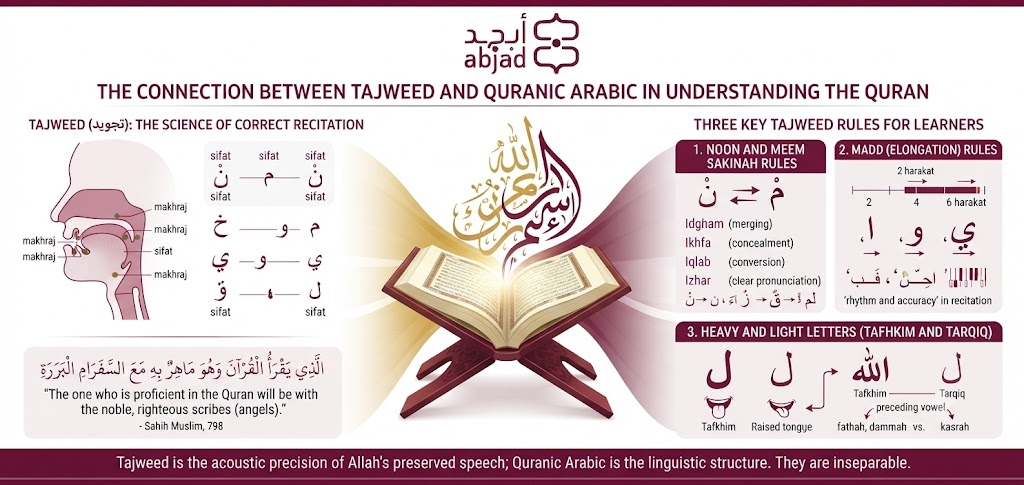
Tajweed (تجويد) is the science governing correct Quranic recitation — the rules that determine how each letter is articulated from its precise point of origin (makhraj), with its correct characteristics (sifat), and how letters interact with their neighbours. Without Tajweed, a reader may produce technically recognisable sounds but miss the acoustic precision the Quran demands.
The Prophet ﷺ said, as recorded by Al-Tirmidhi:
“الَّذِي يَقْرَأُ الْقُرْآنَ وَهُوَ مَاهِرٌ بِهِ مَعَ السَّفَرَةِ الْكِرَامِ الْبَرَرَةِ”
“The one who is proficient in the Quran will be with the noble, righteous scribes (angels).”
The most impactful Tajweed rules for a Quranic Arabic learner are:
1. Noon and Meem Sakinah Rules
These rules govern the pronunciation of ن and م when they carry a sukoon and meet the following letters. They include Idgham (merging), Ikhfa (partial concealment), Iqlab (conversion), and Izhar (clear pronunciation). These rules appear on virtually every page of the Quran and are essential for accurate recitation.
2. Madd (Elongation) Rules
Madd rules specify the precise length — measured in harakat (counts) — that certain vowel letters must be held. The correct length of Madd preserves the accuracy and rhythm of Quranic recitation, while incorrect elongation is one of the most common mistakes among learners.
3. Heavy and Light Letters (Tafkhim and Tarqiq)
These rules determine whether a letter is pronounced with a heavy, raised-tongue sound or a light, frontal sound. For example, the letter lam (ل) in the word Allah (اللَّه) is pronounced heavily when preceded by fathah or dammah and lightly when preceded by kasrah — a distinction that is specific to Quranic recitation.
The key insight is this: Tajweed rules are not arbitrary; they are rooted in the Arabic phonetic system. Learners who understand the Arabic letters and their makharij grasp Tajweed rules faster because they understand why the rules exist, not just what to do.
Read more: How to Learn Quranic Arabic Free Online in the UAE?
How to Learn Quranic Arabic?
Learning Quranic Arabic follows a clear sequence. Skipping stages does not accelerate progress — it creates bottlenecks that cost time later. The sequence below reflects the order that consistent Quranic Arabic learners actually use.
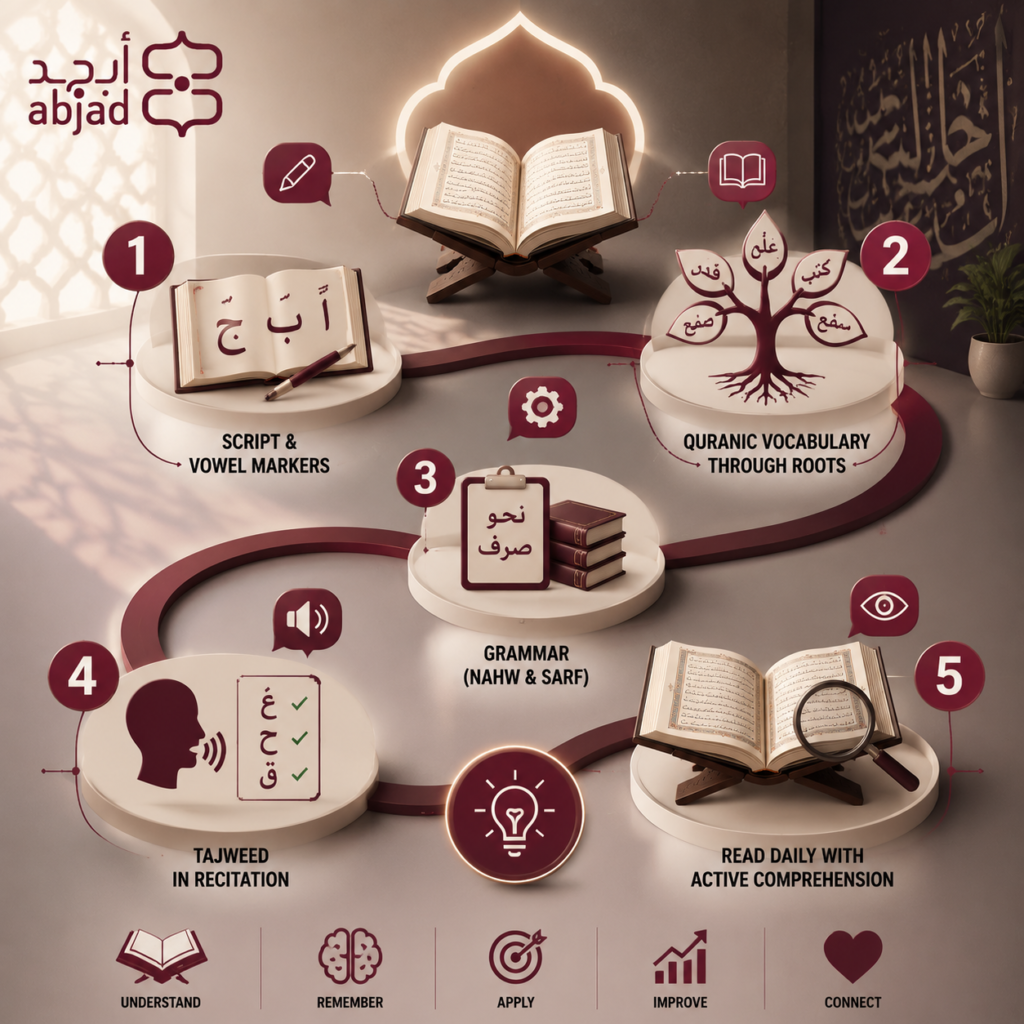
1. Master the Arabic Script and Vowel Markers
Read all 28 letters in all four positional forms before attempting vocabulary. Add the harakat one by one: fathah, kasrah, dammah, sukoon, shaddah, tanwin. Practise reading voweled text aloud daily until letter decoding is automatic. A learner who hesitates on letter shapes during vocabulary study splits attention and learns both skills poorly.
2. Build Quranic Vocabulary Through High-Frequency Roots
The 300 most frequent root words in the Quran cover the majority of its text. Learn words inside Quranic sentences, not in isolation. When you learn the root ع-ل-م (‘a-l-m, related to knowledge), you immediately recognise عَلِيم (All-Knowing), عِلْم (knowledge), عَلَّمَ (He taught), and مُعَلِّم (teacher) — all of which appear in the Quran.
3. Learn Core Quranic Grammar (Nahw and Sarf)
Begin with nominal sentence structure, then verbal sentences, then I’rab case endings, then Idafah. Apply every grammar rule immediately to Quranic verses. The rule is not learned until you can identify it in a verse you have already memorised. This is the approach that produces lasting comprehension rather than abstract rule knowledge.
4. Apply Tajweed Rules to Your Recitation
Learn Tajweed alongside vocabulary and grammar — not after. Every verse you study should be read aloud with correct Tajweed, with letter makharij confirmed by a qualified teacher. Errors that become habits early are the hardest to correct later.
5. Read the Quran Daily with Active Comprehension
Begin with the shorter Surahs of Juz’ Amma, where sentence structures are simpler and vocabulary is more frequently repeated. Read with the intention to understand — pause on words, identify roots, name the grammatical case. Even ten minutes of this kind of active daily reading accelerates all four prior skills simultaneously.
A common mistake among self-directed learners: they study grammar rules theoretically but never apply them to live Quranic text. The practice of identifying who is doing what to whom in a verse — using I’rab — is what converts grammar knowledge into actual comprehension.
Watch Our Classes in Action
Curious what a real session looks like? Take a peek inside our interactive classrooms and see how our expert instructors bring the Arabic language to life. Watch a sample lesson below!
Begin Your Arabic Journey in the UAE
Join Abjad Institute for a professional and immersive Arabic language experience tailored to your goals.
Book Your Free TrialStart Learning Quranic Arabic with Abjad Institute
Knowing what Quranic Arabic is and knowing how to learn it are two different things. Most adult learners who attempt self-study hit the same walls: they can’t confirm their pronunciation is correct, they don’t know which grammar rules to prioritise, and they lose momentum without a structured path or a teacher who can see their specific gaps.
Abjad Institute’s Quranic Arabic Course is built for non-Arabic speakers who want direct comprehension of the Quran — not a simplified approximation, but the real thing. Instructors guide students through the Arabic script, high-frequency Quranic vocabulary, core grammar, and Tajweed fundamentals in a logical sequence that produces comprehension milestones you can actually feel during your Salah.
For families, the Kids’ Arabic Summer Programme gives children a structured, age-appropriate start — building the letter recognition, vocabulary, and pronunciation habits that make Quranic Arabic accessible from a young age.
Book your first lesson with Abjad Institute today and begin reading the Quran the way it was meant to be read — in its own language.

Discover Our Arabic Courses
- Arabic Course for Kids
- Arabic Conversation for Kids
- Arabic Qaida for Kids
- Beginner Arabic for Kids
- Arabic Grammar for Kids
- Teen Arabic Summer Course
- Arabic Kids Camps
- UAE Kindergarten Arabic Classes
- Modern Standard Arabic Course
- Fusha Arabic Course
- Classical Arabic Course
- Emirati Arabic Course
- Gulf Arabic Course
- Learn Saudi Arabic
- Business Arabic Course UAE
- Arabic Language Classes for Professionals in UAE
- Quranic Arabic Course
Begin Your Arabic Journey in the UAE
Join Abjad Institute for a professional and immersive Arabic language experience tailored to your goals.
Book Your Free TrialConclusion
Quranic Arabic is the language Allah chose to preserve His final revelation — a language precise enough to carry divine meaning without corruption, eloquent enough to silence the finest poets of its time, and learnable enough that any committed believer, wherever they were born, can access it directly.
What separates Quranic Arabic from other Arabic varieties is not complexity but focus. Its vocabulary is contained. Its grammar is systematic. Its sounds are governed by Tajweed rules that have been transmitted, teacher to student, in an unbroken chain since the time of the Prophet ﷺ. The path to understanding it is real, structured, and walks through the same four stages it always has: script, vocabulary, grammar, and recitation.
Every Salah you pray is an opportunity to stand before Allah and understand what He is saying to you. That understanding begins with one decision: to learn the language He spoke in.
Frequently Asked Questions About Quranic Arabic
These are the most common questions learners ask about Quranic Arabic, including its differences from other Arabic varieties, the role of grammar, and the best path to understanding the Quran.
What is the difference between Quranic Arabic and Modern Standard Arabic?
Quranic Arabic is Classical Arabic in its most precise and elevated form — the language of the Quran revealed over 1,400 years ago. Modern Standard Arabic (MSA) is derived from it and shares the same grammatical skeleton, but uses updated contemporary vocabulary, a lower rhetorical register, and lacks the classical constructions and layered meanings found throughout the Quranic text. MSA helps you approach Quranic Arabic, but it does not replace focused Quranic Arabic study.
Can I understand the Quran by learning a spoken Arabic dialect?
No. No spoken dialect — Egyptian, Gulf, Levantine, or Moroccan — gives direct access to Quranic meaning. Dialects evolved from Classical Arabic but dropped its grammatical case endings (I’rab), simplified verb forms, and mixed in local vocabulary over centuries. The most direct path to Quran comprehension is studying Quranic Arabic specifically.
How long does it take to learn Quranic Arabic?
Most dedicated adult learners reach functional Quranic comprehension — understanding 70–80% of Quranic vocabulary in context — within 6 to 12 months of focused, structured study. This is achievable because approximately 80% of the Quran’s text can be accessed through the top 300 high-frequency root words. Timelines vary with session frequency, consistency, and whether the learner works with a qualified instructor.
Is grammar necessary for understanding the Quran, or can I just memorise vocabulary?
Grammar is necessary. Vocabulary without grammar gives you individual word meanings but not the meaning of what Allah is saying. I’rab — the case-ending system — tells you who is doing what to whom in each sentence. Without it, a learner cannot reliably determine the subject, object, or predicate of a Quranic verse, and word-by-word translation becomes guesswork.
What is the relationship between Quranic Arabic and Tajweed?
Tajweed is the science of reciting the Quran with correct pronunciation, rooted entirely in the Arabic phonetic system. Every Tajweed rule — Idgham, Ikhfa, Madd, Qalqalah — exists because of specific features of Arabic letters and their articulation points. Learning Quranic Arabic and Tajweed together, rather than sequentially, accelerates both skills and ensures that the sounds a learner produces match the words they are learning to understand.
Can children learn Quranic Arabic?
Yes. Children can begin Arabic letter recognition from age 4 or 5 and move into structured Quranic vocabulary and grammar from around age 9 to 10, when abstract reasoning develops sufficiently for case-ending rules. Younger children benefit most from vocabulary exposure, Quranic listening, and phonics-based reading practice.
Related Articles
Learn Arabic




Leave a Reply