 Learn Arabic

Is every Muslim required to read the Quran in Arabic, even without understanding the language? Yes—Arabic recitation is required to the extent needed for a valid Salah. While Quran translations are valuable for understanding Allah’s message, they cannot replace the Arabic recitation prescribed in prayer.
Scholars explain that every Muslim should learn enough Arabic to perform Salah correctly, beginning with the minimum required recitation and gradually progressing to Surah Al-Fatihah and another Surah. Combining Arabic recitation with understanding the Quran’s meaning helps strengthen both worship and one’s connection with the Book of Allah.
Scholars across the madhabs are also unanimous that Surah Al-Fatiha must be recited in Arabic in every raka’ah. The Quran itself establishes the Arabic obligation:
“We have sent it down as an Arabic Quran, so that ye may learn wisdom.” (Surah Yusuf, 12:2)
The “Arabic Quran” designation is not incidental — it is a statement of divine intentionality. A translation of Al-Fatiha recited in Salah would substitute a human’s interpretation of divine speech for the speech itself. Scholars hold that these are fundamentally different acts.
Does Reading the Quran in Translation Count?
Reading the Quran in translation is a beneficial and rewarding act because it helps you understand Allah’s message. However, it is not a substitute for reciting the Quran in Arabic, nor does it fulfill the Quranic recitation required in Salah.
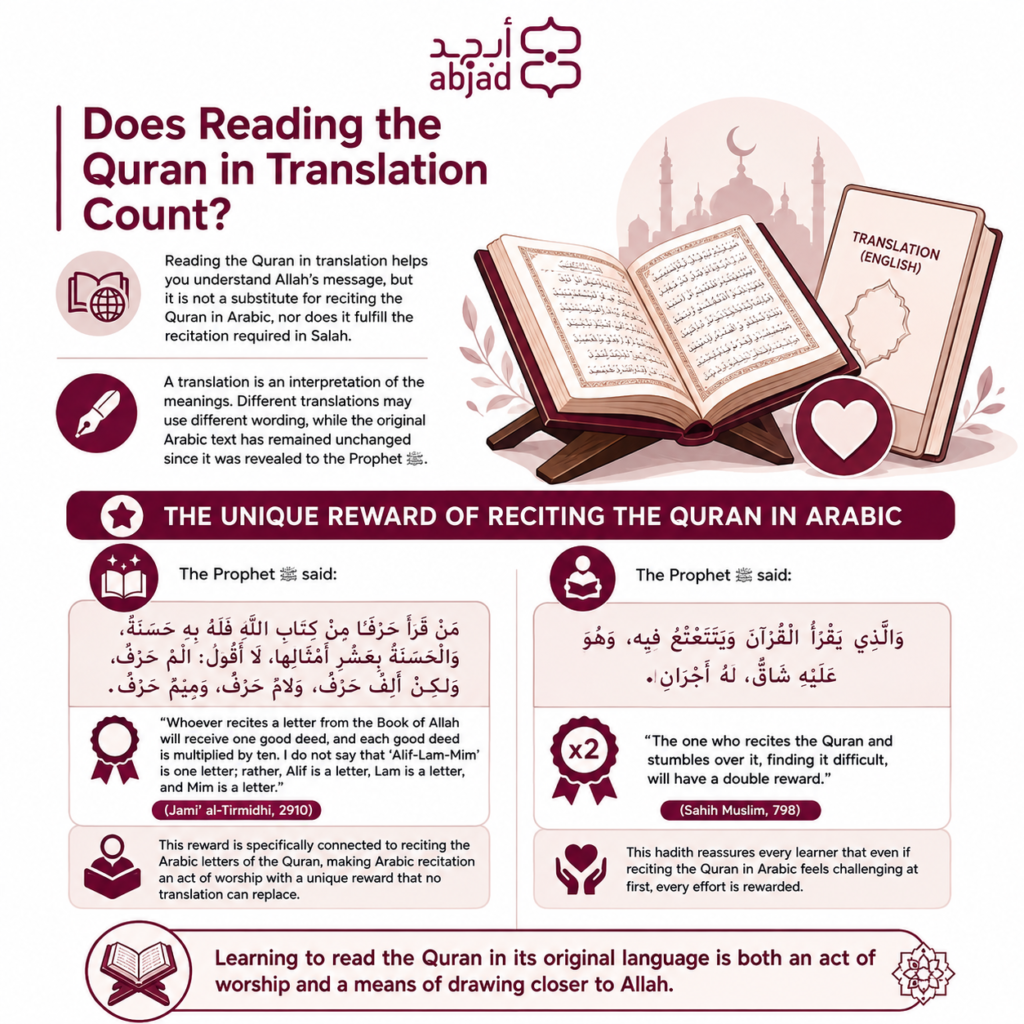
A translation is, by nature, an interpretation of the Quran’s meanings. It reflects the translator’s language choices, scholarly approach, and historical context. This is why different English translations of the same verse often use different wording, while the original Arabic text has remained unchanged since it was revealed to the Prophet ﷺ.
The Unique Reward of Reciting the Quran in Arabic
The Prophet ﷺ said:
«مَنْ قَرَأَ حَرْفًا مِنْ كِتَابِ اللَّهِ فَلَهُ بِهِ حَسَنَةٌ، وَالْحَسَنَةُ بِعَشْرِ أَمْثَالِهَا، لَا أَقُولُ: الم حَرْفٌ، وَلَكِنْ أَلِفٌ حَرْفٌ، وَلَامٌ حَرْفٌ، وَمِيمٌ حَرْفٌ.»
“Whoever recites a letter from the Book of Allah will receive one good deed, and each good deed is multiplied by ten. I do not say that ‘Alif-Lam-Mim’ is one letter; rather, Alif is a letter, Lam is a letter, and Mim is a letter.”
(Jami’ al-Tirmidhi, 2910)
The scholars explain that this reward is specifically connected to reciting the Arabic letters of the Quran, making Arabic recitation an act of worship with a unique spiritual reward that no translation can replace.
The Prophet ﷺ also said:
«وَالَّذِي يَقْرَأُ الْقُرْآنَ وَيَتَتَعْتَعُ فِيهِ، وَهُوَ عَلَيْهِ شَاقٌّ، لَهُ أَجْرَانِ.»
“The one who recites the Quran and stumbles over it, finding it difficult, will have a double reward.”
(Sahih Muslim, 798)
This hadith reassures every learner that even if reciting the Quran in Arabic feels challenging at first, every effort is rewarded. Learning to read the Quran in its original language is therefore both an act of worship and a means of drawing closer to Allah.
If you want to strengthen your Arabic so the recitation becomes both meaningful and rewarded, Abjad Institute’s Arabic Grammar Course builds the structural foundation that makes Quranic reading genuinely comprehensible — not just phonetically correct.
Master Arabic Grammar with a FREE Trial Class in the UAE.
Why Arabic Cannot Be Replaced for the Quran?
Arabic Was Chosen for Its Precision, Not Its Geography The Quran was not revealed in Arabic because the Prophet ﷺ was Arab, or because the first audience was Arab. It was revealed in Arabic because Arabic is the only language with the linguistic architecture to carry divine speech without collapsing its meaning.
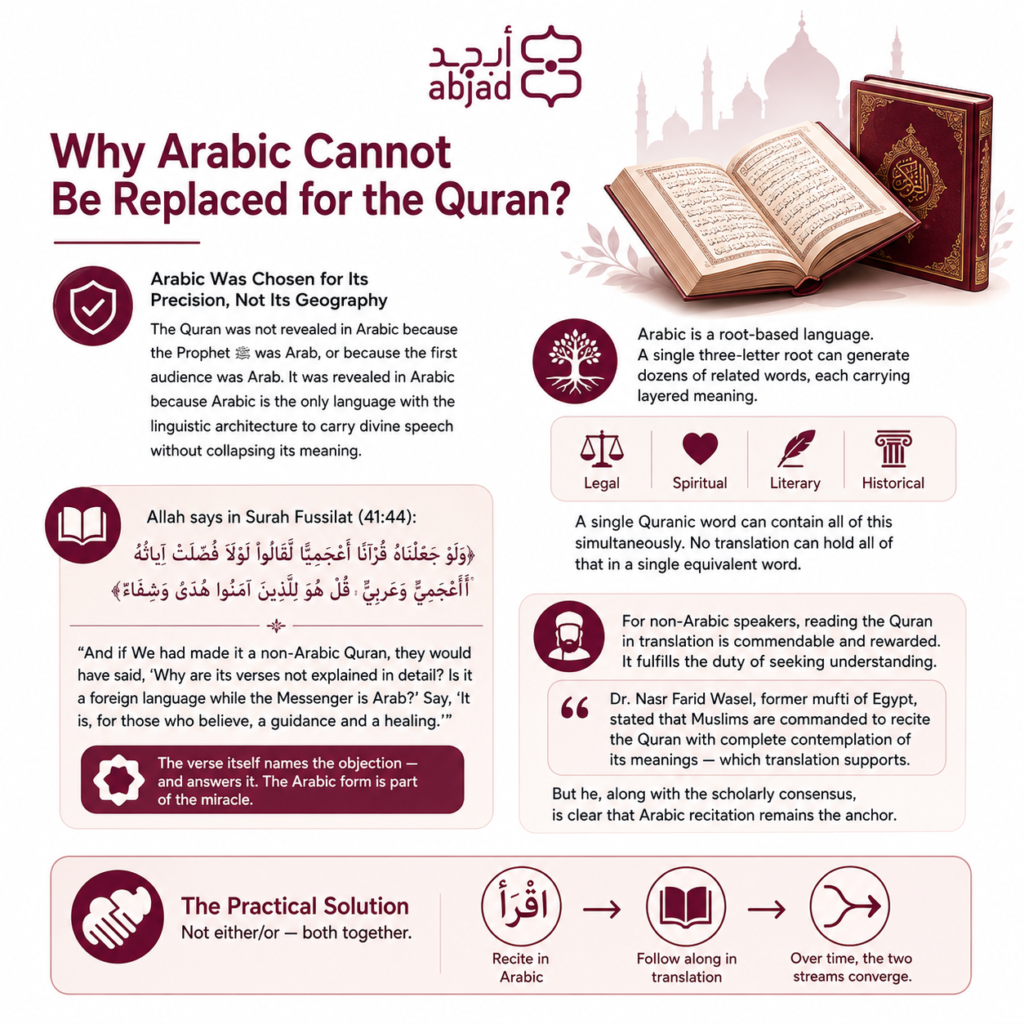
Arabic is a root-based language. A single three-letter root can generate dozens of related words, each carrying layered meaning that builds from the root. A single Quranic word can contain legal, spiritual, literary, and historical meaning simultaneously. No translation can hold all of that in a single equivalent word — it must choose one dimension and lose the rest.
Allah says in Surah Fussilat (41:44):
﴿وَلَوْ جَعَلْنَاهُ قُرْآنًا أَعْجَمِيًّا لَّقَالُوا لَوْلَا فُصِّلَتْ آيَاتُهُ ۖ أَأَعْجَمِيٌّ وَعَرَبِيٌّ ۗ قُلْ هُوَ لِلَّذِينَ آمَنُوا هُدًى وَشِفَاءٌ﴾
“And if We had made it a non-Arabic Quran, they would have said, ‘Why are its verses not explained in detail? Is it a foreign language while the Messenger is Arab?’ Say, ‘It is, for those who believe, a guidance and a healing.'”
The verse itself names the objection — and answers it. The Arabic form is part of the miracle.
For non-Arabic speakers, reading the Quran in translation is commendable and rewarded. It fulfills the duty of seeking understanding. Dr. Nasr Farid Wasel, former mufti of Egypt, stated that Muslims are commanded to recite the Quran with complete contemplation of its meanings — which translation supports. But he, along with the scholarly consensus, is clear that Arabic recitation remains the anchor.
The practical solution is not to choose between Arabic and translation — it is to use both together. Recite in Arabic, follow along in translation, and over time the two streams converge.
Read Also: How to Get Better at Reading Arabic in the UAE?
Do You Get Rewards for Reading the Quran in Translation?
Yes — reading the Quran in translation is a rewarded act, even though the reward differs from reciting in Arabic.
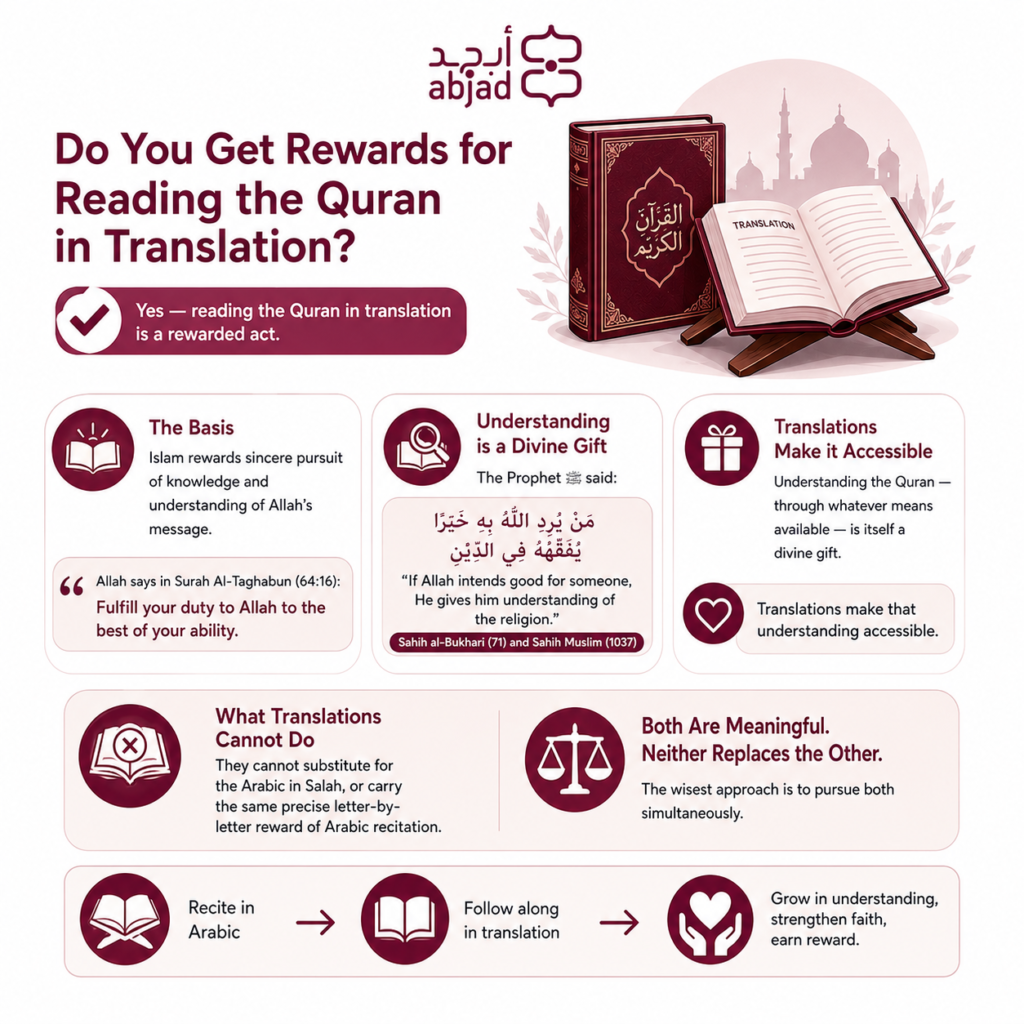
The basis is a general principle: Islam rewards sincere pursuit of knowledge and understanding of Allah’s message. Allah says in Surah Al-Taghabun (64:16) that one should fulfill their duty to Him to the best of their ability. Reading in translation, for those who cannot yet access the Arabic, is precisely that effort.
The Prophet ﷺ said:
«مَنْ يُرِدِ اللَّهُ بِهِ خَيْرًا يُفَقِّهْهُ فِي الدِّينِ»
“If Allah intends good for someone, He gives him understanding of the religion.”
— Sahih al-Bukhari (71) and Sahih Muslim (1037)
Understanding the Quran — through whatever means available — is itself a divine gift. Translations make that understanding accessible.
What translations cannot do is substitute for the Arabic in Salah, or carry the same precise letter-by-letter reward of Arabic recitation. Both are meaningful. Neither replaces the other. The wisest approach is to pursue both simultaneously: recite in Arabic while following along in translation.
For professionals who want structured, goal-oriented Arabic learning that fits a working schedule, Abjad Institute’s Arabic for Professionals course is designed exactly for this — practical, systematic, and paced for adult learners with real demands on their time.
Speak Arabic Confidently in the Workplace with a FREE Trial Class in the UAE.
Read also: Basic Arabic Reading Practice In The UAE – 10 Proven Methods
Watch Our Classes in Action
Curious what a real session looks like? Take a peek inside our interactive classrooms and see how our expert instructors bring the Arabic language to life. Watch a sample lesson below!
Begin Your Arabic Journey in the UAE
Join Abjad Institute for a professional and immersive Arabic language experience tailored to your goals.
Book Your Free TrialWhy Non-Arabic Muslims Should Still Engage with the Arabic Text?
Divine guidance that transcends language barriers The Quran was revealed in Arabic not because it was intended exclusively for Arabs, but because Arabic was — and remains — the only language with the depth and precision to carry the weight of divine speech. Shaykh Yusuf Weltch explains it directly: the Arabic language itself is blessed, and there is genuine spiritual benefit in reciting it even before full comprehension arrives.
Allah answers the implicit question of why non-Arabic speakers were given an Arabic text in Surah Fussilat (41:44):
﴿وَلَوْ جَعَلْنَاهُ قُرْآنًا أَعْجَمِيًّا لَّقَالُوا لَوْلَا فُصِّلَتْ آيَاتُهُ ۖ أَأَعْجَمِيٌّ وَعَرَبِيٌّ ۗ قُلْ هُوَ لِلَّذِينَ آمَنُوا هُدًى وَشِفَاءٌ﴾
“And if We had made it a foreign Quran, they would have said, ‘Why are its verses not explained in detail in our language?'”
The Arabic of the Quran is not an obstacle placed between the believer and the message. It is the invitation to grow toward the message.
The unity of the global Ummah in one language
More than 1.8 billion Muslims on every continent open every prayer with the same Arabic words. A Muslim in Jakarta and a Muslim in Manchester recite identical text in identical language. This shared linguistic anchor — available to any Muslim who learns even basic Arabic recitation — is a connection to the global Ummah that no translation can replicate.
If you are working to improve your Arabic reading comprehension alongside recitation, Abjadinstitute.ae’s Arabic Grammar course provides structured study of the grammatical foundations that unlock deeper Quranic understanding — making the text increasingly accessible over time.
Master Arabic Grammar with a FREE Trial Class in the UAE.
Read Also: How to Read Arabic Books?- A Step-by-Step Guide for Beginners
How to Build Both Arabic Recitation and Quranic Understanding Together?
The dual-track approach that scholars recommend The approach Shaykh Yusuf Weltch describes is not “learn Arabic first, then understand the Quran.
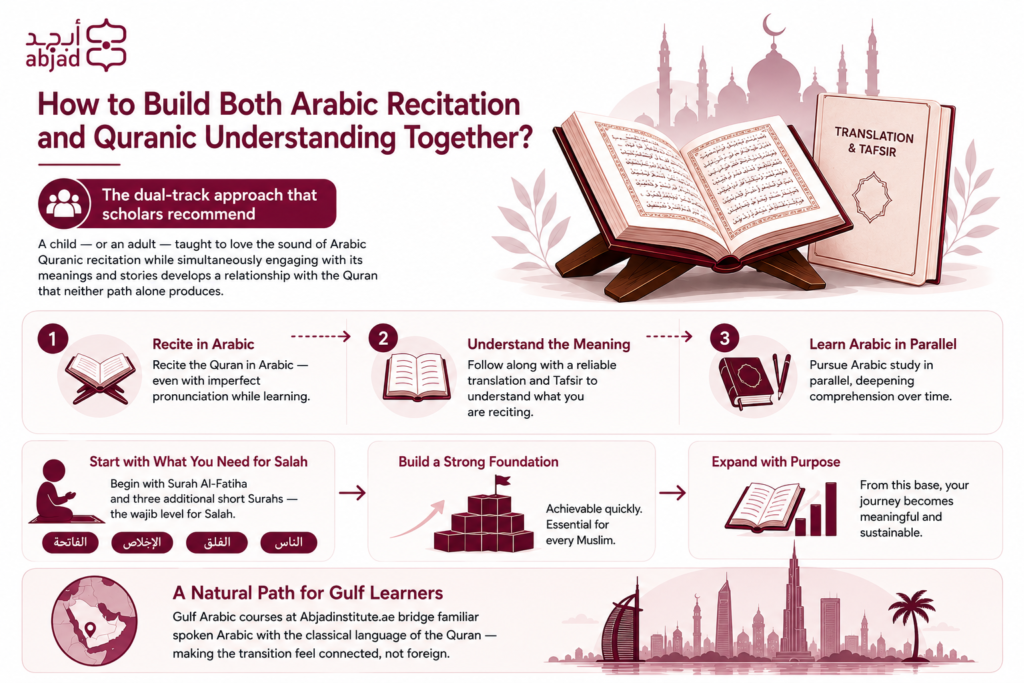
” It is a simultaneous dual engagement:
- Recite the Quran in Arabic — even with imperfect pronunciation while learning.
- Follow along with a reliable translation and Tafsir to understand what you are reciting.
- Pursue Arabic study in parallel, deepening comprehension over time.
This removes the false choice between Arabic and meaning. A child — or an adult — taught to love the sound of Arabic Quranic recitation while simultaneously engaging with its meanings and stories develops a relationship with the Quran that neither path alone produces.
If reciting the Quran in Arabic during prayer currently feels uncertain, the most direct starting point is Surah Al-Fatiha and three additional short Surahs — the wajib level that covers the necessary acts of Salah. These are achievable quickly and form the foundation every Muslim needs.
From that base, expansion becomes meaningful rather than overwhelming. For learners in the Gulf region, Gulf Arabic courses at Abjadinstitute.ae provide a natural entry point — bridging familiar spoken Arabic with the classical register of the Quran, making the transition feel connected rather than foreign.
Read also: Does Arabic Read Right To Left?
Inside Our Live Classes
Don’t just take our word for it—see for yourself! Click below to watch short clips from our live classes and meet the instructors who will guide your learning journey.
Deepen Your Understanding of the Quran with Abjad Institute
Every Muslim who wants a genuine relationship with the Quran — not just phonetic recitation or translated meaning, but both together — eventually arrives at the same conclusion: Arabic is the key.
Abjad Institute offers Arabic courses structured for real adult learners, whether you are a complete beginner, a working professional, or a Gulf-region learner wanting to build fluency in an environment that surrounds you. Their Gulf Arabic course is especially valuable for learners in the UAE and broader Gulf region, connecting Classical and Quranic Arabic to the dialect you hear and live in every day.
Stop reciting what you don’t understand. Start today — one class, one word, one root at a time.
[Book Your Free Trial at Abjad Institute →]
Discover Our Arabic Courses
- Arabic Course for Kids
- Arabic Conversation for Kids
- Arabic Qaida for Kids
- Beginner Arabic for Kids
- Arabic Grammar for Kids
- Teen Arabic Summer Course
- Arabic Kids Camps
- UAE Kindergarten Arabic Classes
- Modern Standard Arabic Course
- Fusha Arabic Course
- Classical Arabic Course
- Emirati Arabic Course
- Gulf Arabic Course
- Learn Saudi Arabic
- Business Arabic Course UAE
- Arabic Language Classes for Professionals in UAE
- Quranic Arabic Course
Begin Your Arabic Journey in the UAE
Join Abjad Institute for a professional and immersive Arabic language experience tailored to your goals.
Book Your Free Trial
Conclusion
Is it compulsory to read Quran in Arabic? Yes — specifically to the level required for valid Salah, which means learning at least Surah Al-Fatiha and one additional Surah at minimum. Beyond that minimum, Arabic is the original, preserved, and spiritually specific form of the divine speech — carrying rewards tied to its letters that translations, however useful, cannot replicate.
The answer to not understanding what you recite is not to abandon Arabic. It is to learn it incrementally, use translations as companions to recitation, and build love for the Quran in children before imposing obligation. The two goals — understanding and Arabic recitation — are not in competition. They are designed to reinforce each other.
Frequently Asked Questions
Many Muslims—especially new Muslims and non-Arabic speakers—have important questions about reciting the Quran in Arabic, the validity of Salah, and the role of translations. The answers below clarify the most common questions based on authentic Islamic teachings and scholarly consensus.
Is it compulsory to read the Quran in Arabic for Salah to be valid?
Yes. Recitation in Salah must be in Arabic for the prayer to be valid. Scholars are unanimous that Surah Al-Fatiha must be recited in Arabic, and that translating it into another language does not fulfill the obligation. This applies to every Muslim regardless of their native language.
What if a new Muslim cannot yet read Arabic — is their prayer invalid?
A new Muslim who genuinely cannot yet recite Arabic may use du’a and dhikr as a temporary substitute while learning, but they are obligated to begin learning Arabic recitation as soon as possible. The obligation is real, but Islam accounts for genuine inability — the key is effort and direction, not immediate mastery.
Does reading a Quran translation give the same reward as reading Arabic?
No, the rewards are different. Reciting the Arabic Quran carries reward for each Arabic letter produced correctly. Reading a translation carries reward for seeking knowledge and understanding — which is also praiseworthy — but the specific letter-based reward is tied to the Arabic text, as established in Hadith (Tirmidhi 2910).
Can I pray using an English translation of the Quran if I don’t know Arabic?
No. The scholarly consensus across all four madhabs is that Quranic recitation in Salah must be in Arabic. A translation is a human interpretation, not the Quran itself. If reciting even the minimum in Arabic is not yet possible, a Muslim should seek qualified instruction immediately while making du’a in their own language for the rest of their supplication.
Is it compulsory to read Quran in Arabic even if you don’t understand what you’re saying?
Yes — and understanding what you recite is a separate goal that Arabic study addresses over time. The spiritual reward for Arabic recitation exists independent of comprehension level. Both recitation and understanding are important; neither cancels the other. The solution to not understanding is to learn Arabic, not to switch languages.
How do I teach my child to love reciting the Quran in Arabic?
Play recordings of renowned Qaris so they grow up hearing the Quran’s sound. Begin with short Surahs recited together daily. Read the meanings in translation so the stories feel alive. And supplement recitation with age-appropriate commentary. Love comes from familiarity — the obligation follows naturally when the relationship is already there.





Leave a Reply