 Learn Arabic
Learning how to read Arabic books is one of the most rewarding steps you can take as a language learner — but it can also feel like the most intimidating. Arabic reads right to left, its letters change shape depending on their position in a word, and most books don’t include vowel markings. Without a clear path, even motivated learners stall out fast.
This guide gives you that path. Whether you’re a complete beginner or someone who knows the alphabet but freezes when you open a real text, these steps will take you from recognising individual letters to reading Arabic books with growing confidence — online and offline, for free and with structured support.
Step 1: Master the Arabic Alphabet Before You Read Anything Else
How to read Arabic books starts before you open a single page — it starts with the Arabic alphabet, called the Abjadiyyah (الأبجدية).
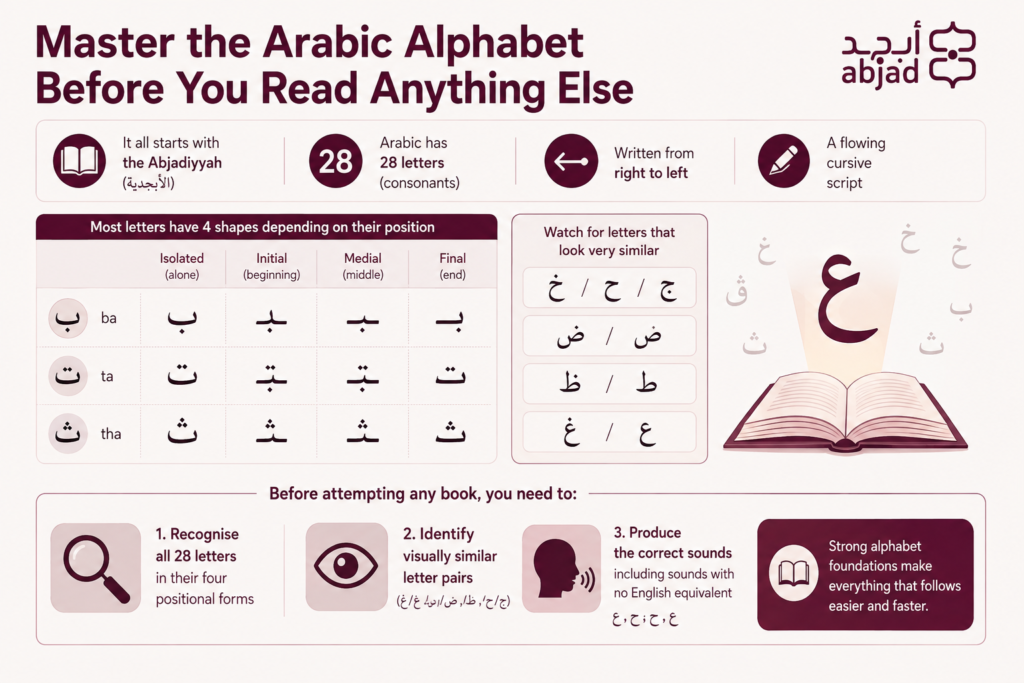
Arabic has 28 letters, all consonants, written in a flowing cursive script from right to left. What makes it particularly challenging for new learners is that most letters have four different shapes depending on whether they appear at the beginning, middle, end, or alone in a word. Letters like ب، ت، ث look nearly identical and are distinguished only by the number and position of dots beneath them.
Before attempting any book, you need to:
- Recognise all 28 letters in their four positional forms
- Identify visually similar letter pairs (ج/ح/خ, ص/ض, ط/ظ, ع/غ)
- Produce the correct sounds each letter makes, including sounds with no English equivalent such as ع, غ, خ, and ح
If you’re starting from zero, the Qaida course at Abjad Institute provides a structured, phonics-based introduction to the Arabic alphabet — the kind of systematic foundation that makes every subsequent reading step easier.
Help Your Child Build Strong Arabic Reading Skills with a FREE Trial Class in the UAE.
Step 2: Learn to Read with Tashkeel (Vowel Markings) First
Most Arabic books written for native adults contain no vowel markings. This is the single biggest stumbling block for beginners learning how to read Arabic books for beginners.
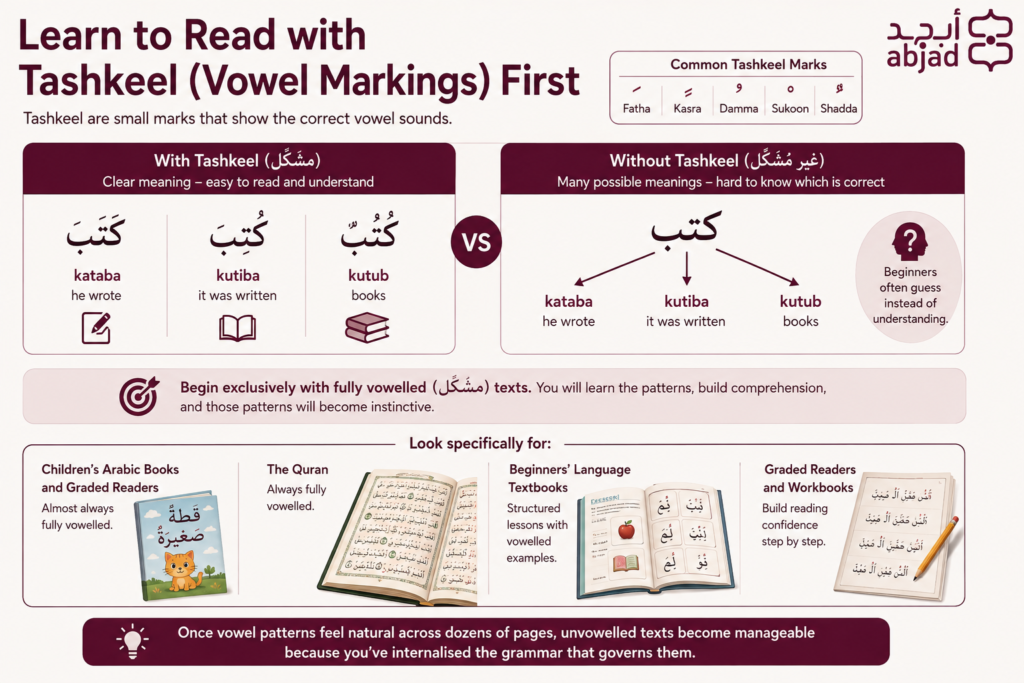
Tashkeel are the small diacritical marks written above and below letters that indicate short vowels — fatha (َ), kasra (ِ), damma (ُ) — as well as sukoon (no vowel) and shadda (doubling). Without them, the word كتب could be read as kataba (he wrote), kutiba (it was written), or kutub (books) depending on the vowel pattern.
begin exclusively with fully vowelled (مشكّل) texts. Beginners who skip straight to unvowelled texts spend most of their reading time guessing vowels rather than building comprehension. Vowelled texts teach you the patterns — and those patterns eventually become instinctive.
Look specifically for:
- Children’s Arabic books and graded readers, which are almost always fully vowelled
- The Quran, which is always fully vowelled
- Beginners’ language textbooks
Once vowel patterns feel natural across dozens of pages, unvowelled texts become manageable because you’ve internalised the grammar that governs them.
Read aslo:How To Learn To Read Arabic For Kids In The UAE?
Step 3: Understand the Arabic Root System to Read Faster
One of the most powerful tools for reading Arabic books is understanding the jidhr wa wazn (الجذر والوزن) — the root and pattern system.
Arabic vocabulary is built on three-letter roots. The root ك-ت-ب, for example, generates: kataba (he wrote), kitaab (book), maktaba (library), kaatib (writer), maktub (written/letter). A reader who recognises this root can often decode an unfamiliar word without a dictionary — because the meaning cluster is familiar.
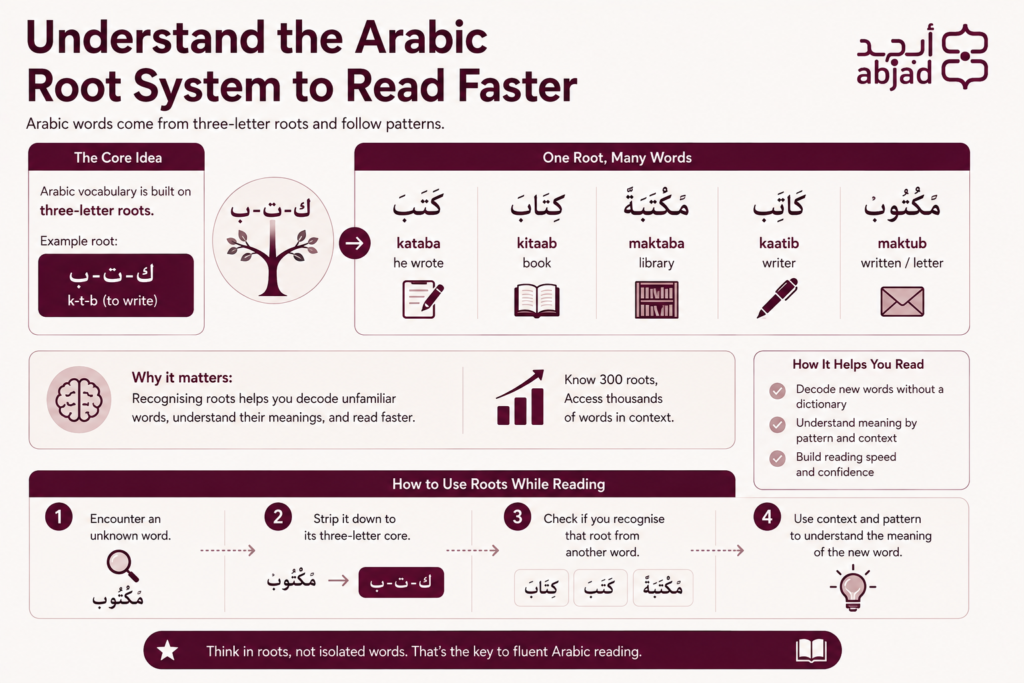
This is the mechanism that makes fluent Arabic reading possible: you’re not memorising isolated words, you’re recognising root families. A learner who knows 300 roots has access to thousands of words in context.
when you encounter an unknown word while reading, try to strip it down to its three-letter core. Check whether you recognise that root from another word. This habit builds reading speed faster than any vocabulary list.
For learners who want to read Arabic books online or engage with Arabic-language media, this root-pattern skill is what separates those who plateau from those who keep progressing. The Basic Arabic course at Abjad Institute covers this root system as part of a structured grammar foundation.
Build a Strong Foundation in Arabic with a FREE Trial Class in the UAE.
Read Also: How Hard Is It to Read Arabic in the UAE? 7 Real Challenges Explained
Step 4: Choose the Right Books for Your Current Level
The most common mistake beginner Arabic readers make is choosing books that are too difficult too soon. Opening a novel written for educated native speakers when you’re three months into learning Arabic is not a challenge — it’s a dead end.
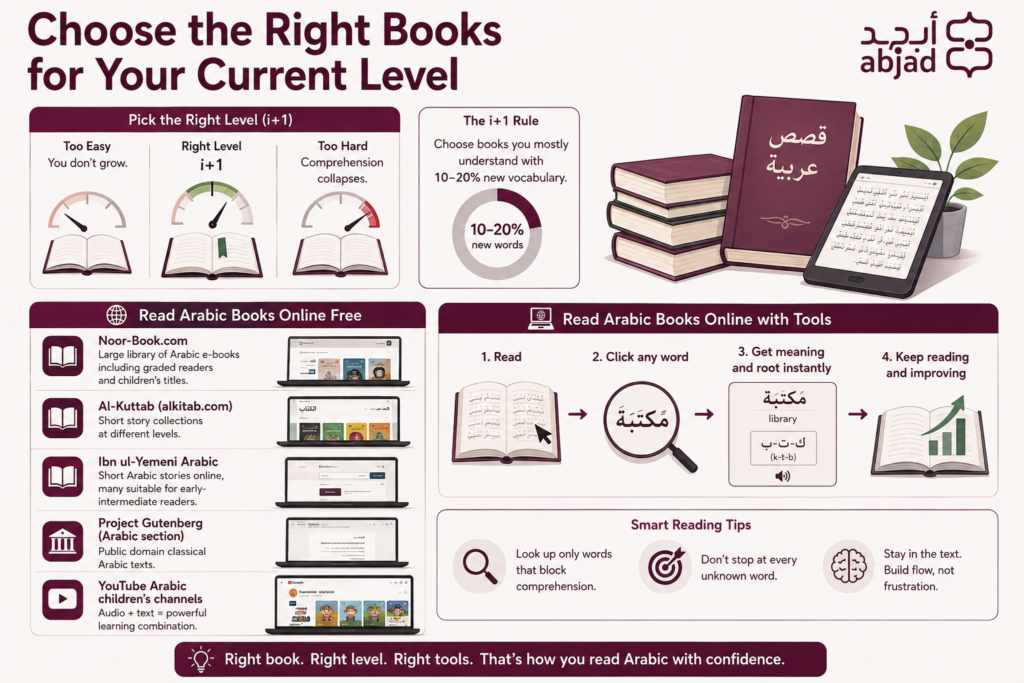
The right level is what language teachers call i+1: texts that are mostly comprehensible but contain roughly 10–20% new vocabulary. Too easy and you don’t grow; too hard and comprehension collapses.
How to Find Arabic Books Online Free?
For beginners exploring how to read Arabic books online free, these sources are reliable and well-structured:
- Noor-Book.com — large library of Arabic e-books including graded readers and children’s titles
- Al-Kuttab (alkitab.com) — short story collections at different levels
- Ibn ul-Yemeni Arabic — short Arabic stories online, many suitable for early-intermediate readers
- Project Gutenberg’s Arabic section — public domain classical Arabic texts (appropriate for advanced learners)
- YouTube Arabic children’s channels — not books, but combining audio with text is extremely effective
Read also:The Best Arabic Books For Kids
How to Read Arabic Books Online with Tools?
Reading Arabic digitally gives you access to instant lookup tools. Browser extensions like Readlang and Morphman let you click any Arabic word and get its meaning and root immediately. This is the modern equivalent of the teacher-prepared glossary — it keeps you in the text rather than breaking your reading flow to look up a dictionary.
The key is discipline: look up only words that block comprehension, not every unfamiliar word. Stopping at every unknown word causes fatigue and frustration within a few paragraphs.
Watch Our Classes in Action
Curious what a real session looks like? Take a peek inside our interactive classrooms and see how our expert instructors bring the Arabic language to life. Watch a sample lesson below!
Begin Your Arabic Journey in the UAE
Join Abjad Institute for a professional and immersive Arabic language experience tailored to your goals.
Book Your Free TrialStep 5: Apply Active Reading Techniques That Build Real Comprehension
Passive exposure to Arabic text rarely builds reading skill. Active reading — deliberate, structured, with a specific focus — is what actually works.
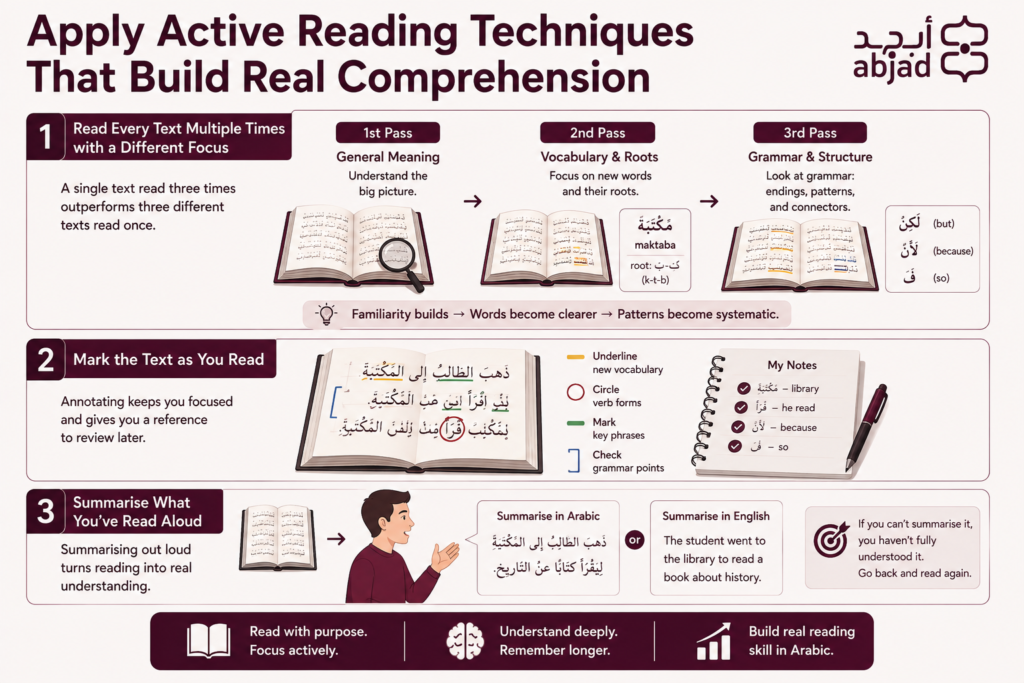
1. Read Every Text Multiple Times with a Different Focus
A single Arabic text read three times outperforms three different texts read once. On your first pass, aim for the general meaning — don’t stop for every word. On your second pass, focus on new vocabulary and the roots behind them. On your third pass, look specifically at grammatical structures: case endings, verb patterns, clause connectors.
This method is especially effective for beginners because it builds familiarity. The second time through, words you couldn’t decode become recognisable. By the third pass, patterns that felt random start to look systematic.
2. Mark the Text as You Read
Underline new vocabulary. Circle verb forms. Mark phrases you want to understand grammatically. This annotation habit does two things: it forces active attention rather than passive scanning, and it creates a personalised reference you can review later.
3. Summarise What You’ve Read Aloud
After finishing a passage, summarise it in Arabic — or in English if your Arabic isn’t ready yet. Speaking what you’ve just read is one of the fastest ways to consolidate reading comprehension into usable memory. If you can’t summarise it, you haven’t fully understood it, and you know exactly where to re-read.
Reading supports speaking, and speaking consolidates reading. If you want to build both simultaneously, the Arabic Speaking course at Abjad Institute combines reading comprehension with structured speaking practice.
Start Speaking Arabic Confidently with a FREE Trial Class in the UAE.

Read Also: How to Get Better at Reading Arabic in the UAE?
Step 6: Read Arabic Every Day — Even for Five Minutes
Consistency beats intensity for language learning. Five minutes of reading Arabic every day produces stronger results over three months than two hours every Saturday.
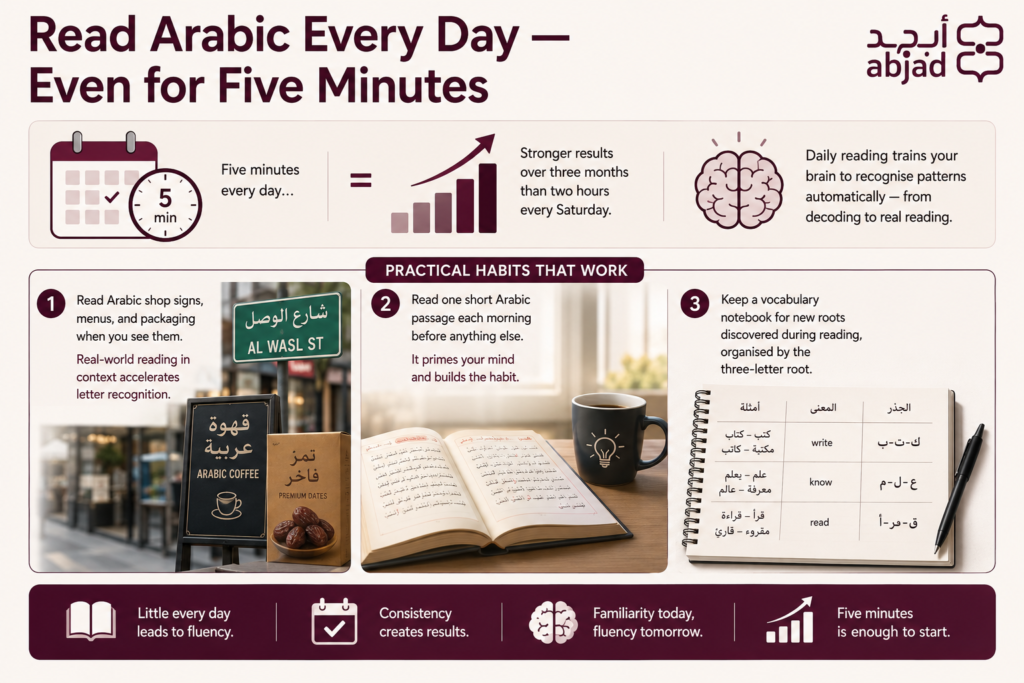
Daily reading builds a specific kind of neural familiarity: your brain begins to recognise letter clusters, common word patterns, and syntactic structures automatically rather than analytically. This is the shift from decoding Arabic to reading Arabic — and it only happens through frequent, regular exposure.
Practical habits that work:
- Read Arabic shop signs, menus, and packaging when you see them — real-world reading in context accelerates letter recognition
- Read one short Arabic passage each morning before anything else — it primes your attention
- Keep a vocabulary notebook for new roots discovered during reading, organised by the three-letter root
For learners at professional or academic level who need to read Arabic in a specific context — contracts, technical documents, media — the Arabic for Professionals course at Abjad Institute builds reading competency within the vocabulary field that actually matters to you.
Join Our Arabic Language Classes for Professionals with a FREE Trial Class in the UAE.

Step 7: Build a Vocabulary Management System
When you read Arabic books regularly, you will encounter far more new words than you can realistically learn. The key skill is not looking up every word — it’s knowing which words to look up.
The selection rule: look up a word only if it appears more than once in the text, or if its absence makes the sentence incomprehensible. Words that appear once in a short passage and whose absence doesn’t block meaning can often be skipped without consequence.
For words you do look up, record them by their three-letter root — not the inflected form you found in the text. This root-centred vocabulary system means one entry in your notebook can unlock dozens of related words you’ll encounter later.
Recommended Arabic Dictionaries
- Hans Wehr’s Dictionary of Modern Written Arabic — the standard reference for Modern Standard Arabic, faster to navigate than older dictionaries
- Lane’s Arabic-English Lexicon — exhaustive reference for classical Arabic vocabulary; essential for reading pre-modern texts
- Almaany.com — reliable free online Arabic-English dictionary with root lookup
Read Also: How to Read Arabic Without Vowels?
Inside Our Live Classes
Don’t just take our word for it—see for yourself! Click below to watch short clips from our live classes and meet the instructors who will guide your learning journey.
Start Reading Arabic Books with Confidence at Abjad Institute
If you’ve read this far, you have the roadmap. The question now is execution — and that’s where the right instructor makes an enormous difference.
At Abjad Institute, expert Arabic instructors guide students from the alphabet through to independent reading, using structured curricula built for non-native learners at every level.
- Fully vowelled beginner texts to build the right foundations
- Root and grammar instruction integrated with reading practice
- Courses for children, adults, and professionals — online, flexible, one-to-one
Book your free trial lesson today
Discover Our Arabic Courses
- Arabic Course for Kids
- Arabic Conversation for Kids
- Arabic Qaida for Kids
- Beginner Arabic for Kids
- Arabic Grammar for Kids
- Teen Arabic Summer Course
- Arabic Kids Camps
- UAE Kindergarten Arabic Classes
- Modern Standard Arabic Course
- Fusha Arabic Course
- Classical Arabic Course
- Emirati Arabic Course
Begin Your Arabic Journey in the UAE
Join Abjad Institute for a professional and immersive Arabic language experience tailored to your goals.
Book Your Free Trial
Conclusion
Learning how to read Arabic books is not a single skill — it’s a sequence of skills built in the right order. Master the alphabet first. Read vowelled texts before unvowelled ones. Learn the root system so vocabulary compounds instead of multiplying endlessly. Choose books at the right level, apply active reading techniques, and read a little every day.
The learners who succeed are not the ones who study the hardest in short bursts — they’re the ones who show up consistently and apply each step deliberately. Arabic books that seemed impenetrable at month three become readable at month six, and genuinely enjoyable at month twelve.
Every page you read is a page closer to that point.
Read more: How To Read Arabic In English Letters? A Step-By-Step Guide For Beginners
Frequently Asked Questions
How do I start reading Arabic books as a complete beginner?
Start with fully vowelled texts and children’s graded readers — not adult novels. Before any book, ensure you can recognise all 28 Arabic letters in their four positional forms. Once you can read basic vowelled text, progress to simple short stories built for early-intermediate learners.
Where can I read Arabic books online for free?
Reliable free sources include Noor-Book.com for a wide range of Arabic titles, Alkitab.com for short story collections, and Ibn ul-Yemeni Arabic for beginner-appropriate online stories. For Quranic text with full vowelling, quran.com provides clean, readable Arabic with audio support.
How long does it take to read Arabic books independently?
Most learners with consistent daily practice — 20–30 minutes per day — can begin reading simple, fully vowelled Arabic books within 6–12 months. Reaching the point of reading an unvowelled newspaper or novel comfortably typically takes 2–3 years of structured study.
What is the easiest type of Arabic book to start with?
Start with fully vowelled children’s literature or beginner graded readers. These texts are written in Modern Standard Arabic with simple vocabulary and complete tashkeel, which teaches you authentic reading patterns without the guesswork that unvowelled texts require.
Do I need to learn Arabic grammar to read Arabic books?
Basic grammar is essential. Understanding verb patterns, noun case endings (i’rab), and the difference between the three word types (ism, fi’l, harf) allows you to decode sentence structure when vocabulary alone isn’t enough. The root and pattern system (jidhr wa wazn) is especially important because it multiplies every word you learn.
What is the difference between reading Arabic online versus reading printed books?
Reading Arabic online gives you access to instant lookup tools — browser extensions and dictionary apps that let you click any word for its root and meaning. This dramatically reduces the friction of encountering unknown vocabulary. Printed books require a physical dictionary but reduce screen distraction. Both are effective; use digital tools for speed in early stages and move toward physical texts as you build independence.






Leave a Reply