 Learn Arabic
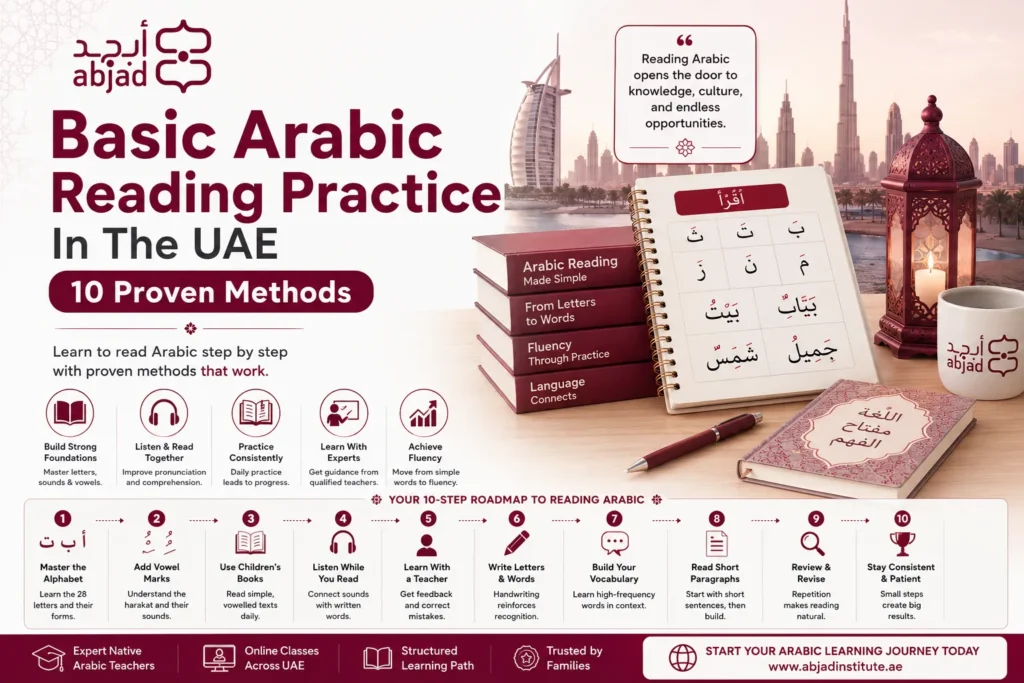
Walk through any mall in Dubai, read any road sign in Abu Dhabi, or open any government document across the Emirates — Arabic is everywhere. Most residents encounter the language daily, yet far fewer can actually read it. For those who want to change that, basic Arabic reading practice in the UAE has never been more accessible, better supported, or more rewarding to pursue.
Arabic is written from right to left, with 28 letters. Each letter has up to four different forms depending on its position in a word — at the beginning, in the middle, at the end, or standing alone. Short vowels, called harakaat, are written as small marks above or below letters, but they appear only in learning materials, children’s books, religious texts, and formal poetry.
This guide covers ten practical methods, arranged in the order that actually works. Skip ahead if you already know the alphabet. Start at the beginning if you are starting from zero.
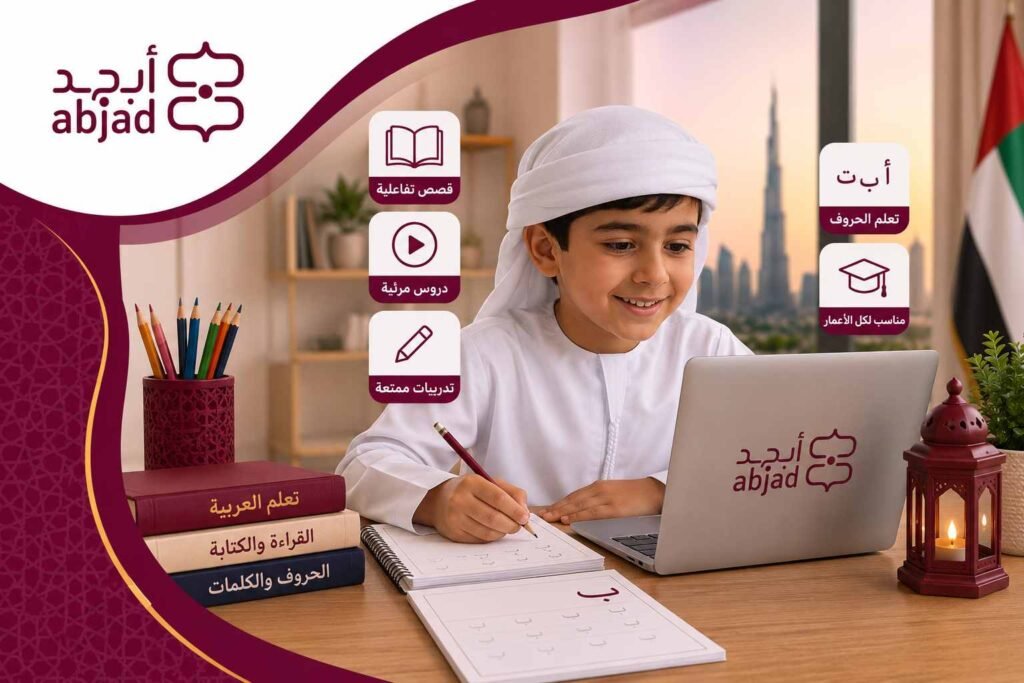
Start Your Arabic Course for Beginners UAE Today
1. Mastering The Arabic Alphabet Is The First Step Toward Basic Arabic Reading Practice In The UAE
The 28 Arabic letters, their sounds, and their four positional forms need to become automatic before you attempt to read anything. Not familiar — automatic. If you have to pause and think about whether a letter is ب (ba) or ت (ta), you are not ready to move to connected words yet.
Plan two to three weeks of daily practice focused entirely on letter recognition and handwriting. Writing letters by hand locks the shapes into visual memory significantly faster than reading alone.
A practical test: if you can read a randomly selected Arabic syllable without hesitating, you are ready to move on. Grasping how to read Arabic letters in the UAE begins here — and there is no shortcut worth taking at this stage.
Join the Best Arabic from Scratch Course in the UAE with the first session free
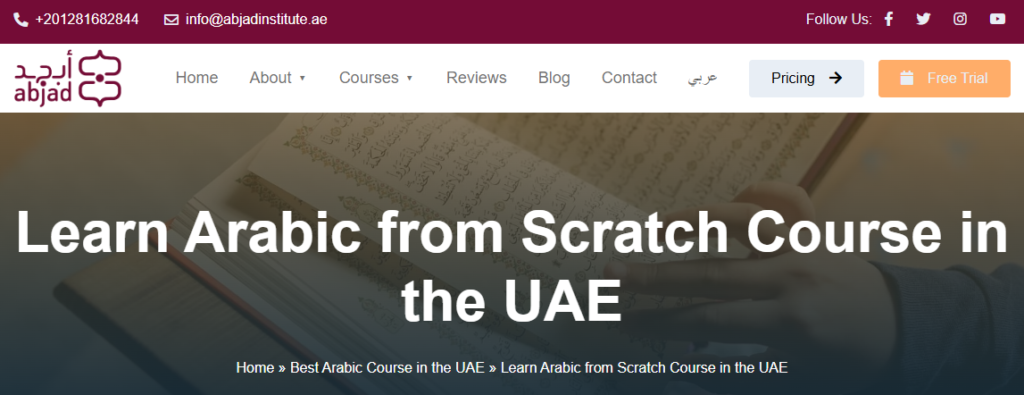
2. Add The Vowel Marks Immediately After Learning The Arabic Letters
The harakaat — fatha (short “a”), damma (short “u”), kasra (short “i”), sukoon (consonant without a following vowel), shadda (doubled consonant), and tanween (nunation at word endings) — convert sequences of letters into readable words.
Learners who skip proper vowel training spend months guessing at words instead of actually reading them. Every beginner text you work with should be fully vowelled. This is not a crutch; it is the correct training stage. The transition to unvowelled text comes later, after fully vowelled reading is genuinely fluid, not before.
3. Use Arabic Children’s Books And Graded Readers As Your Training Ground
The best texts for beginner Arabic readers are not beginner textbooks. They are children’s books. Arabic children’s literature is almost always fully vowelled, uses short sentence structures, and draws on high-frequency vocabulary that reappears across all text types.
Public libraries in Abu Dhabi and Dubai carry Arabic children’s collections that any resident can borrow for free with a library card. For younger learners specifically, structured programmes designed around how children acquire language are far more effective than adult-oriented courses.
Learn Arabic for kids programmes at specialist institutes pair age-appropriate materials with teachers who understand the difference between how a seven-year-old and a thirty-year-old build reading skills — which is a meaningful distinction, not a minor one.
Unlock the Beauty of Arabic at The Arabic Learning Academy with a FREE Trial
4. Listen While You Read To Lock In Correct Pronunciation
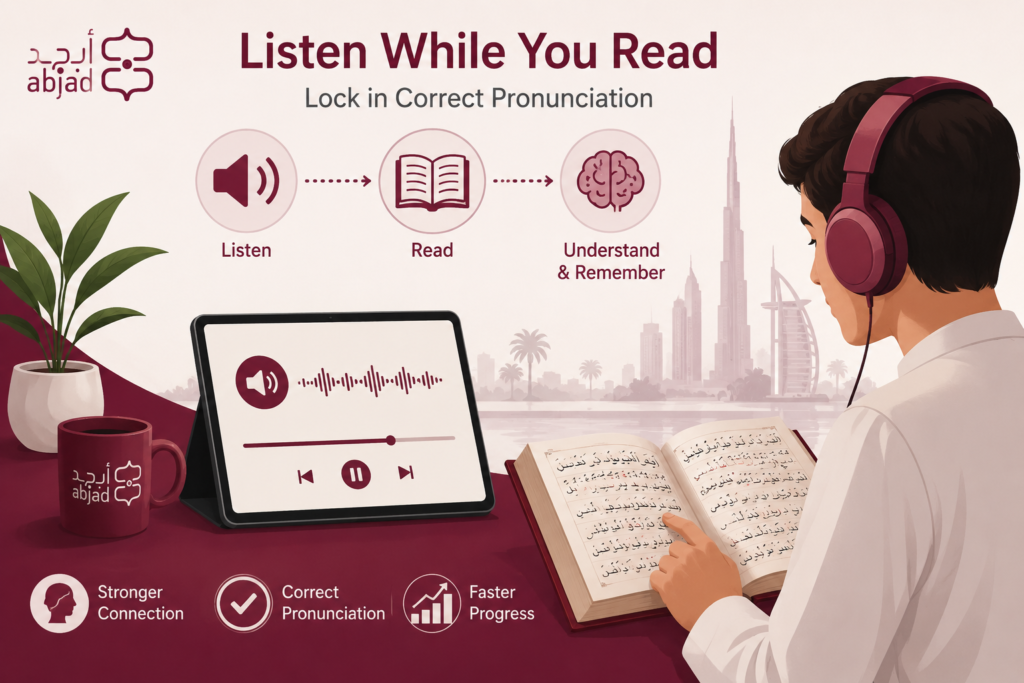
Pairing audio with text is one of the most efficient techniques available for building reading fluency. When you listen to a native speaker read the same passage you are looking at, your brain maps written symbols to their correct sounds in real time. This mirrors exactly how children first learn to read in any language — someone reads aloud to them while they follow along.
For Arabic learners in the UAE, this can mean audiobook-text pairs, language platforms with built-in audio support, or simply asking a native-speaking colleague to read a short passage while you follow the text. Many learners also find it valuable to explore how to learn to read Arabic online for free.
Platforms like Al Jazeera’s Arabic learning portal provide audio-text pairings at no cost, covering material from complete beginner to intermediate level.
5. Work With A Qualified Teacher Or Native Speaker At Least Once A Week
Self-study will take you a certain distance. A qualified teacher takes you further, faster — not because they push you harder, but because they catch errors that you genuinely cannot catch yourself. Confusing ع (ain) with غ (ghain), or reading ح as ه — these are pronunciation errors most learners cannot detect in their own reading without trained feedback from someone who hears them clearly.
One session per week with a native Arabic speaker, combined with daily self-practice, typically produces measurable fluency gains within six to eight weeks. Many learners at that stage become curious about adjacent skills: how to write in Arabic in the UAE alongside reading.
In addition to how grammar connects to reading comprehension, how the spoken dialect they hear around them relates to what they see on the page. A good teacher incorporates all of this naturally as your skills develop.
Read also: How to Get Better at Reading Arabic in the UAE?
Watch Our Classes in Action
Curious what a real session looks like? Take a peek inside our interactive classrooms and see how our expert instructors bring the Arabic language to life. Watch a sample lesson below!
Begin Your Arabic Journey in the UAE
Join Abjad Institute for a professional and immersive Arabic language experience tailored to your goals.
Book Your Free Trial
6. Practice With Quranic Arabic For A Structured And Meaningful Foundation
For Muslim residents in the UAE, Quranic Arabic offers something no other training material provides: every word is always fully vowelled, the text is always available, and the motivation to read it correctly is deeply personal. The Quranic Arabic alphabet is identical to the modern Arabic alphabet, which means the letters you learn for general reading are the same letters you will use to read the Quran.
Quranic Arabic is classical Arabic — richer in vocabulary and more grammatically precise than Modern Standard Arabic — and the benefits of learning Quranic Arabic extend well beyond religious practice. Learners who study Quranic texts develop reading comprehension and vocabulary at a depth that many standard Arabic courses do not reach in the early stages.
For residents who want dedicated instruction in how to read Arabic Quran in the UAE, specialist courses provide both the phonics grounding and the recitation rules (tajweed) that independent study cannot replicate. The combination of full vowelling, deep vocabulary, and qualified instruction makes Quranic Arabic one of the most powerful starting points available.
Explore Our Quranic Arabic Course in the UAE to master Arabic Languag
7. Read Aloud Every Day, Even If Just For Ten Minutes
Silent reading and reading aloud are two different skills. For Arabic learners at the early stages, reading aloud is significantly more valuable because it forces you to produce the correct sound for every letter and vowel mark, rather than glossing over uncertainty in your head.
Ten minutes of daily read-aloud practice, from a fully vowelled children’s book, a short religious text, or a beginner reader, builds pronunciation habits that are genuinely difficult to acquire through correction later.
The practical target after one month: reading a short, fully vowelled passage without stopping on any individual letter, even if you do not yet understand every word.
Begin Your Kid’s Path of Speaking Arabic
Read also: How to Read Arabic Without Vowels?
8. Tap Into UAE’s Public Reading Initiatives And Community Resources
The UAE’s commitment to reading literacy is written into national policy. Reading corners and community library points have been established in malls, hospitals, and public facilities across the country.
Public library membership is free across all emirates, with Arabic-language collections available at every branch. Beyond infrastructure, the Abu Dhabi Arabic Language Centre‘s ongoing programmes include family literacy initiatives, creative writing workshops, and reading events that welcome all residents, not only Emiratis or native speakers.
Engaging with these resources turns Arabic reading practice into a social habit rather than a solitary study routine, which makes long-term consistency dramatically easier to maintain.
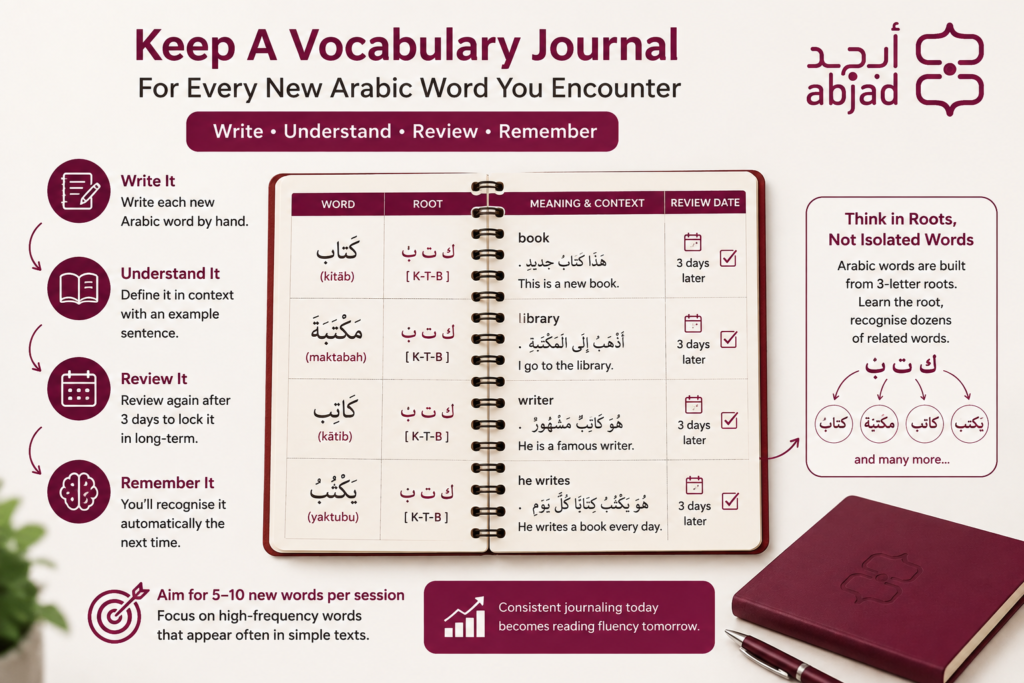
9. Keep A Vocabulary Journal For Every New Arabic Word You Encounter
This is the method most learners skip because it feels slow. It is not slow — it is compounding. Every Arabic word you write by hand, define in context, and review three days later becomes a word you will recognise automatically the next time you encounter it.
Arabic uses a root-based word system: most words derive from a three-letter root, and once you know a root, you can often recognise dozens of related words even on first encounter. A vocabulary journal built around roots rather than isolated words accelerates reading comprehension at a rate that frequency-based drilling alone cannot match.
Aim for five to ten new words per reading session, prioritising words that reappear frequently in simple texts over rare vocabulary.
Read also: Best Arabic Cartoons for Kids to Watch
10. Enrol In A Structured Arabic Reading Course At A Recognised UAE Institute
At a certain point, structured instruction accelerates progress in a way that independent study simply cannot replicate. A good course provides a sequenced curriculum, consistent pronunciation feedback, and the focused practice environment that removes the guesswork from self-directed learning.
For adults beginning from zero, Arabic classes for beginners at a specialist institute builds the systematic foundation that makes all subsequent practice more effective. For professionals with specific workplace goals, a Business Arabic Course UAE integrates reading skills with the vocabulary relevant to their field.
Residents who want to explore the full range of what the language offers can learn Arabic through a Modern Standard Arabic programme that provides both reading and spoken language competency in one coherent curriculum.
The Two Mistakes That Will Cost You Months of Progress
Both of the following errors are extremely common among self-taught learners in the UAE, and both are straightforward to correct once identified.
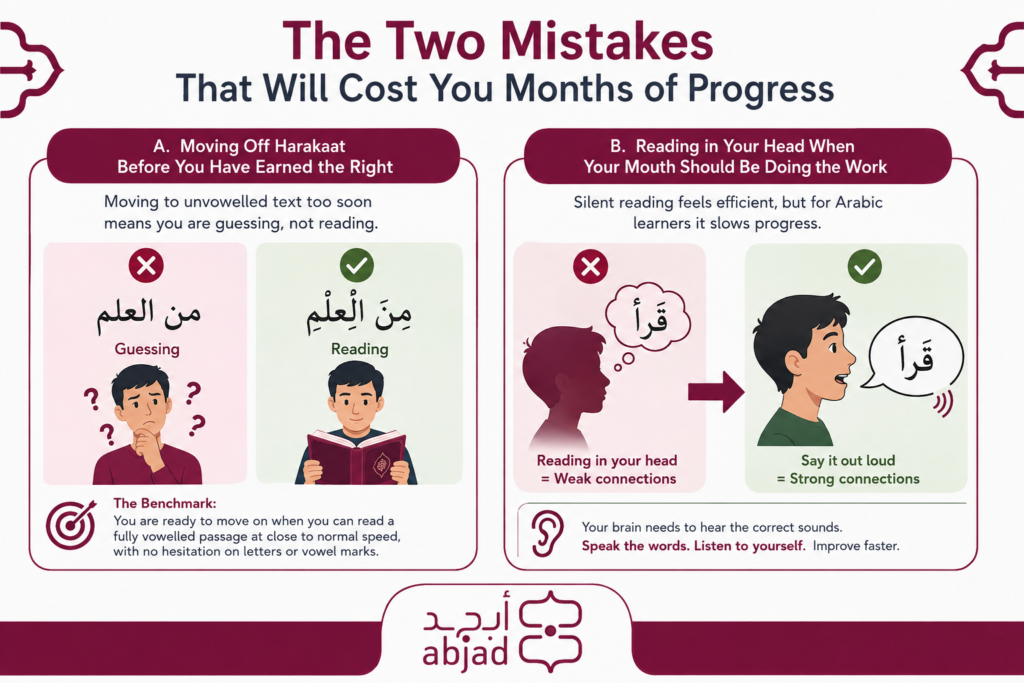
A. Moving Off Harakaat Before You Have Earned the Right
Moving to unvowelled text before you are genuinely ready means you are guessing rather than reading — and guessing builds bad habits faster than almost any other mistake.
You are ready to transition away from fully vowelled texts when you can read a fully vowelled passage at close to normal speaking speed, with no hesitation on individual letters or vowel marks.
Most learners need four to six months of daily practice to reach this benchmark authentically. Understanding how to read Arabic script in the UAE correctly means respecting this transition, not treating unvowelled text as a target to rush toward because training materials feel too easy.
B. Reading in Your Head When Your Mouth Should Be Doing the Work
Adults default to silent reading because it feels more efficient. For Arabic learners building phoneme-grapheme connections in a script they did not grow up with, it is the opposite of efficient. Your brain needs to hear the correct sounds associated with each letter combination, and the only reliable way to get that feedback is to produce the sounds yourself and listen to them.
Read aloud until your reading speed and accuracy are strong enough that silent reading does not risk introducing errors, typically after six to twelve months of consistent daily practice. This is not a commentary on being a slow learner. It is a straightforward observation about how auditory memory and visual memory interact when you are acquiring a new writing system as an adult.
Read also: 8 Trusted Ways To Learn Arabic For Kids Online Free In The UAE
Inside Our Live Classes
Don’t just take our word for it—see for yourself! Click below to watch short clips from our live classes and meet the instructors who will guide your learning journey.
Begin Your Arabic Journey in the UAE
Join Abjad Institute for a professional and immersive Arabic language experience tailored to your goals.
Book Your Free TrialWith Abjad Institute UAE Residents Can Build Arabic That Lasts
Abjad Institute is a leading Arabic language institute in the UAE, offering structured programmes for every level of learner — from complete beginners encountering Arabic letters for the first time, to advanced students refining literary comprehension and formal grammar.
Every course is designed around qualified native-speaker instruction, clear progression milestones, and the practical goal of producing skills that learners actually use in their daily lives in the UAE.
Whether you are an adult resident building literacy for professional reasons, a parent developing your children’s Arabic alongside their schooling, or someone pursuing Quranic reading specifically, Abjad Institute has a programme designed for exactly where you are starting from — and for exactly where you want to go.
Discover Our Arabic Courses:
- Arabic Course for Kids
- Arabic Qaida for Kids
- Beginner Arabic for Kids
- Arabic Grammar for Kids
- Teen Arabic Summer Course
- Arabic Kids Camps
- UAE Kindergarten Arabic Classes
- Fusha Arabic Course
- Classical Arabic Course
- Emirati Arabic Course
- Gulf Arabic Course
- Learn Saudi Arabic
- Arabic Language Classes for Professionals in UAE
Start your Arabic course at Abjad Institute today with a Free Trial and begin reading the Arabic that actually surrounds you in the UAE — without waiting for harakat that will never appear.
Begin Your Arabic Journey in the UAE
Join Abjad Institute for a professional and immersive Arabic language experience tailored to your goals.
Book Your Free TrialConclusion
Practice Arabic reading is a skill that rewards consistency far more than it rewards intensity. Ten focused minutes every day, practised in the right sequence, will outperform three irregular hours on a weekend, every time.
The UAE is one of the best places in the world to pursue basic Arabic reading practice. The language surrounds you, the public infrastructure actively supports learners, and native speakers are part of everyday life in a way that learners in most countries never experience.
What most residents need is not more exposure to Arabic; it is a clear starting point and the discipline to work through the sequence without cutting corners.
Start with the letters. Add the vowels. Read aloud daily. Find a qualified teacher. Keep a vocabulary journal. The Arabic that felt like an impossible code in the first week will feel like a system by the sixth week, and like a second literacy before the year is out.
Frequently Asked Questions
How long does it take to learn to read Arabic from scratch?
Basic letter recognition and sounding out simple, fully vowelled words typically takes four to six weeks of daily practice for most adult learners. Reading fully vowelled texts fluently takes three to six months. Reading unvowelled Arabic with real comprehension generally takes twelve to twenty-four months of consistent study.
Can adults who have never studied Arabic before learn to read it in the UAE?
Completely. Adult learners in the UAE have the considerable advantage of constant environmental exposure — Arabic appears on road signs, in official documents, in shops, and in public spaces throughout the country every single day.
What is the difference between reading Modern Standard Arabic and Gulf Arabic?
Modern Standard Arabic (MSA) is the formal written form used across the Arab world, appearing in books, newspapers, formal correspondence, and official government documents. Gulf Arabic is the spoken dialect used in everyday conversation in the UAE and neighbouring countries. Written Arabic almost always uses MSA — learning to read Arabic means learning to read MSA.
Is Quranic Arabic the same as Modern Standard Arabic?
They share the same script and many grammatical foundations, but Quranic Arabic is the classical form of the language as it existed in the 7th century, with distinct vocabulary and grammatical structures not found in contemporary writing. For learners whose primary goal is Quran recitation and comprehension, a dedicated Quranic Arabic programme is more appropriate than a standard MSA course.
Where can I find Arabic reading materials and structured resources in Abu Dhabi and Dubai?
Public libraries across both cities offer free membership and carry Arabic-language collections including children’s books, graded readers, and literary works. The Abu Dhabi Arabic Language Centre hosts regular events, workshops, and community reading programmes. Many cultural centres and community institutions across the UAE run Arabic literacy initiatives open to all residents.
Is reading Arabic calligraphy the same skill as reading standard printed Arabic?
Not exactly. how to read Arabic calligraphy is related to but distinct from reading standard printed Arabic. Calligraphic styles — particularly Thuluth, Diwani, or Kufic — use highly stylised letterforms that sometimes overlap, stretch, or modify letters in ways that standard typography does not. A solid foundation in reading printed Arabic, typically after six to twelve months of practice, makes calligraphic texts significantly easier to parse.



Leave a Reply