 Learn Arabic

Every Arabic learner hits the same wall. Your textbook has vowels on every word. The real world doesn’t. Open Al Jazeera, pick up a novel, scroll through Arabic social media — the vowel marks (harakat) are gone. The word كتب could be kataba (he wrote), kutub (books), kutiba (it was written), or kattaba (he made someone write). Same letters, four meanings, zero clues.
Here’s the truth: 400 million Arabic speakers read unvowelized text daily without stopping to puzzle over it. They use patterns, grammar, and context — a system any serious learner can acquire. This guide walks you through exactly how to read Arabic without vowels in eight structured steps, from foundational pattern recognition to real-world news articles.
Arabic drops vowels because its writing system is structurally designed to work without them. This isn’t a quirk or oversight — it’s how the language has been written for over a thousand years.
Arabic is an “abjad,” a consonant-based writing system. The three consonants in any root carry the word’s meaning; the vowels between them carry grammatical function — tense, case, voice, number. For a literate reader who knows the root and the grammar, the vowel marks become redundant. They only appear in texts where no ambiguity can be tolerated: the Quran, children’s books, poetry, and language textbooks.
This is the same logic English uses with words like “read” — identical spelling, two pronunciations (red vs. reed), and native speakers never confuse them in context. Arabic operates at the same level, just with far more systematic structure beneath it.
1. Understand How Native Readers Process Unvowelized Text
Before changing how you practice, change how you think about the problem. Native Arabic readers don’t decode vowels letter by letter — they recognize whole word shapes using four simultaneous cues.
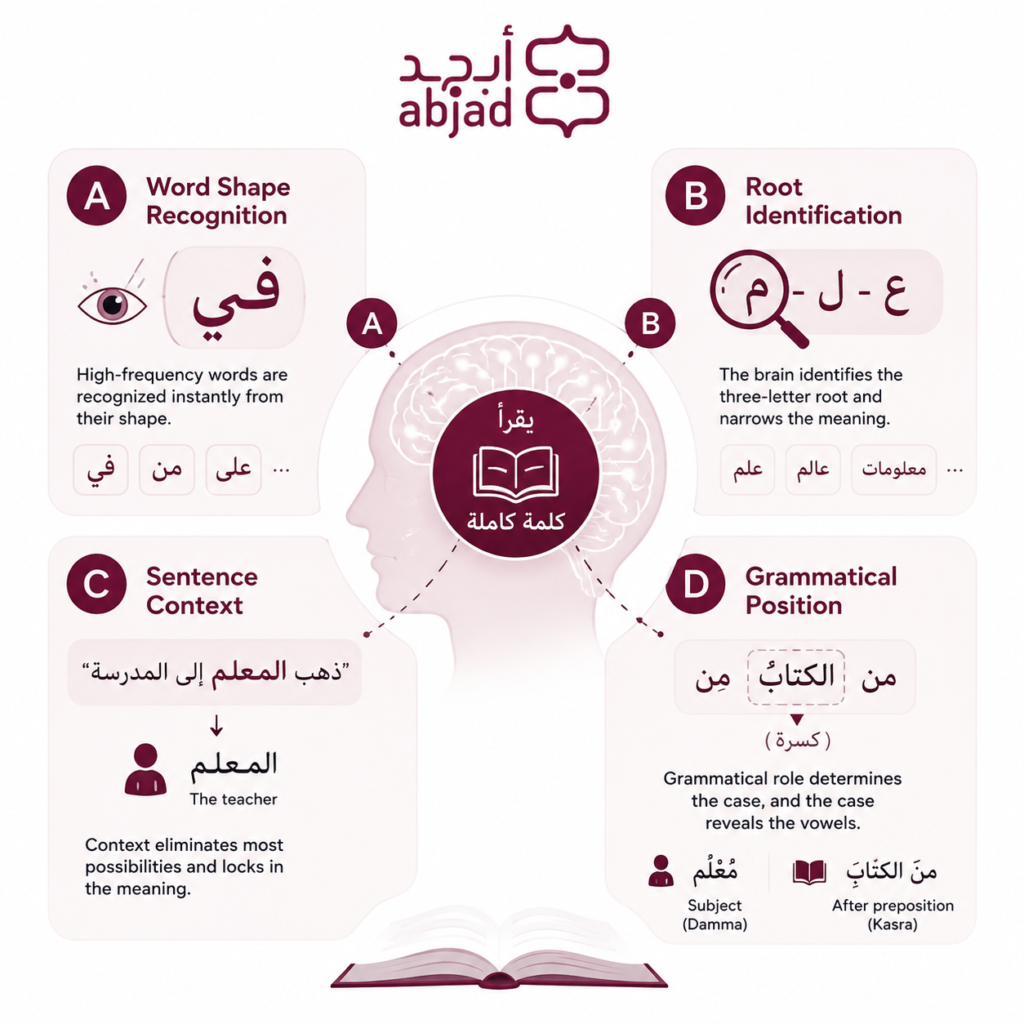
Eye-tracking research on Arabic reading shows that skilled readers process words as complete visual units, not as sequential letters. The four cues they use are:
A. Word shape recognition
High-frequency words like في (in), من (from), and على (on) are recognized in milliseconds from their consonantal skeleton alone, exactly as English readers recognize “the” without sounding it out.
B. Root identification
The brain identifies the three-letter root and narrows the word to a family of related meanings. Seeing علم activates the root ع-ل-م (knowledge), which constrains the possibilities to ‘ilm (knowledge), ‘aalim (scholar), ma’lumaat (information).
C. Sentence context
Surrounding words eliminate most possible readings. In “ذهب المعلم إلى المدرسة,” المعلم must be “the teacher” — context locks in both the meaning and the voweling.
D. Grammatical position
A noun following a preposition must be in the genitive case (majrur), which means it carries kasra. A sentence subject carries damma. Position reveals grammar; grammar reveals vowels.
The practical implication: you do not need to memorize vowels for every word individually. You need to internalize the system that generates them.
If your goal is to read Quranic Arabic, modern news, or classical literature with confidence, Abjad Institute’s Fusha (Modern Standard Arabic) courses give you the grammar and vocabulary foundation that makes unvowelized reading possible.
Build Strong Fusha Arabic Skills with a FREE Trial Class in the UAE.

2. Learn the 10 Arabic Word Patterns That Predict Vowels
The single most powerful tool for reading Arabic without vowels is the Arabic word-pattern system (awzaan). Arabic has a finite set of templates that determine how vowels map onto consonantal roots. Once you know a pattern, you can predict the vowels of every word that fits it — without memorizing each word individually.
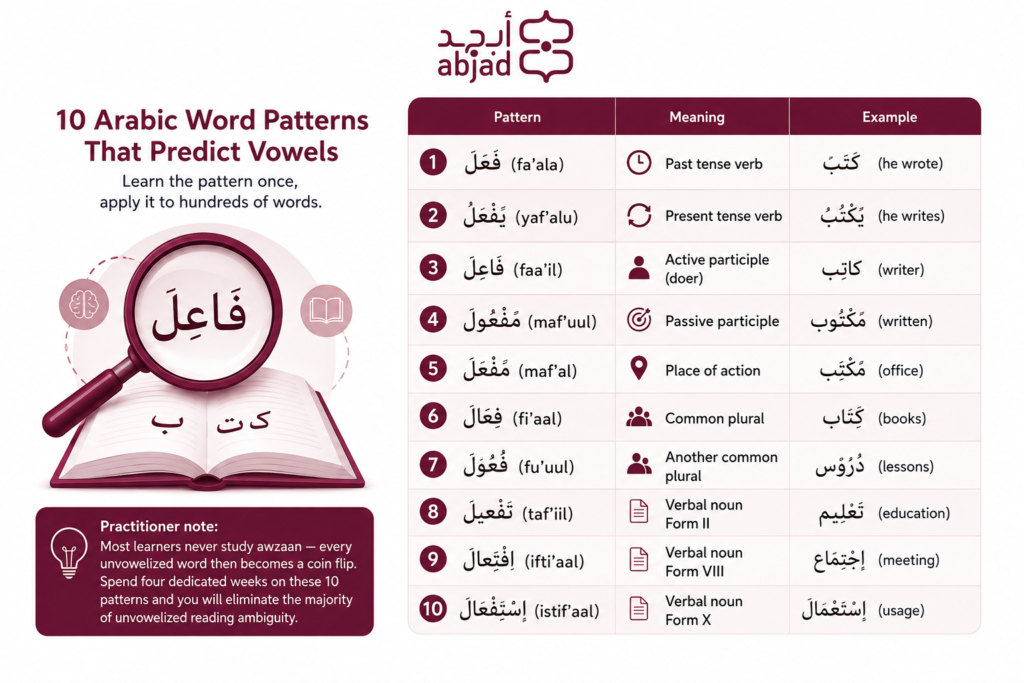
The pattern فَاعِل (faa’il) always means “doer of the action”: كاتِب (writer), عالِم (scholar), طالِب (student). The pattern مَفْعُول (maf’uul) always means “thing acted upon”: مكتوب (written), مفتوح (opened), معلوم (known). Learn the pattern once; apply it to hundreds of words.
These 10 patterns cover the majority of words you will encounter in everyday Arabic:
| Pattern | Meaning | Example |
| فَعَلَ (fa’ala) | Past tense verb | كَتَبَ (he wrote) |
| يَفْعَلُ (yaf’alu) | Present tense verb | يَكْتُبُ (he writes) |
| فَاعِل (faa’il) | Active participle (doer) | كَاتِب (writer) |
| مَفْعُول (maf’uul) | Passive participle | مَكْتُوب (written) |
| مَفْعَل (maf’al) | Place of action | مَكْتَب (office) |
| فِعَال (fi’aal) | Common plural | كِتَاب (books) |
| فُعُول (fu’uul) | Another common plural | دُرُوس (lessons) |
| تَفْعِيل (taf’iil) | Verbal noun Form II | تَعْلِيم (education) |
| اِفْتِعَال (ifti’aal) | Verbal noun Form VIII | اِجْتِمَاع (meeting) |
| اِسْتِفْعَال (istif’aal) | Verbal noun Form X | اِسْتِعْمَال (usage) |
Practitioner note: Most learners never formally study awzaan — every unvowelized word then becomes a coin flip. Spend four dedicated weeks on these 10 patterns and you will eliminate the majority of unvowelized reading ambiguity.
Read also: Ten Charming Arabic Poems Designed for Kids
3. Use the Root System as a Vowel Decoder
When you encounter an unfamiliar unvowelized word, identify the root consonants first. Strip away common prefixes (م، ت، ا، ن، ي) and common suffixes (ة، ات، ون، ين) to expose the three-letter core.
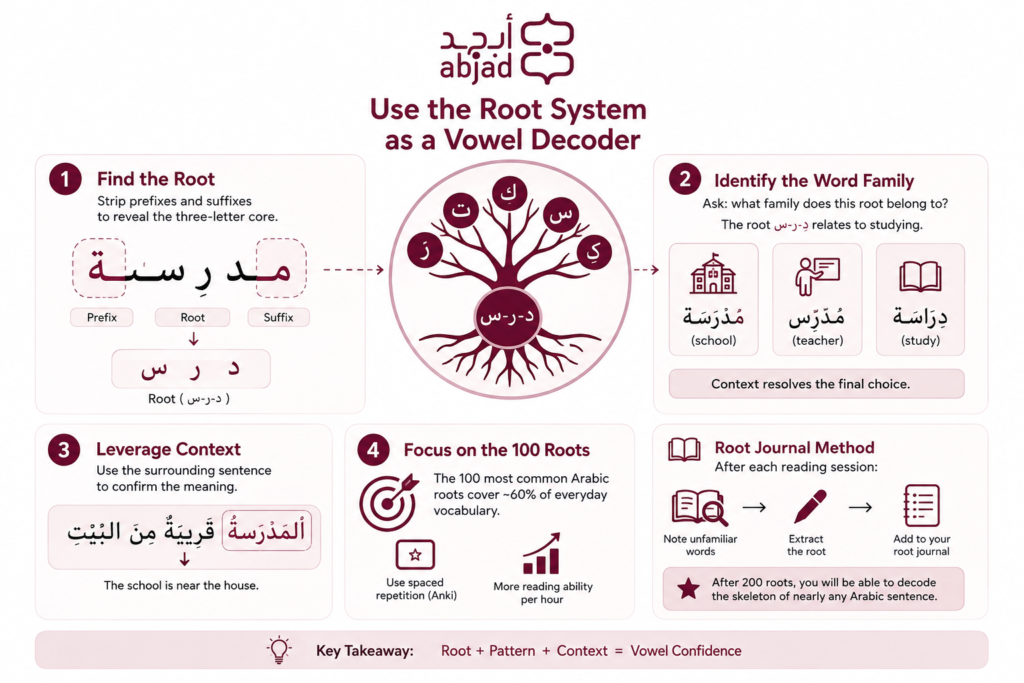
Then ask: what word family does this root belong to? The root د-ر-س relates to studying. An unvowelized word containing those three consonants in a sentence about education is almost certainly مَدْرَسَة (school) or مُدَرِّس (teacher). Context resolves the final choice.
The 100 most common Arabic roots cover roughly 60% of everyday vocabulary. Focused study of those 100 roots delivers more reading ability per hour than any other single investment. Use spaced repetition — Anki is well-suited for this — to review roots systematically.
The root journal method: After each reading session, note every unfamiliar word, extract its root, and add it to a running list organized by root. After 200 roots, you will be able to decode the skeleton of nearly any Arabic sentence you encounter.
Read Also: How Hard Is It to Read Arabic in the UAE? 7 Real Challenges Explained
4. Recognize Prefixes and Suffixes Instantly
Arabic affixes follow highly predictable rules. When you can strip them automatically, you reach the root faster and parse the grammar at the same time.
The prefix ال always means “the.” The prefix يـ on a verb means “he does” (present tense). The suffix ـة marks feminine. The suffix ـون/ـين marks masculine plural. The prefix مـ on a noun usually indicates a place or passive participle.
Working through an example: المدرسون = ال (the) + م (prefix indicating place/agent) + درس (root: study) + ون (masculine plural) = “the teachers (male).”
Make flashcards for the 15 most common prefixes and suffixes. Once these become automatic, you can parse most unvowelized words on sight, extracting root and grammatical function simultaneously.
If you’re starting from the foundations, Abjad Institute’s Arabic from Scratch course builds precisely the grammar intuition that makes affix recognition fast and automatic.
Begin Your Arabic Journey from Zero with a FREE Trial Class in the UAE.

5. Master Grammatical Cases to Supply Missing Vowels
This step is where most learners discover they’ve been working harder than necessary. Arabic grammatical cases are rule-governed, and those rules tell you which vowel ends almost every noun in a sentence.
Arabic uses three cases that directly determine word endings:
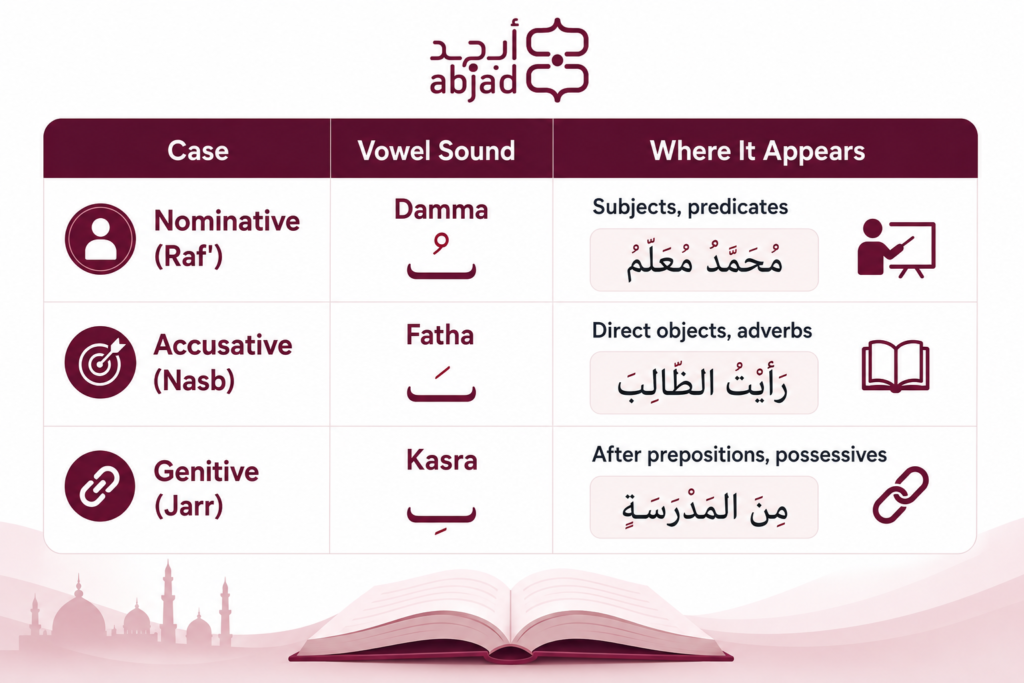
Identify the grammatical role of a noun → you know its case → you know its ending vowel. This isn’t guessing; it’s rule application. Combined with root knowledge, it means unvowelized word endings are almost always recoverable from grammar.
The sentence “رأيتُ المعلمَ في المدرسةِ” (“I saw the teacher at the school”) has three nouns. The teacher is the object (nasb → fatha). The school follows a preposition (jarr → kasra). Grammar alone supplies both vowels without memorization.
Watch Our Classes in Action
Curious what a real session looks like? Take a peek inside our interactive classrooms and see how our expert instructors bring the Arabic language to life. Watch a sample lesson below!
Begin Your Arabic Journey in the UAE
Join Abjad Institute for a professional and immersive Arabic language experience tailored to your goals.
Book Your Free Trial6. Use Context the Way Native Speakers Do
Context resolves over 90% of ambiguities in unvowelized Arabic text. The remaining cases are where even native speakers occasionally pause.
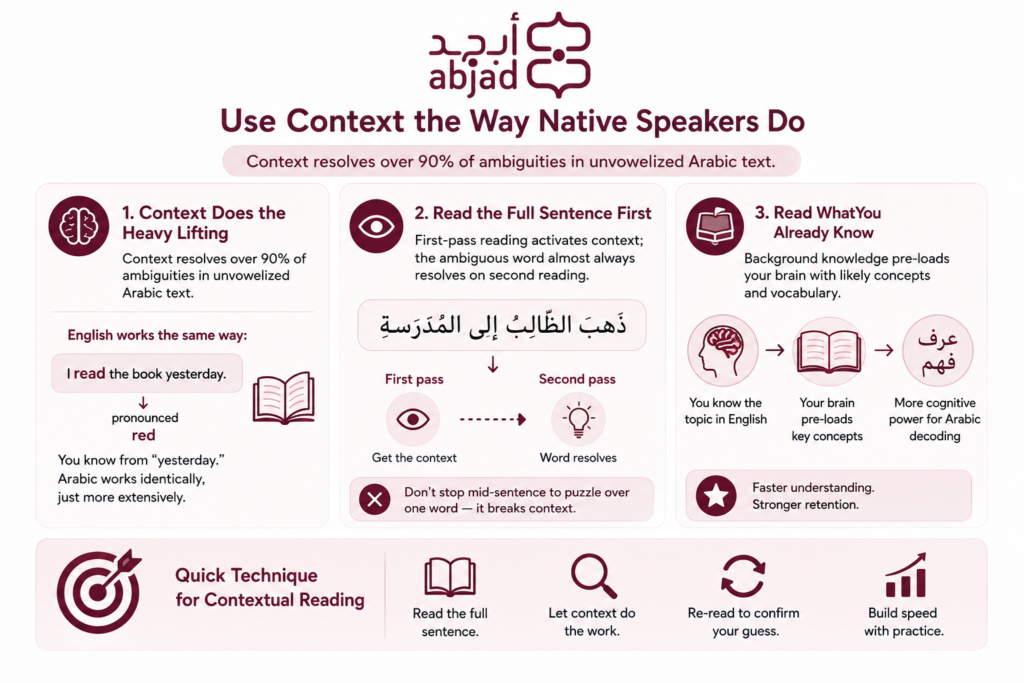
English speakers already use context to supply missing phonetic information constantly. The word “read” in “I read the book yesterday” is pronounced red — past tense — without any marker in the spelling. You know from “yesterday.” Arabic works identically, just more extensively.
The most effective technique for building contextual reading speed: read the full sentence before stopping on any ambiguous word. First-pass reading activates context; the ambiguous word almost always resolves on second reading. Stopping mid-sentence to puzzle over one word disrupts context processing and actually makes the word harder to decode.
A specific technique that accelerates contextual reading significantly: read about topics you already know in English first. If you have background knowledge on a subject, your brain pre-loads the likely concepts and vocabulary, freeing cognitive resources for the Arabic decoding itself.
Read Also: How to Get Better at Reading Arabic in the UAE?
7. Transition Gradually — Don’t Jump Too Fast
The single most common mistake among intermediate learners is transitioning to unvowelized text before they are ready. The result: guessing habits that calcify into permanent mispronunciation.
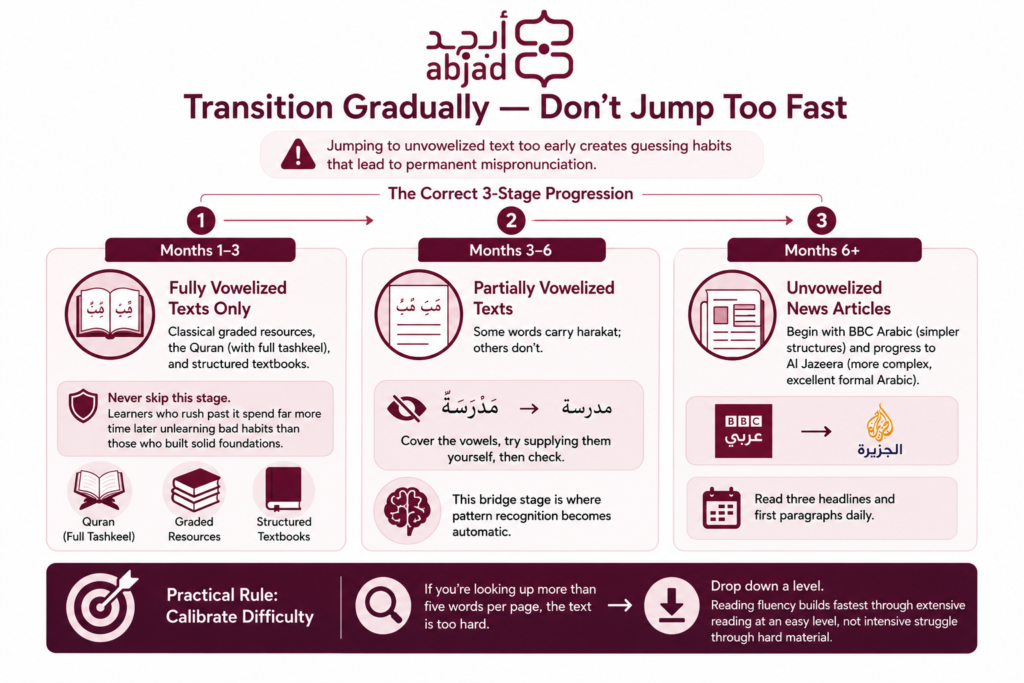
The correct progression moves in three stages:
Months 1–3: Fully vowelized texts only. Classical graded resources, the Quran (which carries full tashkeel), and structured textbooks. Never skip this stage. Learners who rush past it spend far more time later unlearning bad habits than those who built solid foundations.
Months 3–6: Partially vowelized texts. Some words carry harakat; others don’t. Cover the vowels on familiar words and practice supplying them yourself, then check. This bridge stage is where pattern recognition becomes automatic.
Months 6+: Unvowelized news articles. Begin with BBC Arabic (simpler sentence structures) and progress to Al Jazeera (more complex, excellent formal Arabic). Read three headlines and first paragraphs daily.
A practical rule for calibrating difficulty: if you are looking up more than five words per page, the text is too hard. Drop down a level. Reading fluency builds fastest through extensive reading at an easy level, not intensive struggle through hard material.
8. Practice Daily with Real-World Arabic Text
Consistency matters more than session length. Twenty minutes daily produces better reading fluency than two hours on weekends, because pattern recognition builds through frequent repetition, not marathon sessions.
Structure each 20-minute session across four activities:
| Time | Activity | Purpose |
| 5 min | Pattern recognition drill | Reinforce awzaan identification |
| 5 min | Vocabulary review | Build sight-word recognition |
| 5 min | Grammar exercise | Reinforce case and conjugation rules |
| 5 min | Reading practice | Apply all skills to real text |
Always read aloud at the beginner and intermediate stages. The mouth-to-ear feedback loop reinforces sound-letter connections that you will rely on automatically when vowels are absent. Silent reading in the early stages builds speed at the cost of accuracy — a trade you cannot afford.
For structured guidance that covers script mastery, grammar, and vocabulary in a sequenced program designed for adult learners, Abjad Institute’s Arabic Alphabet course provides the phonetic foundation that every subsequent step builds on.
Start Learning the Arabic Alphabet with a FREE Trial Class in the UAE.

Read Also: How to Read Arabic Books?- A Step-by-Step Guide for Beginners
Inside Our Live Classes
Don’t just take our word for it—see for yourself! Click below to watch short clips from our live classes and meet the instructors who will guide your learning journey.
Master Reading Arabic Without Harakat with Abjad Institute
Reading unvowelized Arabic is a learnable skill, not a talent. It comes from systematic exposure to patterns, grammar, and context — not from years of passive exposure.
Abjad Institute’s programs are designed specifically for this transition: building the pattern recognition, grammatical instinct, and contextual reading speed that let you move through Arabic text without depending on harakat. Whether you’re starting from the alphabet or bridging from textbook Arabic to real-world fluency, the structured curriculum and native-speaker instructors give you feedback that self-study cannot.
[Start learning with Abjad Institute today →]
Discover Our Arabic Courses
- Arabic Course in the UAE
- Arabic Intensive Course
- Learn Arabic from Scratch Course
- Madinah Arabic Course
- Arabic Classes for Adults
- Arabic Classes for Beginners
- Self-Paced Arabic Course
- Basic Arabic Course
- Arabic Speaking Classes
- Learn to Write Arabic Course
- Arabic Grammar Course
- Learn Arabic Alphabet Course
Begin Your Arabic Journey in the UAE
Join Abjad Institute for a professional and immersive Arabic language experience tailored to your goals.
Book Your Free Trial
Conclusion
Reading Arabic without vowels becomes possible once you understand the system behind the script. Arabic is not arbitrary — consonantal roots carry meaning, grammatical cases determine endings, and word patterns supply internal vowels. Together, these three systems allow literate readers to reconstruct vowels from consonants plus context, which is exactly what 400 million people do every day.
The practical path forward is clear: master the 10 core word patterns, build root recognition through a root journal, learn the three grammatical cases, and transition gradually from fully vowelized to unvowelized texts over six to twelve months of daily practice. Every step reinforces the others. Within months, unvowelized Arabic shifts from an intimidating wall of consonants to readable, navigable text.
Read also: Is It Compulsory to Read Quran in Arabic?
Frequently Asked Questions
Learning to read Arabic without vowels raises many questions, especially for beginners. Here are clear, evidence-based answers to the most common questions to help you build confidence and progress more effectively.
How to read Arabic without vowels as a beginner?
Start by mastering the 10 most common Arabic word patterns (awzaan) and the three grammatical cases. These two systems allow you to predict the vowels of most words without seeing them written. Begin with fully vowelized textbooks, then transition to partially vowelized texts after three months, and finally to unvowelized news Arabic after six months of consistent daily practice.
How to read Arabic without vowels free?
BBC Arabic and Al Jazeera provide free unvowelized Arabic text at different difficulty levels — BBC Arabic uses simpler sentence structures, making it the better starting point. The Quran with tashkeel (free online via Tanzil.net or any Quran app) provides the ideal fully vowelized reading material for the foundational stage. Anki is a free spaced repetition app well-suited for building root and pattern recognition.
How to read Arabic without fatha kasra damma?
Fatha, kasra, and damma mark grammatical case endings — but those cases follow fixed rules. A noun subject always carries damma (nominative). A direct object always carries fatha (accusative). A noun after a preposition always carries kasra (genitive). Once you apply these three rules automatically from grammar rather than from visible marks, you no longer need the marks on most nouns. Internal word vowels are covered by pattern recognition (awzaan).
Do native Arabic speakers struggle with unvowelized text?
Rarely, but occasionally. Unusual proper nouns, highly technical terminology, and genuinely ambiguous sentences can cause native speakers to pause — this is why news anchors sometimes mispronounce unfamiliar names on live television. It is also why the Quran carries full tashkeel: its authority requires that no ambiguity exist in its recitation.
How long does it take to read Arabic without vowels?
With 20–30 minutes of daily practice, most learners can read simple unvowelized texts after five to six months. Reading news articles with reasonable comprehension typically takes seven to nine months. Full unvowelized reading fluency — moving through text without frequent lookups — generally requires ten to twelve months of consistent, structured practice.
What is the most common mistake when learning to read Arabic without harakat?
The most damaging mistake is transitioning to unvowelized text too early — before knowing at least 1,500–2,000 words. Premature removal of vowels builds guessing habits that produce systematic mispronunciation. These habits are significantly harder to unlearn than they were to form. Stay with fully vowelized text until your word recognition is solid, then move to partial vowelization as a bridge stage.
Related Articles
Learn Arabic






Leave a Reply