 Learn Arabic
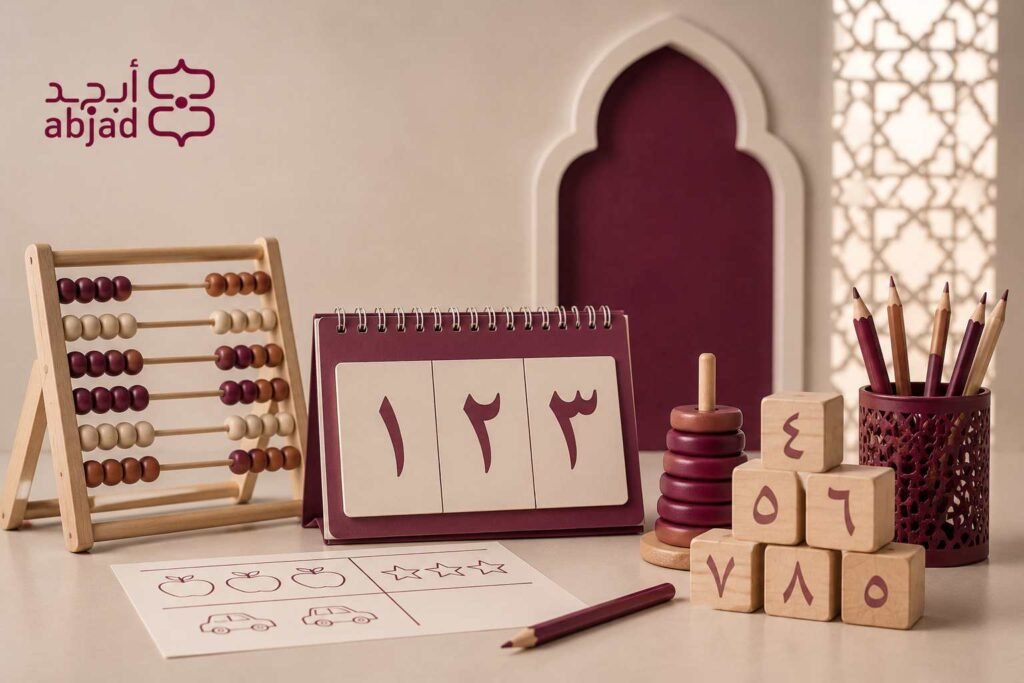
Arabic numerals — ١، ٢، ٣ — appear on classroom boards, supermarket price tags, street signs, and school timetables all across the UAE. For children growing up here, this is not background noise; it is the numerical language of their daily world.
The challenge most parents face is not finding materials — it is knowing which methods work, at what age, and in what sequence. This guide answers those questions directly, drawing on early childhood research, UAE curriculum standards, and the practical realities of raising multilingual children in the Emirates. It offers a complete plan of learning arabic numbers for kids in the UAE.
Whether your child is three years old and just beginning to notice numbers, or six and already in school but struggling with the written forms, the approach below will help you build genuine numeracy — not just shape memorisation.
What You’ll Learn in This Guide
- The right age to introduce Arabic numbers and how to pace the learning.
- Hands-on activities proven to work in UAE homes and classrooms.
- Digital tools and printable resources aligned with the UAE curriculum.
- How to teach Arabic numeral writing in the correct stroke sequence.
- How number mastery connects to Arabic letters, reading, and Quranic study.
Start Learning Your Child Arabic from Scratch Today

Learning Arabic Numbers For Kids In The UAE Starts Earlier Than You Think
Parents often wait for school to formally introduce number recognition, but children’s brains are ready far sooner. Understanding when to begin — and how to begin well — is the decision that shapes everything that follows.
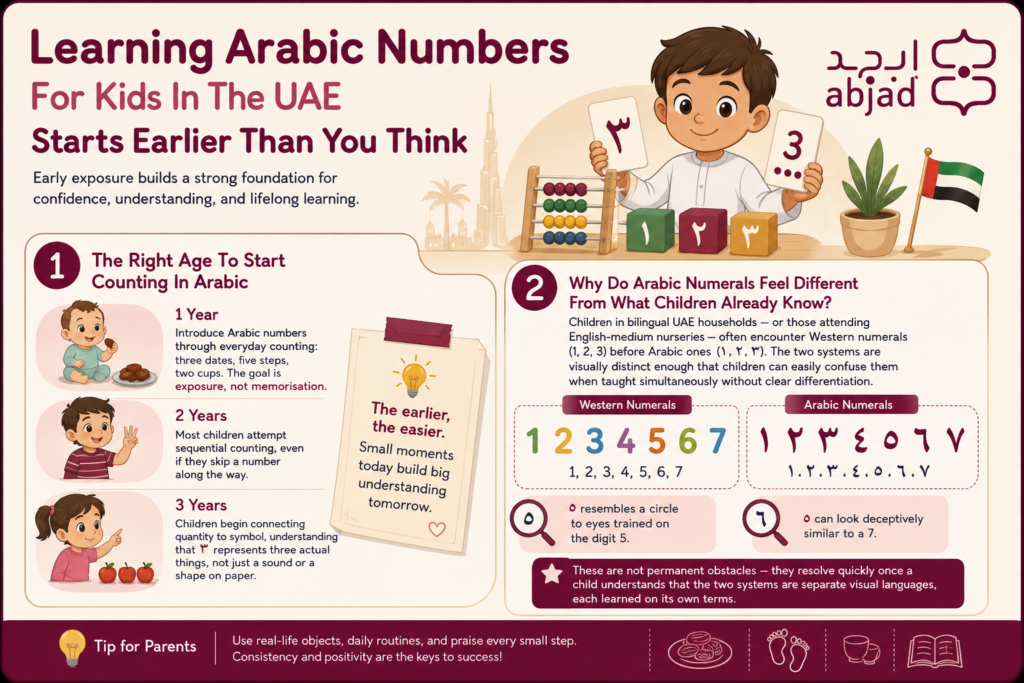
1. The Right Age To Start Counting In Arabic
Children as young as one year old can be introduced to Arabic numbers through ordinary counting: three dates on a plate, five steps to the front door, two cups on the kitchen counter. At this stage, the goal is not memorisation — it is exposure.
By two, most children attempt sequential counting, even if they skip a number along the way. By three, the critical shift happens: children begin connecting quantity to symbol, understanding that ٣ represents three actual things, not just a sound or a shape on paper.
This is a practical advice to start oral counting in Arabic by age one, introduce written numeral recognition between three and four, and introduce writing practice only after a child can reliably count matching objects without prompting.
2. Why Do Arabic Numerals Feel Different From What Children Already Know?
Children in bilingual UAE households — or those attending English-medium nurseries — often encounter Western numerals (1, 2, 3) before Arabic ones (١، ٢، ٣). The two systems are visually distinct enough that children can easily confuse them when taught simultaneously without clear differentiation.
The form ٥, for instance, resembles a circle to eyes trained on the digit 5. The character ٦ can look deceptively similar to a 7. These are not permanent obstacles — they resolve quickly once a child understands that the two systems are separate visual languages, each learned on its own terms.
Treat ١ and 1 the way you would treat two letters from two different alphabets. The mental separation prevents confusion and accelerates mastery of both systems.
Master the official language through Abjad’s Modern Standard Arabic Course in the UAE
Watch Our Classes in Action
Curious what a real session looks like? Take a peek inside our interactive classrooms and see how our expert instructors bring the Arabic language to life. Watch a sample lesson below!
Begin Your Arabic Journey in the UAE
Join Abjad Institute for a professional and immersive Arabic language experience tailored to your goals.
Book Your Free Trial
Hands-On Methods Make Arabic Numbers Stick For Life
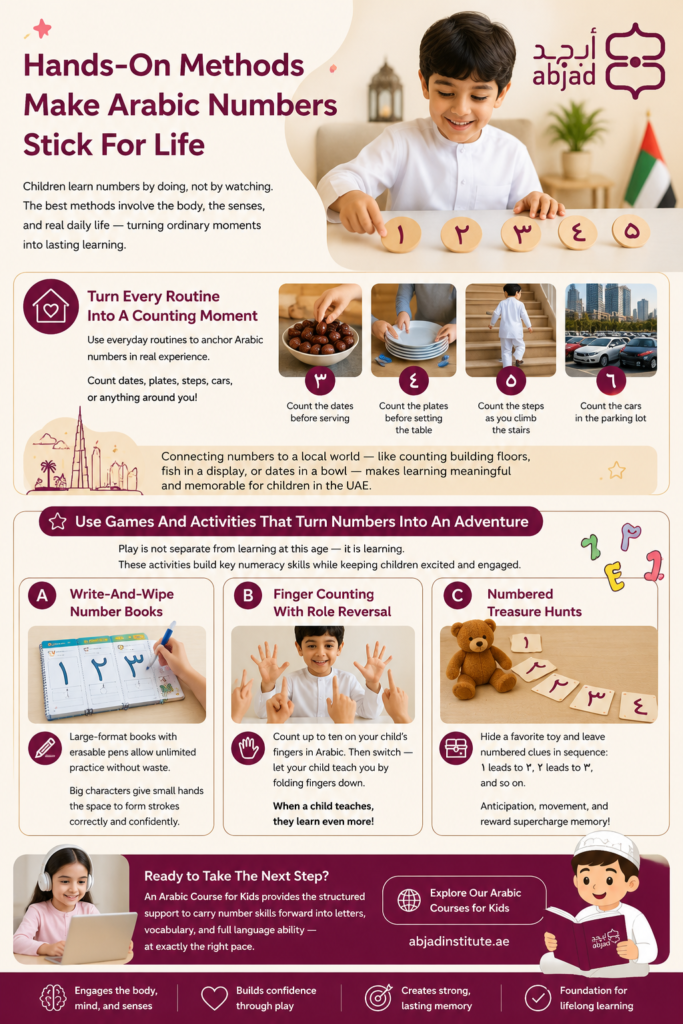
Research in early childhood numeracy is consistent on one point: children learn numbers by doing, not by watching. The methods that produce lasting results are those that involve the body, the senses, and genuine daily life — not flash cards held up passively in front of a seated child.
Turn Every Routine Of Your Kid Into A Counting Moment
The most powerful teaching tool in any UAE home is the daily routine itself. When you count dates before serving them, ask your child to count plates before setting the table, or say the Arabic number aloud for each step walking up to your apartment, you are anchoring number knowledge in real experience rather than drill.
This approach carries an additional richness in the UAE context. Counting the floors of a building from the window, the cars in a car park, or the fish in a display connects Arabic numerals to a distinctly local world — exactly the logic used by UAE-localised educational resources that feature iconic Emirati imagery.
A practitioner note is that the single most common pacing mistake parents make is introducing a new numeral before the previous one is fully owned. Spend two to three days per number — covering recognition, oral counting, and eventually writing — before moving forward.
Read also: How To Read Arabic-Indic Numbers (1 To 100) In English?
Use Games And Activities That Turn Numbers Into An Adventure
Structured play is not an alternative to learning at this age — it is the learning. The following activities are widely used across UAE nurseries, KG classrooms, and family homes, and each one builds a specific numeracy skill:
A. Write-And-Wipe Number Books
The large-format write-and-wipe Arabic number books widely available in UAE stationery shops (typically around 30 AED) come with an erasable pen and allow unlimited repetition without waste. The large character size gives small hands the space needed to form strokes correctly without cramping.
B. Finger Counting With Role Reversal
Count up to ten on your child’s fingers, naming each number aloud in Arabic. Then switch — let your child direct you to fold fingers down. When a child teaches, they consolidate far more than when they are simply shown.
Read also: 10 Daily Arabic Games That Make Learning an Adventure
C. Numbered Treasure Hunts
Hide a favourite toy and leave numbered clues in sequence: ١ leads to ٢, ٢ leads to ٣, and so on. Anticipation, movement, and reward are among the most powerful memory consolidators in early childhood — and this activity delivers all three at once.
For families ready to move beyond home activities, an Arabic course for Kids gives children the structured scaffolding to carry these number foundations forward into letters, vocabulary, and full language ability at exactly the right pace.
Digital Tools And UAE-Aligned Resources Worth Bookmarking
Screen time used with purpose is a legitimate educational resource. The UAE’s fast connectivity and widespread device access make digital tools genuinely practical for families supplementing home learning — provided the screen time is interactive rather than passive.
1- Apps And Printables That Match The UAE Curriculum
The most effective apps for Arabic numeral learning combine three elements: hearing the number pronounced in a Gulf Arabic dialect, seeing the numeral clearly displayed, and interacting with the screen to count or match objects.
On the printable side, platforms aligned with UAE curriculum standards offer number tracing sheets for 1–20 using dotted-line guides — the same format found in UAE school exercise books.
For parents exploring a wider language foundation, searching for how to learn to read Arabic online for free surfaces a range of platforms where children can begin building reading and script skills alongside number work.
For families newer to Arabic script entirely, understanding how to read Arabic in the UAE — where Eastern Arabic and Western numeral systems appear side by side on signs, menus, and documents — begins with exactly this kind of visual recognition practice.

2- When To Move From Screen Time To Structured Writing Practice Of Arabic Numbers?
Introducing pencil practice before this foundation is secure teaches children to copy shapes they do not yet understand — that produces rote imitation, not numeracy. The difference becomes visible when children encounter more complex number concepts in school and have no conceptual framework to build on.
The transition from digital interaction to pencil-on-paper practice should be guided by a developmental signal, not by age alone. When a child can say a number aloud, point to its numeral instantly, and count a matching set of objects without hesitation, they are ready to write it.
Take the first step to meet Our Arabic and Quran Dedicated & Experienced Teachers

Teaching Your Child To Write Arabic Numbers Correctly
Writing Arabic numerals involves more than recognising shapes. Stroke direction, proportion, and sequence all matter — and they differ from both Western numerals and from one another. Parents who understand how to write in Arabic in the UAE school system quickly realise that consistent method from the very first session prevents significant re-teaching later.
1. From Tracing Numbers In Dots To Writing Independently
The progression that specialists consistently recommend follows four clear stages:
- Name and count: Say the number aloud in Arabic, count a matching set of real objects, then look at the numeral together.
- Trace with a finger: Follow the outline of the numeral by hand before picking up a pencil — this teaches stroke direction without the added challenge of managing a writing tool.
- Trace dotted lines: Use grid-lined exercise books (كراسة المربعات), standard in UAE KG classrooms, to practise within a defined space that controls size and proportion.
- Copy, then write from memory: Work from a model visible on the same page first; once consistent, write without looking.
Direction is non-negotiable: always begin strokes at the top. For ١, a single downward stroke. For ٢, the top curve comes before the base. Getting direction right from the first session avoids habits that are surprisingly resistant to correction once they become automatic.
For young learners in the UAE, the UAE Kindergarten Arabic Classes at Abjad Institute are designed specifically around this developmental sequence, giving children the structured practice environment that home sessions complement rather than replace.
2- Common Mistakes Parents Make In Arabic Number Writing Practice
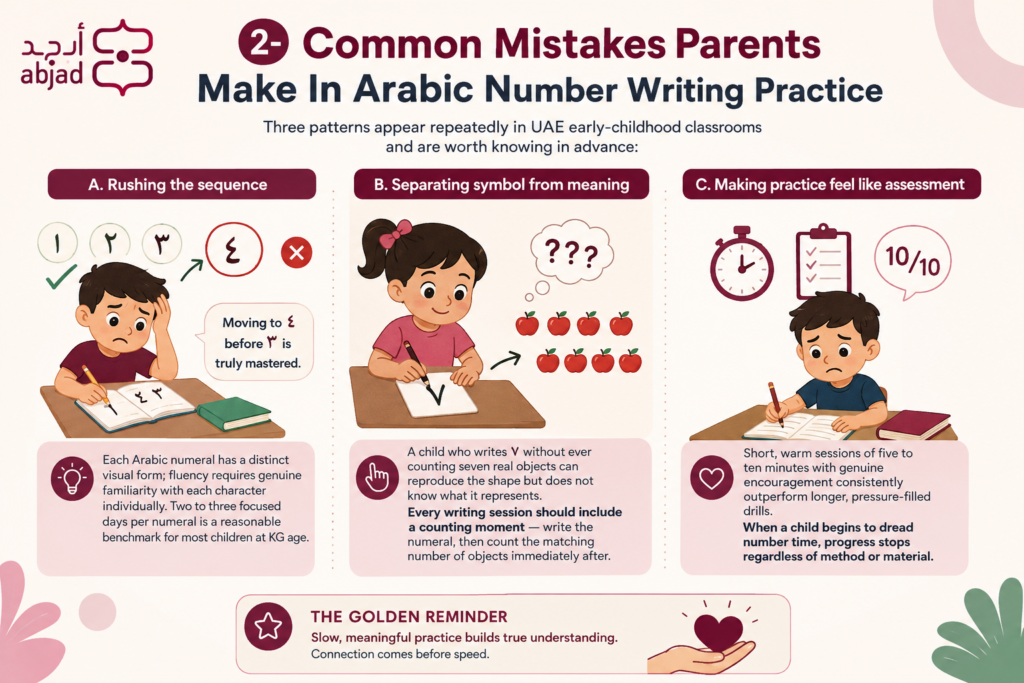
Three patterns appear repeatedly in UAE early-childhood classrooms and are worth knowing in advance:
A. Rushing the sequence
Moving to ٤ before ٣ is truly mastered. Each Arabic numeral has a distinct visual form; fluency requires genuine familiarity with each character individually. Two to three focused days per numeral is a reasonable benchmark for most children at KG age.
B. Separating symbol from meaning
A child who writes ٧ without ever counting seven real objects can reproduce the shape but does not know what it represents. Every writing session should include a counting moment — write the numeral, then count the matching number of objects immediately afterward.
C. Making practice feel like assessment
Short, warm sessions of five to ten minutes with genuine encouragement consistently outperform longer, pressure-filled drills. When a child begins to dread number time, progress stops regardless of method or material.
Read also: How to Teach the Arabic Alphabet to Children
Inside Our Live Classes
Don’t just take our word for it—see for yourself! Click below to watch short clips from our live classes and meet the instructors who will guide your learning journey.
Begin Your Arabic Journey in the UAE
Join Abjad Institute for a professional and immersive Arabic language experience tailored to your goals.
Book Your Free TrialMaster the Language of the Quran with the first free session of our Quranic Arabic course

From Learning Arabic Basics To Opening The Door To The Quran
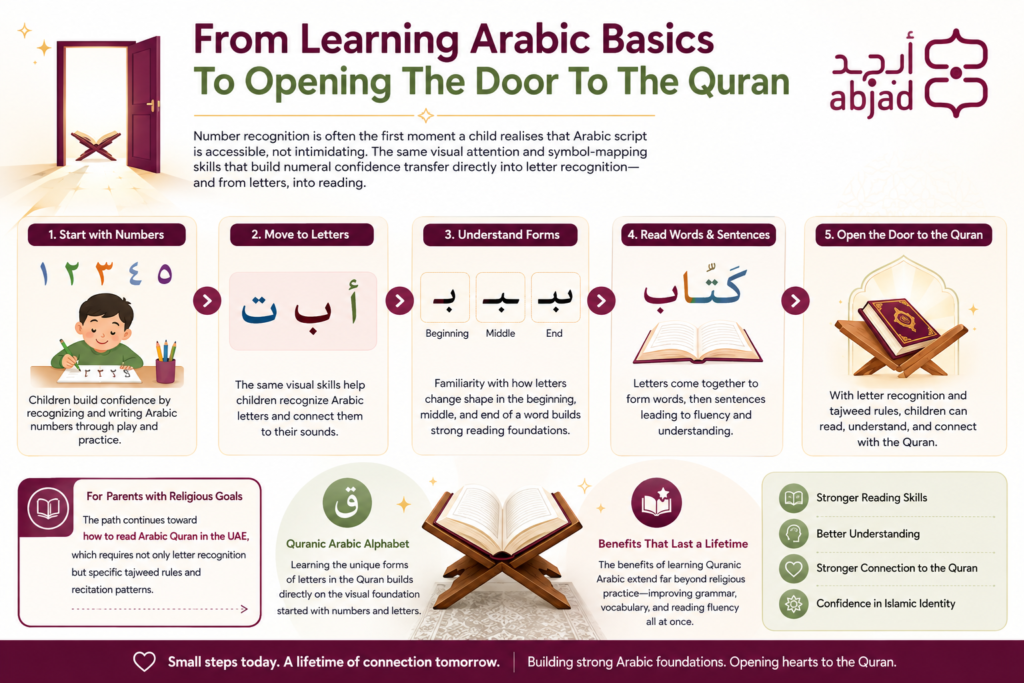
Number recognition is frequently the moment a child first realises that Arabic script is accessible, not intimidating. The same visual attention and symbol-mapping skills that build numeral confidence transfer directly into letter recognition — and from letters, into reading.
For Parents with religious goals alongside language ones, the path frequently continues toward how to read Arabic Quran in the UAE, which requires not only letter recognition but specific tajweed rules and recitation patterns.
Familiarity with the Quranic Arabic alphabet — including the distinct forms letters take at the beginning, middle, and end of a word builds directly on the same visual foundation that numeral work begins.
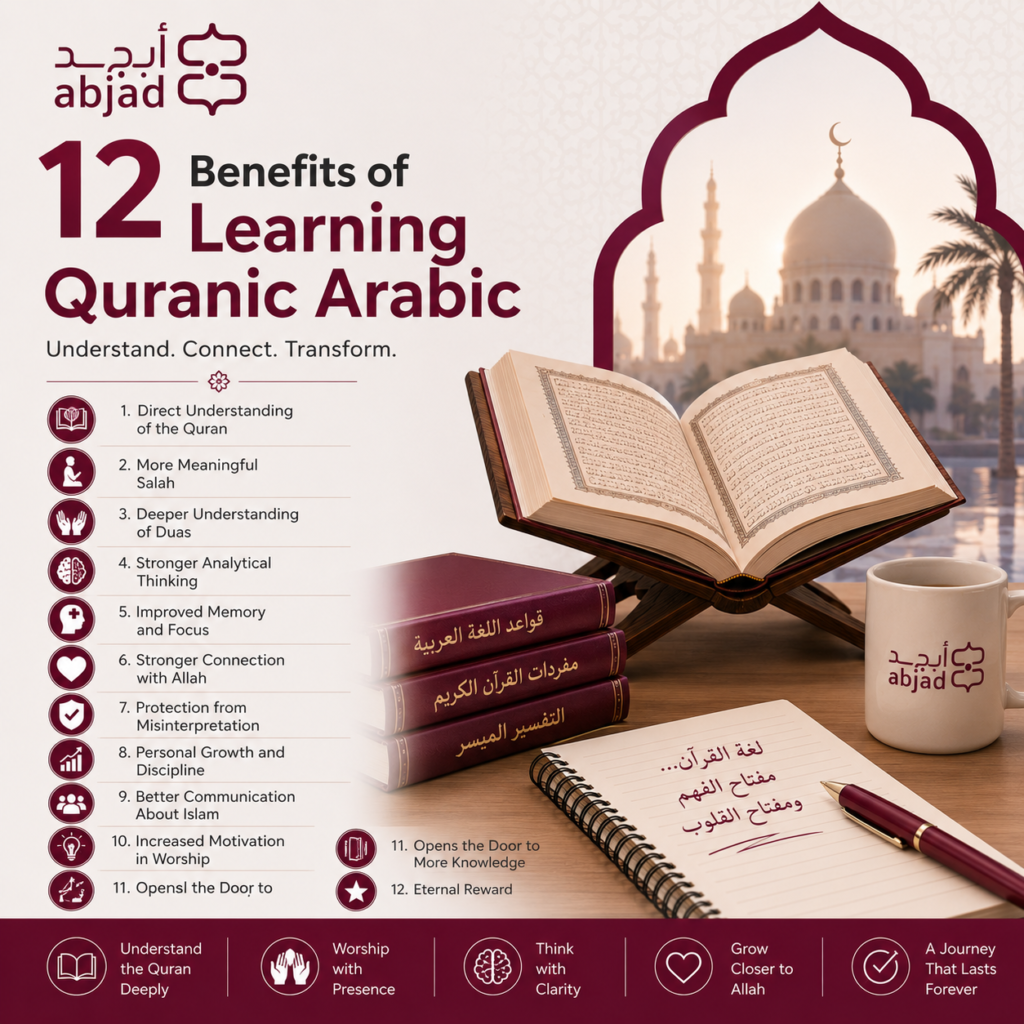
Once parents see this connection, the benefits of learning Quranic Arabic extend far beyond religious practice: the precision of Quranic study reinforces grammar, vocabulary, and reading fluency simultaneously.
Give Your Child The Arabic Advantage By Learning With Abjad Institute Today
Abjad Institute is a specialist Arabic language centre based in the UAE, built specifically for the needs of families in the Emirates and the wider Gulf region. Its programmes cover every learner profile — from young children taking their first steps in the language to adults pursuing professional, Classical, or Gulf Arabic fluency.
What sets Abjad apart is curriculum design grounded in UAE standards and real-world Arabic use. Instructors are qualified, experienced with multilingual learners, and trained to move children from basic recognition to genuine communicative ability at a pace that builds confidence, not pressure. Every course is structured so progress is visible — to your child, and to you.
For children ready to move beyond numbers and into the full language, the pathway at Abjad is clear, sequenced, and proven in UAE classrooms. Take the first step today.
Discover Our Arabic Courses:
- Arabic Course for Kids
- Arabic Conversation for Kids
- Arabic Qaida for Kids
- Beginner Arabic for Kids
- Arabic Grammar for Kids
- Teen Arabic Summer Course
- Arabic Kids Camps
- UAE Kindergarten Arabic Classes
- Modern Standard Arabic Course
- Fusha Arabic Course
- Classical Arabic Course
- Emirati Arabic Course
- Gulf Arabic Course
- Learn Saudi Arabic
- Business Arabic Course UAE
- Arabic Language Classes for Professionals in UAE
- Quranic Arabic Course
Start your Arabic course at Abjad Institute today with a Free Trial

Conclusion
Learning Arabic numbers for kids in the UAE is the beginning of a much larger story, one that connects children to language, scripture, culture, and the everyday life of a country where Arabic is not a subject on a school timetable but a living presence in the streets, homes, and public spaces around them.
The families who see the strongest results are those who start early, keep practice rooted in real daily moments, pace the learning numeral by numeral without rushing, and make sessions short enough to stay genuinely enjoyable.
Progress in early numeracy is quiet and cumulative and then one day your child reads a price tag unprompted, counts something without being asked, or writes a numeral with confident strokes, and every small session reveals its value at once.
From ١ to ١٠, from number recognition to letter reading, from basic Arabic to fluent communication each step your child takes in this language opens another door in one of the world’s most welcoming and opportunity-rich countries.
Frequently Asked Questions
At what age should children in the UAE start learning Arabic numbers?
Oral counting in Arabic can begin as early as age one through everyday routines like counting fruit, steps, or plates. Formal numeral recognition, connecting ١ and ٢ to their written shapes, is typically introduced between three and four, in line with UAE nursery and KG1 curriculum milestones. Writing practice follows once oral counting and symbol recognition are secure.
What is the difference between Arabic numerals and Western numerals?
The numerals taught in UAE schools — ١، ٢، ٣ — are Eastern Arabic (also called Hindi) numerals. The digits 1, 2, 3 familiar from Western contexts share the same historical roots but evolved into distinct visual forms. UAE curriculum teaches both systems, and children benefit from treating them as two separate character sets rather than two versions of the same thing.
How long does it take a child to learn to write Arabic numbers one to ten?
With five to ten minutes of daily practice, most children aged three to five can recognise and write all ten numerals within four to eight weeks. Writing fluency — forming each numeral quickly and correctly from memory without a model — typically develops over three to four months of consistent, well-paced practice.
Should I teach Arabic letters and numbers at the same time?
Most early childhood specialists recommend introducing numbers first. Numerals are fewer in quantity, visually simpler, and lower-stakes as a first encounter with Arabic script. The confidence built through number mastery makes the transition to letters significantly smoother.
Are there UAE-specific resources for Arabic number practice at home?
Yes. Several platforms offer UAE curriculum-aligned worksheets featuring local imagery for number matching and tracing. Write-and-wipe Arabic number books are widely available in UAE stationery shops and online retailers. Many UAE schools also provide printable practice sheets through their parent communication portals.
Does learning Arabic numbers support Quran studies later?
Absolutely. Arabic numeral recognition builds the visual attention, symbol-mapping skills, and right-to-left orientation that Quranic reading requires. Children who are already comfortable navigating Arabic symbols approach Quranic text with far less anxiety and often begin recognising familiar numeral characters embedded in longer words.
Related Articles
Learn Arabic






Leave a Reply