 Learn Arabic
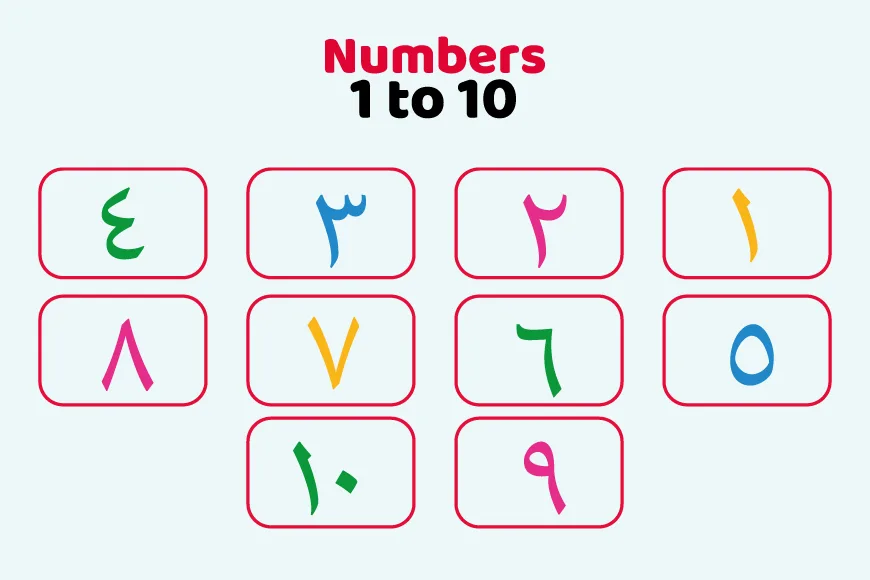
If you’ve opened an Arabic newspaper, a receipt in Dubai, or a page from the Quran and seen digits that don’t look like 1, 2, 3, you were looking at Arabic-Indic numerals. Learning how to read Arabic-Indic numbers is one of the fastest wins for a new Arabic learner, because unlike Arabic script, these digits are read left to right — the same direction as English.
This guide walks you through how to read Arabic-Indic numbers 1 to 100 in English step by step, from single digits to full numbers like 275. At Abjad Academy, this is one of the first skills taught in beginner classes, because once you can read a number, you can read prices, dates, phone numbers, and Quranic verse numbers with confidence.
By the end of this article, you’ll be able to read any Arabic-Indic number from 1 to 100 and beyond.
Step 1: Match Each Arabic-Indic Digit To Its English Equivalent
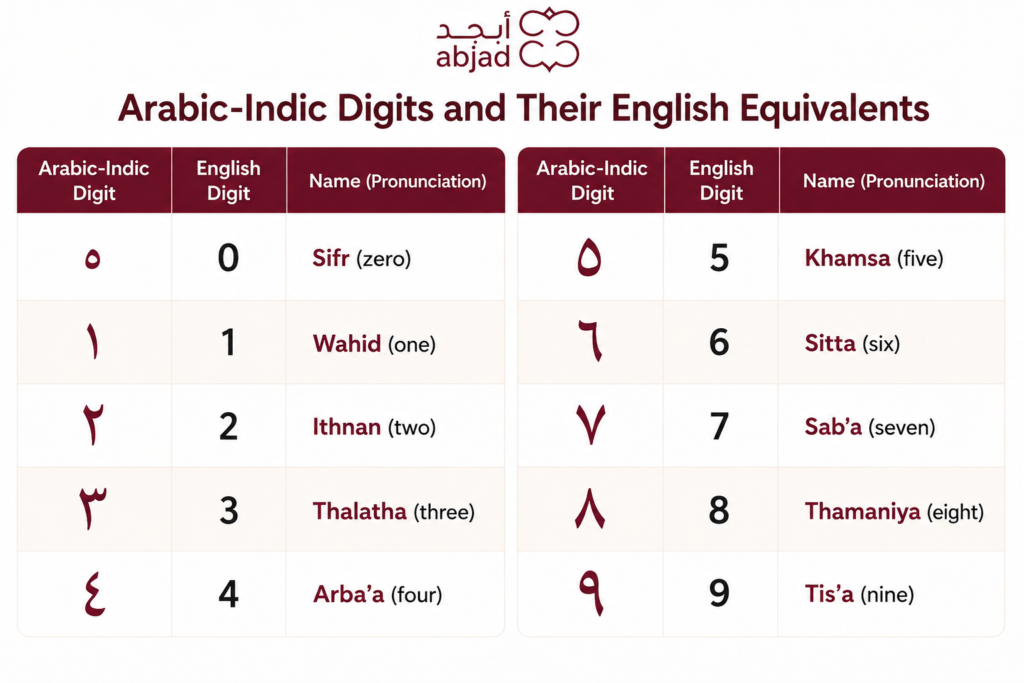
Arabic-Indic numerals are a set of ten symbols, each corresponding directly to one Western digit from 0 to 9. There is no translation or calculation involved — it’s a one-to-one match, the same way “A” matches “a” in two different alphabets.
Here is the full digit conversion list:
- ٠ = 0 — Sifr (zero)
- ١ = 1 — Wahid (one)
- ٢ = 2 — Ithnan (two)
- ٣ = 3 — Thalatha (three)
- ٤ = 4 — Arba’a (four)
- ٥ = 5 — Khamsa (five)
- ٦ = 6 — Sitta (six)
- ٧ = 7 — Sab’a (seven)
- ٨ = 8 — Thamaniya (eight)
- ٩ = 9 — Tis’a (nine)
Why These Are Called “Arabic-Indic” Numerals?
The digit shapes themselves trace back to India, not the Arabian Peninsula. Arab mathematicians adopted and refined the system centuries ago, which is why the numerals used across the Arab world today are formally called Arabic-Indic (or Eastern Arabic) numerals, while the digits used in English are called Western Arabic numerals. Both systems share the same mathematical logic — base ten, place value, a symbol for zero — they simply look different on the page.
Where You’ll Actually See Them?
You’ll run into Arabic-Indic numerals on price tags in Saudi Arabia, Egypt, and the UAE, on car license plates, on clock displays, in phone numbers, and in printed Qurans marking verse numbers.
Students at Abjad Academy often say this is the single most practical mini-skill they pick up in their first two weeks, because it turns confusing signage into something readable within days.
If you want structured practice on this and the rest of the Arabic writing system, the Learn Arabic Alphabet Course builds numeral recognition directly into the early lessons.
Step 2: Read Arabic-Indic Numbers 1 To 10 In English
Numbers 1 through 10 are your foundation — almost every larger number is built from these shapes and sounds. Below is how to read Arabic-Indic numbers 1 to 10 in English, with pronunciation.
| Arabic-Indic | English | Pronunciation |
| ١ | 1 | Wahid |
| ٢ | 2 | Ithnan |
| ٣ | 3 | Thalatha |
| ٤ | 4 | Arba’a |
| ٥ | 5 | Khamsa |
| ٦ | 6 | Sitta |
| ٧ | 7 | Sab’a |
| ٨ | 8 | Thamaniya |
| ٩ | 9 | Tis’a |
| ١٠ | 10 | Ashara |
A practical way to start: don’t memorize the pronunciation and the digit shape at the same time. Learn to recognize the ten shapes first — ٥ minutes a day for a week is usually enough — then layer pronunciation on top once reading feels automatic.
If you’d like a structured, guided path rather than self-study, Abjad Academy’s Arabic Classes for Beginners cover this exact progression with a live instructor correcting your reading in real time.
Read Also: How To Read Arabic Time
Step 3: Read The Tens — Arabic-Indic Numbers 20 To 90
Once you know 1 to 10, the tens are simple to read numerically, because Arabic-Indic numerals just combine the digit for the tens place with ٠ for zero in the ones place — for example, ٢٠ reads left to right as “2” then “0,” giving you 20.
| Arabic-Indic | English |
| ٢٠ | 20 |
| ٣٠ | 30 |
| ٤٠ | 40 |
| ٥٠ | 50 |
| ٦٠ | 60 |
| ٧٠ | 70 |
| ٨٠ | 80 |
| ٩٠ | 90 |
Note that reading the digits and pronouncing the Arabic word for the number are two separate skills. Reading ٤٠ simply means recognizing “4” then “0” = 40.
Saying it aloud as “arba’oun” (forty) is a separate step covered in full number-pronunciation lessons, not in digit-reading itself — a distinction that trips up many self-taught learners who conflate the two.
Read also: How To Read Arabic For Beginners In The UAE? A Step-By-Step Guide
Watch Our Classes in Action
Curious what a real session looks like? Take a peek inside our interactive classrooms and see how our expert instructors bring the Arabic language to life. Watch a sample lesson below!
Begin Your Arabic Journey in the UAE
Join Abjad Institute for a professional and immersive Arabic language experience tailored to your goals.
Book Your Free TrialStep 4: Read Numbers 100 And Above In Arabic-Indic Form
The same left-to-right, digit-by-digit method extends cleanly into the hundreds and thousands. A number like ٢٧٥ is read exactly the way “275” is read in English: two, seven, five — “two hundred seventy-five.” There’s no re-ordering, no mirroring, and no right-to-left flip, even though the surrounding Arabic script on the same page runs right to left.
This same logic applies to years. A printed date such as ١٩٢٤ reads left to right as 1, 9, 2, 4 — the year 1924.
One added wrinkle worth knowing: dates in Arabic material can be given in the Hijri calendar rather than the Gregorian one, and because the Hijri year is shorter, a single Hijri year often overlaps two Gregorian years. Reading the digits correctly is step one; knowing which calendar you’re reading is step two.
Read also:The Parent’s Guide Of Learning Arabic Numbers For Kids In The UAE
A Common Mistake with Partial or Worn Numbers
On older documents, stamps, or low-resolution scans, digits like ٢ and ٣ are the easiest to misread, since both have small tooth-like curves. When part of a number is unclear, read the digits you can confirm first, and treat the rest as unknown rather than guessing — a habit that matters more with Hijri dates on historical material, where one misread digit can shift the year by a decade.
Read Also: How To Learn To Read Arabic In 21 Days? A Step-By-Step Plan
Step 5: Use These Tricks For The Digits People Confuse Most
Five digit pairs cause almost all beginner mistakes. Learning these visual anchors early will save you weeks of second-guessing:
- ٥ looks like a heart or a closed loop — it is 5, not 0.
- ٠ is a small dot or oval — it is 0, not 5.
- ٧ points upward like the letter V — it is 7.
- ٨ points downward, like an upside-down V — it is 8.
- ٢ has one small curve (“tooth”) facing left — it is 2.
- ٣ has three small curves — it is 3.
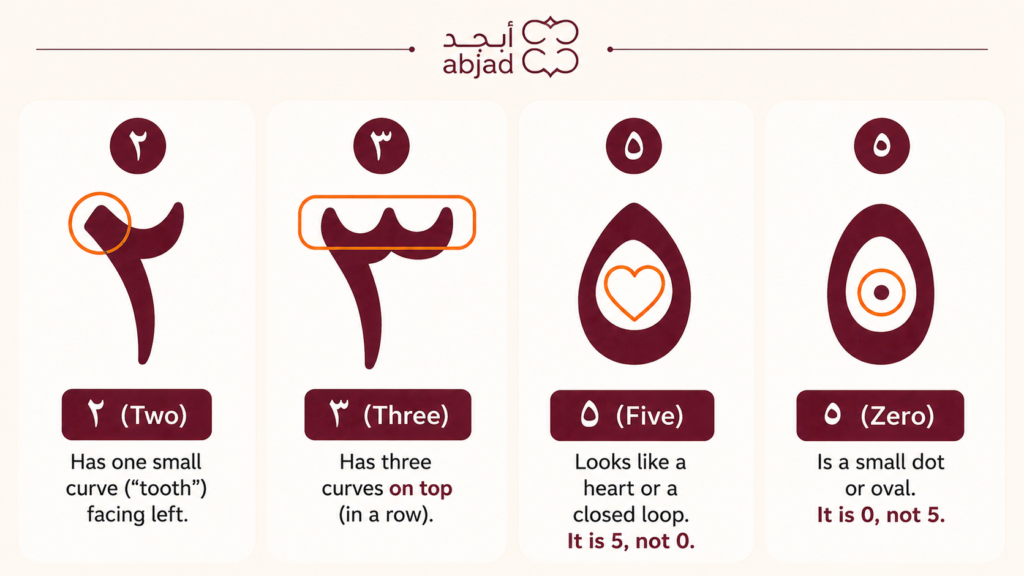
If you find yourself pausing on these four digits specifically, that’s a normal, well-documented stage of learning to read Arabic-Indic numerals — not a sign you’re behind. Most learners stop hesitating on them within two to three weeks of regular reading practice.
Getting comfortable with numerals is also a natural bridge into reading full Arabic script. If numbers have sparked your interest in going further, the Learn Arabic from Scratch Course at Abjad Academy is built for exactly this next step, taking you from isolated symbols like numerals into full sentence reading.
Read Also: How To Read Arabic For Beginners In The Uae?
Inside Our Live Classes
Don’t just take our word for it—see for yourself! Click below to watch short clips from our live classes and meet the instructors who will guide your learning journey.
Start Reading Arabic-Indic Numbers with Confidence Today
You don’t have to keep guessing at price tags, dates, or phone numbers. A live instructor can correct your reading in real time, catch the specific digits you personally mix up, and move you from hesitant to fluent far faster than flashcards alone.

Abjad Academy’s Arabic courses are built around exactly this kind of practical, everyday reading skill — numerals, signage, and real documents, not just textbook drills.
Discover Our Arabic Courses:
- Arabic Intensive Course
- Learn Arabic from Scratch Course
- Madinah Arabic Course
- Arabic Classes for Adults
- Arabic Classes for Beginners
- Self-Paced Arabic Course
- Basic Arabic Course
- Arabic Speaking Classes
- Learn to Write Arabic Course
- Arabic Grammar Course
- Learn Arabic Alphabet Course
Begin Your Arabic Journey in the UAE
Join Abjad Institute for a professional and immersive Arabic language experience tailored to your goals.
Book Your Free Trial
Conclusion
Reading Arabic-Indic numbers in English comes down to one core rule: match each of the ten digit shapes to its Western equivalent, and read left to right, exactly as you would in English — even though the surrounding Arabic text runs the opposite direction. Once you’ve learned how to read Arabic Indic numbers 1 to 100 in English, tens, hundreds, and full multi-digit numbers like 275 or 1924 all follow the same straightforward left-to-right logic.
The only real friction points are a handful of visually similar digits (٢/٣ and ٥/٠), and those resolve quickly with a few weeks of regular practice reading Arabic-Indic numbers in English.
Whether you’re decoding a receipt in Cairo or a verse number in the Quran, knowing how to read Arabic-Indic numbers in English is one of the most immediately useful skills a new Arabic learner can pick up — and it’s exactly where Abjad Academy starts every beginner.
Read Also: Learn to Read Arabic App – The Best Options in 2026

Frequently Asked Questions
Below are quick, direct answers to the questions learners ask most often when they start reading Arabic-Indic numerals. Each one covers a specific point that the sections above touch on in more depth.
1. How do you read Arabic-Indic numbers in English?
You read Arabic-Indic numbers in English by matching each digit (٠–٩) to its Western equivalent and reading left to right, the same direction used in English. A number like ٢٧٥ is read digit by digit as “two, seven, five,” giving you 275. This same method applies whether you’re reading two-digit or four-digit numbers.
2. Are Arabic-Indic numerals read right to left like Arabic script?
No. Even though Arabic script is written right to left, Arabic-Indic numerals are always read left to right, matching the direction used for numbers in English. This is one of the most surprising rules for new learners, since it breaks from the reading direction of the surrounding text.
3. What is the difference between Arabic-Indic and Western Arabic numerals?
Arabic-Indic (or Eastern Arabic) numerals are the ٠١٢٣٤٥٦٧٨٩ symbols used across most of the Arab world, while Western Arabic numerals are the 0123456789 digits used in English and most of the world. Both systems share the same base-ten logic and place value; only the symbol shapes differ.
4. Which Arabic-Indic digits do beginners confuse most often?
Beginners most often confuse ٢ with ٣, and ٥ with ٠, since the shapes are visually similar at a glance. Using a fixed visual anchor for each — one tooth for ٢, three teeth for ٣, a closed loop for ٥, a small dot for ٠ — resolves this confusion within a few weeks of practice.
5. Do all Arabic-speaking countries use Arabic-Indic numerals?
No. Countries such as Egypt, Saudi Arabia, the UAE, and Iraq commonly use Arabic-Indic (Eastern) numerals, while Morocco, Algeria, Tunisia, and Libya generally use Western Arabic numerals instead, even though both regions speak Arabic. If you’re targeting a specific dialect or region, it’s worth confirming which numeral system appears in local print.
6. Can I learn to read Arabic-Indic numbers on my own, without a class?
Yes, self-study works for basic recognition — flashcards and repeated reading of real Arabic material (menus, prices, dates) are enough for many learners to read Arabic-Indic numbers to 100 within a few weeks. Progress is typically faster with guided correction, which is why Abjad Academy builds numeral reading into its early beginner lessons rather than leaving it to self-study alone.







Leave a Reply