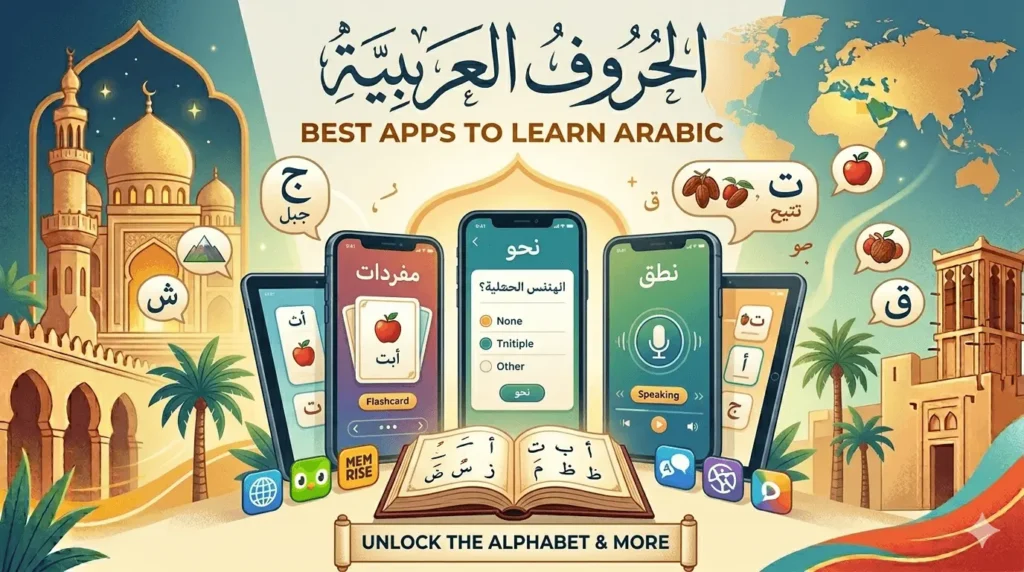
 Learn Arabic
For parents raising children in the Emirates, few decisions carry as much long-term weight as how—and where—their child learns Arabic. Arabic is the official language of the UAE, the language of school assessments, Friday sermons, and the Quran. The challenge is real: school hours move fast, private tutors cost money, and not all screen time earns its keep.
The good news: you don’t have to spend a dirham to give your child a genuinely solid Arabic foundation. A growing ecosystem of free digital platforms, UAE government-backed initiatives, and interactive apps has transformed how families across Abu Dhabi, Dubai, and Sharjah approach early Arabic literacy—from living rooms, not just classrooms.
This guide walks through eight of the most effective free resources available to UAE families right now to learn Arabic for kids online free in the UAE, what age groups they serve best, and how to get the most from each one.
Begin your kid’s Arabic learning path with a FREE trial class
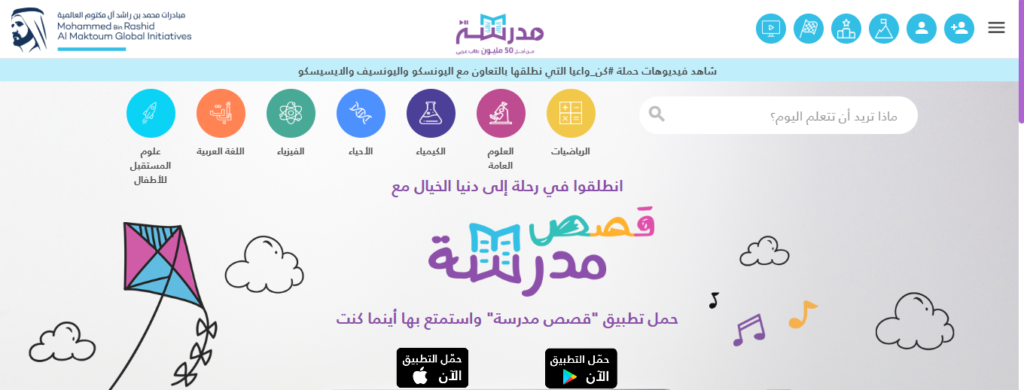
1. Madrasa Is The Government’s Platform To Learn Arabic For Kids Online Free In The UAE
Launched in October 2018 by the Mohammed bin Rashid Al Maktoum Global Initiatives, Madrasa is the most curriculum-aligned free Arabic education platform available to UAE families.
It hosts over 5,000 video lessons across mathematics, science, and language, including 1,000 dedicated Arabic language videos covering kindergarten through Grade 12, with around 200 illustrated stories produced specifically for young readers.
Madrasa’s content was developed with input from UAE and Arab educators and aligns directly with Ministry of Education standards, which makes it unusually useful for children in local and semi-government schools. Parents often use it to reinforce exactly what their child’s class covered that week—without paying for extra tutoring.
The platform is available via browser and iOS app, with no subscription or payment required at any level. For families asking how to read Arabic in the UAE without structured classroom access, Madrasa is the most credible first stop.
2. Alef Ba Ta (أ ب ت) A Game-Based Arabic For Children App
Alefbata is one of the most downloaded Arabic learning apps in the Arab world, and it earns that reputation through a simple philosophy: children learn better when they don’t feel like they’re studying. The app targets ages four to ten and covers letter recognition, word building, and early sentence construction through animated games, tracing exercises, and interactive challenges.
What makes Alefbata particularly well-suited to the UAE context is that it goes beyond the alphabet. As children progress, they tackle short-vowel markings (harakat), letter shapes in different word positions, and simple spelling—skills that UAE school curricula expect early.
Understanding how to read Arabic letters in the UAE begins with exactly this kind of phonics-first exposure, and Alefbata delivers it in a format that holds a child’s attention through repetition without boredom.
Watch Our Classes in Action
Curious what a real session looks like? Take a peek inside our interactive classrooms and see how our expert instructors bring the Arabic language to life. Watch a sample lesson below!
Begin Your Arabic Journey in the UAE
Join Abjad Institute for a professional and immersive Arabic language experience tailored to your goals.
Book Your Free Trial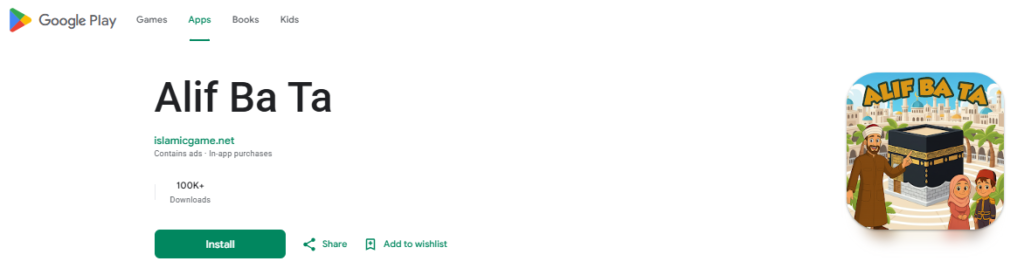
3. 3asafeer A Digital Arabic Story Library That Grows With Your Child
Reading fluency in Arabic requires more than knowing letters—it requires sustained exposure to whole texts, varied vocabulary, and the natural rhythm of written Arabic. 3asafeer addresses exactly that gap.
The platform offers a graded digital library of illustrated Arabic stories, organized by reading level and age group, making it straightforward to find something appropriate whether your child is five years old and still sounding out syllables or nine years old and ready for short chapter-length narratives.
Unlike drill-based apps, 3asafeer builds what reading researchers call “print awareness”—the intuitive understanding of how Arabic text flows on a page, how narratives are structured, and how meaning accumulates across paragraphs.
UAE families in bilingual households often run it alongside English reading practice, since the platform’s clean interface allows even young children to navigate it independently. It is also one of the few free resources that specifically supports learn Arabic for kids at a genuine literacy level, rather than just vocabulary recognition.
Start reading and writing Arabic with a FREE trial class
4. Adam Wa Mishmish A Music-Led Arabic Learning For Toddlers And Preschoolers
For the youngest learners—roughly newborn to age five—Adam wa Mishmish takes an approach grounded in developmental science: language acquisition through song, repetition, and visual association. Each short episode runs between one and three minutes and covers a distinct theme: the Arabic alphabet, numbers, shapes, musical instruments, and common household objects.

The pacing is slow enough for toddlers to track, the visuals are engaging without being chaotic, and the Arabic throughout is clear Modern Standard Arabic delivered with warmth and consistency. Parents in the UAE sometimes ask whether dialect matters at this early stage.
For children who will eventually need to read and write formally, through school, religious study, or understanding how to read Arabic Quran in the UAE, exposure to Modern Standard Arabic from the toddler years builds the grammatical instincts that Emirati spoken Arabic and school-standard Fusha both share.
Adam wa Mishmish delivers that foundation without ever feeling like a formal lesson.
Start learning Arabic letters with a FREE trial class
5. Youtube’s Two Best Free Arabic Teaching Channels
YouTube is genuinely useful for Arabic learning when parents know where to look. Two channels consistently stand above the noise for UAE families.
A. Karazah Channel
It uses animated visuals and original educational songs to introduce Arabic letters, numbers, and core vocabulary to children aged three to seven. The production quality is high, the pacing is developmentally appropriate, and the phonics approach is sound—each letter is introduced by its sound, not just its name, which aligns directly with how reading is taught in UAE schools.
B. Learn With Zakaria
This channel takes a warmer, more conversational tone, blending Arabic with English and French across its videos. Children absorb colours, shapes, animal names, and daily vocabulary while following a character they find genuinely funny and familiar. For bilingual households—common across Dubai and Abu Dhabi—this channel bridges languages without confusing learners.
Parents who are themselves beginning to understand how to read Arabic script in the UAE often find both channels useful to watch alongside their children, which adds a quiet benefit beyond the child’s learning alone.
Read also: How to Read Arabic Calligraphy? — A Complete Guide
6. Alifbee A Structured Arabic App For Heritage Speakers
Where Alefbata is designed for young children still learning letters, AlifBee is built for older beginners—typically children aged eight and above, heritage speakers who understand spoken Arabic but cannot yet read, or older students approaching Arabic more formally.
Lessons are structured around communicative goals: greetings, daily routines, describing objects, asking and answering simple questions. Grammar is introduced contextually rather than as an abstract subject, which avoids the frustration that kills motivation at this stage.
AlifBee’s free tier is substantive enough to produce meaningful progress over several months. For UAE residents whose children attend English-medium schools and receive limited Arabic instruction during the week, AlifBee provides a structured supplement that keeps Arabic active between classes.
It also serves as a natural entry point for families exploring the benefits of learning Quranic Arabic, since the formal vocabulary and script introduced on the platform overlap directly with Quranic Arabic foundations.

7. Arabee Learning The Interactive Arabic For Multicultural UAE Families
Arabee was built with the UAE’s diverse classroom in mind. It serves both native Arabic speakers who need literacy support and non-native children learning Arabic as the official language of their adopted home. The platform combines reading, writing, and speaking exercises through a deliberately playful interface—games, animated interactions, and progress markers keep sessions from feeling like homework.
For expat families in the UAE who want their children to participate meaningfully in Arabic-medium environments—school examinations, Quran recitation classes, community events—Arabee provides a low-pressure entry point that builds genuine confidence.
If you’ve been searching for a learn to read Arabic app that fits around a busy UAE school schedule, Arabee’s typical session length of ten to fifteen minutes is practical for weeknight use without competing with homework.
Enroll your kids in our conversation course in the UAE
8. Khan Academy Kids: A Global Benchmark, Now Available In Arabic
Khan Academy Kids is recognized globally as one of the most rigorous free early-education platforms available anywhere. Its Arabic language content has expanded significantly in recent years, covering early literacy, foundational numeracy, and social-emotional learning for children aged three to seven.
The platform is fully free, carries no advertising, and has been integrated into school curricula across dozens of countries. For UAE parents who want a benchmark—something trusted because it is used in classrooms from Singapore to São Paulo—Khan Academy Kids provides that assurance.
Children who use it alongside Arabic-specific tools like Alefbata or 3asafeer tend to build stronger overall literacy habits, because the platform also models what structured daily learning looks like. Parents who spend time on it together with their children occasionally find it useful for their own journey of how to learn to read Arabic online for free, since the scaffolded approach works regardless of age.
Give your child a structured Arabic advantage. Abjad Institute offers UAE-curriculum-aligned Arabic courses for kids, from kindergarten foundations through grammar and conversation. Explore Arabic Courses for Kids →
Book your FREE trial class in our Arabic grammar course
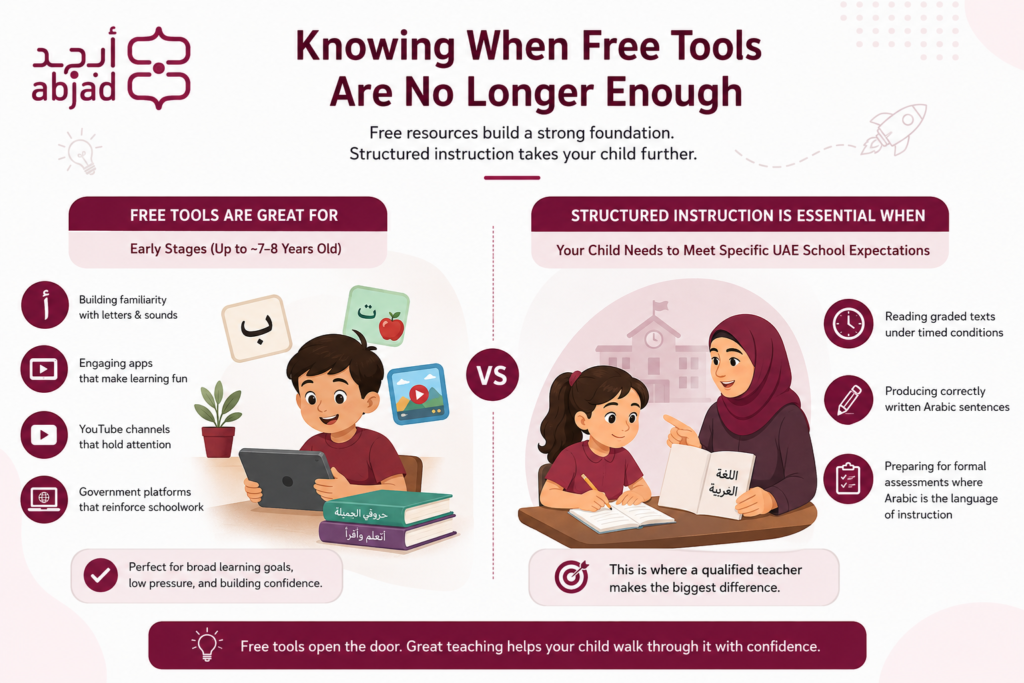
Knowing When Free Tools Are No Longer Enough
Free platforms are genuinely powerful at the early stages of Arabic acquisition. Most UAE parents find them highly effective for children up to around age seven or eight, when learning goals are broad, pressure is low, and building familiarity with letters and sounds is the primary aim. The apps work. The YouTube channels hold attention. The government platforms reinforce schoolwork.
The moment to consider structured instruction typically arrives when a child needs to match specific UAE school expectations—reading graded texts under timed conditions, producing correctly written Arabic sentences, or preparing for formal subject assessments in which Arabic is the language of instruction. At that point, the gap between self-directed app use and a qualified teacher becomes genuinely significant.
Signs That Your Child Is Ready For Structured Arabic Classes
It’s easier to spot than most parents expect. A child who can identify letters and sound out simple words but cannot yet read a full sentence fluently has reached the ceiling of most app-based learning. A child who resists the apps entirely, finding them repetitive or too easy, is usually ready for conversation-led instruction with real-time feedback.
Parents who want to understand how long does it take to learn to read Arabic often underestimate the role of feedback in accelerating progress. With quality instruction and 15 to 20 minutes of daily practice, most children aged five to seven reach functional reading fluency within six to twelve months.
Apps extend that timeline because they cannot correct pronunciation, question comprehension, or adapt in the moment the way a teacher can.
Inside Our Live Classes
Don’t just take our word for it—see for yourself! Click below to watch short clips from our live classes and meet the instructors who will guide your learning journey.
Begin Your Arabic Journey in the UAE
Join Abjad Institute for a professional and immersive Arabic language experience tailored to your goals.
Book Your Free Trial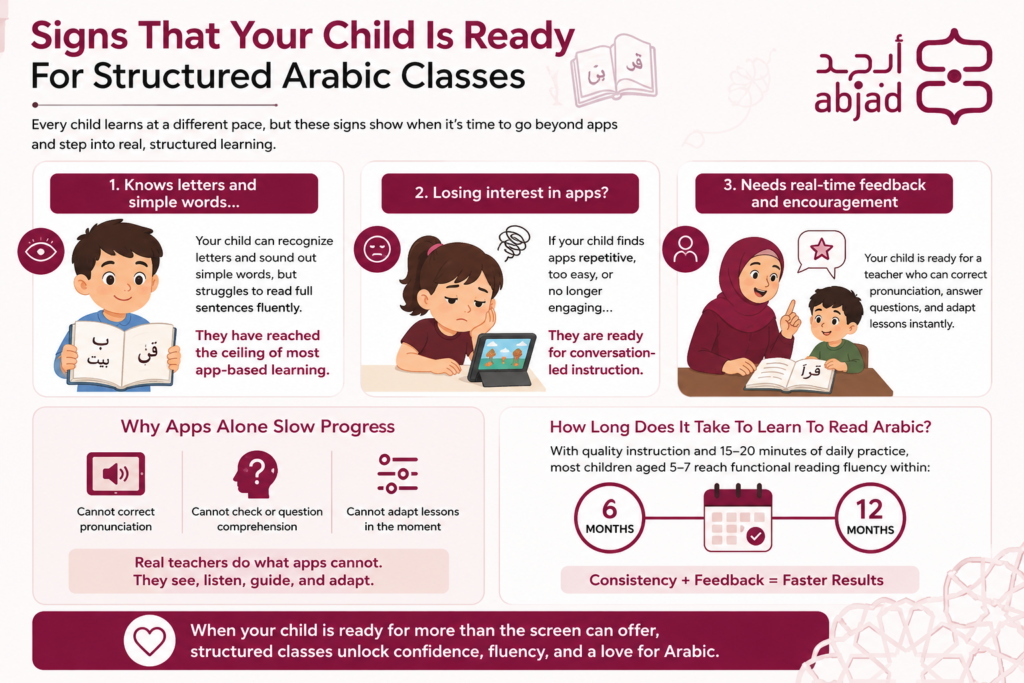
What To Look For In A Quality Arabic Course For Children In The UAE
Curriculum alignment with UAE school standards matters enormously. An Arabic course built for Egyptian or Levantine school norms may not prepare your child for what their teacher expects on Monday morning. Teacher qualification matters just as much—native Arabic-speaking educators with formal Arabic pedagogy training produce measurably better outcomes than generalist tutors who happen to speak the language fluently.
Class size is worth asking about directly. Small groups of four to eight students allow teachers to address individual pronunciation issues in real time, adjust pacing when a concept needs reinforcement, and ensure every child gets active speaking practice rather than passive listening.
If you’re evaluating specific programmes, check how they handle the Quranic Arabic alphabet specifically—Quranic pronunciation standards are stricter than everyday Modern Standard Arabic and require deliberate, structured instruction that not every general Arabic course provides.
For parents who want to understand how to write in Arabic in the UAE at a school-standard level, look for courses that include handwriting practice and dictation alongside vocabulary—not just digital typing or multiple-choice exercises.
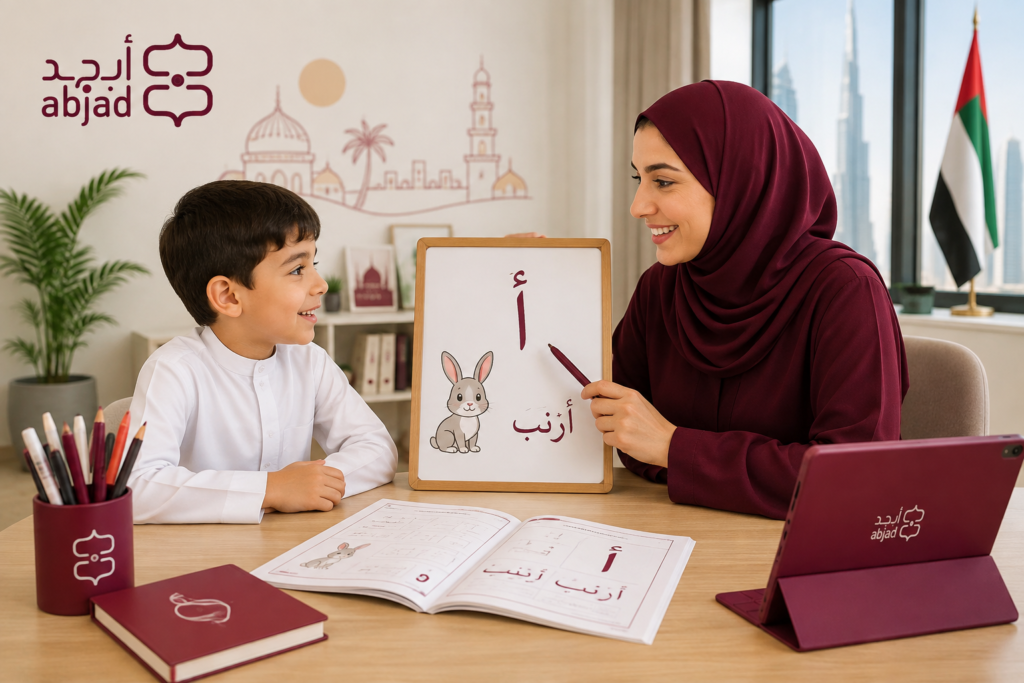
Abjad Institute The UAE’s Specialist Arabic Learning Centre
Abjad Institute is a UAE-based Arabic language centre designed for families who take Arabic seriously—whether for school performance, Quranic study, cultural connection, or professional preparation down the line.
All courses are taught by qualified, experienced instructors and designed to align with UAE curriculum standards. Children’s programmes span kindergarten-level reading foundations through grammar, conversation, summer intensives, and dedicated Qaida courses for Quran readiness.
Abjad’s course structure reflects a core insight that most app-based learning misses: children become fluent in Arabic when they use it to do real things—hold conversations, read stories, express opinions—not just when they drill letters and vocabulary in isolation. Every programme is built around communicative competence within the specific cultural and academic context of the UAE.
Discover Our Arabic Courses:
- Arabic Course in the UAE
- Arabic Intensive Course
- Learn Arabic from Scratch Course
- Madinah Arabic Course
- Arabic Classes for Adults
- Arabic Classes for Beginners
- Self-Paced Arabic Course
- Basic Arabic Course
- Arabic Speaking Classes
- Learn to Write Arabic Course
- Arabic Grammar Course
- Learn Arabic Alphabet Course
Book your free trial session today
Conclusion
Free Arabic learning platforms in the UAE have genuinely improved over the past five years. The combination of the Madrasa government platform, apps like Alefbata and AlifBee, story libraries like 3asafeer, and the best YouTube channels gives any motivated UAE family a real and substantive head start—especially during the foundational years between three and eight.
The honest limitation of free tools is that they plateau. They build letter recognition and vocabulary reliably, but they rarely produce the reading fluency, grammatical accuracy, or speaking confidence that UAE schools and social environments demand.
Children who transition from free tools to structured Arabic instruction at the right moment—typically around age seven or eight—consolidate their gains faster and with less frustration than children who stay on apps alone for too long.
The UAE is one of the few places in the world where a child can grow up genuinely bilingual in Arabic and English, and where that bilingualism opens doors that monolingual fluency cannot. Starting with free tools is smart. Knowing when to go further is what actually makes the difference.
Frequently Asked Questions
What is the best free Arabic learning platform for children in the UAE?
The Madrasa platform, launched by the Mohammed bin Rashid Al Maktoum Global Initiatives, is the most curriculum-aligned free option available. It covers kindergarten through Grade 12 and includes over 1,000 Arabic language video lessons produced to UAE education standards. For younger children focused purely on letters and play-based learning, Alefbata is the strongest app-based complement.
At what age should children in the UAE start learning Arabic online?
Exposure to Arabic through songs, stories, and visuals can begin from age two or three without any pressure toward formal outcomes. Structured letter recognition is typically introduced at four to five years old, which aligns with UAE kindergarten timelines. The earlier a child encounters Arabic in a positive, low-stakes context, the faster formal literacy develops when school introduces it.
Can a child genuinely learn Arabic for free without a tutor?
Free tools can take a child from zero to functional letter recognition and basic vocabulary through consistent daily practice—typically 10 to 15 minutes per day. Reading fluency, grammatical writing, and conversational confidence usually require real-time feedback from a qualified teacher, which apps cannot replicate. Free platforms and structured instruction work best in parallel, not as substitutes for each other.
How long does it take for a child to begin reading Arabic fluently?
With consistent daily practice of around 15 to 20 minutes using quality tools, most children aged five to seven can read simple Arabic sentences within six to nine months. Full reading fluency—handling a variety of texts without sounding out each word—typically takes 12 to 18 months of combined app use and qualified instruction. Consistency across the week matters far more than long, occasional sessions.
Is Modern Standard Arabic or Emirati Arabic better for children to learn first?
For school readiness, Quran study, and written Arabic competence, Modern Standard Arabic (Fusha) should come first. It is the language of textbooks, formal assessments, newspapers, and religious texts in the UAE. Children naturally absorb Emirati spoken dialect through daily social life without requiring deliberate instruction.
What is Quranic Arabic, and should UAE children learn it separately?
Quranic Arabic is the specific register of classical Arabic used in the Quran. It shares the same script and core grammar as Modern Standard Arabic but includes vocabulary, grammatical forms, and pronunciation standards—particularly related to Tajweed rules—that differ from everyday Fusha.
For children who attend Quran classes or whose families prioritize Quranic literacy, a dedicated Qaida course or Quranic Arabic programme taught by a qualified instructor produces far better outcomes than a general Arabic app.



Leave a Reply