 Learn Arabic
Here is a fact that surprises almost every learner: the single most common verb in Arabic — قَالَ (to say) — is a weak verb. So are كَانَ, رَأَى, جَاءَ, وَجَدَ, and دَعَا. Arabic weak verbs are not a rare grammatical corner; they are the backbone of everyday speech.
The problem is that most learners meet them by accident. You memorise كَتَبَ – يَكْتُبُ, feel confident, then run into وَعَدَ – يَعِدُ and wonder where the و disappeared to. At Abjad Academy, this is one of the first walls we help students climb — and it falls faster than you think.
Weak verbs behave irregularly for one reason only: three letters (ا, و, ي) are unstable when vowels press against them. Learn that single principle and dozens of “exceptions” collapse into one predictable system.
This guide walks you through the four types, the conjugation logic, a practical list of Arabic weak verbs in English, and the mistakes that quietly cost you fluency.
Key Highlights of This Article:
- The exact definition of a weak verb and the three letters that cause it.
- All four types explained with clear Arabic weak verbs examples and English meanings.
- Conjugation rules across past, present, jussive, and imperative.
- A ready-to-use list of Arabic weak verbs with meaning you can start drilling today.
- Five common errors and the fixes that stop them repeating.
What Are Arabic Weak Verbs?
Arabic weak verbs are verbs whose three-letter root contains at least one weak letter — ا (alif), و (waw), or ي (ya). Because these letters shift, shorten, or disappear when vowels change around them, the verb does not follow the standard sound-verb pattern.
The Arabic term is الفِعْل المُعْتَل, literally “the ailing verb.” The name is descriptive rather than judgmental: the verb is not broken, it simply bends. Once you know where it bends, you can predict every form.
The Three Weak Letters – Alif, Waw, And Ya
Only three letters in the alphabet can make a verb weak, and they are known collectively as حُرُوف العِلَّة. Every irregularity you will meet traces back to one of them sitting in an unstable position inside the root.
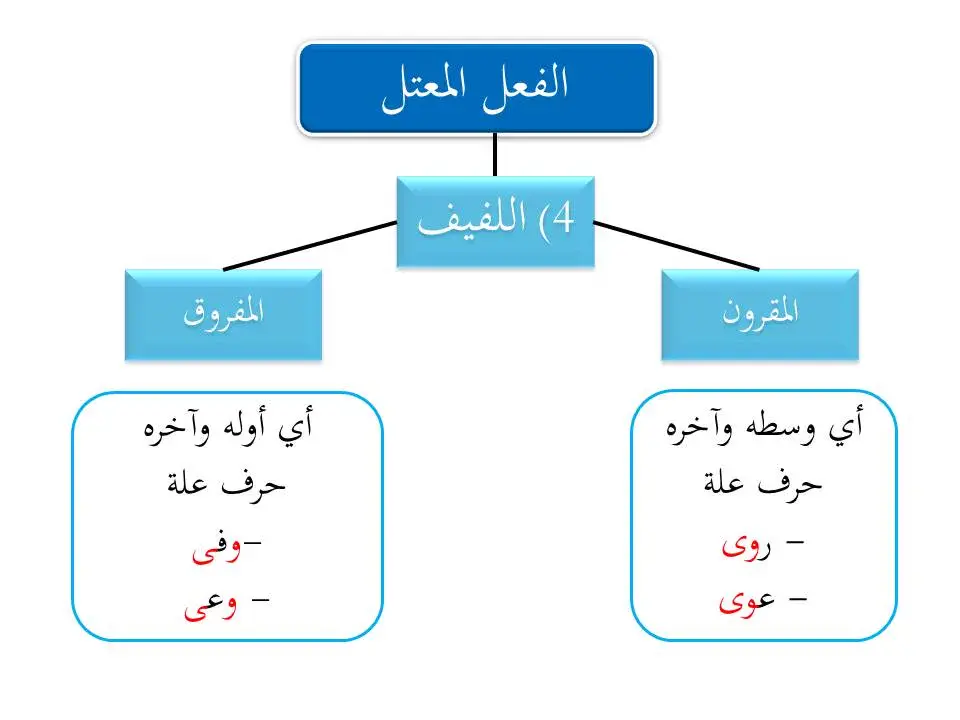
- و (waw) — drops in the present tense of many verbs
- ي (ya) — often merges into a long vowel
- ا (alif) — never an original root letter; it is always a transformed و or ي
That last point is the key that unlocks everything. The alif in قَالَ is not part of the root; the root is ق-و-ل, and the و turned into an alif under vowel pressure. Reverse-engineer the alif and the verb stops being irregular.
Arabic Weak Verbs Vs. Sound Verbs – The Core Difference
A sound verb (الفِعْل الصَّحِيح) keeps all three root letters visible in every single conjugation. A weak verb does not — a letter may vanish, lengthen, or transform depending on the tense and the pronoun attached.
Compare كَتَبَ (sound) with وَعَدَ (weak):
| Form | كَتَبَ (to write) | وَعَدَ (to promise) |
| Past, he | كَتَبَ | وَعَدَ |
| Present, he | يَكْتُبُ | يَعِدُ |
| Imperative | اُكْتُبْ | عِدْ |
The و survives in the past and disappears in the present and the command. Nothing random is happening — a specific rule is firing, and you will learn it further down.
Read also: How to Learn Arabic? A Step-by-Step Guide for UAE Residents
The Four Types Of Arabic Weak Verbs
Arabic weak verbs are classified by where the weak letter sits inside the root. There are four categories, and each one behaves in its own consistent way. Learning them as four separate systems is far more efficient than treating every verb as a special case.
The Arabic weak verbs examples in each table below are grouped by position, so you can see the pattern instead of memorising the word.
Think of the root as three positions: first, middle, last. The category is decided purely by which position holds the weak letter — and whether there are two of them.
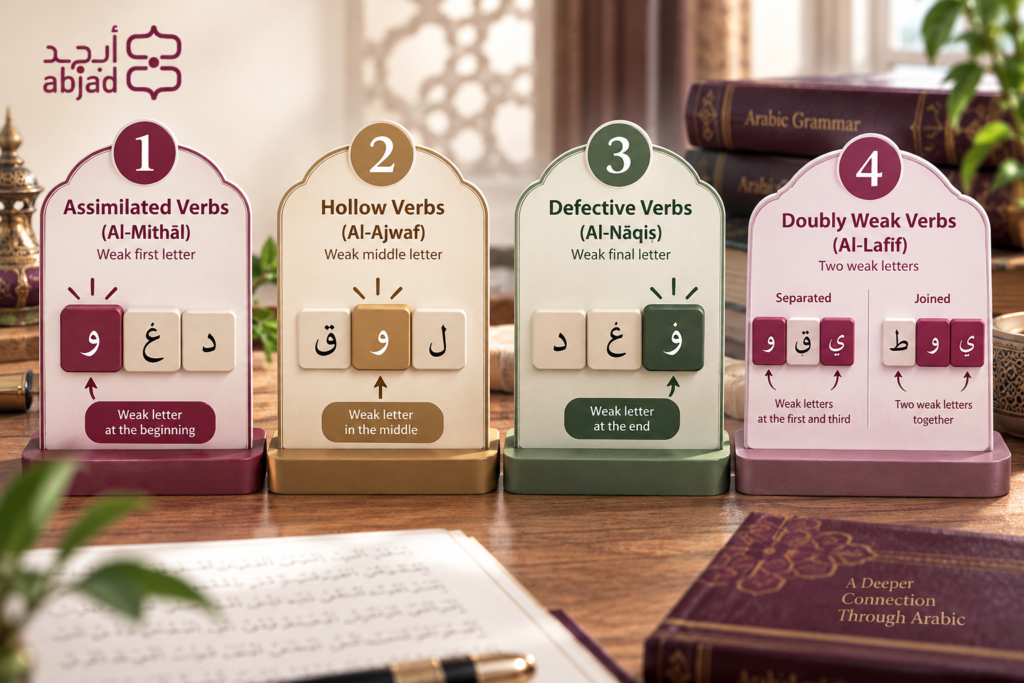
1. Assimilated Verbs (Al-Mithāl) – Weak First Letter
An assimilated verb has a weak letter in the first position of the root. The overwhelming majority begin with و, and a small group begin with ي.
Waw-initial examples:
| Verb | Root | Meaning | Present |
| وَعَدَ | و-ع-د | to promise | يَعِدُ |
| وَصَلَ | و-ص-ل | to arrive | يَصِلُ |
| وَجَدَ | و-ج-د | to find | يَجِدُ |
| وَزَنَ | و-ز-ن | to weigh | يَزِنُ |
| وَقَفَ | و-ق-ف | to stop / stand | يَقِفُ |
The rule: the initial و is deleted in the present tense whenever the middle radical carries a kasra (يَفْعِلُ pattern). If the present takes a fatḥa instead, the و stays put — وَجِلَ becomes يَوْجَلُ, not “يَجَلُ”.
A bonus worth knowing: when the و drops, Arabic often compensates with a ة at the end of the verbal noun — وَعَدَ gives عِدَة, and وَصَلَ gives صِلَة. Spotting that pattern helps you build vocabulary, not just conjugate.
Ya-initial examples: يَبِسَ (to dry out) → يَيْبَسُ, and يَسِرَ (to be easy) → يَيْسَرُ. Here the ي simply stays.
2. Hollow Verbs (Al-Ajwaf) – Weak Middle Letter
A hollow verb carries the weak letter in the middle of the root, which is why the past tense shows a long alif in place of it. These are the most frequent weak verbs in daily Arabic.
| Verb | Root | Meaning | Present |
| قَالَ | ق-و-ل | to say | يَقُولُ |
| كَانَ | ك-و-ن | to be | يَكُونُ |
| بَاعَ | ب-ي-ع | to sell | يَبِيعُ |
| زَارَ | ز-و-ر | to visit | يَزُورُ |
| نَامَ | ن-و-م | to sleep | يَنَامُ |
| طَارَ | ط-ي-ر | to fly | يَطِيرُ |
The rule that solves them all: when you attach a suffix that begins with a sukūn-bearing consonant (تُ، تَ، نَا، نَ), the long vowel shortens.
- يَقُولُ has a long ū → قُلْتُ (I said)
- يَبِيعُ has a long ī → بِعْتُ (I sold)
- يَنَامُ has a long ā → نِمْتُ (I slept)
Look at the present tense vowel and you can predict the past tense form every time. That one shortcut removes most of the guesswork from hollow verbs.
3. Defective Verbs Arabic (Al-Nāqiṣ) – Weak Final Letter
A defective verb ends with a weak letter in the third root position. In English grammar guides you will usually see defective verbs in Arabic described exactly this way — the “deficiency” is at the end of the word.
| Verb | Root | Meaning | Present |
| دَعَا | د-ع-و | to call / invite | يَدْعُو |
| رَمَى | ر-م-ي | to throw | يَرْمِي |
| نَسِيَ | ن-س-ي | to forget | يَنْسَى |
| مَشَى | م-ش-ي | to walk | يَمْشِي |
| بَنَى | ب-ن-ي | to build | يَبْنِي |
| سَعَى | س-ع-ي | to strive | يَسْعَى |
The rule: with a subject suffix, the final weak letter reappears in its original form — دَعَا becomes دَعَوْتُ (root و restored), while رَمَى becomes رَمَيْتُ (root ي restored).
The spelling clue: a verb written with ا (like دَعَا) has a و root; a verb written with ى (like رَمَى) has a ي root. The final letter’s shape is telling you the root — read it as information, not decoration.
Grammar shouldn’t feel like a locked door. Our Arabic Grammar Course in the UAE at Abjad Academy turns rules like these into habits you use without thinking.

4. Doubly Weak Verbs (Al-Lafīf) – Two Weak Letters
Doubly weak verbs contain two weak letters in the same root. They sound intimidating and are actually the smallest group — and each half follows rules you have already learned.
The only question is whether the two weak letters are separated by a strong letter or sitting side by side.
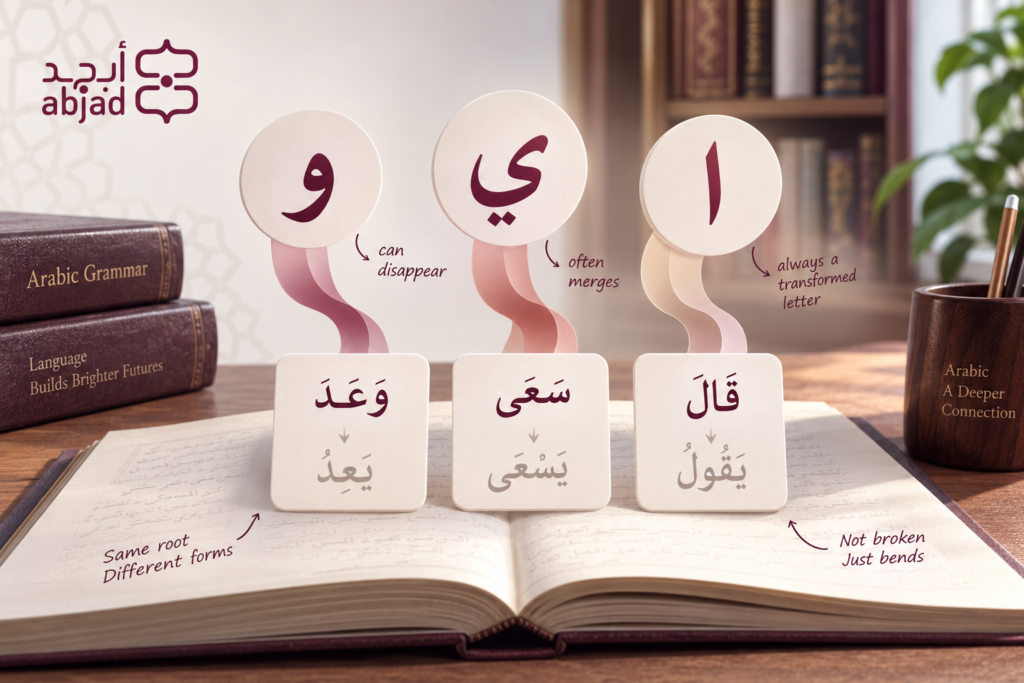
A. Separated Doubly Weak Verbs (Al-Lafīf Al-Mafrūq)
Here the weak letters occupy the first and third positions, with a strong letter between them. The verb behaves like an assimilated verb at the front and a defective verb at the back — simultaneously.
- وَقَى (و-ق-ي) — to protect → يَقِي
- وَفَى (و-ف-ي) — to fulfil → يَفِي
- وَلِيَ (و-ل-ي) — to be in charge of → يَلِي
The imperative of وَقَى is simply قِ — a complete, grammatical Arabic sentence in one letter. Both weak letters drop, leaving only the strong radical standing.
B. Joined Doubly Weak Verbs (Al-Lafīf Al-Maqrūn)
Here the two weak letters sit next to each other in the second and third positions. In practice these conjugate like defective verbs, so you have almost nothing new to memorise.
- طَوَى (ط-و-ي) — to fold → يَطْوِي
- رَوَى (ر-و-ي) — to narrate → يَرْوِي
- نَوَى (ن-و-ي) — to intend → يَنْوِي
- شَوَى (ش-و-ي) — to grill → يَشْوِي
You might also like: How to Speak Arabic Language in the UAE?
Common Arabic Weak Verbs with English Meanings
The fastest way to internalise this topic is to work from a real Arabic weak verbs list rather than abstract patterns. Below are the highest-frequency verbs, grouped by type, with meanings in English so you can start drilling immediately.
Focus on these before expanding. They cover a large share of the verbs you will meet in news, conversation, and classical texts alike.
1. Common Assimilated Verbs Used in Everyday Arabic
These verbs open with a weak letter and appear constantly in daily speech and formal writing.
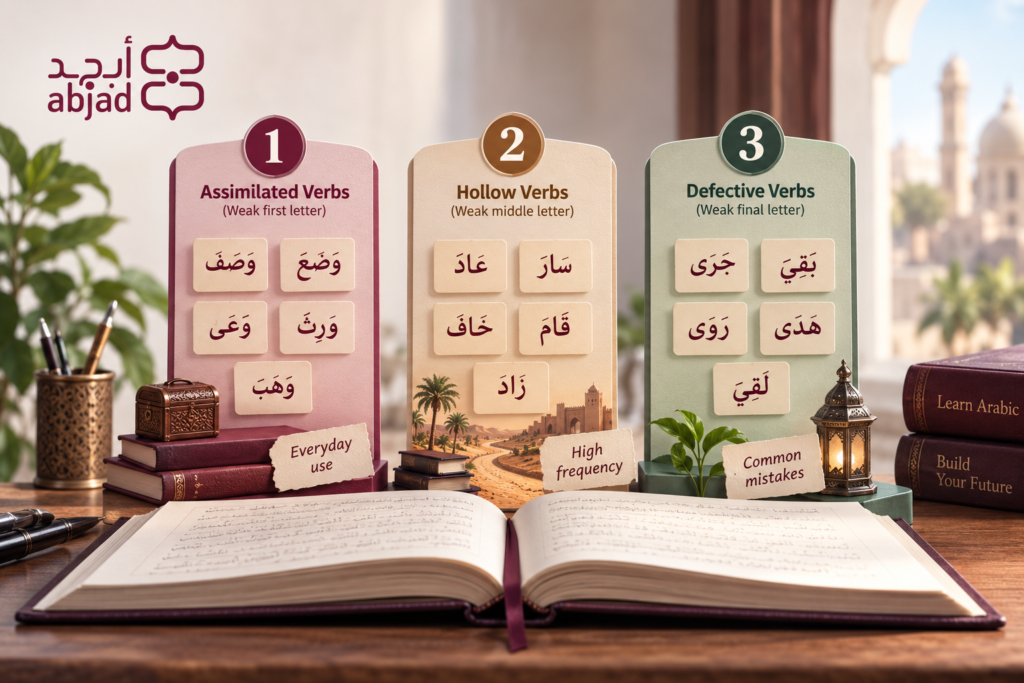
| Verb | Present | Meaning in English |
| وَصَفَ | يَصِفُ | to describe |
| وَضَعَ | يَضَعُ | to place / put |
| وَعَى | يَعِي | to be aware |
| وَرِثَ | يَرِثُ | to inherit |
| وَهَبَ | يَهَبُ | to grant |
2. Common Hollow Verbs Used in Everyday Arabic
If you learn only one group first, make it this one — hollow verbs carry an enormous amount of everyday meaning.
| Verb | Present | Meaning in English |
| عَادَ | يَعُودُ | to return |
| سَارَ | يَسِيرُ | to travel / proceed |
| خَافَ | يَخَافُ | to fear |
| قَامَ | يَقُومُ | to stand / undertake |
| زَادَ | يَزِيدُ | to increase |
Read also: The Definite Article In Arabic – How Al- Actually Works
3. Common Defective Verbs Used in Everyday Arabic
These close with a weak letter and are the group where writing errors happen most often.
| Verb | Present | Meaning in English |
| جَرَى | يَجْرِي | to run / occur |
| بَقِيَ | يَبْقَى | to remain |
| رَوَى | يَرْوِي | to narrate |
| هَدَى | يَهْدِي | to guide |
| لَقِيَ | يَلْقَى | to meet |
How to Conjugate Arabic Weak Verbs Correctly
Arabic weak verbs conjugation looks like four separate systems, but it runs on one principle: a weak letter cannot survive between two conflicting vowels, so it shortens, transforms, or disappears. Every rule below is that principle in action.
Work through the four tenses in order. Each one builds on the last, and by the fourth you will be predicting forms instead of recalling them.
1. Conjugating Weak Verbs in the Past Tense
In the past tense, hollow verbs shorten before consonant suffixes and defective verbs restore their original root letter. Assimilated verbs stay completely regular here — nothing changes at all.
| Pronoun | قَالَ (hollow) | دَعَا (defective) | رَمَى (defective) |
| أَنَا | قُلْتُ | دَعَوْتُ | رَمَيْتُ |
| أَنْتَ | قُلْتَ | دَعَوْتَ | رَمَيْتَ |
| هُوَ | قَالَ | دَعَا | رَمَى |
| هِيَ | قَالَتْ | دَعَتْ | رَمَتْ |
| هُمْ | قَالُوا | دَعَوْا | رَمَوْا |
| نَحْنُ | قُلْنَا | دَعَوْنَا | رَمَيْنَا |
Notice دَعَتْ and رَمَتْ — the weak letter drops entirely before the ت of the feminine. This is the form learners most often get wrong in writing.
2. Conjugating Weak Verbs in the Present Tense
In the present, assimilated verbs lose their initial و, hollow verbs show a long vowel, and defective verbs end in و، ي، or ى depending on their root.
| Pronoun | يَعِدُ | يَقُولُ | يَرْمِي |
| أَنَا | أَعِدُ | أَقُولُ | أَرْمِي |
| أَنْتَ | تَعِدُ | تَقُولُ | تَرْمِي |
| هُوَ | يَعِدُ | يَقُولُ | يَرْمِي |
| هُمْ | يَعِدُونَ | يَقُولُونَ | يَرْمُونَ |
| نَحْنُ | نَعِدُ | نَقُولُ | نَرْمِي |
The plural يَرْمُونَ is worth a second look — the ي vanishes before the و of the plural, leaving a short, clean form.
3. How Weak Verbs Change in the Jussive Case
In the jussive (المَجْزُوم), triggered by لَمْ or لَا النَّاهِيَة, weak verbs do not take a sukūn — they delete the weak letter instead. This is called حَذْف حَرْف العِلَّة, and it is the single most reliable weak-verb rule in the language.
- يَقُولُ → لَمْ يَقُلْ (he did not say)
- يَبِيعُ → لَمْ يَبِعْ (he did not sell)
- يَدْعُو → لَمْ يَدْعُ (he did not call)
- يَرْمِي → لَمْ يَرْمِ (he did not throw)
- يَنْسَى → لَمْ يَنْسَ (he did not forget)
Compare this with لَنْ (the subjunctive), where the letter stays: لَنْ يَدْعُوَ, لَنْ يَرْمِيَ. Mixing up these two particles is what produces most weak-verb errors in intermediate writing.
4. How to Form the Imperative of Arabic Weak Verbs
Imperatives are built from the jussive, so they inherit the same deletions — which is why so many Arabic commands are strikingly short.
- عِدْ — promise!
- قُلْ — say!
- بِعْ — sell!
- اُدْعُ — call!
- اِرْمِ — throw!
- قِ — protect!
If the resulting form starts with a vowelled consonant, no helping alif is needed; that is why قُلْ has no أ while اُدْعُ does.
Two hours a week is all it takes to stop guessing. Build real accuracy with the Modern Standard Arabic Course in the UAE at Abjad Academy and watch your writing tighten up fast.
Want to dive deeper? Read our full guide on: How to Write in Arabic in the UAE?
Watch Our Classes in Action
Curious what a real session looks like? Take a peek inside our interactive classrooms and see how our expert instructors bring the Arabic language to life. Watch a sample lesson below!
Begin Your Arabic Journey in the UAE
Join Abjad Institute for a professional and immersive Arabic language experience tailored to your goals.
Book Your Free TrialCommon Arabic Weak Verb Mistakes and How to Avoid Them
Even advanced students repeat the same handful of errors, almost always because a rule was memorised without its reason. Here are the five that cost the most marks — and the fix for each.
Read these as a diagnostic checklist. If one describes you, that is your next study session.
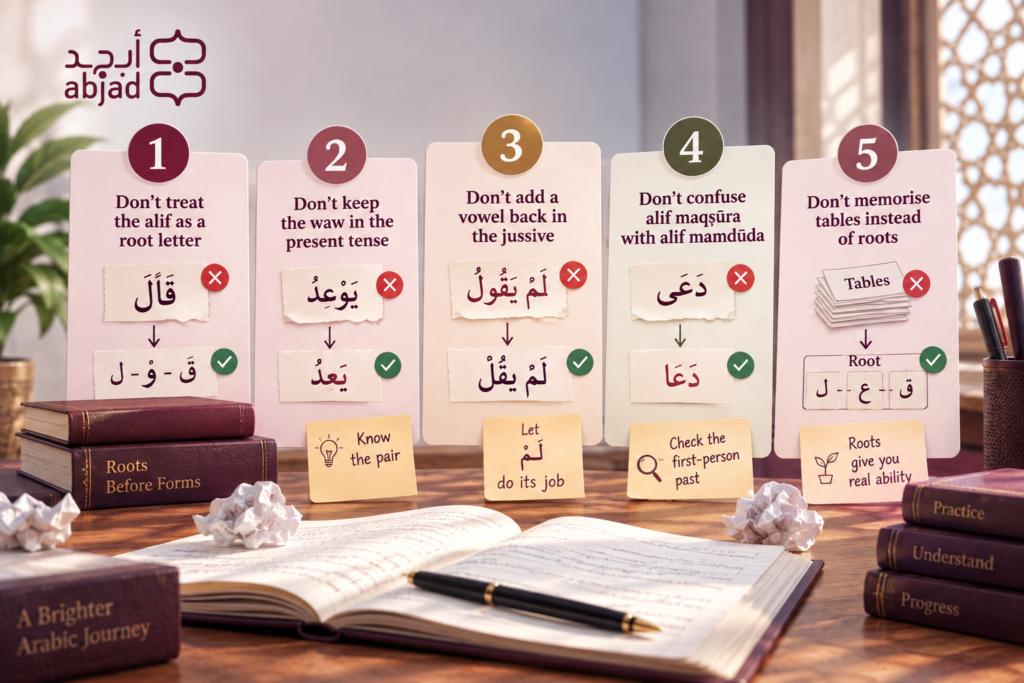
Mistake 1 – Treating The Alif As an Original Root Letter
Learners see قَالَ and assume the root is ق-ا-ل. It is not — alif is never an original root letter in Arabic, only a transformed و or ي.
The fix: whenever you meet an alif inside a verb, immediately ask which letter it came from. Checking the present tense answers it instantly — يَقُولُ reveals the و.
Mistake 2 – Keeping Waw When It Should Drop in the Present Tense
Writing “يَوْعِدُ” instead of يَعِدُ is the classic assimilated-verb slip. The و must go when the present takes a kasra.
The fix: learn assimilated verbs as pairs, never alone — وَعَدَ/يَعِدُ, وَصَلَ/يَصِلُ. The pair encodes the rule so you never store the wrong form.
Mistake 3 – Keeping the Weak Letter in the Jussive Form
Writing “لَمْ يَقُولْ” feels natural to English speakers because nothing seems to be missing. In Arabic, the jussive removes the long vowel: لَمْ يَقُلْ.
The fix: train yourself to treat لَمْ as a deletion signal. Every time you write it, check the verb has lost a letter.
Mistake 4 – Confusing Alif Maqṣūra with Final Alif
Writing دَعَى instead of دَعَا, or رَمَا instead of رَمَى, changes the root you are signalling to the reader. The two shapes are not interchangeable spellings.
The fix: convert the verb to the first-person past. If you get دَعَوْتُ, write ا; if you get رَمَيْتُ, write ى.
Mistake 5 – Memorizing Conjugation Tables Instead of Verb Roots
Conjugation tables give you recall for a week and nothing after that. Roots give you generative ability for life.
The fix: for every new verb, record the three root letters and the type. You will start predicting forms for verbs you have never seen before.
Reference standards such as the Library of Congress Arabic romanization table are useful companions once you begin transcribing what you read.
Read also: The Ten Measures Of Arabic Verbs – Patterns, Meanings, And Examples
How To Master Arabic Weak Verbs In 30 Days
A month of focused practice is genuinely enough to move Arabic weak verbs from “confusing” to “automatic.” The condition is that you practise production, not just recognition.
Here is the sequence our teachers use with students who want measurable progress in four weeks.
Weeks 1–2: Learn to Identify Weak Verb Roots Quickly
Spend the first two weeks doing one thing only: extracting the three root letters from every verb you meet. Do it out loud, ten verbs a day, until it takes under two seconds.
This single habit does more for your grammar than any table. It also transforms your dictionary skills, since Arabic dictionaries are organised by root.
Week 3: Practice Each Type of Arabic Weak Verb Separately
Rotate through the categories on a fixed schedule — assimilated on Monday, hollow on Tuesday, defective on Wednesday, doubly weak on Thursday. Repeat the cycle for the rest of the week.
Isolating one type per session prevents the interference that happens when learners mix all four at once. Friday is for review, not new material.
Week 4: Use Weak Verbs in Sentences and Real Arabic Texts
Write five original sentences a day using weak verbs, then read them aloud. Recognition is passive; production is what actually rewires recall.
Add one authentic text per day — a short news item or a classical passage — and underline every weak verb you find.
Learning alone is slower than learning corrected. The Arabic Intensive Course in the UAE at Abjad Academy compresses months of self-study into focused, guided weeks.

Why Learners Choose Abjad Academy For Arabic Grammar
Grammar is where most Arabic learners stall, and it is exactly where a good teacher makes the biggest difference.
Abjad Academy was built around that gap — structured programmes, native instructors, and a method that explains why a letter drops instead of asking you to accept it.
Here is what studying with us actually looks like in practice.
1. Native Teachers Who Explain The Logic, Not Just The Rule
Our instructors are native Arabic speakers with formal teaching qualifications and more than a decade of combined classroom experience. They do not hand you a table and move on — they show you the phonetic reason behind each transformation.
That approach matters enormously with weak verbs, where one principle replaces fifty memorised exceptions. Students consistently tell us this is the moment Arabic grammar starts to feel logical.

2. Courses Mapped To Your Level And Your Goal
There is no single “Arabic course” that fits a complete beginner, a working professional, and a classical-text reader. So we built distinct pathways for each.
If you are starting from zero, the Learn Arabic from Scratch Course in the UAE builds your foundation letter by letter. If your goal is reading heritage and religious texts in their original form, the Classical Arabic Course in the UAE takes you deep into the morphology that weak verbs sit inside.
Younger learners have their own track too — the Arabic Grammar for Kids in the UAE programme teaches the same structures through age-appropriate activities rather than drills.

3. Flexible Online Classes Across The UAE
Every class runs live and online, so you can join from Dubai, Abu Dhabi, Sharjah, or anywhere else in the Emirates. Scheduling is built around working hours, school runs, and shifting calendars.
Adults who need consistency without rigidity usually start with Arabic Classes for Adults in the UAE, which balances grammar, reading, and speaking in one structured track.
Read also: Arabic Verb “To Be” – Conjugation, Rules, and Examples
4. Progress You Can Actually Measure
You get a defined level at intake, clear milestones, and regular feedback on your written and spoken output. No vague “you’re improving” — you see exactly which structures you have mastered and which need another pass.
Correction is where the real learning happens. Our teachers mark your errors with the rule attached, so the same mistake does not survive to the next session.
Conclusion
Arabic weak verbs come down to three unstable letters and four predictable positions. Assimilated verbs lose their opening و, hollow verbs shorten their long vowel, defective verbs restore their root ending, and doubly weak verbs combine the two rules you already know.
None of it is arbitrary. Every deletion, shortening, and transformation follows the same phonetic logic — Arabic simply avoids vowel combinations that are hard to pronounce. The takeaway is this: stop memorising forms and start reading roots.
Once you can extract ق-و-ل from قَالَ and و-ع-د from يَعِدُ in under two seconds, Arabic weak verbs stop being a special topic and become just another part of the language you use without hesitation.Consistent, corrected practice is the only thing standing between you and that point.
Inside Our Live Classes
Don’t just take our word for it—see for yourself! Click below to watch short clips from our live classes and meet the instructors who will guide your learning journey.
Begin Your Arabic Journey in the UAE
Join Abjad Institute for a professional and immersive Arabic language experience tailored to your goals.
Book Your Free TrialStart Your Arabic Grammar Journey With Abjad Academy!
You have the map now — the four types, the conjugation rules, the verb list, and the mistakes to avoid. What turns a map into fluency is guided practice with someone who catches the errors you cannot see in your own writing.
Book your free consultation with Abjad Academy today. We will assess your current level, identify exactly where your grammar is leaking, and recommend the programme that closes the gap fastest — whether that is a structured grammar track, an intensive sprint, or a full beginner pathway.
Classes run live and online across all seven emirates, with flexible timings built around real schedules. Your first session can be this week. Let us build the foundation that makes every future Arabic lesson easier.
Discover Our Arabic Courses
- Arabic Course in the UAE
- Arabic Intensive Course
- Learn Arabic from Scratch Course
- Madinah Arabic Course
- Arabic Classes for Adults
- Arabic Classes for Beginners
- Self-Paced Arabic Course
- Basic Arabic Course
- Arabic Speaking Classes
- Learn to Write Arabic Course
- Arabic Grammar Course
- Learn Arabic Alphabet Course

Frequently Asked Questions
What Are The 10 Forms Of Verbs In Arabic?
Arabic verbs derive into ten measured patterns, from Form I (فَعَلَ) through Form X (اسْتَفْعَلَ), each adding a predictable shade of meaning such as causation, intensity, or reflexivity. Abjad Academy teaches these forms as one connected system, so you learn to predict a verb’s meaning instead of memorising it word by word.
What Are Form 2 Verbs In Arabic?
Form II verbs follow the pattern فَعَّلَ, doubling the middle root letter to add intensity or causation — عَلِمَ (to know) becomes عَلَّمَ (to teach). Our instructors drill this shift with paired examples so the difference between the base verb and its Form II sibling becomes instantly recognisable.
What Are The Three Types Of Verbs In Arabic?
Arabic verbs divide into three tenses by form: the past (الماضي), the present (المضارع), and the imperative (الأمر). Every weak verb you meet will appear in all three, which is exactly why Abjad Academy’s grammar track covers them together rather than in isolation.
What Are Some Basic Verbs In Arabic?
Core beginner verbs include كَتَبَ (to write), قَرَأَ (to read), ذَهَبَ (to go), أَكَلَ (to eat), and قَالَ (to say). Notice that even a starter list contains weak verbs, which is why we introduce them early rather than treating them as an advanced topic.
What Are 100 Common Arabic Verbs?
A practical hundred-verb core covers movement, speech, thought, and daily action — verbs like سَأَلَ, فَهِمَ, عَمِلَ, رَجَعَ, أَعْطَى, and وَجَدَ. Roughly a third of any such list turns out to be weak, so mastering the four weak patterns unlocks a large slice of everyday Arabic at once.
Does Arabic Have The Hardest Grammar?
Arabic grammar is highly systematic rather than genuinely hard — its reputation comes from the root system and case endings, both of which follow strict logic. With structured teaching at Abjad Academy, most learners find the rules far more consistent than those of the languages they already speak.
What Are Defective Verbs Arabic?
Defective verbs in Arabic (الفِعْل النَّاقِص) are verbs whose third root letter is و or ي — دَعَا, رَمَى, مَشَى, نَسِيَ. The weak ending drops in the jussive (لَمْ يَرْمِ) and returns to its original root letter with suffixes (رَمَيْتُ). Abjad Academy drills this group early because it is where most written errors appear.






Leave a Reply