 Quran
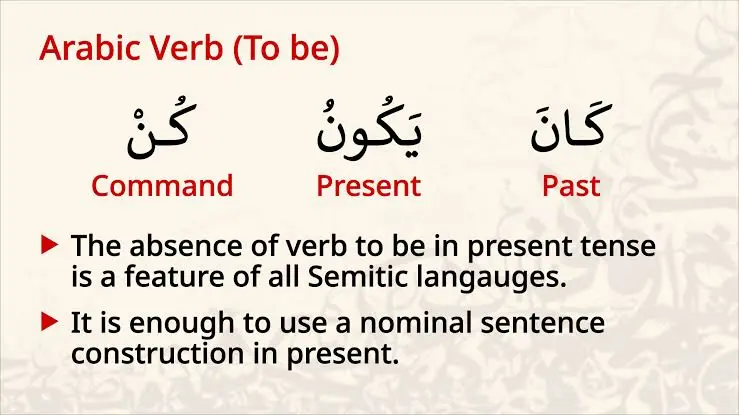
Here is a sentence that confuses almost every beginner: البيتُ كبيرٌ. It means “the house is big” — yet there is no word for “is” anywhere in it. That single observation is the doorway into the arabic verb to be.
Arabic is spoken by more than 400 million people and is one of the six official languages of the United Nations, as confirmed on the UNESCO World Arabic Language Day page. Millions of learners meet this exact puzzle in week one.
At Abjad Academy, our teachers watch students trip over this daily — not because it is hard, but because English habits get in the way. Once you see the logic, it clicks permanently.
In the next few minutes you will get the full conjugation, a clean chart for every tense, real examples from conversation and the Qur’an, and the three mistakes that quietly hold learners back.
Key Highlights of This Article:
- Why Arabic drops “is/are” in the present tense — and when it doesn’t.
- A complete arabic verb to be chart covering past, present, and future forms.
- How كَانَ changes the grammatical endings of the words after it.
- Practical arabic verb to be examples from daily speech and Qur’anic verses.
- The sisters of كَانَ and how to negate “to be” correctly.
What Is The Arabic Verb “To Be” ?
The arabic verb to be is كَانَ (kāna), and it is used mainly in the past and future — not in the present. In the present tense, Arabic simply leaves it out and lets two words sit side by side.
This is called the zero copula, and it is one of the cleanest features of the language. Understanding it early saves you from writing sentences that sound instantly foreign.
Why Arabic Omits “Is” And “Are” In The Present Tense
Arabic treats present-tense equivalence as self-evident, so no linking verb is needed. Placing a definite noun next to an indefinite description already communicates “X is Y.”
Look at how tight this is:
- الطالبُ ذكيٌّ — the student is smart
- الجوُّ جميلٌ — the weather is nice
- أنا معلمٌ — I am a teacher
Notice there is no am, is, or are. Inserting one would be a grammatical error, not a stylistic choice.
How Mubtadaʾ and Khabar Form a Nominal Sentence
A sentence without a verb is called a جملة اسمية (nominal sentence), built from two parts. The first is the mubtada’ (subject), the second is the khabar (predicate).
Both parts normally carry the nominative ending -u (ضمة). So in الطالبُ ذكيٌّ, both words end in a damma — that agreement is the sentence’s grammatical glue.

Getting comfortable with noun endings here pays off everywhere else. Our guide to Quranic Grammar: The Complete Guide to Understanding the Language of the Quran breaks this down with Qur’anic examples if you want a deeper foundation.
How to Conjugate كَانَ in the Past Tense
The past tense is where the arabic verb to be finally appears as an actual verb.
كَانَ means “was” or “were,” and it is a hollow verb — its middle letter wāw disappears in several forms.
That disappearance is what makes learners hesitate. The table below removes the guesswork.
Complete Past-Tense Conjugation Chart for كَانَ
Save this arabic verb to be chart — the pattern behind it is simple. When the ending starts with a consonant (-tu, -ta, -nā), the long ā shortens to u; third-person forms keep the long vowel.
| Pronoun | Arabic | Transliteration | Meaning |
| أنا | كُنْتُ | kuntu | I was |
| أنتَ | كُنْتَ | kunta | you were (m.) |
| أنتِ | كُنْتِ | kunti | you were (f.) |
| هو | كَانَ | kāna | he was |
| هي | كَانَتْ | kānat | she was |
| نحن | كُنَّا | kunnā | we were |
| أنتم | كُنْتُمْ | kuntum | you were (pl. m.) |
| أنتنَّ | كُنْتُنَّ | kuntunna | you were (pl. f.) |
| هم | كَانُوا | kānū | they were (m.) |
| هنَّ | كُنَّ | kunna | they were (f.) |
If you want the wider rule behind this shortening, ourArabic Grammar Course in the UAE covers hollow, doubled, and weak verbs in one structured sequence.
How كَانَ Changes The Case Endings
When كَانَ enters a nominal sentence, it lifts the subject to nominative and pushes the predicate into the accusative. The subject becomes ism kāna, the predicate becomes khabar kāna.
Compare the shift directly:
- البيتُ كبيرٌ → the house is big
- كَانَ البيتُ كبيرًا → the house was big
The final word moved from kabīrun to kabīran. That one fatha is the single most reliable sign that a learner truly understands كَانَ.

Struggling to hear the difference between -un and -an? One live lesson with a qualified teacher fixes in 20 minutes what months of self-study leave blurry — that is exactly what the Arabic Grammar Course in the UAE at Abjad Academy is built for.
Present and Future Forms of the Arabic Verb “To Be”
The present form يَكُونُ exists, but it does not mean “is.” It carries the sense of becomes, happens to be, or tends to be, and it appears after particles like أنْ and لَنْ.
Knowing when this form is legitimate is what separates confident writers from cautious ones.
How to Conjugate يَكُونُ in the Present Tense
Typical usage: يجب أن تَكُونَ صادقًا — “you must be honest.” Here the verb is grammatically required, so leaving it out would break the sentence.
| Pronoun | Arabic | Transliteration |
| أنا | أَكُونُ | akūnu |
| أنتَ | تَكُونُ | takūnu |
| أنتِ | تَكُونِينَ | takūnīna |
| هو | يَكُونُ | yakūnu |
| هي | تَكُونُ | takūnu |
| نحن | نَكُونُ | nakūnu |
| أنتم | تَكُونُونَ | takūnūna |
| هم | يَكُونُونَ | yakūnūna |
| هنَّ | يَكُنَّ | yakunna |
How to Express the Future With سَيَكُونُ
The future adds the prefix سَـ or the word سَوْفَ to the present form. Nothing else changes, which makes this the easiest tense of the three.
- سَأَكُونُ في المسجدِ — I will be at the mosque
- سَتَكُونُ الرحلةُ طويلةً — the trip will be long
- سَنَكُونُ مستعدين — we will be ready
Note that the predicate stays accusative here too, exactly as it did with كَانَ.
Read also: The Ten Measures Of Arabic Verbs – Patterns, Meanings, And Examples
Arabic Verb “To Be” Examples in Real Sentences
Tables build recognition; sentences build fluency. These arabic verb to be examples show the verb doing real work in both casual and classical registers.
Read each one aloud twice — once for meaning, once for the final vowel.
Everyday Examples Using كَانَ and يَكُونُ
- كُنْتُ متعبًا أمس — I was tired yesterday
- كَانَتْ أمي في السوق — my mother was at the market
- كُنَّا أصدقاء في المدرسة — we were friends at school
- لم يَكُنِ الطعامُ لذيذًا — the food was not tasty
That last example is worth pausing on: negating the past uses لم + يكن, not كان.

Spoken dialects handle this differently, which our guide to How to Learn Egyptian Arabic in the UAE illustrates well.
Examples of كَانَ and Its Forms in the Quran
The Qur’an uses كَانَ constantly, and the accusative predicate is always visible:
- وَكَانَ اللَّهُ غَفُورًا رَحِيمًا — “And Allah is ever Forgiving, Merciful” (An-Nisā’ 4:96)
- إِنَّ الصَّلَاةَ كَانَتْ عَلَى الْمُؤْمِنِينَ كِتَابًا مَوْقُوتًا — (An-Nisā’ 4:103)
- كُونُوا قَوَّامِينَ بِالْقِسْطِ — “Be upholders of justice” (An-Nisā’ 4:135)
The last verse shows the imperative كُونُوا (“be!”), a form most textbooks skip entirely. Students in our Quranic Arabic Course in the UAE meet it in the first month.

Kāna Wa Akhawātuhā: كَانَ and Its Sisters
كَانَ belongs to a family of ten verbs that behave identically — raising the subject and putting the predicate in the accusative. Arab grammarians call them أخوات كان, “the sisters of kāna.”
Learn one, and you have effectively learned all ten.
The Most Common Sisters of كَانَ and Their Meanings
- أَصْبَحَ — became / to be in the morning
- صَارَ — became
- ظَلَّ — remained, continued
- بَاتَ — spent the night being
- مَا زَالَ — still is
Example: أَصْبَحَ الجوُّ باردًا — “the weather became cold.” Same structure, same accusative ending on the predicate.
Read also: Arabic Weak Verbs – Types, Conjugation Rules, And Examples With Meaning
Watch Our Classes in Action
Curious what a real session looks like? Take a peek inside our interactive classrooms and see how our expert instructors bring the Arabic language to life. Watch a sample lesson below!
Begin Your Arabic Journey in the UAE
Join Abjad Institute for a professional and immersive Arabic language experience tailored to your goals.
Book Your Free TrialHow to Negate “To Be” With لَيْسَ “To Be” With لَيْسَ
لَيْسَ is the sister used to negate the present tense, and it means “is not.” It looks past-tense in form but always carries present meaning.
- لَيْسَ الطالبُ حاضرًا — the student is not present
- لَيْسَتِ المسألةُ صعبةً — the matter is not difficult
Because Arabic has no present-tense “is,” لَيْسَ is the only clean way to say “is not” in formal Arabic.
Ten verbs, one rule, endless sentences. Let an Abjad Academy tutor walk you through كان وأخواتها live — join our Best Arabic Course in the UAE and take your first session free.

Read also: Arabic Short Vowels Explained – Fatha, Damma, And Kasra
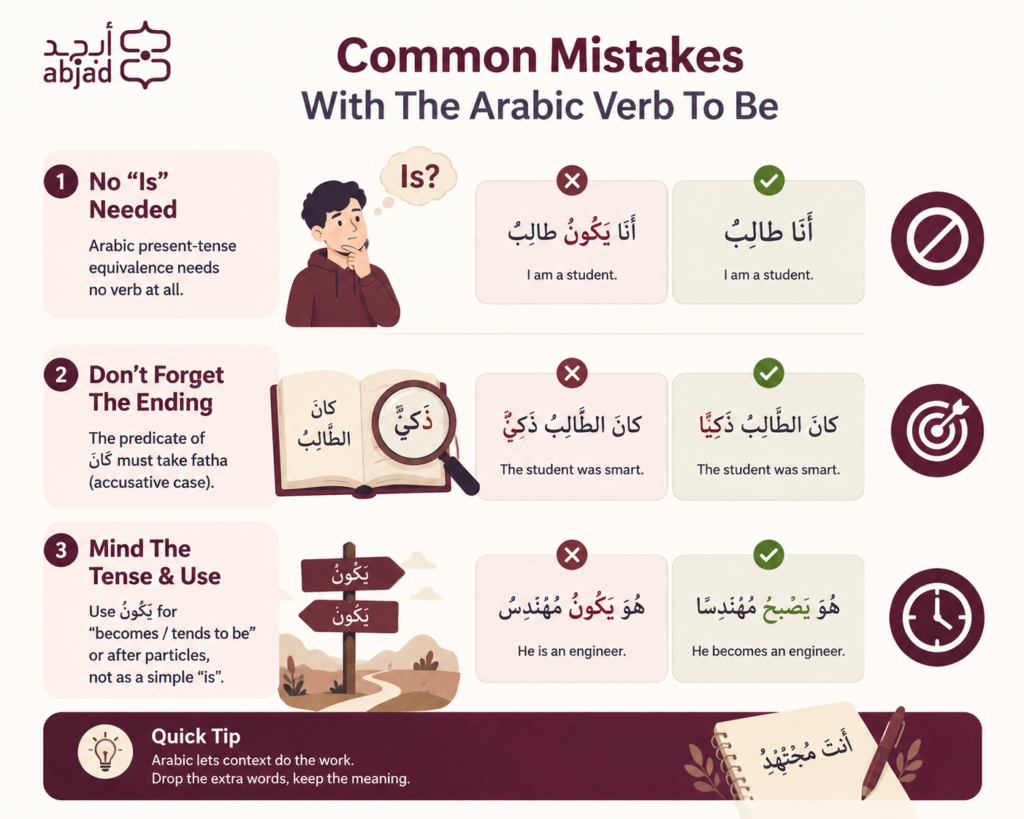
Common Mistakes When Using the Arabic Verb “To Be”
Most errors here are not memory failures — they are English habits transferred onto Arabic structure. Naming them makes them easy to catch.
1. Adding “Is” or “Are” Where Arabic Does Not Need Them
Writing أنا يكون طالب instead of أنا طالبٌ is the single most frequent beginner error. Arabic present-tense equivalence needs no verb at all.
2. Forgetting the Accusative Predicate After كَانَ
Saying كان الطالبُ ذكيٌّ instead of كان الطالبُ ذكيًّا is technically incorrect. The predicate of كَانَ must take fatha.
3. Using يَكُونُ as a General Present-Tense “Is”
Using يَكُونُ as a general present “is” produces sentences that no native speaker would say. Reserve it for becomes, tends to be, and post-particle positions.
Register awareness matters here too — our overview of Is Quranic Arabic Different from Normal Arabic? A Complete Comparison explains when formal rules apply and when they relax.
How Abjad Academy Helps You Master Arabic Grammar
Grammar rules are easy to read and hard to internalise alone. What changes outcomes is correction — someone hearing your fatha and fixing it the moment it slips.
That is exactly what Abjad Academy is built around.
1. One-To-One Lessons With Qualified Native Teachers
Every class is private and live, with certified teachers from Al-Azhar and other recognised institutions. You speak, they correct, and the rule sticks in real time.
Meet the people who would be teaching you on our teachers page before you commit to anything.

Read also: The Definite Article In Arabic – How Al- Actually Works
2. A Structured Grammar Path, Not Scattered Lessons
Our Arabic Grammar Course moves in order: nouns, sentence types, كان وأخواتها, then verb patterns. Nothing is introduced before its foundation exists.
For learners who want faster results, the Arabic Intensive Course in the UAE compresses months of progress into weeks.

3. Flexible Scheduling, Fair Pricing, And A Free Trial
Classes run across every time zone, so lessons fit your week instead of disrupting it. Full pricing is published openly on our pricing page.
You can also move at your own rhythm through our Self-Paced Arabic Course if you prefer studying between live sessions.

4. Learning That Connects To The Qur’an
Grammar is not the destination — comprehension is. Our Fusha Arabic Course in the UAE links every rule to real texts you actually want to read.

Inside Our Live Classes
Don’t just take our word for it—see for yourself! Click below to watch short clips from our live classes and meet the instructors who will guide your learning journey.
Begin Your Arabic Journey in the UAE
Join Abjad Institute for a professional and immersive Arabic language experience tailored to your goals.
Book Your Free TrialStart Practicing Arabic Grammar With a Free Trial
You have the charts, the examples, and the rules. What you need now is someone listening while you use them — because reading a conjugation table and producing a correct sentence under pressure are two very different skills.
Book your free trial class with Abjad Academy today. In one session, a qualified native teacher will assess your level, correct your endings live, and map out exactly what you should study next. There is no payment required and no obligation to continue.
Take a look at our specialized online courses:
- Teen Arabic Summer Course in the UAE
- Beginner Arabic for Kids Course in the UAE
- Arabic Grammar for Kids in the UAE
- Arabic Conversation for Kids Course in the UAE
- Emirati Arabic Course in the UAE
- Classical Arabic Course in the UAE
Thousands of students across the UK, US, Canada, and Australia have already started with that single free lesson. Claim yours now and turn passive knowledge into confident Arabic.

Conclusion
Here is the whole topic in five lines. Arabic has no present-tense “is” — nouns simply sit together in a nominal sentence. The past uses كَانَ, the future uses سَيَكُونُ, and negation uses لَيْسَ.
The one rule that matters most: كَانَ raises the subject to nominative and pushes the predicate to accusative. Master that single shift and the arabic verb to be stops being an obstacle and becomes a tool.
Everything else — the sisters, the imperative, the Qur’anic usage — grows naturally from that foundation.
Frequently Asked Questions
When Should I Use لا And When Should I Use لَيْسَ?
Use لَيْسَ to negate a nominal sentence (“the student is not present”), and لا to negate a present-tense verb (“he does not write”). The difference is what follows: لَيْسَ works on nouns and adjectives, while لا works on verbs.
What Is فعل الماضي In Arabic?
فعل الماضي is the past-tense verb — an action already completed, like كَتَبَ (“he wrote”) or كَانَ (“he was”). It is the base form of every Arabic verb, which is why dictionaries and conjugation tables always start from it.
What Is The Difference Between مَا And مَاذَا?
مَاذَا means “what?” and introduces a question about an action (مَاذَا تَفْعَل؟ — “what are you doing?”).
مَا can also mean “what,” but in classical Arabic it frequently functions as a negation particle instead, so context decides its role.
How Do You Say “Be” As A Command In Arabic?
The imperative is كُنْ for one male, كُونِي for one female, and كُونُوا for a group. You see it in the Qur’anic phrase كُنْ فَيَكُونُ — “Be, and it is” — one of the most quoted uses of this verb.
How Do You Say “I Am Going” In Arabic?
Say أَنَا ذَاهِبٌ (active participle) or أَذْهَبُ (present verb) — no separate word for “am” is needed. This is the same zero-copula logic behind كَانَ, and Abjad Academy tutors drill both patterns until choosing between them becomes automatic.
What Is The Best Way To Teach The Verb “To Be” To Beginners?
Start with verbless present-tense sentences, then introduce كَانَ and the accusative ending, and only afterwards move to لَيْسَ and the sisters. That is the exact sequence used in Abjad Academy’s Arabic Grammar Course, where each stage is practised live before the next one begins.






[…] Read also: Arabic Verb “To Be” – Conjugation, Rules, and Examples […]