 Learn Arabic
If you have ever typed “can you learn Quranic Arabic on Duolingo” into a search bar, you already sense that something might be missing from the app. The short answer is no — Duolingo was not built for Quranic Arabic, and using it as your primary tool will leave you stuck long before you can read or understand a single surah with confidence.
But that answer needs explanation. Duolingo does some things well, and knowing exactly where it helps — and where it falls short — lets you make a smarter decision about how to spend your learning time.
This article tells you what Duolingo actually teaches, why it is not built for Quranic Arabic specifically, and what a serious learner needs instead.
Can You Learn Quranic Arabic on Duolingo?
No Duolingo is not designed for Quranic Arabic, and it does not teach it. The app introduces a simplified version of Modern Standard Arabic — covering the alphabet, basic vocabulary, and short sentence patterns — but Quranic Arabic is a distinct classical register with its own grammar structures, vocabulary, and pronunciation rules that Duolingo does not address.
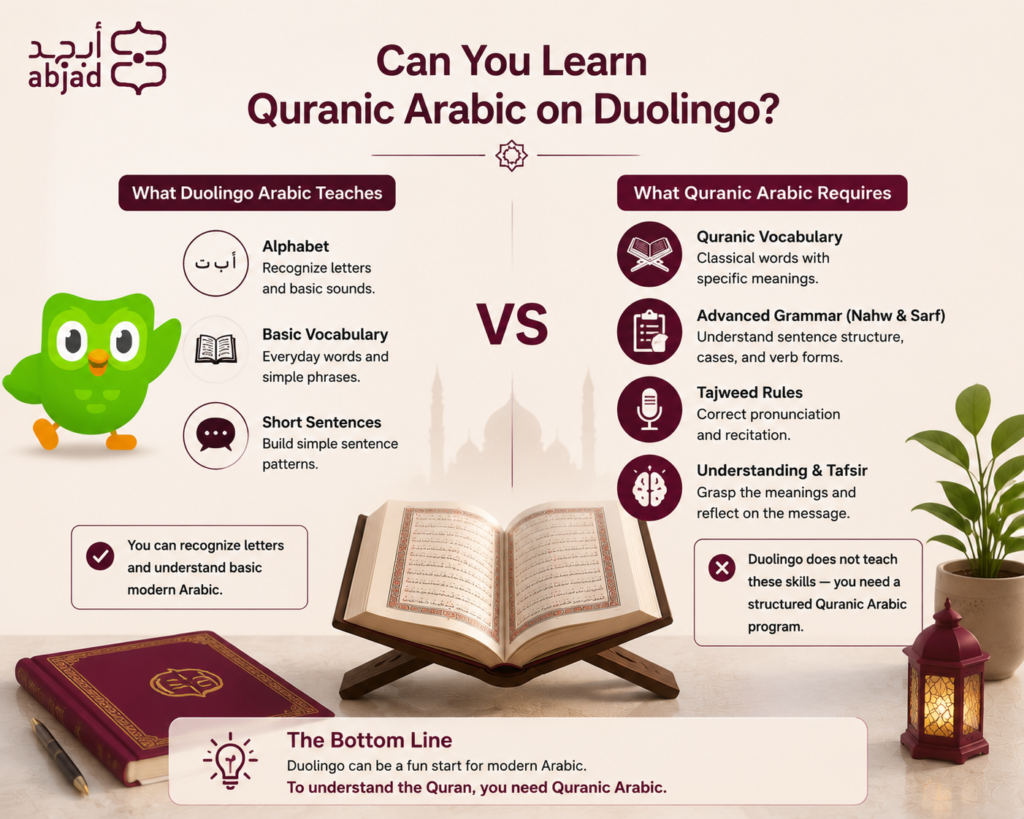
A learner who completes the entire Duolingo Arabic course will be able to recognize Arabic letters and some basic words. They will not be able to read a verse of the Quran with understanding, identify grammatical cases in Quranic sentences, or apply tajweed rules during recitation. These are not features Duolingo ever promised — but they are exactly what a Quran learner needs To understand why, it helps to know what Quranic Arabic actually is.
What Makes Quranic Arabic Different From Modern Arabic?
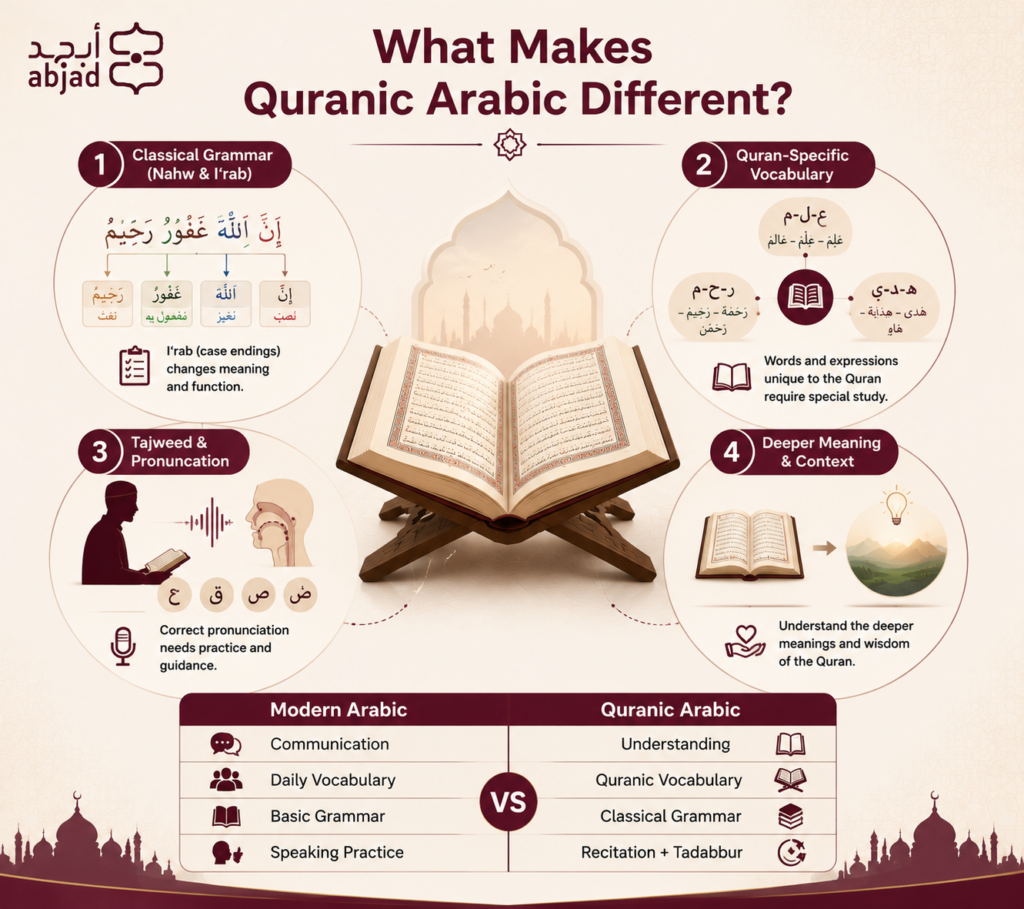
Quranic Arabic is the classical form of Arabic used in the Quran. It has unique grammar rules, vocabulary, and pronunciation principles that make it different from Modern Standard Arabic and everyday Arabic dialects.
1. Classical Grammar and Sentence Structure
Quranic Arabic follows the complete classical Arabic grammar system, including i’rab (case endings), where the ending of a word changes according to its role in the sentence.
A small vowel change can affect the meaning and grammatical function of a word. Unlike many modern Arabic learning apps, Quranic Arabic requires a deeper understanding of these structures to interpret Quranic verses accurately.
2. Quran-Specific Vocabulary
Many words frequently used in the Quran are not common in everyday Arabic conversations. Terms related to faith, worship, and Quranic concepts have meanings that require special study and context.
Learning general Arabic vocabulary helps with communication, but Quranic comprehension requires learning the vocabulary and expressions found specifically in the Quran.
3. Tajweed and Correct Pronunciation
Quranic Arabic is closely connected to Tajweed, the science of reciting the Quran correctly. Proper pronunciation requires mastering the articulation points (makharij) and characteristics of Arabic letters.
Letters such as ع (ayn), ح (ha), ق (qaf), ص (sad), and ض (dad) require practice and correction from a qualified teacher to pronounce them accurately.
4. Deeper Meaning and Context
Quranic Arabic includes unique rhetorical styles, word choices, and expressions that carry deeper meanings. Understanding these elements helps learners move beyond reading the words to truly grasping the message of the Quran.
For anyone aiming to read the Quran correctly and understand its meanings, mastering Quranic Arabic requires focused study of grammar, vocabulary, and Tajweed — areas that general Arabic courses do not fully cover.
Read more: Learn Quranic Arabic Free in the UAE
Does Duolingo Teach Quranic Arabic — Even Partially?
Duolingo does not label any part of its Arabic course as “Quranic Arabic,” nor does it teach tajweed, classical grammar, or Quranic vocabulary as a dedicated track. What the app teaches is a limited form of Modern Standard Arabic optimized for quick recognition exercises, not reading comprehension or spiritual engagement with the Quran.
Some learners wonder whether completing the Duolingo Arabic course gives them a head start on Quranic study. The honest answer is: partially, and only at the very surface level. Recognizing Arabic letters is genuinely useful, and Duolingo does teach the alphabet in a beginner-friendly way. But this is roughly equivalent to learning the English alphabet and then being told you are ready to read Shakespeare. The script is only the beginning.
Start Your Fusha Arabic Learning Journey with a FREE Trial Class in the UAE.

Can Duolingo Help You Learn Quranic Arabic for Free?
Duolingo’s Arabic course is free to access, which is one of its most appealing qualities. But the real question is not whether it is free — it is whether it delivers the outcome you need at zero cost.
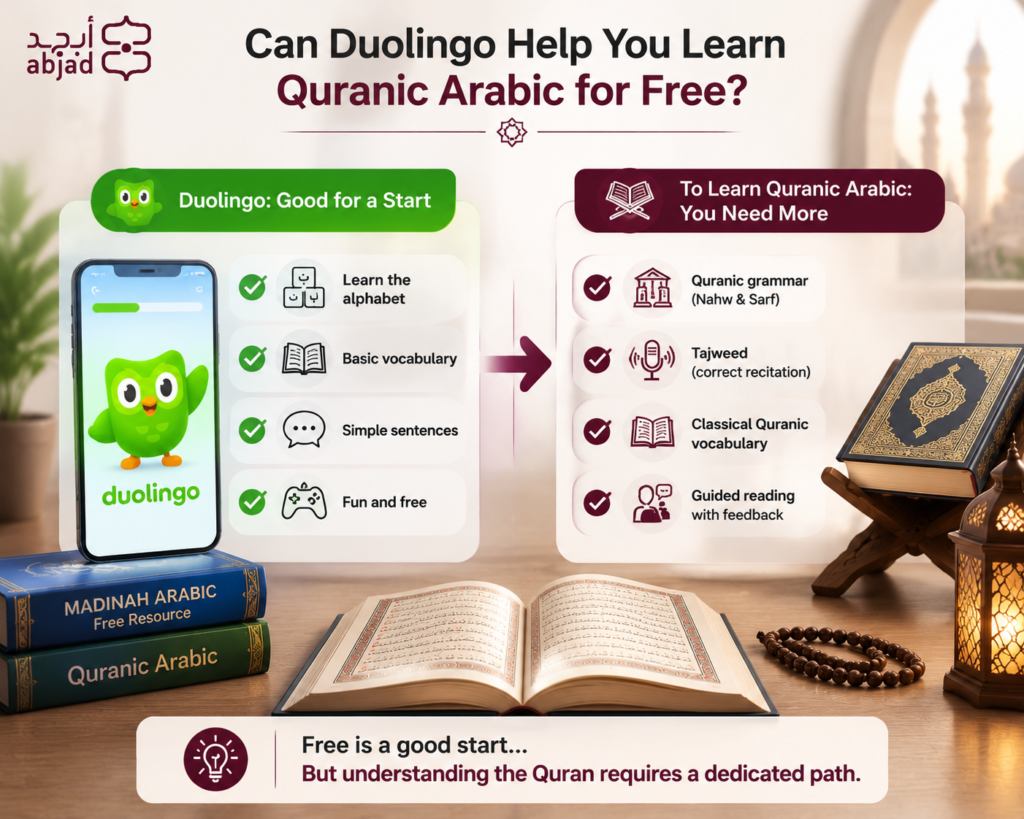
What you get for free on Duolingo: letter recognition, basic vocabulary, simple sentence matching, and a gamified habit system. These are not worthless, especially for a complete beginner who has never seen Arabic script.
What free does not get you: Quranic grammar instruction, tajweed correction, classical Arabic vocabulary, structured reading practice, or feedback from a qualified teacher. These elements are not behind a Duolingo paywall — they simply do not exist in the app at any price.
Several genuinely free resources do provide Quranic Arabic foundations — Madinah Arabic books, for example, offer a structured classical grammar curriculum at no cost. But free learning of any kind has a ceiling for most people: without accountability and correction, progress stalls.
Inside Our Live Classes
Don’t just take our word for it—see for yourself! Click below to watch short clips from our live classes and meet the instructors who will guide your learning journey.
Begin Your Arabic Journey in the UAE
Join Abjad Institute for a professional and immersive Arabic language experience tailored to your goals.
Book Your Free TrialHow Far Can You Get Learning Arabic on Duolingo?
Duolingo teaches Arabic in short gamified sessions using four core activity types: matching letters to sounds, selecting correct translations, rearranging words, and listening to audio. These exercises are well-designed for the purpose of building familiarity, and they succeed at that goal.
The learning path on Duolingo Arabic covers: the Arabic alphabet (letters and their sounds), short vowels and basic harakat, simple vocabulary (greetings, numbers, colors, family members), and elementary sentence patterns (“this is a book,” “I have a cat”). For someone starting from zero, this is a comfortable on-ramp to a script that can look overwhelming at first glance.
The path stops there. There is no second level of grammar that explains how Arabic sentences are structured beyond simple subject-verb-object patterns. There is no Quranic vocabulary list. There is no instruction on the classical case system. And there is no human correction.
This means Duolingo works as a ten-to-fifteen minute daily warm-up for the first few months of Arabic learning — particularly useful for reinforcing letter recognition and basic vocabulary. It does not work as a path to Quran comprehension. Most serious learners outgrow Duolingo within two to three months and find themselves needing something structured to move forward.
Learn Arabic from the Basics with a FREE Trial Class.
What Duolingo Does Well for Arabic Beginners?
It is worth being fair. Duolingo earns its popularity for real reasons The app makes Arabic feel less intimidating. Opening a grammar textbook on your first day and seeing case tables, root systems, and verb conjugation charts can stop a learner before they start. Duolingo removes that barrier by starting with letters, sounds, and tiny wins.
The streak system and daily reminders genuinely help people build a habit. Consistency matters more than any single lesson, and Duolingo is better at creating consistency than most structured courses — because it is always in your pocket and takes three minutes to satisfy.
For Muslim learners who have never seen the Arabic script, Duolingo’s alphabet introduction provides a low-pressure first encounter with letter shapes and connected writing. This is not trivial. Arriving at your first real Arabic class already able to recognize the letters saves several sessions and reduces anxiety significantly.
Use Duolingo for what it does well: daily habit reinforcement and alphabet familiarity. Do not use it as a substitute for structured Quranic Arabic study.
Read more: How to Read Quranic Arabic?
What Duolingo Cannot Give Quran Learners?
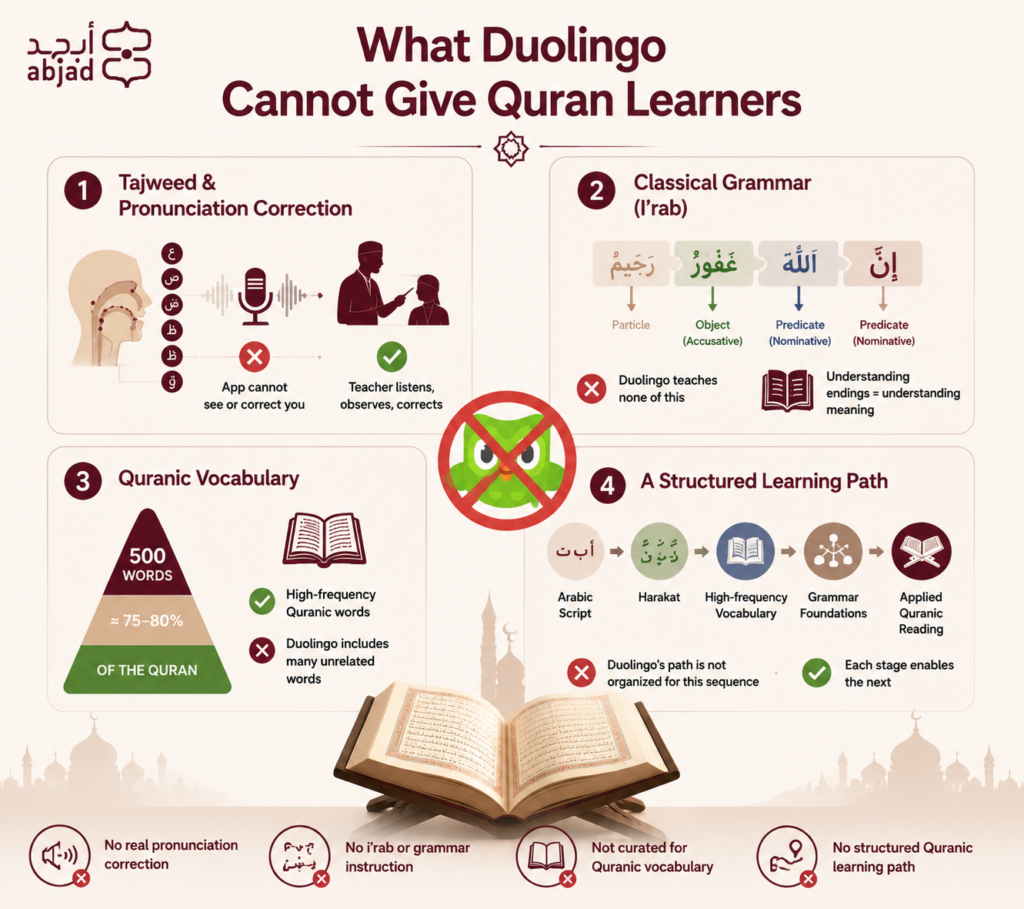
Duolingo can introduce beginners to Arabic basics, but Quranic Arabic requires specialized skills that language apps are not designed to teach.
1. Tajweed and Pronunciation Correction
Arabic contains sounds that English speakers have never produced: the deep ع (ayn), the emphatic ص (sad), ض (dad), ط (ta), and ظ (dha), and the guttural ق (qaf). Mispronouncing these in Quranic recitation is not a minor accent issue — in some cases, it changes the word’s meaning entirely, which affects the validity of recitation.
Duolingo plays audio and checks whether you tapped the right answer. It cannot observe your mouth and throat position, identify where your sound is going wrong, or demonstrate the physical correction. A qualified tajweed teacher does all three. This gap is not bridgeable by any app.
2. Classical Grammar (I’rab)
Quranic Arabic relies on a full grammatical case system called i’rab, where word endings signal grammatical function — subject, object, possessive, and more. Ignoring these endings means reading words in isolation without understanding how they connect to form meaning. Duolingo introduces none of this, which is appropriate for a conversation app but disqualifying for Quranic study.
3. Quranic Vocabulary
Research on Quranic Arabic shows that the 500 most frequent words in the Quran account for roughly 75–80% of all Quranic text. Learning these 500 words in their correct Quranic forms is therefore the fastest path to comprehension. Duolingo’s vocabulary list was not curated for this purpose and includes many everyday words that rarely or never appear in the Quran, while omitting high-frequency Quranic terms entirely.
4. A Structured Learning Path
Quranic Arabic study has a logical sequence: Arabic script → harakat → high-frequency vocabulary → classical grammar foundations → applied Quranic reading. Each stage enables the next. Duolingo’s path is not organized around this sequence. It mixes vocabulary, letters, and patterns in a way designed for daily engagement, not for building Quranic comprehension systematically.
Watch Our Classes in Action
Curious what a real session looks like? Take a peek inside our interactive classrooms and see how our expert instructors bring the Arabic language to life. Watch a sample lesson below!
Begin Your Arabic Journey in the UAE
Join Abjad Institute for a professional and immersive Arabic language experience tailored to your goals.
Book Your Free TrialStart Your Quranic Arabic Journey the Right Way with Abjad Institute
Duolingo can open the door to Arabic. Genuine Quranic understanding requires a different key entirely — one built from classical grammar, Quran-specific vocabulary, tajweed instruction, and consistent feedback from a qualified teacher.
At Abjad Institute, our Quranic Arabic program is built precisely around what Duolingo skips: a structured curriculum from the Arabic script through classical grammar, instructors trained in Quranic Arabic specifically, and live one-on-one sessions that correct your pronunciation and build your comprehension lesson by lesson.
Whether you are starting from zero or have dabbled with apps and want to make real progress, Abjad Institute gives you a clear path forward.
[Book your free trial lesson today ]

Discover Our Arabic Courses
- Arabic Course for Kids
- Arabic Conversation for Kids
- Arabic Qaida for Kids
- Beginner Arabic for Kids
- Arabic Grammar for Kids
- Teen Arabic Summer Course
- Arabic Kids Camps
- UAE Kindergarten Arabic Classes
- Modern Standard Arabic Course
- Fusha Arabic Course
- Classical Arabic Course
- Emirati Arabic Course
- Gulf Arabic Course
- Learn Saudi Arabic
- Business Arabic Course UAE
- Arabic Language Classes for Professionals in UAE
- Quranic Arabic Course
Begin Your Arabic Journey in the UAE
Join Abjad Institute for a professional and immersive Arabic language experience tailored to your goals.
Book Your Free TrialConclusion
Can you learn Quranic Arabic on Duolingo? No — not in any meaningful sense. Duolingo is a beginner Arabic tool that covers the alphabet and basic vocabulary. Quranic Arabic is a classical discipline requiring tajweed, classical grammar, Quran-specific vocabulary, and qualified teaching. These are fundamentally different goals, and Duolingo was built for a different purpose.
Use Duolingo if you enjoy it, if it helps you stay consistent, or if you want a gentle introduction to the Arabic script before your first structured lesson. But do not mistake familiarity with the alphabet for readiness to read the Quran.
The path to Quranic Arabic runs through structured teaching, qualified instructors, and a curriculum designed specifically for that purpose — not through a gamified app. Start with the right tool for the right goal.
FAQ About Duolingo and Quranic Arabic
Before starting a Quranic Arabic journey, many learners wonder whether language apps like Duolingo are enough. These FAQs explain what Duolingo can help with, where it falls short, and what learners need for true Quran understanding.
Can you learn Quranic Arabic on Duolingo?
No. Duolingo teaches a simplified form of Modern Standard Arabic — covering letters, basic vocabulary, and short phrases. It does not teach tajweed, classical Quranic grammar, or Quran-specific vocabulary. Learners who want to read and understand the Quran need a dedicated Quranic Arabic course.
Does Duolingo teach Quranic Arabic?
Duolingo does not offer a Quranic Arabic track or any course focused on classical Arabic grammar or tajweed. Its Arabic content is designed for general beginner familiarity with the language, not Quranic study.
Can you learn Quranic Arabic on Duolingo for free?
Duolingo’s Arabic course is free, but it does not teach Quranic Arabic regardless of the price. Free Quranic Arabic resources do exist — structured grammar books and dedicated online platforms — but they are separate from Duolingo entirely.
How is Quranic Arabic different from the Arabic Duolingo teaches?
Duolingo teaches simplified Modern Standard Arabic focused on everyday communication. Quranic Arabic is a classical register with a full case grammar system (i’rab), Quran-specific vocabulary, and tajweed pronunciation rules. The two overlap only at the level of the Arabic script and a limited amount of shared vocabulary.
What should I use instead of Duolingo for Quranic Arabic?
A dedicated Quranic Arabic course with a qualified teacher is the most effective alternative. Look for a program that covers the Arabic script with harakat, high-frequency Quranic vocabulary, classical grammar basics, and live pronunciation correction — the elements Duolingo does not provide.
Is it worth using Duolingo before starting a Quranic Arabic course?
Yes, with one condition: use it only for alphabet familiarity and daily habit building, not as a substitute for structured Quranic study. Arriving at your first lesson already recognizing Arabic letters saves time. Arriving thinking Duolingo has prepared you for Quranic reading will set unrealistic expectations.
Related Articles
Learn Arabic





Leave a Reply