 Quran
| Key Takeaways |
| Arabic has only two grammatical genders, masculine and feminine, with no neutral category equivalent to the English word “it”. |
| A noun’s gender controls the form of its adjective, verb, pronoun, and demonstrative, so one wrong ending breaks the whole sentence. |
| Three endings signal a feminine word: ة, اء, and ى, though around forty common words are feminine without carrying any visible marker. |
| Numbers from three to ten reverse gender, so masculine nouns take the feminine number form and feminine nouns take the masculine form. |
Does Arabic have grammatical gender? This is the first structural question most learners in the UAE ask after their opening lessons, usually when they notice two spellings of the same adjective on a single page.
The answer shapes everything that follows. Unlike English, which treats objects as neutral, Arabic sorts every noun into one of two categories and then demands that the rest of the sentence follow that choice.
This guide covers how word gender in Arabic works across nouns, adjectives, verbs, pronouns, plurals, prepositions, and numbers, with the exact markers that tell you which category a word belongs to.
Does the Arabic Language Assign Gender to Every Word?
Yes, Arabic assigns gender to every noun without exception, including objects, abstract ideas, and places. There is no neutral option and no way to avoid the choice.
A table (طاولة) is feminine. A book (كتاب) is masculine. Neither carries biological sex, yet both force the speaker to select matching forms for every word that refers to them.
This is why grammatical gender in Arabic is not a side topic for advanced students. It appears in the first sentence a beginner builds and continues through every level of the language.
Why Does Arabic Have Grammatical Gender in Every Noun?
Arabic inherits its two-gender system from the wider Semitic family, where gender marking is built into the root and pattern structure rather than added as an optional label.
The system also carries a practical function. Because Arabic allows flexible word order, gender agreement tells the listener which adjective belongs to which noun even when several nouns appear in one sentence.
Classical grammarians treated the masculine as the base form and the feminine as the marked form. That logic explains why most feminine words are built by adding an ending to a masculine stem.
Types of Gender Rules in Arabic Grammar
Gender does not behave the same way across all word classes. Some parts of speech change shape completely, others take a small suffix, and one group ignores gender entirely.
| Word Class | Carries Gender | How Gender Appears |
| Nouns | Yes | Fixed by the word itself, often marked by ة |
| Adjectives | Yes | Must match the noun they describe |
| Verbs | Yes | Prefix or suffix changes with the subject |
| Pronouns | Yes | Separate words for masculine and feminine |
| Demonstratives | Yes | هذا for masculine, هذه for feminine |
| Numbers | Yes | Reverse agreement from three to ten |
| Prepositions | No | Fixed form, gender shows in the attached pronoun |
These are the main types of gender rules in Arabic grammar, and each one is covered in detail in the sections below with examples you can test immediately.
Read also: 10 Most Used Sentences in Arabic With Pronunciation
How to Tell If an Arabic Word Is Masculine or Feminine
Two checks answer this question. First, look at the ending of the word. Second, check whether the word belongs to a known group of unmarked feminine nouns.
Feminine Endings That Mark Word Gender in Arabic
Three written endings identify a feminine noun on sight. Learning these three signs resolves the gender of the large majority of Arabic vocabulary without any memorization.
| Ending | Example | Transliteration | Meaning |
| ة (taa marbuta) | مَدْرَسَة | madrasa | school |
| اء (alif mamduda) | صَحْرَاء | sahraa | desert |
| ى (alif maqsura) | ذِكْرَى | dhikra | memory |
The first of these is by far the most common. Adding ة to a masculine noun produces its feminine counterpart, as in مُعَلِّم (male teacher) becoming مُعَلِّمَة (female teacher).
Feminine Words Without a Visible Gender Marker
A closed group of nouns is feminine despite having no ending. These words must be learned as a set, because nothing in their spelling reveals their category.
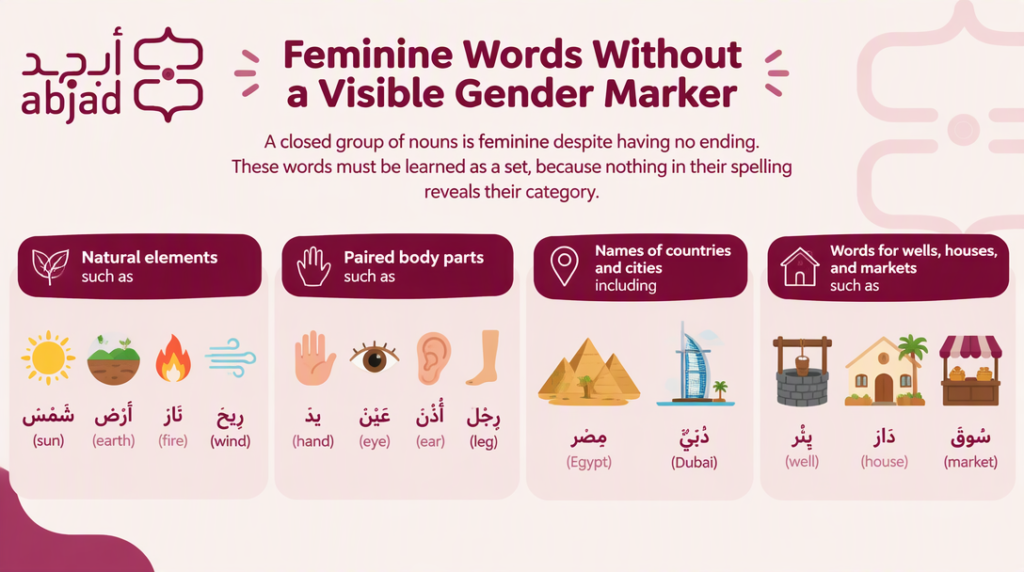
- Natural elements such as شَمْس (sun), أَرْض (earth), نَار (fire), and رِيح (wind).
- Paired body parts such as يَد (hand), عَيْن (eye), أُذُن (ear), and رِجْل (leg).
- Names of countries and cities, including مِصْر (Egypt) and دُبَيّ (Dubai).
- Words for wells, houses, and markets such as بِئْر, دَار, and سُوق.
Arabic Noun Gender Rules for Masculine and Feminine
Arabic noun gender splits into two further layers that classical grammar treats separately. The distinction matters because it predicts how flexible a word’s agreement will be.
Real Feminine and Figurative Feminine Nouns
A real feminine noun (مؤنث حقيقي) refers to a female living being, such as بِنْت (girl) or نَاقَة (she-camel). The gender matches a biological reality.
A figurative feminine noun (مؤنث مجازي) has no female referent at all. Words such as شَمْس (sun) and سَيَّارَة (car) are feminine purely by grammatical convention.
Both types demand feminine agreement from adjectives and verbs. The difference appears mainly in poetry and classical texts, where figurative feminines sometimes accept masculine agreement.
Masculine Nouns That Carry a Feminine Ending
A small group of words ends in ة yet stays masculine, because meaning overrides the written marker. Treating these as feminine is one of the most frequent beginner errors.
- حَمْزَة, طَلْحَة, and مُعَاوِيَة are male personal names.
- خَلِيفَة means caliph and refers to a male ruler.
- عَلَّامَة means a highly learned scholar.
Abjad Academy offers an Arabic Grammar Course that drills noun gender, agreement, and case endings through live correction with certified Arabic teachers based in the Gulf.
Practice Gender Agreement in a Free Lesson
Arabic Pronoun Gender Across Singular and Plural
Arabic pronoun gender is more detailed than English. Where English offers one word for “you”, Arabic offers five, split by gender and by number.
| Meaning | Masculine | Feminine |
| You (singular) | أَنْتَ (anta) | أَنْتِ (anti) |
| He / She | هُوَ (huwa) | هِيَ (hiya) |
| You (plural) | أَنْتُمْ (antum) | أَنْتُنَّ (antunna) |
| They (plural) | هُمْ (hum) | هُنَّ (hunna) |
| You / They (dual) | أَنْتُمَا, هُمَا | أَنْتُمَا, هُمَا |
The dual forms are the single exception. Both أَنْتُمَا and هُمَا serve masculine and feminine pairs alike, which gives learners one rule less to memorize.
Demonstratives follow the same split.
هَذَا points to a masculine item and هَذِهِ points to a feminine one, so pointing at an object in Arabic already requires a gender decision.
See Us in Action!
Curious about what our online classrooms look like? Watch the short clips below to see how our interactive, one-on-one sessions bring learning to life with real-time feedback and engaging teaching methods.
Begin Your Arabic Journey in the UAE
Join Abjad Institute for a professional and immersive Arabic language experience tailored to your goals.
Book Your Free TrialDo Verbs in Arabic Have Gender?
Yes, Arabic verbs change form according to the gender of their subject, in both the past and the present tense. The verb itself tells you who performed the action.
Arabic Verb Gender in the Past Tense
In the past tense, a silent ت is attached to the end of the verb when the subject is feminine. Nothing is added when the subject is masculine.
| Subject | Masculine | Feminine |
| He / She wrote | كَتَبَ (kataba) | كَتَبَتْ (katabat) |
| You wrote | كَتَبْتَ (katabta) | كَتَبْتِ (katabti) |
| They wrote | كَتَبُوا (katabu) | كَتَبْنَ (katabna) |
This feminine ت appears constantly in Quranic Arabic, including the opening verse of Surah Al-Inshiqaq, where the feminine noun السماء forces the feminine verb form.
إِذَا السَّمَاءُ انْشَقَّتْ
(Idha as-samaa’u inshaqqat)
“When the sky has split open.”
Arabic Verb Gender in the Present Tense
In the present tense, gender shows in the prefix rather than the suffix. The letter ي signals a masculine third-person subject, while ت signals a feminine one.
So يَكْتُبُ means “he writes” and تَكْتُبُ means “she writes”. The root letters never change, which makes the prefix the only clue to the subject’s gender.
Commands follow the same logic.
اُكْتُبْ (uktub) addresses a man, while اُكْتُبِي (uktubi) addresses a woman, a difference heard in every Arabic classroom in Dubai.
Abjad Academy offers a Modern Standard Arabic Course that trains verb conjugation across both genders until the correct endings become automatic in speech and writing.

Start Your Arabic Verb Training Today
Gender Adjectives in Arabic and Noun Agreement
Gender adjectives in Arabic follow their noun completely. An adjective describing a feminine noun takes ة, and an adjective describing a masculine noun stays bare.
| Arabic Phrase | Transliteration | Meaning |
| طَالِب مُجْتَهِد | talib mujtahid | a hardworking male student |
| طَالِبَة مُجْتَهِدَة | taliba mujtahida | a hardworking female student |
| كِتَاب جَدِيد | kitab jadid | a new book |
| سَيَّارَة جَدِيدَة | sayyara jadida | a new car |
Agreement extends beyond gender alone. The adjective must also match its noun in number, in definiteness, and in case ending, which produces four simultaneous checks in one short phrase.
Arabic also builds a separate pair for colors and physical traits.
أَحْمَر (red, masculine) becomes حَمْرَاء (red, feminine), a pattern that ignores the usual ة rule entirely.
Gender Rules for Plural Nouns in Arabic
Gender in plural nouns works on two separate systems, and choosing the wrong one produces a sentence that native speakers immediately flag as incorrect.
Sound Plural Forms and Word Gender in Arabic
Sound plurals keep the singular word intact and attach an ending. The ending itself carries the gender, which makes these plurals easy to identify at a glance.
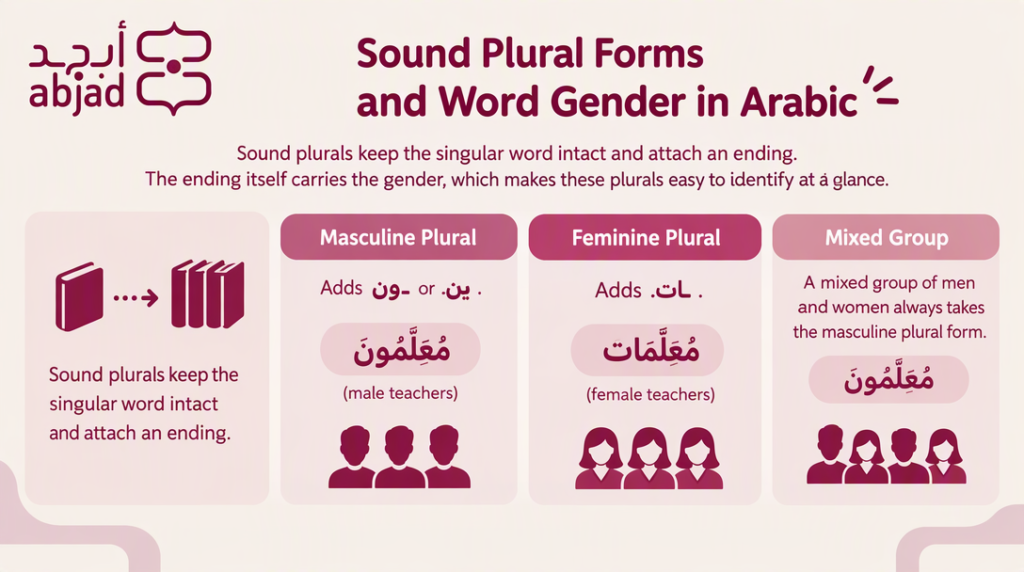
- Sound masculine plural adds ـون or ـين, as in مُعَلِّمُون (male teachers).
- Sound feminine plural adds ـات, as in مُعَلِّمَات (female teachers).
- A mixed group of men and women always takes the masculine plural form.
Broken Plurals of Non-Human Nouns
Broken plurals rearrange the internal letters of a word, as كِتَاب becomes كُتُب. For non-human nouns, these plurals trigger a rule that surprises most learners.
Any plural of a non-human noun is treated as a feminine singular. So “the new books” becomes الكُتُب الجَدِيدَة, with a feminine singular adjective rather than a plural one.
The Quran applies this rule consistently, including in Surah Al-Qiyamah, where the plural وُجُوه takes the feminine singular adjective نَاضِرَة instead of a plural form.
وُجُوهٌ يَوْمَئِذٍ نَاضِرَةٌ
(Wujuhun yawma’idhin nadirah)
“Some faces, that Day, will be radiant.”
Abjad Academy offers an Arabic Course for Beginners that introduces plural forms and their agreement rules in a sequence beginners can follow without confusion.

Book Your First Arabic Lesson Free
Arabic Preposition Gender and Pronoun Endings
Prepositions are the one word class that carries no gender at all.
فِي (in), مِن (from), عَلَى (on), and إِلَى (to) keep the same form regardless of what follows them.
Gender appears only when a pronoun attaches to the preposition.
مِنْهُ means “from him” and مِنْهَا means “from her”, so the ending does the gender work.
The same applies to possessive endings on nouns.
كِتَابُهُ is “his book” and كِتَابُهَا is “her book”, with the noun itself remaining unchanged in both cases.
Read also: Tenses in Arabic Explained With Charts and Examples
Number and Gender Agreement in Arabic Counting
Counting reverses the expected pattern. From three to ten, a masculine noun takes the feminine number form and a feminine noun takes the masculine form.
| Number Range | Agreement Behavior | Example |
| 1 and 2 | Match the noun normally | رَجُل وَاحِد, اِمْرَأَة وَاحِدَة |
| 3 to 10 | Reverse the noun’s gender | ثَلَاثَة رِجَال, ثَلَاث نِسَاء |
| 11 and 12 | Both parts match the noun | أَحَدَ عَشَرَ رَجُلًا |
| 13 to 19 | Unit reverses, ten agrees | ثَلَاثَةَ عَشَرَ رَجُلًا |
| 20 and above | No gender change in the tens | عِشْرُونَ رَجُلًا |
This reversal (التذكير والتأنيث في العدد) is the rule learners misapply most often. Writing ثَلَاثَة نِسَاء instead of ثَلَاث نِسَاء is an immediate signal of a non-native speaker.
Inside Our Virtual Classrooms
We believe in full transparency and proven quality. Take a look at these actual snippets from our live classes to experience our modern learning platform, patient instructors, and interactive student participation.
Begin Your Arabic Journey in the UAE
Join Abjad Institute for a professional and immersive Arabic language experience tailored to your goals.
Book Your Free TrialGender in Arabic Language Across Emirati Daily Speech
Gender in Arabic language use does not weaken in spoken dialect. Emirati Arabic marks it as firmly as Modern Standard Arabic, and sometimes more audibly.
Addressing a woman in the UAE adds a clear ـين sound to the present tense verb. “شُو تِبِي؟” (shu tabi) speaks to a man, while “شُو تِبِين؟” (shu tabeen) speaks to a woman.
Participles behave the same way in everyday exchanges. “وِين رَايِح؟” asks a man where he is going, while “وِين رَايْحَة؟” asks a woman the same question.
For professionals working across Dubai, Abu Dhabi, and Sharjah, this matters daily. Using a masculine ending with a female colleague is grammatically wrong and socially noticeable in the first sentence.
Learn Arabic Gender Rules With Abjad Academy Instructors
Gender agreement is corrected fastest through live speaking practice, because the error is audible before it becomes visible. Abjad Academy builds every lesson around that correction loop with qualified Arabic teachers.
What sets Abjad Academy apart:
- One-to-one live sessions with native Arabic instructors who correct gender endings in real time.
- Flexible scheduling aligned with UAE working hours and school timetables.
- Separate learning tracks for Modern Standard Arabic, Quranic Arabic, and Emirati dialect.
Our Arabic Courses
- Arabic Grammar Course.
- Modern Standard Arabic Course.
- Arabic Course for Beginners.
- Emirati Arabic Course.
- Arabic Speaking Course.
- Arabic Courses for Kids.
Conclusion
Does Arabic have grammatical gender? The answer is a complete yes, applied to every noun in the language and enforced by every adjective, verb, and pronoun that refers to it.
The system is learnable because it runs on a small set of signals. Three feminine endings, one short list of unmarked feminine nouns, and one reversal rule for numbers cover most of what learners meet.
Treat gender as a sentence-level habit rather than a vocabulary detail. Once agreement becomes automatic, Arabic word order, reading fluency, and listening comprehension all improve at the same time.
FAQs
Are There Gender Pronouns in Arabic?
Yes, Arabic has separate pronouns for masculine and feminine in the second and third person, both singular and plural. Only the dual forms أَنْتُمَا and هُمَا are shared, serving masculine and feminine pairs equally.
What Are the Gender Forms in Arabic?
Arabic has two gender forms, masculine (مُذَكَّر) and feminine (مُؤَنَّث). There is no neutral third category. The masculine is the base form, and the feminine is usually created by adding ة, اء, or ى to it.
How Do You Know If an Arabic Word Is Male or Female?
Check the ending first. Words ending in ة, اء, or ى are feminine. Then check whether the word belongs to the unmarked feminine group, which includes body-part pairs, natural elements, countries, and cities.
Does Arabic Have a Neutral Gender Like the English Word “It”?
No, Arabic has no neutral gender. Every object, concept, and place is classified as either masculine or feminine, so a chair, an idea, and a city each require a gendered pronoun and a matching adjective.
Do Arabic Numbers Follow Gender Rules?
Yes, and they reverse. Numbers from three to ten take the opposite gender of the counted noun, so ثَلَاثَة رِجَال uses the feminine number form with a masculine noun, while ثَلَاث نِسَاء uses the masculine form.
How Long Does It Take to Learn Arabic Gender Rules?
Most learners recognize the main markers within two to three weeks of daily study. Applying them automatically in speech usually takes three to six months of consistent practice with a teacher who corrects errors immediately.





[…] Read also: Does Arabic Have Grammatical Gender? Word Gender Guide […]
[…] Read also: Does Arabic Have Grammatical Gender? Word Gender Guide […]