 Quran
Arabic present tense verbs appear more often than any other verb form in conversation, news broadcasts, workplace Arabic, and the Quran. Learners who control this single form gain immediate traction in reading and listening.
Most beginners meet this tense as a table of endings to memorize, then struggle the moment a particle changes the ending. The real system is smaller than it looks, because every form grows from one three letter root and one prefix set.
This guide covers formation, the complete conjugation chart, the three grammatical moods, every usage, negation, future meaning, Quranic examples, frequent learner errors, and short practice drills.
Arabic Present Tense Definition and Core Function
The Arabic present tense, called المضارع (al-muḍāriʿ, “the resembling one”), is the verb form that expresses an action in progress, a repeated habit, a permanent truth, or an expected future event.
Classical grammarians gave it that name because it resembles the noun. Unlike the past tense, its final letter carries case style endings that shift according to the particle in front of it, which is why mood matters so much here.
English separates “I write,” “I am writing,” and “I will write” into three structures. Arabic keeps one form, أَكْتُبُ (aktubu, I write), and lets context, adverbs, and particles carry the time information.
Four Prefix Letters That Mark Present Tense Verbs
Every present tense verb in Arabic opens with one of four letters. Teachers across the UAE usually introduce them through the mnemonic word أَنَيْتُ (anaytu), which contains all four in order.
These prefixes carry the subject information that English expresses through a separate pronoun. Once a learner recognizes them, present tense verbs become instantly identifiable inside any sentence or verse.
| Prefix | Example | Transliteration | Subject |
| أَ | أَكْتُبُ | aktubu | أنا (anā, I) |
| نَ | نَكْتُبُ | naktubu | نحن (naḥnu, we) |
| يَ | يَكْتُبُ | yaktubu | هو (huwa, he) |
| تَ | تَكْتُبُ | taktubu | أنتَ (anta, you) and هي (hiya, she) |
Notice the overlap in the final row. The letter تَ serves both the second person and the third person feminine singular, so تَكْتُبُ (taktubu) means “you write” or “she writes” depending on context.
How Arabic Present Tense Verbs Are Built From Roots
Present tense verbs are built by placing a prefix on the three letter root and attaching an ending that signals mood, number, and gender. Nothing is memorized word by word.
Prefix, Stem, and Ending in Every Present Verb
Each verb divides into three predictable slots. The prefix names the subject, the stem carries the root meaning, and the ending marks the grammatical mood or the number and gender of the subject.
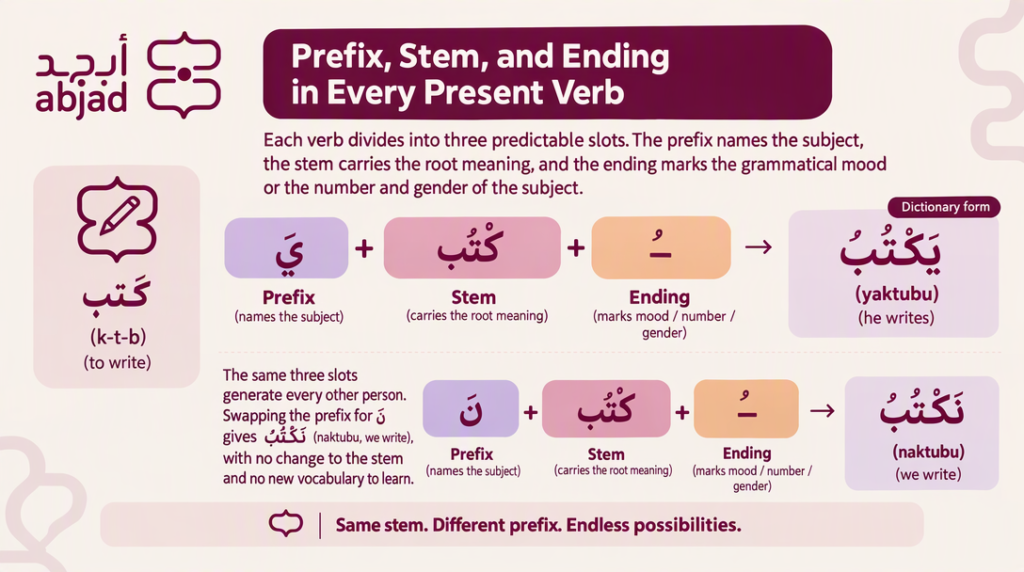
Take the root كتب (k-t-b), which relates to writing. Adding يَ plus the stem كْتُب plus the ending ـُ produces يَكْتُبُ (yaktubu, he writes), the dictionary reference form for this verb.
The same three slots generate every other person. Swapping the prefix for نَ gives نَكْتُبُ (naktubu, we write), with no change to the stem and no new vocabulary to learn.
Three Middle Vowel Patterns in Form I Verbs
In Form I verbs, the middle root letter of the present tense takes one of three short vowels. This vowel is not predictable from the past tense, so learners record it with each new verb.
| Verb | Transliteration | Meaning | Middle Vowel |
| يَكْتُبُ | yaktubu | he writes | ḍammah (u) |
| يَفْتَحُ | yaftaḥu | he opens | fatḥah (a) |
| يَجْلِسُ | yajlisu | he sits | kasrah (i) |
Dictionaries list this vowel beside the entry for a reason. Guessing it produces a word that native speakers still understand but immediately mark as non-native pronunciation.
Abjad Academy teaches this pattern system inside a structured Arabic Grammar Course that moves students from root recognition to full sentence building with a certified tutor.

Try a Free Arabic Grammar Lesson
Arabic Present Tense Conjugation Chart for 14 Pronouns
A complete Arabic present tense conjugation chart covers 14 forms, generated from three persons, two genders, and three numbers. The verb كَتَبَ (kataba, he wrote) serves as the standard model below.
| Pronoun | Transliteration | Present Verb | Transliteration | Meaning |
| أنا | anā | أَكْتُبُ | aktubu | I write |
| نحن | naḥnu | نَكْتُبُ | naktubu | we write |
| أنتَ | anta | تَكْتُبُ | taktubu | you (m. sg.) write |
| أنتِ | anti | تَكْتُبِينَ | taktubīna | you (f. sg.) write |
| أنتما (m.) | antumā | تَكْتُبَانِ | taktubāni | you two (m.) write |
| أنتما (f.) | antumā | تَكْتُبَانِ | taktubāni | you two (f.) write |
| أنتم | antum | تَكْتُبُونَ | taktubūna | you (m. pl.) write |
| أنتنّ | antunna | تَكْتُبْنَ | taktubna | you (f. pl.) write |
| هو | huwa | يَكْتُبُ | yaktubu | he writes |
| هي | hiya | تَكْتُبُ | taktubu | she writes |
| هما (m.) | humā | يَكْتُبَانِ | yaktubāni | they two (m.) write |
| هما (f.) | humā | تَكْتُبَانِ | taktubāni | they two (f.) write |
| هم | hum | يَكْتُبُونَ | yaktubūna | they (m. pl.) write |
| هنّ | hunna | يَكْتُبْنَ | yaktubna | they (f. pl.) write |
Substitute any Form I root into the same template and the chart regenerates itself. Using شرب (sh-r-b, drinking) produces يَشْرَبُ (yashrabu, he drinks) and تَشْرَبِينَ (tashrabīna, you drink) with identical endings.
Learners who memorize this one table unlock hundreds of verbs at once. That is the practical payoff of the root and pattern system, and it is the reason this chart comes early in any serious Arabic syllabus.
Three Grammatical Moods of Present Tense Verbs
Here is the part most beginner guides skip. A present tense verb changes its final ending depending on the particle before it, and Arabic grammar gives each ending a name and a trigger.
| Mood | Arabic Name | Ending | Common Triggers |
| Indicative | مرفوع (marfūʿ) | ḍammah ـُ | no particle, default state |
| Subjunctive | منصوب (manṣūb) | fatḥah ـَ | أن (an), لن (lan), كي (kay), حتى (ḥattā) |
| Jussive | مجزوم (majzūm) | sukūn ـْ | لم (lam), لا الناهية (lā al-nāhiya), إن (in) |
Compare the three states in one verb.
يَكْتُبُ (yaktubu, he writes) is indicative, لَنْ يَكْتُبَ (lan yaktuba, he will not write) is subjunctive, and لَمْ يَكْتُبْ (lam yaktub, he did not write) is jussive.
One further detail decides whether sentences sound correct. In plural and dual forms, the subjunctive and jussive drop the final noon, so تَكْتُبُونَ (taktubūna) becomes لَنْ تَكْتُبُوا (lan taktubū, you will not write).
Read also: Masculine And Feminine Nouns In Arabic
Main Usages of Present Tense Verbs in Arabic
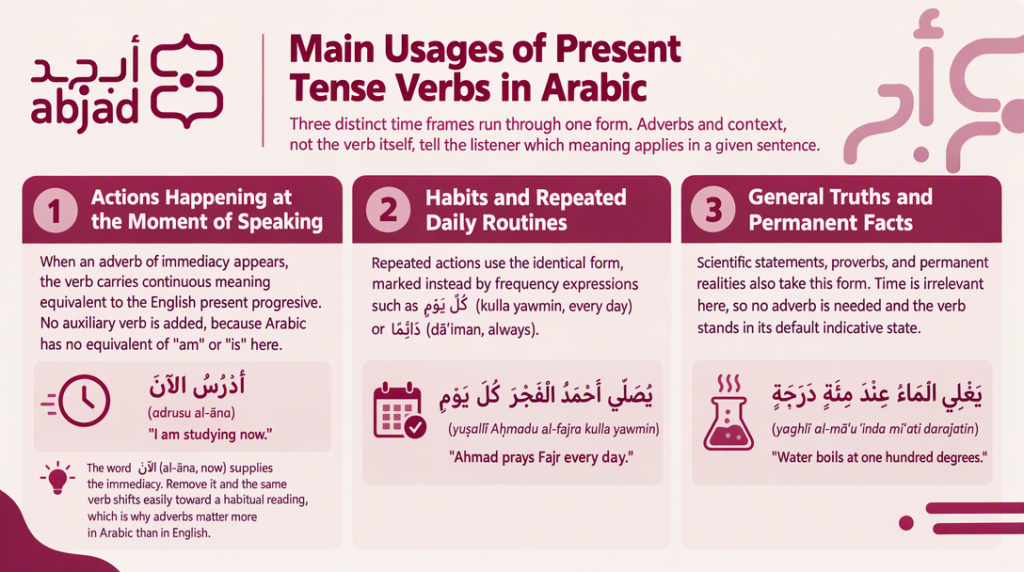
Three distinct time frames run through one form. Adverbs and context, not the verb itself, tell the listener which meaning applies in a given sentence.
Actions Happening at the Moment of Speaking
When an adverb of immediacy appears, the verb carries continuous meaning equivalent to the English present progressive. No auxiliary verb is added, because Arabic has no equivalent of “am” or “is” here.
أَدْرُسُ الآنَ
(adrusu al-āna)
“I am studying now.”
The word الآنَ (al-āna, now) supplies the immediacy. Remove it and the same verb shifts easily toward a habitual reading, which is why adverbs matter more in Arabic than in English.
Habits and Repeated Daily Routines
Repeated actions use the identical form, marked instead by frequency expressions such as كُلَّ يَوْمٍ (kulla yawmin, every day) or دَائِمًا (dāʾiman, always).
يُصَلِّي أَحْمَدُ الْفَجْرَ كُلَّ يَوْمٍ
(yuṣallī Aḥmadu al-fajra kulla yawmin)
“Ahmad prays Fajr every day.”
General Truths and Permanent Facts
Scientific statements, proverbs, and permanent realities also take this form. Time is irrelevant here, so no adverb is needed and the verb stands in its default indicative state.
يَغْلِي الْمَاءُ عِنْدَ مِئَةِ دَرَجَةٍ
(yaghlī al-māʾu ʿinda miʾati darajatin)
“Water boils at one hundred degrees.”
Speaking practice is what converts these three usages from a chart into a reflex. Abjad Academy runs an Arabic Speaking Course where tutors correct tense choice live during conversation.

Book a Free Conversation Session
Negation of Arabic Present Tense With Laa and Lan
Two particles negate present tense verbs, and each one produces a different meaning and a different ending. Choosing the wrong particle changes the sentence from a denial into a future refusal.
لا (lā) negates a present or habitual action and leaves the verb in its default indicative state. The ending stays a ḍammah, which keeps the sentence firmly in present time.
لا يَكْذِبُ الْمُؤْمِنُ
(lā yakdhibu al-muʾminu)
“The believer does not lie.”
لن (lan) negates the future with emphasis and forces the verb into the subjunctive. The final ḍammah becomes a fatḥah, and that vowel shift is the audible signal of the change.
لَنْ أَكْذِبَ
(lan akdhiba)
“I will never lie.”
| Particle | Transliteration | Meaning | Ending | Example |
| لا | lā | does not | ḍammah | لا يَكْتُبُ (lā yaktubu) |
| لن | lan | will not | fatḥah | لَنْ يَكْتُبَ (lan yaktuba) |
| لم | lam | did not | sukūn | لَمْ يَكْتُبْ (lam yaktub) |
The third row surprises most learners.
لم (lam) attaches to a present tense form yet produces past meaning, which is why Arabic grammarians treat tense and form as two separate questions.
Future Meaning Built From Present Tense Verbs
Arabic has no separate future conjugation. Future meaning comes from attaching one of two particles to the front of an ordinary present tense verb, leaving the conjugation itself untouched.
سَـ (sa-) attaches directly to the verb and indicates the near future.
سَأَكْتُبُ الرِّسَالَةَ غَدًا (sa-aktubu al-risālata ghadan) means “I will write the letter tomorrow.”
سَوْفَ (sawfa) stands as a separate word and carries a more formal, more distant tone.
سَوْفَ نُسَافِرُ (sawfa nusāfiru) means “we will travel,” and it appears far more often in writing than in casual speech.
Context alone can also push the verb forward in time. Adding غَدًا (ghadan, tomorrow) to a bare present verb creates future meaning, though particle construction remains the clearer and more common choice.
See Us in Action
Curious about what our online classrooms look like? Watch the short clips below to see how our interactive, one-on-one sessions bring learning to life with real-time feedback and engaging teaching methods.
Begin Your Arabic Journey in the UAE
Join Abjad Institute for a professional and immersive Arabic language experience tailored to your goals.
Book Your Free TrialPresent Tense Compared With Past and Imperative
Arabic verbs sit in a three way system, and the differences are structural rather than lexical. All three forms draw on the same root, so the comparison is a matter of affixes and endings.
| Feature | الماضي (al-māḍī, past) | المضارع (al-muḍāriʿ, present) | الأمر (al-amr, imperative) |
| Structure | suffixes only | prefix plus ending | stripped prefix, added alif |
| Example (he) | كَتَبَ (kataba) | يَكْتُبُ (yaktubu) | اُكْتُبْ (uktub) |
| Meaning | he wrote | he writes | write! |
| Negation | ما (mā), لم (lam) | لا (lā), لن (lan) | لا الناهية (lā al-nāhiya) |
| Endings | fixed | variable by mood | fixed sukūn |
The past tense is built purely with suffixes, which makes it stable. The present tense combines prefixes and endings, and only the present tense carries variable endings, which is exactly what grammarians meant by calling it “the resembling one.”
Students working through Modern Standard Arabic benefit from seeing all three tenses in one sequence. Abjad Academy delivers that progression inside a full Modern Standard Arabic Course designed for adult learners.

Start Your Free MSA Assessment
Quranic Examples of Present Tense Verbs in Context
Quranic Arabic is saturated with this form, which means every learner who understands it starts recognizing structure during Salah instead of hearing undifferentiated sound.
The opening chapter contains one of the most recited present tense constructions in the entire Quran, built on the first person plural prefix نَ (na-).
إِيَّاكَ نَعْبُدُ وَإِيَّاكَ نَسْتَعِينُ
(Iyyāka naʿbudu wa-iyyāka nastaʿīn)
“It is You we worship and You we ask for help.”
Both verbs here are present tense.
نَعْبُدُ (naʿbudu, we worship) comes from the root عبد (ʿ-b-d), while نَسْتَعِينُ (nastaʿīnu, we seek help) is a Form X derivation from عون (ʿ-w-n).
A second example from Surah Al-Baqarah stacks three third person plural verbs in a single verse, each one marked by the prefix يَ and the plural ending ـُونَ.
الَّذِينَ يُؤْمِنُونَ بِالْغَيْبِ وَيُقِيمُونَ الصَّلَاةَ وَمِمَّا رَزَقْنَاهُمْ يُنفِقُونَ
(Alladhīna yuʾminūna bil-ghaybi wa yuqīmūna al-ṣalāta wa mimmā razaqnāhum yunfiqūn)
“Those who believe in the unseen, establish prayer, and spend out of what We have provided for them.”
Note the contrast inside this verse.
رَزَقْنَا (razaqnā, We provided) is past tense, while the surrounding verbs are present, which paints belief as an ongoing state rather than a completed event.
Common Mistakes Learners Make With Al-Mudari Verbs
Teachers across Dubai and Abu Dhabi report the same handful of errors in almost every beginner cohort. Each one comes from transferring an English habit onto an Arabic structure.
- Using يَ instead of تَ for “she,” because English keeps “she” visually separate from the verb.
- Keeping the final noon after لن (lan) or لم (lam), producing لَنْ تَكْتُبُونَ instead of the correct لَنْ تَكْتُبُوا (lan taktubū).
- Pairing لم (lam) with a past tense form, when لم always takes the present form in the jussive mood.
- Repeating the subject pronoun unnecessarily, since the prefix already identifies the subject.
- Treating سَـ (sa-) and سَوْفَ (sawfa) as fully interchangeable in formal writing.
The second error is the most persistent, because the dropped noon is quiet and easy to miss in fast speech. Hearing it corrected in real time is what fixes it permanently.
A guided beginner track prevents these habits from setting in at all. Abjad Academy offers an Arabic Course for Beginners that builds verb accuracy before vocabulary volume.
Claim Your Free Beginner Lesson
Practice Drills for Present Tense Verbs in Arabic
Short daily drills beat long weekly sessions for verb retention. Work through the four tasks below using the root درس (d-r-s, studying) and check yourself aloud.
- Conjugate يَدْرُسُ (yadrusu, he studies) across all 14 pronouns without looking at the chart.
- Add لا (lā) to five of those forms and keep the ḍammah ending intact.
- Add لن (lan) to the same five forms and switch each ending to a fatḥah.
- Rewrite three sentences with سَوْفَ (sawfa) and read them aloud twice.
Quick exercise: Pick one verb each morning. Say it in the present, then negate it with لا, then negate it with لن, then push it to the future with سَـ. Four seconds, four grammatical states.
Record yourself on day one and again on day fourteen. The difference in ending accuracy is usually audible, and it tells you whether the mood system has become automatic.
Read also: Arabic Broken Plurals And How Each Pattern Is Formed
Inside Our Virtual Classrooms
We believe in full transparency and proven quality. Take a look at these actual snippets from our live classes to experience our modern learning platform, patient instructors, and interactive student participation.
Begin Your Arabic Journey in the UAE
Join Abjad Institute for a professional and immersive Arabic language experience tailored to your goals.
Book Your Free TrialLearn Arabic Present Tense With Abjad Academy Tutors
Abjad Academy pairs every learner in the UAE and beyond with a native, certified tutor who teaches verb structure through live correction rather than silent chart memorization.
What sets Abjad Academy apart:
- One-on-one live sessions with native Arabic tutors trained for non-Arabic speakers.
- Flexible scheduling built around Gulf working hours and school timetables.
- Structured levels that carry you from the alphabet to full grammatical control.
- Immediate pronunciation and ending correction during every session.
Our Arabic Courses
- Arabic Grammar Course
- Arabic Speaking Course
- Modern Standard Arabic Course
- Arabic Course for Beginners
- Arabic Classes for Adults
- Quranic Arabic Course
Conclusion
The Arabic present tense carries ongoing actions, habits, permanent truths, and future events inside one adaptable form. Four prefix letters, one three letter root, and a short set of endings generate all 14 conjugations.
Mood is the detail that separates confident learners from hesitant ones. Default endings stay marfūʿ, particles such as لن (lan) force manṣūb, and لم (lam) forces majzūm with a dropped noon in plural forms.
Start with the conjugation chart, drill the two negation particles until the ending change feels automatic, then read Quranic verses daily and name the verbs you recognize. Progress compounds faster than most learners expect.
FAQs
What Does Al-Mudari Mean in Arabic Grammar?
المضارع (al-muḍāriʿ) literally means “the resembling one.” Grammarians chose this name because present tense verbs resemble nouns in carrying variable case style endings, unlike past tense verbs, which keep fixed endings regardless of position.
How Many Conjugation Forms Does the Present Tense Have?
Fourteen forms cover every combination of person, gender, and number, including singular, dual, and plural. Dual forms and the feminine plural are usually the last to become automatic, often needing an extra week of focused review.
What Is the Difference Between Laa and Lan?
لا (lā) denies a present or habitual action and leaves the ḍammah ending untouched.
لن (lan) denies a future action with emphasis and forces a fatḥah on the final letter, shifting the verb into the subjunctive mood.
Can Present Tense Verbs Express Past Meaning?
Only with the particle لم (lam). It attaches to a present tense form, forces the jussive ending, and produces past negative meaning, as in لَمْ يَذْهَبْ (lam yadhhab, he did not go).
How Long Does It Take to Memorize the Conjugation Chart?
Most motivated adult beginners internalize all 14 forms within two to three weeks of daily fifteen minute practice. Recognition while reading comes faster than production while speaking, which typically needs guided conversation sessions.





[…] Read also: Arabic Present Tense Forms, Conjugation, Usage, and Negation […]
[…] Read also: Arabic Present Tense Forms, Conjugation, Usage, and Negation […]
[…] Read also: Arabic Present Tense Forms, Conjugation, Usage, and Negation […]