How to Learn Quranic Arabic Free Online in the UAE?
Most Muslims in the UAE recite the Quran every single day — in Fajr, after Maghrib, throughout the nights of Ramadan — yet the meaning of what they are saying remains out of reach. That gap is not a personal shortcoming. It is simply a matter of never having had a clear, realistic starting point.
The UAE is one of the best places in the world to begin learning Quranic Arabic for free. Islamic institutions, public libraries, masjid halaqat, and the Arabic environment surrounding you every day are all tools available right now, at no cost. You just need to know how to use them together.
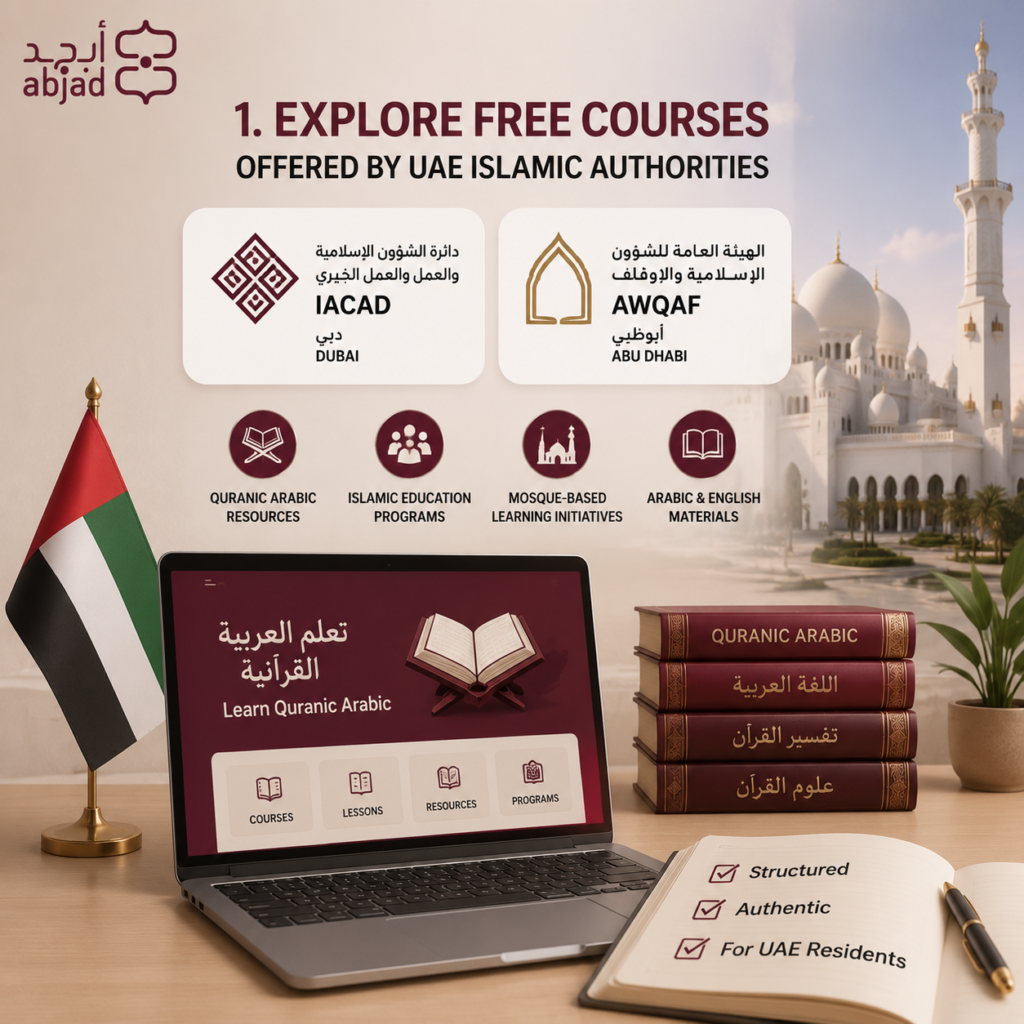
1. Explore Free Courses Offered by UAE Islamic Authorities
The UAE’s Islamic infrastructure is one of the most developed in the Arab world — and much of what it offers is free to residents. The Islamic Affairs and Charitable Activities Department (IACAD) in Dubai and the General Authority of Islamic Affairs and Endowments (Awqaf) in Abu Dhabi both publish Quranic Arabic and Islamic education resources, run programs for residents, and oversee mosque-based learning initiatives across the Emirates.
Before looking anywhere else, check what these authorities offer directly. Their materials are designed for UAE residents, produced in both Arabic and English, and built on verified Islamic scholarship rather than generic language-learning methodology. IACAD’s educational portal and Awqaf’s programs are a starting point that most learners in the UAE overlook entirely — which means those who use them gain a structured foundation before touching any self-study tool.
This official layer matters for a specific reason: Quranic Arabic is not the same as Modern Standard Arabic or Gulf dialect. Resources produced by UAE Islamic authorities are designed around the Quran specifically, not around conversational Arabic or MSA for professional settings. Starting here means starting in the right direction.
2. Use the Mohammed Bin Rashid Library’s Free Digital Resources
UAE residents have access to one of the most significant library collections in the Arab world through the Mohammed Bin Rashid Library in Dubai. Its digital resources include Arabic language references, Quranic sciences texts, and Islamic studies materials — many accessible online to registered residents at no cost.
For Quranic Arabic learners specifically, the library’s collection includes classical Arabic grammar references (Nahw and Sarf texts), Quranic vocabulary dictionaries, and Tafsir works that explain both the linguistic and scholarly dimensions of individual ayahs. These are the same reference works used in traditional Islamic education — access to them in a free public library is an advantage that most online learners globally cannot replicate.
Register for a membership, explore the Arabic language and Islamic studies sections, and identify two or three reference books to work alongside your online lessons: a Quranic vocabulary dictionary, a basic Nahw primer, and a word-by-word Tafsir. Using these as companions to your daily study — rather than relying on digital tools alone — deepens retention and builds the kind of reference habits that sustain long-term learning.
The Sharjah Public Library offers a comparable collection for residents in the Northern Emirates, with free membership and strong Arabic language holdings. If your children are learning Arabic alongside you, Abjad Institute’s Arabic grammar courses for kids build the same structured grammar foundation in an age-appropriate online format.
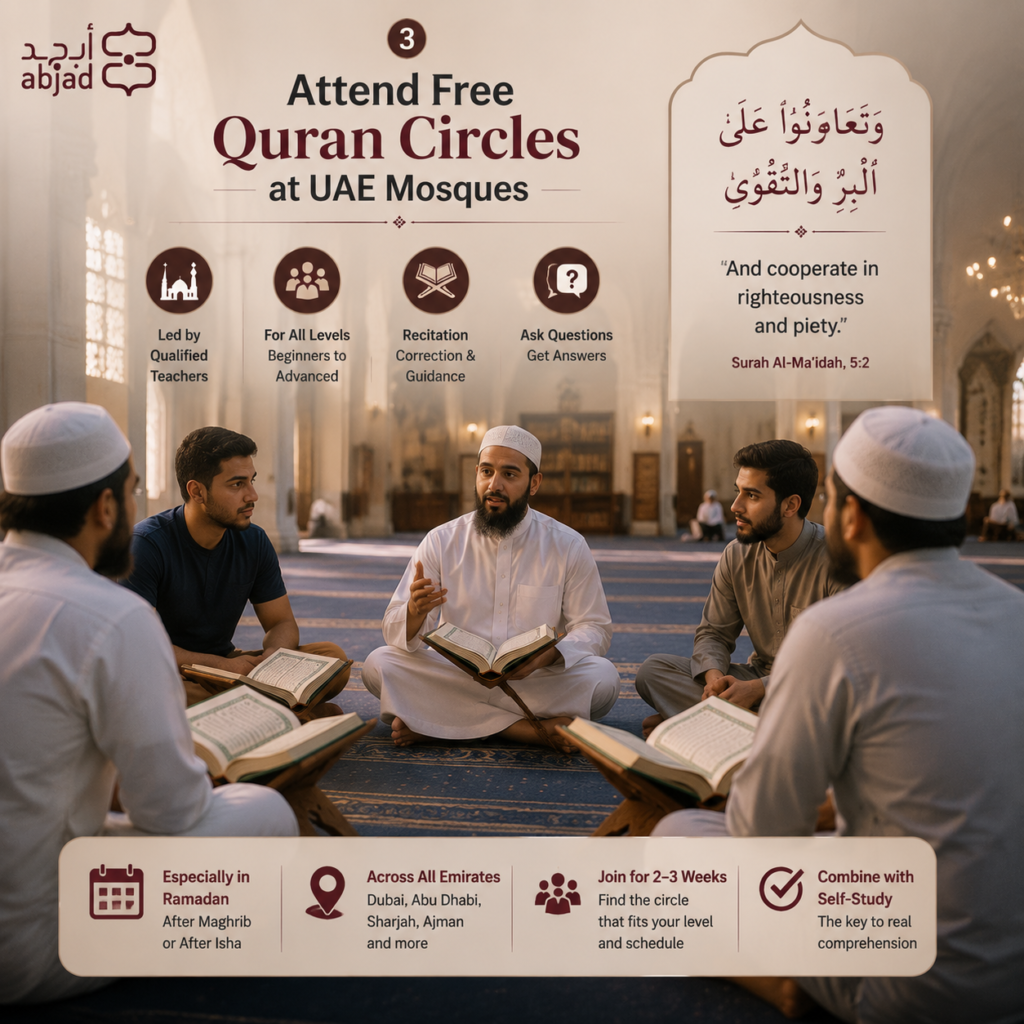
Across Dubai, Abu Dhabi, Sharjah, Ajman, and the other emirates, major mosques organize free Halaqat — Quranic study circles — throughout the year, and especially in Ramadan. These are typically held after Maghrib or after Isha, led by imams or qualified teachers, and open to residents at every level of Arabic knowledge.
A Halaqa gives you something that no online resource can provide: a qualified teacher who can hear your recitation, correct your pronunciation in real time, and answer questions specific to your level. Pronunciation errors in Quranic Arabic — incorrect articulation points (Makharij), wrong vowel length (Madd), imprecise sounds — are impossible to self-diagnose from reading alone. A weekly circle, even if it meets just once, provides the human feedback layer that free digital tools cannot.
Attend your nearest mosque’s Halaqa for at least two to three weeks before deciding whether it fits your level and schedule. Many mosques run parallel circles for beginners and advanced learners — ask the imam which one matches where you are. This face-to-face layer, combined with the self-study steps in this guide, is what separates learners who reach genuine comprehension from those who plateau after a few months.
4. Join Free Online Programs During Ramadan in the UAE
Ramadan in the UAE is one of the most concentrated periods of free Islamic education available anywhere. UAE mosques, IACAD, Awqaf, and numerous Islamic organizations livestream Tafsir classes, Quranic Arabic lectures, and Quran recitation programs throughout the month — accessible from home, free of charge, and often available as recordings after broadcast.
For working residents and families, this is practically significant: Ramadan programming covers in one month what a self-studying learner might take six months to encounter through scattered online resources. Tafsir classes in particular offer linguistic breakdown of individual ayahs alongside their scholarly explanation — exactly the vocabulary and grammar exposure that Quranic Arabic learners need, delivered within the context of the Quran itself.
Make a specific plan before Ramadan begins. Identify two programs to follow consistently — one focused on Tafsir and one focused on recitation or Quranic Arabic grammar — and treat them as fixed commitments rather than optional additions. The learners who gain the most from Ramadan programs are those who prepare a notebook and carry written vocabulary and grammar observations from each session into their daily study.
Beyond the Mohammed Bin Rashid Library, the UAE’s public library network — including Sharjah Public Library, Abu Dhabi Public Library, and Dubai’s community library branches — provides free access to Arabic grammar books, Quranic dictionaries, and classical Islamic reference texts that are difficult to access without paying for specialist publications.
The specific books worth locating in these libraries for Quranic Arabic study are: a copy of the Madinah Arabic Reader series (widely available and used in traditional Islamic universities as a Nahw introduction through Quranic examples), a Quranic root dictionary such as Al-Mu’jam al-Mufahras li-Alfaz al-Qur’an, and any available Tafsir in English or Arabic that provides word-level analysis of ayahs.
Physical books offer a study experience that screens do not — you can annotate them, return to flagged pages quickly, and read without the distraction of connected devices. For vocabulary review in particular, handwritten notes from physical reference books produce stronger retention than digital flashcard sessions alone.
Watch Our Classes in Action
Curious what a real session looks like? Take a peek inside our interactive classrooms and see how our expert instructors bring the Arabic language to life. Watch a sample lesson below!
Begin Your Arabic Journey in the UAE
Join Abjad Institute for a professional and immersive Arabic language experience tailored to your goals.
If you travel on the Dubai Metro, the Abu Dhabi Bus Network, or by car across the Emirates, you have 20 to 40 minutes of daily study time that most learners waste. That block of time — used consistently — adds up to over two hours of Quranic Arabic practice per week without any restructuring of your schedule.
Use commute time specifically for listening and vocabulary review, not for reading or grammar analysis which require more focused attention. Listen to a Surah you are currently studying and try to identify words you have already learned by sound. Review vocabulary roots you studied the previous day. Listen to a short Tajweed explanation and find an example of that rule in the Surah playing afterward.
The commute study habit works best when it is anchored to a specific trigger — the moment you sit down on the Metro, or the moment you start the car. Consistent triggers build automatic habits faster than scheduled reminders. For families using this guide alongside children’s Arabic education, Abjad Institute’s Arabic camps for kids offer immersive structured sessions that complement the daily habits parents are building for themselves.
One of the practical challenges of learning Quranic Arabic in the UAE is that the standard working day — often starting early and running long — leaves limited focused study time. The solution that consistently works for UAE residents is anchoring study sessions to the prayer schedule rather than to clock-based reminders.
The most effective windows are post-Fajr (before the working day begins) and between Maghrib and Isha (when the evening is not yet occupied by sleep). Post-Fajr is particularly powerful: memory consolidation during sleep means the brain processes new language material most efficiently in the early morning, and the 20–30 minutes between Fajr and sunrise is a quiet block that most UAE residents are already awake for.
A realistic prayer-anchored schedule:
Prayer Window
Study Focus
Time
Post-Fajr
New vocabulary (5 words) + root analysis
15–20 minutes
Post-Maghrib
Grammar concept + read 3–5 ayahs analytically
15–20 minutes
This two-session structure distributes the cognitive load of language learning across the day, which produces better retention than one longer session in the evening. Neither session requires 30 minutes — 15 focused minutes each, maintained daily, outperforms an hour once a week in every measurable outcome for language retention.
8. Join UAE-Based Muslim Communities Online
WhatsApp groups, Telegram channels, and Facebook communities run by Islamic centers in Dubai, Abu Dhabi, Sharjah, and Ajman share free Quranic Arabic resources, coordinate online study sessions, and create accountability structures that solo self-study cannot provide. These communities are active, free to join, and often include access to teachers or advanced learners who answer questions in real time.
The specific value of these communities for Quranic Arabic learners is peer accountability — having a group of people at a similar level who share vocabulary they are learning, ask grammar questions, and report on their daily progress. Research on language acquisition consistently shows that social accountability increases study consistency more than any app notification or personal reminder system.
Search for groups connected to your local masjid first. Then look for emirate-wide Quranic Arabic communities through IACAD social media pages and UAE Islamic center websites. For learners with children, groups run by Islamic education communities in the UAE often share resources for both adult and child learners simultaneously — which simplifies family learning coordination significantly. Abjad Institute’s Arabic conversation courses for kids work well alongside these community groups as a structured complement to peer-based learning.
9. Benefit from Free Islamic Events and Exhibitions
The Sharjah International Book Fair — the largest in the Arab world — takes place annually and features free lectures, Arabic language workshops, Quranic education initiatives, and access to Islamic reference books at discounted or no cost. Local Islamic exhibitions and cultural events organized by UAE authorities throughout the year similarly provide free access to Quranic learning materials, Arabic grammar resources, and sometimes direct sessions with qualified scholars.
These events matter for a reason most learners miss: they provide access to physical Islamic reference books and scholarly content that is either unavailable online or costs significantly more when purchased individually. The Sharjah Book Fair in particular hosts Arabic language publishers who distribute free samples, learning materials, and beginner guides specifically produced for non-native learners of Arabic.
Add these events to your calendar as learning opportunities rather than passive experiences. Come with specific questions from your current study — a vocabulary root you could not trace, a grammar structure from an ayah you analyzed. Events that connect you with knowledgeable people are worth far more when you arrive with targeted questions than when you attend without a specific learning goal.
10. Combine Online Learning with Daily Quran Reading
Every online lesson, vocabulary session, and grammar explanation only becomes real comprehension when you apply it directly inside the Quran text. This final step is what separates learners who accumulate knowledge from those who actually understand what they recite.
After each study session — however short — open the Quran and read three to five ayahs from the Surah you are currently working on. Identify every word you recognize from your vocabulary study. Note the grammar structures you can name. Then read the full translation and observe the gap between what you understood independently and the complete meaning. That gap is your precise study target for the next session.
This daily application habit works especially well for UAE residents balancing work, university, or family life, because it does not require a dedicated long session — it requires five minutes of attentive Quranic reading after whatever you have already done. Over weeks, those five minutes reshape how you experience every salah, every recitation, and every encounter with the words of Allah ﷻ.
“Then do they not reflect upon the Quran, or are there locks upon their hearts? “Surah Muhammad, 47:24
Inside Our Live Classes
Don’t just take our word for it—see for yourself! Click below to watch short clips from our live classes and meet the instructors who will guide your learning journey.
Begin Your Arabic Journey in the UAE
Join Abjad Institute for a professional and immersive Arabic language experience tailored to your goals.
Learn Quranic Arabic Step by Step With Abjad Institute
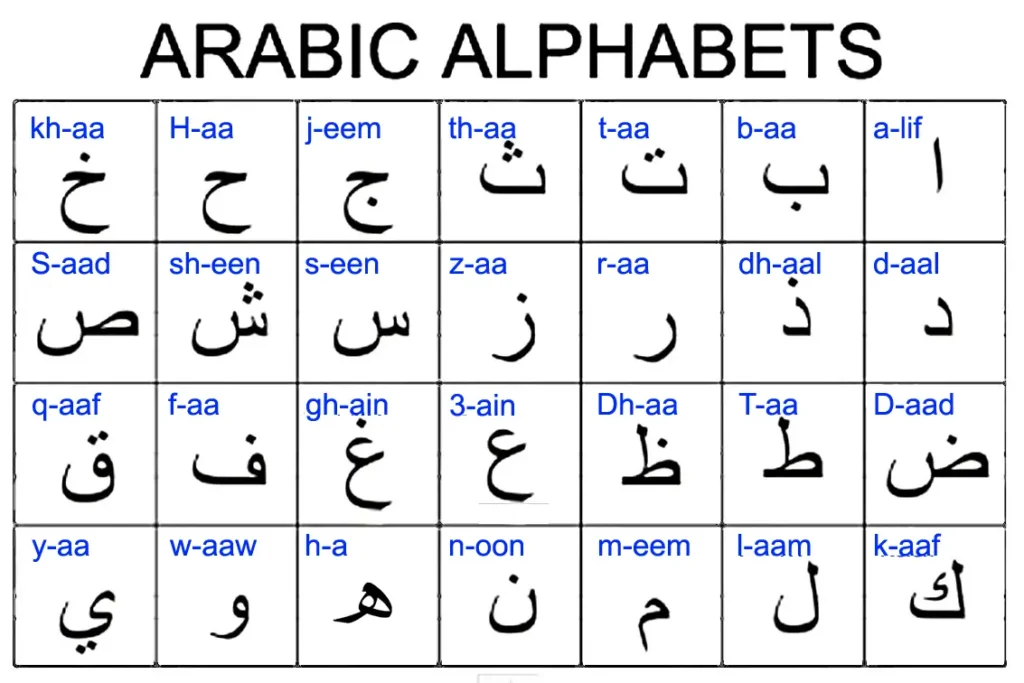
Whether you are starting from the Arabic alphabet, improving your Quran reading skills, or aiming to understand the meanings behind the verses, Abjad Institute provides a structured learning path designed to support every stage of your journey.
Our Quranic Arabic programs are created for non-Arabic speakers and guide students step by step — beginning with letter recognition and pronunciation, then progressing to Tajweed application, reading fluency, and deeper Arabic understanding with the support of qualified instructors.
Our programs include:
Arabic letters and Quran reading fundamentals
Quranic Arabic courses for beginners
Essential Tajweed rules and Quran recitation practice
Learning Quranic Arabic free online in the UAE is not about choosing between self-study and formal education — it is about layering both intelligently. UAE Islamic authorities, public libraries, masjid halaqat, Ramadan programming, community groups, and the Arabic environment surrounding you every day are all free resources most learners never think to combine deliberately. Combined with daily vocabulary study, grammar practice anchored to the prayer schedule, and consistent Quran reading, they form a complete learning system that costs nothing and is uniquely available to those living in the Emirates.
The Quran is meant to be understood, not only recited. Every step you take toward that understanding is an act of worship in itself.
Frequently Asked Questions About How to Learn Quranic Arabic Free Online in the UAE
What is the best free starting point for learning Quranic Arabic in the UAE?
The Islamic Affairs and Charitable Activities Department (IACAD) in Dubai and the General Authority of Islamic Affairs and Endowments (Awqaf) in Abu Dhabi both offer free Quranic education resources and programs for UAE residents. These are designed specifically for the Quran — not general Arabic — and are the most overlooked free starting point available in the Emirates.
Are mosque Quran circles (Halaqat) suitable for complete beginners?
Yes. Most major mosques across Dubai, Abu Dhabi, and Sharjah run parallel circles for different levels. Tell the imam you are a beginner and ask which circle is appropriate. Many beginner circles start from Arabic script reading and basic Tajweed, requiring no prior Arabic knowledge to join.
How do I study Quranic Arabic during Ramadan in the UAE?
Choose two livestreamed programs before Ramadan begins — one Tafsir class and one Quranic Arabic or recitation program — and commit to following both consistently throughout the month. Keep a notebook and carry vocabulary and grammar observations from each session into your daily study. Ramadan programming in the UAE is among the most concentrated free Islamic education available anywhere.
Can I learn Quranic Arabic using only UAE public library resources?
Public library resources — including the Mohammed Bin Rashid Library and Sharjah Public Library — provide excellent reference materials for Quranic Arabic, including grammar primers, Quranic dictionaries, and Tafsir works. These work best as companions to structured online lessons or mosque circles rather than as a standalone learning system, since they require guided reading without a teacher to be used effectively.
How much time per day do I need to learn Quranic Arabic with a full UAE work schedule?
Fifteen to twenty minutes after Fajr and fifteen minutes between Maghrib and Isha is enough to make consistent, measurable progress. Commute time on the Dubai Metro or Abu Dhabi Bus Network adds another 20–40 minutes of listening and vocabulary review without restructuring your day. Daily short sessions — even 15 minutes — consistently outperform longer infrequent ones for language retention.
When should I move from free resources to a paid Quranic Arabic course?
The practical sign that free resources have reached their limit is when your self-assessment — reading unfamiliar ayahs and checking comprehension against the translation — stops revealing new specific gaps, or when your recitation does not match qualified reciters despite knowing the rules. At that point, a qualified teacher identifies the precise errors that free tools cannot detect, and structured instruction produces faster progress than continued self-study.
 Learn Arabic



Leave a Reply