 Learn Arabic
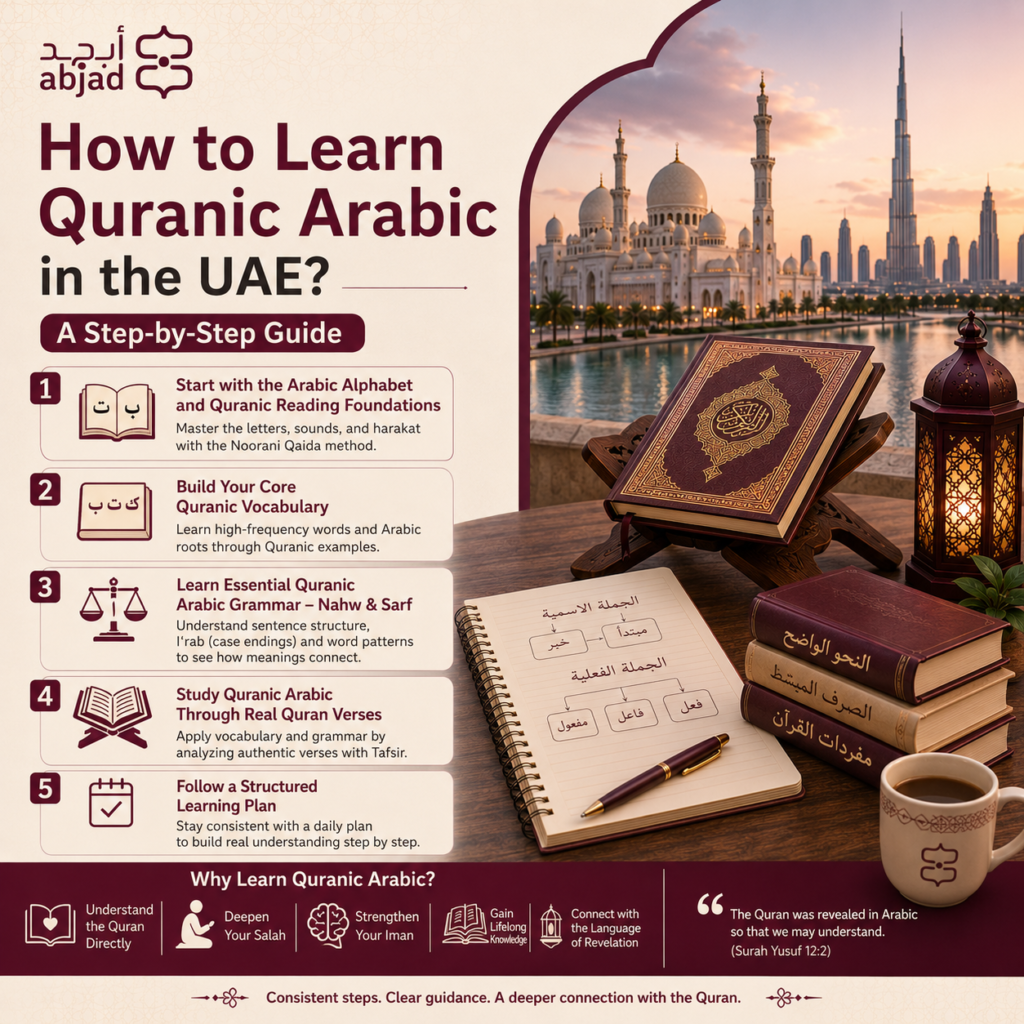
Learning Quranic Arabic in the UAE is not about becoming fluent in everyday Arabic conversation. It is about developing the specific skills needed to understand the Quran’s words, grammar, and meanings directly.
For many learners in the UAE, including Emirati students, Arab residents, and non-Arab Muslims, the goal is to move beyond recitation and build a deeper connection with the Quran. The best way to learn Quranic Arabic in the UAE is through a structured path that combines Arabic reading foundations, Quranic vocabulary, essential grammar, and practical verse analysis.
Quranic Arabic is the classical language in which the Quran was revealed over 1,400 years ago. While it shares roots with Modern Standard Arabic and spoken dialects, it contains unique vocabulary and structures that require focused study.
1. Start with the Arabic Alphabet and Quranic Reading Foundations
The first step in how to learn Quranic Arabic — in the UAE or anywhere else — is mastering the Arabic script. Before studying vocabulary or grammar, learners need to read letters confidently and understand harakat (vowel markings) to pronounce Quranic words correctly.
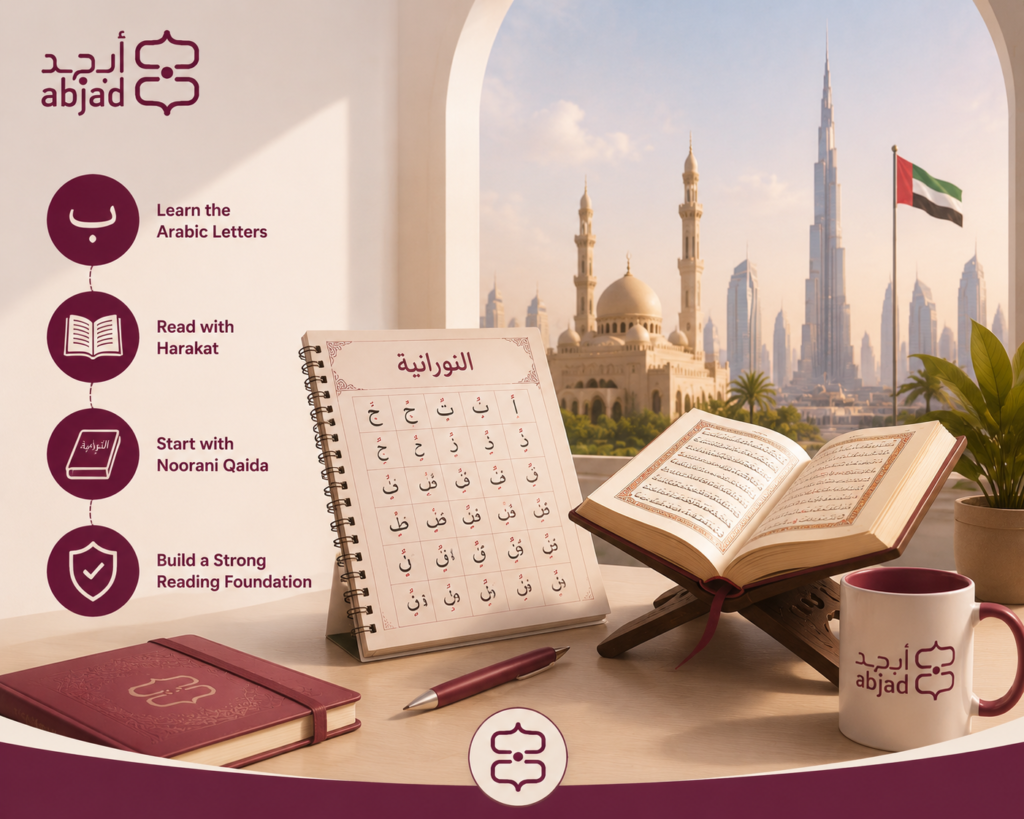
For learners in the UAE, most adults can recognize the 28 Arabic letters within a few weeks of consistent practice. The focus should be on understanding letter forms in different positions — initial, medial, final, and isolated — and building accurate reading habits from the start.
The Noorani Qaida method is the most practical starting point for non-Arabic speakers. It teaches letters, vowel sounds, and phonetic skills gradually before moving to Quranic words. Building a strong reading foundation early prevents pronunciation mistakes from embedding themselves and makes every later stage of understanding Quranic Arabic significantly easier.
The most common mistake at this stage: rushing through the alphabet to reach vocabulary. Learners who skip harakat precision spend months later rereading passages with built-in errors that require active effort to correct. Slow, accurate script reading now produces faster comprehension later.
2. Build Your Core Quranic Vocabulary
Building a focused Quranic vocabulary is one of the most important steps toward understanding Quranic Arabic and making it easy. Instead of memorizing thousands of general Arabic words, the best way to learn Quranic Arabic fast is to focus on the words and roots that appear most frequently in the Quran itself.
The most effective approach is the Arabic root-word method. Most Arabic words come from three-letter roots, and one root can generate a family of related words with connected meanings. This allows learners to expand their Quranic vocabulary faster than memorizing each word separately.
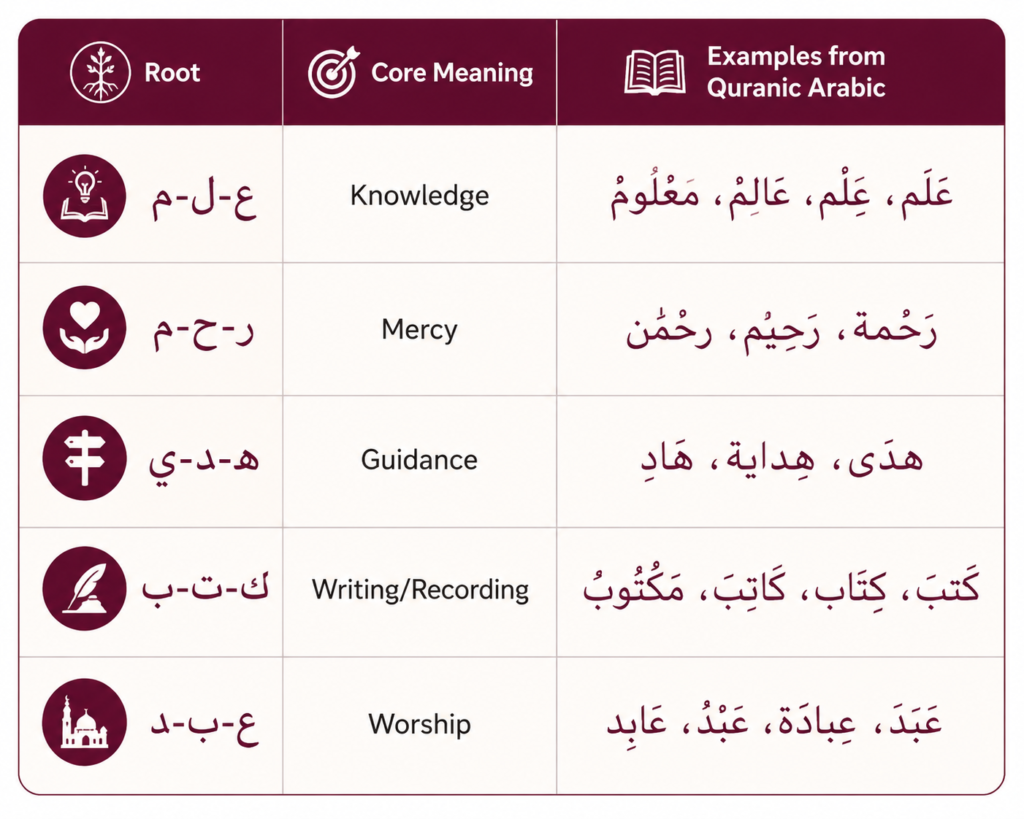
Start with high-frequency Quranic roots and study them within actual verses rather than isolated vocabulary lists. Repeated exposure helps learners recognize patterns and makes Quranic Arabic easier to learn.
For learners in the UAE, it is also important to remember that some Quranic words may carry meanings different from their usage in Modern Arabic. Learning vocabulary through Quranic context leads to a more accurate understanding of the words and meanings of the Quran.
Read more: Why Learn Quranic Arabic?
3. Learn Essential Quranic Arabic Grammar — Nahw and Sarf
Understanding Quranic Arabic requires more than memorizing vocabulary. Grammar shows how words connect, how meanings are built, and why word endings change. The two main sciences are Nahw (syntax) and Sarf (morphology).
Nahw explains sentence structure and I‘rab (case endings), helping learners understand the role of each word:
- Raf‘ (ـُ): usually marks the subject.
- Nasb (ـَ): often marks the object.
- Jarr (ـِ): used after prepositions and in possession structures.
Sarf explains how words develop from Arabic roots and patterns. Learning one root helps learners recognize multiple Quranic words.
| Root | Examples | Meaning |
| ك-ت-ب | كَتَبَ، كِتَاب، مَكْتُوب | Writing |
| ر-ح-م | رَحْمَة، رَحِيم، رَحْمٰن | Mercy |
| ن-ز-ل | نَزَلَ، نَزَّلَ، أَنْزَلَ | Sending down |
The best way to learn Quranic grammar is to apply Nahw and Sarf directly to Quranic verses. This makes grammar practical and helps learners move toward deeper understanding of Quranic Arabic. For those who want to build this foundation systematically, Fusha Arabic courses at Abjad Institute cover classical Arabic grammar in a structured sequence designed for Quranic comprehension.
Master Fusha Arabic Step by Step With a FREE Trial Today

Watch Our Classes in Action
Curious what a real session looks like? Take a peek inside our interactive classrooms and see how our expert instructors bring the Arabic language to life. Watch a sample lesson below!
Begin Your Arabic Journey in the UAE
Join Abjad Institute for a professional and immersive Arabic language experience tailored to your goals.
Book Your Free TrialRead also: 12 Benefits of Learning Quranic Arabic
4. Study Quranic Arabic Through Real Quran Verses
Learning Quranic Arabic becomes more effective when learners apply vocabulary and grammar directly to the Quran itself. Instead of studying rules through artificial examples, practice analyzing real Quranic verses to see how the language works in context.
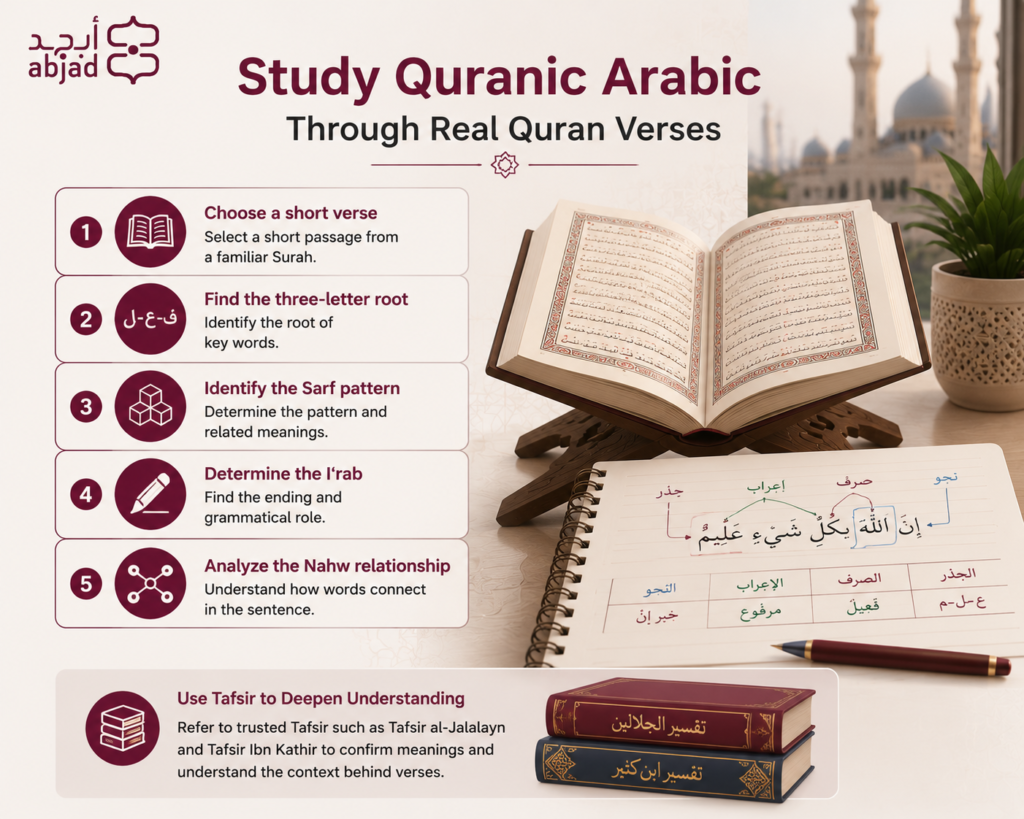
A practical approach is to choose a short passage from a familiar Surah and analyze key words by identifying:
- The three-letter root of the word.
- The Sarf pattern and related meanings.
- The I‘rab ending and grammatical role.
- The relationship between words in the sentence through Nahw.
This process helps learners move from simply knowing individual word meanings to actually understanding how Quranic sentences are constructed.
Using Tafsir alongside this practice can also deepen understanding. Classical explanations such as Tafsir al-Jalalayn and Tafsir Ibn Kathir help learners confirm meanings and understand the context behind verses while keeping the focus on the original Quranic language.
Read also: How to Read Arabic Dates — A Complete Guide for English Speakers
5. Follow a Structured Learning Plan — Not a Random One
One of the most overlooked aspects of how to learn Quranic Arabic fast in the UAE is the structure of daily study. Learning Quranic Arabic requires consistency more than long sessions. A structured daily routine builds vocabulary, strengthens grammar, and develops Quranic comprehension step by step — without requiring hours that most UAE learners cannot realistically spare.
A practical 30-minute daily plan:
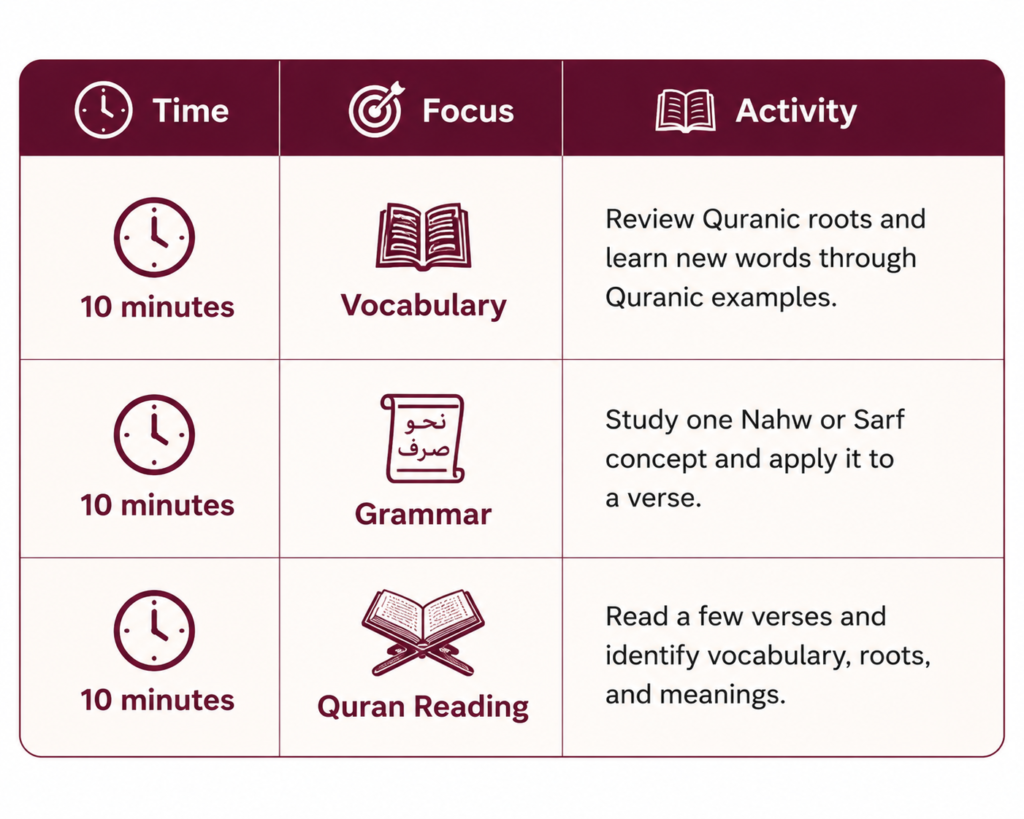
For learners in the UAE, this approach works well with busy schedules, whether they are students, professionals, or parents. The key is daily practice rather than occasional long sessions.
Choosing a consistent study time, such as after Fajr or after Isha, can make learning easier by creating a regular habit connected to Quran recitation and reflection.
6. Learn with a Qualified Quranic Arabic Teacher
Self-study resources such as apps, videos, and books can support your learning, but a qualified teacher provides the guidance needed to build accurate Quranic Arabic skills.
A teacher helps you:
- Correct pronunciation mistakes early.
- Understand Nahw and Sarf in the right sequence.
- Apply grammar and vocabulary directly to Quranic verses.
- Stay consistent through structured guidance.
This is especially important for beginners, as small mistakes in reading or grammar can affect comprehension and become harder to correct later. If you are starting from scratch, Arabic courses for beginners at Abjad Institute provide a structured path that builds each skill in the right order, from reading foundations through to Quranic vocabulary and grammar.
7. Use Online Quranic Arabic Classes — the UAE’s Most Practical Option
For learners asking how to learn Quranic Arabic online, the answer depends on one distinction: live instruction with a qualified teacher produces results that recorded content and apps cannot. The effectiveness of online Quranic Arabic learning is determined by the quality of instruction, not the format.
Live online lessons provide the essential elements needed for progress:
- Real-time pronunciation correction.
- Grammar explanation and guidance.
- Verse analysis with personalized feedback.
- A structured learning path based on the student’s level.
For UAE learners, online classes offer several advantages:
| Advantage | Why It Matters |
| Flexible scheduling | Lessons can fit around UAE work hours, studies, and family commitments. |
| No commuting | Avoids travel challenges, especially for busy schedules in cities like Dubai and Abu Dhabi. |
| Personalized learning | Lessons adapt to your Arabic background and learning goals. |
| Access to qualified teachers | Learn from experienced instructors regardless of location. |
| Progress tracking | A structured plan helps maintain steady improvement. |
Learners who also want to strengthen their spoken Arabic alongside Quranic study can explore Arabic speaking courses at Abjad Institute — a practical complement for those who want to engage with the language beyond the Quran in daily life and work in the UAE.
Improve Your Arabic Speaking Skills Step by Step With a FREE Trial Today

8. Practice Daily and Use the UAE Environment as a Learning Asset
The UAE provides a supportive environment for learners of Quranic Arabic. Arabic is part of daily life, from street signs and public spaces to mosques and Islamic activities, giving learners regular exposure that reinforces what they study in structured lessons.
The key is turning exposure into active practice. Listening to the Adhan, Quran recitation, or Arabic conversations is helpful, but paying attention to familiar words, recognizing vocabulary, and observing pronunciation and Tajweed rules makes this exposure more valuable for learning.
Mosques and Quran circles across cities such as Dubai, Abu Dhabi, and Sharjah can provide additional practice, motivation, and connection with other learners. However, the UAE environment should support structured study, not replace it.
Read more: How Long Does It Take to Learn Quranic Arabic in the UAE?
9. Focus on Understanding, Not Just Memorization
The purpose of learning Quranic Arabic is not only to memorize vocabulary or grammar rules. The real goal is to move through three stages:
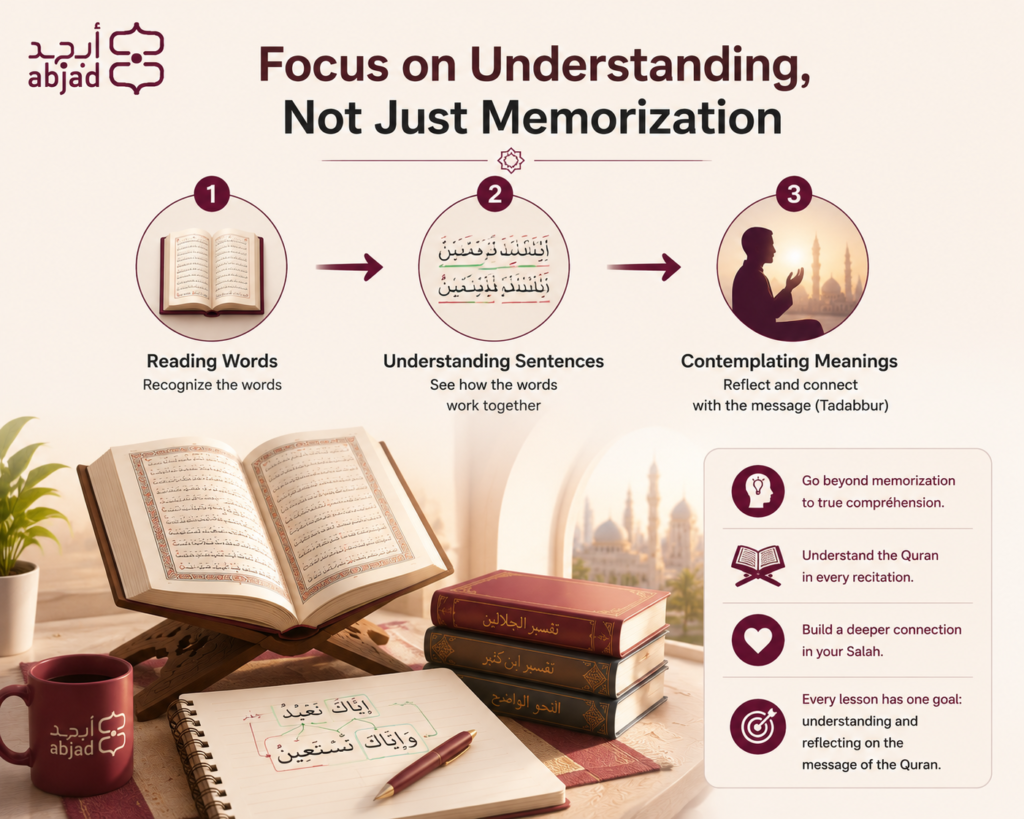
Reading words → Understanding sentences → Contemplating meanings (Tadabbur)
Many learners remain stuck at the first stage because they study words and grammar separately without applying them to actual Quranic verses. True progress happens when vocabulary and grammar work together to reveal the meaning of the Quran.
Understanding Quranic Arabic can also transform the experience of Salah. Verses that were once familiar sounds begin to carry deeper meaning. For example, إِيَّاكَ نَعْبُدُ وَإِيَّاكَ نَسْتَعِينُ in Surah Al-Fatihah is not only memorized text; its structure emphasizes the meaning of worshipping and seeking help from Allah alone.
This deeper connection is the true purpose of learning Quranic Arabic. Every vocabulary lesson and grammar rule should serve one goal: moving from simply reciting the Quran to understanding and reflecting on its message.
Inside Our Live Classes
Don’t just take our word for it—see for yourself! Click below to watch short clips from our live classes and meet the instructors who will guide your learning journey.
Begin Your Arabic Journey in the UAE
Join Abjad Institute for a professional and immersive Arabic language experience tailored to your goals.
Book Your Free TrialLearn Quranic Arabic with Expert Guidance at Abjad Institute
The right guidance can make your journey from reading Quranic words to understanding their meanings clearer and more achievable.
At Abjad Institute, our Quranic Arabic courses help learners progress through:
- Structured learning paths that build skills step by step, from Arabic reading foundations to Quranic vocabulary and grammar.
- Live 1-on-1 lessons with qualified instructors who adapt the course to your level and learning goals.
- Practical Quranic application by connecting grammar and vocabulary directly to Quranic verses.
- Flexible scheduling designed for learners in the UAE and worldwide.
Whether you are a complete beginner or looking to deepen your understanding of Quranic language, Abjad Institute provides the guidance and support needed to make steady progress.
Book your free trial lesson today and take the first step toward understanding the Quran through its original language.

Discover Our Arabic Courses
- Arabic Course in the UAE
- Arabic Intensive Course
- Learn Arabic from Scratch Course
- Madinah Arabic Course
- Arabic Classes for Adults
- Arabic Classes for Beginners
- Self-Paced Arabic Course
- Basic Arabic Course
- Arabic Speaking Classes
- Learn to Write Arabic Course
- Arabic Grammar Course
- Learn Arabic Alphabet Course
Begin Your Arabic Journey in the UAE
Join Abjad Institute for a professional and immersive Arabic language experience tailored to your goals.
Book Your Free TrialConclusion
Learning Quranic Arabic in the UAE is an achievable goal when you follow the right sequence: build a strong reading foundation, develop Quranic vocabulary, understand essential grammar, and apply what you learn directly to Quranic verses.
The UAE provides a supportive environment through daily exposure to Arabic, mosques, and Islamic learning opportunities. Combined with structured study and qualified guidance, this environment can help learners progress more effectively.
The Quran’s words are meant to be understood, not only recited. Start building the skills that allow you to connect with its meanings directly.
Frequently Asked Questions
Learners often have questions about the best way to start, the time required, online learning options, and how Quranic Arabic connects with grammar and Tajweed. The following answers address the most common questions for students learning Quranic Arabic in the UAE.
Can I learn Quranic Arabic in the UAE without knowing Modern Arabic?
Yes — and for most learners, starting with Quranic Arabic directly is the faster path. Modern Standard Arabic introduces vocabulary and grammatical patterns largely absent from the Quran. Dedicated Quranic Arabic study targets the 1,700 classical roots the Quran actually uses, making comprehension achievable significantly faster than an MSA detour allows.
How long does it take to learn Quranic Arabic in the UAE?
Most dedicated adult learners reach functional Quranic comprehension — understanding 70 to 80% of Quranic vocabulary in context — within 6 to 12 months of structured daily study. Native Arabic speakers in the UAE reach the intermediate stage faster, since their gap is classical grammar and Tajweed precision rather than the alphabet. Full comprehension including classical rhetorical structures typically requires two to three years.
What is the best way to learn Quranic Arabic fast in the UAE?
The fastest path combines three habits: study the Quran’s 300 highest-frequency roots using the root-word method, apply Nahw and Sarf grammar directly to Quranic verses from the beginning, and practice daily in 20 to 30 minute sessions rather than infrequent longer ones. Live 1-on-1 instruction from a qualified teacher accelerates all three by providing real-time correction and structured progression that self-study cannot replicate.
How do online Quranic Arabic classes work for UAE residents?
Online Quranic Arabic classes deliver live 1-on-1 instruction through video sessions scheduled around UAE working hours and time zones. A qualified instructor corrects pronunciation in real time, explains grammar, guides verse analysis, and tracks progression across sessions. This format provides everything in-person instruction offers — minus the commute — which makes it the most practical option for most working professionals and students in the UAE.
Is Quranic Arabic easier than Modern Standard Arabic?
For the specific goal of understanding the Quran, yes — significantly. The Quran’s 300 highest-frequency roots cover roughly 80% of the text, giving learners a bounded, achievable vocabulary target. Modern Standard Arabic covers a far broader vocabulary range and requires years more study before reaching equivalent comprehension of any specific text.
Do I need Tajweed to understand Quranic Arabic?
Foundational Tajweed — the core pronunciation rules governing how Quranic letters are produced and how words flow — is an integral part of Quranic Arabic learning, not a separate advanced subject. Without it, mispronounced letters can alter word meanings, and Quranic recitation loses the precision the text requires. The foundational Tajweed rules needed for correct comprehension are learnable within the first few months of structured study.





Leave a Reply