 Learn Arabic
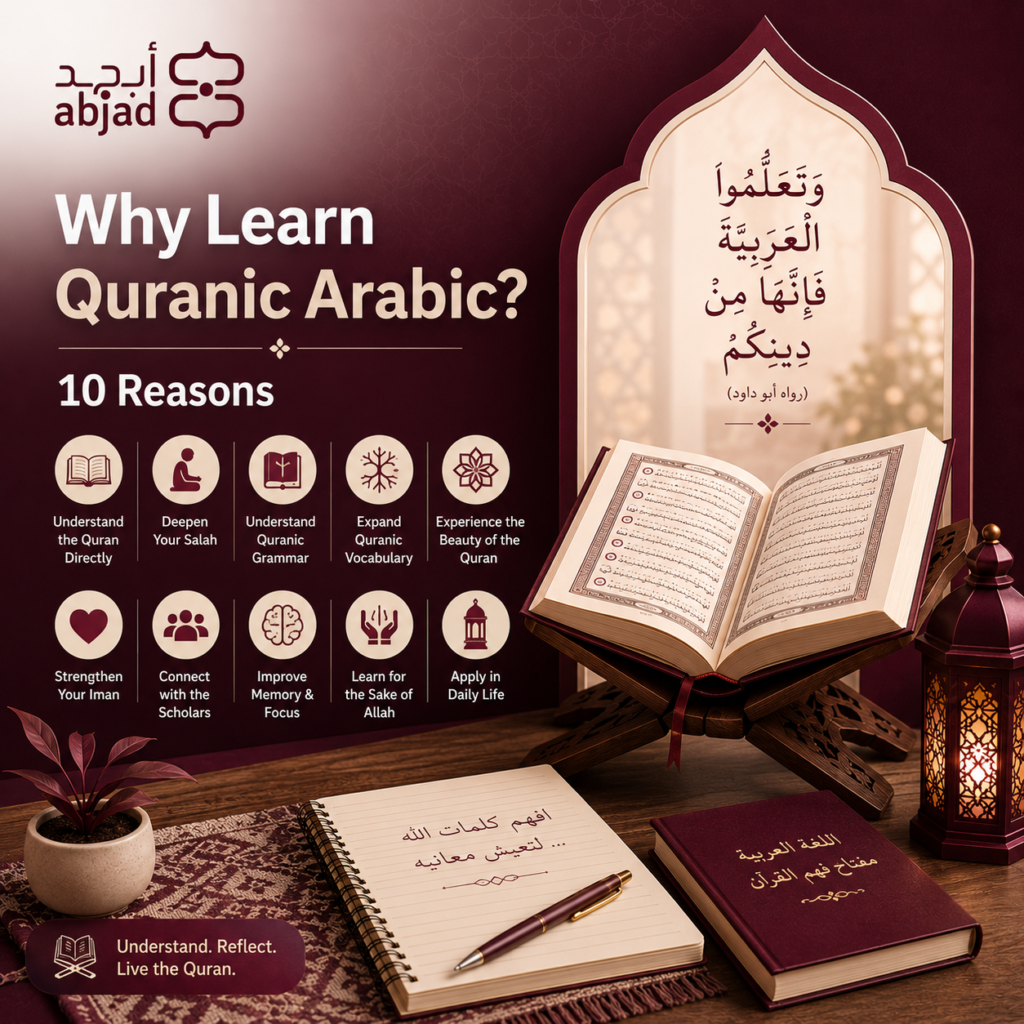
Most Muslims who learn Quranic Arabic describe the same turning point: the moment they understood Al-Fatihah word by word in Salah. Not memorized it. Understood it — in real time, as they stood before Allah. That moment does not come from reading a translation. It comes only from learning the language.
Quranic Arabic is the classical Arabic of the revealed text. It is not a dialect, not Modern Standard Arabic, and not conversational Arabic. It is the precise, preserved language in which Allah chose to send His final message — and learning it is among the most spiritually significant things a Muslim can do outside of the obligatory acts of worship.
Before the ten reasons, there is one foundational one: Allah explicitly connected Arabic to comprehension.
إِنَّا أَنزَلْنَـٰهُ قُرْءَانًا عَرَبِيًّا لَّعَلَّكُمْ تَعْقِلُونَ
Innā anzalnāhu Qur’ānan ‘arabiyyan la’allakum ta’qilūn
“Indeed, We have sent it down as an Arabic Quran that you might understand.” — Surah Yusuf, 12:2
The word used here is ta’qilūn — from the root ع-ق-ل, meaning rational comprehension, not passive hearing. The connection Allah draws is between Arabic and ‘aql — active understanding. Every translation of the Quran is an interpretation by a human scholar. The word choices, connotations, and rhetorical weight of the Arabic are carried only partially into another language. Learning Quranic Arabic is how you close that gap.
1. Understand the Quran Directly Without Relying Only on Translation
Translations help convey the general meaning of the Quran, but every translation involves choices. Some meanings, nuances, and linguistic details cannot be fully transferred from Arabic into another language.
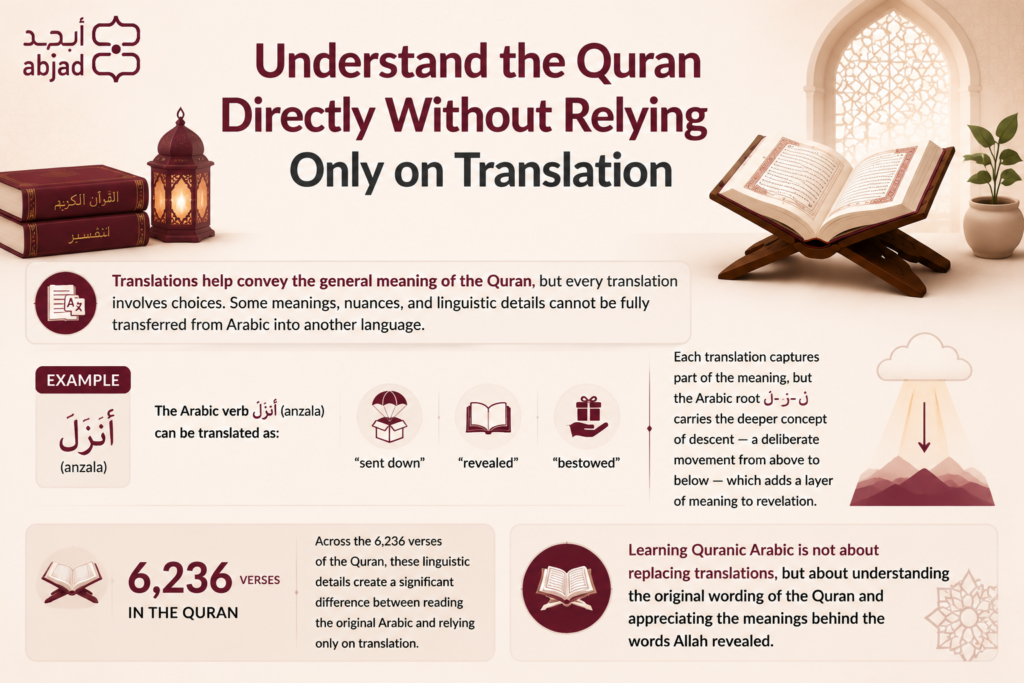
For example, the Arabic verb أَنزَلَ (anzala) can be translated as “sent down,” “revealed,” or “bestowed.” Each translation captures part of the meaning, but the Arabic root ن-ز-ل carries the deeper concept of descent — a deliberate movement from above to below — which adds a layer of meaning to the concept of revelation.
Across the 6,236 verses of the Quran, these linguistic details create a significant difference between reading the original Arabic and relying only on translation. Learning Quranic Arabic is not about replacing translations, but about understanding the original wording of the Quran and appreciating the meanings behind the words Allah revealed.
Abjad Institute’s Quranic Arabic courses are built precisely around this goal: helping learners move from translation-dependence to direct Quranic engagement, step by step.
Build Your Quranic Arabic Skills Step by Step With a FREE Trial Today
2. Deepen Your Salah Through Understanding Quranic Words
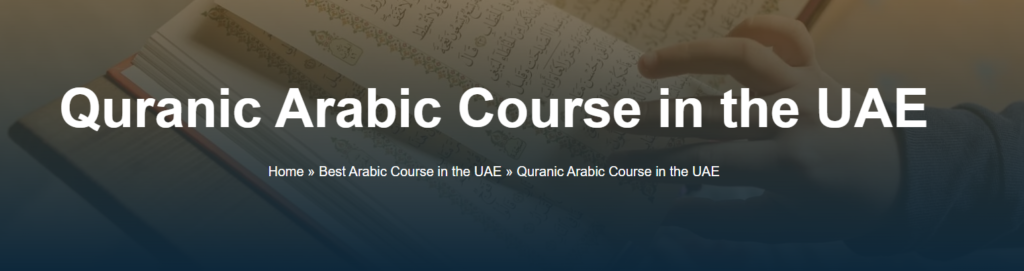
Many non-Arabic-speaking Muslims recite Quranic verses in Salah every day while understanding little of what they are saying. The recitation is sincere, but understanding the words adds a deeper dimension to the worship.
When you understand Ar-Rahmān as “the Most Merciful,” Al-Mālik as “the Sovereign King,” and the verse:
إِيَّاكَ نَعْبُدُ وَإِيَّاكَ نَسْتَعِينُ
Iyyāka na’budu wa iyyāka nasta’īn
“You alone we worship, and You alone we ask for help.” — Surah Al-Fatihah, 1:5
Al-Fatihah transforms from a memorized recitation into a meaningful conversation with Allah. Understanding the words you recite changes the way you experience Salah.
Understanding the meaning of Quranic recitation is also connected to khushu’ (focus and humility in prayer). When the heart and mind follow the meanings of the words being recited, distraction decreases and the connection with the prayer becomes stronger.
Read more: What Is Quranic Arabic?
3. Understand How Quranic Grammar Reveals Meaning
Quranic Arabic grammar — especially the science of I’rāb (grammatical case endings) — is not simply about pronunciation rules. It reveals the function of each word and shows how meanings are built within a sentence. A single ending can indicate whether a word is the subject, the object, or part of a possessive structure, and these differences can directly affect the interpretation of Quranic verses.
By studying Nahw (Arabic syntax), learners begin to understand why words appear in specific forms and how grammatical structures contribute to meaning. They also gain insight into why classical scholars sometimes discussed different possible readings of certain verses — not because the Quran is unclear, but because Arabic grammar allows for layers of meaning that translations cannot fully capture.
Learning Quranic grammar allows readers to engage with the Quran’s structure directly rather than relying only on translated explanations.
Watch Our Classes in Action
Curious what a real session looks like? Take a peek inside our interactive classrooms and see how our expert instructors bring the Arabic language to life. Watch a sample lesson below!
Begin Your Arabic Journey in the UAE
Join Abjad Institute for a professional and immersive Arabic language experience tailored to your goals.
Book Your Free Trial4. Expand Your Quranic Vocabulary Through Arabic Root Words
Classical Arabic is built on a three-letter root system (jذر), where a single root can generate a family of related words. Understanding these roots allows learners to recognize connections between Quranic words instead of memorizing each word separately.
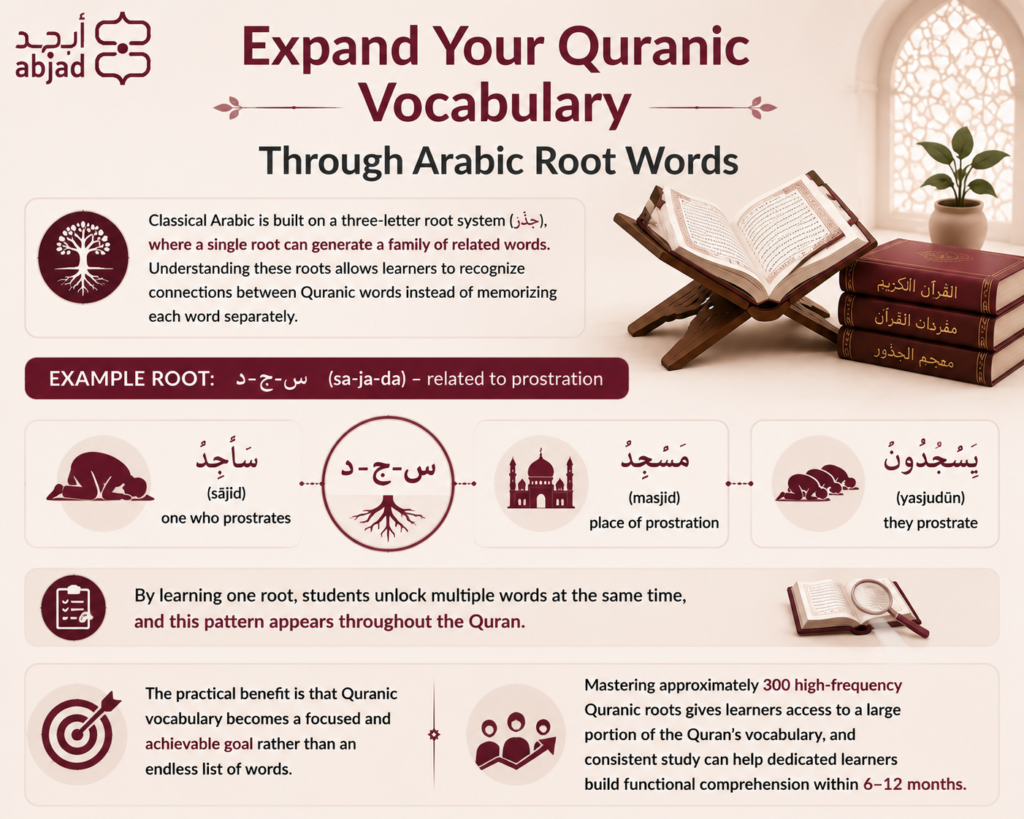
For example, the root س-ج-د (sa-ja-da) is related to prostration and produces several Quranic words:
- ساجِد (sājid) — one who prostrates
- مَسجِد (masjid) — place of prostration
- يَسجُدُون (yasjudūn) — they prostrate
By learning one root, students unlock multiple words at the same time, and this pattern appears throughout the Quran.
The practical benefit is that Quranic vocabulary becomes a focused and achievable goal rather than an endless list of words. Mastering approximately 300 high-frequency Quranic roots gives learners access to a large portion of the Quran’s vocabulary, and consistent study can help dedicated learners build functional comprehension within 6–12 months.
This root-based approach is the foundation of Abjad Institute’s Arabic courses for adults, where vocabulary is taught systematically rather than as disconnected word lists.
5. Experience the Linguistic Beauty of the Quran in Its Original Arabic
The Quran was revealed with exceptional linguistic precision. Its first audience — the Arabs of the 7th century, known for their mastery of language and eloquence — recognized its unique style and rhetorical power. This linguistic excellence was central to the Quran’s challenge to produce something comparable.
This precision appears in every aspect of the Quran’s language, including word choice, sentence structure, rhythm, and rhetorical patterns. Many of these details cannot be fully preserved through translation because a single Arabic word can carry layers of meaning that require multiple words to explain in another language.
By learning Quranic Arabic, learners can experience the Quran’s eloquence directly — not just through explanations of its beauty, but through engaging with the language, expressions, and structures in which it was revealed.
6. Understand Tafsir Through the Original Language of the Quran
Tafsir (Quranic commentary) has a deep connection with the Arabic language. Many classical works of Tafsir by scholars such as Ibn Kathir, Al-Tabari, and Al-Qurtubi were written in Arabic, and translations often provide only selected portions of their discussions. The detailed linguistic analysis, grammatical explanations, and word meanings that support interpretation are primarily found in the original Arabic works.
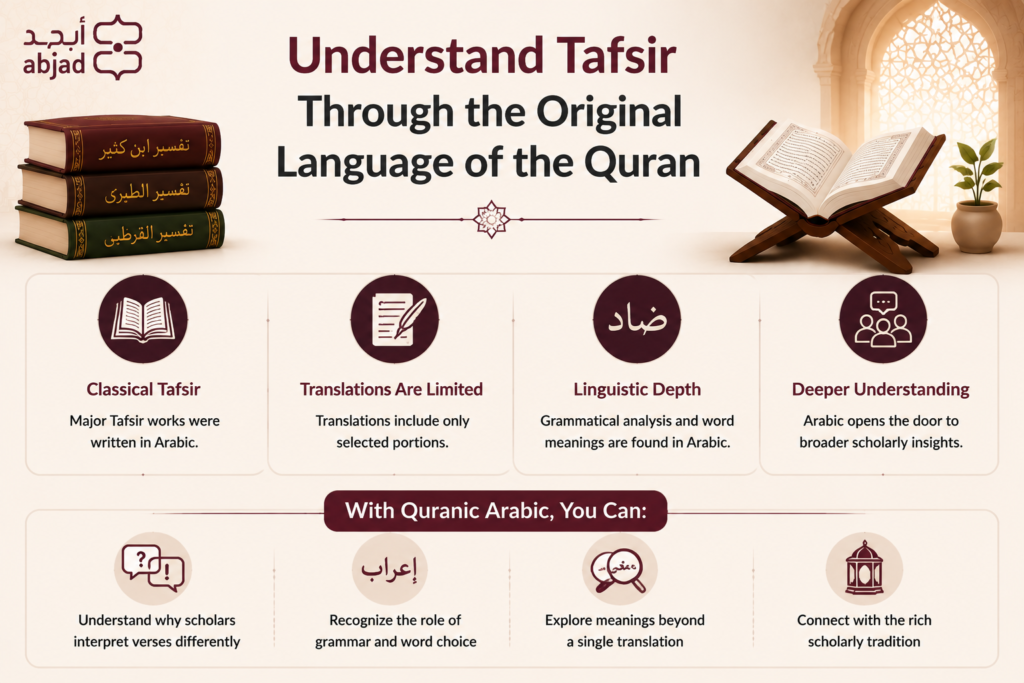
Having a foundation in Quranic Arabic allows learners to engage with Tafsir more effectively. They can understand why scholars interpret certain verses in different ways, recognize the role of grammar and word choice in interpretation, and explore Quranic meanings beyond a single translated explanation. For anyone seeking deeper Quranic understanding, learning Arabic provides access to a much broader scholarly tradition.
7. Understand the Differences Between Quran Translations
Many Muslims notice that different Quran translations sometimes use different words or expressions for the same verse. These differences do not necessarily indicate mistakes; they often reflect the complexity and richness of the Arabic language and the choices scholars make when conveying meanings into another language.
Learning Quranic Arabic helps readers understand why translators choose certain words and how different interpretations are connected to the original Arabic wording. It allows learners to engage with the Quran more thoughtfully instead of relying on a single translation without understanding the linguistic reasons behind it.
The goal of learning Quranic Arabic is not to replace translations, but to move from depending only on translations to developing a direct connection with the Quran’s original text.
8. Strengthen Tajweed and Correct Pronunciation Simultaneously
Quranic Arabic and Tajweed are closely connected disciplines. Tajweed focuses on the accurate pronunciation of Quranic letters and sounds, which depends on understanding the Arabic alphabet, makhārij (points of articulation), and the characteristics of each letter. Learning Quranic Arabic alongside Tajweed helps learners recognize word structures, pronounce letters correctly, and understand how sounds carry meaning.
Pronunciation mistakes in Quranic recitation are not always minor, as changing a letter can sometimes change the meaning of a word. For example, the letters ص (Ṣād) and س (Sīn) have different sounds and are not interchangeable. Studying Arabic together with Tajweed develops the linguistic and phonetic awareness needed for accurate Quran recitation and deeper understanding of the words being recited.
Abjad Institute’s Arabic courses integrate pronunciation foundations from the beginning, so learners build correct habits before any errors become ingrained.
Master Arabic Step by Step in the UAE — Start Your FREE Trial Today

9. Access the Deeper Meanings of Hadith in Arabic
The words of the Prophet Muhammad ﷺ were transmitted and preserved in Arabic. He was known for jawāmi’ al-kalim — the ability to convey profound meaning in few words. That quality is a feature of the Arabic language, and it does not travel cleanly into translation.
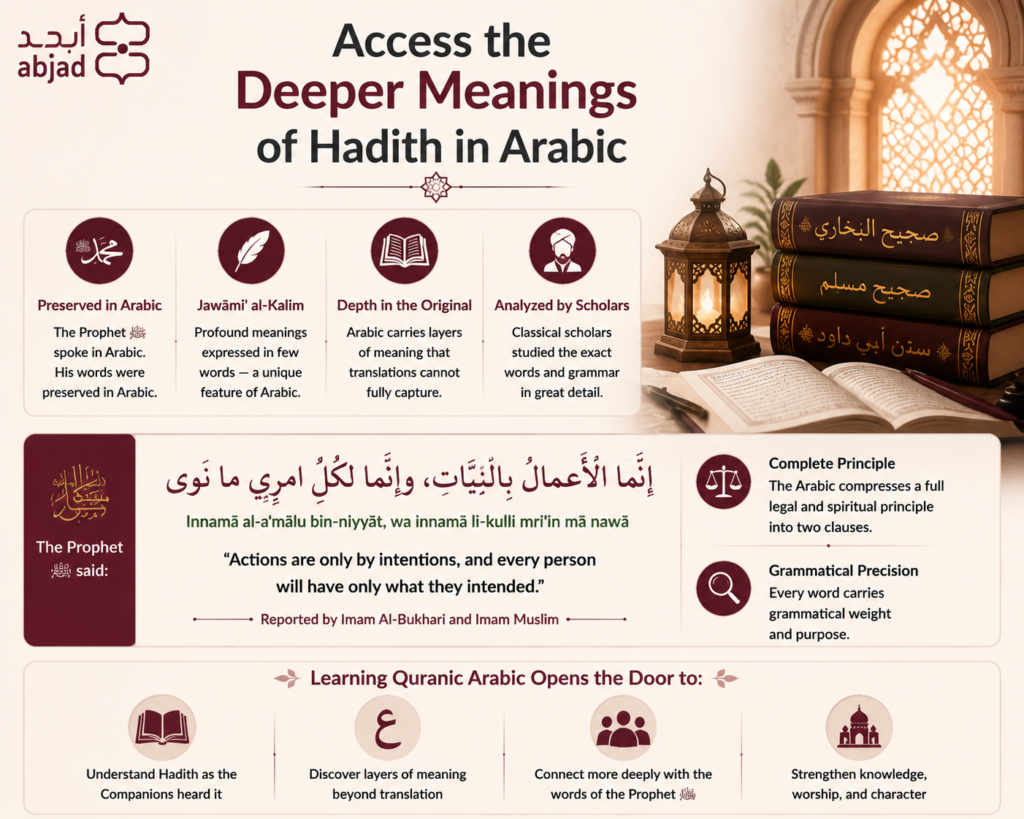
The Prophet ﷺ said:
إِنَّمَا الأَعْمَالُ بِالنِّيَّاتِ، وَإِنَّمَا لِكُلِّ امْرِئٍ مَا نَوَى
Innamā al-a’mālu bin-niyyāt, wa innamā li-kulli mri’in mā nawā
“Actions are only by intentions, and every person will have only what they intended.” — Imam Al-Bukhari and Imam Muslim
The Arabic here compresses a complete legal and spiritual principle into two clauses. Every word carries grammatical weight that classical scholars analyzed in detail. Learning Quranic Arabic opens access to this dimension of Hadith — not just translations, but the original text as the companions of the Prophet ﷺ heard it.
Read more: Quranic Grammar
10. Develop a Lifelong Connection With the Quran
Unlike memorizing a translation, which provides a fixed understanding that may need additional explanation when encountering new verses, Quranic Arabic is a skill that continues to grow over time. Every root word you learn makes new verses more familiar, and every grammatical pattern you understand makes Quranic sentences easier to analyze.
The knowledge gained from Quranic Arabic does not expire. It is a lifelong tool that allows learners to continue discovering meanings every time they read the Quran. Since Classical Arabic has remained preserved since the time of revelation, the language you learn today is the same language through which the Companions of the Prophet ﷺ understood Allah’s words more than 1,400 years ago.
Inside Our Live Classes
Don’t just take our word for it—see for yourself! Click below to watch short clips from our live classes and meet the instructors who will guide your learning journey.
Begin Your Arabic Journey in the UAE
Join Abjad Institute for a professional and immersive Arabic language experience tailored to your goals.
Book Your Free TrialBegin Your Journey to Understanding the Quran with Abjad Institute
Whether your goal is to understand the Quran directly, strengthen your Arabic foundation, or learn the language of revelation step by step, Abjad Institute provides a structured learning path designed around your goals.
At Abjad Institute, our Quranic Arabic programs help learners build essential skills through guided lessons, practical Quranic application, and qualified teacher support.
Our programs include:
- Quranic Arabic for beginners and advanced learners
- Quranic vocabulary and root-based learning
- Nahw and Sarf (Arabic grammar and morphology)
- Understanding Quranic verses through grammar analysis
- Arabic reading and pronunciation foundations
- Interactive online classes
- Personalized instruction for children and adults
Start your free trial lesson today and take the first step toward understanding the Quran through its original language.

Discover Our Arabic Courses
- Arabic Course in the UAE
- Arabic Intensive Course
- Learn Arabic from Scratch Course
- Madinah Arabic Course
- Arabic Classes for Adults
- Arabic Classes for Beginners
- Self-Paced Arabic Course
- Basic Arabic Course
- Arabic Speaking Classes
- Learn to Write Arabic Course
- Arabic Grammar Course
- Learn Arabic Alphabet Course
Begin Your Arabic Journey in the UAE
Join Abjad Institute for a professional and immersive Arabic language experience tailored to your goals.
Book Your Free TrialConclusion
Learning Quranic Arabic is more than learning a language; it is a journey toward deeper understanding of Allah’s words. It bridges the gap between reciting the Quran and comprehending its meanings, allowing learners to appreciate its vocabulary, grammar, eloquence, and linguistic precision in the original Arabic.
Through understanding Nahw, Sarf, Quranic vocabulary, and the relationship between Arabic and Tajweed, learners gain the tools to approach the Quran with greater awareness and reflection. Every root word learned, every grammatical pattern understood, and every verse analyzed builds a stronger connection with the Quran.
The beauty of Quranic Arabic is that it is a lifelong skill. The knowledge you gain today continues to benefit you every time you open the Quran, helping you discover deeper meanings and engage with the revelation in the language in which it was revealed.
Frequently Asked Questions
These are the most common questions learners ask about Quranic Arabic, including its meaning, learning process, relationship with other Arabic forms, and its role in understanding the Quran.
What is Quranic Arabic?
Quranic Arabic is the classical Arabic of the revealed Quran — a distinct register from Modern Standard Arabic and from any spoken dialect. It is the language in which Allah revealed His final message to the Prophet Muhammad ﷺ and has remained textually unchanged since the 7th century.
How long does it take to learn Quranic Arabic?
Most non-Arabic speakers with consistent daily study reach basic Quranic comprehension — understanding 60–70% of the text — within 12 to 18 months. Functional comprehension of approximately 80% of the Quran is achievable in 6–12 months by focusing on the 300 highest-frequency roots.
Can I learn Quranic Arabic without learning spoken Arabic first?
Yes. Quranic Arabic is a distinct goal from conversational Arabic, and studying it directly is generally more efficient for learners whose aim is Quran comprehension. Modern Standard Arabic introduces grammar and vocabulary patterns that appear rarely in the Quran; a Quranic Arabic course addresses classical structures from the start.
Does learning Quranic Arabic improve Salah?
It transforms it. Understanding the meaning of Al-Fatihah, the tashahhud, and the Quranic verses recited in each rak’ah converts Salah from a memorized sequence into a moment of genuine communication. This effect typically appears within the first weeks of Quranic vocabulary study.
Is Quranic Arabic the same as Modern Standard Arabic?
No. Modern Standard Arabic is used in contemporary media, formal writing, and education across Arab countries. Quranic Arabic is a classical register with distinct grammatical constructions, vocabulary choices, and rhetorical patterns. Learning one provides some benefit for the other, but they are not the same discipline.
Do I need to know Arabic to understand Tafsir?
Not as a prerequisite — English Tafsir resources are available and valuable. But a foundation in Quranic Arabic significantly deepens Tafsir study, because most classical Tafsir works discuss grammar and word choice in Arabic directly. Learners with Arabic access broader scholarly commentary and can distinguish between grammatical and contextual interpretations of a verse.





Leave a Reply