 Learn Arabic
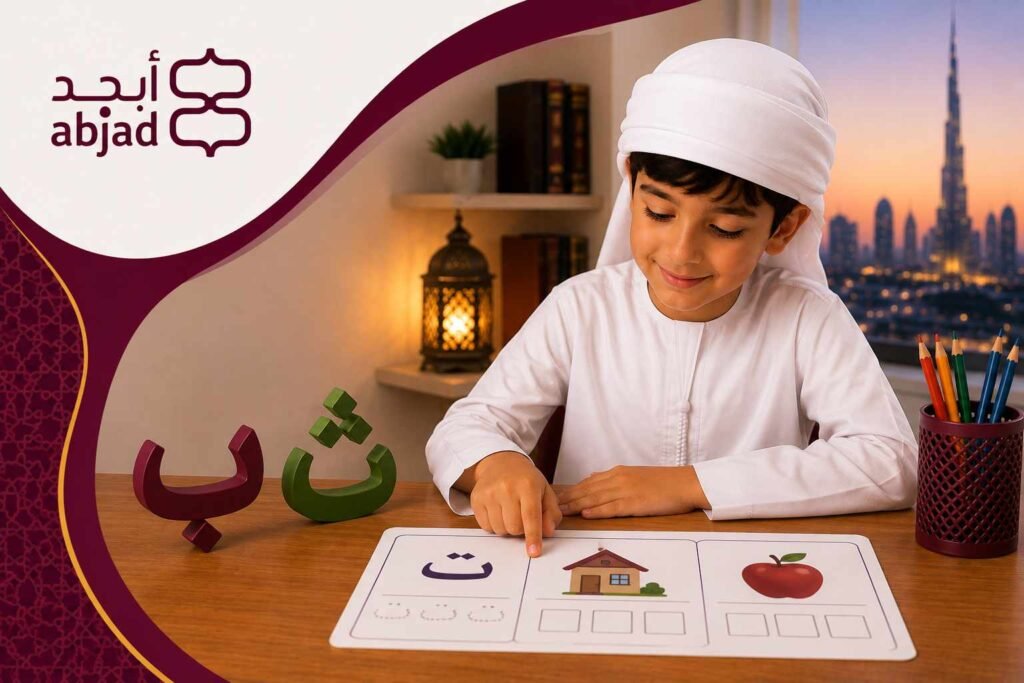
Arabic literacy gives children in the UAE something durable — access to the language of Quranic scripture, national culture, public life, and future professional opportunity. For families raising children here, whether Emirati or from the UAE’s wide-ranging expat community, the question is less whether to pursue Arabic reading and more how to start on the right foot.
When families ask about how to learn to read Arabic for kids in the UAE, the frustration is usually the same: they have tried workbooks, alphabet apps, or structured classes – and something has not clicked. In most cases, the issue is not the child’s ability; it is the starting point.
This guide gives you ten concrete, sequenced steps to help your child learn to read Arabic, shaped around the resources, programs, and teaching approaches that work specifically for UAE families.
Start speaking Arabic with a FREE trial session
1. To Learn To Read Arabic For Kids In The UAE Begin With Phonemic Awareness Not Letter Names
Phonemic awareness is the ability to hear, identify, and manipulate individual sounds in spoken words. Before a child sees a single written letter, they need to be comfortable with how Arabic sounds actually work specifically, that the letter ب produces three different sounds (“ba,” “bi,” “bu”) depending on whether it carries a fatha, kasra, or damma.
Children taught the three vowel sounds for each letter — rather than the letter’s name in isolation — begin reading actual two- and three-letter words weeks earlier than those following an alphabetical naming approach. This is the sounds-and-vowels method, and it underpins every effective Arabic reading curriculum that practising educators consistently recommend.
Knowing how to read Arabic letters in the UAE begins here, with the sounds rather than the names.
2. Introduce Arabic Letters In Teaching Order And Start Blending Words Immediately
The Arabic alphabet contains 28 letters. Teaching them in alphabetical order — alif, ba, ta, tha — is conventional, but not optimal. Letters grouped by ease of production and visual distinctiveness allow children to master a working set quickly and move into word-reading before the full alphabet is memorised.
Begin Your Kid’s Path of learning Arabic with Arabic for Kids Course at Abjad Institute
A. Start Blending Letters Into Words As Soon As Possible
Once a child can produce the three vowel sounds for eight to ten letters, they can read simple words: درس، أكل، باب. This early success is not a shortcut — it builds the reading confidence that carries children through the harder letters and more complex rules that follow.
Understanding how to read Arabic script in the UAE at a foundational level means letters should serve words, not the other way around.
B. Make The Most Of UAE Arabic Literacy Resources
The UAE offers Arabic literacy resources that families in most countries simply do not have access to: government-funded nursery programs, cultural institution events, specialist academies, and a public library network that actively supports children’s Arabic reading. Knowing what is available is the first step to using it well.
Watch Our Classes in Action
Curious what a real session looks like? Take a peek inside our interactive classrooms and see how our expert instructors bring the Arabic language to life. Watch a sample lesson below!
Begin Your Arabic Journey in the UAE
Join Abjad Institute for a professional and immersive Arabic language experience tailored to your goals.
Book Your Free Trial3. Use The UAE’s National Programs Like Al Saff Al Emirati And Al Tifl Yaqra
Two government-backed initiatives are particularly worth knowing about for families with young children.
A. Al Saff Al Emirati
It was launched by the Abu Dhabi Department of Education and Knowledge, operates within private nurseries and targets children aged two to four.
The program embeds Arabic language instruction within culturally grounded activities under the guidance of qualified Emirati educators. As of the most recent reporting cycle, Al Saff Al Emirati runs across 11 private Abu Dhabi nurseries, with additional nurseries joining throughout the current academic year.
Begin your robust grammatical foundation with our Classical Arabic Course

B. Al Tifl Yaqra (The Child Reads)
A joint initiative by the Abu Dhabi Arabic Language Centre and UAE University’s College of Education, delivers structured reading events in community library settings.
The most recent session, held at the Cultural Foundation’s Children’s Library in Abu Dhabi, served approximately 70 children through interactive storytelling, phonics activities, and a practical parent workshop on supporting early Arabic literacy at home.
These are among the most culturally grounded learn Arabic for kids programs available in the UAE — and both are free.
4. Choose The Right Learning Arabic App
The Arabic children’s app market has expanded considerably, but apps differ meaningfully in what they teach and for whom:
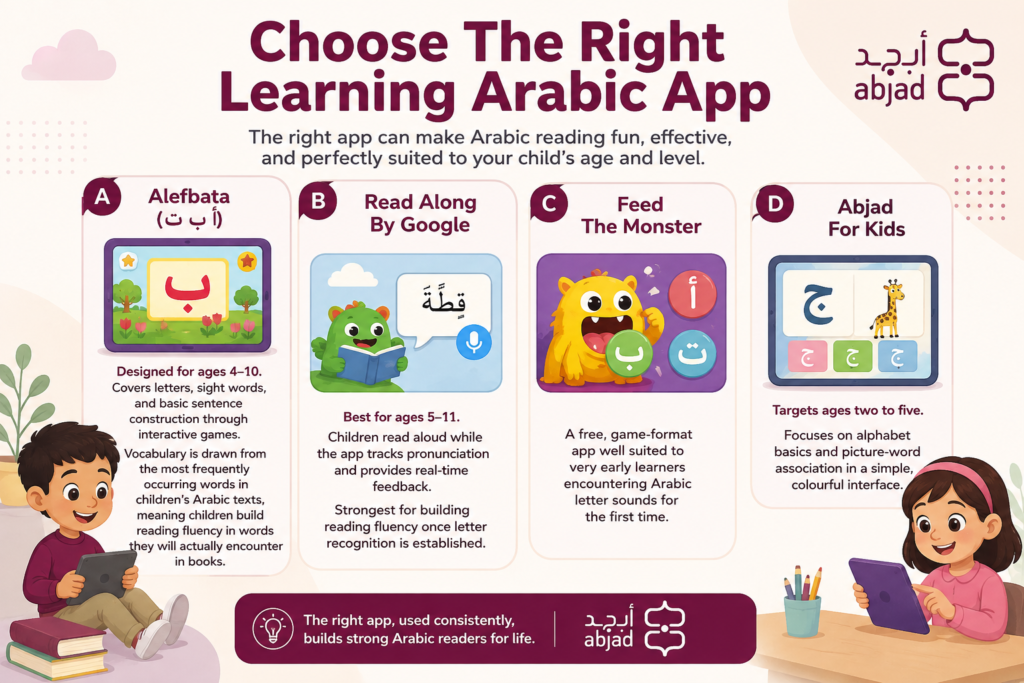
A. Alefbata (أ ب ت)
Designed for ages 4–10. Covers letters, sight words, and basic sentence construction through interactive games. Vocabulary is drawn from the most frequently occurring words in children’s Arabic texts, meaning children build reading fluency in words they will actually encounter in books.
B. Read Along By Google
Best for ages 5–11. Children read aloud while the app tracks pronunciation and provides real-time feedback. Strongest for building reading fluency once letter recognition is established.
Master Arabic Grammar And Start Today with first free session

C. Feed The Monster
One of the interesting apps to learn to read Arabic for kids online free, game-format app well suited to very early learners encountering Arabic letter sounds for the first time.
D. Abjad For Kids
Targets ages two to five. Focuses on alphabet basics and picture-word association in a simple, colourful interface.
When parents search for a learn to read Arabic app, the right choice depends on the child’s current stage. Alefbata is the most complete option for children ready to begin blending letters into words. Read Along is the stronger tool for children who already have letter recognition and need fluency reinforcement.
5. Explore How To Learn To Read Arabic For Kids Online Platforms
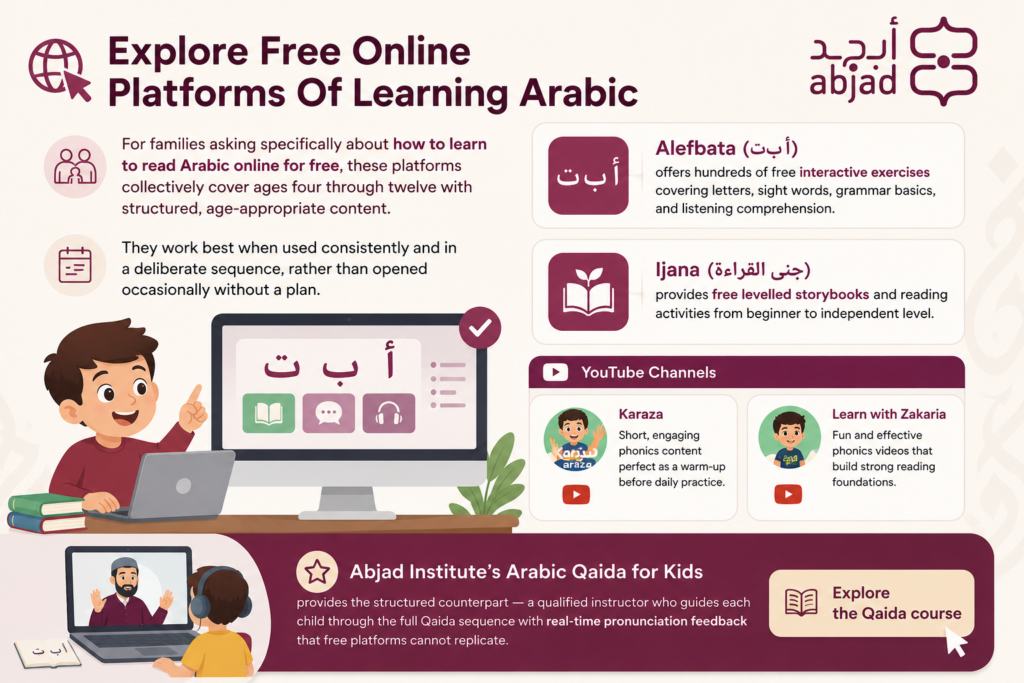
Alefbata (أ ب ت) offers hundreds of free interactive exercises covering letters, sight words, grammar basics, and listening comprehension. Ijana (جنى القراءة) provides free levelled storybooks and reading activities from beginner to independent level.
YouTube channels such as Karaza and Learn with Zakaria add short, engaging phonics content – well-suited as a warm-up before a daily practice session.
For families asking specifically about how to learn to read Arabic online for free, these platforms collectively cover ages four through twelve with structured, age-appropriate content. They work best when used consistently and in a deliberate sequence, rather than opened occasionally without a plan.
Abjad Institute‘s Arabic Qaida for Kids course provides the structured counterpart — a qualified instructor who guides each child through the full Qaida sequence with real-time pronunciation feedback that free platforms cannot replicate. [Explore the Qaida course.
6. Never Skip The Stage Of Harakat While Reading
One of the most consistent observations among Arabic reading specialists: children moved to unvocalised text before they have mastered reading with vowel marks almost always plateau. They can decode individual letters but cannot sustain reading across connected words because they have never learned to predict vowel sounds from context.
The non-negotiable sequence is deliberate: letters with all three short vowels → three-letter words (fully vocalised) → short sentences (fully vocalised) → gradual introduction of unvocalised text, only after fluency is secured at each prior stage.
Children who complete this progression reach unvocalised reading fluency faster than those who rush ahead. This is the practitioner’s insight that most self-study resources fail to communicate clearly.
Those asking how to write in Arabic in the UAE encounter the same logic in reverse — writing with correct vowel marks requires exactly the phonemic grounding that reading with harakat builds.
Secure Your Spot By the Next Arabic intensive Course
7. Use Illustrated Books And Levelled Stories
Picture books are a core reading development tool. When a child sees an image alongside its Arabic word, vocabulary acquisition and print decoding happen simultaneously. This dual-coding effect strengthens word recognition faster than isolated letter drills, and it builds the reading stamina that sustains longer sessions as children advance.
The digital platform Ijana (جنى القراءة) provides levelled Arabic storybooks online, structured from beginner picture-led content through to independent school-level reading.
For families wondering how to read Arabic books with a child who is just starting, Ijana’s levelling system removes the guesswork — each level is calibrated to a specific reading stage, so the child reads at the edge of their current ability rather than above or below it.
Abjad Institute‘s Arabic Course for Kids pairs levelled reading material with live instruction, ensuring each child encounters text at exactly the right difficulty stage while a qualified instructor monitors progress.
Start learning Arabic letters with a FREE trial class
8. Build A 15-Minute Daily Arabic Reading Routine
A child who reads Arabic for fifteen minutes daily will outpace one who sits through an hour-long session on weekends. Frequency, not duration, is the primary driver of early reading development.
For UAE families managing school schedules, sports, and extracurriculars, the fifteen-minute format is also more sustainable — and sustainability is what makes the difference over the months that literacy development actually requires.
Practically speaking, remove as much friction as possible between deciding to practise and actually starting: keep a reading book on the kitchen table, pre-load a single app on the tablet and leave it open, make practice feel automatic rather than a decision that has to be made fresh each time.
How to get better at reading Arabic in the UAE is almost never a question of finding a better curriculum. It is almost always a question of practising at higher frequency, with a method that a child can access independently most days.
Join the Best Arabic from Scratch Course in the UAE
9. Understand How Quranic Arabic Reading Connects To General Literacy
Quranic Arabic uses the same script as Modern Standard Arabic, but it is fully vocalised — every word carries its harakat. This makes Quranic text paradoxically easier to decode than unvocalised written Arabic, because the reader never has to predict a vowel sound.
A child who can read fully vocalised Arabic text has the phonetic foundation to begin Quranic reading under qualified instruction. The standard entry point for Quranic reading is the Qaida — a structured primer that covers the Quranic Arabic alphabet, short and long vowels, tanwin, shadda, and the foundational rules of Tajweed pronunciation.
Understanding how to read Arabic Quran in the UAE means starting with this primer, ideally under an instructor who teaches Tajweed correctly from the outset rather than allowing habits to form that must be corrected later.
The broader benefits of learning Quranic Arabic extend well beyond religious practice. Children who engage with Quranic text develop stronger classical Arabic comprehension, which reinforces reading across all registers of written Arabic. Both literacies strengthen each other in practice.
Master the Quranic Arabic with a free trial
10. Enroll In A Structured Course Because Self-Study Has Real Limits
Apps and free platforms are valuable complements to instruction, but they are not substitutes for a live teacher. An instructor corrects pronunciation errors in real time — something no current app does with sufficient precision for young learners.
A teacher identifies specific gaps a child cannot diagnose independently, adapts the pace based on individual progress, and provides targeted encouragement that sustains a child through genuinely difficult stages.
This is the point where basic Arabic reading practice in the UAE moves from home activity into formal learning. Does Arabic read right to left? Yes — and this directional shift from English is one of the first things a qualified teacher addresses explicitly.
Inside Our Live Classes
Don’t just take our word for it-see for yourself! Click below to watch short clips from our live classes and meet the instructors who will guide your learning journey.
Begin Your Arabic Journey in the UAE
Join Abjad Institute for a professional and immersive Arabic language experience tailored to your goals.
Book Your Free TrialAbjad Institute A Personalized Approach To Arabic Learning For UAE Children
Give your child the confidence to read Arabic with a clear, supportive learning journey at Abjad Institute. Our live online Arabic courses for kids combine qualified native-speaking teachers, age-appropriate materials, pronunciation guidance, and structured progress—from mastering letters and harakat to reading complete sentences independently.
Available to families across every emirate, the program makes high-quality Arabic instruction accessible from home.
Discover Our Arabic Courses at Abjad Academy:
- Arabic Course for Kids
- Arabic Conversation for Kids
- Arabic Qaida for Kids
- Beginner Arabic for Kids
- Arabic Grammar for Kids
- Teen Arabic Summer Course
- Arabic Kids Camps
- UAE Kindergarten Arabic Classes
- Modern Standard Arabic Course
- Fusha Arabic Course
- Classical Arabic Course
- Emirati Arabic Course
- Gulf Arabic Course
- Learn Saudi Arabic
- Business Arabic Course UAE
- Arabic Language Classes for Professionals in UAE
- Quranic Arabic Course
Book your child’s FREE trial session today and take the first step towards confident Arabic reading.

Conclusion
Learning to read Arabic for kids in the UAE becomes easier when children follow a clear, age-appropriate sequence. Begin with letter sounds and harakat, introduce simple word blending early, use illustrated and levelled stories, and maintain a consistent 15-minute daily routine.
Apps to learn to read Arabic for kids free produced by UAE literacy initiatives can make practice more engaging, but live instruction remains essential for correcting pronunciation, identifying learning gaps, and building lasting confidence.
With the right combination of home practice, suitable resources, and guidance from a qualified teacher, every child can develop strong Arabic reading skills and progress towards independent reading.
Frequently Asked Questions
What Is The Best Age For A Child To Start Reading Arabic?
Children can begin developing Arabic listening and sound-awareness skills from ages two to four. Formal letter recognition and word blending commonly begin around ages four to six, although the right starting point depends on each child’s readiness and language exposure.
How Can I Teach My Child To Read Arabic At Home?
Start with Arabic letter sounds rather than letter names, practise the three short vowels, and gradually blend letters into simple words. Use picture books, phonics games, and short daily reading sessions to keep learning manageable and enjoyable.
How Long Does It Take A Child To Learn To Read Arabic?
Progress varies according to the child’s age, consistency, previous exposure to Arabic, and quality of instruction. Regular 15-minute practice sessions combined with structured teaching generally produce better results than occasional, longer lessons.
Which Arabic Reading App Is Best For Kids?
The best app depends on the child’s level. Feed the Monster and Abjad for Kids suit early beginners, Alefbata supports children learning letters and word blending, while Read Along by Google can help children who already recognise letters improve their fluency.
Should Children Learn Harakat Before Reading Arabic Without Vowel Marks?
Yes. Children should become confident reading letters, words, and short sentences with harakat before gradually moving to unvocalised text. Skipping this stage can make decoding words and developing fluent reading more difficult.
Can Learning Quranic Arabic Help A Child Read Modern Standard Arabic?
Yes. Quranic Arabic helps children practise letter recognition, vowel marks, accurate pronunciation, and fluent decoding. These foundational skills also support reading in Modern Standard Arabic, although children will eventually need practice with unvocalised texts.
Related Articles
Learn Arabic




Leave a Reply