 Learn Arabic
Have you ever read the Quran and wondered whether you’re pronouncing the letters correctly — or whether what sounds like an “s” should actually be a ص or a س? You’re not alone. This confusion is one of the most common starting points for every new Quranic Arabic learner, and fixing it early protects everything you build afterward.
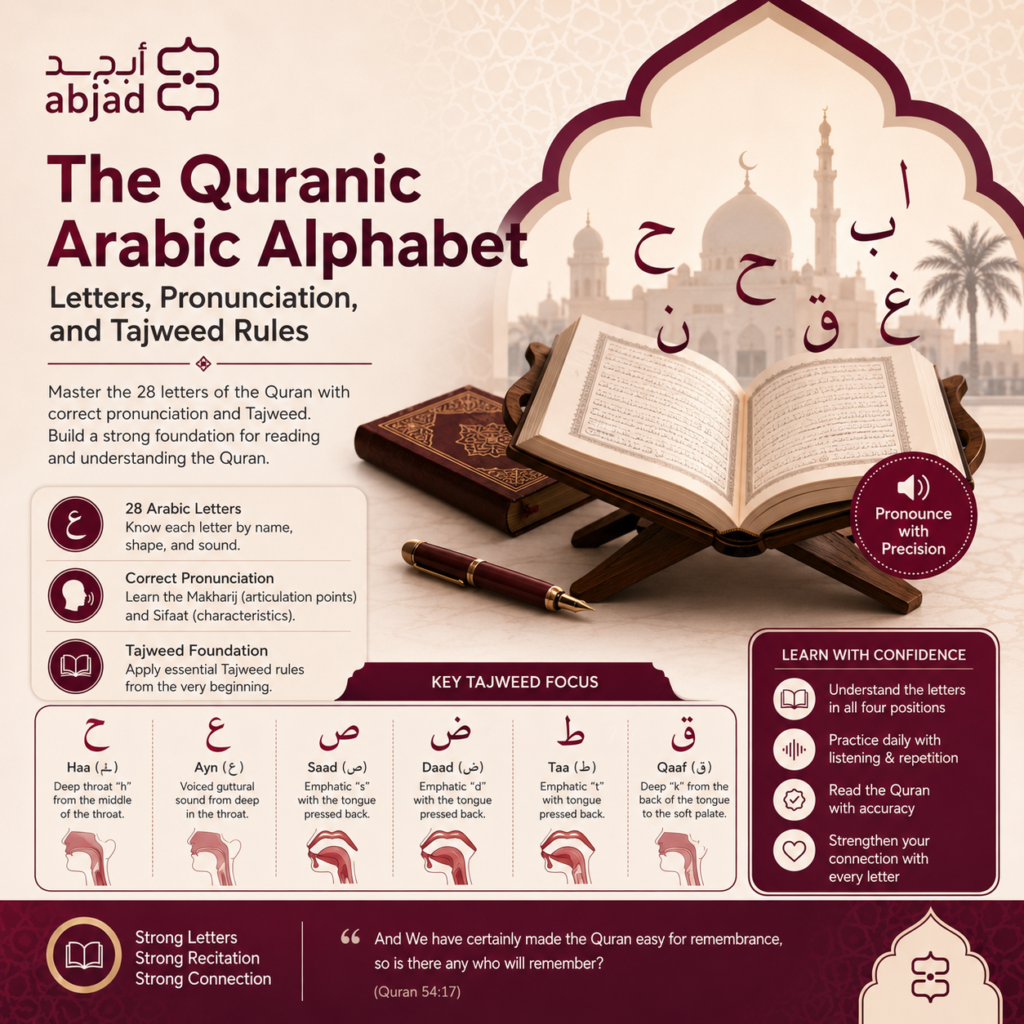
The Quranic Arabic alphabet consists of 28 letters — the same letters used in Modern Standard Arabic — but reciting them in the Quran demands a level of precision that goes well beyond casual reading. Each letter has a defined articulation point (makhraj), a set of phonetic characteristics (sifaat), and a role within Tajweed rules that shapes how it sounds in connected recitation.
This guide walks you through every Quranic letter, the sounds that trip up most English speakers, and the Tajweed basics that sit on top of letter pronunciation. Whether you’re starting from scratch or correcting habits picked up along the way, you’ll leave with a clear, actionable picture.
The Quranic Arabic Alphabet: 28 Letters, One Precise System
The Quranic Arabic alphabet is the foundation of everything in Quranic recitation. Before you can follow Tajweed rules, read Quranic words fluently, or work toward memorization, you need to know each letter by name, shape, and sound.
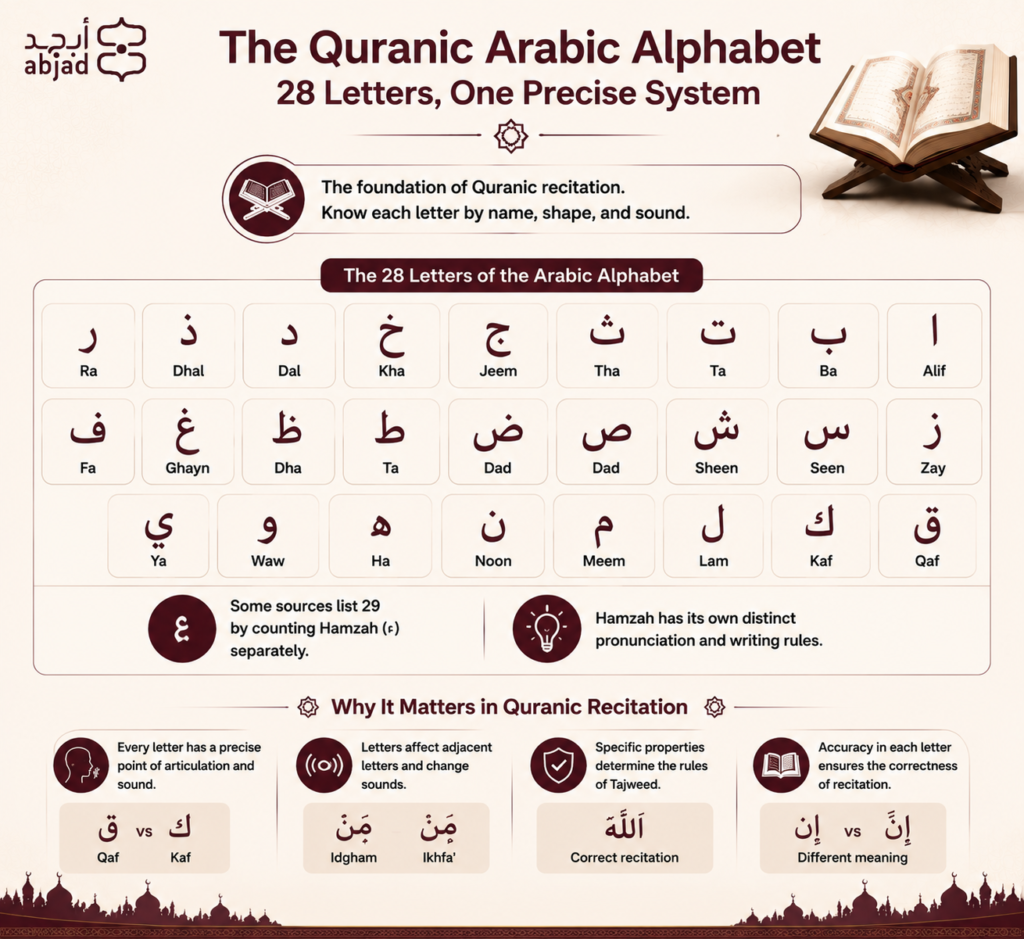
The alphabet contains 28 letters. Some sources list 29 by counting Hamzah (ء) separately — and for good reason, since Hamzah has its own distinct pronunciation and writing rules — but the core Arabic alphabet itself stands at 28. What makes the Quranic alphabet distinct from simply knowing Arabic letters is this: every letter carries phonetic properties that affect adjacent letters, change sounds under specific conditions, and determine whether a recitation is accurate or not.
Complete Quranic Arabic Alphabet Chart
The table below covers every letter with its name, isolated form, four positional shapes, and the closest English approximation. Note that for several letters — particularly the emphatic consonants and throat sounds — there is no true English equivalent.
| Letter | Name | Isolated | Initial | Medial | Final | Approximate Sound |
| ا | Alif | ا | ا | ـا | ـا | “a” as in father |
| ب | Baa | ب | بـ | ـبـ | ـب | “b” as in book |
| ت | Taa | ت | تـ | ـتـ | ـت | “t” as in table |
| ث | Thaa | ث | ثـ | ـثـ | ـث | “th” as in think |
| ج | Jeem | ج | جـ | ـجـ | ـج | “j” as in jump |
| ح | Haa (deep) | ح | حـ | ـحـ | ـح | No English equivalent — deep breathy h |
| خ | Khaa | خ | خـ | ـخـ | ـخ | “ch” in Scottish loch |
| د | Daal | د | د | ـد | ـد | “d” as in door |
| ذ | Dhaal | ذ | ذ | ـذ | ـذ | “th” as in this |
| ر | Raa | ر | ر | ـر | ـر | Rolled “r” (single flap, like Spanish r) |
| ز | Zaay | ز | ز | ـز | ـز | “z” as in zoo |
| س | Seen | س | سـ | ـسـ | ـس | “s” as in sun |
| ش | Sheen | ش | شـ | ـشـ | ـش | “sh” as in ship |
| ص | Saad | ص | صـ | ـصـ | ـص | Emphatic “s” — no English equivalent |
| ض | Daad | ض | ضـ | ـضـ | ـض | Emphatic “d” — no English equivalent |
| ط | Taa (emphatic) | ط | طـ | ـطـ | ـط | Emphatic “t” — no English equivalent |
| ظ | Zaa (emphatic) | ظ | ظـ | ـظـ | ـظ | Emphatic “dh/z” — no English equivalent |
| ع | Ayn | ع | عـ | ـعـ | ـع | Deep guttural — no English equivalent |
| غ | Ghayn | غ | غـ | ـغـ | ـغ | Like French “r” — voiced throat sound |
| ف | Faa | ف | فـ | ـفـ | ـف | “f” as in fish |
| ق | Qaaf | ق | قـ | ـقـ | ـق | Deep back-of-throat “k” — no English equivalent |
| ك | Kaaf | ك | كـ | ـكـ | ـك | “k” as in kite |
| ل | Laam | ل | لـ | ـلـ | ـل | “l” as in lamp |
| م | Meem | م | مـ | ـمـ | ـم | “m” as in moon |
| ن | Nuun | ن | نـ | ـنـ | ـن | “n” as in nose |
| ه | Haa (soft) | ه | هـ | ـهـ | ـه | “h” as in hat |
| و | Waaw | و | و | ـو | ـو | “w” as in water / long “oo” |
| ي | Yaa | ي | يـ | ـيـ | ـي | “y” as in yes / long “ee” |
One practical note: Arabic is a connected script. Most letters connect to the letter that follows them, which is why every letter has four positional forms. A learner who knows only the isolated form will struggle to recognize the same letter in the middle of a word. Spend time on all four forms before moving to whole words.
Watch Our Classes in Action
Curious what a real session looks like? Take a peek inside our interactive classrooms and see how our expert instructors bring the Arabic language to life. Watch a sample lesson below!
Begin Your Arabic Journey in the UAE
Join Abjad Institute for a professional and immersive Arabic language experience tailored to your goals.
Book Your Free TrialRead more: Learn Quranic Arabic Free in the UAE
Pronunciation of Quranic Letters: The Sounds That Require Deliberate Training
Pronouncing Quranic letters correctly is the single most important skill to build at the beginning — and the hardest to correct once errors become habitual. The majority of English-speaking learners struggle with a specific group of letters that have no counterpart in English.
Understanding makharij — the exact articulation points where each letter originates — is what separates a learner who approximates Quranic sounds from one who produces them accurately. Below are the letters that require the most deliberate attention.
For learners working toward professional Arabic fluency rather than recitation alone, Abjad Institute’s Arabic courses for professionals offer structured pronunciation training within a broader language framework.

1. How to Pronounce ح (Haa) — The Deep Throat H
ح (Haa) is produced in the middle of the throat (pharynx) by partially constricting the airflow there. It is not the same as the soft English “h” in hat. Think of the sensation of fogging a mirror — that breathy, throat-centered exhale — but with more constriction and more control.
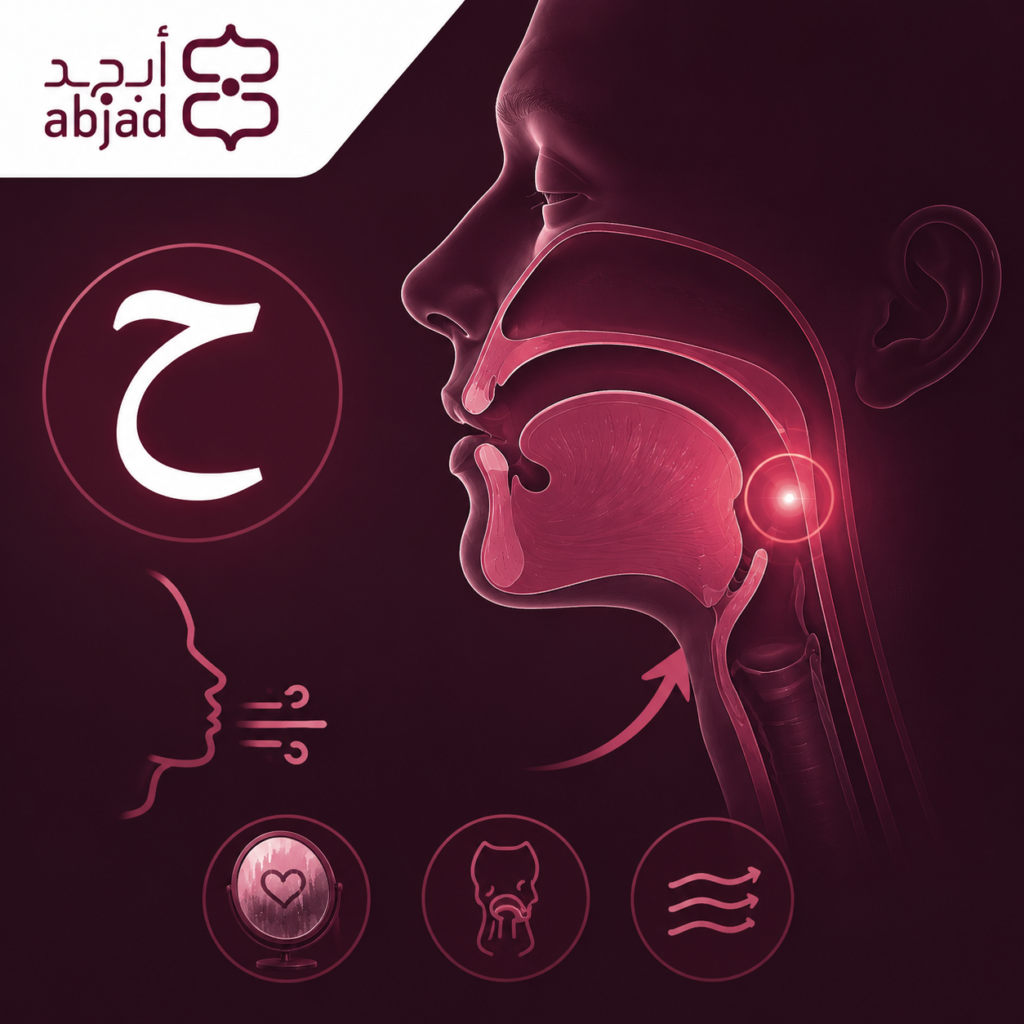
You hear it immediately in سورة الفاتحة: الْحَمْدُ (Al-Hamdu — all praise). If your ح sounds the same as your ه, you are producing the wrong letter.
2. How to Pronounce ع (Ayn) — The Guttural Voiced Sound
ع (Ayn) comes from the same region as ح but is voiced — meaning your vocal cords are engaged. Linguists classify it as a voiced pharyngeal fricative, which is a sound that simply does not exist in English phonology. The closest description: imagine starting to say “ah” but squeezing the middle of your throat as you produce it.
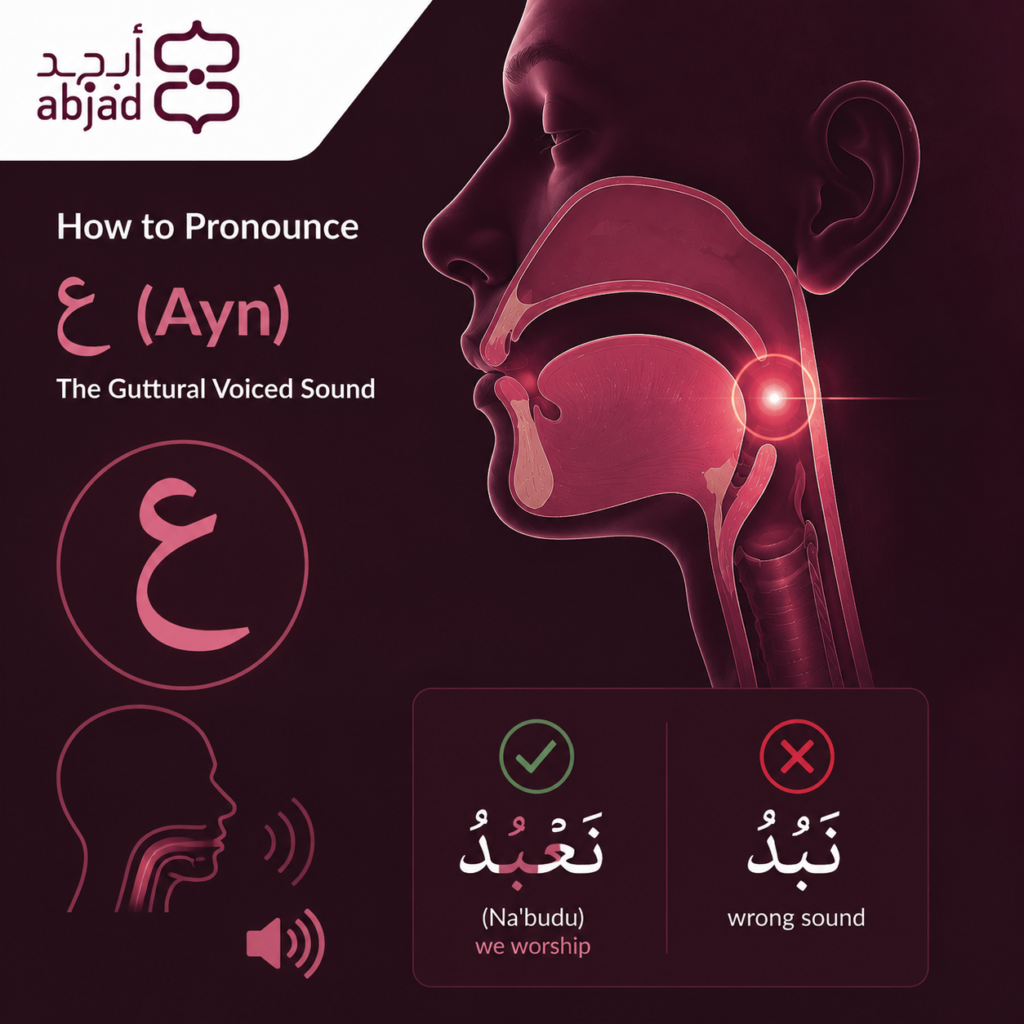
You hear it in نَعْبُدُ (Na’budu — we worship). The ع in the middle is what makes it distinct. A learner who replaces ع with a simple vowel sound has effectively changed the word.
3. How to Pronounce ص (Saad) — The Emphatic S
ص (Saad) and س (Seen) are both “s” sounds, but produced very differently. The Seen is a front-of-mouth sound; the Saad is an emphatic consonant, produced with the tongue body raised toward the back of the mouth (velarized), making the sound feel “heavier” and more resonant.

The difference matters in the Quran. In الصِّرَاطَ (as-Sirata — the straight path), the Saad’s emphatic quality changes how the surrounding vowels sound. Replacing it with a regular Seen is a recognizable recitation error.
4. How to Pronounce ض (Daad) — Arabic’s Most Unique Letter
Arabic is sometimes called lughat ad-Daad — the language of the Daad — because ض is considered uniquely Arabic. It is produced by raising the side of the tongue to the upper back molars, creating a laterally emphatic “d” sound. There is no equivalent in English, French, or most other languages.
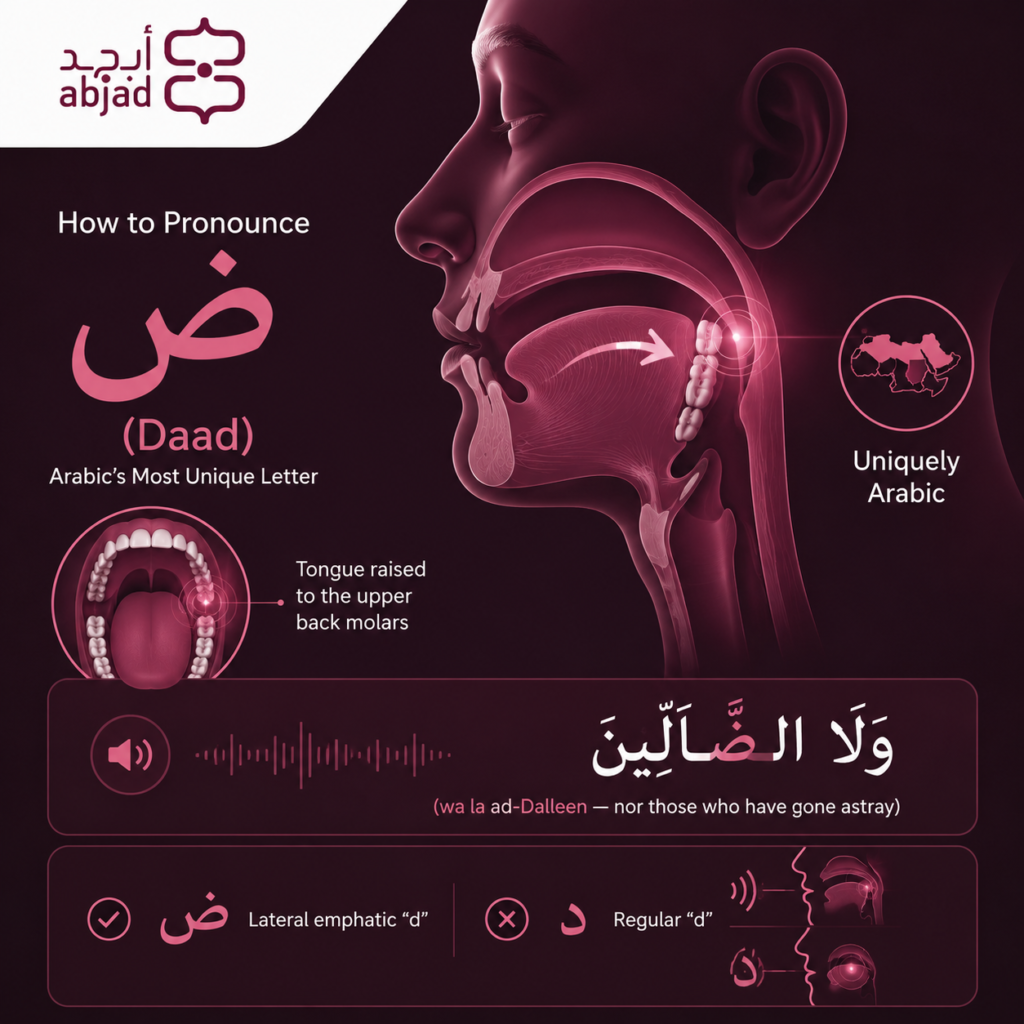
You hear it in وَلَا الضَّالِّينَ (wa la ad-Dalleen — nor those who have gone astray). The difference between ض and د is audible and phonetically significant in recitation.
5. How to Pronounce ق (Qaaf) — The Deep Back-of-Throat K
ق (Qaaf) is produced at the uvula — the small flap at the very back of your soft palate — making it distinctly deeper than the English “k,” which is produced further forward on the hard palate.
ك (Kaaf) and ق (Qaaf) are frequently confused by beginners precisely because they are both “k-type” sounds but articulated from completely different locations.
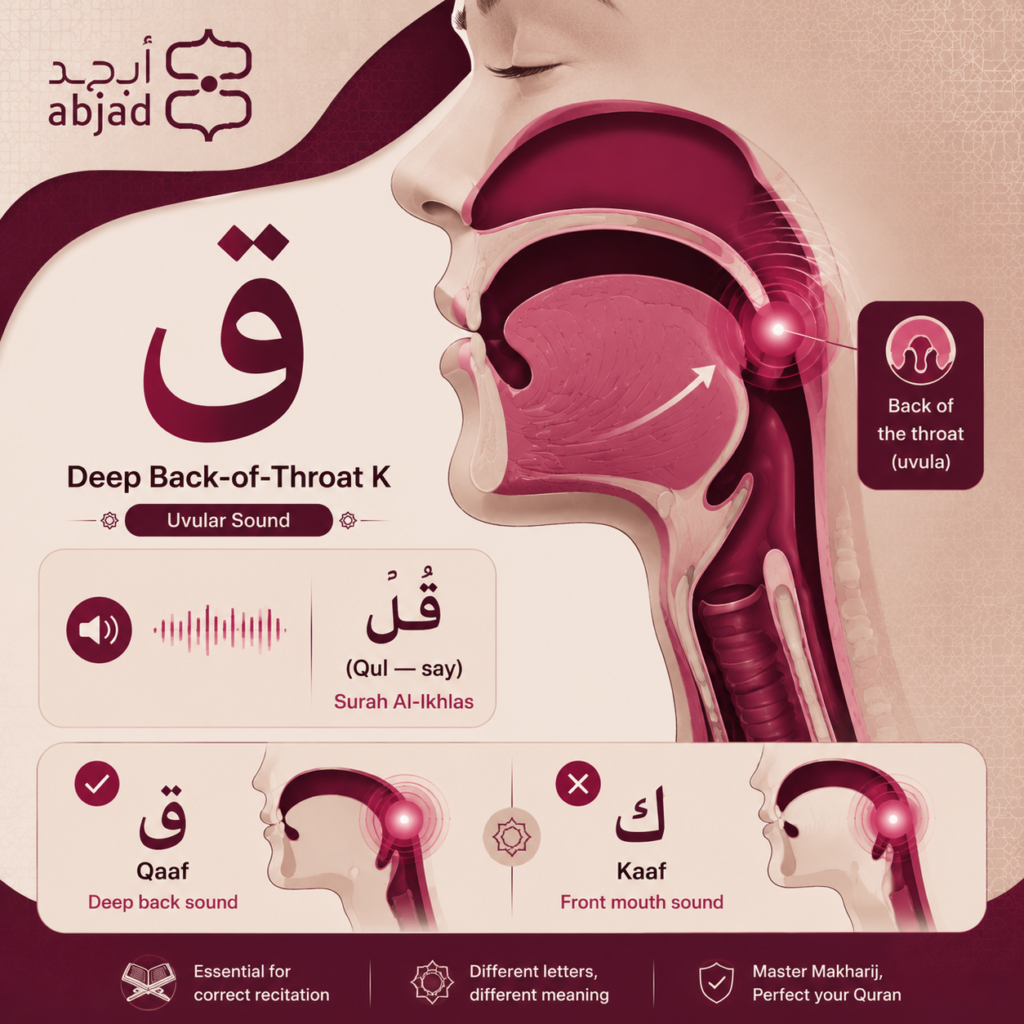
قُلْ (Qul — say) opens Surah Al-Ikhlas and gives you an immediate, clean context to practice this sound.
6. How to Pronounce غ (Ghayn) and خ (Khaa) — The Throat Fricatives
غ (Ghayn) is a voiced sound produced in the upper throat, similar to the French “r” or a light gargling quality.
خ (Khaa) is the same location but voiceless — the “ch” in the Scottish loch or the German Bach. Both require the back of the tongue to approach the uvular region, which is unfamiliar territory for English speakers.
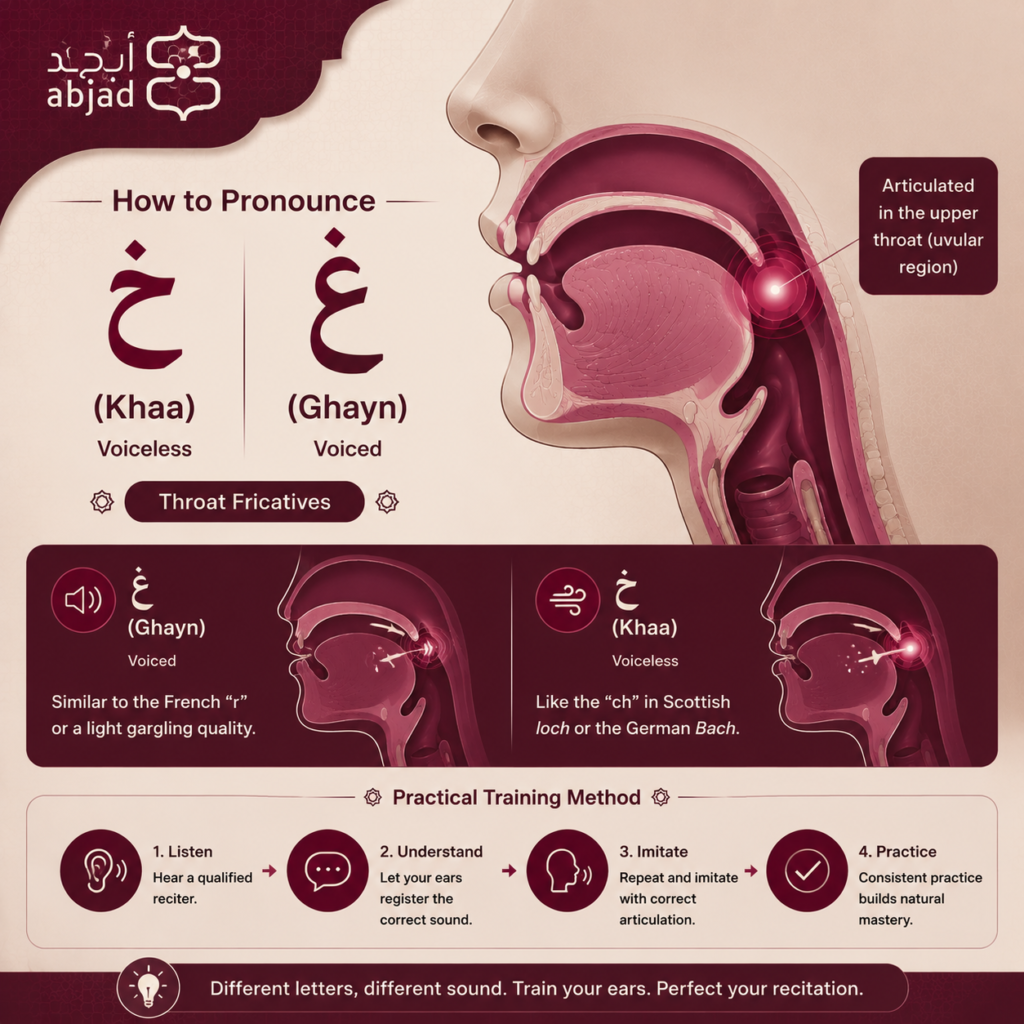
The practical training method: listen to a qualified reciter pronounce these letters in isolation and in real words, then imitate — not the other way around. Your ears need to register the correct sound before your articulation can reproduce it.
Read more: Can You Learn Quranic Arabic on Duolingo?
How Tajweed Changes Quranic Alphabet Pronunciation?
Knowing the Quranic letters and their isolated pronunciation is the first layer. Tajweed is the second — and it is what the Quran itself was revealed with. Tajweed is the science of reciting each letter from its correct articulation point, with its full phonetic characteristics, and applying the rules governing how letters interact with each other in connected speech.
Several Tajweed rules activate directly from the alphabet level, before you even reach word-level rules. Parents looking for a structured, age-appropriate introduction for younger learners can explore Abjad Institute’s kindergarten Arabic courses, where alphabet and early Tajweed foundations are taught together.

1. Madd — Elongation of Specific Letters
Madd (مَدّ — lengthening) occurs when the letters ا، و، or ي appear after a matching short vowel with no vowel of their own. The letter is then held for a prescribed number of counts rather than read quickly.
In قَالَ (Qaala — he said), the Alif is not a consonant here — it is a long vowel carrier that stretches the “aa” sound for two counts. Rushing through it collapses a Tajweed rule that is audible to any trained reciter.
2. Idgham – Merging of Adjacent Letters
Idgham (إدغام — merging) occurs when a Noon Saakin (نْ) or Tanween meets one of six specific letters: ي، ر، م، ل، و، ن. The Noon’s sound is absorbed into the following letter, producing a smooth, merged pronunciation with nasalization (ghunnah) in some cases and without it in others.
In مِن رَّبِّهِم (min rabbihim — from their Lord), the Noon of “min” merges completely into the Raa that follows it. A learner who pronounces each letter separately, producing a distinct “n” before the “r,” has broken an Idgham rule.
3. Ghunnah – The Nasal Resonance
Ghunnah (غُنَّة — nasalization) is a nasal sound held for two counts that accompanies ن (Nuun) and م (Meem) in specific conditions. It is produced through the nose, not the throat, and must be clearly audible rather than swallowed.
Many beginners produce either too much ghunnah (applying it everywhere Noon or Meem appears) or too little (eliminating it even where it is obligatory). The correct rule: ghunnah is obligatory when Nuun or Meem carries a Shadda, and in Ikhfa and Iqlab situations. It is absent in Izhar positions.
Read also: A Complete Guide to Teaching Arabic Letters for Kids
4. Izhar – Clear, Unmixed Pronunciation
Izhar (إظهار — clarity) is the opposite of Idgham. When Noon Saakin or Tanween meets one of the six throat letters (ء، ه، ع، ح، غ، خ), the Noon must be pronounced fully and distinctly — no merging, no nasalization.
In مَنْ آمَنَ (man amana — whoever believes), the Noon Saakin before the Hamzah of “amana” is an Izhar position. The Noon is clear, the Hamzah starts fresh.
Inside Our Live Classes
Don’t just take our word for it—see for yourself! Click below to watch short clips from our live classes and meet the instructors who will guide your learning journey.
Begin Your Arabic Journey in the UAE
Join Abjad Institute for a professional and immersive Arabic language experience tailored to your goals.
Book Your Free TrialStart Learning the Quranic Alphabet the Right Way — with Abjad Institute
Most learners spend weeks repeating letters in isolation, then find they can’t recognize them inside actual Quranic words. The gap between knowing letters and reading the Quran fluently comes down to one thing: guided, corrected practice in connected text, not isolated drills.
At Abjad Institute, structured Arabic and Quranic courses take you from the alphabet all the way through Tajweed recitation — with qualified instructors who correct your pronunciation in real time, in every session.
Whether you’re an adult starting from scratch, a professional who needs structured Arabic language skills through our Arabic speaking courses, or a parent getting your child started early — Abjad has a program built for your goal.
[Book your free trial lesson at Abjad Institute]

Discover Our Arabic Courses
- Arabic Course in the UAE
- Arabic Intensive Course
- Learn Arabic from Scratch Course
- Madinah Arabic Course
- Arabic Classes for Adults
- Arabic Classes for Beginners
- Self-Paced Arabic Course
- Basic Arabic Course
- Arabic Speaking Classes
- Learn to Write Arabic Course
- Arabic Grammar Course
- Learn Arabic Alphabet Course
Begin Your Arabic Journey in the UAE
Join Abjad Institute for a professional and immersive Arabic language experience tailored to your goals.
Book Your Free TrialConclusion
The Quranic Arabic alphabet is 28 letters — the same letters as Modern Standard Arabic, but recited under a completely different standard of precision. Makharij (articulation points) determine where each letter originates; sifaat (phonetic characteristics) determine how it sounds; and Tajweed rules govern how letters interact once they appear in sequence.
For English speakers, the most critical investment is in the letters that have no English equivalent: ح، ع، ص، ض، ط، ظ، ق، غ، خ. These are the sounds most often approximated, and approximation in Quranic recitation is not good enough — even a subtle difference in ص versus س, or ق versus ك, changes what is being pronounced.
Mastering the Quranic alphabet is not a one-week task. It is a foundational stage that rewards patience and qualified guidance. Build it correctly, and everything else — Tajweed, fluency, memorization — stands on solid ground.
Frequently Asked Questions About the Quranic Arabic Alphabet
Learning the Quranic Arabic alphabet is the first step toward accurate Quran recitation and understanding. These FAQs answer the most common questions about the letters, pronunciation differences, difficult sounds, and the role of Tajweed in mastering them.
How many letters are in the Quranic Arabic alphabet?
The Quranic Arabic alphabet has 28 letters. Some teaching materials list 29 by counting Hamzah (ء) separately from Alif, because Hamzah has distinct pronunciation and writing rules. The core alphabet itself is 28 letters, identical to the Modern Standard Arabic alphabet.
Is the Quranic alphabet different from the regular Arabic alphabet?
The letters are the same in both. What differs is the standard of pronunciation. Quranic recitation requires each letter to be produced from its precise articulation point (makhraj) and with its full phonetic characteristics (sifaat). Casual Arabic pronunciation allows more flexibility; Quranic recitation does not.
Which Quranic letters are hardest for English speakers to pronounce?
The most difficult letters for English speakers are ع (Ayn), ح (deep Haa), ق (Qaaf), ص (Saad), ض (Daad), ط (emphatic Taa), and غ (Ghayn). None of these have English counterparts, meaning they require ear training alongside physical pronunciation practice — not just reading a description.
What is the difference between ص and س in Quranic Arabic?
Both are “s” sounds, but ص (Saad) is an emphatic consonant produced with the tongue body raised toward the back of the mouth, giving it a heavier, more resonant quality.
س (Seen) is produced at the front of the mouth with a lighter sound. Substituting one for the other in recitation produces a different letter and, in many cases, a different word.
Do I need to learn Tajweed to recite the Quran?
Tajweed rules are not optional additions to Quranic recitation — they are how the Quran was revealed and transmitted. Basic Tajweed rules such as Ghunnah, Madd, Idgham, and Izhar apply from the very first verse. A beginner does not need to master all Tajweed rules before reading, but they should learn them alongside alphabet study rather than treating them as an advanced stage.
How long does it take to learn the Quranic Arabic alphabet?
Most adult learners can recognize all 28 letters in their four positional forms within two to four weeks of daily practice. Producing the difficult letters — ع، ح، ق، ص، ض — with correct pronunciation typically takes one to three months of guided practice with feedback from a qualified teacher. Rushing this stage to reach Quran reading faster usually requires going back and correcting ingrained errors later.
Related Articles
Learn Arabic





Leave a Reply