 Learn Arabic
Arabic poetry and children have always belonged together.
Long before structured curricula existed, Arab families passed values, language, and cultural identity through verse – short rhythmic lines that lodged in memory effortlessly and surfaced years later without prompting.
An Arabic poem for kids is not just a classroom exercise. It is one of the most reliable tools Arabic teachers and parents have for building vocabulary, instilling values, and creating an emotional connection to the language that worksheet drills simply cannot replicate.
This guide presents 10 Arabic poems for children, carefully selected for their clarity, educational power, and proven staying power across generations. Each entry includes a translated excerpt, an explanation of what the poem teaches, the age group it suits best, and practical guidance on how to use it — at home, in a language class, or in a school setting.
Begin Your Arabic Speaking Journey With a Free Trial Today at Abjad Institute

1. The Little Bird (العصفور الصغير) The Amazing Arabic Poem For Kids Aged 3 – 5 Years
The Little Bird is the natural entry point for very young Arabic learners. Its short paired lines, familiar imagery, and gentle rhyme scheme make it immediately accessible to children who are just beginning to recognize Arabic sounds.
فَوْقَ غُصْنِ الشَّجَرَهْ / غَرَّدَ العُصْفُورُ مَرَّهْ
طَارَ فِي جَوِّ الصَّبَاحْ
Upon the tree branch / The little bird sang once / It flew through the morning sky
The poem introduces core vocabulary — tree, bird, branch, morning, sky — that reappears throughout early Arabic children’s literature. Parents who are beginning to read Arabic with their child for the first time will benefit from understanding that does Arabic read right to left, which determines how a child’s eye should follow these short lines across the page.
2. Al-Madrasa (المدرسة – By Ahmad Shawqi)
Ahmad Shawqi‘s The School (قصيدة المدرسة) addresses the child aged 5 – 7 years directly, personifying school as a welcoming mother rather than a place of obligation. It is among the most memorized poems in Arabic language curricula across the Arab world.
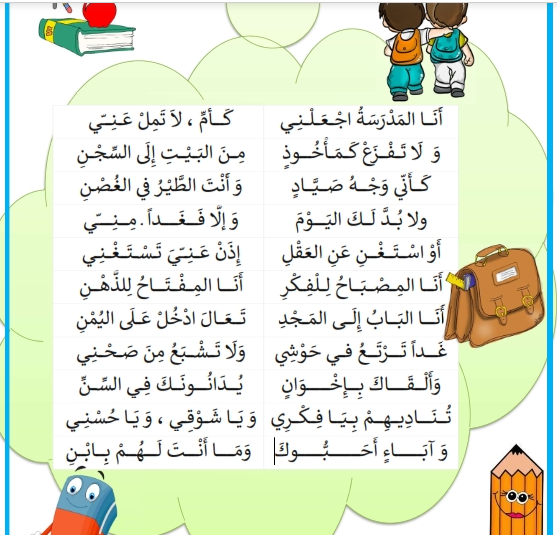
أَنا المدرَسةُ اجعَلني كأُمٍّ، لا تَمِلْ عنِّي
أَنا المِصْباحُ للفِكرِ أَنا المِفتاحُ للذِّهْن
I am the school — make me like a mother, do not turn from me / I am the lamp for thought, I am the key to the mind
The personification technique is deceptively sophisticated for a children’s poem. It introduces abstract nouns, thought, mind, key, lamp, through a familiar human metaphor, giving children emotional access to vocabulary they would otherwise find dry. Teachers frequently introduce this poem at the start of a school year to set a positive frame around learning.
3. The Cat And Cleanliness (القط والنظافة – By Ahmad Shawqi)
Rather than lecturing children on personal hygiene, Shawqi observes the meticulous grooming habits of a household cat and leaves the moral for the child to draw independently.
هِرَّتي جِدُّ أَليفَه / وَهيَ لِلبَيتِ حَليفَه
My cat is very friendly / She is the ally of the home
The cat washes regularly, keeps her fur clean, and treats cleanliness as a natural part of her daily routine — not as an obligation. Children absorb the parallel message without feeling corrected. This is the core practitioner technique behind Shawqi’s children’s work: indirection. Lessons delivered through observation sticks; lessons delivered through instruction are resisted.
Watch Our Classes in Action
Curious what a real session looks like? Take a peek inside our interactive classrooms and see how our expert instructors bring the Arabic language to life. Watch a sample lesson below!
Begin Your Arabic Journey in the UAE
Join Abjad Institute for a professional and immersive Arabic language experience tailored to your goals.
Book Your Free Trial4. Kindness To Animals (الرفق بالحيوان – By Ahmad Shawqi)
Kindness to Animals (نشيد الرفق بالحيوان) is one of Shawqi’s most widely reproduced pieces in Arab school curricula.
الحَيوانُ خَلقُ لَهُ عَلَيكَ حَقُّ
مِن حَقِّهِ أَن يُرفَقا بِهِ وَأَلّا يُرهَقا
The animal is a created being that has rights over you / It is its right to be treated gently and not burdened
The poem frames animal care as a moral obligation — not a kindness, but a right. This resonates particularly well in Islamic ethical contexts, where care for animals carries recognized religious weight.
The poem works naturally as an introduction to classroom discussions about responsibility, and as a writing prompt where children describe how they care for an animal they have observed.
Secure Your Child’s Spot in the Arabic Qaida Course Today
5. My Arabic Language (لغتي العربية – By Dr. Luqman Shatnawi)
This contemporary poem is a celebration of Arabic itself — written for children old enough aged 7 – 10 years to feel the weight of belonging to a language.
ما أَجمَلَ لُغَتي العَربيَّةْ / تَزهُو بحُروفٍ سِحريَّةْ
لُغَتي يا لغةَ القرآنْ
How beautiful is my Arabic language / It glows with magical letters / My language, the language of the Quran
For children growing up in multilingual environments — particularly in the UAE, where Arabic competes with English in daily life — this poem provides an emotional anchor. It names Arabic as the language of the Quran, deepening its significance for Muslim families.
Parents who want to reinforce this connection can explore the benefits of learning Quranic Arabic alongside this poem, building a bridge between literary Arabic and the sacred text.
At Abjad Institute, Arabic programs for children are built around exactly this principle — helping young learners feel that Arabic belongs to them personally, not just to their school syllabus.
Read also: Basic Arabic books for kids
6. Eid For Children (By Mahmoud Mofleh) For All Ages
Seasonal poetry serves a unique function: it gives children the vocabulary to celebrate the moments that define their cultural calendar. Eid for Children captures the joy of Eid morning in a rhythm children naturally want to clap to.
أقبلَ فجرُ العيدِ الأنورْ / وَعَلا صوتي فيهِ وكبَّرْ
ألعبُ فيهِ مع أصحابي / والفرحةُ فوقَ الأهدابِ
The bright dawn of Eid arrived / And my voice rose in takbir / I play in it with my friends / And joy spills over the eyelashes
The poem’s vocabulary — Eid, prayer, joy, family, guests — introduces children to the cultural and religious language they need to participate confidently in Arab social life.
Because the emotional context is already positive, vocabulary retention is significantly higher than in neutral classroom settings. Reading this poem before Eid and discussing it afterward is one of the most natural language-learning activities a family can share.
Start Your Arabic Learning Journey With a FREE Trial Today

7. The Mother (الأم – By Ghalib Mohna)
Family-themed poetry forms the emotional core of Arabic children’s literature, and The Mother (قصيدة الأم) is among the most tender examples in the contemporary canon.
تَحِيَّاتٌ مِنَ الْقَلْبِ / لِرَمْزِ الْخَيْرِ وَالْحُبِّ
بِغَيْرِ حَنَانِهَا نَبْقَى / لَفِي ظَمَأٍ وَفِي جَدْبِ
Greetings from the heart / For the symbol of goodness and love / Without her tenderness we remain / In thirst and drought
The metaphor of maternal warmth as water in a desert reaches children emotionally before it reaches them linguistically — which is the right sequence for vocabulary acquisition. Children feel the image first; the words become anchors for that feeling.
For children who are progressing toward reading independently, how to read Arabic books pairs well with poems like this one, providing the mechanics to support the emotional engagement poetry creates.
8. Fatherhood And Childhood (الأبوة والطفولة – By Abdul Hamid Daha)
More emotionally complex than earlier family poems, this piece is suitable for older primary children who can engage with layered emotional language.
أَبِي يَا أَجْمَلَ الْكَلِمَاتِ / أَعْذَبَهَا عَلَى قَلْبِي
بِحِضْنِكَ جَنَّةُ الدُّنْيَا / بِقَلْبِكَ مَنْبَعُ الْحُبِّ
My father — you are the most beautiful of words / The sweetest upon my heart / In your embrace is the paradise of this world / In your heart is the source of love
This poem works especially well as a creative writing prompt. After reading and discussing it, children compose their own short verse about someone they love — an exercise that reinforces vocabulary, practices sentence structure, and produces something personally meaningful.
Children developing their composition skills alongside poetry can benefit from structured Arabic writing practice in the UAE, which builds the foundational handwriting and compositional skills this kind of creative work requires.
Don’t Miss the Next Holiday Camp For Your Child in Abjad Institute
9. The Lion, The Fox, And The Calf (الأسد والثعلب والعجل – By Ahmad Shawqi)
This is Shawqi’s most sophisticated animal fable for children aged 8 – 12 years, a narrative poem with a plot, character development, rising tension, and a morally complex ending.
The fox convinces the naive calf to follow it to the lion by flattering him with a promise of a ministerial appointment. The calf, blinded by ambition, is devoured. The fox escapes and concludes:
سَلِمَ الثَعلَبُ بِالرَأسِ الصَغير
فَفَداهُ كُلُّ ذي رَأسٍ كَبير
The fox survived with its small head / While every large-headed one was sacrificed
The moral is layered — naivety, the danger of flattery, and the value of knowing your own limitations. Children aged 8 and above can engage with this through guided discussion: Why did the calf believe the fox? What would a wiser animal have done?
For children who have built their reading skills to an intermediate level, reading Arabic in the UAE offers specific strategies that help bridge the gap between structured reading exercises and genuine literary engagement with longer narrative poems.
Start your Journey of Arabic Intensive Course in the UAE at Abjad Institute
10. The Dog And The Dove (الكلب والحمامة – By Ahmad Shawqi)
Friendship and loyalty are universal themes, and Shawqi delivers both with precision in this fable about a dog saved by a dove, who later repays the favor by alerting her to a hunter.
هَذا هُوَ المَعروفُ يَا أَهلَ الفِطَن
الناسُ بِالناسِ وَمَن يُعِن يُعَن
This is kindness, O people of discernment / People need people — whoever helps will be helped
The final couplet functions as a standalone proverb — clean enough for children to memorize separately and carry through life. This poem is ideal for reading comprehension exercises where children identify the problem, the action, and the lesson, then discuss the moral in their own words.
Many families also choose to display a favorite Arabic poem at home as a decorative piece — and understanding what goes into how to read Arabic calligraphy adds genuine appreciation for why these words look the way they do when written with care on a wall or frame.
Begin Learning Quranic Arabic Today with a free trial
How To Use Arabic Poems At Home?
Poetry does not require a classroom to be effective. There are practical ways any parent or guardian can use these poems to support a child’s Arabic development throughout the week.
A. Use Poems To Improve Your Own Arabic Reading
For parents building their own Arabic reading skills alongside their children, how to read Arabic for beginners in the UAE provides structured guidance for adults who want to read clearly and with correct vowel pronunciation — which matters greatly when modeling for a child.
B. Turn Narrative Poems Into Acting Activities
Acting out narrative poems turns comprehension into physical experience. Children who act out the fox’s flattery or the dove’s rescue remember vocabulary embedded in those scenes with remarkable accuracy. Drama activates procedural memory — a different system than the declarative memory that drills use, and a more durable one for young learners.
Build Strong Fusha Arabic Skills with a FREE Trial Class in the UAE.
C. Combine Poetry With Structured Arabic Reading Practice
For families who want to complement home poem reading with additional structured practice, basic Arabic reading practice in the UAE offers exercises designed for the UAE learning context that pair well with poem recitation as a consistent weekly routine.
Abjad Institute‘s conversation and grammar programs in the UAE also complement poem-based learning particularly well for families who want expert-guided support alongside home activities.
D. Discuss The Poem’s Moral Before Reading
One counterintuitive but consistently effective technique: discuss the poem’s moral before reading it together. When children know what question to look for, they read with purpose. Purposeful reading accelerates both comprehension and vocabulary retention, and gives children a framework for re-reading that builds literary engagement rather than passive recitation.
E. Use Free Online Resources To Extend Poetry Learning
For families where Arabic is a second language and who want to extend learning through digital tools, how to learn to read Arabic online for free outlines free resources that complement poem-based learning with structured phonics and reading exercises — useful for parents who want to support their child without enrolling in a formal class right away.
Discover a supportive learning environment with our skilled teachers Now
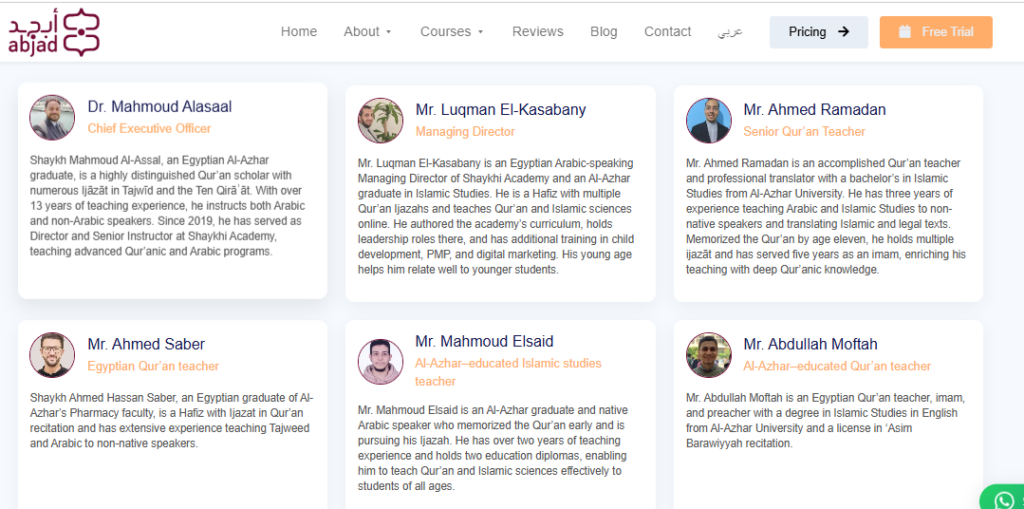
Inside Our Live Classes
Don’t just take our word for it—see for yourself! Click below to watch short clips from our live classes and meet the instructors who will guide your learning journey.
Begin Your Arabic Journey in the UAE
Join Abjad Institute for a professional and immersive Arabic language experience tailored to your goals.
Book Your Free TrialStart Your Child’s Arabic Journey At Abjad Institute Today
Abjad Institute has built a strong reputation across the UAE as the place families turn to when they want Arabic results that actually show. The institute’s approach is child-centered, outcomes-focused, and grounded in the belief that Arabic should feel like a living language — not a school subject to survive.
Children at Abjad do not simply study Arabic. They experience it through conversation, storytelling, creative expression, and structured play. Instructors are trained to meet children at their exact level — whether that is a kindergartener recognizing letters for the first time or a teenager building conversational fluency. Programs are designed to produce measurable progress from the first session, not just participation certificates.
Families across the UAE choose Abjad because the results speak clearly: children leave programs able to hold genuine conversations, read independently, and feel a personal connection to Arabic that carries well beyond the classroom.
The institute’s range of programs covers every learner profile — heritage speakers who need structure, complete beginners starting from scratch, and professionals seeking formal Arabic for career development.
Discover Our Arabic Courses at Abjad Academy:
- Arabic Course in the UAE
- Arabic Intensive Course
- Learn Arabic from Scratch Course
- Madinah Arabic Course
- Arabic Classes for Adults
- Arabic Classes for Beginners
- Self-Paced Arabic Course
- Basic Arabic Course
- Arabic Speaking Classes
- Learn to Write Arabic Course
- Arabic Grammar Course
- Learn Arabic Alphabet Course
Book your child’s FREE trial session today and take the first step towards confident Arabic reading.

Conclusion
Arabic poems for kids are not decorative additions to a language curriculum — they are foundational. The ten poems in this guide span centuries of Arabic poetic craft, covering every major theme in children’s literature: nature, family, school, moral values, loyalty, ambition, and the beauty of the language itself.
Ahmad Shawqi remains the defining figure of Arabic children’s poetry, but the tradition is alive and growing. Contemporary poets like Dr. Luqman Shatnawi and Mahmoud Mofleh continue the work — writing poems that speak to children in modern, multilingual societies while staying rooted in Arabic literary identity.
The most important step is also the simplest: choose one poem from this list, read it aloud to your child, and return to it across the week. The rhythm will do most of the work. Vocabulary follows naturally, values land without instruction, and the love of Arabic grows in ways that no app or worksheet can replicate. Poetry has worked this way for centuries. It will work again — for your child, starting today.
Frequently Asked Questions
What is the best Arabic poem for kids who are just beginning to learn?
The Little Bird (العصفور الصغير) is the recommended starting point for children aged 3–6. Its lines are short, its rhymes are clear, and its imagery, a bird on a branch, flying through morning air, is immediately appealing to young children.
The vocabulary it introduces (bird, branch, tree, sky, morning) reappears throughout early Arabic texts, making the investment in memorizing it particularly high-value for beginning learners.
Who is Ahmad Shawqi and why does he matter for Arabic children’s poetry?
Ahmad Shawqi (1868–1932) was an Egyptian poet who earned the title Amir al-Shu’ara (Prince of Poets) from his peers. He was one of the first major Arabic poets to write specifically for children, producing a collection of animal fables that have remained in school curricula across the Arab world for over a century.
How do Arabic poems help children build vocabulary faster than drills?
Poems accelerate vocabulary acquisition through three reinforcing mechanisms. The rhyme scheme makes the sounds of new words predictableو children absorb them before fully understanding them, then recognize them faster in new contexts. Repeated reading required for memorization builds automaticity with high-frequency words.
Can a child who does not yet know the Arabic script benefit from these poems
Yes. Phonetic exposure to Arabic rhythm and vocabulary is valuable even before a child can read independently. Reading poems aloud to a child builds phonological awareness that accelerates reading acquisition when it begins. When a child is ready to learn the script, learning how to write and read Arabic for beginners provides the foundational mechanics that make decoding poetry on the page possible.
How do I make Arabic poem recitation more engaging for my child?
Three techniques work consistently well. First, use different voices for different characters in fable poems, clap the rhythm, tap the table, sway with the meter. Third, ask your child to teach the poem to someone else. Teaching reinforces memory far more deeply than passive recitation and gives children a genuine sense of pride in what they know.
What is the connection between Arabic poetry and the Quran?
The Quran is itself the supreme example of Arabic literary power, and classical Arabic poetry draws from the same linguistic tradition. Children who engage seriously with Arabic poetry — particularly classical poets like Shawqi — build the vocabulary range and syntactic familiarity that makes the language of the Quran more accessible.




Leave a Reply