 Learn Arabic
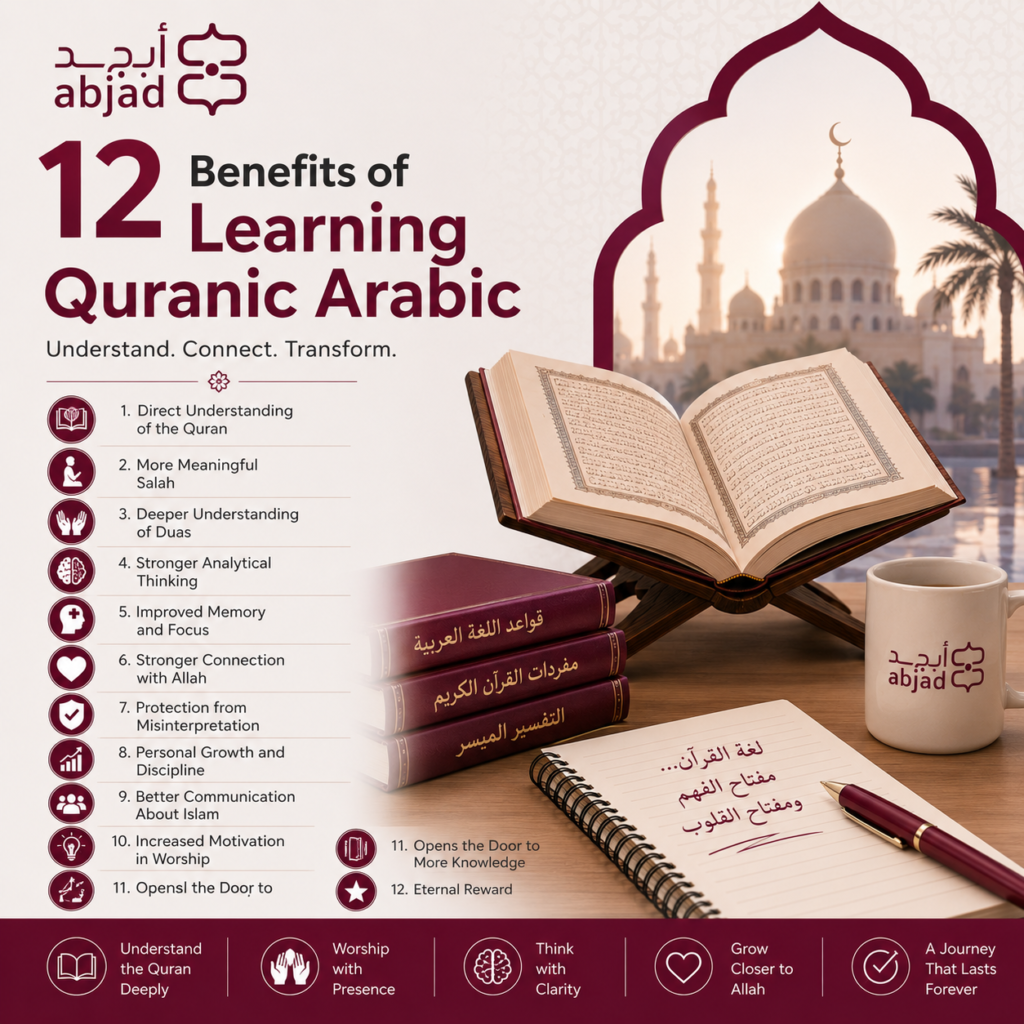
Most Muslims recite the Quran every day — in Salah, in du’a, in Tarawih — yet the majority do not understand the words leaving their lips. Translations help, but every translation is an interpretation. The translator makes choices, compresses meaning, and resolves ambiguity for you before you even encounter the text. Learning Quranic Arabic removes that filter entirely and gives you the Quran as Allah revealed it.
Quranic Arabic is the classical Arabic in which the Quran was revealed — grammatically precise, rhetorically layered, and preserved unchanged since the seventh century. It differs from Modern Standard Arabic in structure, vocabulary, and rhetorical style. A student who learns general Arabic can understand perhaps 70–80% of Quranic vocabulary, but will encounter classical verb patterns, case constructions, and rhetorical devices that require specific Quranic Arabic training to interpret correctly.
Learning Quranic Arabic is not simply learning a language. It is learning the specific way Allah chose to express His message — and that distinction matters for every benefit that follows.
1. Direct Understanding of the Quran as It Was Revealed
Every Quran translation is an interpretation of the original Arabic text. While translations help convey the general meaning, they cannot fully capture the depth, precision, and layers of meaning contained in the Arabic language.
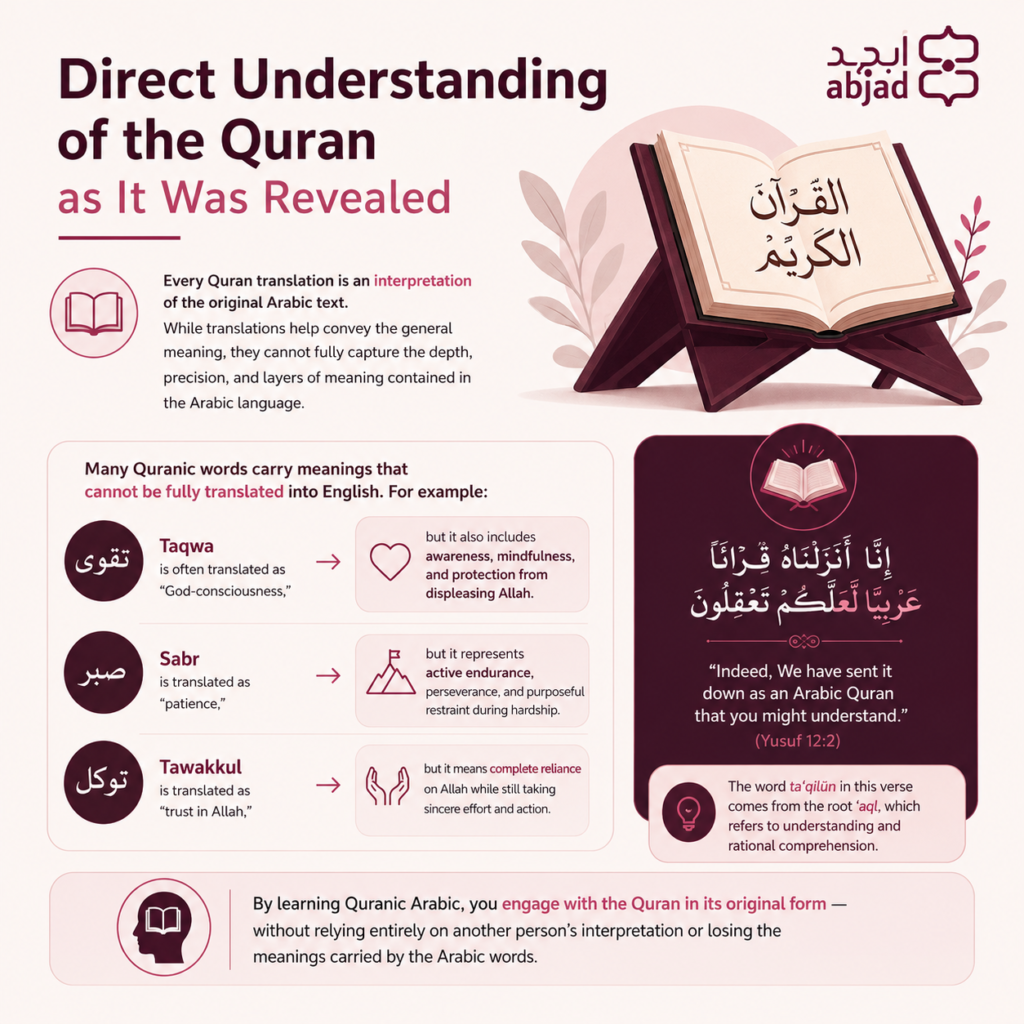
Many Quranic words carry meanings that cannot be fully translated into English. For example:
- Taqwa is often translated as “God-consciousness,” but it also includes awareness, mindfulness, and protection from displeasing Allah.
- Sabr is translated as “patience,” but it represents active endurance, perseverance, and purposeful restraint during hardship.
- Tawakkul is translated as “trust in Allah,” but it means complete reliance on Allah while still taking sincere effort and action.
Allah says:
“إِنَّا أَنزَلْنَاهُ قُرْآنًا عَرَبِيًّا لَّعَلَّكُمْ تَعْقِلُونَ”
“Indeed, We have sent it down as an Arabic Quran that you might understand.”
(Yusuf 12:2)
The word ta‘qilūn in this verse comes from the root ‘aql, which refers to understanding and rational comprehension. This connects the Arabic language of the Quran with the depth of understanding Allah intended for His message.
By learning Quranic Arabic, you engage with the Quran in its original form — without relying entirely on another person’s interpretation or losing the meanings carried by the Arabic words.
Read also: How to Read Arabic Dates — A Complete Guide for English Speakers
2. A More Meaningful and Focused Salah Experience
Praying while understanding the meaning of the words you recite creates a completely different experience from repeating memorized phrases without comprehension.
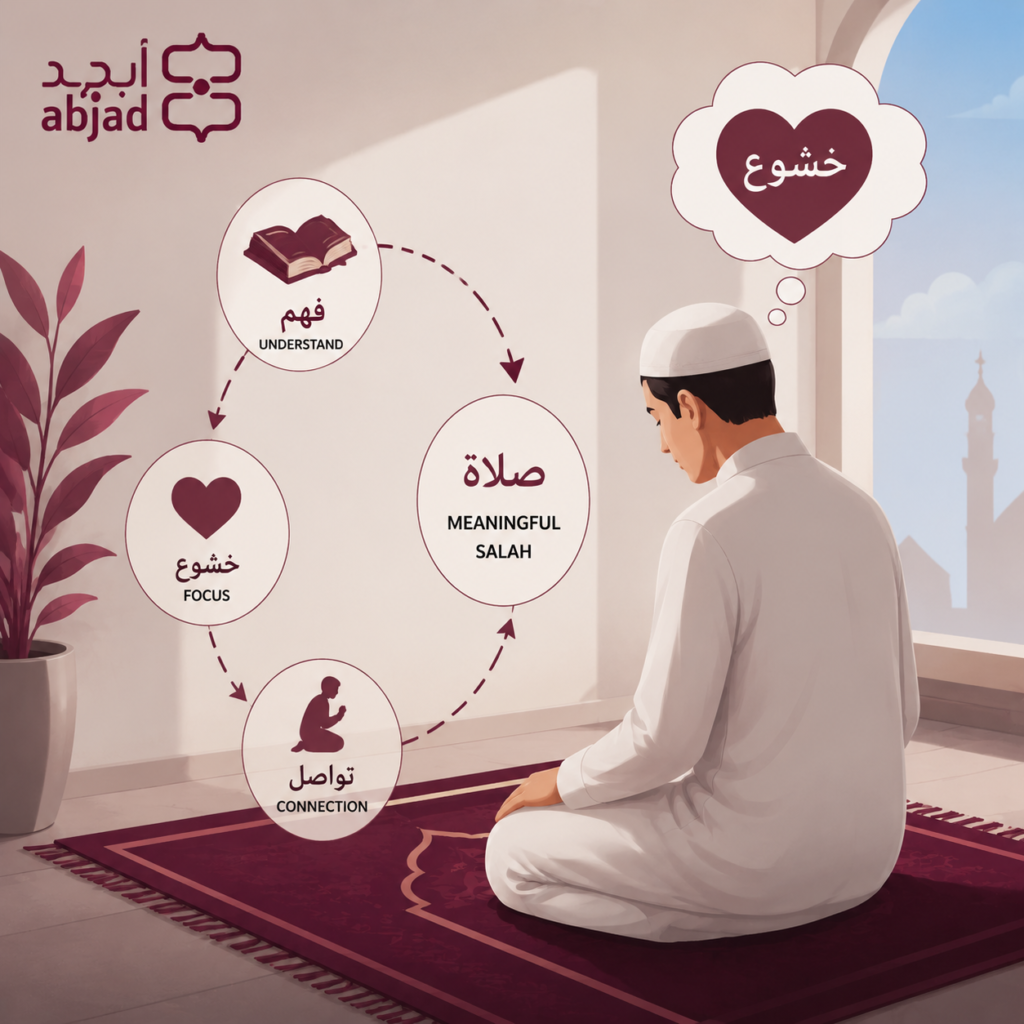
When you understand the meaning of verses in Al-Fatihah, such as:
- “Mālik yawm id-dīn” — Master of the Day of Judgment
- “Iyyāka nasta‘īn” — You alone we ask for help
Each verse becomes a direct conversation with Allah rather than a sequence of words repeated from memory.
Ibn Al-Qayyim highlighted understanding one’s recitation as one of the foundations of khushu‘ — deep focus and humility in prayer. When the heart follows the meaning alongside the recitation, distractions decrease and the worshipper becomes more present.
This deeper connection with Salah is one of the first transformations many students experience after beginning structured Quranic Arabic study, and its impact continues as their understanding grows.
Read more: The Quranic Arabic Alphabet
3. Deeper Understanding of Duas and Supplications
Many Muslims recite the same duas for years without fully understanding the meanings behind the words. Learning Quranic Arabic reveals the depth, emotion, and precision carried within each supplication — meanings that translations can only partially capture.
The duas of the Prophets, the morning and evening adhkar, and the supplications taught by the Prophet ﷺ contain layers of meaning that become clearer when understood in their original Arabic.
For example:
“Rabbana atina fid-dunya hasanatan”
is often translated as “Our Lord, give us good in this world.” However, the word hasanah carries a much deeper meaning, referring to goodness that is beautiful, complete, beneficial, and wholesome in every aspect of life.
Read also: How to Learn Quranic Arabic in the UAE? A Step-by-Step Guide
4. Stronger Analytical Thinking Through the Arabic Root System
Quranic Arabic is built on a powerful trilateral root system, where most words come from a three-letter root that carries a core meaning. Different patterns built from the same root create related words, allowing learners to understand new vocabulary through connections rather than memorizing each word separately.
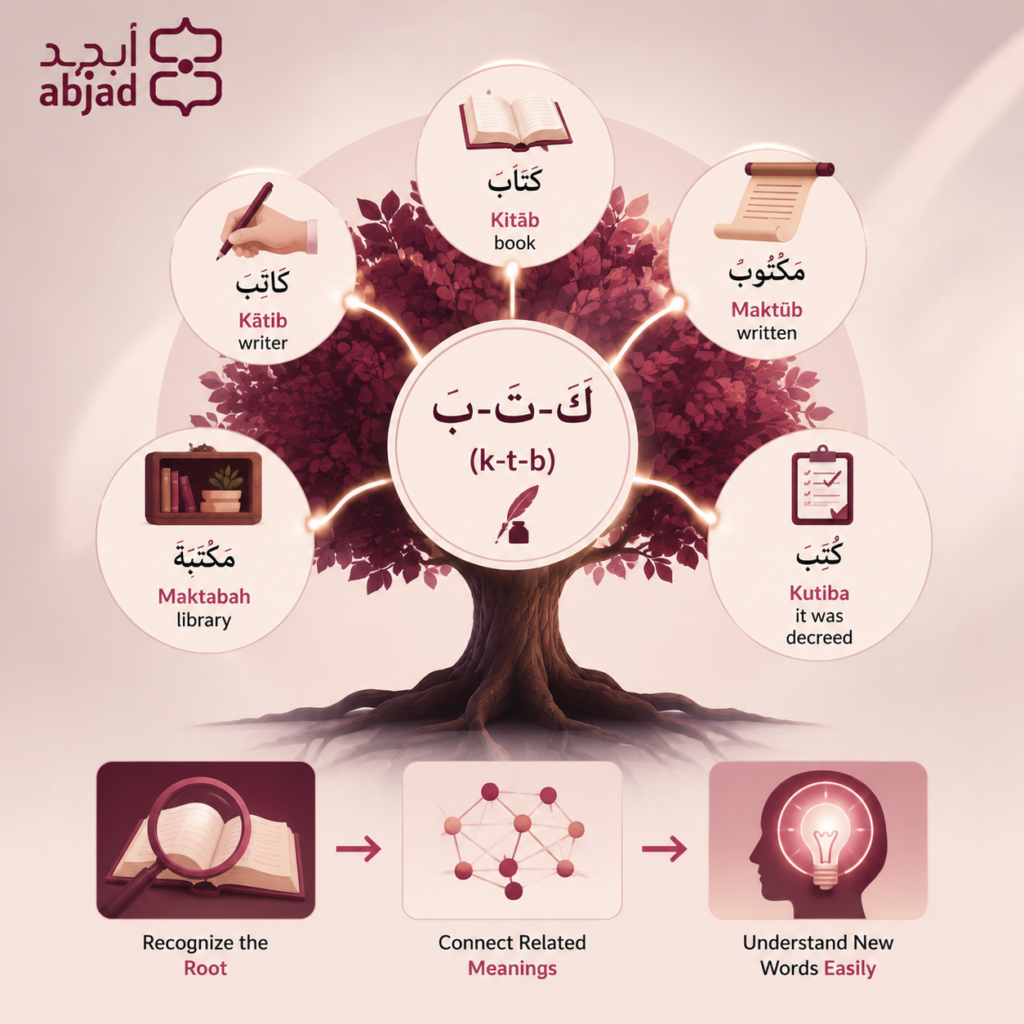
For example, the root ك-ت-ب (k-t-b) is connected to the idea of writing and produces words such as:
- Kitāb (كتاب) — book
- Kātib (كاتب) — writer
- Maktūb (مكتوب) — written
- Maktabah (مكتبة) — library
- Kutiba (كُتِبَ) — it was decreed
Once students understand this system, encountering an unfamiliar Quranic word becomes easier because they can recognize its root and infer its meaning from related words they already know.
The Quran contains approximately 77,000 words, but these words come from around 1,700 unique roots. Learning the root system is therefore not about memorizing thousands of separate words — it is about learning a pattern that unlocks many meanings at once.
This type of pattern-based learning also strengthens analytical thinking by training the mind to identify structures, recognize relationships, and apply rules to new information — the same skills used in logical reasoning and problem-solving.
Inside Our Live Classes
Don’t just take our word for it—see for yourself! Click below to watch short clips from our live classes and meet the instructors who will guide your learning journey.
Begin Your Arabic Journey in the UAE
Join Abjad Institute for a professional and immersive Arabic language experience tailored to your goals.
Book Your Free Trial5. Improved Memory and Pattern Recognition Skills
Learning Quranic Arabic requires the brain to perform two processes at the same time: building vocabulary and applying grammatical patterns to understand meaning. This combination creates a deeper learning experience that strengthens working memory, attention control, and pattern recognition.
Research in second-language acquisition shows that learning languages with complex structures and word patterns can improve the ability to recognize relationships, retain information, and process new concepts more effectively.
For children, these benefits can be even greater. Managing two language systems helps develop mental flexibility and builds cognitive skills that support learning across different subjects.
Unlock Your Child’s Arabic Skills with a FREE Trial Class in the UAE

6. Direct Access to Classical Islamic Scholarship
The overwhelming majority of classical Islamic scholarship — Tafsir, Fiqh, Hadith commentary, Usul — was written in Arabic and has never been fully translated into English. Works by Ibn Kathir, Al-Nawawi, Al-Ghazali, and Ibn Taymiyyah exist in English only partially, and always imperfectly, because translation compresses meaning their authors spent lifetimes choosing with precision.
Learning Quranic Arabic progressively opens this tradition in the language its authors chose. A student who reaches intermediate Quranic Arabic can begin engaging with simplified Tafsir texts directly — no longer dependent on translations that may be partial, or waiting for ones that may never come. This is one of the most significant long-term benefits, and one most beginners do not fully appreciate until they experience it.
7. Faster Arabic Learning for Children Through Early Exposure
Children between the ages of 4 and 10 are at a peak stage of neurological development for sound discrimination and pattern recognition. Quranic Arabic, with its consistent root system and rhythmic recitation, is ideally suited to this developmental window.
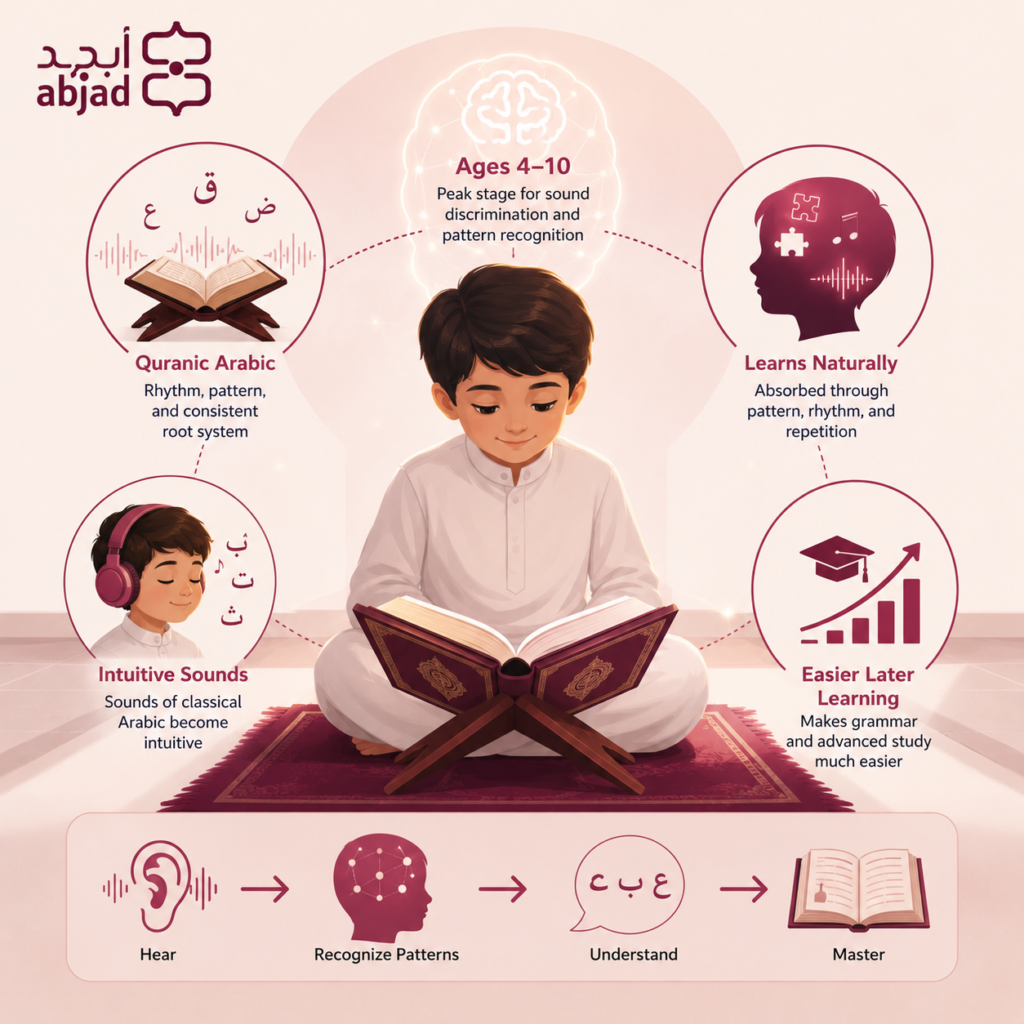
A child who begins learning at age 6 or 7 absorbs Quranic Arabic naturally through pattern, rhythm, and repetition, much like they acquired their first language. Unlike adults, they do not experience it as a foreign language.
Early exposure also offers a practical advantage: the sounds of classical Arabic become intuitive, making formal grammar study easier later on. Children who grow up hearing and partially understanding Quranic recitation internalize phonemic patterns that adult learners must consciously practice to master.
8. Build a Stronger Islamic Identity Through Quranic Understanding
A child who understands the words they recite in Salah develops a completely different relationship with their faith compared to a child who only memorizes sounds without understanding their meaning.
Understanding creates a sense of connection and ownership — Islam becomes something they personally comprehend and engage with, not simply something they inherit or are taught. This becomes especially important during adolescence, when questions of identity, belonging, and personal values become central.
An Islamic identity built on Quranic understanding is more resilient when facing external influences and confusion. When a teenager can read the Quran and understand what Allah is saying directly, their relationship with the Quran becomes personal and meaningful — not dependent only on what others explain to them.
9. Build a Strong Foundation for Conversational Arabic
Quranic Arabic and conversational Arabic are not separate languages — they share the same root system, core grammar, and a significant amount of vocabulary. Learning Quranic Arabic provides students with a strong structural foundation that makes transitioning into spoken Arabic much easier.
A student who learns around 500 common Quranic root words along with essential Arabic grammar already understands many of the building blocks of the language. Moving from Quranic comprehension to conversational fluency then becomes a matter of practicing speaking patterns and applying knowledge that is already established.
10. Master Tajweed by Understanding Quranic Arabic
Tajweed — the science of precise Quranic pronunciation — is taught and explained in Arabic. Students who try to learn Tajweed without understanding Arabic often memorize rules like ikhfa, idgham, or madd tabi‘i as isolated labels, without grasping why or how they apply.
When a student has a foundation in Quranic Arabic, they can understand the grammatical and phonological context behind each rule. For example:
- Why noon sakinah behaves differently depending on the following letter
- How changes in sound reflect the interaction of classical Arabic phonetics within a verse
One common error among non-Arabic speakers is applying Tajweed rules correctly in isolation but mispronouncing them within a complete verse. Learning Quranic Arabic removes this issue at its source, allowing students to read for both meaning and correct pronunciation simultaneously, rather than treating each word as a separate exercise.
11. Appreciate the Quran’s Meaning and Eloquence More Fully
The Quran represents the pinnacle of Arabic literary expression, and much of its beauty and rhetorical depth is lost in translation. Features such as:
- Iltifāt — deliberate shifts in person or address within a passage
- Single words carrying multiple simultaneous meanings
- Precise rhythmic and phonetic weight of each verse
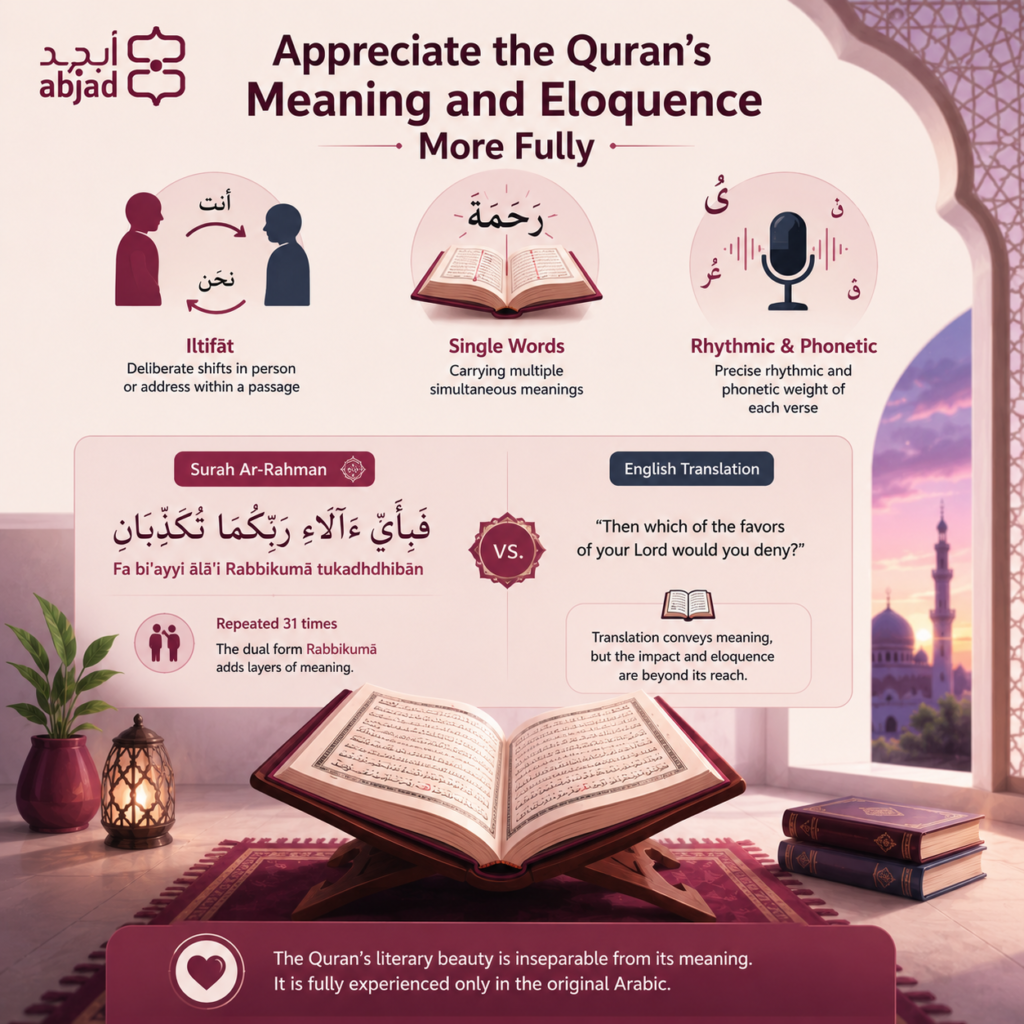
are all aspects of the Arabic text that cannot be fully captured in English.
For example, in Surah Ar-Rahman, the verse:
فَبِأَىِّ ءَالَآءِ رَبِّكُمَا تُكَذِّبَانِ
“Fa bi’ayyi ālā’i Rabbikumā tukadhdhibān”
is repeated 31 times, and understanding the dual form Rabbikumā and its intended address adds layers of meaning. Reading the verse in Arabic provides a completely different impact compared to the English translation:
“Then which of the favors of your Lord would you deny?”
This literary beauty is inseparable from meaning and is fully experienced only in the original Arabic, highlighting the importance of learning Quranic Arabic to engage deeply with the text.
12. Greater Independence From Translation When Understanding the Quran
One of the most practical benefits of learning Quranic Arabic is becoming less dependent on other people’s interpretations. Every translation involves choices — a word translated as “patience” by one translator may appear as “endurance” in another, while words like “mercy” and “compassion” may carry different shades of meaning in English.
When relying on a single translation, these choices can shape your understanding of the Quran without you realizing it.
Learning Quranic Arabic gives you the ability to:
- Compare different translations more effectively
- Notice where translators interpret meanings differently
- Examine the original Arabic words directly
- Develop a more grounded understanding of Quranic verses
This level of independence does not require becoming a scholar. With consistent study and a strong foundation in Quranic vocabulary and grammar, any serious learner can begin engaging with the Quran more directly.
Learn Quranic Arabic from the Basics with a FREE Trial Class in the UAE
Is Quranic Arabic Difficult to Learn?
Quranic Arabic can be challenging, but it is learnable by any motivated student, even those with no prior experience in Arabic. The trilateral root-word system makes learning faster than many other languages because understanding one root allows you to recognize multiple related words simultaneously. Most beginners start to recognize familiar Quranic words within the first few weeks of structured study.
A realistic learning path includes:
- Learning the Arabic alphabet and letter sounds
- Mastering basic Quran reading with correct pronunciation
- Building core Quranic vocabulary through root-word study
- Learning essential grammar patterns — including sentence structures, verb conjugation, and case endings
- Practicing comprehension directly on Quranic verses
- Studying with a qualified teacher who can correct errors and provide context
The final step — guided study with a teacher — is crucial. While self-study can help build vocabulary, Quranic Arabic’s grammatical and rhetorical structures require expert explanation. Without guidance, learners often struggle to correctly apply grammar and understand Tafsir, even if they know the words themselves.
Read more: Can You Learn Quranic Arabic on Duolingo?
Who Can Benefit From Learning Quranic Arabic?
The benefits of Quranic Arabic are not limited to scholars or advanced students. Anyone who wants a deeper connection with the Quran can benefit from learning its language.
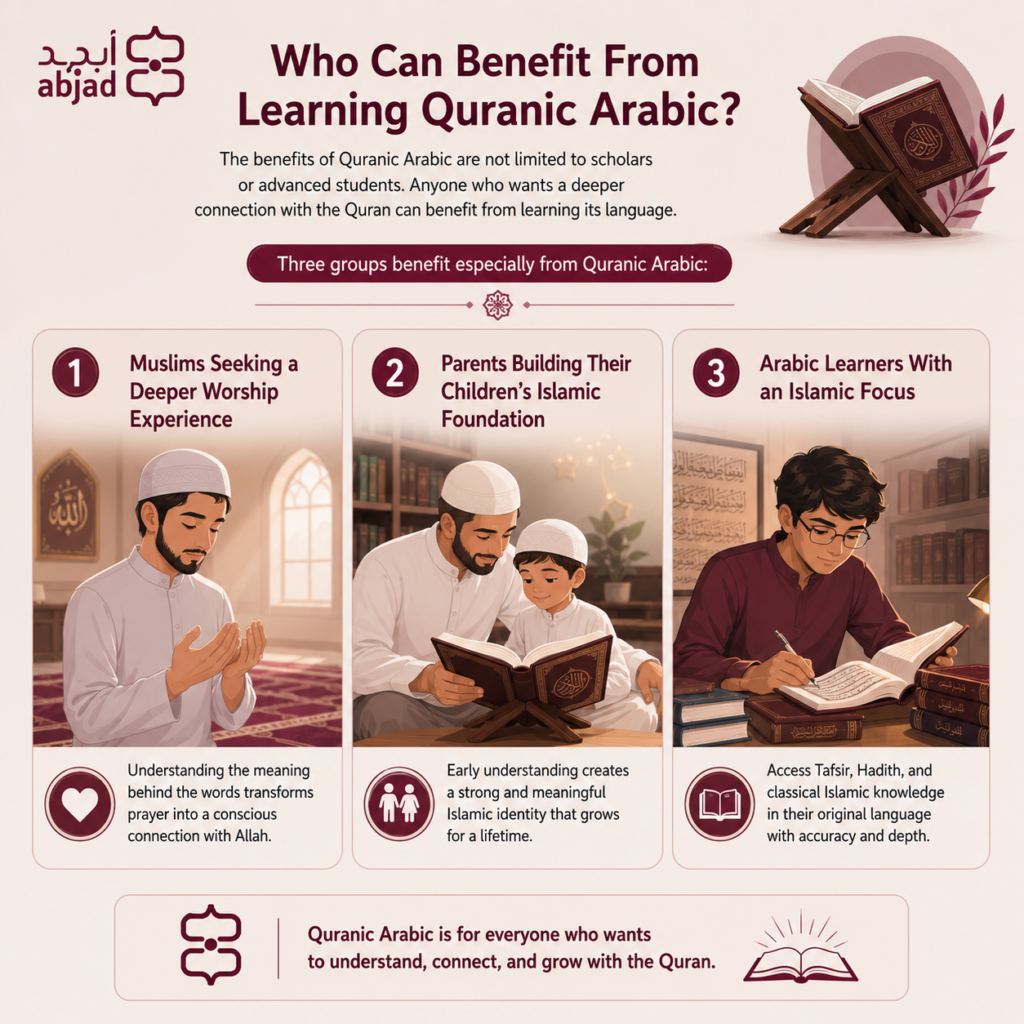
Three groups benefit especially from Quranic Arabic:
1. Muslims Seeking a Deeper Worship Experience
Anyone who wants Salah to become more than a memorized recitation can benefit from understanding Quranic Arabic. Knowing the meaning behind the words transforms prayer into a more conscious connection with Allah and allows believers to engage with the Quran beyond simply reciting its sounds.
2. Parents Building Their Children’s Islamic Foundation
Teaching children Quranic Arabic from an early age helps them develop a relationship with the Quran based on understanding rather than habit alone. This foundation creates a stronger and more meaningful Islamic identity that can continue through adolescence and adulthood.
3. Arabic Learners With an Islamic Focus
Students interested in Tafsir, Hadith commentary, and classical Islamic scholarship can benefit greatly from learning Quranic Arabic. It allows them to access these works in their original language instead of relying only on translations that may be incomplete or unable to capture the full meaning.
Watch Our Classes in Action
Curious what a real session looks like? Take a peek inside our interactive classrooms and see how our expert instructors bring the Arabic language to life. Watch a sample lesson below!
Begin Your Arabic Journey in the UAE
Join Abjad Institute for a professional and immersive Arabic language experience tailored to your goals.
Book Your Free TrialUnderstand the Quran in Its Original Language With Abjad Institute
The benefits of learning Quranic Arabic become truly meaningful when you follow a structured learning path with qualified guidance. Learning Quranic Arabic for comprehension is different from simply learning general Arabic or improving basic reading skills — it requires a focused approach that combines vocabulary, grammar, pronunciation, and understanding of Quranic meanings.
At Abjad Institute, students can learn Quranic Arabic through courses designed for both adults and children. The programs are taught by qualified instructors and focus on building genuine comprehension rather than memorization alone, with flexible scheduling that fits different learning goals and lifestyles.
[Book your free trial lesson at Abjad Institute]
- Arabic Course in the UAE
- Arabic Intensive Course
- Learn Arabic from Scratch Course
- Madinah Arabic Course
- Arabic Classes for Adults
- Arabic Classes for Beginners
- Self-Paced Arabic Course
- Basic Arabic Course
- Arabic Speaking Classes
- Learn to Write Arabic Course
- Arabic Grammar Course
- Learn Arabic Alphabet Course
Begin Your Arabic Journey in the UAE
Join Abjad Institute for a professional and immersive Arabic language experience tailored to your goals.
Book Your Free TrialConclusion
Learning Quranic Arabic is not simply learning a language — it is gaining direct access to the Quran as Allah revealed it. The benefits span every dimension of a Muslim’s life: spiritually, it deepens Salah, enriches du’a, and enables genuine tadabbur. Cognitively, it builds the analytical thinking, memory, and pattern recognition skills that carry into every area of learning. Practically, it grants independence from translation and access to 1,400 years of classical Islamic scholarship in the language its authors chose.
For children, starting early makes the process natural and lasting. For adults, starting at any point produces real, measurable changes in worship quality and Quran engagement. The gap between reciting and understanding is real — and Quranic Arabic closes it permanently.
Frequently Asked Questions
What are the main benefits of learning Quranic Arabic?
The main benefits of learning Quranic Arabic include understanding the Quran directly without depending on translation, improving focus and khushu’ in Salah, deepening du’a comprehension, learning Quranic vocabulary faster through the root-word system, strengthening memory and analytical thinking, and gaining direct access to classical Islamic scholarship in Tafsir, Hadith, and Fiqh.
Is Quranic Arabic difficult to learn?
Quranic Arabic is challenging but accessible to any motivated student. The root-word system makes vocabulary acquisition faster than most languages — one root unlocks multiple related words at once. Most students begin recognizing familiar Quranic words within the first few weeks of structured study. A qualified teacher is essential for progressing from basic vocabulary into grammar, comprehension, and Tafsir application.
Can I understand the Quran by learning Quranic Arabic?
Yes. Quranic Arabic study is specifically designed to build the vocabulary and grammar needed to engage with the Quran’s text directly. Even at an intermediate level, students follow the meaning of verses they previously only recited phonetically. Full comprehension develops progressively — but practical improvements in understanding begin well before fluency.
How long does it take to learn Quranic Arabic?
Functional comprehension of core Quranic vocabulary and basic grammar is achievable within 6 to 12 months of consistent weekly study. Meaningful improvements in Salah comprehension often begin earlier — within the first few months. Advanced engagement with classical Tafsir and scholarship requires longer study, but the practical benefits of understanding arrive well before that stage.
Is Quranic Arabic different from Modern Standard Arabic?
Yes. Quranic Arabic is the classical Arabic of the seventh-century revelation — grammatically richer and more complex than Modern Standard Arabic. The two share core vocabulary and grammar, but Quranic Arabic includes classical verb patterns and rhetorical structures not used in contemporary MSA. A course focused on Quranic comprehension addresses these features specifically; a general Arabic course typically does not.





Leave a Reply