 Learn Arabic
Your child knows all 28 letters. Their Arabic grades look fine. And they still cannot read a shop sign in Deira.
If that sounds like your home, you are not failing. You have hit a gap that most homes here run into.
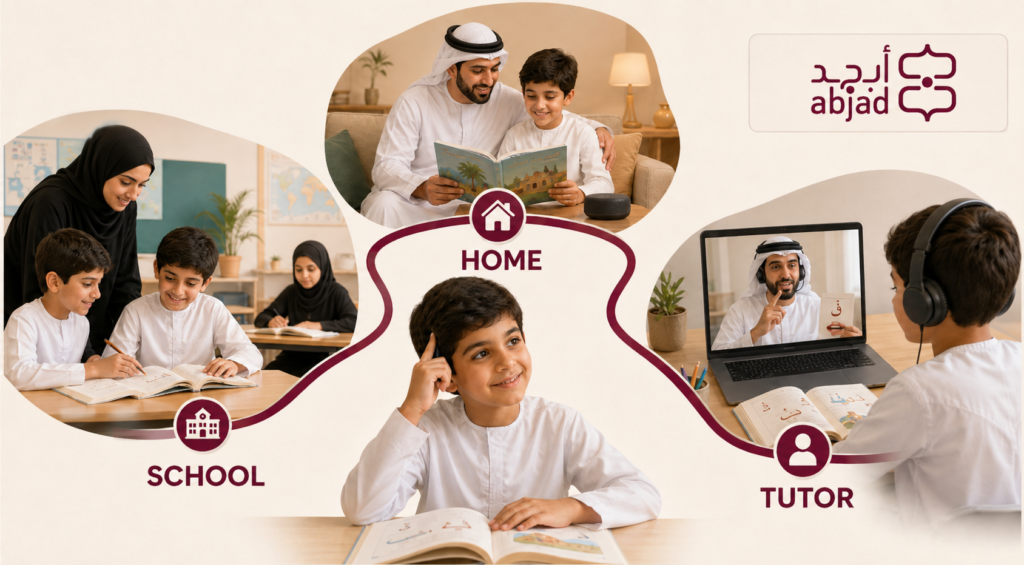
Learning how to teach kids Arabic in the UAE is not about one perfect class. It is about three tracks that run at once, in the right order.
So let’s walk through four things together. The method that works. The teaching order that takes a child from letters to reading. Your options in Dubai, Abu Dhabi and Sharjah. And why school teaching Arabic language is rarely enough for yor kids.
1. The Three-Track Plan For Teaching Kids Arabic In The UAE
Teaching kids Arabic in the UAE has three tracks. Each one has a clear role. But all the three should work together to get you where you want to go. Let’s take a clear look at each track, so you can see which one to push.
A. School Track — Monitor Arabic Learning and Reading Progress
School covers the curriculum, tests, and classroom practice, but your role is to check whether those activities are producing real Arabic skills.
Twice a year, ask the teacher whether your child can read a new Arabic sentence aloud without help, which stream they are in (Arabic A or B), and how much individual reading time they receive each week.
Grades and completed worksheets show progress within the course, but unfamiliar text is a better test of independent reading.
Also check your child’s notebook. Copied text shows practice, while free writing and original answers reveal stronger language ability. If your child earns good grades but freezes when given unfamiliar Arabic text, the school track needs more support from home or tutoring.
B. Home Track — Build Daily Arabic Exposure Through Stories, Audio, and Play
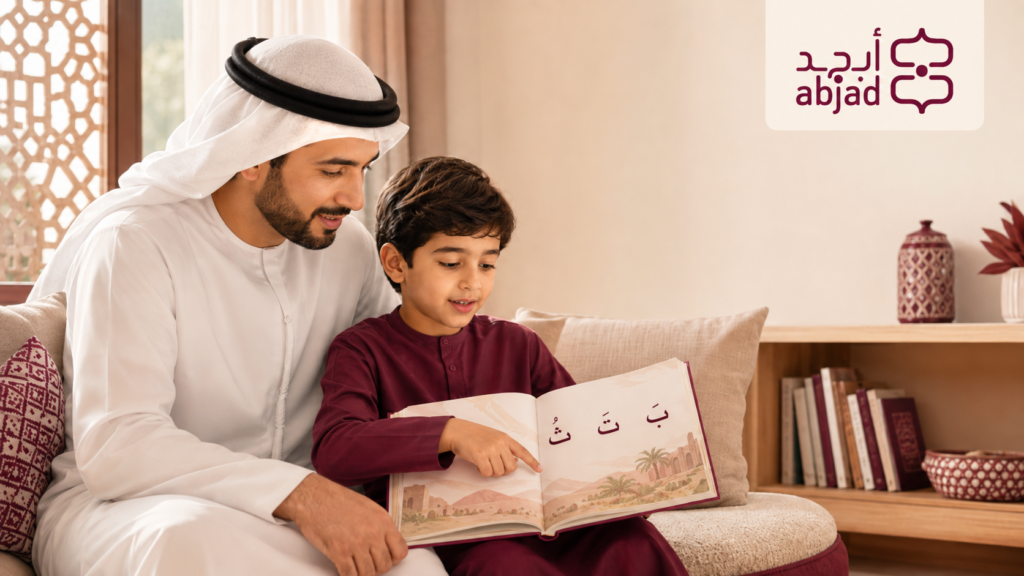
The home track should make Arabic feel like part of everyday life through stories, songs, games, and audio, rather than another formal lesson.
Even if you do not speak Arabic, aim for around 20 minutes of exposure each day and attach it to a fixed routine such as the school run or bedtime. Consistent short exposure works better than occasional long sessions.
Do not worry if your child initially responds in English. Continue providing Arabic input and create opportunities outside the home too, such as reading road signs or using simple Arabic in shops. If siblings usually speak English together, shared Arabic stories or games can also keep the language present at home.
C. Tutor Track — Improve Arabic Pronunciation With One-to-One Correction
A private tutor gives your child something group learning cannot always provide: immediate individual pronunciation correction. Difficult letter pairs such as س/ص، ت/ط، ق/ك، خ/غ، ح/ه، and ع/أ can be identified and corrected as soon as your child reads them.
In a strong lesson, the child should spend most of the time reading and speaking while the teacher models correct sounds and asks them to repeat.
Two or three short sessions can also be more effective for young learners than one long weekly lesson.
Use the trial lesson to assess the teacher. They should be able to identify your child’s current stage, explain the main gaps, and outline what comes next.
At Abjad Institute, native Arabic teachers, most of them Al-Azhar graduates, give one-to-one lessons pitched at each child’s actual level. Sessions are built so roughly 70% of the time is spent speaking, which is exactly where pronunciation gets fixed.
Families can ask for a male or female tutor, and lessons are scheduled around UAE school hours.
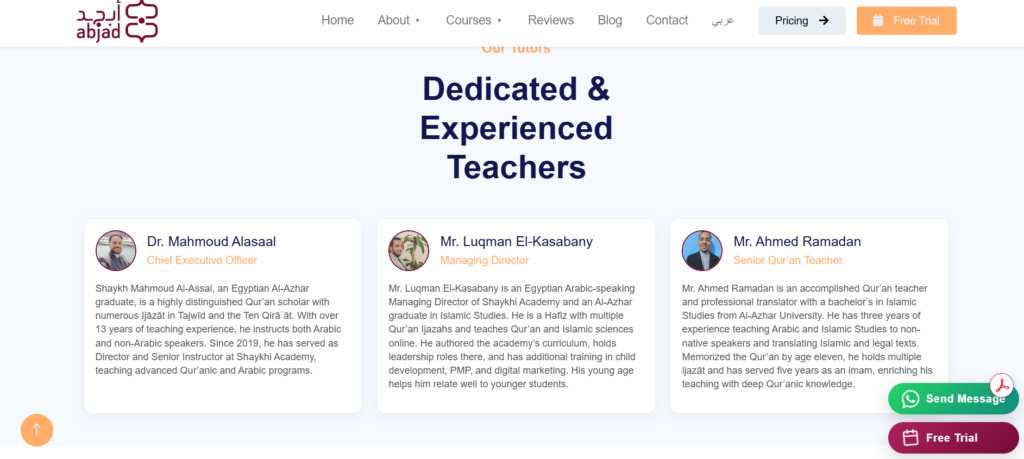
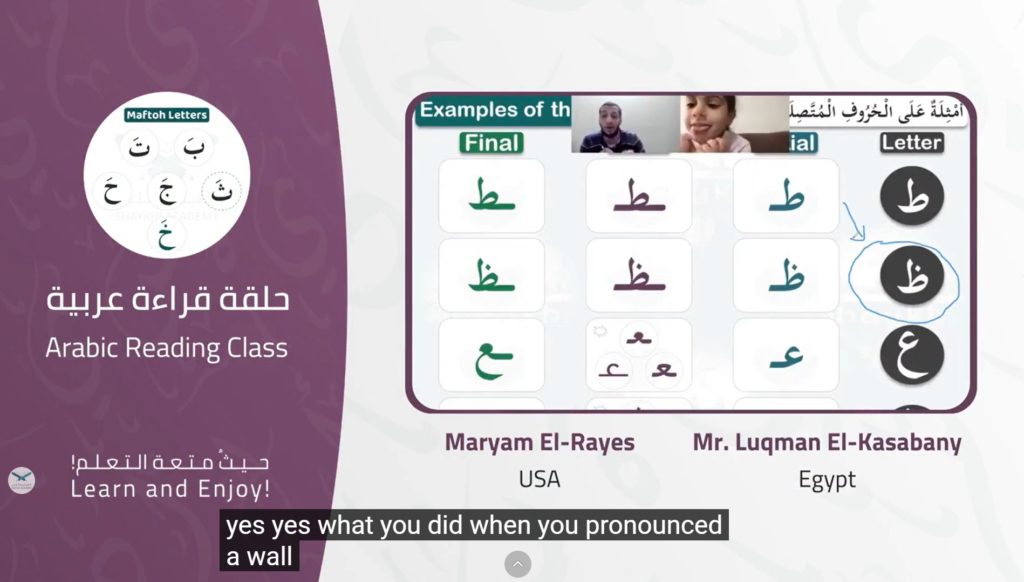
You can also pick a male or female tutor, and slot lessons around school hours in the UAE. Watch a real Arabic reading class in action, and see what a good lesson looks like.
Real Online Arabic Reading Classes – Shaykhi Academy
2. The Best Order for Teaching Kids to Read Arabic
Arabic reading develops in stages. Moving forward before one stage is secure can leave gaps that become harder to correct later. Use the following sequence whether your child learns at home, at an institute, or with a tutor.
A. Learn Arabic Letter Sounds and Connected Shapes
Start with the sound of each Arabic letter, then teach how its shape changes at the beginning, middle, and end of words. Knowing only the isolated alphabet shape is not enough for reading connected Arabic.
Introduce three or four letters at a time and use letter cards, matching activities, tracing, and other hands-on exercises. A letter is secure when your child can produce its sound quickly and recognize it inside a word.
You may also like: The Best Arabic Learning App For Kids
B. Learn Harakat and Start Blending Arabic Letters
Begin with Fatha, then practice blending two letters before moving to simple three-letter words. Once Fatha is comfortable, introduce Kasra and then Damma using the same progression.
Teach children to blend sounds directly rather than naming each letter first. Keep practice to five or ten minutes at a time, as tired beginners often start guessing instead of reading.
Progress may feel slow here, but blending is one of the most important foundations of Arabic reading. Consistent repetition is more useful than changing methods when progress temporarily slows.
C. Master Madd, Sukoon, Shaddah, and Tanween
Once short vowels are secure, introduce Madd (ا، و، ي), Sukoon, Shaddah, and Tanween one at a time, with reading practice between each new concept.
Teach children to connect each mark with both its shape and sound:
- Fatha (ـَ): short “a” sound.
- Kasra (ـِ): short “i” sound.
- Damma (ـُ): short “u” sound.
- Sukoon (ـْ): indicates no vowel.
- Shaddah (ـّ): doubles the letter.
- Tanween (ـً ـٌ ـٍ): adds an “n” sound at the end.
Children commonly confuse Madd with short Harakat, so demonstrate the difference by stretching long vowels and keeping short vowels brief.
Use this check: Give your child a fully marked sentence they have never seen. If they still guess words rather than read them, return to the earlier stage that needs strengthening.
D. Learn Sun and Moon Letters Before Reading Real Arabic Texts
Sun and moon lam (اللام الشمسية والقمرية) teaches children when the Lam in الـ is pronounced or assimilated. Introduce the difference by sound first, using examples such as الشمس and القمر, before teaching the letter groups.
Practice with signs, book titles, and simple words beginning with الـ. Once your child understands the rule, shift the focus toward short marked stories and daily reading aloud rather than continuing to add isolated rules.
Choose texts slightly below your child’s maximum level and aim for five to ten minutes of reading each day. Familiar, manageable texts help build speed and confidence.
Grammar can then be introduced through readable examples, including demonstratives such as هذا and هذه, prepositions, pronouns, plurals, and common verb forms.
Read also: Teaching The Arabic Alphabet For Kids
E. How Long Does Each Arabic Reading Stage Take?
With around three short lessons per week plus daily Arabic exposure, children aged five to seven may need several months for letters and Harakat, while comfortable reading of marked Arabic text can take roughly a school year. Later stages often progress faster once blending is secure.
Children starting around nine or ten may move through reading stages faster but sometimes need more support with speaking confidence. Progress also tends to happen in jumps rather than at a steady weekly rate.
Check progress monthly rather than weekly using the same short marked sentence. Increasing speed and fluency over time is a better indicator than day-to-day performance.
Consistency matters most. Missing practice and moving ahead before a stage is secure can extend the timeline considerably.
Reading and speaking may also develop at different speeds, so a child may become a capable reader before speaking Arabic confidently.
3. Home Routines That Build Kids’ Arabic Skills Without Formal Lessons
Arabic develops through frequent exposure, not lessons alone. Simple routines at home can strengthen listening, reading, vocabulary, and speaking without making Arabic feel like extra schoolwork.
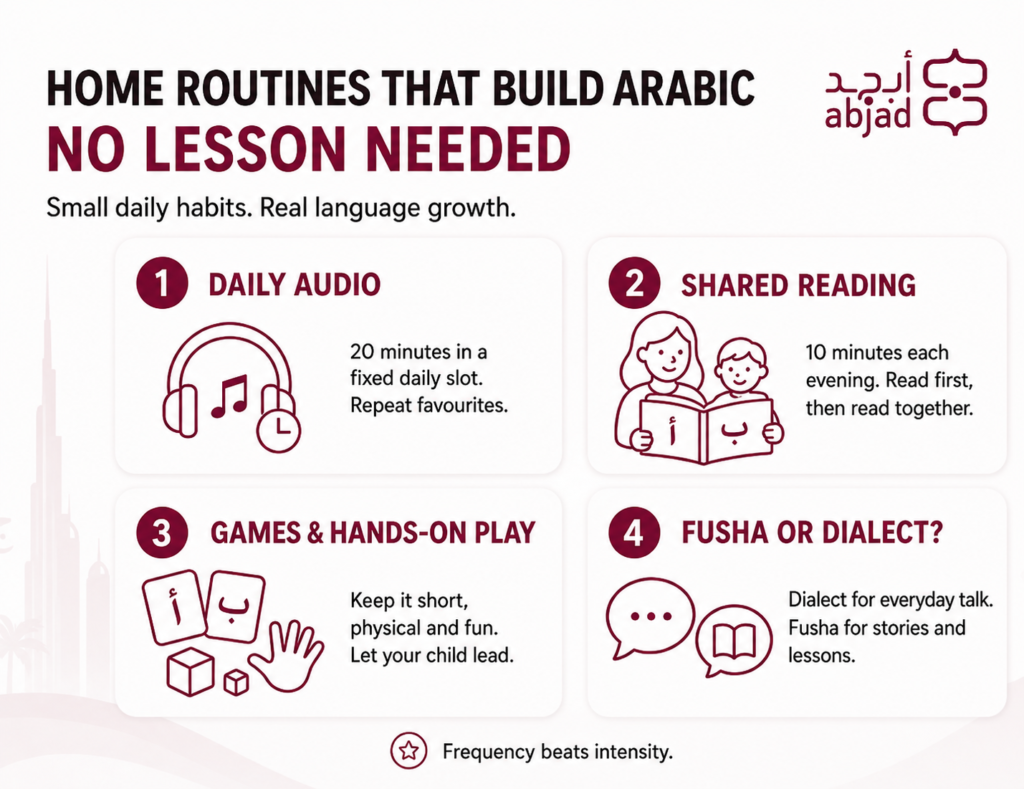
A. Use Daily Arabic Audio to Build Listening Skills
Read a short Arabic story together each evening using books with simple vocabulary, clear vowel marks, and helpful illustrations. Read first, then let your child repeat or read the same passage.
Repeating the same book across several nights helps vocabulary and reading patterns become familiar.
Ask one or two simple questions afterward to connect reading with meaning, but avoid turning story time into a test. If your child struggles with a word, help them and keep the story moving.
Read also: Arabic Vocabulary for Kids – The First 300 Words- In the Right Order
B. Practice 10 Minutes of Shared Arabic Reading Each Evening
Read a short Arabic story together each evening using books with simple vocabulary, clear vowel marks, and helpful illustrations. Read first, then let your child repeat or read the same passage.
Repeating the same book across several nights helps vocabulary and reading patterns become familiar.
Ask one or two simple questions afterward to connect reading with meaning, but avoid turning story time into a test. If your child struggles with a word, help them and keep the story moving.
C. Use Arabic Games and Hands-On Activities for Practice
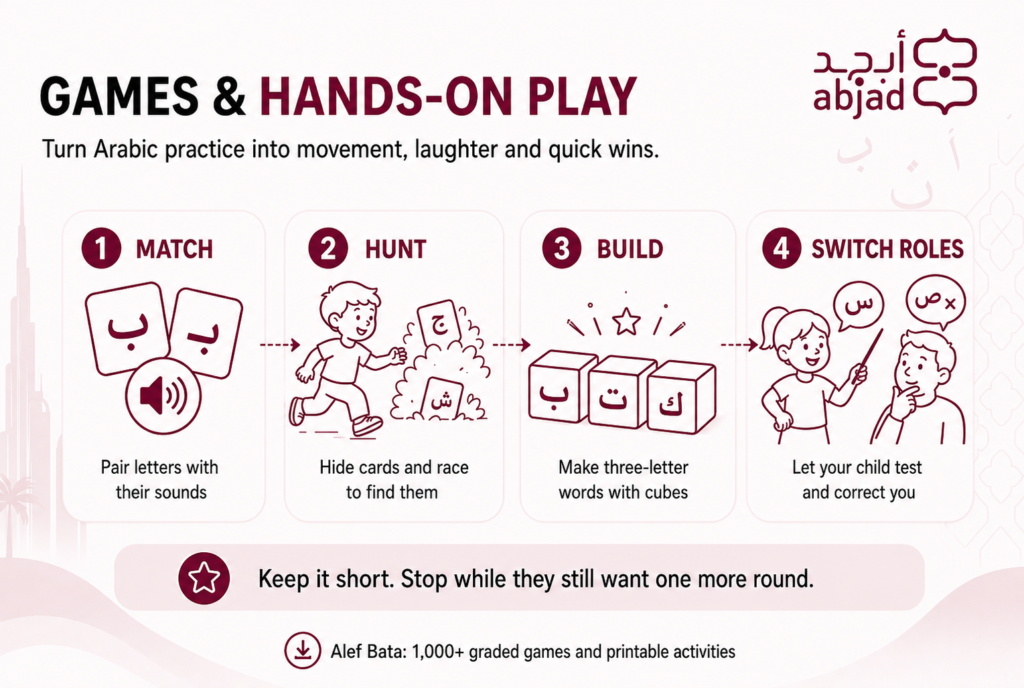
Letter-matching cards, word-building cubes, letter hunts, and word searches turn repetition into play while showing you which skills your child remembers.
Keep activities short and physical when possible. Let your child become the teacher occasionally by testing or correcting you. Resources such as Alef Bata can also provide graded games and printable exercises for additional practice.
D. Should Kids Learn Fusha or Arabic Dialect at Home?
Use the Arabic you naturally speak at home. Dialect helps children communicate comfortably with family and in everyday situations, while Fusha supports reading, school Arabic, books, and Quranic learning.
For many UAE families, a practical balance is simple: use dialect in everyday conversation and Fusha for books, stories, and structured lessons. Consistent exposure to both helps children learn when and where each form of Arabic is used.
One habit makes the split clear. Books and lessons stay in Fusha, and the kitchen table stays in dialect. Your child learns which room each one lives in, and stops mixing them without being told.
Read also: The Parent’s Guide Of Learning Arabic Numbers For Kids In The UAE
Watch Our Classes in Action
Curious what a real session looks like? Take a peek inside our interactive classrooms and see how our expert instructors bring the Arabic language to life. Watch a sample lesson below!
Begin Your Arabic Journey in the UAE
Join Abjad Institute for a professional and immersive Arabic language experience tailored to your goals.
Book Your Free Trial4. Where to Learn Arabic for Kids in the UAE
The UAE offers more Arabic routes than almost anywhere else. Match the route to the job you need done, not to what is closest.
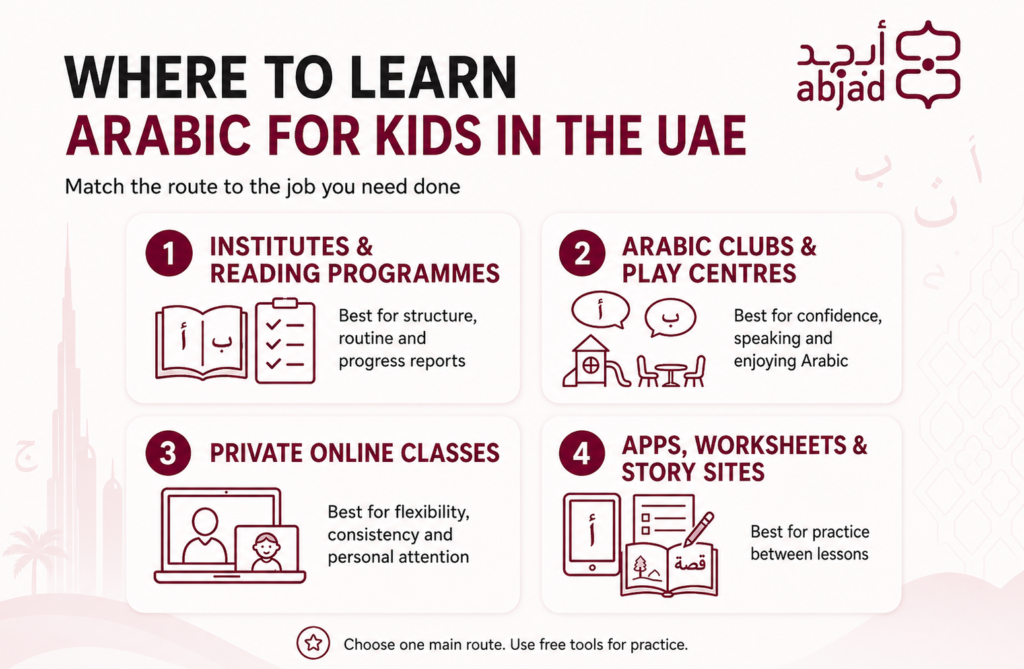
A. Arabic Institutes and Reading Programs for Structured Learning
Arabic institutes provide a fixed curriculum, regular schedules, and progress reports. Programs such as iEnglish Kids and Berlitz Dubai can suit families who want structured reading and writing instruction.
Before enrolling, check the class size, individual reading time, and the teacher’s experience with non-Arabic-speaking children. Group classes follow a shared pace, so also ask whether your child can move levels if the class becomes too easy or difficult.
B. Arabic Clubs and Play Centres for Speaking and Confidence
Arabic clubs use stories, games, art, and group activities to make the language enjoyable. They can be particularly helpful for children who have lost interest in formal Arabic lessons or need more confidence speaking.
However, clubs usually do not teach Arabic reading in a structured sequence. Use them to build interest, speaking confidence, and social exposure, while maintaining separate reading practice.
Read also: Daily Routine in Arabic for Kids
C. Private Online Arabic Classes for Personalized Reading and Correction
One-to-one online classes let the teacher work at your child’s actual level, and fix reading and pronunciation mistakes the moment they happen. They also cut out travel time, and make it easier to keep lessons going through school holidays and family trips.
At Abjad, your child studies with one native Arabic tutor, and you can ask for a male or female teacher. Most of them are Al-Azhar graduates, and several hold ijazah in Tajwid and Quran recitation. Lesson times are flexible, with early morning and late evening slots that fit around the UAE school week.
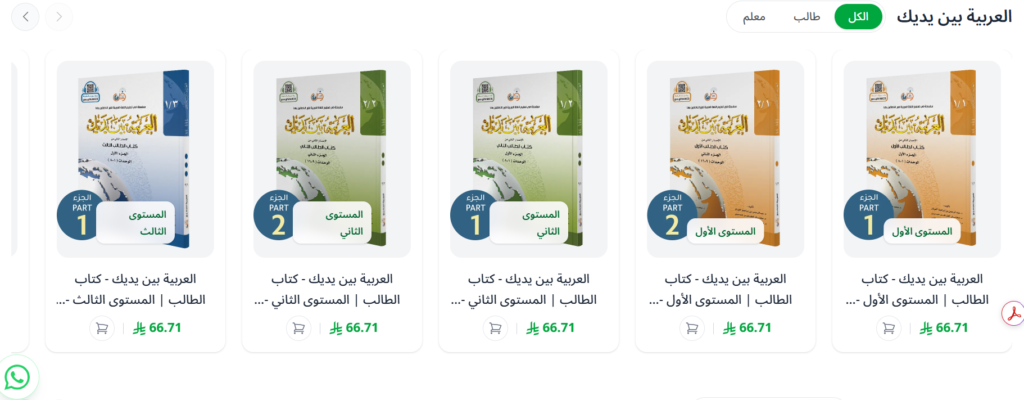
Apps, worksheets, and graded stories are useful for reinforcing skills between lessons. Resources such as Alef Bata and 3asafeer provide activities covering letters, vocabulary, reading, and other Arabic skills.
Choose one or two resources and use them consistently instead of frequently switching platforms. Whenever possible, combine screen activities with handwriting and reading aloud. Free tools work best as additional practice rather than a replacement for teacher feedback and correction.
Which Arabic Learning Option Is Best for Getting Your Child Reading?
The four routes are not four versions of the same thing. Each one does a different job, and only one of them puts an adult ear on your child’s reading every week.
| What matters | Institutes | Clubs and play centres | Private online (Abjad) | Free apps and sheets |
| Best for | A fixed course | Rebuilding the mood | Reading and correction | Extra practice |
| Format | Group class | Group activity | One child, one teacher | Solo, on screen or paper |
| Reading aloud per child | Shared with the group | Very little | The whole lesson | None heard by anyone |
| Who corrects mistakes | Teacher, when there is time | Not the focus | Teacher, on the spot | Nobody |
| Pace | Speed of the group | Speed of the group | Speed of your child | Your child’s guess |
| Travel | Drive there and back | Drive there and back | None | None |
| Runs through summer | Usually stops | Usually stops | Yes | Yes |
| Carries on when you travel | No | No | Yes | Yes |
| Try before you pay | Ask the centre | Ask the centre | Two free classes | Free anyway |
| Teacher credentials | Ask before you sign | Ask before you sign | Native speakers, Al-Azhar, Ijazah | None |
| Cost model | Per term | Per term or session | From about $19 a month | Free |
Look at the “reading aloud” row first. It explains why children stall in three of these four routes. Reading gets fixed by being heard, and only one column gives your child an adult ear in every lesson.
Then look at the pace row. A group moves at the speed of the group, so your child either waits or falls behind. A private lesson moves at your child’s own speed. That is the speed that counts.
That is exactly what Abjad is built to do. Your child sits with one native Arabic teacher, most of them Al-Azhar graduates with ijazah, in lessons timed around school hours in the UAE.
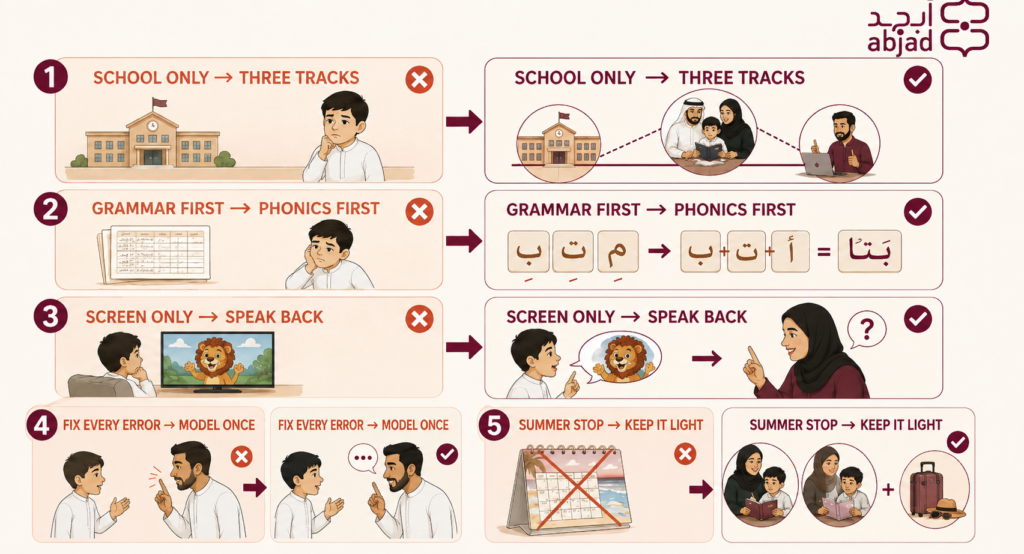
Five Common Mistakes That Slow Your Child’s Arabic Progress and How to Fix Them
Stalled Arabic tends to have the same few causes. Check your setup against these before you switch schools or books.
Stalled Arabic progress often comes from a few predictable mistakes. Check these five areas before switching schools, tutors, or learning materials.
1. Relying on School Arabic as the Complete Learning Plan
School Arabic may produce good grades without building the reading or speaking fluency you expect. The gap often becomes obvious around Grade 3 or 4, when a child performs well in class but still struggles with unfamiliar Arabic text.
Define your goal first. Do you want your child to read stories, speak with family, understand Quranic Arabic, or succeed academically? Then use home practice and tutoring to cover what the school curriculum does not.
2. Teaching Arabic Grammar Before Building Reading Skills
Grammar can look like progress because children complete tables and identify parts of speech. But if they cannot read the examples confidently, they are learning labels before mastering the language itself.
Test your child with a fully marked Arabic sentence. If reading is still difficult, strengthen letter sounds, Harakat, and blending before pushing further into grammar.
Read also: Easy Arabic Stories for Kids -Turn Reading Time Into Arabic Practice
3. Using Arabic Screen Time Without Active Practice
Arabic cartoons and apps can improve listening, but passive exposure alone does not build confident speaking. Constantly switching between apps can also keep children repeating beginner material instead of progressing.
Choose one app or resource and add a small speaking task after each session: repeat a sentence, name three objects, or answer one simple question in Arabic.
4. Correcting Every Mistake While Your Child Speaks Arabic
Interrupting every error can make children afraid to experiment with Arabic. During normal conversation, confidence and willingness to speak matter more than perfect accuracy.
Let your child finish, then naturally repeat the sentence correctly. During structured reading lessons, however, pronunciation errors should be corrected immediately before they become habits.
5. Stopping Arabic Practice During the Summer
A long summer break can quickly weaken reading speed and fluency. When lessons restart, children may spend the first weeks recovering skills they had already developed.
Reduce the workload instead of stopping completely. Keep one or two short lessons each week, daily Arabic audio, and around 10 minutes of regular reading. A light summer routine is much easier than starting again from scratch.
Check our Arabic Kids Comps in the UAE
Inside Our Live Classes
Don’t just take our word for it—see for yourself! Click below to watch short clips from our live classes and meet the instructors who will guide your learning journey.
Start Your Child’s Arabic The Right Way — Book A Free Trial Class Today
Stop guessing where your child is stuck. In one lesson, a native Arabic teacher can hear where the reading breaks, tell you what to fix, and build a plan around your child’s real level, not their school grade.
Abjad’s teachers are native Arabic speakers, most of them Al-Azhar University graduates, and several hold ijazah in Tajwid and Quran recitation. Male and female tutors are both on the team, with up to 13 years of teaching behind them. Classes run online, at times that fit around school in the UAE.
You do not have to take our word for it. Hamza Osama started with the Arabic alphabet, then learned Tajweed, and has now memorised about two juz of the Quran. Read what Hamza says about his lessons.
The Arabic Courses Your Child Can Start With
Abjad groups its Arabic courses by age and by goal, so your child joins at the right point rather than at a fixed level.
- UAE Kindergarten Arabic Classes — first letters and sounds for the youngest learners
- Beginner Arabic for Kids — for a child starting from zero
- Arabic Qaida for Kids — letters, joins, and reading, step by step
- Arabic for Kids Course — the full course for school-age children
- Arabic Conversation for Kids — for a child who reads but will not speak
- Arabic Grammar for Kids — rules taught at a child’s level
- Teen Arabic Summer Course — for older students in the school break
- Arabic Kids Camps — short, intensive blocks
- Quranic Arabic Course — for reading and understanding the Quran
Why Parents in the UAE Choose Abjad Institute
Abjad UAE Arabic Learning Academy teaches Arabic and Islamic studies online, with lessons built around each learner. Here is what you get:
- Al-Azhar-trained leadership. The teaching team is led by Al-Azhar University graduates, and includes Quran scholars who hold ijazat in Tajwid and Qira’at, along with huffaz and former imams.
- Native Arabic teachers. All instructors are native speakers, with 20 qualified teachers and 50 professional tutors on the team.
- Ten years of teaching, 350 students taught. The academy has more than ten years of experience, and has taught over 350 students across all seven emirates.
- Talking, not just listening. Sessions are built so that about 70% of the time is speaking practice, which is how a child starts to use the language instead of only knowing it.
- Emirati Arabic, not only textbook Arabic. Teachers know the Emirati dialect and Gulf usage, so your child can speak with the people around them, and still read Fusha and Quranic Arabic properly.
- One place for the whole path. Grammar, reading, writing, speaking, Quranic Arabic, and Islamic studies all sit under one academy, with a curriculum written in-house and set by level.
- Hours that fit a UAE week. Classes run early in the morning and late in the evening, so lessons fit around school, work, and travel, with no drive and no traffic.
- Programs made for children. Arabic for kids, Arabic conversation for kids, Arabic Qaida, and kids camps are all separate tracks, each pitched at a child’s level rather than trimmed down from an adult course.
- A free trial class first. Book a trial, and a tutor will confirm the time with you. Watch a lesson with your child before you decide anything
Begin Your Arabic Journey in the UAE
Join Abjad Institute for a professional and immersive Arabic language experience tailored to your goals.
Book Your Free TrialConclusion
Teaching kids Arabic in the UAE works when three tracks run as one. A school that covers the course. A home where the language lives and feels good. And a teacher who hears your child read out loud each week. Drop one, and progress slows in a way you can see coming.
None of the three can carry the load alone. The school moves on a calendar. The home builds warmth but not phonics. The tutor fixes reading but cannot fill your child’s day with Arabic. Together they cover what each one misses.
Follow the order: letter sounds, harakat, madd and sukoon, sun and moon lam, then real reading. Do not jump ahead to grammar. Keep lessons short and often, not long and rare, and hold the routine through the break.
Expect flat weeks. Every child sits on the same spot for a while before the next jump, and that is not the moment to change the plan. Changing methods every few months is what costs families years.
Then judge progress by one question. Can your child read a sentence they have never seen? Not a sentence from the textbook, and not one they have heard before. A new one.
Start this week, not next term. Pick the daily audio slot tonight. Ask the school which stream your child is in. Book one trial lesson and find out which stage they are really at. Three small steps, and the plan is running.
FAQs
How do I teach my child Arabic at home in the UAE?
Run three tracks at once: school for the course, home for daily audio and stories, and a private tutor for reading correction. Teach in order, from letter sounds to harakat to reading. Twenty minutes a day beats one long session a week.
At what age should I start teaching my child Arabic in the UAE?
Start audio from birth, and letter work at about four or five. Dubai’s KHDA policy on early years Arabic covers kids from birth to six. It favours play, daily talk and stories over drills at that age.
Is school Arabic enough for non-Arab kids in the UAE?
School Arabic alone is rarely enough for fluency. The Arabic B stream is built to give new speakers basic reading, and one teacher cannot hear 24 kids read each week. Parents who want strong reading add private lessons and daily Arabic audio at home.
Should I teach my child Fusha or the local dialect first?
Teach both, but keep them apart: dialect when you talk, and simple Fusha for stories, lessons and reading. Kids keep them apart on their own, and Gulf dialect surrounds them here anyway.
How much do Arabic classes for kids cost in the UAE?
It depends on the format. Centres charge per term, tutors who come to you charge per hour plus travel, and online schools charge per month. Abjad’s private plans run from $18.99 to $142.50 a month, set by lesson length and how often your child goes. A 30-minute lesson once a week is $18.99, and five 45-minute lessons a week is $142.50.
How long does it take a child to read Arabic?
With three short lessons a week plus daily audio, most young kids read fully marked text with ease inside a school year. How often you practise counts far more than how long. Twenty minutes a day beats two hours on a Saturday.
Related Articles
Learn Arabic





Leave a Reply