 Learn Arabic
Finding the right Arabic activity for kids in the UAE is something every parent and teacher wrestles with at some point. Arabic is the official language of the Emirates, yet for many children, especially in bilingual or expat households, it can feel distant or hard to connect with at home.
The gap between hearing Arabic at school and genuinely engaging with it daily is real, and it matters more than most families realise. The good news is that closing that gap doesn’t require expensive materials or specialist training. It requires the right mix of sensory play, varied repetition, and connection to things children already find interesting.
This guide gives you ten structured, practical activities that work across age groups and home settings, including free printable Arabic activity for kids and downloadable resources accessible right here in the UAE.
Join Our Learn to Write Arabic Course in the UAE with a FREE Trial Class

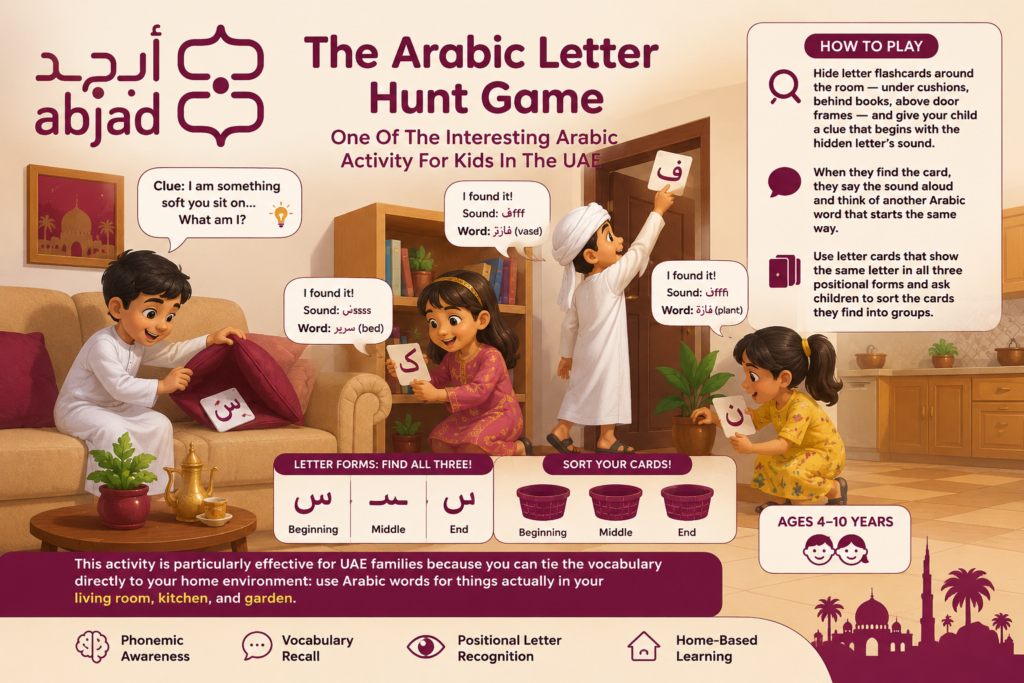
1. The Arabic Letter Hunt Game One Of The Interesting Arabic Activity For Kids In The UAE
Hide letter flashcards around the room — under cushions, behind books, above door frames — and give your child a clue that begins with the hidden letter’s sound. When they find the card, they say the sound aloud and think of another Arabic word that starts the same way.
This activity is particularly effective for UAE families because you can tie the vocabulary directly to your home environment: use Arabic words for things actually in your living room, kitchen, and garden. Use letter cards that show the same letter in all three positional forms and ask children to sort the cards they find into groups.
It is designed for children aged 4–10 years and focus on phonemic awareness, vocabulary recall, positional letter recognition.
2. Arabic Letter Clay Sculpting
Give a child a piece of clay and ask them to form the letter ب (baa), and something clicks that a flashcard can’t replicate. The physical act of shaping a letter — pressing, rolling, adjusting — encodes its form through touch and movement, not just sight.
Set out modelling clay or play dough, call out a letter sound (not the letter name, the sound is what matters at this stage), and ask your child to build it. For children who already know a letter’s shape, challenge them to construct all three positional forms: at the start of a word, in the middle, and at the end.
This activity targets children aged 3–8 years to develop letter shape recognition, fine motor control, phoneme-to-grapheme connection.
Learn Arabic at Your Own Pace with a FREE Trial Class in the UAE
3. Printable Arabic Letter Worksheets
Printable worksheets are everywhere online, and most parents use them in the least effective way: handed to a child cold, with no context. A worksheet used after five minutes of sensory play with the same letter becomes a consolidation tool rather than a chore.
Look for three things in a quality Arabic worksheet: dotted tracing lines that show correct stroke direction; an image connected to the letter’s initial sound (not a random picture); and a word-linking section so the letter is never encountered in total isolation.
Basic Arabic reading practice in the UAE starts with recognising individual letters in context — these arabic activity for kids printables bridge the gap between isolated letter learning and connected-text reading.
Start learning Arabic letters with a FREE trial class
Watch Our Classes in Action
Curious what a real session looks like? Take a peek inside our interactive classrooms and see how our expert instructors bring the Arabic language to life. Watch a sample lesson below!
Begin Your Arabic Journey in the UAE
Join Abjad Institute for a professional and immersive Arabic language experience tailored to your goals.
Book Your Free Trial
4. Arabic Storytelling With Picture Books
Picture books do something worksheets cannot; they show Arabic living inside a narrative. A child who hears the same Arabic phrase repeated across five colourful pages absorbs it in a way no vocabulary list can replicate.
Effective Arabic storytelling sessions ask the child to point to words as you read, repeat key phrases, and eventually narrate the pictures alone. This builds print awareness before formal reading instruction begins. Many parents skip this stage entirely and later wonder why their children resist independent reading.
How to read Arabic books covers practical techniques for making Arabic reading a sustainable, enjoyable family habit rather than a reluctant school obligation.
Secure Your Place in the Fusha Arabic Course at Abjad Insitute
5. Home Vocabulary Card Labelling
Write the Arabic word for a household object on a card and stick it to that object — the refrigerator gets ثلاجة (thallaja), the door gets باب (baab), the window gets نافذة (naafidha). Leave them up for a week. By day three, most children are reading them without being prompted.
This is label immersion — a technique used in second-language classrooms worldwide — adapted for home use. In a UAE household where English or another language dominates, it quietly rebalances the linguistic environment and introduces Arabic as a language of everyday life.
Once your child can read all the cards, replace them with handwritten versions they created themselves. Ownership of the written word dramatically increases retention.
Enroll in Abjad’s Arabic from Scratch Course and get a FREE trial

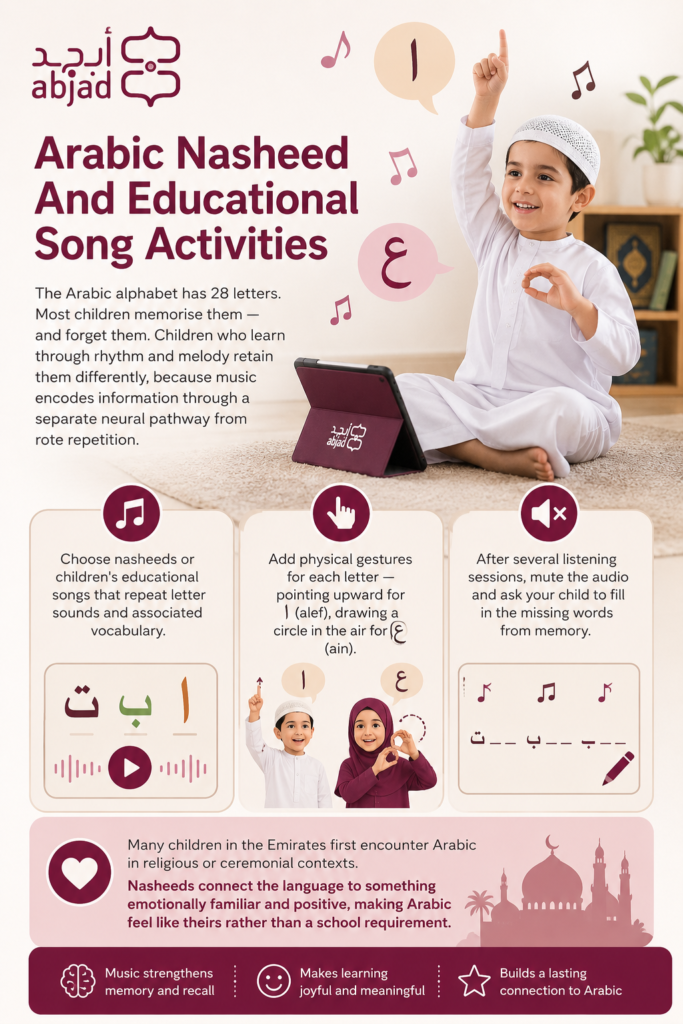
6. Arabic Nasheed And Educational Song Activities
The Arabic alphabet has 28 letters. Most children memorise them — and forget them. Children who learn through rhythm and melody retain them differently, because music encodes information through a separate neural pathway from rote repetition.
Choose nasheeds or children’s educational songs that repeat letter sounds and associated vocabulary. Add physical gestures for each letter — pointing upward for ا (alef), drawing a circle in the air for ع (ain). After several listening sessions, mute the audio and ask your child to fill in the missing words from memory.
Many children in the Emirates first encounter Arabic in religious or ceremonial contexts. Nasheeds connect the language to something emotionally familiar and positive, making Arabic feel like theirs rather than a school requirement.
7. Free Arabic Activity For Kids PDF Downloads
Families in the UAE have access to a growing library of free Arabic activity for kids online resources — many specifically designed for Gulf-context Arabic learners.
Where to find them:
- Noory Books (noorybooks.com/activities): Free PDF worksheets covering letter tracing, alphabet booklets, Ramadan activity packs, and coloring sheets — all print-ready
- Kalimat School (kalimatschool.com/activities): Structured Arabic worksheets for ages 5–14, organised by skill level, covering short vowels, similar-sounding letters, and reading comprehension
- Twinkl UAE (twinkl.ae): Curriculum-aligned Arabic resources including letter-search activities and early reading materials
A practical download priority order for beginners:
- Alphabet tracing sheets — letter formation before letter recognition
- Positional form matching cards — the same letter at the start, middle, and end of words
- Simple vocabulary matching sheets — word to image
- Short mazes and puzzle activities — for consolidation when the child needs variety
Arabic activity for kids free download is an excellent start, but sequence matters. How to learn to read Arabic online for free explains how to organise these resources into a coherent learning path rather than an unstructured pile of printouts.
Help Your Child Build Strong Arabic Qaida with a Free Trial Class in the UAE
8. The Arabic Letter Train Game
Draw a train with four carriages on a large sheet of paper. Each carriage holds one positional form of the same Arabic letter: the isolated form in the first carriage, the word-initial form in the second, the mid-word form in the third, and the final form in the fourth.
This addresses one of the most persistent stumbling blocks in Arabic literacy: children who can name a letter in isolation but cannot recognise it inside a word. Arabic letters change shape depending on where they appear in a word, a rule that confuses nearly every beginner. The letter train makes this rule visual, tangible, and memorable.
Ask your child to write or cut and paste actual words into each carriage — words where that letter appears at the start, middle, and end respectively. This activity is designed for children aged 6–10 years to build positional letter recognition, word analysis, readiness for connected-text reading.
Read also: Which Arabic learning app is most effective?

9. Arabic Calligraphy For Older Children
Calligraphy is where Arabic letter learning becomes art — and for children aged eight and above, it is one of the most effective routes to both writing accuracy and genuine cultural pride.
No specialist kit is needed. A broad-tipped marker, large paper, and a reference card showing the correct letter proportions are enough to start. Ask your child to copy a simple word — their name in Arabic, or a word they find visually beautiful — and focus entirely on the shape and flow of each stroke, not on speed.
In the UAE, Arabic calligraphy is visible everywhere: on government buildings, mosque walls, shop signs, and public art. A child who has tried to form these letters by hand looks at the city differently afterwards. How to read Arabic calligraphy covers the major calligraphic scripts and how to teach children to identify them in the environment around them.
Read also: How to Read Arabic Without Vowels?
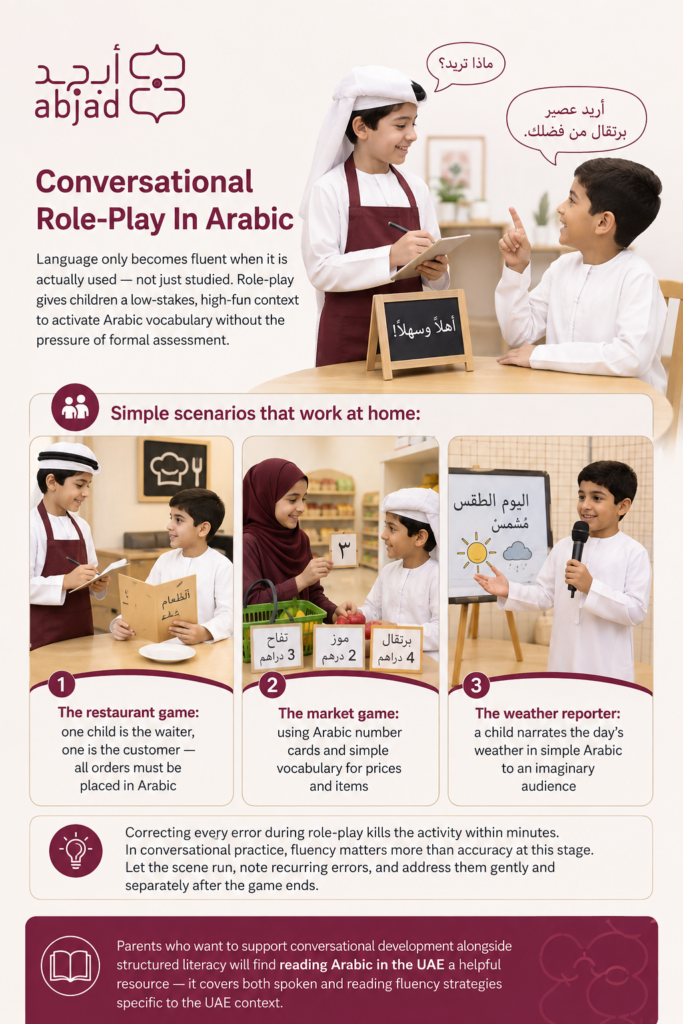
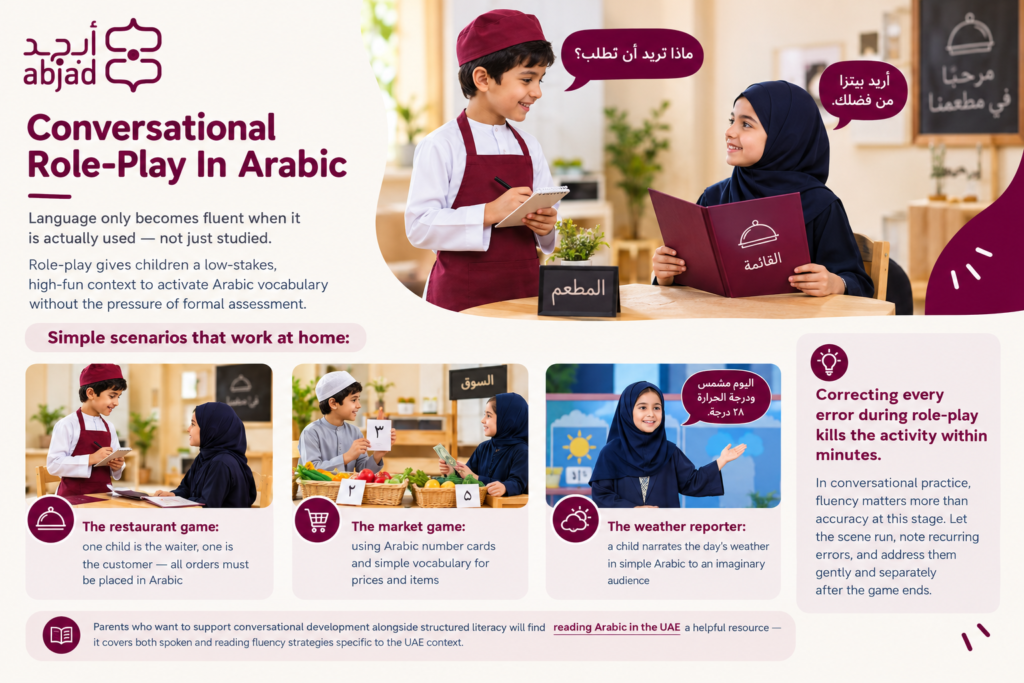
10. Conversational Role-Play In Arabic
Language only becomes fluent when it is actually used — not just studied. Role-play gives children a low-stakes, high-fun context to activate Arabic vocabulary without the pressure of formal assessment.
Simple scenarios that work at home:
- The restaurant game: one child is the waiter, one is the customer — all orders must be placed in Arabic
- The market game: using Arabic number cards and simple vocabulary for prices and items
- The weather reporter: a child narrates the day’s weather in simple Arabic to an imaginary audience
Correcting every error during role-play kills the activity within minutes. In conversational practice, fluency matters more than accuracy at this stage. Let the scene run, note recurring errors, and address them gently and separately after the game ends.
Parents who want to support conversational development alongside structured literacy will find reading Arabic in the UAE a helpful resource — it covers both spoken and reading fluency strategies specific to the UAE context.
What To Do After The Activities?
Ten activities are a strong start. But without a clear next step, learning often plateaus. Children who can identify individual Arabic letters need to see how those letters connect — how حَ، حِ، حُ carry different sounds, how letters join to form words, how reading a short text feels different from reading a flashcard.
This progression rarely happens automatically. It needs guidance. Learn how to write and read Arabic for beginners covers the core building blocks that make the transition from activity-based learning to genuine literacy much smoother.
For children already writing letters and ready to develop real fluency, Arabic writing practice in the UAE offers structured exercises that bridge home play and classroom-level writing skill.
Three Common Mistakes To Avoid With Home Arabic Activities
Home Arabic activities can make a significant difference when they are simple, consistent, and matched to a child’s developmental stage. However, a few common mistakes can unintentionally slow progress or make Arabic feel frustrating. Avoiding these following three pitfalls helps keep learning enjoyable while building strong, lasting skills.
A. Starting With Writing Before Audio Recognition Is Established
Arabic contains sounds that don’t exist in English — the distinction between ح (ha) and هـ (ha) is invisible on paper if the ear can’t distinguish them first. Always establish the sound through listening and repetition before introducing the written form.
B. Consistent Practice Works Better Than Constant Variety
Switching between five apps, three worksheets, and two YouTube channels every week creates breadth without depth. Children need to encounter the same letters and words repeatedly, across different formats, before retention sets in. Two or three activity types, rotated consistently, outperform constant novelty.
C. Corrections Should Not Become The Focus Of Learning Making Correction The Main Event
When a child senses that their Arabic attempts are being judged, they stop attempting. Praise the effort, redirect the error quietly, and keep sessions short enough to end on a success.
Read also: The best Arabic Worksheets For Kids
Inside Our Live Classes
Don’t just take our word for it-see for yourself! Click below to watch short clips from our live classes and meet the instructors who will guide your learning journey.
Begin Your Arabic Journey in the UAE
Join Abjad Institute for a professional and immersive Arabic language experience tailored to your goals.
Book Your Free Trial
Start Your Child’s Arabic Journey At Abjad Institute
Abjad Institute is one of the UAE’s most respected Arabic language academies, with dedicated programmes for every age group, learning goal, and language background — from children who have never seen an Arabic letter to teens building towards academic fluency.
Children who complete Abjad’s foundational programmes can read short Arabic texts within months, not years. Conversational Arabic students gain enough confidence to use the language outside the classroom — ordering food, greeting neighbours, and understanding daily announcements.
Discover Our Arabic Courses:
- Arabic Course in the UAE
- Arabic Intensive Course
- Learn Arabic from Scratch Course
- Madinah Arabic Course
- Arabic Classes for Adults
- Arabic Classes for Beginners
- Self-Paced Arabic Course
- Basic Arabic Course
- Arabic Speaking Classes
- Learn to Write Arabic Course
- Arabic Grammar Course
- Learn Arabic Alphabet Course
Explore all Arabic courses at Abjad Institute →
Conclusion
The ten activities in this guide cover every major Arabic learning modality: sensory and kinesthetic play, visual recognition, auditory memory, storytelling, writing mechanics, and conversational practice. No single activity is a complete programme — but together, they create the kind of varied, repeated exposure that language acquisition genuinely requires.
The UAE’s Arabic learning environment is unique: children here have both the motivation (Arabic surrounds them) and the challenge (other languages often dominate the home). The families who close that gap fastest are the ones who make Arabic a normal part of daily life — not a separate, pressured study block, but something woven into playtime, meal prep, bedtime stories, and weekend routines.
For children ready to move beyond home activities into structured Arabic literacy, Abjad Institute offers the expertise, curriculum, and UAE-specific teaching experience to take them further. How to learn Arabic is a comprehensive starting point for understanding the full journey — from first letters to fluent, confident reading.
Arabic is one of the world’s great languages, and the UAE is one of the finest places on earth to raise a child who speaks it well.
Frequently Asked Questions
What is the best Arabic activity for kids in the UAE for total beginners?
For children with no prior Arabic exposure, sensory activities work best. They establish shape and sound recognition without the pressure of formal writing. Once a child can identify ten or more letters by sound, worksheet-based tracing and picture book reading become the natural next step.
Where can I find free printable Arabic activity for kids PDF resources in the UAE?
Several platforms offer free, print-ready Arabic worksheets: Noory Books provides alphabet activity packs and colouring sheets; Kalimat School offers structured reading and writing worksheets for ages 5–14; and Twinkl UAE provides curriculum-aligned Arabic resources. All are available for direct download and home printing.
How long should a home Arabic activity session be?
For children under six, ten to fifteen minutes is the effective ceiling, long enough to work with one letter or concept, short enough to end before attention drops. For children aged six to ten, twenty to thirty minutes works well if you vary the activity type mid-session: for example, five minutes of listening, ten minutes of hands-on activity, then ten minutes of a game.
Can children learn Arabic online for free?
Yes. Beyond downloadable worksheets, platforms like Kalimat School and Twinkl UAE offer free interactive Arabic activities online. These work best as a supplement to — rather than a replacement for — direct human interaction, whether with a parent, sibling, or teacher.
What is the difference between Emirati Arabic and Modern Standard Arabic for children?
Modern Standard Arabic (MSA) is the written form used in books, news, and formal education; it is what children learn to read and write at school and what opens doors to the entire Arabic-speaking world. Emirati Arabic is the spoken dialect used by UAE nationals in daily life.
At what age should children move from home activities to a structured Arabic class?
Home activities are most effective before age six as a foundation. From around age five to six structured instruction alongside home activities produces significantly faster progress. Children who arrive at their first Arabic class having already played with letters at home settle into formal learning faster and with less anxiety than those encountering the alphabet for the first time in a classroom setting.




Leave a Reply