 Quran
Quran
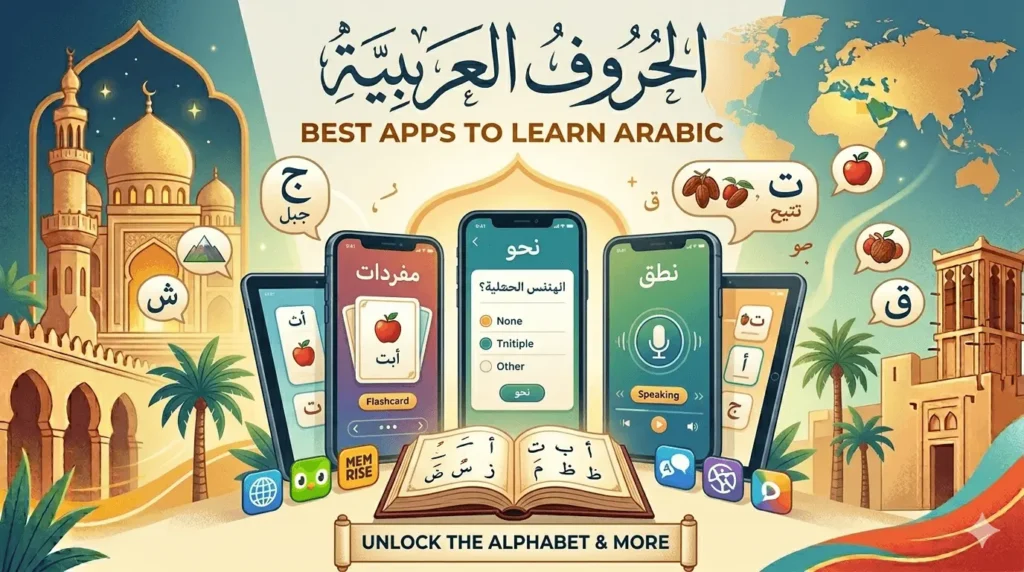
If you’ve been searching for a learn to read Arabic app, you’ve probably already downloaded two or three and deleted them within a week. Most either move too fast, stay stuck on tourist phrases, or gamify vocabulary without ever teaching you to actually decode Arabic script on the page.
Reading Arabic is a distinct skill from speaking it. The alphabet connects letters differently depending on position in a word, most vowels aren’t written at all in everyday text, and the right-to-left direction throws off pattern recognition that took years to build in your native language.
A good learn to read Arabic app has to account for all three problems, not just one — and the good news is a genuinely useful learn to read Arabic app free option exists for every stage, so cost doesn’t have to be the thing holding you back.
This guide covers the apps that actually build reading ability — free and paid — along with what each one does well, where it falls short, and how to combine them so you’re not relying on a single tool that only covers part of the skill.
1. Duolingo
Duolingo is a free, gamified language app that teaches the Arabic alphabet, pronunciation, and foundational vocabulary through short daily lessons. Each lesson runs 5–10 minutes, and a streak system builds the daily habit that most learners struggle to maintain on their own.
For Layer 1 script recognition, Duolingo is a genuinely solid free app to learn to read Arabic — no account is required to start, and there’s no placement test standing between you and your first lesson.
As a learn to read Arabic app free of any paywall on its core course, it’s the easiest starting point on this entire list.
The tradeoff: Duolingo’s Arabic course is shorter than its European-language courses, and it builds recognition faster than production. You’ll recognize words in the app before you can generate them independently on a blank page.
- Platforms: iOS, Android, Web
- Price: Free / $6.99 per month (Super Duolingo)
- Best for: Absolute beginners who need a frictionless, habit-forming entry point into the alphabet.
2. Madinah Arabic Reader
Madinah Arabic Reader is a free reading app built on the curriculum from the Islamic University of Madinah, the institution behind the widely used Madinah Arabic Book series.
It moves learners through voweled texts of increasing difficulty, with comprehension checks at each stage before you advance.

This is a Layer 2 tool: it assumes you already know your letters and focuses entirely on building sentence-level reading fluency through structured, sequenced texts rather than isolated vocabulary.
That structure is its main advantage over more game-like apps — it’s built for genuine skill progression, not engagement metrics.
It isn’t polished or gamified, so learners who need entertainment to stay motivated may find it plain. It’s also not an alphabet-teaching tool, so complete beginners should start elsewhere first.
- Platforms: iOS, Android
- Price: Free
- Best for: Learners whose goal is Quranic or classical Arabic reading, with a structured, academically grounded curriculum.
Read Also: How To Learn To Read Arabic Online For Free
3. Beelinguapp
Beelinguapp presents Arabic stories and articles in a split-screen format — Arabic text on one side, your native language on the other — with native-speaker audio that highlights each sentence as it plays.
This parallel-text method lets you follow meaning without stopping constantly to look up individual words.
The audio-plus-text combination is what makes it useful at Layer 2: you’re processing the written form, the sound, and the meaning at the same time, which reinforces reading in a way that silent reading alone doesn’t. A karaoke-style mode also lets you read aloud while the app tracks your position.
The free library is limited to a handful of texts, and the app assumes basic literacy already — it teaches reading practice, not the alphabet itself.
- Platforms: iOS, Android
- Price: Free (limited) / $2.99 per month / $19.99 lifetime
- Best for: Learners who already know the script and want to build reading comprehension through real stories.
4. LingQ
LingQ is a reading and listening platform built around one idea: learn by working through content you actually want to read, not simplified learner text. Every unknown word you tap becomes a saved vocabulary item, tracked through spaced repetition until it’s marked as known.
What separates LingQ from a typical learn to read Arabic app is that it works with unmodified, authentic Arabic — news articles, podcasts, imported PDFs, even a Quranic verse you paste in yourself.
That flexibility makes it the strongest Layer 3 tool on this list, since independent reading ultimately means handling text nobody simplified for you.
LingQ works best as the reading-focused half of a learn to read Arabic app pairing — combined with a script-focused tool for absolute beginners, it covers both ends of the skill.
The free tier caps you at 20 saved words before the paywall, and the interface has a real learning curve. It also isn’t built for beginners — you need the alphabet and a base vocabulary of 200–300 words before LingQ becomes useful rather than overwhelming.
- Platforms: iOS, Android, Web
- Price: Free (limited) / $12.99 per month / $199 lifetime
- Best for: Intermediate-plus readers ready to work through real Arabic news, literature, or religious texts.
Read Also: How To Read Arabic-Indic Numbers (1 To 100) In English?
5. Anki
Anki isn’t an Arabic app at all — it’s a spaced repetition flashcard system, and it happens to be the most effective vocabulary retention tool available to Arabic readers.

It shows you each word right before your brain is about to forget it, which is a more efficient use of study time than repeated, undirected review.
For Arabic specifically, its value comes from free pre-made decks: a Quranic Arabic frequency deck covering roughly 75% of the Quran’s total word count with just 500 words, a Hans Wehr dictionary deck, and Madinah Arabic vocabulary sets. Reading fluency depends heavily on instant word recognition, and that’s exactly what spaced repetition builds.
The interface is dated and unintuitive, and new users often build poorly structured cards that undercut the method. Download an existing Arabic deck rather than building your own from scratch when you’re starting out.
- Platforms: Android + Web (Free) / iOS ($24.99 one-time)
- Best for: Any learner who needs to lock in vocabulary long-term, especially those working toward Quranic Arabic.
Watch Our Classes in Action
Curious what a real session looks like? Take a peek inside our interactive classrooms and see how our expert instructors bring the Arabic language to life. Watch a sample lesson below!
Begin Your Arabic Journey in the UAE
Join Abjad Institute for a professional and immersive Arabic language experience tailored to your goals.
Book Your Free Trial6. Drops
Drops teaches Arabic vocabulary through fast, visual word-association games — no grammar, no sentences, just Arabic words connected directly to images. Sessions are capped at exactly 5 minutes on the free plan, which keeps each one short enough to avoid fatigue.
The speed is deliberate: words cycle quickly enough that you’re forced into instant recognition rather than slow translation, which is the same instinct fluent reading depends on. Each word also displays in Arabic script alongside transliteration and audio, so letter recognition builds passively in the background.
The 5-minute cap is genuinely restrictive, and Drops teaches vocabulary in isolation — no sentence context, no grammar. It works best as a daily warm-up alongside a grammar-focused app, not as your only tool.
- Platforms: iOS, Android
- Price: Free (5 min/day) / $9.99 per month / $69.99 per year
- Best for: Visual learners who want a quick daily vocabulary habit rather than a full course.
7. Mango Languages
Mango Languages offers a structured Modern Standard Arabic course that moves from basic phrases through grammar and vocabulary in sequenced lessons.
Its most useful feature for cost-conscious learners: free access through a public library card, which makes it one of the only fully free, structured Arabic courses available to anyone with a library membership.
Grammar explanations are built directly into lessons instead of buried in a separate reference section, which suits learners who want to understand why Arabic reads the way it does rather than just pattern-matching through repetition.
Mango covers MSA only, not dialects or Quranic Arabic, and it plateaus around upper-beginner level. Treat it as a foundation, then move to a Layer 3 tool like LingQ.
- Platforms: iOS, Android, Web
- Price: Free with library card / $7.99 per month
- Best for: Adult beginners who want explicit grammar explanation, especially those with library access.
Read Also: How To Learn To Read Arabic In 21 Days? A Step-By-Step Plan
8. Write It! Arabic
Write It! Arabic teaches the Arabic script through handwriting recognition, paired with native-speaker audio for pronunciation.
You start by practicing a small set of characters, then test yourself through multiple-choice and writing exercises.
Reading and writing reinforce each other more than most learners expect — physically forming a letter builds recognition of it on the page faster than passive viewing alone.
This makes Write It! Arabic a useful companion at Layer 1, run alongside whichever app is teaching you vocabulary and grammar.
It offers limited background on each letter’s history or usage, so it’s a drilling tool rather than a full course.
- Platforms: iOS, Android
- Price: Free
- Best for: Beginners who want to reinforce script recognition through handwriting practice.
Read also:10 Arabic Games For Kids That Turn Learning Into A Daily Adventure
How To Choose The Best App To Learn To Read Arabic?
Choosing the right app depends on where you actually are, not where you’d like to be. A learner who can’t yet identify the 28 Arabic letters needs a completely different tool than one who can sound out words but stalls on comprehension.
It helps to think of Arabic reading as three layers, built one on top of the other.
Layer 1 — Script recognition. You can identify each letter in its four positional forms (isolated, initial, medial, final) and sound out short, fully-voweled words.
Layer 2 — Guided reading. You can read voweled sentences and short paragraphs with support — audio, translation, or a teacher — but you still lean on that support heavily.
Layer 3 — Independent reading. You can work through unvoweled text on your own, using context and root patterns to fill in what isn’t written.
Almost every app on this list is built for one layer, not all three. A common mistake is staying on a Layer 1 app (like a flashcard or matching game) for months, expecting it to eventually produce Layer 3 reading ability. It won’t — the skills don’t transfer that way. You need to change tools as you move up.
Free Vs. Paid: Which App To Read Arabic Text Is Worth Paying For
| App | Free Tier | Paid Tier | Best For |
| Duolingo | Full course, all levels | $6.99/month | Alphabet + basic vocabulary |
| Madinah Arabic Reader | Full app, free | — | Quranic and classical reading |
| Write It! Arabic | Full app, free | — | Handwriting-based script practice |
| Mango Languages | Free with library card | $7.99/month | Structured MSA grammar |
| Beelinguapp | Small story library | $2.99/month or $19.99 lifetime | Story-based reading + listening |
| Anki | Free (Android/Web) | $24.99 one-time (iOS) | Long-term vocabulary retention |
| Drops | 5 minutes/day | $9.99/month or $69.99/year | Quick visual vocabulary bursts |
| LingQ | 20 saved words | $12.99/month | Authentic text and news reading |
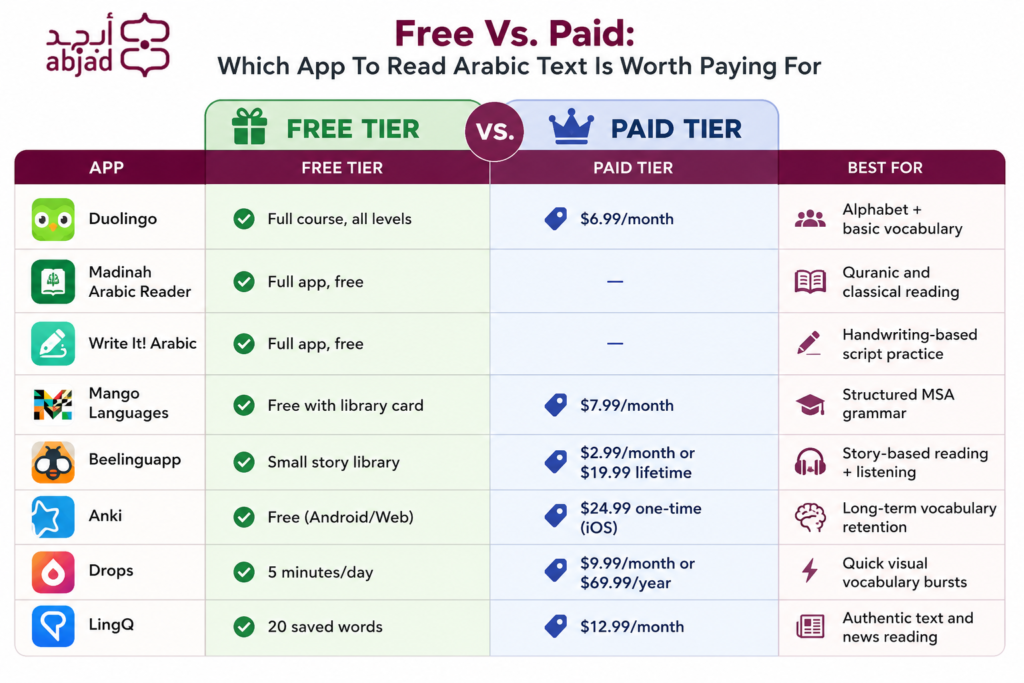
If your goal is simply to learn to read Arabic app-by-app without spending anything, Duolingo plus Madinah Arabic Reader plus Write It! Arabic covers the alphabet, structured sentence reading, and handwriting reinforcement at zero cost.
Paid tiers become worth it once you outgrow a free plan’s limits — LingQ’s 20-word cap, for instance, stops being workable the moment you start reading real articles rather than sample sentences.
Read Also: How To Read Arabic In English Letters? A Step-By-Step Guide For Beginners
Inside Our Live Classes
Don’t just take our word for it—see for yourself! Click below to watch short clips from our live classes and meet the instructors who will guide your learning journey.
Start Reading Arabic With Real Guidance, Not Just An App
Apps get you through the alphabet and into your first sentences. What most learners actually get stuck on is the jump after that — reading confidently without a translation crutch or an audio cue holding your hand.

That’s the gap a structured course closes. Abjad Academy pairs the reading foundation you build in an app with instructor feedback that catches mistakes no algorithm can hear.
If you’re ready to move past recognition and into real reading, explore Abjad Academy’s Arabic courses and start with guidance built around where you actually are.
Discover Our Arabic Courses:
- Madinah Arabic Course
- Arabic Classes for Adults
- Arabic Classes for Beginners
- Self-Paced Arabic Course
- Basic Arabic Course
- Arabic Speaking Classes
- Teen Arabic Summer Course
- Arabic Kids Camps
- UAE Kindergarten Arabic Classes
- Modern Standard Arabic Course
- Fusha Arabic Course
- Classical Arabic Course
- Emirati Arabic Course
- Gulf Arabic Course
- Learn Saudi Arabic
Begin Your Arabic Journey in the UAE
Join Abjad Institute for a professional and immersive Arabic language experience tailored to your goals.
Book Your Free Trial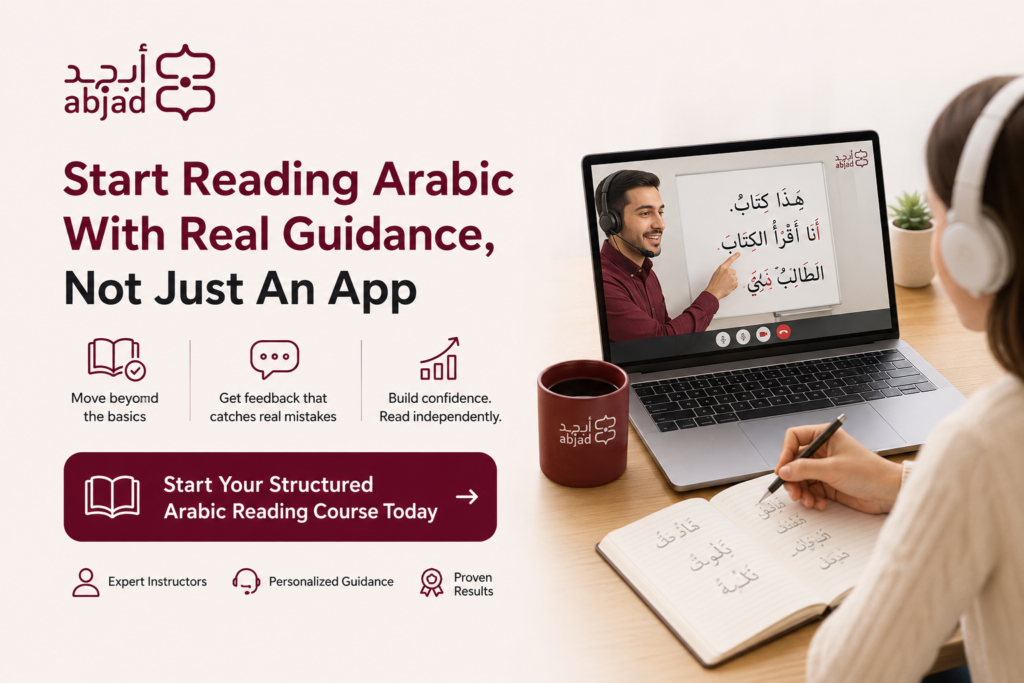
Conclusion
No single learn to read Arabic app covers all three reading layers on its own. Duolingo and Write It! Arabic build script recognition, Madinah Arabic Reader and Beelinguapp build guided reading through structured or story-based texts, and LingQ and Anki carry you into independent reading of real Arabic content.
Pick your tools based on which layer you’re actually in, not which app has the best reviews.
Where self-study apps consistently fall short is correction — catching the small habits that quietly cap a reader’s progress.
That’s where a structured, instructor-guided course like Abjad Academy fits in, closing the gap between “I can sound this out” and reading Arabic comfortably on your own. Whichever learn to read Arabic app you start with, treat it as step one on the path, not the whole plan.
Read also: How Hard Is It to Read Arabic in the UAE? 7 Real Challenges Explained
Frequently Asked Questions
Below are the questions learners ask most often when choosing a learn to read Arabic app or deciding whether to move on to structured instruction. An infographic mapping each app to its reading layer would work well alongside this section.
1. What is the best free app to learn to read Arabic?
Duolingo is the strongest fully free option for absolute beginners, since it teaches the alphabet and basic vocabulary with no account or paywall required. Pair it with Madinah Arabic Reader for structured sentence reading once you know your letters.
2. What is the best free app to read Arabic text once I know the alphabet?
Madinah Arabic Reader is the best free option for reading voweled Arabic text in a structured sequence, since it’s built entirely around a graded reading curriculum rather than isolated vocabulary drills.
3. Can I learn to read Arabic using only an app?
You can reach basic independent reading through apps alone, but most learners plateau before reading unvoweled text comfortably. A structured course, like the ones offered at Abjad Academy, adds the correction and feedback that self-paced apps can’t provide.
4. How long does it take to learn to read Arabic script?
Most learners recognize the full alphabet within a few weeks of consistent daily practice. Comfortable independent reading of unvoweled text typically takes several months of regular exposure, since it depends on pattern recognition that builds gradually rather than all at once.
5. Is Duolingo enough to learn to read Arabic on its own?
Duolingo builds strong recognition of letters and common words, but its Arabic course is shorter than its European-language courses and leans toward recognition over production. Most learners need to supplement it with a dedicated reading tool like LingQ or Madinah Arabic Reader.
6. What’s the difference between apps for MSA and apps for Quranic Arabic?
Modern Standard Arabic apps like Mango Languages and Duolingo focus on contemporary vocabulary and grammar used in news and daily communication. Quranic-focused tools like Madinah Arabic Reader and Anki’s Quranic frequency deck instead prioritize the vocabulary and structures that appear in the Quran itself.





Leave a Reply