 Learn Arabic

Twenty-one days is enough time to read Arabic out loud — even if you don’t understand every word yet. That’s the real, honest goal behind learning to read Arabic in 21 days: recognizing all 28 letters in their different shapes, understanding the vowel marks that sit above and below them, and sounding out real words and short sentences without freezing up.
This guide breaks the process into three focused weeks, based on the same structure Abjad Academy uses with new students who want fast, practical reading skills — not just alphabet trivia.
If you’re searching for a way to learn to read Arabic in 21 days for free online, or you’re deciding whether a paid, guided course is worth it, this article gives you the exact daily breakdown and tells you honestly where a self-taught plan runs into trouble.
Step 1: Master the alphabet and letter shapes (Days 1–7)
Arabic has 28 letters, and every one of them changes shape depending on where it sits in a word: at the start, in the middle, at the end, or standing alone.
This is the single biggest hurdle for beginners trying to learn to read Arabic in 21 days, because it means memorizing roughly four visual variations per letter instead of one fixed symbol.
The fix is to learn letters in small batches and drill shape recognition daily, rather than trying to absorb all 28 at once.
A. Learn four letters a day, grouped by shape
Split the alphabet into seven daily batches of four letters. Group letters that share a base shape and differ only by the number or placement of dots — such as ب (ba), ت (ta), and ث (tha), which use the identical base stroke. Learning them side by side, rather than in isolation, cuts confusion later because your eye learns to scan for dots as the distinguishing feature, not the shape itself.
B. Write every letter by hand before typing it
Typing Arabic on a keyboard hides the stroke direction, and Arabic is written and read right to left. Hand-writing each letter, even messily, forces your brain to register the shape actively instead of just recognizing it passively.
Abjad Academy’s beginner instructors see this consistently: students who skip handwriting in week one take noticeably longer to read fluently by week three, because letter recognition never moved past passive familiarity.
If you want structured handwriting drills instead of building your own, the Learn Arabic Alphabet Course covers this exact week-one process with guided practice sheets and instructor correction — useful if you’re learning to read Arabic in 21 days free through scattered YouTube videos and finding the shape drills inconsistent.
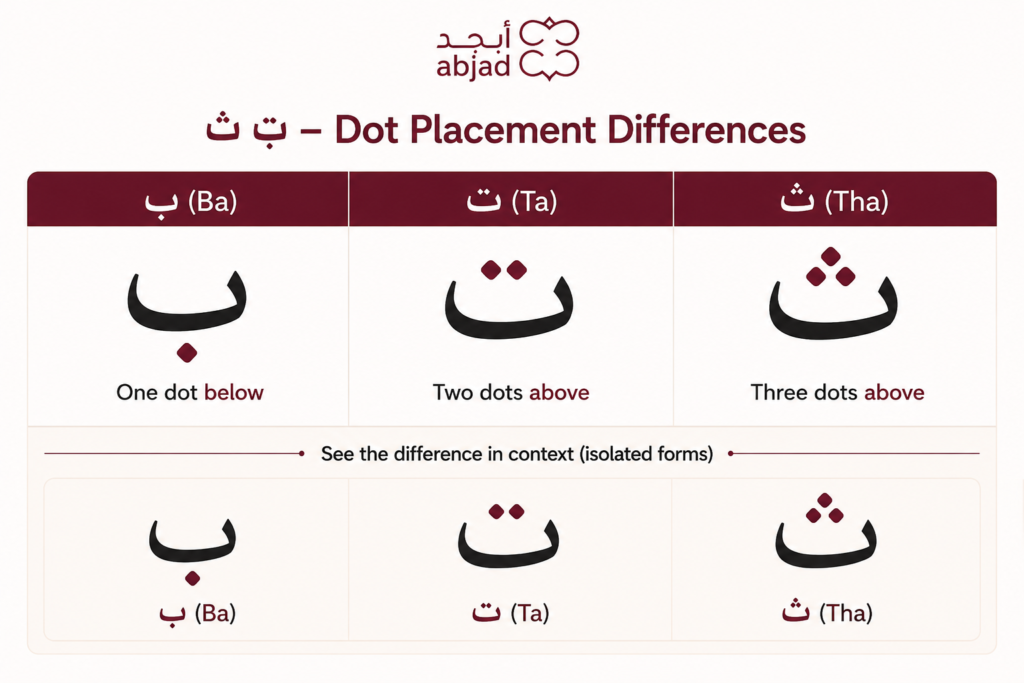
c. Test yourself on isolated letters daily
By day seven, you should be able to identify any of the 28 letters, in any of their forms, within about three seconds. If you can’t yet, that’s normal — spend an extra day or two here rather than moving forward.
Reading fluency in week three depends entirely on this recognition speed being automatic, not something you have to consciously work out letter by letter.
Step 2: Learn the vowel marks and how letters join (Days 8–14)
Arabic script is normally written without short vowels, but beginners need “tashkeel” — the vowel marks — to read accurately. Skipping this step is the most common reason people who try to learn to read Arabic in 21 days online free get stuck: they can name letters but can’t actually sound out a word.
The three short vowels and how they attach
Fatha (a short “a” sound), kasra (a short “i” sound), and damma (a short “u” sound) are small marks placed above or below a letter. Each one changes the sound of the letter it’s attached to, so بَ reads “ba,” بِ reads “bi,” and بُ reads “bu.” There’s no way to guess pronunciation without them — this is the mechanism, not a shortcut you can skip and pick up later.
Sukoon and shaddah change the rhythm of a word
Sukoon marks the absence of a vowel, which tells you to move straight to the next sound without a pause. Shaddah doubles a letter’s sound within the same syllable.
Both appear constantly in real text, so learning them in week two — rather than treating them as advanced material — prevents a habit of mispronouncing common words later.
Once the vowel marks are familiar, start blending: a consonant plus a vowel, then two consonants with vowels between them. This is where reading starts to feel like reading instead of decoding symbols one at a time.
If grammar mechanics like this feel shaky, the Arabic Grammar Course at Abjad Academy builds directly on this stage with structured sentence practice once the vowel system is solid.
A quick soft note here: self-study works for motivated learners, but the instructors correction is what catches small pronunciation drift before it becomes a habit — which is exactly what small-group sessions in the Arabic Classes for Beginners track are built to do.
Read Also: How To Read Arabic-Indic Numbers (1 To 100) In English?
Step 3: Read Real Words And Simple Sentences (Days 15–21)
This is where the 21-day plan pays off. You’re not learning anything new structurally in this final week — you’re applying weeks one and two to actual reading.
A. Read fully vowelled short words first
Children’s books, beginner readers, and religious texts with full tashkeel are ideal here because every vowel is marked, so there’s no guessing. Reading 50 or so simple words this way, slowly and out loud, is what converts letter knowledge into reading speed.
B. Build a core sight-vocabulary of 30–50 words
Focus on greetings, basic nouns, and numbers 1–10 — words you’ll see constantly and can reinforce daily. Repetition here matters more than volume; recognizing 40 words instantly is more useful by day 21 than half-recognizing 100.
C. Practice out loud for at least 20 minutes daily
Reading Arabic silently doesn’t train the same skill as reading it aloud. Sounding words out loud trains your mouth and your eyes to work together, which is what separates someone who can technically identify letters from someone who can actually read to read Arabic in 21 days at a usable, functional level.
By day 21, most learners following this structure can read any fully vowelled Arabic text aloud, even without understanding every word — which is the realistic, honest benchmark for this timeline.
For learners who want to keep the pace once the 21 days are done, the Arabic Intensive Course at Abjad Academy is designed to move straight from reading fluency into comprehension and speaking, without losing the momentum you just built.
Watch Our Classes in Action
Curious what a real session looks like? Take a peek inside our interactive classrooms and see how our expert instructors bring the Arabic language to life. Watch a sample lesson below!
Begin Your Arabic Journey in the UAE
Join Abjad Institute for a professional and immersive Arabic language experience tailored to your goals.
Book Your Free TrialWhat The “21 Days” Timeline Actually Gets You?
Every “learn to read Arabic in 21 days” plan you’ll find online — including the popular Haniff Bagh Khan method many learners reference — promises the same outcome: reading ability, not conversational fluency. That distinction matters, and most articles on this topic gloss over it.
Twenty-one days, done consistently, gets you decoding: recognizing letters, applying vowel marks, and sounding out words and short sentences correctly. It does not get you vocabulary depth, grammar fluency, or conversational ability — those take months, not weeks, regardless of which course or app you use.
Being upfront about this is what separates a realistic plan from a marketing claim, and it’s why Abjad Academy structures the 21-day track specifically as a reading foundation, with grammar and speaking built in afterward through the Learn Arabic from Scratch Course or the Madinah Arabic Course for learners who want the classical, structured route.
A useful way to hold this plan in your head is what we call the 3-3-3 method: 3 weeks, 3 core skills per week (shape recognition, vowel application, blending), and roughly 3 letters per practice session once you move past the initial alphabet drills.
It’s not a shortcut — it’s a way to keep the 21-day plan from feeling like an undifferentiated wall of material.
Read more: Learn to Read Arabic App – The Best Options in 2026
Common mistakes that stall a 21-day reading plan
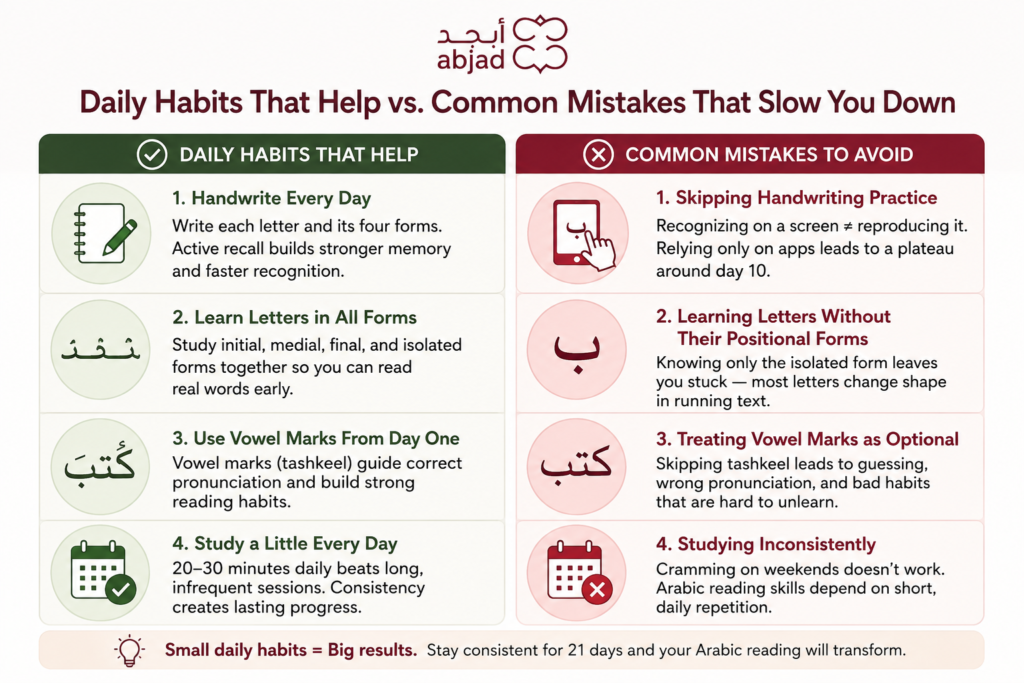
Most people who fail to learn to read Arabic in 21 days don’t fail because the plan is wrong — they fail because of a handful of predictable habits.
1. Skipping handwriting practice
Recognizing a letter on a screen and being able to reproduce it are different skills. Learners who only tap flashcard apps often plateau around day 10, because passive recognition doesn’t build the same neural pathway as active recall.
2. Learning letters without their positional forms
Memorizing only the isolated form of each letter leaves you unable to read real words, since almost every letter in running text appears in its initial, medial, or final shape. This is the single most common gap in free online guides.
3. Treating vowel marks as optional
Some learners try to skip tashkeel to “read faster.” This backfires — without vowel marks, beginners can’t reliably pronounce anything, and guessing builds bad habits that are hard to unlearn later.
4. Studying inconsistently instead of daily
A rushed weekend cramming session does not replace 20–30 minutes of daily practice. Arabic letter and sound recognition depends on short, frequent repetition, not occasional long sessions.
Should You Go The Free Route Or Take Structured Classes?
If you’re self-motivated, have no deadline pressure, and can hold yourself accountable to a daily 30-minute habit, free resources and a plan like this one can genuinely get you reading in 21 days. If any of those three conditions is missing, structured classes close the gap.
The decision usually comes down to three factors: how quickly you need results, whether you learn better with correction or with trial and error, and whether you have someone checking your pronunciation.
Adults balancing work and family often do better with a fixed schedule and instructor accountability than with an open-ended self-study plan — which is why Arabic Classes for Adults at Abjad Academy are built around short, consistent sessions rather than long unstructured study blocks.
Learners who prefer to move at their own pace but still want a syllabus and feedback usually do better with the Self-Paced Arabic Course instead.
Read Also: Learn to Read Arabic App – The Best Options in 2026
Inside Our Live Classes
Don’t just take our word for it—see for yourself! Click below to watch short clips from our live classes and meet the instructors who will guide your learning journey.
Start Your 21-Day Reading Plan Today
You don’t need a textbook stack or a semester of classes to start reading Arabic — you need 21 focused days and a plan you’ll actually follow.

Abjad Academy built its Basic Arabic Course around exactly this outcome: real reading ability, with an instructor checking your pronunciation from day one instead of guessing on your own.
Discover Our Arabic Courses:
- Arabic Intensive Course
- Learn Arabic from Scratch Course
- Madinah Arabic Course
- Arabic Classes for Adults
- Arabic Classes for Beginners
- Self-Paced Arabic Course
- Basic Arabic Course
- Arabic Speaking Classes
- Learn to Write Arabic Course
- Arabic Grammar Course
- Learn Arabic Alphabet Course
Begin Your Arabic Journey in the UAE
Join Abjad Institute for a professional and immersive Arabic language experience tailored to your goals.
Book Your Free Trial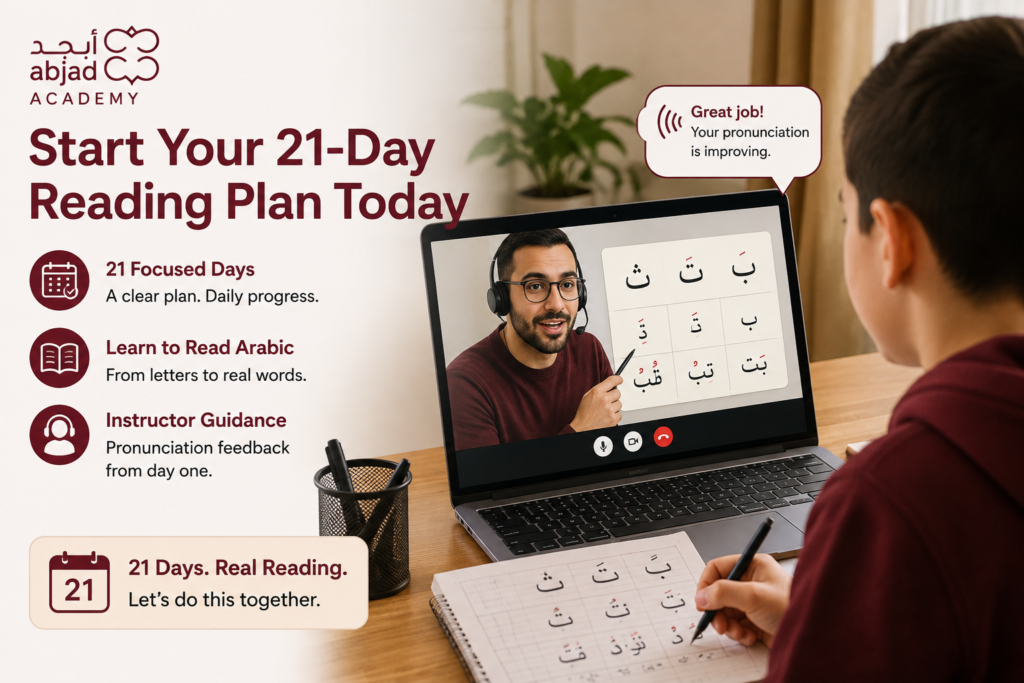
Conclusion
Learning to read Arabic in 21 days is realistic if you follow a structured, daily plan: alphabet and letter shapes in week one, vowel marks and blending in week two, and real word and sentence reading in week three.
It won’t make you fluent, but it will make you able to pick up any vowelled Arabic text and read it aloud with confidence — which is the foundation every further skill, from vocabulary to conversation, is built on.
Whether you get there through free resources and consistent daily practice, or through guided instruction with Abjad Academy, the timeline holds as long as the daily habit does. Start with the alphabet, don’t skip the vowel marks, and read out loud every single day.
Read Also: How To Read Arabic In English Letters? A Step-By-Step Guide For Beginners

Frequently Asked Questions
Here are direct answers to the questions learners most often ask about this 21-day plan, based on what tends to trip people up during each week.
1. Can I really learn to read Arabic in 21 days with no prior experience?
Yes, if you commit to daily practice. Complete beginners can go from zero letter recognition to reading fully vowelled words and short sentences aloud in 21 days, following the week-by-week structure above.
What you won’t get in 21 days is vocabulary depth or conversational fluency — those require ongoing study beyond the initial reading foundation.
2. Is it possible to learn to read Arabic in 21 days online free?
Yes, using free resources like structured video series, printable letter charts, and vowelled reading texts. The trade-off is that you’re responsible for your own pronunciation correction, which is where self-taught learners most often drift into bad habits without noticing.
3. How many hours a day does this plan actually require?
Around 30 to 45 minutes daily is enough, based on the day-by-day breakdown in this guide. Consistency matters more than session length — a rushed two-hour Sunday session does not produce the same retention as 30 focused minutes every day.
4. Do I need to learn Arabic grammar to read Arabic in 21 days?
No. This plan focuses purely on decoding: recognizing letters, applying vowel marks, and sounding out words. Grammar, sentence structure, and vocabulary depth come after reading fluency, typically through a follow-on course like Abjad Academy’s Learn to Write Arabic Course or a grammar-focused track.
5. What’s the hardest part of learning to read Arabic in 21 days?
Most learners struggle most with the fact that letters change shape based on position in a word — a single letter can look noticeably different at the start, middle, or end of a word. The second-hardest part is the vowel marks, since skipping them makes accurate pronunciation impossible even once letter recognition is solid.
6. Can speaking practice wait until after the 21 days?
Yes, and it generally should. Reading and speaking use different skills, and trying to build both simultaneously in the first three weeks usually slows down letter and vowel mastery. Once reading is solid, Arabic Speaking Classes are a natural next step to build on that foundation.






Leave a Reply