 Learn Arabic

Reading Arabic in the UAE is more than a school requirement — it is a life skill. Whether you are navigating government forms in Abu Dhabi, reading road signs in Sharjah, or helping your child with their Arabic homework, the ability to read Arabic fluently opens doors that remain firmly shut without it.
The good news: Arabic reading is a learnable, trainable skill. A 2012 study from the University of Haifa found that Arabic reading activates the left hemisphere of the brain — the side responsible for logic and structured processing — more exclusively than most other languages. That means every reading session is a cognitive workout, not just a language exercise. With the right method and consistent practice, progress in the UAE context is faster than you might expect.
Reading Arabic fluently requires more than memorizing the alphabet. It is a layered skill that builds from letter recognition through word patterns, font familiarity, vocabulary, and finally fluent comprehension. The steps below follow that natural progression — skip none of them, because each one removes a specific obstacle.
1. Master the Arabic Alphabet in All Its Forms
The Arabic alphabet — الأبجدية — contains 28 letters, and every one of them changes shape depending on its position in a word: at the start, in the middle, at the end, or standing alone. That is four possible shapes per letter, and the letters are written connected in a cursive flow from right to left.
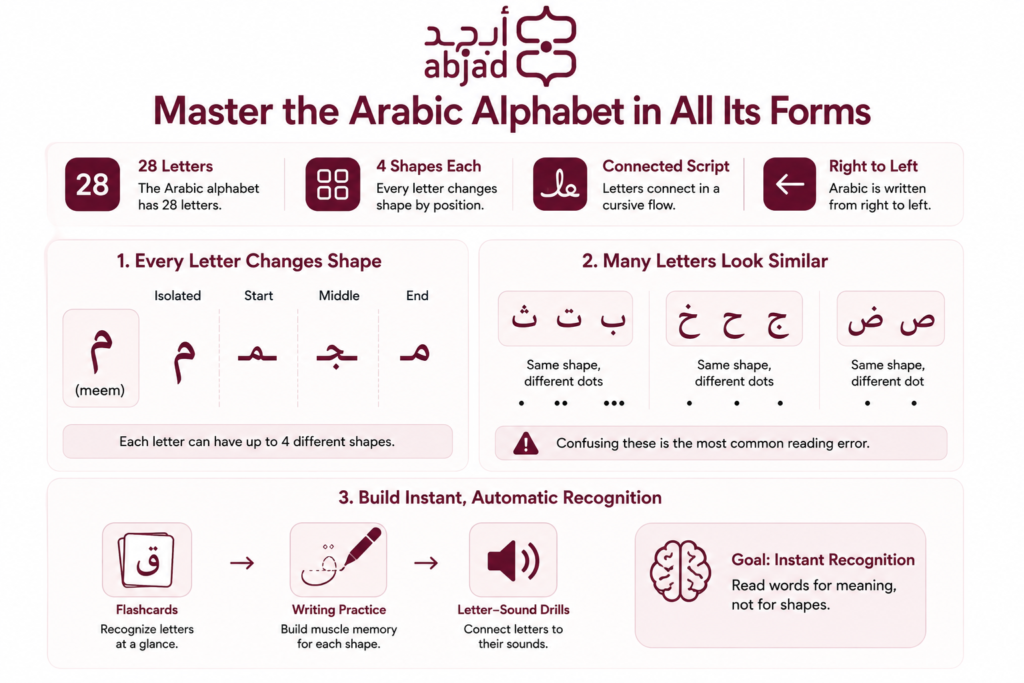
Many letters are visually similar and distinguished only by dots. The group ب، ت، ث shares the same base shape; only the number and position of dots differs. The same applies to ج، ح، خ and to ص، ض. Confusing these is the single most common reading error for beginners in the UAE, and it creates comprehension mistakes even at intermediate levels.
Spend dedicated time on isolated letter recognition before moving to connected text. Flashcards, writing practice, and letter-sound drills all work — the goal is instant, automatic recognition so that when you read a word, your brain processes meaning rather than decoding shapes.
If you are looking for a structured starting point, the Basic Arabic Course at Abjad Institute covers the alphabet through to connected reading, with a curriculum built for learners in the UAE.
Start Your Basic Arabic Learning Journey with a FREE Trial Class in the UAE.
2. Learn the Two Main Arabic Fonts
Most Arabic learning materials use Naskh (النسخ) — the clean, book-style font you see in printed texts, the Quran, and digital content. It is the standard and the right font to master first.
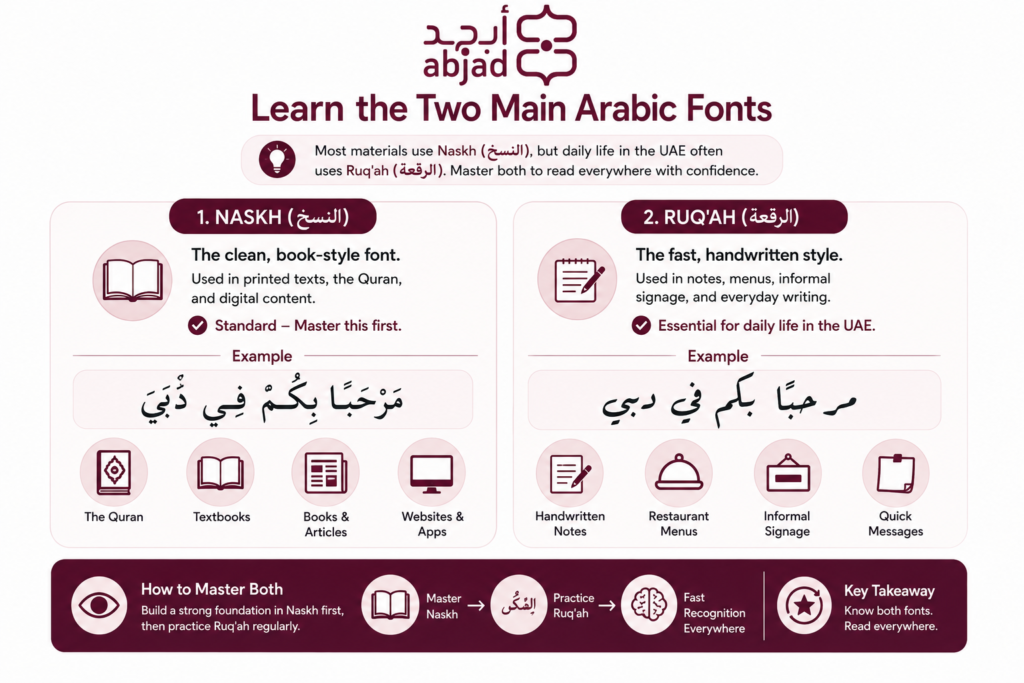
But daily life in the UAE often presents you with Ruq’ah (الرقعة), the fast, handwritten style used in notes, restaurant menus, and informal signage. The letterforms in Ruq’ah are noticeably different: strokes are simpler and some distinctions blur. A learner who has only trained on Naskh will struggle to read a handwritten note from a colleague or a chalkboard menu.
Expose yourself to both fonts deliberately. Once Naskh is solid, spend time reading Ruq’ah texts, even slowly. The transfer happens quickly when you know what you are looking for.
3. Study Arabic Word Roots (الجذر والوزن)
Arabic is a root-based language. Most words derive from a three-letter root that carries a core meaning, and different patterns built on that root produce related words. The root ك-ت-ب, for example, generates كتب (he wrote), كتاب (book), كاتب (writer), مكتبة (library), and مكتوب (letter/written).
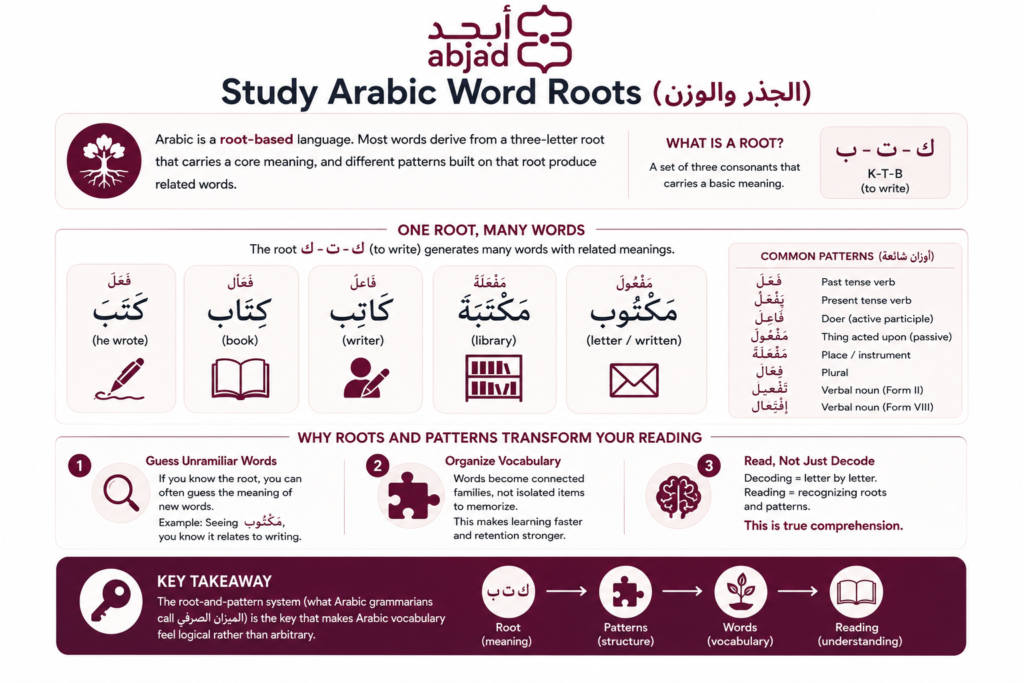
Understanding this system does two things for your reading. First, it lets you guess unfamiliar words from roots you already know. Second, it organizes vocabulary into meaningful clusters instead of isolated items to memorize.
This is where Arabic reading comprehension separates from mere decoding. A learner who reads letter by letter is decoding. A learner who recognizes roots and patterns is reading. The root-and-pattern system (what Arabic grammarians call الميزان الصرفي) is the key that makes Arabic vocabulary feel logical rather than arbitrary.
4. Read with a Purpose Every Time
Unfocused reading produces slow progress. Before you open any Arabic text, decide what you are looking for in that specific session. Are you practising letter recognition? Are you tracking how verbs are conjugated? Are you building vocabulary in a particular topic area?
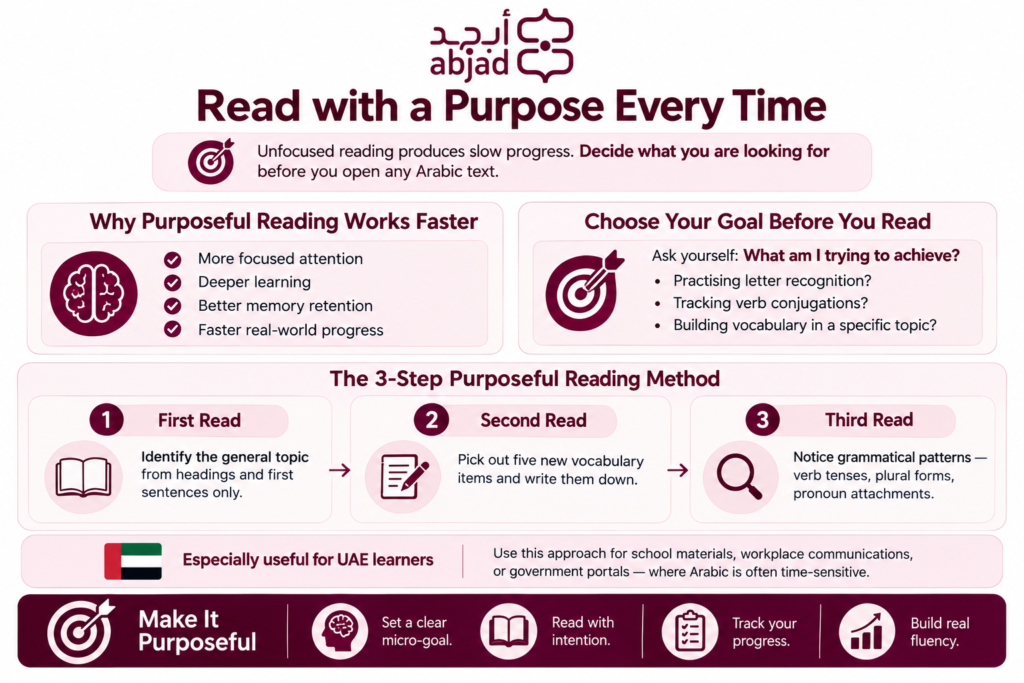
Purposeful reading is more cognitively demanding — and that is exactly why it works faster. Set one micro-goal per session:
- First read: identify the general topic from headings and first sentences only
- Second read: pick out five new vocabulary items and write them down
- Third read: notice grammatical patterns — verb tenses, plural forms, pronoun attachments
This layered approach is especially practical for UAE learners who often read Arabic in time-pressured contexts: school materials, workplace communications, or government portals.
Read Also: How to Read Arabic Books?- A Step-by-Step Guide for Beginners
5. Use the UAE’s Bilingual Environment as a Reading Lab
The UAE is one of the best countries in the world to practice Arabic reading, because Arabic text is literally everywhere. Road signs are bilingual. Shop names appear in both Arabic and English. Food packaging, government forms, metro station signs, and official announcements all carry Arabic text.
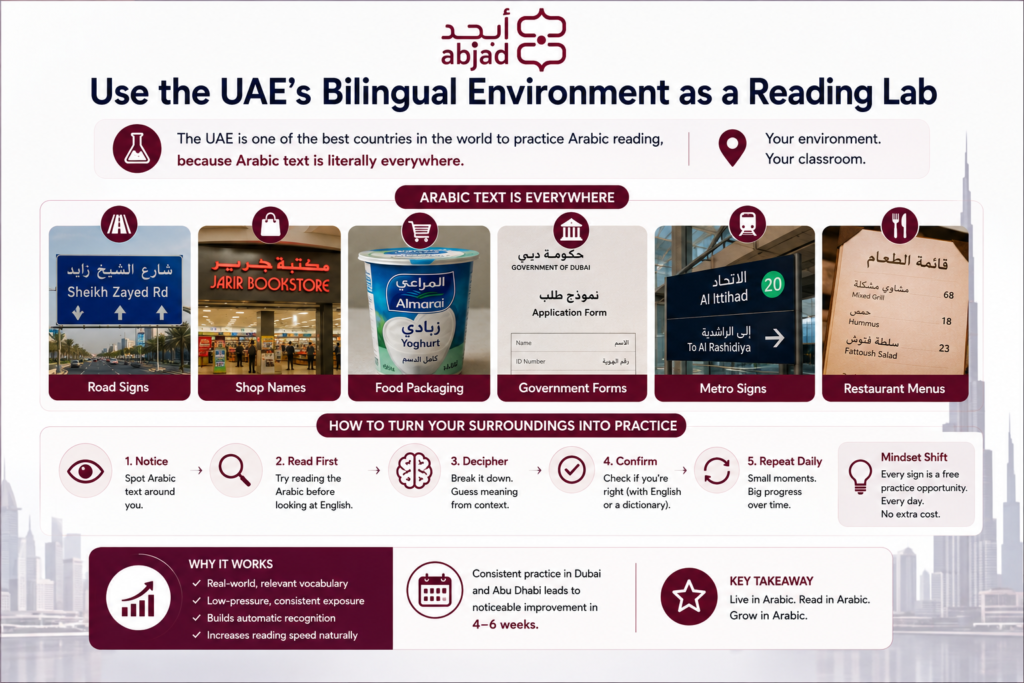
Most UAE residents walk past thousands of Arabic words every day without reading them. Shift your mindset: every sign is a free practice opportunity. Start reading shop names in Arabic script when you are in a mall. Read the Arabic side of metro signage before the English. Decipher restaurant menus.
This passive-to-active switch costs nothing and produces consistent low-pressure practice that adds up significantly over weeks. Learners in Dubai and Abu Dhabi who build this habit report a noticeable increase in reading speed within four to six weeks, simply from daily environmental exposure.
Watch Our Classes in Action
Curious what a real session looks like? Take a peek inside our interactive classrooms and see how our expert instructors bring the Arabic language to life. Watch a sample lesson below!
Begin Your Arabic Journey in the UAE
Join Abjad Institute for a professional and immersive Arabic language experience tailored to your goals.
Book Your Free Trial6. Read Multiple Times — Each Pass with a Different Focus
One of the most underused techniques in Arabic reading improvement is re-reading. The first time through any text, your brain is busy decoding. The second time, decoding is easier and comprehension increases. By the third read, you start noticing structure, vocabulary patterns, and stylistic features.
This approach works especially well with short Arabic news articles, children’s books with full diacritics (harakat), and simple stories. Short texts allow you to complete three full reads in a single study session without fatigue.
A structured self-paced Arabic course at your own schedule makes this kind of repeated reading practice easy to build into a routine — you return to the same lesson materials as many times as needed without pressure.
Learn Arabic at Your Own Pace with a FREE Trial Class in the UAE.

7. Annotate and Engage with the Text
Passive reading — eyes moving across words — is the least effective form of reading practice. Active reading means interacting with the text: underlining unfamiliar words, writing meanings in the margin, circling recurring grammatical forms, and noting questions.
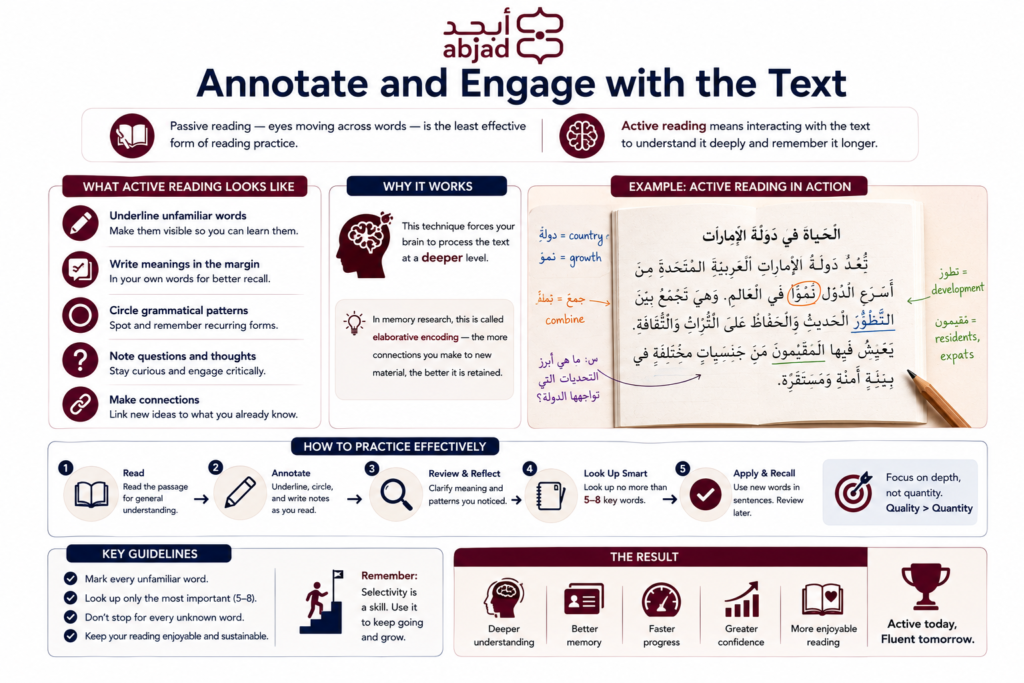
This technique forces your brain to process the text at a deeper level than simple recognition. In memory research, this is called elaborative encoding — the more connections you make to new material, the better it is retained.
In practice: keep a pencil in hand when reading Arabic. Mark every word you do not immediately recognize. After the session, look up no more than five to eight of the most important ones — not every single unfamiliar word, which leads to fatigue and discourages continued reading. Selectivity here is a skill in itself.
Read Also: Is It Compulsory to Read Quran in Arabic?
8. Build Vocabulary Through Reading, Not Just Lists
Vocabulary lists have limited value in isolation. Words are retained and usable when you encounter them in context multiple times, in different sentence structures and topics. This is why reading widely — not just studying — is the fastest path to a strong Arabic reading vocabulary.
Choose reading materials that are slightly above your current level (what linguists call “i+1” input). If every word is familiar, you are not growing. If the majority are unfamiliar, comprehension collapses and motivation drops. The productive zone is roughly 90–95% familiar words per page.
For UAE learners, good sources at different levels include: illustrated Arabic children’s books (تشكيل is essential for beginners), Gulf-focused Arabic news apps, bilingual editions of common texts, and graded reader series published for Arabic learners.
Improving your reading also strengthens your writing. If you want to develop both skills in parallel, the Arabic Writing Course at Abjad Institute links reading vocabulary directly to writing production — the two skills reinforce each other more than most learners realize.
Join Our Learn to Write Arabic Course in the UAE with a FREE Trial Class.

9. Read Aloud to Build Fluency
Silent reading builds comprehension. Reading aloud builds fluency — the smooth, automatic processing that distinguishes a confident reader from a slow decoder.
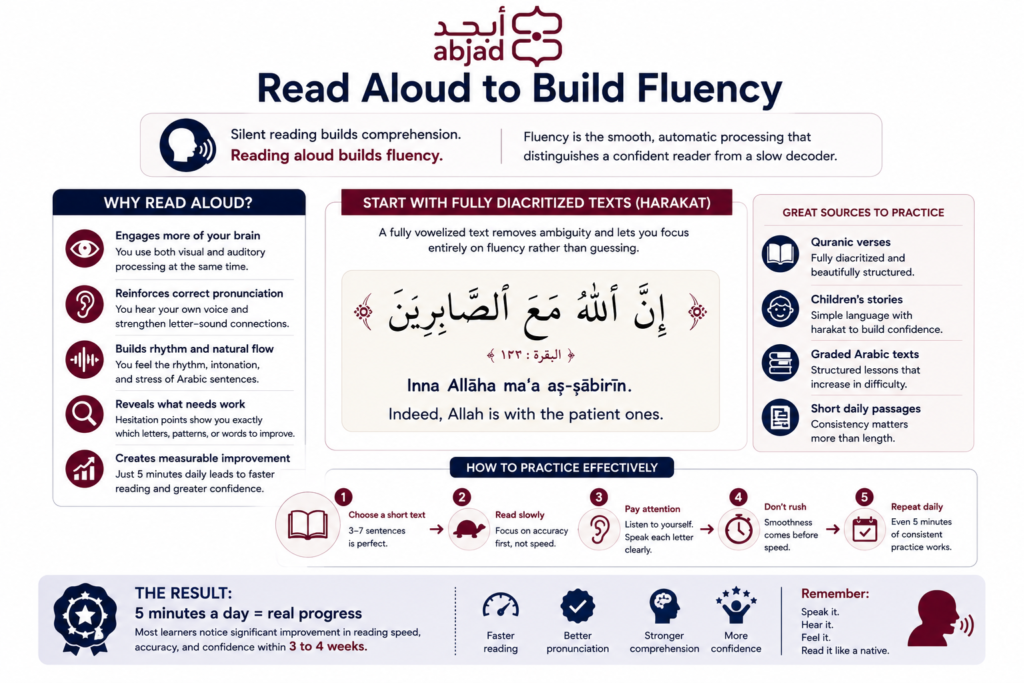
When you read Arabic aloud, you engage auditory processing alongside visual processing. You hear your own pronunciation, which reinforces correct letter-sound pairings. You feel the rhythm and stress of Arabic sentences. And you immediately notice where you hesitate — those hesitation points tell you exactly which letters, patterns, or words need more work.
Start with short passages that include full diacritical marks (harakat). A fully vowelized text removes ambiguity and lets you focus entirely on fluency rather than guessing. Quranic verses, children’s stories, and graded Arabic texts all typically carry harakat for this reason. Five minutes of daily reading aloud produces measurable gains in speed and confidence within three to four weeks.
10. Build a Consistent Daily Routine
Consistency outperforms intensity every time in language learning. A 20-minute daily Arabic reading session produces far stronger results than a two-hour session once a week. The brain consolidates language skills during the intervals between practice sessions — which is why the daily habit is structurally superior, not just motivationally so.
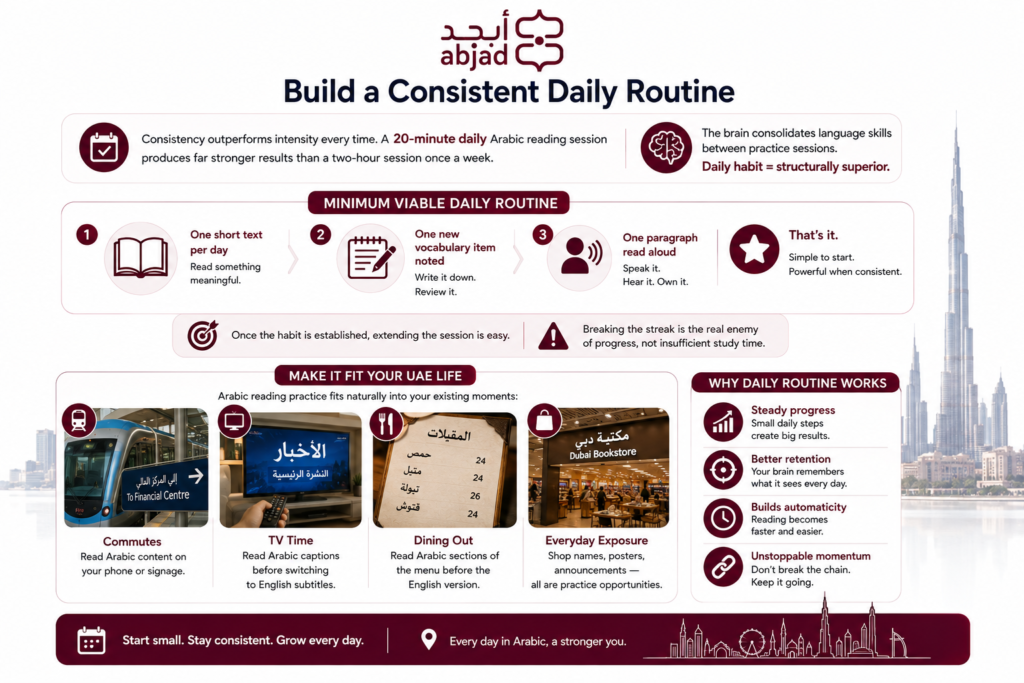
Build a minimum viable routine first: one short text per day, one new vocabulary item noted, one paragraph read aloud. That is it. Once the habit is established, extending the session is easy. Breaking the streak is the real enemy of progress, not insufficient study time.
UAE residents with busy schedules — work, school runs, commutes — often find that Arabic reading practice fits naturally into existing moments: reading Arabic content on your phone during commutes, reading Arabic captions on TV before switching to English subtitles, or reading Arabic sections of a bilingual menu before the English versio.
Read Also: How to Read Arabic Without Vowels?
Inside Our Live Classes
Don’t just take our word for it—see for yourself! Click below to watch short clips from our live classes and meet the instructors who will guide your learning journey.
Start Reading Arabic Confidently with Abjad Institute
If you are serious about improving your Arabic reading in the UAE, self-study takes you a certain distance — but structured instruction accelerates progress significantly. You learn faster, you make fewer errors that calcify into habits, and you get feedback at the moments when you most need it.
Abjad Institute offers Arabic courses designed specifically for learners in the UAE, from complete beginners building their alphabet foundations to intermediate learners working on reading fluency and comprehension. Courses are structured, flexible, and taught by qualified instructors who understand the bilingual UAE context.
Whether you want to read Arabic for everyday life, for professional communication, or to connect more deeply with the language and culture of the country you live in — the right course makes the difference between slow struggle and real, measurable progress.
Start your Arabic reading journey at Abjad Institute today
Discover Our Arabic Courses
- Arabic Course in the UAE
- Arabic Intensive Course
- Learn Arabic from Scratch Course
- Madinah Arabic Course
- Arabic Classes for Adults
- Arabic Classes for Beginners
- Self-Paced Arabic Course
- Basic Arabic Course
- Arabic Speaking Classes
- Learn to Write Arabic Course
- Arabic Grammar Course
- Learn Arabic Alphabet Course
Begin Your Arabic Journey in the UAE
Join Abjad Institute for a professional and immersive Arabic language experience tailored to your goals.
Book Your Free Trial
Conclusion
Getting better at reading Arabic in the UAE comes down to a clear sequence: master the alphabet in all its forms, understand the font differences you will encounter in daily life, learn the root system that makes Arabic vocabulary logical, and then read purposefully and consistently. The UAE’s bilingual environment is not a distraction from Arabic learning — it is one of the best free reading practice tools available anywhere in the world.
The 10 steps in this guide work together. Skipping foundational steps — like root study or font familiarity — creates ceilings that slow progress later. Following them in order, even at a modest pace, produces compounding gains. Most learners who commit to a consistent daily routine report meaningful improvement in reading speed and confidence within six to eight weeks.
Start with one step today. Even ten minutes of focused Arabic reading, using the environment around you in the UAE, is progress that adds up.
Frequently Asked Questions
Improving your Arabic reading skills in the UAE comes with many questions, especially for beginners and non-native speakers. Below are clear, practical answers to the most frequently asked questions to help you make faster and more confident progress.
How long does it take to get better at reading Arabic in the UAE?
Most learners see a noticeable improvement in reading speed and confidence within six to eight weeks of consistent daily practice — roughly 20 minutes per day. The timeline depends on starting level: complete beginners reaching comfortable reading fluency typically need four to six months with structured instruction.
Is it harder to learn to read Arabic than other languages?
Arabic has specific challenges — right-to-left direction, letter shapes that change by position, and a root-pattern vocabulary system — but these are learnable with the right method. A University of Haifa study found Arabic reading primarily activates the left hemisphere of the brain, which handles logical and structured processing. Once the system is understood, many learners find it more logical than it first appears.
What is the best way to practice Arabic reading in the UAE?
The UAE’s bilingual environment offers constant practice opportunities. Reading Arabic shop signs, metro station names, road signs, and food menus as you encounter them daily builds recognition speed without requiring study time. Combine this with 15–20 minutes of structured text reading and you have a highly effective routine.
Should I learn Modern Standard Arabic or a dialect for reading?
For reading, Modern Standard Arabic (MSA) is the correct target. All written Arabic — newspapers, books, official documents, signage, and digital content in the UAE — uses MSA. Dialects are spoken only; they have no standardized written form. Starting with MSA reading gives you access to all written Arabic content.
Do I need to learn Arabic grammar to read well?
A foundational understanding of Arabic grammar — particularly the root system, verb patterns, and how definite/indefinite constructions work — significantly improves reading comprehension. You do not need advanced grammar to start reading, but learners who understand basic grammatical patterns read faster and make fewer guessing errors on unfamiliar words.
What reading materials are best for Arabic beginners in the UAE?
Fully vowelized (harakat) texts are essential for beginners — they remove ambiguity and let you focus on fluency. Start with illustrated children’s books in Arabic, short graded reader texts, and simple Quranic verses. As recognition improves, move to unvowelized texts like Arabic news articles and standard books.
Related Articles
Learn Arabic





Leave a Reply