 Learn Arabic

There is no shortage of Arabic grammar exercises. There is a shortage of a plan for using them. You can finish forty worksheets and still freeze when you speak. That is because spotting a rule and using one are two different skills. Each one needs a different kind of practice.
Thus, let’s sort Arabic grammar exercises into three simple types. Then, you will learn what each type does, the order to practice them in, and five drills you can make from any Arabic page you already own. Every example below comes from real classroom worksheets.

What you will learn
- The 3 types of Arabic grammar exercises and what each one trains.
- The best order to practice: Find It, Write It, Fix It.
- 5 drills you can make at home from any Arabic text.
- The one rule that causes the most adjective mistakes.
- How to check your own answers with no teacher.
The 3 types of Arabic grammar exercises
Arabic grammar exercises come in three types. Most worksheets do not tell you which type they are. So, learners do too many of the easy type and skip the type that helps most.
Once you can name the type, you know what it will fix.
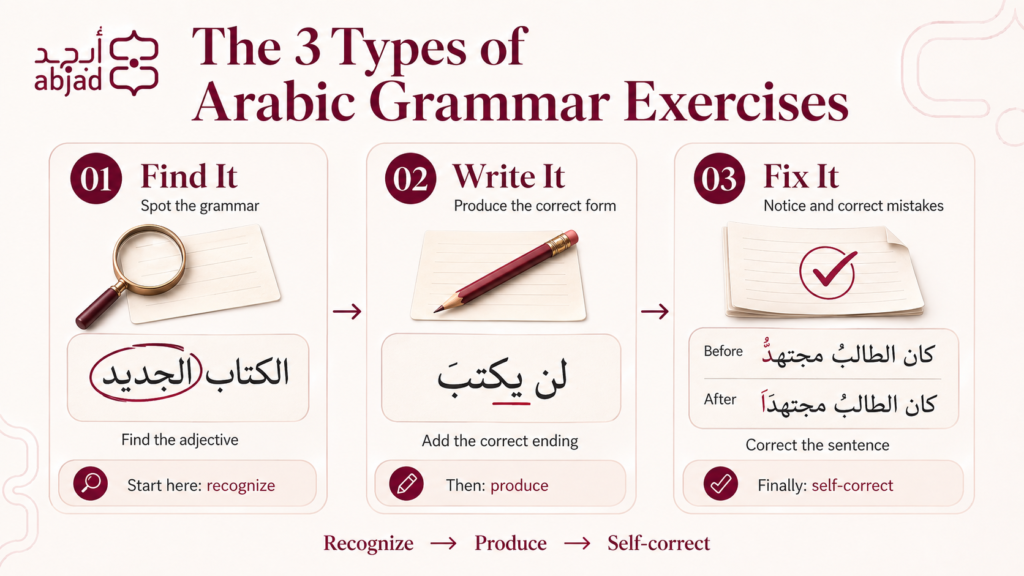
Type 1: Find It — Spot The Grammar In A Sentence Or Paragraph
A “find it” exercise asks you to spot something that is already printed on the page. You do not change the sentence. You only point at the right part of it.
You have seen these everywhere. “Is this noun definite or indefinite?” “Find the subject in this sentence.” “Is this verb transitive or intransitive?” Longer versions use a whole text, so you hunt for كان and its sisters inside a paragraph, or every adjective in a short story.
Choose this type when a topic is brand new to you, because you cannot use a rule before you can recognize it when it walks past you. It is also the right choice on a tired day, since these exercises are light but still keep your eyes trained.
What you gain is real. Arabic stops looking like one long line of letters, and you start seeing words that each have a job. That change comes fast, and it feels good.
But notice what the exercise already did for you: it printed the ending. You only point at it, and you never choose it. That is why ten right answers today will not stop you from writing the wrong ending tomorrow.
Read also: Quranic Grammar: The Complete Guide to Understanding the Language of the Quran
Type 2: Write It — You Fill In The Correct Form Yourself
A “write it” exercise gives you a word, a blank, or a frame, and you have to produce the correct form yourself with nothing to copy.
The tasks look like this. You change a singular noun to a dual. You rewrite an adjective so it matches its noun. You turn an active verb into a passive one, pick the right negation word, or turn يكتب into لن يكتب with the correct ending.
Choose this type once you can spot the topic without stopping to think, because recognition comes first and production comes second. Do it when you have energy and quiet, since ten of these can take longer than fifty “find it” questions.
This is where your Arabic really starts to change. The answer is not on the page, so it has to come from you, and every ending you write by hand is one your brain builds instead of copying.
The slowness is the learning, not a sign that something is wrong. Adults on a structured grammar course usually feel the shift right here.
Abjad Institute‘s Arabic grammar track moves learners into this stage early, so you spend your time producing Arabic instead of only reading about it.

Type 3: Fix It — Correct A Sentence That Is Already Wrong
A “fix it” exercise hands you a sentence with a mistake inside it, and your job is to find the mistake and correct it.
Real worksheets phrase it like this. “There is one mistake in the ending of كان and its khabar. Find it.” “Correct the adjectives underlined below.” “One number in this table is written wrong.” You can also build your own by taking a correct sentence, breaking one ending on purpose, and returning to it the next day.
Choose this type at the end of every topic, once you can already write the forms, because it is the last step and not the first. It is also the right choice when your writing keeps getting corrected for the same thing, since fixing drills go straight at that habit.
What it gives you is the alarm in your head. You cannot fix an ending until you first notice that something feels off, and that noticing is the whole skill. It also shows you your own patterns, because the same three mistakes keep coming back until you can name them.
There is one catch when you work alone. You can only break the endings you already know about, so your own blind spots never make it into your drills.
This is where a teacher earns their hour, and it is why Abjad’s grammar lessons hand learners errors they did not expect to see.
The best order to practice: Find It, then Write It, then Fix It
Order matters more than how many exercises you finish. Pick one topic. Run it through all three types before you move to the next topic.
That is the whole system, and it fits in six words. Find it, then write it, then fix it.
Why This Order Works
Each type gets you ready for the next one. You cannot write an ending on a word you cannot even find yet. And you cannot fix a wrong ending until you know how to write the right one. So the order is not a preference. It is the only order that works.
Think of it as three small jumps instead of one big one. Each jump is short enough that you land it. Most learners get stuck because they skip a step. They read a rule, then jump straight to writing a paragraph.
That is a long way to jump. In one paragraph, you have to find the words, choose every ending, and catch your own mistakes, all at the same time. Then, the paragraph comes back covered in red pen, and they feel like the grammar is too hard. The grammar was fine. The order was wrong.
You can see this in the worksheets teachers actually use. They almost always run “find the subject” pages before “choose the ending” pages, and error-correction pages come last. That is not an accident. It is the order built into good teaching, and you can copy it at home for free.
You may also like: Arabic Writing Practice In The UAE
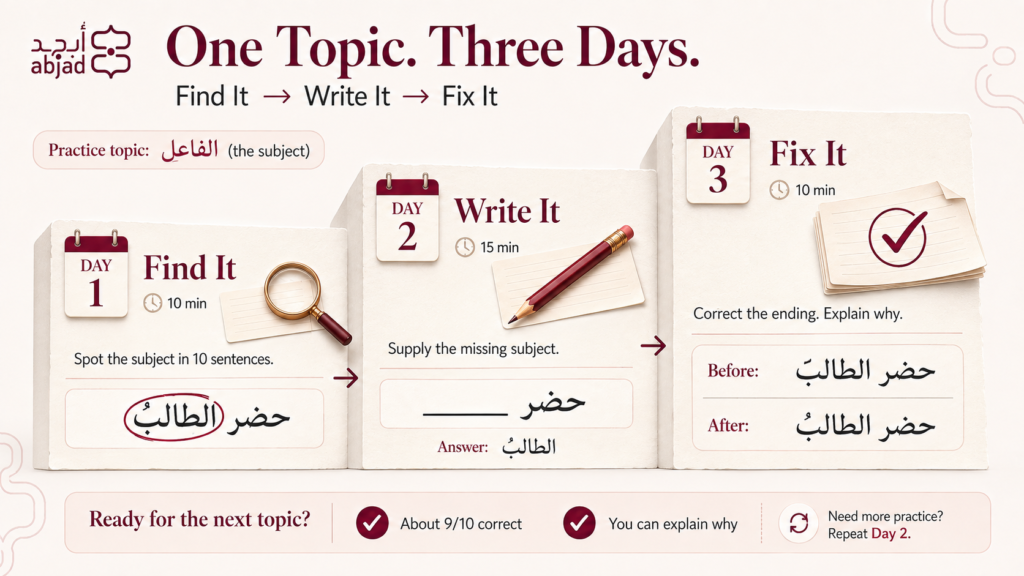
A 3-Day Plan For One Grammar Topic
The order is easier to trust once you watch it run on a real topic. Let’s use one real topic: the subject of a sentence. In Arabic, it is called al-fa’il, and it is the person or thing doing the action.
The rule is short. A subject takes the -u ending, written as a small damma mark (ُ) above the last letter. Now here is that one rule across three short days.
Day one is the “find it” day, and it takes about ten minutes. Read ten easy sentences and point at the subject in each one, without changing anything.
| Sentence | What it means | The subject | Why |
| حضر الطالبُ المجتهدُ | The hardworking student came | الطالبُ | He is the one who came |
| يذهبُ التلميذُ إلى المدرسةِ | The pupil goes to school | التلميذُ | He is the one going |
| تقرأُ البنتُ الكتابَ | The girl reads the book | البنتُ | She is the one reading |
| لعبَ الأولادُ في الحديقةِ | The boys played in the garden | الأولادُ | They are the ones who played |
Notice the last column. Every answer comes from the same question: who is doing the action?
When ten sentences feel easy, try a short paragraph. Finding the subject inside real text is the goal of day one.
Day two is the “write it” day, and it takes about fifteen minutes. Now the subject is taken out of the sentence, you are given the plain word, and your job is to drop it in with the right ending.
| Sentence with a gap | What it means | Plain word | You write |
| حضر ……… المجتهدُ | The hardworking student came | الطالب | الطالبُ |
| يذهبُ ……… إلى المدرسةِ | The pupil goes to school | التلميذ | التلميذُ |
| تقرأُ ……… الكتابَ | The girl reads the book | البنت | البنتُ |
| لعبَ ……… في الحديقةِ | The boys played in the garden | الأولاد | الأولادُ |
Look at the last column. You added the damma (ُ) yourself. No answer was printed anywhere on the page.
This day feels slower than day one, and you will finish fewer questions. That is normal, and it means the work is real.
Day three is the “fix it” day, and it takes about ten minutes. The endings are wrong on purpose, so your job is to find each mistake and correct it.
| Wrong sentence | What is wrong | Fixed | Say this out loud |
| حضر الطالبَ المجتهدُ | Ends in -a (fatha) | الطالبُ | “It is the subject, so it takes -u.” |
| يذهبُ التلميذِ إلى المدرسةِ | Ends in -i (kasra) | التلميذُ | “It is the subject, so it takes -u.” |
| تقرأُ البنتَ الكتابَ | Ends in -a (fatha) | البنتُ | “It is the subject, so it takes -u.” |
| لعبَ الأولادِ في الحديقةِ | Ends in -i (kasra) | الأولادُ | “It is the subject, so it takes -u.” |
Notice the last column is not extra. Saying the reason out loud is the exercise, because it proves you used the rule and did not just guess.
Three short days beat one long afternoon. You get a night’s sleep between each step, and you finish with the skill you actually need.
Read also: Arabic Worksheets For Kids
How To Know You Are Ready For The Next Grammar Topic
Do not move on just because you finished the worksheet. Finishing measures your patience, not your grammar.
Check these two signs before you start a new topic. One is about your score, and one is about your reasoning.
Sign 1: You Get About Nine Out Of Ten Right On The “Fix It” Day
Count your mistakes on the fixing round. Around one mistake in ten means the rule is working. Notice that the target is not ten out of ten. Perfect scores usually mean the sentences were too easy, so a perfect page is a reason to pick harder examples, not a reason to celebrate.
If you are missing three or four, the topic is not ready. Go back and repeat the “write it” day, because that gap almost always comes from producing endings, not from spotting them.
There is a second thing to watch besides the score, and that is your speed. If every answer takes you thirty seconds of thinking, the rule is still being calculated instead of remembered. Give it one more short session. Aim for the point where you see the word and already know its ending.
Sign 2: You Can Say The Reason Out Loud, Not Just The Fix
This is the sign most learners skip, and it matters more than your score. Point at any sentence you corrected and explain it. It should sound like this: “الطالبَ was wrong because that word is the subject, and a subject takes -u, not -a.”
Say it in full sentences, out loud, as if you were teaching it to someone else. If the explanation comes out tangled, the rule is still tangled in your head.
Here is why this test matters so much. You can correct an ending for the wrong reason and still get a tick on the page.
Maybe you changed الطالبَ to الطالبُ because it looked more familiar that way. The answer is right, the reason is empty, and no answer key will ever catch it.
If you can fix the ending but cannot name the rule, stop there. You have learned the shape of the answer, not the rule behind it. A shape breaks the moment the sentence changes. A rule goes with you into every new sentence you write, for the rest of your Arabic.
So repeat the “write it” day and say your reason on every single question. One extra day now saves you weeks of correcting the same mistake later.
Read also: Arabic Grammar for Quran – How One Vowel Changes the Meaning of an Ayah
5 Arabic Grammar Exercises You Can Make At Home
You do not need a workbook. You can build all five of these from any Arabic page you already own, so you never run out of practice.
Each exercise takes a page you can already read and turns it into a drill that makes you produce or repair endings, not just recognize them. The tables below show you what each drill looks like once it is filled in.
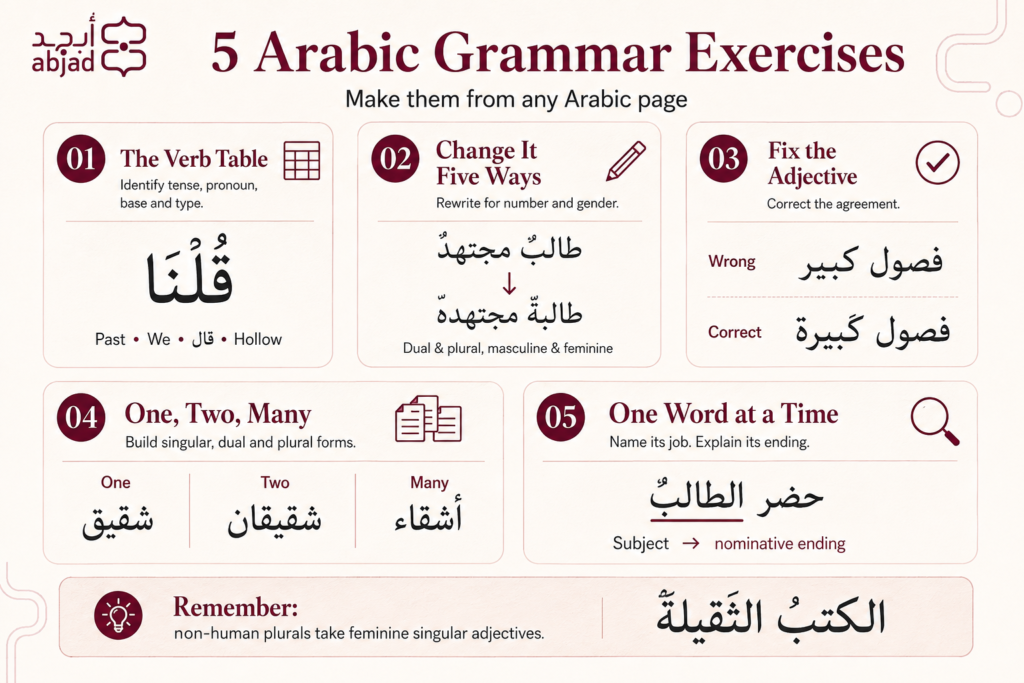
Exercise 1: The Verb Table
Draw five columns: the verb, its tense, its pronoun, its base form, and its type. Then fill in a row for every verb on the page you chose, and do not skip the ones that look hard.
| Verb | Tense | Pronoun | Base form | Type |
| قُلْنَا | past | نحن (we) | قال | hollow (weak middle letter) |
| يَسمَعْنَ | present | هنّ (they, female) | سمع | sound (no weak letter) |
| تَسِيرُ | present | هي (she) | سار | hollow (weak middle letter) |
| مُدُّوا | command | أنتم (you, plural) | مدّ | doubled (last letter twice) |
The first three columns are the warm-up. Naming the tense and the pronoun is mostly recognition, and you get quick at it after a page or two.
The base form column is where the real work starts. Look at قُلْنَا and you have to find قال behind it, which means knowing that the middle letter dropped out when the past-tense ending arrived. Reading that rule in a book teaches you one sentence. Rebuilding the word yourself teaches you the rule.
The type column then asks one simple question: why did the letter move? When you can answer “hollow,” the verb stops being a new puzzle and joins a group you already know, and verbs in the same group all behave the same way, so one row teaches you a whole family.
One habit to avoid: do not fill in the base form from the meaning. That is how learners write قول instead of قال. Work from the letters and the rule, then check.
When the easy verbs stop slowing you down, move to the awkward ones: سَلْ · بُحْ · ادْعُ · قِفِي · صِلوا. Take سَلْ — two letters, a command, and the base form is سأل, so the hamza has vanished. Guessing cannot get you there, which is exactly what makes it useful.
Exercise 2: The Change-It-Five-Ways Drill
Take one sentence. Write it five more times, once for each form below. Add the vowel marks every time. Start with: هُوَ الذي يَحمِلُ القرآنَ طالبٌ مجتهدٌ (“He who carries the Qur’an is a hardworking student.”)
| Form | The sentence |
| Two males | هُمَا اللذانِ يَحمِلانِ القرآنَ طالبانِ مجتهدانِ |
| Many males | هُمُ الذينَ يَحمِلونَ القرآنَ طلابٌ مجتهدونَ |
| One female | هِيَ التي تَحمِلُ القرآنَ طالبةٌ مجتهدةٌ |
| Two females | هُمَا اللتانِ تَحمِلانِ القرآنَ طالبتانِ مجتهدتانِ |
| Many females | هُنَّ اللاتي يَحمِلْنَ القرآنَ طالباتٌ مجتهداتٌ |
Read down each row and count what moved. Five parts change together every time: the pronoun, the linking word, the verb, the noun, and the adjective.
That chain reaction is the heart of Arabic. Change one thing and four others must follow, and a printed sentence can never show you this, because it only ever shows you one row.
Compare the first row with the last one and the point becomes obvious. هُوَ became هُنَّ, الذي became اللاتي, يَحمِلُ became يَحمِلْنَ, and both طالبٌ and مجتهدٌ grew new endings. Not one word survived untouched. This is why single-word exercises can leave you feeling ready when you are not, because they never ask you to move five things at once.
Start with two rows, not five. Most learners get the pronoun and the verb right and forget the adjective, so build the habit on a short version first.
Note: this drill is also where a bad habit spreads fastest. One wrong ending repeats itself in all five rows, and you practice the mistake five times without noticing.
That is why this drill works best with someone watching the first few rounds. Abjad’s grammar classes run this exact transformation work with live correction, so a wrong ending gets caught on row one instead of living in your Arabic for months.
Exercise 3: The Adjective Fixing Table
Make three columns: the wrong sentence, your correction, and the reason. Never skip the reason column, because that column is the whole exercise.
| Wrong | Correct | Why |
| هناك فصول كبير | كبيرة | فصول (classrooms) is a plural thing |
| المساجد الواسع في القرية | الواسعة | المساجد (mosques) is a plural thing |
| أحبُّ الأقلامَ الأزرق | الزرقاء | الأقلام (pens) is a plural thing |
| هو نام على السرير العالية | العالي | السرير (bed) is masculine singular |
| الأب الأقوياء يشرب الحليب | القوي | الأب (father) is one person, not many |
| الحجر السوداء في كعبة | الأسود | الحجر (stone) is masculine singular |
One rule explains the first three rows. When a plural noun is a thing and not a person, its adjective becomes feminine singular.
That is why فصول takes كبيرة, الأقلام takes الزرقاء, and الكتب takes الثقيلة. The adjective ends up in its feminine singular form, even though the noun is plural, and that surprises learners for years. So, the question you must answer first is about meaning, not letters. Is this noun a person or a thing?
Mosques, pens and books are things, so they follow the rule. Teachers, students and brothers are people, so their adjectives stay plural instead.
The last three rows have the opposite problem. The noun is singular, but the adjective was written as if it were plural, or given the wrong gender. Row five is the easiest one to see. الأب means one father, so الأقوياء cannot describe him, no matter how strong he is. One man needs one adjective, which is قوي
Both kinds of mistakes sit in the same table on purpose. If every row broke the same way, you would stop looking at the noun and just repeat the same fix. Mixing them forces you to read the noun first, every time.
Once a few tables feel easy, build your own. Copy six sentences from any page, break one adjective in each, and come back to them the next day. This is the mistake that follows learners the longest. One honest table, done twice, usually ends it.
Read also: Free Arabic Grammar Course – The Best Options Online
Watch Our Classes in Action
Curious what a real session looks like? Take a peek inside our interactive classrooms and see how our expert instructors bring the Arabic language to life. Watch a sample lesson below!
Begin Your Arabic Journey in the UAE
Join Abjad Institute for a professional and immersive Arabic language experience tailored to your goals.
Book Your Free TrialExercise 4: The One, Two, Many Table
Make three columns: one, two, many. Then cover two of the three and fill in the missing forms with vowel marks.
| One | Two | Many | Meaning |
| قاضٍ | قاضِيانِ | قُضاة | judge |
| فتى | فتَيانِ | فِتْية | young man |
| مستشفى | مستشفيانِ | مستشفيات | hospital |
| شقيق | شقيقانِ | أشِقَّاء | brother |
| سيّارة | سيّارتانِ | سيّارات | car |
Notice which direction is harder for you. Going from one to two is usually easy, and going from many back to one is where learners stall. That is why covering the first column is the better drill. Rebuilding قاضٍ from قُضاة asks you to take the word apart, not just add letters to the end of it.
Pick hard nouns on purpose, because easy nouns only confirm what you already know. سيّارة is in the table to show you a smooth one, and it is the only row you will get right without thinking.
The other four rows are the real lesson. Words ending in a weak letter, like قاضٍ and فتى, change shape in ways that no simple ending can explain. Look at what happens to قاضٍ. The dual brings a hidden letter back and gives you قاضِيانِ, then the plural rearranges the whole word into قُضاة.
You cannot reach قُضاة by adding anything. You have to know that this group of nouns is built differently, and that is why the table is worth your time.
Watch the plural column too, because it hides a second lesson. مستشفيات and سيّارات add a neat ending, while قُضاة and أشِقَّاء are rebuilt from the inside. Arabic has both kinds, and learners often assume every plural is the neat kind. This table shows you the difference on the same page, side by side.
Five rows a day is enough. This drill is small, and its value comes from repeating it on new words all week rather than filling one long page once.
Exercise 5: One Underlined Word At A Time
Underline a single word in a sentence. Say what job it does, then say what ending it takes. Five minutes is enough for a full session.
| Sentence | Word | Its job | Its ending |
| حضر الطالبُ المجتهدُ | الطالبُ | subject | -u |
| حضر الطالبُ المجتهدُ | المجتهدُ | adjective, matches the subject | -u |
| قرأتُ كتاباً مفيداً | كتاباً | object | -an |
| يذهبُ التلميذُ إلى المدرسةِ | المدرسةِ | follows a preposition | -i |
Look at the first two rows of the table. Same sentence, different word underlined, and the same -u ending both times, but for two different reasons.
الطالبُ takes -u because it is the subject. المجتهدُ takes -u only because it copies the word in front of it.
Two different rules produced one identical mark. This is why the “job” column matters more than the “ending” column: the ending is the answer, but the job is the reason, and the reason travels with you into new sentences.
Once single words feel easy, move to one full sentence and find the words yourself:
كتبَ الطالبُ المجتهدُ درساً جديداً في دفترِ الصفِّ
(“The hardworking student wrote a new lesson in the class notebook.”)
Find three things: the subject, the object, and the word after the preposition. Say the job first, then the ending. Then check yourself against this table.
| Word | Its job | Its ending |
| الطالبُ | subject | -u |
| درساً | object | -an |
| دفترِ | comes after the preposition في | -i |
Now do the bonus round with the two adjectives. المجتهدُ copies الطالبُ and takes -u, while جديداً copies درساً and takes -an.
That is one adjective rule producing two different endings in a single sentence. Seeing it happen twice on one line teaches it faster than two separate questions ever could.
Notice what changed about the task itself. Nothing is underlined this time, so you have to decide which words matter before you can say anything about them.
That decision is the new skill, and worksheets never ask for it. Someone else always chose the word for you, and you only supplied the ending.
Read also: Arabic Grammar for Beginners – A Step-by-Step Guide
4 Mistakes That Slow Your Practice Down
These four habits show up again and again in learners who work hard and still feel stuck. None of them is about effort. All four are about method.
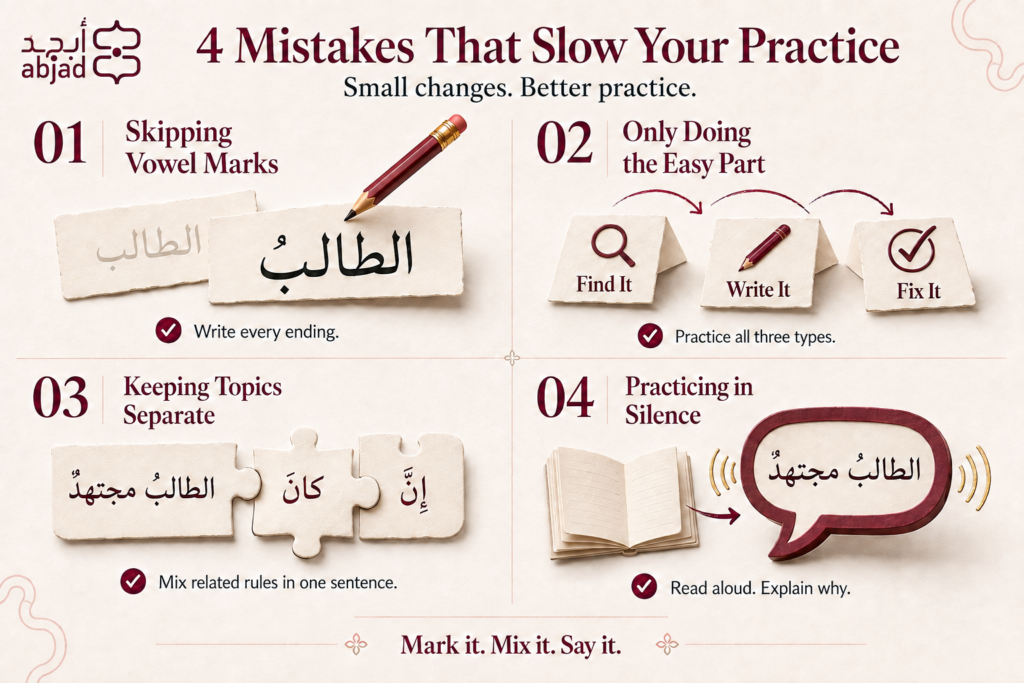
Read each one and check it against your own last week of practice.
Mistake 1: Writing Answers Without The Vowel Marks
You do the exercise, but you write the words bare. No damma, no fatha, no kasra, just the letters.
It usually starts for a good reason. The marks are slow to write; your teacher can read the word without them, and Arabic books for adults leave them out anyway.
Here is why it still costs you everything. Look at these two words: طالبانِ and طالبَينِ. Both mean “two students,” but one is a subject, and the other is an object.
Without the marks, they look almost the same in your notebook. So you never actually chose between them, and choosing was the whole task.
That turns a “write it” exercise back into a “find it” exercise. You did the work and got none of the benefit. It also hides your mistakes from you when you check your page a day later, a bare word agrees with every answer, so nothing looks wrong and nothing gets fixed.
There is a quieter cost too. Endings are what carry meaning in Arabic, so skipping them trains you to read for words and guess the rest.
That habit follows you into real texts. You reach a sentence where the ending is the only clue to who did what, and there is nothing in your training to lean on.
Mistake 2: Doing Only The Easy “Find It” Exercises
If most of your practice involves spotting adjectives or deciding whether a word is definite or indefinite, you may be getting the answers right without improving your writing.
These exercises help you recognise patterns, but they don’t make you choose the correct ending yourself or fix an incorrect one.
When the answer is already on the page, you can often identify it without knowing how to produce it. That is why a worksheet can feel easy while writing a sentence from scratch still feels difficult.
Check your last five practice sessions: did any of them ask you to write an ending or correct a mistake? If none did, it’s time to vary your practice. Try a simple rotation: one session to find the correct forms, one to write them yourself, and one to fix errors.
For the writing session, complete a few sentences with missing endings before checking the answers. For the correction session, rewrite sentences with incorrect endings and explain why each one needs to change.
Keep a short list of the mistakes you repeat so you can practise those forms again in new sentences. This helps you move from recognising the rules to using them in your own writing.
Mistake 3: Studying Each Topic On Its Own
If you study adjectives, then كان, then إنّ, but never practise them together, you may understand each lesson and still struggle to choose the right endings in a sentence. Learning topics separately gives you a useful starting point, but you also need to see how their rules interact.
Real sentences often bring several rules together, and adding one word can change the ending another word needs. Take الطالبُ مجتهدٌ, meaning “The student is hardworking”: both the subject and the predicate are nominative.
Add كان to make كان الطالبُ مجتهدًا, and the predicate مجتهدًا becomes accusative while الطالبُ stays nominative. Use إنّ instead to make إنّ الطالبَ مجتهدٌ, and the noun الطالبَ becomes accusative while the predicate مجتهدٌ stays nominative.
Studying these examples together helps you notice exactly what changes and what stays the same. It also makes you choose a rule based on the sentence in front of you, rather than simply following the topic printed at the top of a worksheet.
Once you understand the basics of a topic, mix it with another one you have already studied. You could practise nouns with adjectives, distinguish subjects from objects, or alternate between sentences with كان and إنّ. Start with one short sentence, write it three ways, and explain each ending that changes.
Then repeat the exercise with different words to check that you can apply the rule beyond a familiar example. Even five minutes of this mixed practice can help you connect individual lessons and use them more confidently in your own writing.
Mistake 4: Practicing In Silence
If you read an exercise, write the answer, check it, and move on without saying anything aloud, you miss a chance to practise using the ending in speech. Silent work can help you understand a rule, but recognising the correct form on paper is different from saying it smoothly in a sentence.
You may know which ending belongs on a word and still hesitate when you try to pronounce the whole sentence. This matters when you practise formal Arabic with grammatical endings, because you need to connect what you know with what you say.
Start by reading each corrected sentence aloud, making its endings clear. Then explain your choice in one short line, such as “This noun is accusative because it follows إنّ.” If you hesitate, check the rule and say the complete sentence again.
Once you can read it comfortably, look away from the page and try saying it from memory. You can also change one word and repeat the sentence to check that you can use the pattern yourself. Keep this routine short enough to become part of your regular practice, even when nobody is listening.
This is one reason live lessons move faster than solo worksheets. Abjad’s online and hybrid classes put grammar drills and speaking in the same session, so the ending you say out loud twenty times is the one that stays with you. Read what Abjad’s students saying about their learning experience.

How to Check Your Own Answers Without a Teacher
You can check a lot of your own work if you have a reliable reference and a clear way to review your mistakes. The aim is to understand why an answer is correct and what to practise next. These three methods work well together.
1. Use Texts That Already Have Vowel Marks
A fully vowelled Qur’an, school reader, or graded textbook can serve as an answer key. Choose a short passage that matches your level and focus on a rule you have already studied.
If you are practising adjective endings, for example, cover only those endings rather than every vowel mark on the page. Write your answers, then uncover the original marks and compare them with your choices.
Use a reliable edition with carefully checked vowel marks so you have a dependable reference. Whenever your answer differs from the text, look at the word’s role in the sentence and try to explain the correct ending.
2. Write the Reason Next to Every Answer
Write a short explanation beside each answer before you check it. For example, you might write, “This noun is a non-human plural, so its adjective takes the feminine singular form,” or “This noun is accusative because it follows إنّ.”
Keep the explanation specific enough to show which rule you used. A vague note such as “It sounds right” will not help you check your understanding.
Then, compare both your answer and your explanation with a reliable grammar reference or a worked example. Sometimes the ending is correct even though your reasoning is wrong, which means you may have guessed successfully.
In other cases, you understand the rule but apply it to the wrong word. These are different problems and need different kinds of practice. After correcting your explanation, try one similar sentence without looking at the reference to see whether you can apply the rule again.
3. Track Your Mistakes by Topic, Not Just by Score
Keep a small mistake log with a separate entry for each topic, such as hamza spelling, adjective agreement, or endings after كان and إنّ.
Each time you check an exercise, record the mistake type, your original answer, and the correction. Add a brief explanation if it will help you avoid repeating the error. This turns your corrected exercises into a useful guide for future practice.
A score of 80% shows how much you got right, but it does not reveal whether the remaining mistakes come from one difficult rule or several unrelated topics. Five hamza mistakes and one adjective mistake suggest a different practice priority from five adjective mistakes and one hamza mistake.
Review your log after two weeks and identify the topics that appear most often. Focus your next few sessions on those areas, then try fresh examples to check your progress. As the same errors become less frequent, shift your attention to the next topic that needs work.
Where Self-Study Hits A Wall
There is one thing you cannot do alone. An answer key tells you that you were wrong. It does not tell you which idea in your head produced the mistake.
Here is what that looks like in real life. You write الكتب الثقيل, and the key says the answer is الثقيلة. Now, ask yourself why you wrote it. There are at least two very different reasons, and the key cannot tell them apart.
Maybe you thought الكتب was masculine singular. Or maybe you knew it was plural, but you did not know that plural things take a feminine adjective.
Those are two different holes in your knowledge. They need two different fixes, but they both got the same red mark. So, you correct the word, feel fine, and carry the broken idea into the next ten sentences. This is how one small gap survives for months.
An answer key also cannot catch a lucky guess. You picked the right ending for the wrong reason, the page says you were correct, and nobody finds the problem.
A teacher works differently. They hear your reason, not just your answer, and the broken idea shows up in the first minute. They also see across your whole page. One mistake is an accident, but the same mistake in three places is a habit, and habits are what a good teacher hunts for.
That is the part worth paying for. It is also why most steady learners do both: solo drills through the week, and regular lessons to keep the drills honest.
Inside Our Live Classes
Don’t just take our word for it—see for yourself! Click below to watch short clips from our live classes and meet the instructors who will guide your learning journey.
Begin Your Arabic Journey in the UAE
Join Abjad Institute for a professional and immersive Arabic language experience tailored to your goals.
Book Your Free TrialBook Your Free Trial Lesson At Abjad Institute TODAY
You now know which exercises to do. The fastest way to make them count is to have someone check your reasons, not just your answers.
Abjad Institute runs a dedicated Arabic grammar course for learners in the UAE. It is built for the step most people skip: moving past word lists into real endings, real sentences, and real corrections.

Your teacher does the one thing a worksheet cannot. When you get an ending wrong, they name the idea that caused it, so the same mistake does not come back next month.
Classes are online and hybrid, and Abjad works with learners across all seven emirates. Lessons are scheduled around your week, whether you are a working professional, an international school student, or a parent booking for your child.
You do not have to commit first. Your trial lesson is free, and it starts with a short level check, so your very first session is aimed at the gaps you actually have.
Book your free trial lesson now — it is just a Click.
Discover Our Arabic Courses
- Arabic Course in the UAE
- Arabic Intensive Course
- Learn Arabic from Scratch Course
- Madinah Arabic Course
- Arabic Classes for Adults
- Arabic Classes for Beginners
- Self-Paced Arabic Course
- Basic Arabic Course
- Arabic Speaking Classes
- Learn to Write Arabic Course
- Arabic Grammar Course
- Learn Arabic Alphabet Course

Conclsuion
Arabic grammar exercises work when you put them in order. First you spot the rule in a sentence. Then you write it yourself with no answer printed. Then you fix sentences that get it wrong.
Run every topic through all three steps before you move on. One topic across three short days will always beat one long afternoon on a pile of worksheets, because each step is a small jump you can land instead of one big jump that leaves your page covered in red pen.
You do not need to buy anything or wait for the right course to start. Pick one small topic, like the subject of a sentence, and give it three short days.
- Day one: find the subject in ten sentences, then in a paragraph.
- Day two: write the ending yourself in new sentences.
- Day three: fix wrong endings, and say the reason out loud.
Then move to the next topic and repeat. That is the whole method, and it costs you about ten minutes a day.
Your material is already on your shelf. Any Arabic page becomes a verb table, a change-it-five-ways sentence, an adjective fixing table, a one-two-many table, or a single underlined word.
Then protect that practice from the four traps. Write the vowel marks every time, because the mark is the answer. Do more than “find it” exercises. Study topics in pairs that push on each other, like كان with إنّ. And say your answers out loud, so the endings reach your speech and not just your notebook.
Check yourself well too. Use vowelled texts, write the reason next to every answer, and track mistakes by topic instead of by score.
So be patient on the slow days. The exercise that feels hardest, where you write or fix an ending yourself, is the one doing the most work. Progress in Arabic grammar is not about finding more exercises. It is about ordering the ones you already have.
FAQs
What are the best Arabic grammar exercises for beginners?
The best beginner exercises are sorting nouns as definite or indefinite, building simple two-word sentences, and changing singular nouns to dual with the vowel marks written in. These three cover the noun system that every later topic sits on. Add fixing exercises as soon as you can write endings without help.
How do I practice Arabic case endings the right way?
Practise one underlined word at a time instead of parsing a whole sentence. Say the word’s job first, then its ending, like “this is the subject, so it takes -u.” Once single words feel easy, pull three parts out of one long sentence.
How many Arabic grammar exercises should I do each day?
Ten to fifteen minutes a day is enough if the exercises are ordered. One short session of “write it” or “fix it” beats an hour of “find it” worksheets. Consistency matters far more than volume here.
How long does it take to learn Arabic grammar?
There is no set time, because it depends on your starting level, your weekly practice hours, and whether anyone corrects you. Short daily practice works better than one long weekly session. Getting your reasons checked, not just your answers, is what shortens the road most.
Can I learn Arabic grammar without a teacher?
Yes, you can learn to spot and write most rules alone if you practise from texts that already show the vowel marks. Those texts act as your answer key. What you cannot do alone is find out why you made a mistake, which is why most learners mix solo drills with regular lessons.
What is the most common Arabic grammar mistake?
Adjective agreement with plural things is one of the most common. When the plural noun is a thing and not a person, its adjective becomes feminine singular. So it is فصول كبيرة and الأقلام الزرقاء, never a masculine adjective.
Are free Arabic grammar worksheets good enough?
Free worksheets are good for the “find it” stage, and there are plenty of them online. They rarely include error-correction drills, which is the type that helps most. You can close that gap yourself by taking a correct sentence and breaking one ending on purpose.
A note on which to keep: six questions is the sweet spot, so drop one before publishing. “How long does it take to learn Arabic grammar?” is the weakest for this page, since it drifts from the exercises topic. The other six all pull directly from what someone searching arabic grammar exercises would ask next.






Leave a Reply