 Egyptian Arabic
Egyptian Arabic – known locally as ‘Ammiyya Masriyya – holds a unique position across the Arabic-speaking world. Thanks to a century of Egyptian cinema, television, and music, it is the most widely understood Arabic dialect from Morocco to the Gulf.
A child who grows comfortable with Egyptian colloquial does not just speak one dialect – they gain access to a cultural output that resonates with hundreds of millions of listeners across the Arab world.
Its sentence structures are simpler than Modern Standard Arabic, it drops most grammatical case endings, and its vocabulary maps directly onto the objects, feelings, and situations of daily life – which is precisely why children find it so accessible.
What children need to acquire is not a textbook. They need a consistent mix of methods that deliver language through play, story, conversation, and repetition. This guide brings together ten of those methods, each explained with practical detail for UAE families; what it involves, why it works, and how to integrate it into a life that is already full.
1. To Learn Egyptian Arabic For Kids Sing It Out Songs, Chants, And Nursery Rhymes Make Words Stick
Music is the fastest route into any new language for a child. Melody and rhyme reduce the cognitive effort of holding unfamiliar words in memory because the tune acts as a built-in retrieval cue — a child who cannot recall an isolated word will often remember it the moment a familiar song begins. Egyptian Arabic children’s music is rich, widely available, and rhythmically distinctive enough to hold a young listener’s attention through repeated plays.

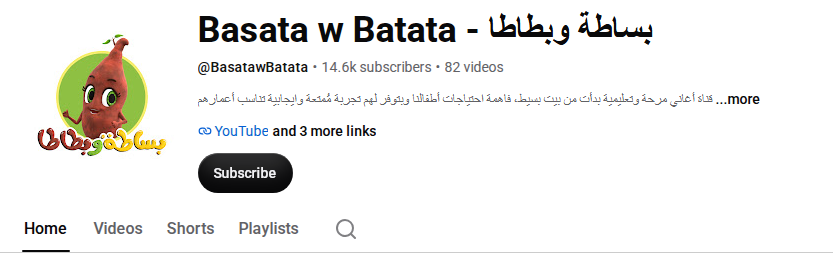
Channels like Korkor Tone (قناة كور كور تون), Bsata w Batata (قناة بساطة وبطاطا), and the Mangaya Project (مشروع مانجاية) offer Egyptian Arabic children’s songs built around animals, colours, family members, and everyday situations. Playing the same two or three songs daily for a fortnight embeds a working vocabulary far more reliably than an hour of formal study once a week.
Language specialists working with young multilingual learners consistently find that songs paired with physical actions — clapping, pointing, mimicking animal sounds — produce significantly stronger recall. The body gives each new word a physical anchor, which makes it retrievable across more contexts than audio-only exposure can achieve.
2. Use Storytelling and Illustrated Picture Books Once Upon a Time
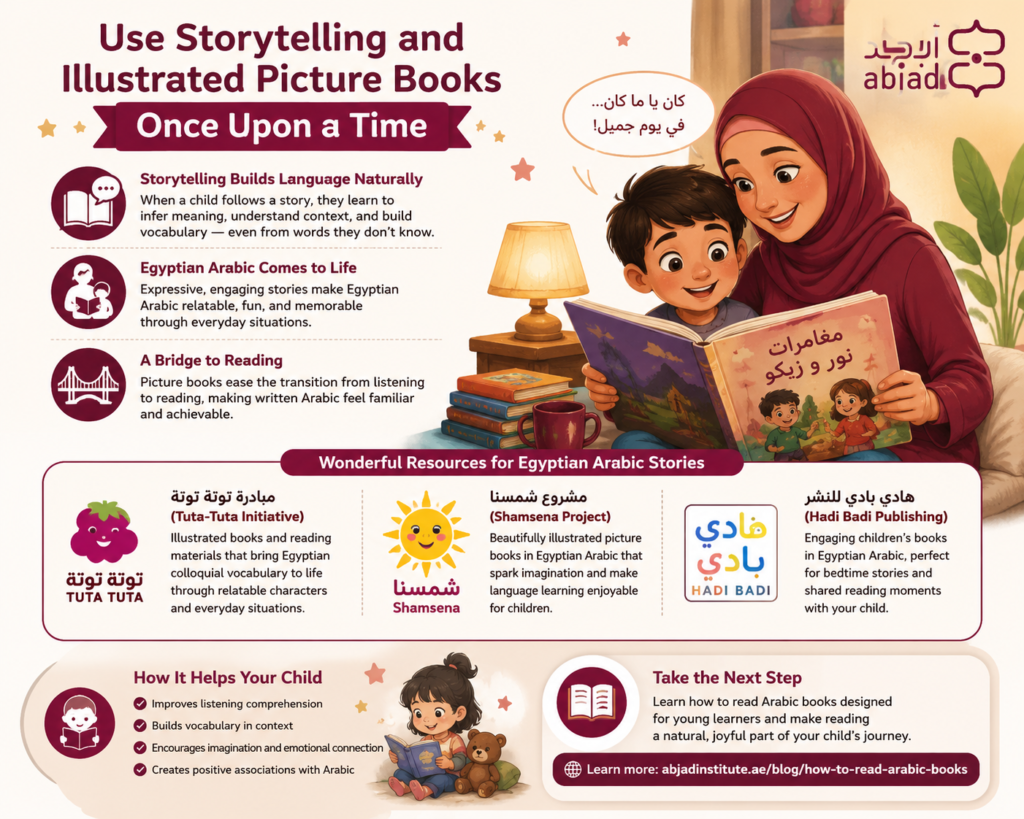
Storytelling is one of the oldest and most effective tools in language education. When a child follows a story — even one they only partially understand — they develop the inferencing habit that drives rapid vocabulary growth: reading context to work out the meaning of unfamiliar words. Egyptian Arabic, with its expressive intonation and vivid everyday vocabulary, lends itself beautifully to oral storytelling.
The Tuta-Tuta initiative (مبادرة توتة توتة) has developed illustrated books and reading materials that bring Egyptian colloquial vocabulary to life through relatable characters and everyday situations. The Shamsena project (شمسنا) and Hadi Badi publish additional picture books in Egyptian Arabic that parents can read aloud at bedtime or shared reading sessions.
For children beginning to encounter the written language alongside spoken dialect, understanding how to read Arabic books designed for young learners provides a non-intimidating bridge from listening to reading that feels like a natural next step rather than a separate subject.
3. Name Everything Around Them To Build Daily Vocabulary Through Everyday Objects
Object-naming is the oldest and most reliable language method in existence. Connecting words directly to physical things in the child’s environment bypasses translation entirely and builds direct, durable meaning. In Egyptian Arabic, a cat is otta (قطة), a ball is kora (كورة), water is mayya (مايا), bread is eish (عيش), and a cup is kouz (كوز).
The practical approach is to pick one vocabulary theme each week and weave it into every interaction during that period. Family members one week — mama, baba, gedo (grandfather), teta (grandmother).
Kitchen objects the next. Animals the week after. Parents who do this consistently accumulate 200–400 words in their child’s active vocabulary within a few months, entirely without formal lessons.
This method also addresses the question UAE parents ask most often: how long does it take to learn to read Arabic or develop conversational ability depends almost entirely on the consistency of daily exposure, not the length of individual study sessions.
Watch Our Classes in Action
Curious what a real session looks like? Take a peek inside our interactive classrooms and see how our expert instructors bring the Arabic language to life. Watch a sample lesson below!
Begin Your Arabic Journey in the UAE
Join Abjad Institute for a professional and immersive Arabic language experience tailored to your goals.
Book Your Free TrialBegin Your Kid’s Path of learning Arabic with Arabic for Kids Course at Abjad Institute
4. Educational Videos And Egyptian Cartoons Actually Teaches
Egyptian Arabic is the best-resourced dialect for children’s video content in the Arab world, a direct consequence of Egypt’s century-long dominance in Arabic media production. YouTube channels dedicated to Egyptian children’s language learning offer pronunciation practice through animated characters, vocabulary-building games, and repetition-based sequences designed for young attention spans.
The Abgad Hawaz channel (أبجد هوز) focuses specifically on first words and early pronunciation for young Egyptian Arabic learners. Alam Simsim (عالم سمسم) — Egypt’s Sesame Street equivalent — was re-released in Egyptian colloquial after a brief switch to Modern Standard Arabic dramatically reduced viewership, a telling indicator of how deeply children’s language acquisition depends on authentic spoken exposure rather than formal register.
For Dubai and Abu Dhabi families who have already integrated tablet time into the daily routine, redirecting even 15–20 minutes toward high-quality Egyptian Arabic video content produces measurable progress within weeks, especially when a parent briefly uses the same vocabulary from what the child just watched.
5. Mobile Apps Designed For Kids And Beginners Facilitate Learning
The Fast – Learn Egyptian Arabic app by Wazma Studio introduces Egyptian phrases through audio recordings and daily practice prompts, rated suitable from age three. The يلا نتكلم بالمصري (Yalla Netkalem Belmasri) app uses vocabulary games, transport-themed scenes, and everyday life situations to teach colloquial Egyptian in a format children engage with voluntarily rather than from obligation.
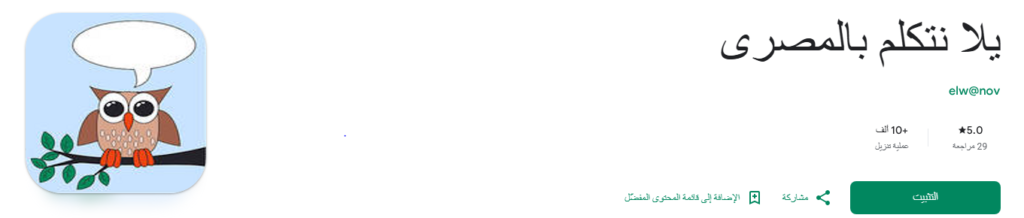
Apps work best as a supplement to conversation, not a standalone. A ten-minute app session followed by a parent using the same vocabulary in natural speech turns passive screen exposure into active, memorable learning.
For UAE parents looking to develop both listening and reading skills simultaneously, pairing an Egyptian dialect app with a solid learn to read Arabic app creates a multi-modal experience that builds spoken fluency and emerging literacy side by side.
Join the Arabic Intensive Course in the UAE with a FREE Trial Class.
6. Use Flashcards And Visual Learning Activities
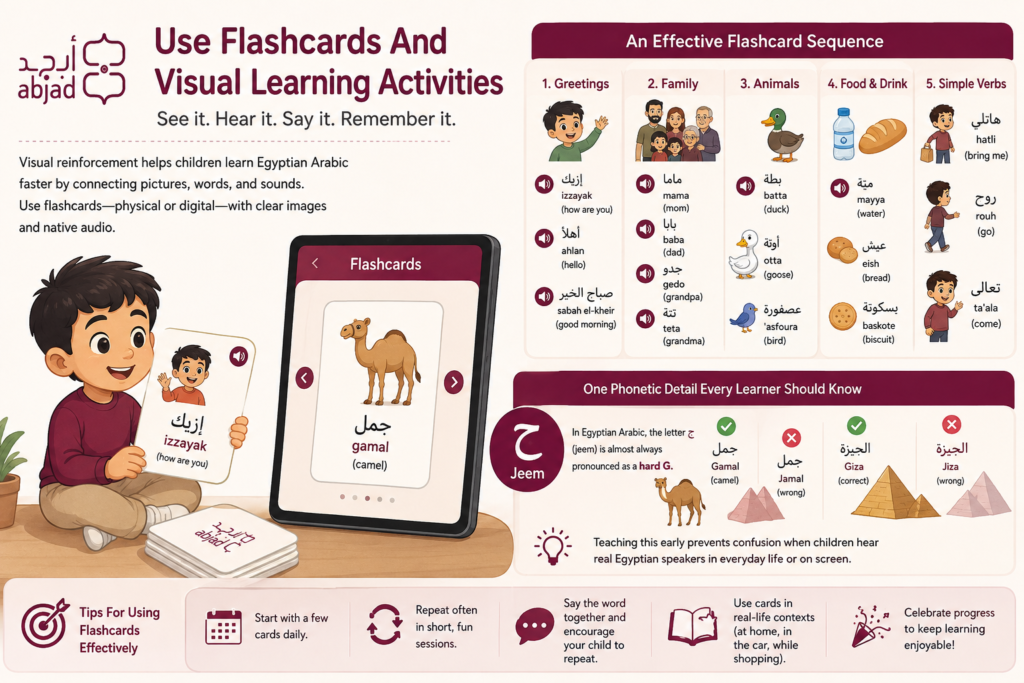
Visual reinforcement is particularly effective for children who process the world primarily through images — a large proportion of young learners, especially in screen-rich environments like the UAE. Egyptian Arabic flashcards, whether physical or digital, pair a picture with the Egyptian colloquial word and a clear audio recording of native pronunciation.
An effective flashcard sequence for Egyptian Arabic starts with high-frequency, concrete vocabulary and builds outward. Greetings first: izzayak (إزيك – how are you), ahlan (أهلاً – hello), sabah el-kheir (صباح الخير – good morning). Then family: mama, baba, gedo, teta. Then animals: otta, batta, ‘asfoura (bird). Food and drink: mayya, eish, baskote (biscuit). Once nouns are secure, simple verbs follow: hatli (bring me), rouh (go), ta’ala (come).
One phonetic detail that every good visual learning tool should flag explicitly: the letter jeem (ج) in Egyptian Arabic is almost universally pronounced as a hard G — “gamal” not “jamal” for camel, “Giza” not “Jiza.” Children who learn this early avoid a persistent confusion when they encounter Egyptian speakers in person or on screen.
Read also:Arabic Cartoons: Fun Ways for Kids to Learn
7. Enroll In Professional Online Classes With Native Egyptian Speakers
For children who respond better to structure than home-led immersion, one-to-one online classes with a native Egyptian Arabic teacher deliver the most targeted and consistent results. A skilled teacher identifies precisely which sounds a specific child is struggling with, adapts vocabulary to that child’s interests — animals, space, football, stories — and makes sessions genuinely enjoyable rather than a chore.
Platforms such as Preply and Orcas list tutors specialising in Egyptian Arabic for young learners. Sessions of 20–30 minutes suit younger children (ages 4–7); 40–45 minutes works well for children aged 8–12. Twice-weekly lessons typically produce visible improvement within four to six weeks.
For UAE families who want a structured, accountable approach to learn Arabic for kids — with measurable milestones and an expert who adjusts pace to the individual child — live instruction with a qualified teacher remains the single most reliable method.
UAE-based institutions like Abjad Institute offer children’s Arabic programmes that incorporate dialect work alongside formal Arabic — a particularly practical arrangement for children who are simultaneously learning Arabic in school and building spoken confidence at home.
Start speaking Arabic with a FREE trial session
8. Watch Egyptian Media, Dubbed Films, And Audio Stories
Disney reversed an earlier decision to dub its animated films in Modern Standard Arabic, returning to Egyptian Arabic after widespread audience feedback — which means familiar films are now available in Egyptian dialect, turning regular leisure viewing into meaningful daily language exposure.
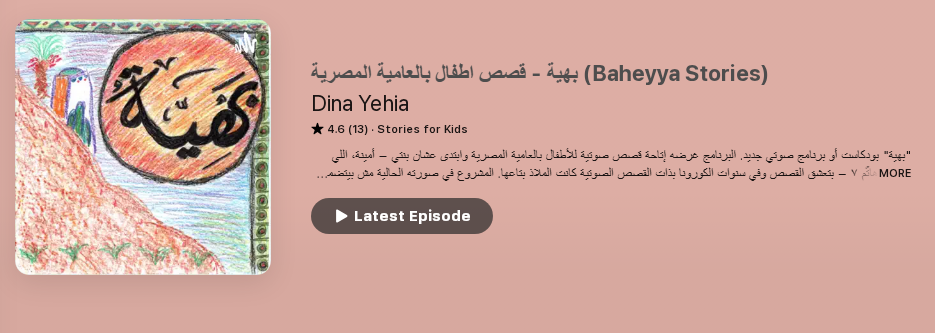
Alam Simsim (عالم سمسم) remains outstanding for ages 2–6. Audio resources like the Buhayya podcast (بهية – قصص أطفال بالعامية المصرية) and Sandouq El-Hawadeet (صندوق الحواديت) deliver high-quality Egyptian storytelling in a format children engage with in the car, at rest time, or before sleep. The Tuta-Tuta YouTube channel offers animated stories and resource playlists curated specifically for Egyptian children’s language acquisition.
For parents navigating the relationship between spoken dialect and formal Arabic school learning, researching how to read Arabic in the UAE curriculum context — which script resources align with UAE Ministry of Education standards — ensures that media-based dialect exposure at home complements rather than conflicts with what children learn in formal Arabic classes.
9. Practice The Egyptian Arabic In Real Or Simulated Social Situations
Conversational reflexes — the ability to respond naturally in a new language without stopping to translate — develop only through practice in real or simulated social situations. Role-play gives children a low-stakes environment to try out new phrases without fear of getting them wrong.
A simple shop-play exercise, where one child asks eih da? (إيه ده؟ – what is this?) and the other replies with the Egyptian name of a nearby object, builds conversational habit that no worksheet can replicate.
Daily greetings are deceptively powerful. A parent who greets their child each morning with izzayak? and waits for an Egyptian reply, embeds one of the most common social phrases in the language within a fortnight, through nothing more than a ten-second daily habit.
Children being introduced to Arabic script at school will sometimes ask whether does Arabic read right to left — the answer is yes, and while it surprises English-dominant learners initially, most children adjust quickly once they are genuinely motivated to engage with Arabic text.
Start Your Arabic Learning Journey with a Free Trial Class in the UAE

10. Combining Egyptian Arabic with Formal Arabic Study
Egyptian Arabic and Modern Standard Arabic are complementary, not competing. Children who begin with Egyptian dialect develop spoken confidence, a natural feel for Arabic rhythm and intonation, and a genuine emotional connection to the language as something living and useful.
Parents who are also thinking ahead to religious study will find that the benefits of learning Quranic Arabic sit naturally alongside conversational dialect work — a child who feels at home in spoken Arabic approaches Quranic and classical texts with curiosity rather than anxiety.
When these children later encounter formal Arabic in school — grammar analysis, essay writing, or reading classical and religious texts — they arrive with a positive existing relationship to Arabic that many of their peers lack entirely.
This matters particularly in the UAE, where school Arabic instruction often runs alongside community dialects. A child who wants to understand how to write in Arabic in the UAE school and professional context builds on a spoken foundation that makes the formal written system feel like a natural next step rather than a subject starting from zero.
Master the Quranic Arabic with a free trial
Key Points Every UAE Parent Should Know About Learning Egyptian Arabic For Kids
Choosing to teach a child Egyptian Arabic is the straightforward part. Getting the foundations right is what separates consistent, enjoyable progress from early frustration and eventual abandonment. A few contextual points help parents set realistic expectations and avoid the most common early mistakes.
The correct model is immersion: saturation, repetition, and use in real contexts. Parents who instinctively reach for grammar rules and formal explanations before a child has sufficient vocabulary to make sense of those rules consistently slow their child’s progress. Exposure first. Structure later.
A. How The Arabic Script Fits Into Dialect Learning?
Egyptian Arabic is spoken, but Arabic is written — and UAE children will eventually need the written script for school, for Quranic reading, and in professional life. When the Egyptian dialect appears in written form, it uses the same alphabet as Modern Standard Arabic, meaning a child who develops Arabic reading skill through formal instruction can apply it across all written Arabic content.
Parents who want to know how to get better at reading Arabic in the UAE will find that the most effective path combines spoken immersion at home — through the dialect methods in this guide — with structured literacy instruction at school or at an Arabic institute. The two tracks reinforce each other: a child who can hear and speak Arabic confidently has a significant head start when they encounter the written form.
For families beginning to introduce the script at home, starting with how to read Arabic letters in the UAE resources aligned with the UAE Ministry of Education curriculum ensures that what the child learns at home is consistent with what they encounter at school. UAE schools typically introduce Arabic script from year one, using a standard curriculum that covers letter recognition, basic phonics, and simple word formation.
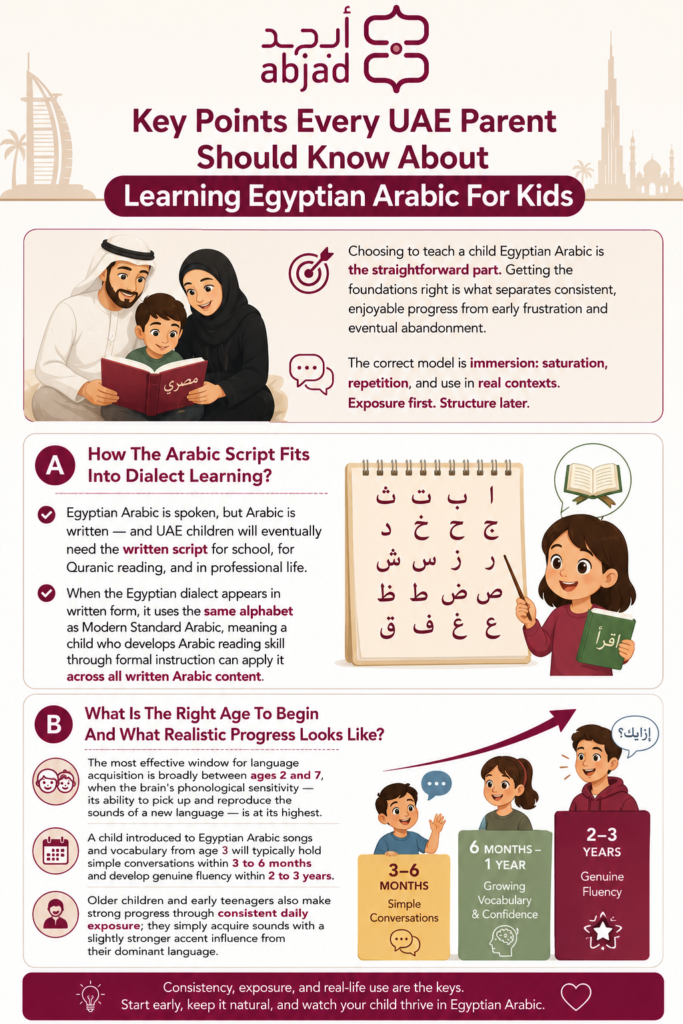
B. What Is The Right Age To Begin And What Realistic Progress Looks Like?
The most effective window for language acquisition is broadly between ages 2 and 7, when the brain’s phonological sensitivity — its ability to pick up and reproduce the sounds of a new language — is at its highest. A child introduced to Egyptian Arabic songs and vocabulary from age 3 will typically hold simple conversations within three to six months and develop genuine fluency within two to three years.
Older children and early teenagers also make strong progress through consistent daily exposure; they simply acquire sounds with a slightly stronger accent influence from their dominant language.
For parents who want to support this journey with structured resources, exploring how to read Arabic script in the UAE materials appropriate for the child’s school year connects spoken dialect work at home to the written Arabic learning happening in class — giving the child a unified, reinforcing experience of Arabic rather than two disconnected subjects.
The most important variable is not the method chosen or even the child’s age. It is a daily consistency. Twenty minutes of genuine, engaged exposure every day produces far stronger results than a two-hour session once a week.
Inside Our Live Classes
Don’t just take our word for it—see for yourself! Click below to watch short clips from our live classes and meet the instructors who will guide your learning journey.
Begin Your Arabic Journey in the UAE
Join Abjad Institute for a professional and immersive Arabic language experience tailored to your goals.
Book Your Free TrialStart learning Arabic letters with a FREE trial class

Abjad Institute The Structured Arabic Learning Built For UAE Families
Abjad Institute is one of the UAE’s most respected Arabic language institutions, offering expert-led courses for children, teenagers, and adults across all levels, dialects, and goals. Designed for the UAE’s multilingual environment Abjad’s programmes provide a clear, progressive path from first contact with the language to confident, fluent use in both spoken and written registers.
For children specifically, Abjad combines qualified native instructors, interactive lesson formats, and age-appropriate content that makes Arabic feel like an exciting skill to build rather than a school subject to endure.
Whether a child is starting from absolute zero or building on an existing foundation in Egyptian or another dialect, Abjad has a course that fits their level, pace, and interests.
Parents looking for a trusted partner to support their child’s Arabic journey, alongside the home methods described in this guide, will find Abjad’s track record across the UAE a strong and well-earned reassurance.
Discover Our Arabic Courses at Abjad Academy:
- Arabic Course for Kids
- Arabic Conversation for Kids
- Arabic Qaida for Kids
- Beginner Arabic for Kids
- Arabic Grammar for Kids
- Teen Arabic Summer Course
- Arabic Kids Camps
- UAE Kindergarten Arabic Classes
- Modern Standard Arabic Course
- Fusha Arabic Course
- Classical Arabic Course
- Emirati Arabic Course
- Gulf Arabic Course
- Learn Saudi Arabic
- Business Arabic Course UAE
- Arabic Language Classes for Professionals in UAE
- Quranic Arabic Course
Book your free trial session today

Conclusion
Egyptian Arabic is the most widely understood Arabic dialect in the world, and giving a child a solid foundation in it is one of the most practically valuable language investments a UAE family can make.
The ten methods in this guide, songs, storytelling, daily object-naming, educational video content, apps, flashcards, role-play, professional classes, Egyptian media, and formal Arabic integration, all succeed because they align with how children actually acquire language: through repetition, joy, real-life use, and a daily trickle of meaningful exposure rather than an occasional flood.
The most effective approach is to combine two or three methods that fit your family’s rhythm. A daily vocabulary habit paired with an Egyptian children’s channel in the background and a regular online lesson will produce consistent, measurable progress within weeks.
For UAE families who want to extend that progress into formal Arabic proficiency, reading, writing, grammar, and Quranic Arabic, pairing home dialect learning with structured instruction at an institution like Abjad Institute gives children the full picture: conversational confidence in Egyptian Arabic and the academic grounding that formal Arabic study requires.
Frequently Asked Questions
At what age should a child begin learning Egyptian Arabic?
The most effective window is between 2 and 7 years, when the brain’s phonological sensitivity is at its highest. A child introduced to Egyptian Arabic songs, greetings, and daily vocabulary from age 2–3 will typically begin holding simple conversations within three to six months. Older children and teenagers also make strong progress with consistent daily practice, though they are more likely to retain a noticeable accent from their dominant language.
Is Egyptian Arabic harder or easier for kids than Modern Standard Arabic?
Egyptian Arabic is considerably more accessible for young learners. It drops the complex case-ending system of Modern Standard Arabic, uses shorter and more predictable sentence structures, and draws its core vocabulary from concrete everyday life — exactly the kind of language children absorb fastest through listening and imitation rather than formal study.
Can a child learn Egyptian Arabic and formal Arabic at the same time?
Yes — and most language educators recommend it. Egyptian dialect builds spoken confidence and a genuine emotional connection to Arabic as a living language, while formal Arabic provides the reading, writing, and grammar skills required for school, religious texts, and professional life. The vocabulary overlap between Egyptian colloquial and Modern Standard Arabic is substantial, meaning progress in one consistently supports progress in the other.
How much daily practice does a child need to make real progress?
Fifteen to thirty minutes of genuine, engaged daily exposure produces faster results than several hours once a week. The key variable is daily contact — a song at breakfast, naming objects at mealtimes, a short Egyptian video before bed. For families who want to add a literacy dimension alongside spoken dialect practice, resources on basic Arabic reading practice in the UAE are widely available and integrate naturally into a home Arabic routine without significant extra time.
Are there apps designed specifically for kids learning Egyptian Arabic?
Yes. The Fast – Learn Egyptian Arabic app by Wazma Studio is rated from age 3 and covers common phrases with clear audio recordings. The يلا نتكلم بالمصري app uses word games and everyday scenes to build colloquial vocabulary. For children who are also developing Arabic literacy, learn how to write and read Arabic for beginners resources from UAE-aligned publishers complement dialect apps by building script recognition alongside spoken fluency.
Can children learn Egyptian Arabic online without paying for a course?
A strong spoken foundation is entirely achievable through free resources alone. YouTube channels including Korkor Tone, Nounoutilly, and Abgad Hawaz provide hours of structured Egyptian Arabic children’s content at no cost. For literacy development running alongside dialect, how to learn to read Arabic online for free options are also widely available, with platforms offering beginner script lessons that align with the standard Arabic reading progression used in UAE schools.
Related Articles
Egyptian Arabic




Leave a Reply