 Learn Arabic
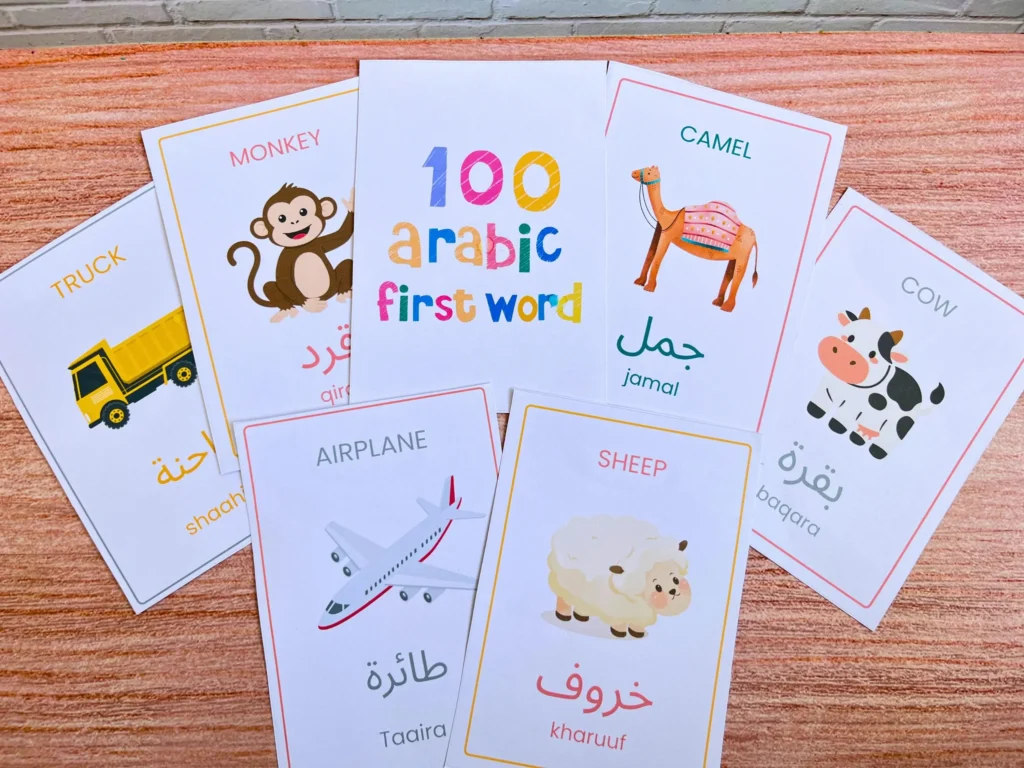
Arabic vocabulary for kids is the set of Arabic words a child can understand and use every day. It starts with the words for the people, things, and actions already inside their own home.
A child needs about 300 well-chosen words to greet, ask, refuse, describe, and answer in Arabic. The number is the easy part. Your real problem is knowing which 300, in what order, and in which form. That is what turns a word list into speech.
Search for Arabic words for kids and you will find the same list over and over. Greetings, colors, numbers, a few verbs, and that’s it. What none of those pages tell you is that many of them teach the wrong form of the word.
They mix standard Arabic with local dialects and never say which is which. And they lock the child into English letters. About a year later, you will discover that your child can recite forty words, but can’t say a sentence or read a line of Arabic script. Let’s figure out the problem together and fix it.
What you’ll learn:
- The four tiers of Arabic vocabulary for kids, in an order where each tier makes the next one usable.
- Why most Arabic word lists teach verbs in a form your child can never say, and how to fix them.
- When English letters help, and when they start capping your child’s progress.
- How many new Arabic words a week actually stick, and the review schedule that kees them.
- Which Arabic words appear in both daily life and the Quran, so every word pays twice.
- The signs your child’s Arabic has stalled, and what to do about it.
What Is Arabic Vocabulary For Kids?
Arabic vocabulary for kids is all the Arabic words a child can understand and use. It comes in two parts. There is the listening part — the words your child knows when they hear them. And there is the speaking part — the smaller set they can say out loud.
The two parts do not grow the same way. The listening part grows fast, and it grows on its own, from cartoons, songs, and everyday talk. The speaking part only grows when your child needs a word to get something they want.
That difference is easy to miss, and parents miss it all the time. Your child follows your Arabic, so you assume they know Arabic. Then you ask them a question, and they go quiet.
Both parts count. But only the speaking part holds a conversation, and it is the part you have to build on purpose. So, start with words from your child’s own world: family, body parts, food, things around the house, colors, numbers, and daily actions.
How Many Arabic Words Does A Child Need To Start Speaking?
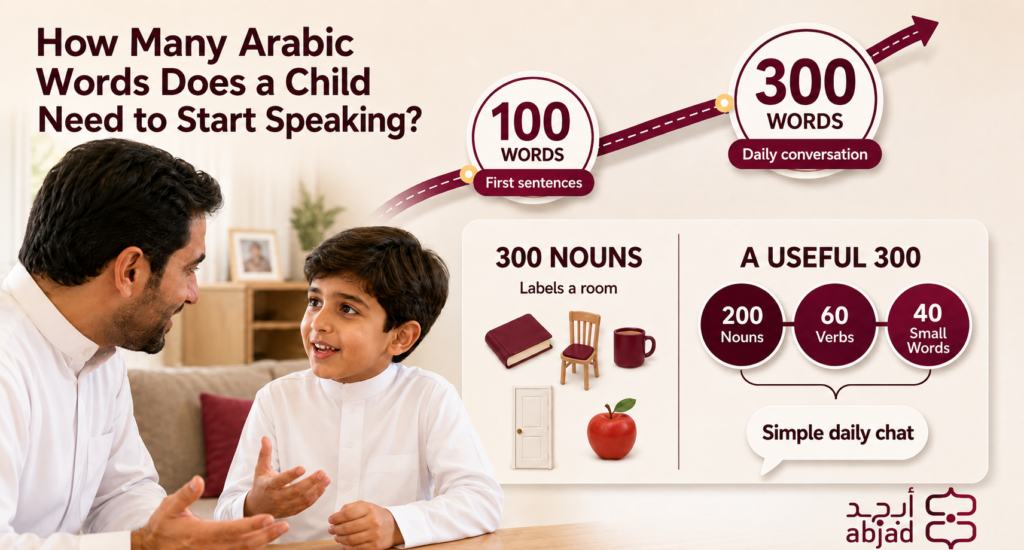
At about 100 words, your child can start making real Arabic sentences. At about 300, they can hold a simple daily chat. But only if those 300 include verbs, question words, and the small joining words. Nouns on their own will not get them there.
Ignore the word-count charts on general education sites. Numbers like 1,500 words at age four and 2,600 at age six are for a child’s first language. Arabic learned as a second language does not follow that curve.
Holding your six-year-old up to a native-speaker chart will only upset you both. A child with 300 words they are willing to use is far ahead of a child with 800 words they never say.
So, the mix matters more than the number. Teach 300 nouns and you get a child who can label a room. Teach 200 nouns, 60 verbs, and 40 small words and you get a child who can ask for things. That second mix is your goal.
The Four Tiers Of Arabic Vocabulary For Kids
Teach these four tiers in order. Each one gives your child words they can use today, with what they already know. A word that gets used stays; however, the one that waits gets forgotten.
1. Tier 1 — Survival Words for Everyday Arabic (About 60 Words)
Tier 1 is about the greetings, manners, yes and no, and family words your child needs to know in Arabic before they can build a sentence.
About 60 words. This is the only tier you can finish in a few weeks, because every word in it already has a moment in the day that belongs to it.
a- The Moment In The Day That Teaches Each Word
Children remember everyday Arabic vocabulary more easily when each word is connected to a real situation rather than memorized from a list.
Use the moments below as natural prompts throughout the day. When your child enters the house, asks for something, receives something, or says goodbye, introduce the matching Arabic expression and repeat it consistently in the same context.
| Moment | What your child says | Arabic |
| Walking in the door | Peace be upon you | السَّلَامُ عَلَيْكُمْ |
| Waking up, breakfast | Good morning | صَبَاحُ الْخَيْرِ |
| After sunset | Good evening | مَسَاءُ الْخَيْرِ |
| Handed anything at all | Thank you | شُكْرًا |
| Asking for anything | Please | مِنْ فَضْلِكَ |
| Answering a question | Yes / No | نَعَمْ / لَا |
| Bumping into someone | Sorry | آسِف / آسِفَة |
| Leaving the house | Goodbye | مَعَ السَّلَامَةِ |
| Talking about people at home | my mother, my father | أُمِّي، أَبِي |
b. Use Everyday Greetings and Manners to Build Your Child’s First Arabic Conversations
Greetings and polite expressions are among the easiest Arabic words for children to use naturally because the same situations happen every day.
Start with the phrases your child needs most — saying hello, thanking someone, asking politely, apologizing, and saying goodbye — and encourage them to use each expression when the real situation occurs.
| English | Arabic | Pronunciation |
| Hello | مَرْحَبًا | marhaban |
| Peace be upon you | السَّلَامُ عَلَيْكُمْ | as-salāmu ʿalaykum |
| And upon you peace (the reply) | وَعَلَيْكُمُ السَّلَامُ | wa-ʿalaykumu s-salām |
| Good morning | صَبَاحُ الْخَيْرِ | ṣabāḥu l-khayr |
| Good evening | مَسَاءُ الْخَيْرِ | masāʾu l-khayr |
| Goodbye | مَعَ السَّلَامَةِ | maʿa s-salāma |
| See you later | إِلَى اللِّقَاءِ | ilā l-liqāʾ |
| Yes | نَعَمْ | naʿam |
| No | لَا | lā |
| Thank you | شُكْرًا | shukran |
| You’re welcome | عَفْوًا | ʿafwan |
| Please (to a boy / to a girl) | مِنْ فَضْلِكَ / مِنْ فَضْلِكِ | min faḍlika / min faḍliki |
| Excuse me (to a boy / to a girl) | لَوْ سَمَحْتَ / لَوْ سَمَحْتِ | law samaḥta / law samaḥti |
| Sorry (boy says / girl says) | آسِف / آسِفَة | āsif / āsifa |
c. Teach Family Words Through the People Your Child Talks About Every Day
Family vocabulary becomes easier to remember when children connect each Arabic word with a real person they already know.
Teach the forms they will actually use in conversation — such as “my mother” and “my father” — rather than isolated dictionary forms.
| English | Arabic | Pronunciation |
| my mother | أُمِّي | ummī |
| my father | أَبِي | abī |
| my brother | أَخِي | akhī |
| my sister | أُخْتِي | ukhtī |
| my grandfather | جَدِّي | jaddī |
| my grandmother | جَدَّتِي | jaddatī |
| my uncle (father’s side) | عَمِّي | ʿammī |
| my uncle (mother’s side) | خَالِي | khālī |
| my aunt (father’s side) | عَمَّتِي | ʿammatī |
| my aunt (mother’s side) | خَالَتِي | khālatī |
| my family | عَائِلَتِي | ʿāʾilatī |
How to Teach Tier 1 Vocabulary Through Daily Routines
Tier 1 works best when Arabic is attached to situations that already repeat throughout your child’s day.
Instead of creating separate vocabulary lessons, use greetings, family conversations, meals, and everyday requests to provide natural repetition.
- Tie each word to a moment that already repeats. السَّلَامُ عَلَيْكُمْ goes at the door.
صَبَاحُ الْخَيْرِ goes at breakfast.
شُكْرًا goes every time someone hands your child something. This matters more than it sounds. In Tier 1, the day supplies the repetition for you, so your child hits five real uses without you planning a single one. No other tier gives you that. - Teach family words with the “my” already built in. Teach أُمِّي (“my mother”), not أُمّ (“mother”). That is the form your child will actually say.
- Give your child their own gender form first. A boy says آسِف and a girl says آسِفَة, and the word for “please” changes with who you are talking to. Teach the form your child needs for themselves, then add the other one later.
- Fill the rest of the 60 with real people. The tables above are the core. Add the names your child actually uses every day, and the boy and girl version of each form they will hear.
- Skip the long formulas for now. Let your child hear جَزَاكَ اللهُ خَيْرًا, but don’t ask them to say it yet. A five-year-old still working on مَرْحَبًا does not need a four-word blessing.
You are done with Tier 1 when your child greets and thanks people without being told, and can name everyone in the house in Arabic. Two to four weeks is normal. Don’t rush past it. In Tier 2, the day stops doing the work for you. Therefore, the habit you build now is what gets you through it.
Read also: The Best Arabic Books For Kids
Tier 2 — The Home, The Body, And Food (About 80 Words)
Tier 2 is about the nouns for things your child can point at: the house, the body, food, animals, and nature. About 80 words.
This is the largest tier and the easiest to teach, because the object is sitting right there doing half the work.
A. Teach Each Vocabulary Group Where Your Child Naturally Uses It
Instead of teaching Tier 2 from a vocabulary list, connect each group to the place where your child encounters it.
Kitchen words belong at snack time, body words at bath time, and nature words on walks or the school run.
| Group | Teach it here | Best moment |
| The house | Room by room | While tidying up |
| Things | Wherever they already are | During play |
| The body | Bathroom and bedroom | Bath time, getting dressed |
| Food and drink | The kitchen | Cooking, snack time |
| At the table | The dining table | Every meal |
| Animals | Outside, or picture books | Walks, the park |
| Nature | Outside | On the way to school |
B. Teach House Vocabulary Using Objects Your Child Sees Every Day
Start with familiar objects your child can immediately identify around the home. Point to the real door, bed, chair, book, or toy as you say its Arabic name so the word becomes connected to something concrete.
| English | Arabic | Pronunciation |
| house | بَيْت | bayt |
| room | غُرْفَة | ghurfa |
| door | بَاب | bāb |
| window | نَافِذَة | nāfidha |
| bed | سَرِير | sarīr |
| table | طَاوِلَة | ṭāwila |
| chair | كُرْسِيّ | kursī |
| kitchen | مَطْبَخ | maṭbakh |
| bathroom | حَمَّام | ḥammām |
| book | كِتَاب | kitāb |
| pen | قَلَم | qalam |
| bag | حَقِيبَة | ḥaqība |
| toy | لُعْبَة | luʿba |
| ball | كُرَة | kura |
Read also: How to Teach Kids Arabic in the UAE? – A Parent’s Step-by-Step Plan
C. Teach Body Parts During Bath Time and Getting Dressed
Body vocabulary is easy to reinforce because children can point to each part as they hear its Arabic name. Bath time, brushing teeth, and getting dressed provide natural opportunities to repeat these words every day.
| English | Arabic | Pronunciation |
| head | رَأْس | raʾs |
| eye | عَيْن | ʿayn |
| ear | أُذُن | udhun |
| nose | أَنْف | anf |
| mouth | فَم | fam |
| hair | شَعْر | shaʿr |
| hand | يَد | yad |
| leg | رِجْل | rijl |
| stomach | بَطْن | baṭn |
| teeth | أَسْنَان | asnān |
D. Teach Food and Table Vocabulary During Meals and Snack Time
Use meals to introduce food, drink, and table vocabulary naturally. Name the water, bread, fruit, spoon, plate, and cup while your child is actually using them instead of teaching the words separately.
| English | Arabic | Pronunciation |
| water | مَاء | māʾ |
| milk | حَلِيب | ḥalīb |
| bread | خُبْز | khubz |
| juice | عَصِير | ʿaṣīr |
| apple | تُفَّاح | tuffāḥ |
| banana | مَوْز | mawz |
| dates | تَمْر | tamr |
| carrot | جَزَر | jazar |
| rice | أَرُزّ | aruzz |
| spoon | مِلْعَقَة | milʿaqa |
| fork | شَوْكَة | shawka |
| plate | طَبَق | ṭabaq |
| cup | كُوب | kūb |
E. Teach Animal and Nature Words Through Walks, Parks, and Picture Books
Teach animal and nature vocabulary when your child can see the real thing or a clear picture of it. Walks, parks, picture books, and the school journey provide repeated opportunities to point out animals, trees, the sun, rain, and other familiar sights.
| English | Arabic | Pronunciation |
| cat | قِطَّة | qiṭṭa |
| dog | كَلْب | kalb |
| bird | عُصْفُور | ʿuṣfūr |
| horse | حِصَان | ḥiṣān |
| lion | أَسَد | asad |
| fish | سَمَكَة | samaka |
| chicken | دَجَاجَة | dajāja |
| tree | شَجَرَة | shajara |
| flower | زَهْرَة | zahra |
| sun | شَمْس | shams |
| moon | قَمَر | qamar |
| star | نَجْم | najm |
| rain | مَطَر | maṭar |
| sky | سَمَاء | samāʾ |
| sea | بَحْر | baḥr |
| earth | أَرْض | arḍ |
How to Teach Tier 2 Vocabulary Through Real Objects and Daily Routines
Tier 2 works best when vocabulary is taught in context rather than from a list. Use the objects, rooms, meals, and routines your child already interacts with every day to create natural repetition. Focus on one small group at a time and expand only when those words become familiar.
- Teach each group where it lives. Kitchen words in the kitchen, with the food in your hand. Body words at bath time. Animal and nature words outside. Hold up a real spoon, and your child learns the word.
- Take one room at a time. Teach ten to twelve words per room, finished before you move on. Your child ends up owning a room in Arabic. One room they own beats four rooms they half know.
- Fill the rest of the 80 from your own house. The tables above are the core set. Your child’s own toys, their favourite fruit, the pet next door — those words matter more to them than anything on a list, and they stick faster.
- Say the gender; don’t teach it. Arabic nouns are masculine or feminine, and a word ending in ة is usually feminine — قِطَّة، سَمَكَة، شَجَرَة. Don’t teach that as a rule. Just say the right form every time and let the pattern settle. Your child will use it correctly long before they can explain it.
You are done with a group when your child names the object before you do. That is the signal to move on, not the number of words you have covered.
Tier 3 — Describing Words That Help Your Child Build Short Arabic Phrases
Tier 3 moves your child from simply naming objects to describing and comparing them. Colors, numbers, shapes, opposites, and position words allow them to combine vocabulary from Tier 2 into short, meaningful Arabic phrases.
Read also: Daily Routine in Arabic for Kids
What Each Vocabulary Group Helps Your Child Say in Arabic
Each group adds a different speaking skill. Colors describe objects, numbers show quantity, opposites help children choose between things, and position words allow them to explain where something is.
| Group | What it lets your child do | Example |
| Colors | Describe a thing, not just name it | كِتَاب أَحْمَر (a red book) |
| Numbers | Count real objects | ثَلَاث تُفَّاحَات (three apples) |
| Shapes | Sort and compare | دَائِرَة كَبِيرَة (a big circle) |
| Opposites | Choose and refuse | الْكُوب الْكَبِير (the big cup) |
| Position | Answer a “where” question | تَحْت الطَّاوِلَة (under the table) |
A. Teach Colors, Shapes, and Position Words With Objects Around Your Child
Use familiar objects to make these words meaningful. Ask your child about the color or shape of something they can see, or place an object above, below, inside, or behind something so position words describe a real situation.
| Group | English | Arabic | Pronunciation |
| Color | red | أَحْمَر | aḥmar |
| Color | blue | أَزْرَق | azraq |
| Color | green | أَخْضَر | akhḍar |
| Color | yellow | أَصْفَر | aṣfar |
| Color | white | أَبْيَض | abyaḍ |
| Color | black | أَسْوَد | aswad |
| Color | orange | بُرْتُقَالِيّ | burtuqālī |
| Color | purple | بَنَفْسَجِيّ | banafsajī |
| Color | pink | وَرْدِيّ | wardī |
| Color | brown | بُنِّيّ | bunnī |
| Shape | circle | دَائِرَة | dāʾira |
| Shape | square | مُرَبَّع | murabbaʿ |
| Shape | triangle | مُثَلَّث | muthallath |
| Shape | rectangle | مُسْتَطِيل | mustaṭīl |
| Shape | star | نَجْمَة | najma |
| Position | above | فَوْق | fawq |
| Position | below | تَحْت | taḥt |
| Position | inside | دَاخِل | dākhil |
| Position | outside | خَارِج | khārij |
| Position | in front of | أَمَام | amām |
| Position | behind | خَلْف | khalf |
B. Teach Numbers 1–10 by Counting Real Objects
Numbers become useful when children connect them to quantity rather than simply memorizing them in order.
Count toys, books, fruit, spoons, or other familiar objects so each number represents something your child can actually see.
| Number | Arabic | Pronunciation |
| one | وَاحِد | wāḥid |
| two | اثْنَان | ithnān |
| three | ثَلَاثَة | thalātha |
| four | أَرْبَعَة | arbaʿa |
| five | خَمْسَة | khamsa |
| six | سِتَّة | sitta |
| seven | سَبْعَة | sabʿa |
| eight | ثَمَانِيَة | thamāniya |
| nine | تِسْعَة | tisʿa |
| ten | عَشَرَة | ʿashara |
Watch Our Classes in Action
Curious what a real session looks like? Take a peek inside our interactive classrooms and see how our expert instructors bring the Arabic language to life. Watch a sample lesson below!
Begin Your Arabic Journey in the UAE
Join Abjad Institute for a professional and immersive Arabic language experience tailored to your goals.
Book Your Free TrialC. Teach Opposites Together So Each Word Explains the Other
Opposites are easier to remember as pairs because children can compare two things directly.
Use real examples such as a big and small cup or hot and cold water so the contrast provides the meaning.
| English pair | Arabic pair | Pronunciation |
| big / small | كَبِير / صَغِير | kabīr / ṣaghīr |
| tall / short | طَوِيل / قَصِير | ṭawīl / qaṣīr |
| hot / cold | حَارّ / بَارِد | ḥārr / bārid |
| clean / dirty | نَظِيف / وَسِخ | naẓīf / wasikh |
| new / old | جَدِيد / قَدِيم | jadīd / qadīm |
How to Teach Tier 3 by Turning Known Nouns Into Short Arabic Phrases
Tier 3 should build on vocabulary your child already knows rather than becoming another isolated word list.
Combine Tier 2 nouns with colors, numbers, opposites, and position words until your child begins producing simple two-word answers.
- Teach opposites as pairs, in one session. Children hold on to contrasting words better than single ones, because each word gives the other its meaning.
- Stop collecting words and start asking for answers. Point at something and ask أَيْنَ الْكُرَة؟ Accept a two-word reply: تَحْت الطَّاوِلَة. Two words is a sentence at this stage, so praise it like one.
- Now join the two tiers: 2 and 3. Take a noun your child knows and add a describing word to it.
كِتَاب أَحْمَر.
ثَلَاث تُفَّاحَات.
الْكُوب الْكَبِير. Numbers are the one tricky part, because their shape changes with the thing being counted. Skip the rule. Say it correctly and let your child copy you. - Test numbers out of order. A child who can recite وَاحِد to عَشَرَة has learned a song, not the numbers. Ask كَمْ كِتَابًا؟ then كَمْ مِلْعَقَة؟ about real objects in front of them.
You are done with Tier 3 when your child answers a “which one” or “where” question with two words, without being prompted.
Read also: How to Learn Arabic for Kids? A Step-by-Step Guide for UAE Families
Tier 4 — Everyday Verbs That Help Your Child Start Speaking Arabic (About 90 Words)
Tier 4 turns vocabulary into action. Your child learns around 40 everyday verbs in two useful forms: the command they hear from you and the “I” form they use to describe what they are doing.
A. Teach Each Verb in the Two Forms Your Child Actually Uses
Do not teach verbs as isolated dictionary entries. Pair the form you naturally say to your child — such as “eat,” “sit,” or “read” — with the form your child needs to answer, such as “I eat,” “I sit,” or “I read.”
| Meaning | Say to your child (boy / girl) | Your child says |
| eat | كُلْ / كُلِي (kul / kulī) | آكُل (ākul) — I eat |
| drink | اِشْرَبْ / اِشْرَبِي (ishrab / ishrabī) | أَشْرَب (ashrab) |
| sleep | نَمْ / نَامِي (nam / nāmī) | أَنَام (anām) |
| play | اِلْعَبْ / اِلْعَبِي (ilʿab / ilʿabī) | أَلْعَب (alʿab) |
| read | اِقْرَأْ / اِقْرَئِي (iqraʾ / iqraʾī) | أَقْرَأ (aqraʾ) |
| write | اُكْتُبْ / اُكْتُبِي (uktub / uktubī) | أَكْتُب (aktub) |
| go | اِذْهَبْ / اِذْهَبِي (idhhab / idhhabī) | أَذْهَب (adhhab) |
| come | تَعَالَ / تَعَالَيْ (taʿāla / taʿālay) | آتِي (ātī) |
| sit | اِجْلِسْ / اِجْلِسِي (ijlis / ijlisī) | أَجْلِس (ajlis) |
| stand | قِفْ / قِفِي (qif / qifī) | أَقِف (aqif) |
| look | اُنْظُرْ / اُنْظُرِي (unẓur / unẓurī) | أَنْظُر (anẓur) |
| open | اِفْتَحْ / اِفْتَحِي (iftaḥ / iftaḥī) | أَفْتَح (aftaḥ) |
| close | أَغْلِقْ / أَغْلِقِي (aghliq / aghliqī) | أُغْلِق (ughliq) |
| wash | اِغْسِلْ / اِغْسِلِي (ighsil / ighsilī) | أَغْسِل (aghsil) |
| run | اُرْكُضْ / اُرْكُضِي (urkuḍ / urkuḍī) | أَرْكُض (arkuḍ) |
B. Use Everyday Arabic Commands and Phrases Throughout the Day
Some phrases naturally repeat dozens of times at home. Replacing everyday English commands such as “come,” “wait,” and “give me” with Arabic gives your child frequent practice without creating an additional lesson.
Those last four phrases do more work than almost any noun on the list. Combined with the vocabulary your child already knows, they make it possible to ask for things, accept help, and refuse something in Arabic.
| Meaning | Arabic (boy / girl) | Pronunciation |
| Come | تَعَالَ / تَعَالَيْ | taʿāla / taʿālay |
| Let’s go | هَيَّا | hayyā |
| Wait | اِنْتَظِرْ / اِنْتَظِرِي | intaẓir / intaẓirī |
| Pay attention | اِنْتَبِهْ / اِنْتَبِهِي | intabih / intabihī |
| Give me | أَعْطِنِي / أَعْطِينِي | aʿṭinī / aʿṭīnī |
| Help me (child says this) | سَاعِدْنِي | sāʿidnī |
| I want (child says this) | أُرِيد | urīd |
| I don’t want (child says this) | لَا أُرِيد | lā urīd |
Those last four phrases do more work than any noun on the list. A child with them and 100 nouns can get through a day in Arabic.
Read also: Easy Arabic Stories for Kids -Turn Reading Time Into Arabic Practice
How to Teach Tier 4 by Connecting Arabic Verbs to Real Actions
Verbs stick more easily when children hear the word, perform the action, and then describe what they are doing.
Use commands already built into family life instead of relying mainly on verb lists or memorization.
- Teach by doing, not by listing. You say the command. Your child does the action. Then, your child says what they are doing in the “I” form.
Say اِجْلِسْ, they sit, they say أَجْلِس. The word gets attached to a movement, which is why verbs learned this way last far longer than verbs learned from a table.
- Plan for two forms per verb. That is why 40 verbs turn into 90 words. Six to eight verbs a week is a realistic pace, and it is fine for this tier to take three months.
- Use the commands you already say in English. You say “come here” and “wait” a hundred times a week. Swap those into Arabic first, because the repetition is already built into your day.
- Don’t trust the verb lists you find online. Almost all of them give the past tense form, so the row labeled “eat” is teaching your child to say “he ate.” The next section shows you how to spot that.
This is the tier that decides whether your child speaks Arabic or only understands it. A child with nouns alone can label a room. A child with verbs can ask for things, refuse things, and tell you what happened.
You are done with Tier 4 when your child gives you a command in Arabic without being asked, and answers “what are you doing?” with a verb instead of a noun.
See for yourself an Arabic class for kids in action at our Abjad Institute.
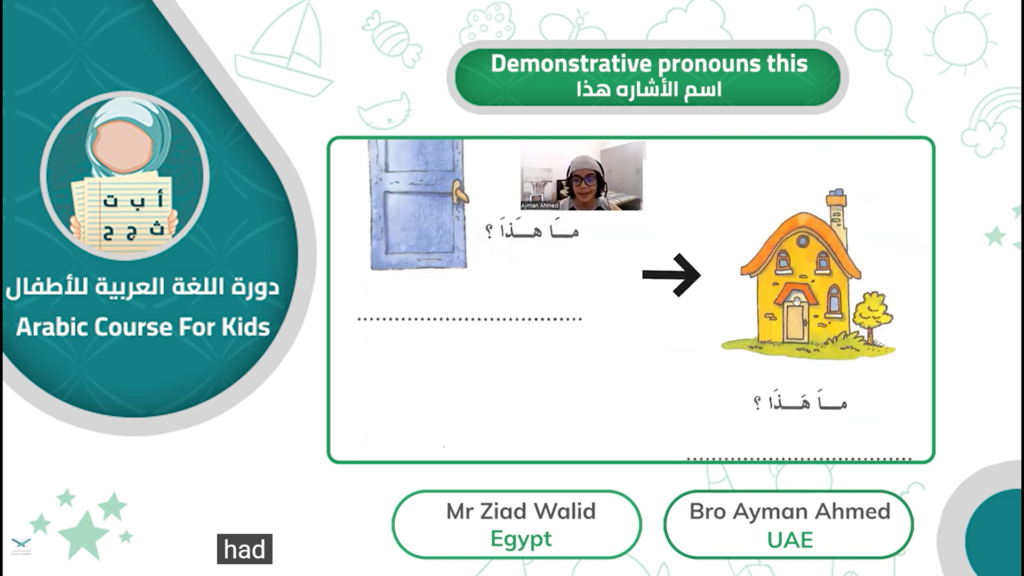
📖 How to Form the Question “ما هذا؟” in Arabic | Arabic for Kids 🎙️✨
Why Kids Should Learn Arabic Vocabulary in Arabic Script Instead of English Letters
Teach vocabulary in Arabic script from the beginning. English letters can temporarily help parents with pronunciation, but they should not become the child’s main reading system.
English transliteration cannot clearly represent several Arabic sound distinctions, including ع/أ, ح/ه, ق/ك, and س/ص. Learning وَرْدَة instead of only warda also teaches your child letters they will recognize in future Arabic words and Quranic text.
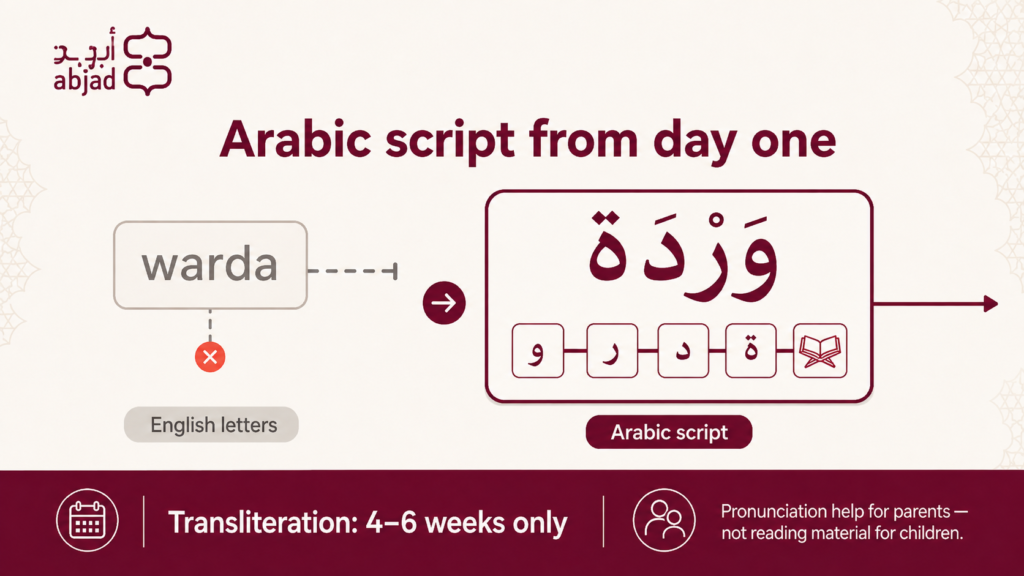
A practical approach is to use English pronunciation support during the first four to six weeks while learning the alphabet, then gradually remove it from the child’s materials.
Read also: How to Speak Arabic Language in the UAE?
How Many Arabic Words Should Kids Learn Each Week to Remember Them?
Around five to ten new words per week is more useful than teaching dozens once. Retention comes from repeatedly using each word in different situations.
Three habits matter most:
- Use each word at least five times. Put it into different situations, questions, games, and sentences.
- Review it over time. Revisit the word after a day, a week, and a month.
- Make your child say it. Recognition is not enough; ask them to answer, request something, or give an instruction using the word.
Also test vocabulary out of order. A child who recites numbers from one to ten may know the sequence without being able to answer كَمْ كِتَابًا؟ about real objects.
If your child understands much more Arabic than they speak, direct conversation with a native speaker can help close the gap. Abjad
‘s Arabic conversation course for kids gives children one-to-one practice answering real Arabic questions aloud, with about 70% of each session spent speaking.
Arabic Words Kids Can Use at Home and Recognize in the Quran
Some everyday Arabic words also appear throughout the Quran or in Surah names. Teaching these words connects daily vocabulary with Quranic reading, helping children recognize meaning when they later encounter the same vocabulary in Quranic text.
| Word | Daily meaning | Where your child meets it in the Quran |
| رَبّ | Lord | Al-Fātiḥa, verse 2 — الْحَمْدُ لِلَّهِ رَبِّ الْعَالَمِينَ |
| نُور | light | Surah An-Nūr (24) |
| شَمْس | sun | Surah Ash-Shams (91) |
| قَمَر | moon | Surah Al-Qamar (54) |
| نَجْم | star | Surah An-Najm (53) |
| لَيْل | night | Surah Al-Layl (92) |
| نَاس | people | Surah An-Nās (114) |
| فِيل | elephant | Surah Al-Fīl (105) |
| نَمْل | ants | Surah An-Naml (27) |
| نَحْل | bees | Surah An-Naḥl (16) |
| تِين / زَيْتُون | fig / olive | Surah At-Tīn (95) |
| مَاء، أَرْض، سَمَاء | water, earth, sky | Throughout the Quran |
| قَلْب، عَيْن، يَد | heart, eye, hand | Throughout the Quran |
For example, a child may first learn نَمْل while watching ants outside and later recognize the same word in Surah An-Naml. That connection turns Quran reading from simply decoding letters into recognizing meaning.
Six Ways To Teach Arabic Vocabulary At Home
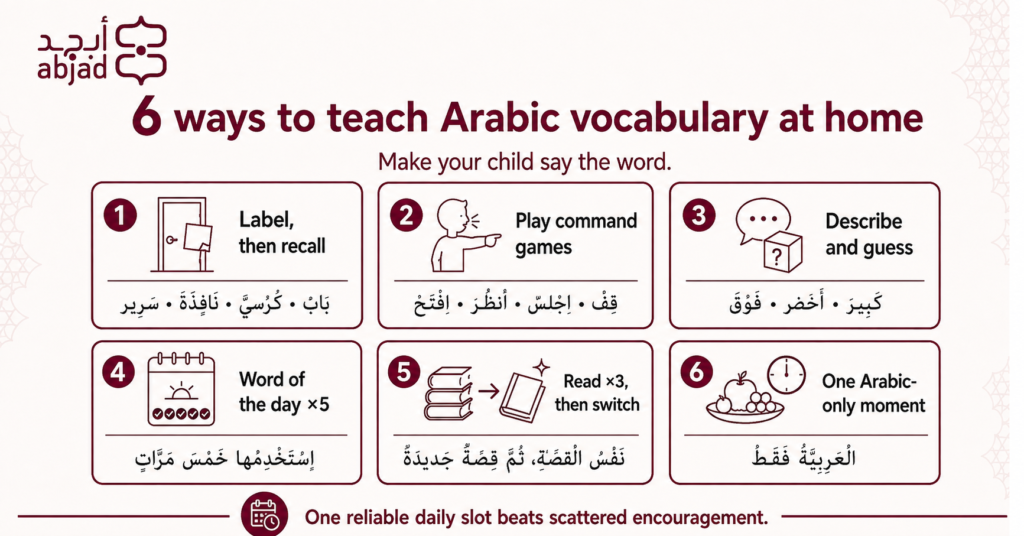
These activities work best because they move children beyond recognizing vocabulary and require them to say and use the words themselves.
- Label the house, then remove the labels. Label familiar objects for two weeks, then remove the labels and ask your child to name them.
- Play command games. Use commands such as قِفْ, اِجْلِسْ, اُنْظُرْ, and اِفْتَحْ الْبَاب in games such as Simon Says.
- Play description games. Let your child describe an object using its color, size, or position while you guess.
- Use one word five times a day. Choose a daily word and have everyone use it repeatedly before bedtime.
- Repeat stories before changing them. Repetition strengthens familiar vocabulary, while new stories gradually expand it.
- Create one Arabic-only moment each day. Choose a routine such as asking for a snack where your child must use Arabic.
Four Common Mistakes in Arabic Word Lists for Kids and How to Avoid Them
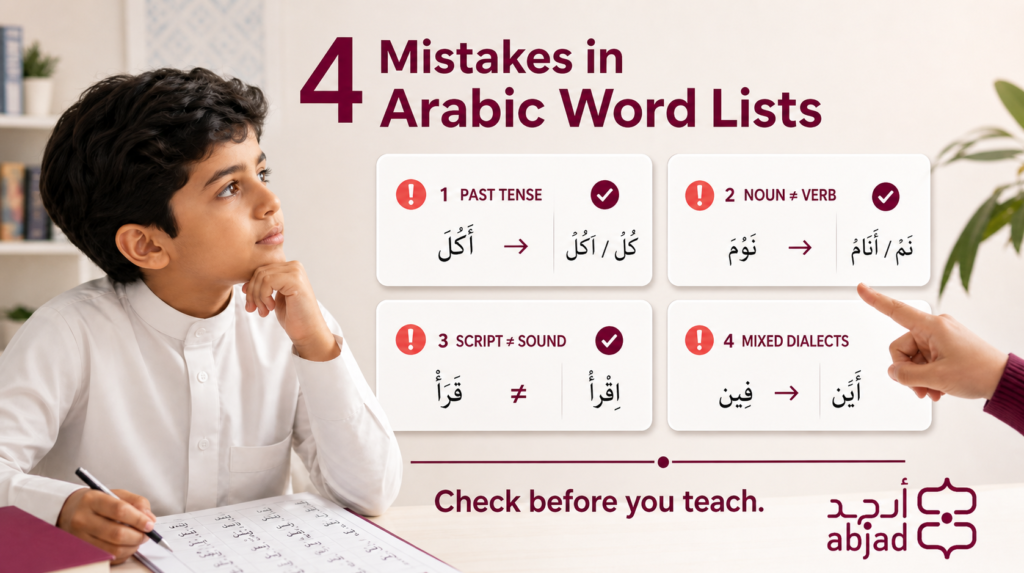
Many Arabic vocabulary lists give children the wrong verb form, word type, pronunciation, or variety of Arabic. That is why a child can memorize dozens of words but still struggle to use them in a sentence.
Here are four common problems, how to recognize them, and what to teach instead.
1. Teaching Past-Tense Arabic Verbs Instead of Forms Kids Can Use
Many lists translate “eat” as أَكَلَ (akala), but this actually means “he ate.” Arabic dictionaries commonly list verbs in the third-person masculine past tense, which is useful as a dictionary entry but not necessarily the form a child needs in conversation.
Children need two more practical forms: the command you say to them and the “I” form they use themselves.
| Meaning | Often listed (wrong for a child) | Say to a boy / girl | Your child says |
| eat | أَكَلَ (akala — he ate) | كُلْ / كُلِي | آكُل (I eat) |
| drink | شَرِبَ (shariba — he drank) | اِشْرَبْ / اِشْرَبِي | أَشْرَب |
| read | قَرَأَ (qaraʾa — he read) | اِقْرَأْ / اِقْرَئِي | أَقْرَأ |
| write | كَتَبَ (kataba — he wrote) | اُكْتُبْ / اُكْتُبِي | أَكْتُب |
| see | رَأَى (raʾā — he saw) | اُنْظُرْ / اُنْظُرِي | أَرَى (I see) |
| sit | جَلَسَ (jalasa — he sat) | اِجْلِسْ / اِجْلِسِي | أَجْلِس |
| go | ذَهَبَ (dhahaba — he went) | اِذْهَبْ / اِذْهَبِي | أَذْهَب |
How to spot it: forms such as akala, kataba, dhahaba, and jalasa are past-tense forms. Also remember that Arabic commands can change depending on whether you are speaking to a boy or girl, so teach the form your child will hear most first.
2. Teaching an Arabic Noun When Your Child Actually Needs a Verb
Some lists label nouns as actions. For example, نَوْم means “sleep” as a noun, while لُعْبَة means “a toy.” Neither gives your child the verb they need to say “sleep” or “play.”
Arabic often has separate nouns for actions, such as قِرَاءَة for “reading” and كِتَابَة for “writing.” These are correct Arabic words, but they cannot replace the practical verb forms children need for conversation.
| The list says | The Arabic it gives | What that word really means | What your child needs |
| sleep | نَوْم (nawm) | sleep, the thing | نَمْ / نَامِي → أَنَام |
| play | لُعْبَة (luʿba) | a toy | اِلْعَبْ / اِلْعَبِي → أَلْعَب |
| drink | شُرْب (shurb) | drinking, the act | اِشْرَبْ / اِشْرَبِي → أَشْرَب |
| go | ذَهَاب (dhahāb) | going, the act | اِذْهَبْ / اِذْهَبِي → أَذْهَب |
| read | قِرَاءَة (qirāʾa) | reading, the act | اِقْرَأْ / اِقْرَئِي → أَقْرَأ |
How to spot it: ask whether your child could act the word out. You can act out “eat.” You cannot act out “a spoon.” If the word names a thing rather than something a body does, it is a noun, whatever the English column claims.
3. Using Arabic Script and Pronunciation That Represent Different Words
Sometimes the Arabic and transliteration in the same row do not match. A list might show قَرَأَ (“he read”) but give iqraʾ as the pronunciation, even though اِقْرَأْ means “read!” as a command.
This creates confusion, especially when one parent teaches from the Arabic script and another relies on the pronunciation guide.
How to spot it: compare the script and pronunciation carefully. Commands commonly appear as forms such as iqraʾ, uktub, ijlis, and ishrab, while past-tense forms include qaraʾa, kataba, and jalasa. If the two columns represent different forms, use another source.
4. Mixing Arabic Dialects With Standard Arabic Without Labeling Them
Dialect is not incorrect Arabic, but problems arise when vocabulary lists mix Egyptian, Levantine, or other dialect words with Fuṣḥā without identifying them.
For children learning to read Arabic, Standard Arabic provides the foundation used in books, school Arabic, and the Quran. Dialect can still be learned for everyday family conversation, but children should know which form they are learning.
| Dialect word you’ll see | Where it’s from | Standard Arabic your child needs |
| فين | Egyptian | أَيْن (where) |
| إيه | Egyptian | مَا / مَاذَا (what) |
| عايز | Egyptian | أُرِيد (I want) |
| ميّة | Egyptian | مَاء (water) |
| دلوقتي | Egyptian | الآن (now) |
| كيفك | Levantine | كَيْفَ حَالُكَ (how are you) |
| بكام | Egyptian | بِكَمْ (how much) |
Use Fuṣḥā as the reading foundation and add dialect for natural conversation rather than mixing the two without explanation.
How To Avoid These Arabic Vocabulary Mistakes
You do not need to speak Arabic fluently to catch many vocabulary-list problems. Before teaching from a list, ask three questions:
- Can my child do this word? If the list claims to teach a verb, make sure the Arabic actually represents an action rather than a noun.
- Would I say this to my child or about someone? Your child needs useful commands and first-person forms, not only dictionary-style “he did” forms.
- Would this word appear in a book? If reading is part of your goal, make sure Standard Arabic is clearly distinguished from dialect.
| Check | Warning sign | What to look for instead |
| Verb form | Pronunciation ends in -a: akala, qaraʾa | كُلْ (command) and آكُل (I form) |
| Noun sold as a verb | “sleep” = نَوْم, “play” = لُعْبَة | نَمْ / أَنَام, اِلْعَبْ / أَلْعَب |
| Row disagrees with itself | Arabic says one word, pronunciation says another | A row where both columns agree |
| Dialect words | فين، كيفك، إيه، عايز، ميّة | أَيْن، كَيْفَ حَالُكَ، مَا، أُرِيد، مَاء |
| No vowel marks | كتب with nothing above or below it | كَتَبَ (he wrote) or كُتُب (books)? |
| One gender form only | A single word for “please” or “sorry” | مِنْ فَضْلِكَ / مِنْ فَضْلِكِ, آسِف / آسِفَة |
| English letters only | No Arabic script anywhere on the page | A list that shows the script first |
Vowel marks matter because كتب, for example, can represent different words depending on its Harakat. Gender forms also matter when expressions change depending on who is speaking or being addressed.
Choose one reliable children’s Arabic source rather than combining several conflicting lists. Also prioritize useful phrases such as أُرِيد (I want), لَا أُرِيد (I don’t want), أَعْطِنِي (give me), and سَاعِدْنِي (help me)..
Inside Our Live Classes
Don’t just take our word for it—see for yourself! Click below to watch short clips from our live classes and meet the instructors who will guide your learning journey.
Build Your Child’s Arabic Vocabulary With Abjad
You now have the plan. Four tiers, the right word forms, fuṣḥā, and a review schedule you can keep.
What you cannot hand your child on your own is the accuracy: the sounds, the corrections, and the unrehearsed questions that make a child speak.
Your child learns one to one with a native Arab tutor — most of Abjad’s teachers are Al-Azhar graduates, and several hold ijazah in Tajwid and Quran recitation. Every word arrives in Arabic script, in fuṣḥā, in the form a child can actually use, and tied to Quran reading from the first class.
What that looks like week to week:
- Your child does the talking. Abjad builds sessions so about 70% of the time is speaking practice. No group, no waiting for a turn, no hiding behind the child who answers first.
- Wrong sounds get fixed the second they happen — before ع and ق set into an accent that takes years to undo.
- Classes run 30 or 45 minutes, from one to five times a week, booked around your week rather than the other way around.
- You can ask for a male or female teacher, and 12 named tutors are listed on the site with their qualifications.
- Plans start at $18.99 a month, and your first class is a free trial.
See it before you decide anything. 👉 Hear it from the students themselves.https://abjadinstitute.ae/students-reviews/
Book your child’s free trial class now
Quran-Focused Courses for Kids
Check these if the Quran is the real goal, and Arabic is the road to it.
- Arabic Qaida for Kids — letters, joins, and correct sounds, the base every Quran reader needs
- Quranic Arabic Course — reading and understanding the words of the Quran itself
- Learn Arabic Alphabet Course — for a child who is not reading letters yet
- Arabic for Kids Course — the full course, with Quran reading built on top
Begin Your Arabic Journey in the UAE
Join Abjad Institute for a professional and immersive Arabic language experience tailored to your goals.
Book Your Free TrialConclusion
Arabic vocabulary for kids is not a list problem. Every page you land on hands you the same 150 words. If lists were the answer, far more children would speak Arabic than do.
Four things decide the outcome. The order you teach in. The form you teach each word in. Whether your child reads the word in Arabic script. And whether they have to say it to get what they want. Get those four right and the list barely matters. Get them wrong and no list will save you.
So, here is the whole plan in one breath. Teach the four tiers in order, and finish each one before you start the next. Give every verb in the command form and the “I” form, never the dictionary form.
Stay in fuṣḥā and let dialect arrive on its own. Pick the words that show up in both the kitchen and the Quran, so every word pays twice. Add five to ten a week, review them after a day, a week, and a month, and make your child say them out loud to get something they want.
You can start tonight without buying anything. Pick six words from Tier 1, tie each one to a moment that already happens in your day, and use them tomorrow. That is the whole method at its smallest size.
Be patient with the timeline. This is a year of small habits, not a project you finish in a month. The children who end up fluent are rarely the ones who started fastest.
Frequently Asked Questions
What Arabic vocabulary should a child learn first?
A child should learn greetings, manners, yes and no, and family words first. These let them join an Arabic conversation before they can build a sentence.
Add water, food, and body parts next — the objects are right there to hold the meaning in place. Leave verbs until your child has about a hundred nouns and phrases they can already use.
Should I teach my child standard Arabic or a dialect?
Teach standard Arabic, or fuṣḥā, as your child’s base. It is the Arabic of the Quran, of books, and of school in every Arab country, and it does not change from one country to the next.
Dialect comes on its own from family and travel. A child taught only dialect has to unlearn it before they can read.
How long does it take a child to learn 300 Arabic words?
At five to ten new words a week with steady review, a child reaches about 300 usable Arabic words in eight to twelve months.
Age matters far less than how often each word gets used in a real sentence. A child who learns three words a week and uses all three will pass a child who learns fifteen and uses none.
Can I teach my child Arabic vocabulary if I don’t speak Arabic?
Yes, for a large part of it. You can pick the words, label the house, run the games, and keep the review schedule — none of that needs Arabic.
What you cannot supply is sounds like ع and ق, the fixes to wrong word forms, and real unrehearsed conversation. That is why most families add a native tutor for a session or two a week.
How many Arabic words does my child need before reading the Quran?
There is no fixed number. Reading and vocabulary grow together, so your child can start the Quran before they know many words.
What helps most is picking words that appear in both daily life and the Quran — مَاء، شَمْس، قَمَر، نُور، and رَبّ all do. Then early Quran reading feels like understanding, not sounding out letters.
What is the best age to start teaching Arabic vocabulary to a child?
Between three and six is the easiest window. Young children copy new sounds without self-consciousness, so pronunciation comes faster. But it is never too late. An older child learns words faster than a toddler — they just need more help with the sounds, and a reason to speak.
Related Articles
Learn Arabic





Leave a Reply