 Learn Arabic
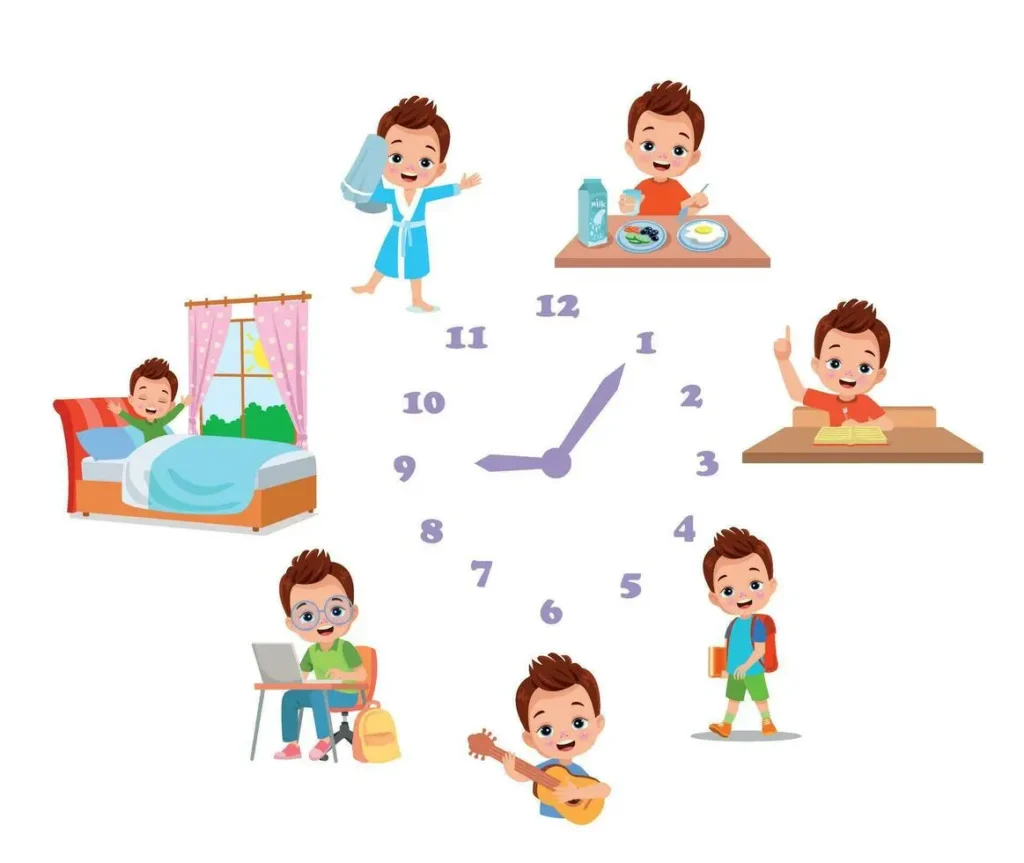
What if your child could learn Arabic without a single extra minute in the day? That is what a daily routine in Arabic for kids does. Your child already wakes up, brushes their teeth, eats breakfast, does homework, and goes to sleep. You simply name each of those steps in Arabic while it happens.
And because those steps repeat every day, the words repeat with them. Your child hears the same phrase in the same real moment, over and over. That is how children pick up a language. They do not need to sit down and memorize it.
So let’s go through those phrases together. Every phrase comes with three things: the Arabic, how to say it out loud, and the English meaning. They are sorted into morning, afternoon, and evening, so you can start with one part of the day.
After that, you will see how to turn the same phrases into a printable chart, how to play a sorting game with them, and how to mark your child’s answers.
A. Morning Routine in Arabic for Kids With English Meanings
Start with the morning because it follows a predictable order every school day. Teach phrases in the first person (“I”) so your child can use them directly.
In many present-tense verbs, أَ indicates “I,” while forms beginning with تَـ can address a boy, تَـ…ينَ a girl, and نَـ means “we.”
| Arabic | How to say it | English meaning |
| أَسْتَيْقِظُ مُبَكِّرًا | astayqizu mubakkiran | I wake up early |
| الحَمْدُ لِلَّه | al-hamdu lillah | Praise be to God (said on waking) |
| أُرَتِّبُ سَرِيرِي | urattibu sareeri | I make my bed |
| أَغْسِلُ وَجْهِي | aghsilu wajhi | I wash my face |
| أَفْرُشُ أَسْنَانِي | afrushu asnani | I brush my teeth |
| أَرْتَدِي مَلَابِسِي | artadi malabisi | I put on my clothes |
| أَتَنَاوَلُ الفُطُورَ | atanawalu al-futoor | I eat breakfast |
| أَشْرَبُ الحَلِيبَ | ashrabu al-haleeb | I drink milk |
| أُحَضِّرُ حَقِيبَتِي المَدْرَسِيَّةَ | uhaddiru haqibati al-madrasiyya | I get my school bag ready |
| أَذْهَبُ إِلَى المَدْرَسَةِ | adhhabu ila al-madrasa | I go to school |
| مَعَ السَّلَامَةِ | ma’a as-salama | Goodbye |
Do not teach all eleven phrases at once. Start with four actions — waking, washing, dressing, and eating — and add more when your child uses them comfortably.
Teach Morning Arabic Phrases During the Actions They Describe
Say each phrase while the action happens rather than drilling it separately. For example, say أَغْسِلُ وَجْهِي while washing the face and أُحَضِّرُ حَقِيبَتِي when preparing the school bag.
Use the Harakat as written and pay attention to sounds such as ق, ح, and ط, but avoid overcorrecting natural speech.
For pronunciation support, a native teacher in an Abjad one-to-one Arabic class can identify and correct difficult sounds before they become habits.
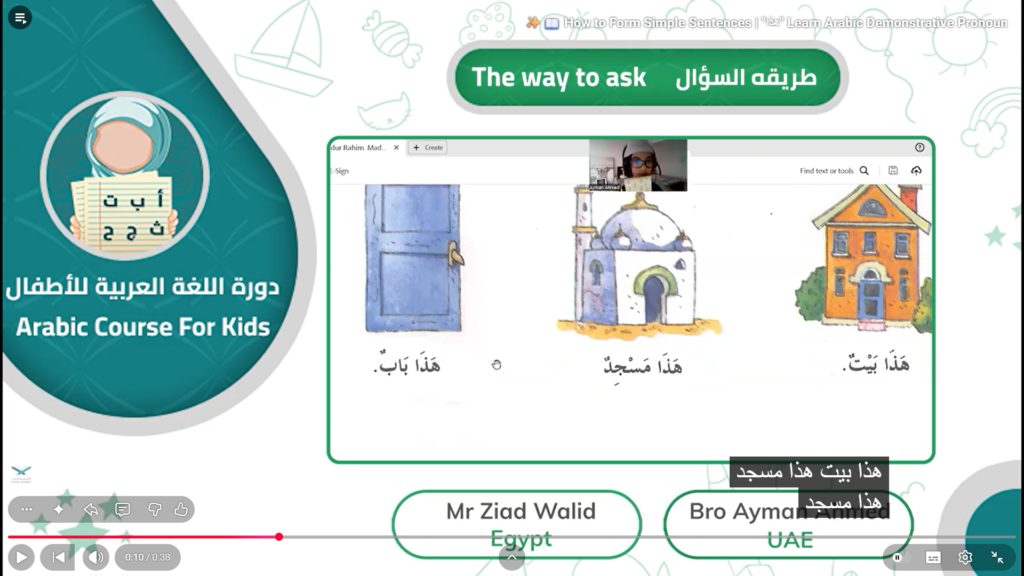
Watch a real-life Arabic class at Abjad Institute.
Learn Arabic Demonstrative Pronoun “هذا” | How to Form Simple Sentences 📖✨
B. Build an After-School Arabic Routine That Teaches Organization and Independence
After school is an ideal time for a short, predictable Arabic routine. A written list reduces repeated reminders and gives your child a clear sequence with a visible finish line.
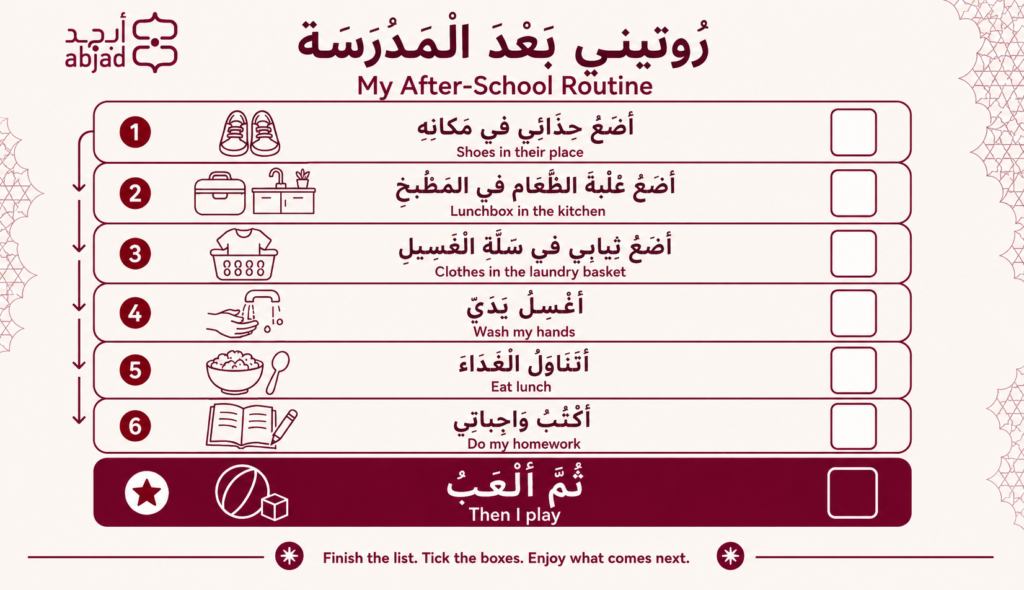
Keep the order simple: put belongings away → wash hands → eat → homework → play. Start with only six steps from the table below and add more once your child can complete them with little prompting.
| Arabic | How to say it | English meaning |
| أَعُودُ مِنَ المَدْرَسَةِ | a’udu min al-madrasa | I come back from school |
| أَضَعُ حِذَائِي فِي مَكَانِهِ | ada’u hitha’i fi makanih | I put my shoes in their place |
| أَضَعُ عُلْبَةَ الطَّعَامِ فِي المَطْبَخِ | ada’u ‘ulbat at-ta’am fi al-matbakh | I put my lunchbox in the kitchen |
| أَضَعُ ثِيَابِي المُتَّسِخَةَ فِي سَلَّةِ الغَسِيلِ | ada’u thiyabi al-muttasikha fi sallat al-ghaseel | I put my dirty clothes in the laundry basket |
| أَغْسِلُ يَدَيَّ | aghsilu yadayya | I wash my hands |
| أَتَوَضَّأُ | atawadda’u | I make wudu |
| أُصَلِّي | usalli | I pray |
| أَتَنَاوَلُ الغَدَاءَ | atanawalu al-ghada’ | I eat lunch |
| أَكْتُبُ وَاجِبَاتِي | aktubu wajibati | I do my homework |
| أُسَاعِدُ أُمِّي | usa’idu ummi | I help my mother |
| أَلْعَبُ | al’abu | I play |
C. Evening Routine In Arabic For Kids
Keep the evening routine short, calm, and consistent. A simple sequence such as play or reading → dinner → shower → pyjamas → Adhkar → sleep gives your child the same Arabic phrases to hear and use every night.
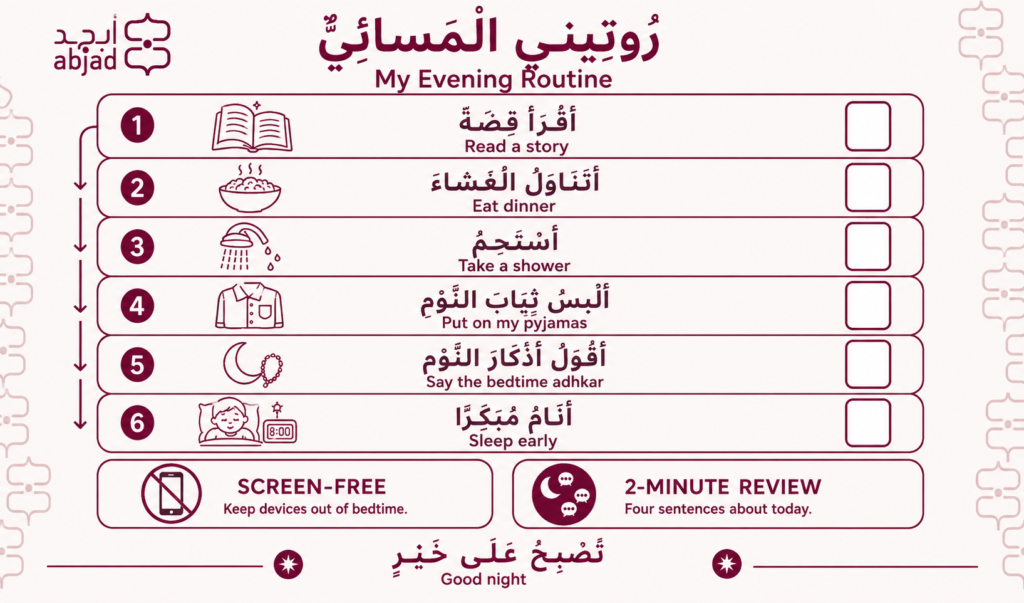
Adjust the order to your household, but keep it consistent. Limit screens during this block so your child remains available for conversation and can wind down before sleep.
| Arabic | How to say it | English meaning |
| أَلْعَبُ قَلِيلًا | al’abu qalilan | I play a little |
| أَقْرَأُ قِصَّةً | aqra’u qissatan | I read a story |
| أَتَنَاوَلُ العَشَاءَ | atanawalu al-‘asha’ | I eat dinner |
| أَسْتَحِمُّ | astahimmu | I take a shower |
| أُرَتِّبُ غُرْفَتِي | urattibu ghurfati | I tidy my room |
| أَلْبَسُ ثِيَابَ النَّوْمِ | albasu thiyab an-nawm | I put on my pyjamas |
| أَقُولُ أَذْكَارَ النَّوْمِ | aqulu adhkar an-nawm | I say the bedtime adhkar |
| أَنَامُ مُبَكِّرًا | anamu mubakkiran | I sleep early |
| تُصْبِحُ عَلَى خَيْرٍ | tusbihu ‘ala khayr | Good night |
Use a Two-Minute Bedtime Arabic Review to Reinforce the Day’s Phrases
Before bed, briefly review tomorrow’s chart so your child knows what comes next. Then ask them to retell today in Arabic using four short sentences.
Keep the exercise to around two minutes and focus on speaking rather than correcting every mistake.
Setting the alarm together can also give your child more responsibility for the next morning.
If pronunciation or spontaneous speaking needs more support, a 30-minute Abjad Institute lesson two or three times a week can give your child practice retelling their day with a native speaker.
You can explore Abjad Institute’s Quran teachers and choose a teacher experienced with children.
Six Arabic Sequence Words That Help Kids Turn Daily Vocabulary Into Sentences
Individual words help children name actions and objects; sequence words help them connect those actions into a story. These six words allow your child to describe their routine using Arabic phrases they already know.
Teach them gradually. Start with أَوَّلًا and أَخِيرًا, then introduce ثُمَّ and بَعْدَ ذَلِكَ. Add قَبْلَ and بَعْدَ once the first four are familiar.
| Arabic | How to say it | English meaning |
| أَوَّلًا | awwalan | First |
| ثُمَّ | thumma | Then |
| بَعْدَ ذَلِكَ | ba’da dhalik | After that |
| أَخِيرًا | akhiran | Finally |
| قَبْلَ | qabla | Before |
| بَعْدَ | ba’da | After |
Put them together and your child can produce a short Arabic paragraph:
أَوَّلًا أَسْتَيْقِظُ مِنَ النَّوْمِ.
ثُمَّ أَغْسِلُ أَسْنَانِي.
بَعْدَ ذَلِكَ أَتَنَاوَلُ الفُطُورَ.
أَخِيرًا أَذْهَبُ إِلَى المَدْرَسَةِ.
First I wake up. Then I brush my teeth. After that I eat breakfast. Finally I go to school.
Practice قَبْلَ and بَعْدَ through questions rather than grammar explanations. For example:
هَلْ نَحْمِلُ الحَقِيبَةَ قَبْلَ الأَكْلِ أَمْ بَعْدَهُ؟
This makes your child compare two actions and describe their order in Arabic.
Children answer these fast. To answer, they must hold two Arabic verbs in mind at once.
Read also: Is Quranic Arabic Different from Normal Arabic? A Complete Comparison
How to Create a Printable Daily Arabic Routine Chart for Kids
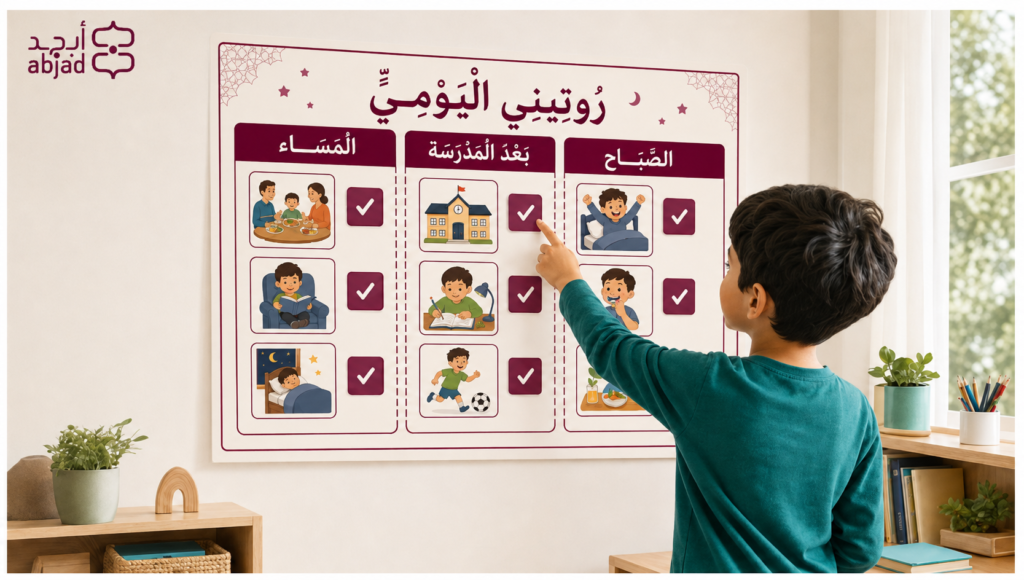
A daily routine printable should show each step in Arabic, in order, with a simple picture and tick box. It moves repeated reminders from the parent to the chart and gives children a visual structure they can follow independently.
Design it for your child: make the Arabic large and prominent, place a picture beside it, and keep the English translation small underneath.
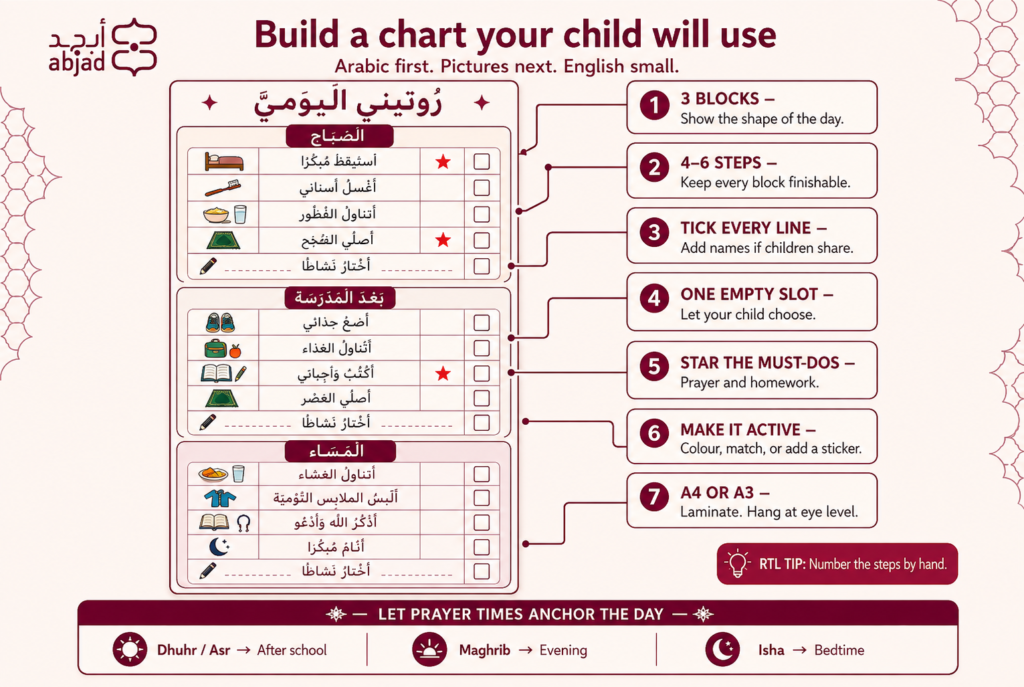
Build the printable like this:
- Divide the day into three blocks: الصَّبَاح, بَعْدَ المَدْرَسَة, and المَسَاء.
- Keep each block to four to six steps so your child can realistically complete it.
- Add a tick box to every step. Include a name column if siblings share the chart.
- Leave one empty slot per block for your child to choose an activity.
- Mark essential tasks with a star, such as prayer or homework, while optional activities use regular boxes.
- Add something interactive, such as coloring, stickers, or picture matching, to keep the chart engaging.
- Print at A4 or A3 and laminate it. Hang it at your child’s eye level and use a dry-erase pen for daily reuse.
A. Choose Daily Habits That Build Responsibility, Health, and Islamic Routine
The chart should prioritize habits you want your child to repeat consistently: sleeping and waking early, making the bed, washing hands, exercising, reading, writing, praying on time, and practicing Islamic manners at meals.
Also set clear boundaries around habits you want to reduce, particularly excessive screen time, eating or studying in bed, leaving clothes on the floor, and shouting or using rude language when angry.
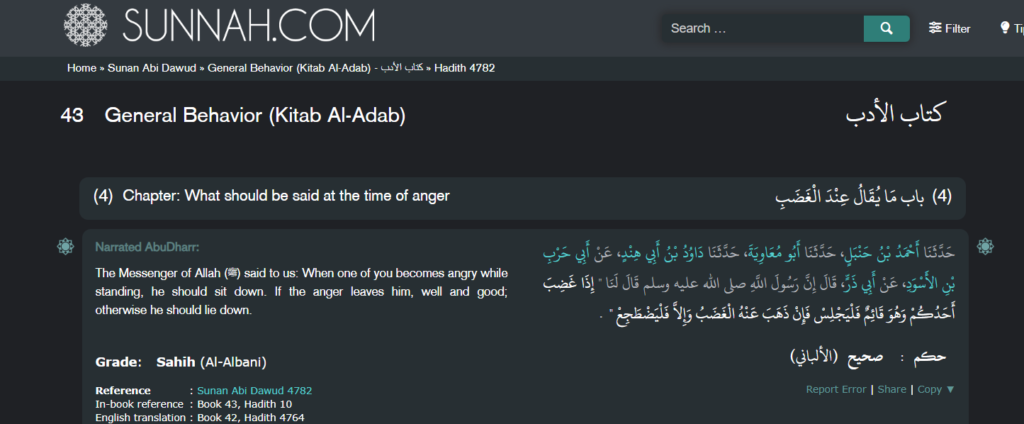
For anger, teach a simple Prophetic response: the Prophet ﷺ instructed someone who becomes angry while standing to sit down, and if the anger remains, to lie down. Sunan Abi Dawud 4782
Most importantly, match the chart to your child’s age and ability. A routine that asks too much creates resistance rather than independence.
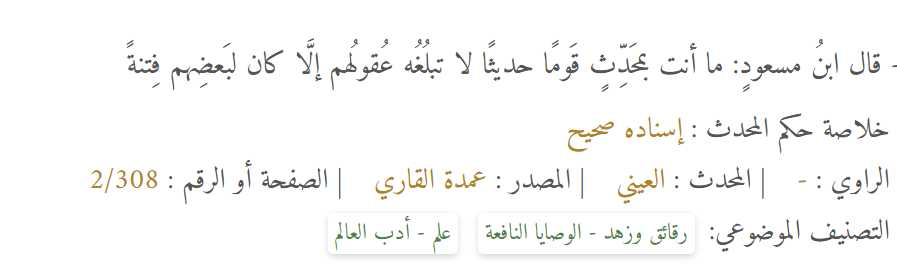
Finally, match the chart to your child’s age and ability. Ask for too much and you get pushback, not discipline. Ibn Mas’ud put it well: speak to people above what their minds can hold, and you cause trouble for some of them.
Read also: Easy Arabic Stories for Kids -Turn Reading Time Into Arabic Practice
Watch Our Classes in Action
Curious what a real session looks like? Take a peek inside our interactive classrooms and see how our expert instructors bring the Arabic language to life. Watch a sample lesson below!
Begin Your Arabic Journey in the UAE
Join Abjad Institute for a professional and immersive Arabic language experience tailored to your goals.
Book Your Free TrialB. Use the Five Daily Prayer Times to Structure Your Child’s Routine
Prayer times provide natural anchors for organizing the day. Allah says:
إِنَّ الصَّلَاةَ كَانَتْ عَلَى المُؤْمِنِينَ كِتَابًا مَوْقُوتًا
Prayer has prescribed times (An-Nisa 4:103).
Instead of relying only on clock times, connect routine blocks to Salah: Dhuhr or Asr can anchor the after-school routine, Maghrib can begin the evening block, and Isha can mark the approach to bedtime.
Introduce prayer vocabulary naturally from an early age with phrases such as أَتَوَضَّأُ (I perform Wudu) and أُصَلِّي (I pray). The Prophet ﷺ instructed parents to begin teaching children Salah at seven, with greater firmness from ten. Sunan Abi Dawud 495
This allows one routine to teach two habits together: the importance of Salah and the value of using time well.

Read also: What Is Quranic Arabic?
The Say–Do–Sequence Loop – A Three-Step Method for Teaching Arabic Through Daily Routines
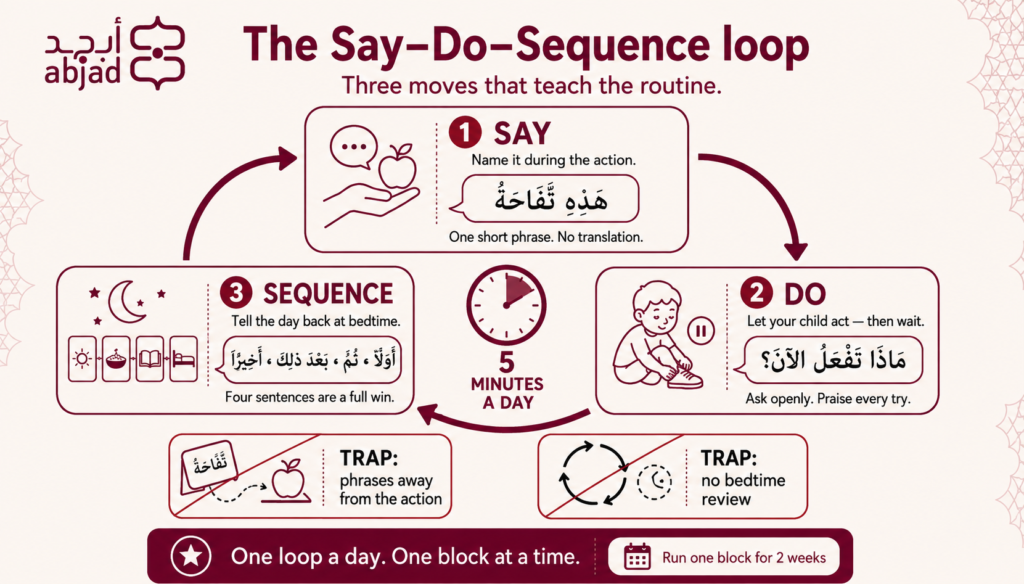
The Say–Do–Sequence Loop turns daily routines into Arabic practice: say the phrase during the action, let your child do it while hearing the Arabic, then ask them to sequence the routine back to you at bedtime.
Focus on one routine block for about two weeks before adding another. Move on when your child begins saying the phrase during the action without prompting.
The method requires only a few minutes of focused practice each day: seconds during each action and around two minutes of review before bed.
1. Say One Short Arabic Phrase While the Action Is Happening
Connect each phrase directly to what your child can see or do. Say هَذِهِ تُفَّاحَةٌ while handing them an apple or نَحْنُ نَرْتَدِي الحِذَاءَ الآنَ while putting on shoes.
Keep it to one short phrase per action. Avoid immediately translating into English; the object or action already provides the meaning. Too much explanation can hide the Arabic words you want your child to notice.
2. Ask Open Arabic Questions and Give Your Child Time to Answer
Open questions encourage more speech than yes/no questions. Instead of هَلْ أَكَلْتَ؟ (“Did you eat?”), ask مَاذَا أَكَلْتَ؟ (“What did you eat?”).
Keep a few practical questions ready:
- مَاذَا تَفْعَلُ الآنَ؟ — What are you doing now?
- مَاذَا سَتَفْعَلُ بَعْدَ ذَلِكَ؟ — What will you do next?
- أَيْنَ الكُرَةُ؟ — Where is the ball?
- مَا لَوْنُ هَذَا؟ — What color is this?
Ask about objects and actions your child can see, then wait five or six seconds for an answer. Searching for the word is part of the learning process.
If they are stuck, point to the object or give the first sound rather than supplying the whole answer. Encourage attempts instead of correcting every mistake. Your role during this practice is simple: ask, wait, and encourage.
Read also: Arabic Vocabulary for Kids – The First 300 Words- In the Right Order
3. Ask Your Child to Retell the Daily Routine in Arabic Before Bed
End the day by asking your child to retell four simple events in order using:
أَوَّلًا (first) → ثُمَّ (then) → بَعْدَ ذَلِكَ (after that) → أَخِيرًا (finally).
For example:
أَوَّلًا أَسْتَيْقِظُ.
ثُمَّ أَفْرُشُ أَسْنَانِي.
بَعْدَ ذَلِكَ أَتَنَاوَلُ الفُطُورَ.
أَخِيرًا أَذْهَبُ إِلَى المَدْرَسَةِ.
Four sentences are enough. The goal is to make your child retrieve and sequence the Arabic they used during the day, not to correct every error.
For younger children, use four or five pictures of daily activities. Mix them up, let your child arrange them in order, and ask them to say the matching Arabic phrase for each picture.
You can then briefly preview tomorrow’s routine in Arabic. This closes the loop: today’s actions become tonight’s review, and tonight’s review prepares your child for tomorrow’s Arabic.
Three Practice Exercises With Answers About Daily Routine in Arabic for Kids
Use this worksheet after introducing the routine chart. Read each Arabic phrase once, then let your child complete the activities independently.
Keep the worksheet under ten minutes. It is a quick check of what your child remembers, not another lesson. When marking it, focus on the type of mistake rather than the total score so you know what needs more practice.
1. Put the Morning Arabic Routine in the Correct Order
This exercise checks whether your child understands the sequence of the morning routine. Ask them to number these five phrases from 1 to 5.
| Arabic phrase | How to say it | English meaning |
| أَتَنَاوَلُ الفُطُورَ | atanawalu al-futoor | I eat breakfast |
| أَذْهَبُ إِلَى المَدْرَسَةِ | adhhabu ila al-madrasa | I go to school |
| أَسْتَيْقِظُ مُبَكِّرًا | astayqizu mubakkiran | I wake up early |
| أَرْتَدِي مَلَابِسِي | artadi malabisi | I put on my clothes |
| أَفْرُشُ أَسْنَانِي | afrushu asnani | I brush my teeth |
Do not give the correct sequence first. If your child gets stuck, ask, “What do you do first in the morning?” and let them work out the remaining steps.
For younger children, cut the phrases into strips and let them physically arrange them in order.
2. Complete the Routine With the Correct Arabic Sequence Words
This exercise checks whether your child can connect separate actions using أَوَّلًا, ثُمَّ, بَعْدَ ذَلِكَ, and أَخِيرًا.
| Line | Complete the sentence |
| 1 | ــــــ أَسْتَيْقِظُ مِنَ النَّوْمِ. |
| 2 | ــــــ أَغْسِلُ وَجْهِي. |
| 3 | ــــــ أَتَنَاوَلُ الفُطُورَ. |
| 4 | ــــــ أَذْهَبُ إِلَى المَدْرَسَةِ. |
Ask your child to read the completed sentences aloud. If they place أَخِيرًا incorrectly, ask “Which step ends the morning?” rather than immediately giving the answer.
3. Match Each Arabic Daily Routine Phrase to Its English Meaning
This final exercise checks basic recognition. Ask your child to match each Arabic phrase with the correct English meaning.
| Arabic phrase | How to say it | Match with |
| أَسْتَحِمُّ | astahimmu | I pray |
| أُصَلِّي | usalli | I sleep early |
| أَكْتُبُ وَاجِبَاتِي | aktubu wajibati | I do my homework |
| أَنَامُ مُبَكِّرًا | anamu mubakkiran | I take a shower |
For a harder version, cover the pronunciation column and ask your child to work directly from the Arabic script.
Daily Routine Arabic Worksheet Answer Key
Mark the answers together so your child can immediately see and understand any mistakes.
| Exercise | Correct answers |
| 1 — Morning order | 1. أَسْتَيْقِظُ مُبَكِّرًا · 2. أَفْرُشُ أَسْنَانِي · 3. أَرْتَدِي مَلَابِسِي · 4. أَتَنَاوَلُ الفُطُورَ · 5. أَذْهَبُ إِلَى المَدْرَسَةِ |
| 2 — Sequence words | 1. أَوَّلًا · 2. ثُمَّ · 3. بَعْدَ ذَلِكَ · 4. أَخِيرًا |
| 3 — Matching | أَسْتَحِمُّ = I take a shower · أُصَلِّي = I pray · أَكْتُبُ وَاجِبَاتِي = I do my homework · أَنَامُ مُبَكِّرًا = I sleep early |
For Exercise 1, adapt the answer to your actual family routine. If your child normally gets dressed before brushing their teeth, that sequence is correct for your chart.
Keep completed worksheets and review them after a few weeks to identify which Arabic phrases are secure and which need more repetition.
Note: The printable PDF file includes all the exercises and the answer key.
Four Common Mistakes That Can Stop the Say–Do–Sequence Method From Working
Most problems with this method are not caused by difficult Arabic. They happen when children receive too many new phrases at once or too little opportunity to think and respond independently.
The four mistakes below can be corrected without changing your entire routine. Pay particular attention during the second week, when the novelty fades, and consistency becomes more important.
1. Teaching Too Many Arabic Routine Phrases at the Same Time
Introducing all three routine blocks at once can overwhelm your child with too many unfamiliar sounds and meanings. It also makes it difficult to identify which phrases they have actually learned.
Start with one block and keep it for about two weeks before adding another. The strongest sign that your child is ready to progress is when they begin saying a phrase before you prompt them.
Three blocks may take around six weeks, but gradual learning is more sustainable than introducing everything quickly and abandoning the routine later.
2. Translating Arabic Into English Instead of Letting the Action Show the Meaning
If every Arabic phrase is immediately followed by English, your child may learn to ignore the Arabic and wait for the translation.
For example, when saying أَغْسِلُ وَجْهِي, let washing the face communicate the meaning. If your child seems confused, repeat the action, point, or give a small clue rather than immediately translating.
Keep English for charts and worksheets. During daily routines, let the action provide the meaning.
3. Asking Yes-or-No Questions Instead of Questions That Encourage Arabic Speaking
Closed questions limit your child’s response. هَلْ أَكَلْتَ؟ can be answered with only نَعَمْ or لَا, while مَاذَا أَكَلْتَ؟ requires them to retrieve vocabulary and build a longer response.
Use question words such as مَاذَا (what), أَيْنَ (where), and مَتَى (when), preferably about something your child can see or has just done.
After asking, wait five or six seconds. Do not immediately supply the answer. Combining open questions with enough thinking time gives your child more opportunities to produce Arabic independently.
4. Letting Screen Time Replace the Daily Moments Used for Arabic Practice
This method depends on small opportunities already built into the day: coming home, eating together, getting ready, and preparing for bed. If those moments are consistently occupied by phones or tablets, there is little space left for conversation.
You do not need to remove screens completely. Protect a few specific practice windows, particularly the doorway, dining table, and bedtime routine.
Consistency in the wider family routine also helps. Regular meal times, bedtime, and morning sequences give children predictable situations in which the same Arabic phrases can naturally repeat.
The goal is not a perfect schedule. It is a predictable daily structure that gives Arabic the same recurring moments every day.
Read also: How to Teach Kids Arabic in the UAE? – A Parent’s Step-by-Step Plan
Inside Our Live Classes
Don’t just take our word for it—see for yourself! Click below to watch short clips from our live classes and meet the instructors who will guide your learning journey.
Book A Free Trial Class And Hear Your Child Speak Arabic TODAY
You have the phrases, the chart, the method, and the worksheet. That is everything a page can hand you. Here is what a page cannot do. It cannot hear your child say أَفْرُشُ أَسْنَانِي and fix the ط in one breath. It cannot answer their question. It cannot notice that they went quiet this week.
A native teacher at Abjad Institute does all three in the first ten minutes. That is the gap between a child who knows Arabic when they see it and a child who speaks it out loud. You do not have to take our word for it. Hear what our students are saying before you decide.

Why Parents Choose Abjad
Most parents come to us after a free app or a group class stopped working. Here is what is different:
- Your child speaks for the whole lesson, not for two minutes of it. Sessions are built so that about 70% of the time is speaking practice.
- Certified native Arab tutors. Most are Al-Azhar graduates, and several hold ijazah in Tajwid and Quran recitation. They hear the sounds an app cannot hear, and fix them on the spot.
- A plan built for children. Kids courses run as separate tracks — kindergarten, beginner, Qaida, conversation, grammar — paced for a child’s attention span, not cut down from an adult course.
- You pick the schedule. 30 or 45 minutes, one to five times a week. Early morning and late evening slots run too, so lessons fit around school, not against it.
- Female tutors on request. Abjad’s team is close to half female, for families who prefer a sister teaching their daughter.
- Clear pricing from $18.99 a month. Every plan and price is published on the site, so you can see what you pay before you book.
- Arabic and Quran under one roof. The same tutor team can carry your child from routine phrases to reading the Quran, through Qaida and Quranic Arabic.
Book your child’s free trial class now.

The Arabic Courses Your Child Can Start With
Abjad groups its Arabic courses by age and by goal, so your child joins at the right point rather than at a fixed level.
- UAE Kindergarten Arabic Classes — first letters and sounds for the youngest learners
- Beginner Arabic for Kids — for a child starting from zero
- Arabic Qaida for Kids — letters, joins, and reading, step by step
- Arabic for Kids Course — the full course for school-age children
- Arabic Conversation for Kids — for a child who reads but will not speak
- Arabic Grammar for Kids — rules taught at a child’s level
- Teen Arabic Summer Course — for older students in the school break
- Arabic Kids Camps — short, intensive blocks
- Quranic Arabic Course — for reading and understanding the Quran
Begin Your Arabic Journey in the UAE
Join Abjad Institute for a professional and immersive Arabic language experience tailored to your goals.
Book Your Free TrialConclusion
A daily routine in Arabic works because children learn phrases while doing the actions they describe. Morning, after-school, and evening routines provide natural repetition without adding separate lesson time.
Start with one block and four phrases for two weeks, then expand gradually. Use the Say–Do–Sequence loop: say the phrase during the action, give your child time to respond, and spend two minutes before bed retelling the day with sequence words such as أَوَّلًا، ثُمَّ، بَعْدَ ذَلِكَ، and أَخِيرًا.
Keep the printable visible, Arabic prominent, screens away from practice moments, and connect routines to prayer times where practical.
Consistency matters more than quantity. A few Arabic phrases used every day will teach your child more than dozens memorized once and forgotten.
FAQs
At what age can a child start learning a daily routine in Arabic?
A child can start as soon as they follow simple spoken steps, usually around age three. Younger children pick up the words by hearing them during the action. School-age children can also read the chart, tick items off, and do written worksheets.
How many Arabic routine phrases should I teach per week?
Teach four to six phrases a week, from one block only. A few phrases repeated daily beat a long list given once. Words stick when your child meets them again and again in the same real moment.
Do I need to speak Arabic to teach my child a daily routine in Arabic?
No. You only need to say a few fixed phrases at the right moment, and the guide above shows you how to say each one. Fixing your child’s own sounds is the part a parent with no Arabic cannot do. That is what a native tutor is for.
What should a daily routine in Arabic for kids printable include?
It should have three blocks: morning, after school, and evening. Put four to six Arabic phrases in each, with a picture per step and a tick box on every line. Add one empty slot your child fills in, the English meaning in small print, and a star next to must-do items like prayer and homework.
How do I stop my child from waiting for the English translation?
Say the Arabic phrase, do the action, and stop there. If your child looks lost, show the action again instead of translating. Handing over the English right away teaches them that a short wait gets the meaning for free.
Which Arabic order words should my child learn first?
Start with أَوَّلًا (first) and أَخِيرًا (finally). The start and end of a day are the easiest points to spot. Add ثُمَّ and بَعْدَ ذَلِكَ next. Save قَبْلَ and بَعْدَ for last, and teach them as a spoken game.
Does a daily routine help children with speech or communication difficulties?
Yes. Daily routines give the same language chances again and again, and your child knows what comes next. Picture sorting links a word straight to an action. That pairing helps children with autism or speech delays more than word drills do.






Leave a Reply