 Learn Arabic
The difference between sukoon and jazm confuses almost every Arabic learner. The two look alike on the page. However, they are not the same thing at all.
Here is the short version. Sukoon is a mark you see on a letter. Jazm is a grammatical state that happens to a verb. They meet in one place only, and that meeting is what causes the mix-up.
Once you see the line between them, a lot of Arabic grammar gets easier. Miss it, and you will keep guessing.
What you will learn
- What sukoon is, and what its symbol looks like.
- How to pronounce a letter that has sukoon on it.
- What jazm is, and the three signs that show it.
- The three cases that break the “sukoon means jazm” rule.
- A three-step test you can use on any sukoon you meet.
What Is The Difference Between Sukoon And Jazm In Arabic?
Sukoon is a small mark that shows a letter has no vowel. Jazm is a grammatical state, and it happens to one kind of word only: the present tense verb. Sukoon is what you see. Jazm is what happened.
The two overlap in one spot. Sukoon is the main sign of jazm when the verb ends in a strong letter. That case comes up first for most learners. So they learn to treat the two words as one thing.
A good way to keep them apart is to ask where each one lives. Sukoon lives in the sound and the spelling of a word, so you can point at it and say it out loud. Jazm lives in the sentence, so you can only work it out from the word that came before the verb.
That is why a letter can carry sukoon with no jazm anywhere near it. It is also why a verb can be in jazm with no sukoon written on it at all.
| Sukoon | Jazm | |
| What it is | A mark for “no vowel” | A grammatical state |
| Where it lives | Sound and spelling | Sentence structure |
| Works on | Any letter, in any word | Present tense verbs only |
| Caused by | The shape of the word | A jazm word before the verb |
| Can you hear it? | Yes | No |
| How many forms? | One mark | Three signs |
Think of it this way. Jazm is the ruling. Sukoon is one of three ways that ruling gets written down.
What Is Sukoon In Arabic?
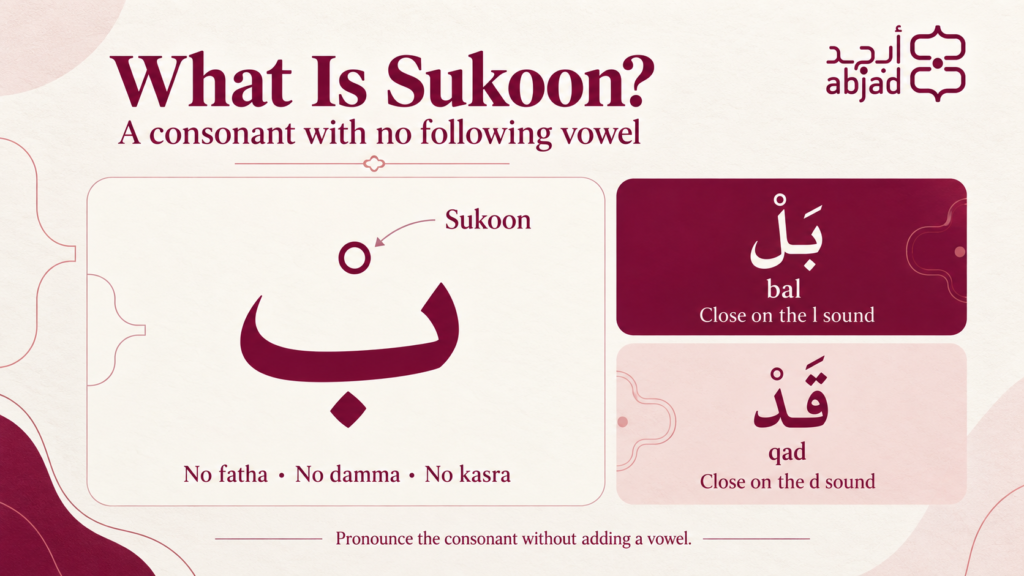
Sukoon means a letter has no vowel on it. It has no fatha, no damma, and no kasra. A letter in that state is called sakin, which means silent.
Sukoon is not just for verbs. It is not just for the end of a word. Most of the time it has nothing to do with grammar at all.
The mark does one job, and it does it everywhere. It tells you to stop the letter and move on. That is why you meet it in every kind of word, and not only in verbs.
Native readers stop noticing it, because it is simply part of how the word sounds. Learners notice it because they were taught it as a grammar rule first.
You will find it in the middle of a noun, as in مَرْيَم. You will find it at the end of small words, as in مِنْ and عَنْ. You will find it on question words, as in مَنْ and كَمْ. You will find it at the end of a command, as in اكْتُبْ. None of those is jazm.
What Is The Symbol Of Sukoon?
The symbol of sukoon is a small circle above the letter: ( ْ ). You can see it in بَلْ, قَدْ, and مَرْيَم.
The circle sits on top of the letter, never below it. It is easy to mix it up with the small circle of a shadda or a hamza at first glance. A quick check helps here. A sukoon is a plain, empty ring, and nothing sits inside it.
The sukoon symbol in the Quran often looks different. Many Mushaf prints use a tiny head of the letter kha with no dot ( ۡ ). Some prints leave the letter bare. The job is the same, and only the shape changes.
This is not a mistake, and it is not a different rule. It comes from the way Quranic script was set down and then printed by hand for centuries. Each printing house followed the style of its own region.
So the same verse can look one way in a Madinah print and another way in an Egyptian one. Learn both shapes early, and no Mushaf will slow you down.
How To Pronounce Sukoon In Arabic
A silent letter cannot be said on its own. It has no vowel to carry it, so it leans on the vowel before it and closes that beat.
In بَلْ you do not say ba-la; you say bal, because the lam seals the sound. In قَدْ the dal closes onto the qaf: qad.
Say both words slowly, and you will feel the difference. Your mouth forms the silent letter, but no new beat comes out of it. English works the same way, which makes this easier than it sounds. The word cat ends on a t that you shape but do not follow with a vowel. That t is doing the job of a sakin letter.
This is also why no Arabic word starts with a silent letter. There would be nothing for it to lean on.
It also explains a rule you may have met in Tajweed class. Two silent letters cannot sit side by side in speech. When that happens, a short vowel is added to break them up.
Learners often try to force a small vowel onto a silent letter to make it easier to say. That habit is worth catching early, because it changes the shape of the word.
Read also:Quranic Grammar: The Complete Guide to Understanding the Language of the Quran
Can Alif Take A Sukoon? And Which Letters Can
No, the long alif (ا) cannot take a sukoon. It is silent by nature, and a fatha always comes before it, so the mark would add nothing. Every other letter can take a sukoon, apart from the waw and the ya when they stretch a sound.
Here is the simple rule to hold. If a letter can carry a fatha, a damma, or a kasra, then it can also carry a sukoon. The three stretch letters cannot carry any of those, so the question never comes up for them.
Many learners still search for “alif with sukoon” rules. What they saw was most likely a hamza with sukoon, as in اقْرَأْ. That is a different letter with a real sukoon on it.
The same idea covers waw and ya inside a long vowel, as in مُوسَى and فِي. They are silent already, and that silence is part of the vowel, not a mark you add.
Learning Arabic in the UAE? In Abjad’s grammar classes, a teacher fixes these details while you read. That is much faster than working them out alone.
What Is Jazm In Arabic Grammar?
Jazm is one of the four grammatical states in Arabic. The other three are raf, nasb, and jarr. Jazm works on the present tense verb, and on nothing else.
In plain Arabic, the word jazm means to cut off. That is a fair picture of what it does to the end of a verb. The verb loses its full ending and stops short. Nothing else in the sentence changes.
Jazm never happens on its own. A verb only falls into jazm when a trigger word sits in front of it. Learn those trigger words and you will spot jazm before you even look at the verb.
Three kinds of words can never take jazm. This rule alone cuts out most of the guessing.
- Nouns never take jazm. A noun may end in sukoon, as in مَنْ, كَمْ, and الَّذي. That sukoon is fixed. It is not a case ending.
- The past tense verb never takes jazm. Its ending is fixed too.
- The command verb never takes jazm. It is fixed on sukoon, as in اكْتُبْ. The mark looks the same. The grammar is not.
The Three Signs Of Jazm
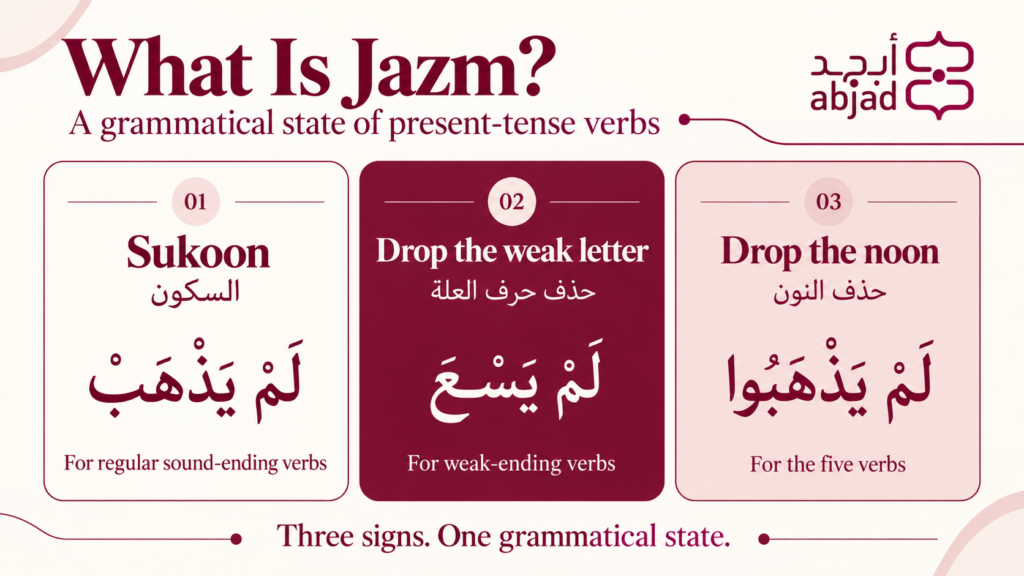
Jazm has one main sign and two backups. Which sign you get depends on how the verb ends, not on which trigger word came before it. So look at the last letter of the verb first.
- Sukoon. This is the main sign. Use it when the verb ends in a strong letter: لَمْ يَذْهَبْ, مَنْ يَجْتَهِدْ يَنْجَحْ, لَمْ يُهْمِلْ. A strong letter is any letter that is not ا, و, or ي.
- Dropping the weak letter. Use it when the verb ends in ا, و, or ي: لَمْ يَسْعَ, لَا تَدْعُ, لَمْ يَقْضِ. The vowel left behind shows you which letter went. A fatha points to a dropped alif, a damma points to a dropped waw, and a kasra points to a dropped ya. That leftover vowel is your proof that jazm happened.
- Dropping the noon. Use it with the five verbs. These are present tense verbs that end in the dual alif, the plural waw, or the ya for a female listener: لَمْ يَذْهَبُوا, لَمْ تَفْعَلِي, إِنْ تَتُوبَا. In their normal state these verbs end in a noon, and jazm takes that noon away. So the noon is the part you watch.
One point saves a lot of confusion here. Only the first sign is a sukoon, and the other two are not marks at all. They are things that go missing.
Read also: Sukoon In Arabic – Meaning, Pronunciation and Grammatical Role
Which Words Cause Jazm?
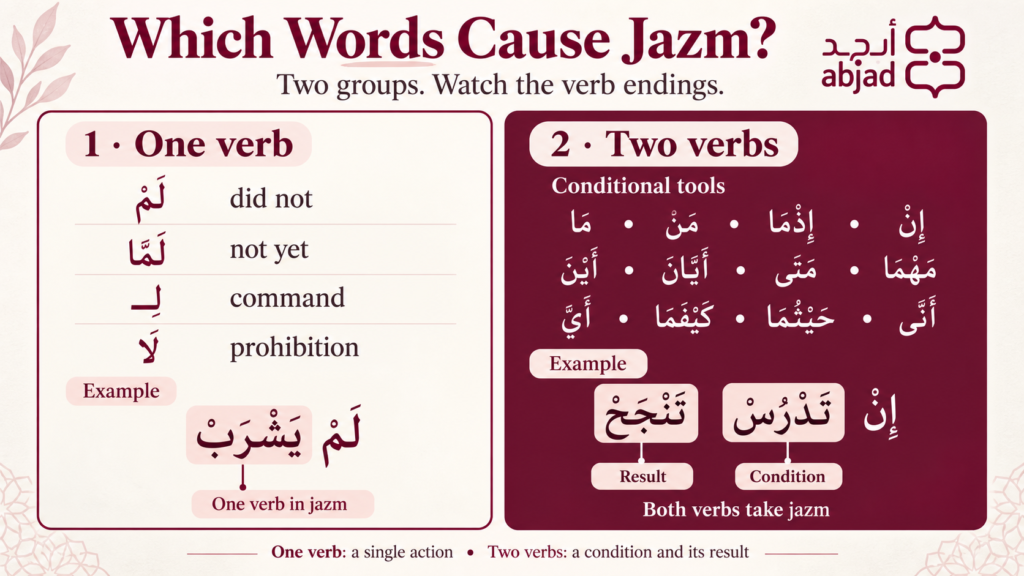
Two groups do it. The first group works on one verb. The second group works on two verbs at once.
Some words put one verb in jazm. They are لَمْ, لَمَّا, the lam of command, and the la of warning. You can see them in لَمْ يَشْرَبْ, لِيَدْرُسْ أَخُوكَ, and لَا تُفَرِّطْ. لَمْ and لَمَّا both turn the verb into a denial of the past.
The lam of command asks for something to be done. The la of warning asks for something to stop. So each one changes the meaning as well as the ending.
Other words put two verbs in jazm: the condition and its answer. They are إنْ، إذْما، مَنْ، ما، مهما، متى، أيّان، أين، أنّى، حيثما، كيفما، أيّ. The first verb sets the condition. The second verb is what happens if that condition is met. Both of them take jazm, so watch for two endings, not one.
Grammar books do not agree on the count. Some list eleven and some list thirteen. The gap is mostly about إذا, which takes jazm in poetry only. You do not need to settle that debate to use the list.
You may also like: The Quranic Arabic Alphabet: Letters, Pronunciation, and Tajweed Rules
Watch Our Classes in Action
Curious what a real session looks like? Take a peek inside our interactive classrooms and see how our expert instructors bring the Arabic language to life. Watch a sample lesson below!
Begin Your Arabic Journey in the UAE
Join Abjad Institute for a professional and immersive Arabic language experience tailored to your goals.
Book Your Free TrialSukoon And Jazm: Three Cases That Break The Rule
“Jazm shows up as sukoon” will serve you well most of the time. It will fail you at the moments that matter. Here are those moments.
1. Jazm With No Sukoon On The Page
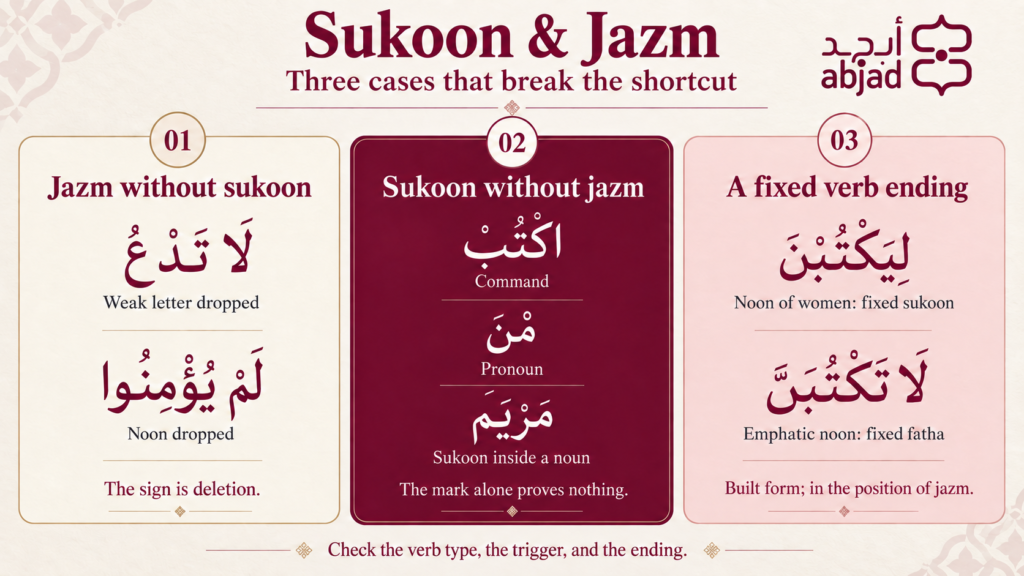
Look at (وَلَا تَدْعُ مَعَ اللَّهِ إِلَٰهًا آخَرَ). The verb تَدْعُ is in jazm, but there is no circle in sight. The sign here is the dropped waw. In its normal state the verb ends in a waw, as in تَدْعُو. The la of warning came in and took that waw away. All that is left is a damma on the letter before it, and that damma is your clue.
Now look at (كَمَا لَمْ يُؤْمِنُوا بِهِ أَوَّلَ مَرَّةٍ). The verb يُؤْمِنُوا is in jazm too, and the sign is the dropped noon. Its normal form is يُؤْمِنُونَ, and jazm removed that noon. In both cases the grammar is clear, yet the page shows you nothing new. You have to know what is missing.
This is where a lot of learners lose marks in class. They scan the verb, see no sukoon, and decide there is no jazm.
The habit to build is the opposite one. Read the word in front of the verb first, then look at the verb. If a trigger word is there, the verb is in jazm, and your only job is to name which of the three signs did the work.
2. Sukoon With No Jazm At All
Most of the sukoons you meet are like the four below. Every one of them is fixed by the word itself, and no jazm is involved.
- A command verb sits on sukoon by nature — اكْتُبْ
- A question word ends in a fixed sukoon — مَنْ, كَمْ
- A name can hold a sukoon in the middle, and that one is pure sound — مَرْيَم
- A word you pause on loses its last vowel and ends silent — نَسْتَعِينْ
This group is much bigger than the jazm group, which surprises most learners. Open any page of Arabic text and count the sukoons on it. Most of them will have nothing to do with verbs. A few will sit on verbs that were never in jazm to begin with. So the mark on its own proves nothing.
The stop case is the one that catches readers out most often. A word can end in a damma when you read straight through it, and end in a silent letter when you pause on it.
Nothing about its grammar changed between those two readings. Only your breath changed. So never take a sukoon at the end of a line as proof of anything.
3. Sukoon That Is Fixed, Even After A Jazm Word
This case sorts out who really understands the topic. Read (وَلْيَضْرِبْنَ بِخُمُرِهِنَّ). The lam of command is right there, so you expect jazm. But the verb carries the noon for a group of women. That noon locks the ending in place. So the verb sits on sukoon, and the jazm is there in position only.
The same thing happens with the noon of stress. In (وَلَا تَحْسَبَنَّ اللَّهَ غَافِلًا), the word of warning is there. Yet تَحْسَبَنَّ ends in fatha, not jazm.
Grammar books call this a fixed ending, and it beats the jazm every time. The trigger word still did its job in the sentence. It just could not change an ending that was already locked. This is the only case where you can see a jazm word and a sukoon together, and still not be looking at the sign of jazm.
A quick rule: if a present tense verb carries the noon for women or the noon of stress, stop looking for a jazm sign. That verb no longer takes case endings.
This is the case learners get wrong alone, because the page looks right. Every Abjad teacher is a native speaker and a trained tutor. So the fix comes while you read, not a week later on a marked sheet. Try one lesson and see how fast it stops catching you out.

Read also: Jazm In Arabic Grammar
Examples Of Sukoon In The Quran
The Quran is the best place to test this. Both kinds of sukoon sit on the same page. The text is fully marked, so nothing is hidden from you. That makes it far easier to practise on than a plain newspaper page.
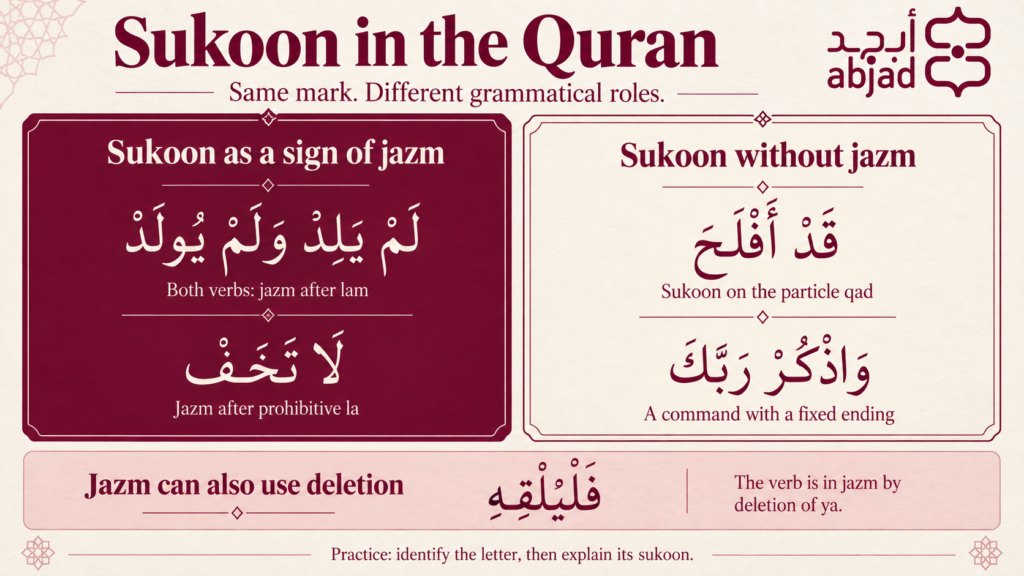
Here sukoon is the sign of jazm:
- (لَمْ يَلِدْ وَلَمْ يُولَدْ) — two verbs, both in jazm by لم
- (يَا مُوسَىٰ لَا تَخَفْ) — jazm after the la of warning
- (وَإِن لَّمْ تَفْعَلْ فَمَا بَلَّغْتَ رِسَالَتَهُ) — jazm by لم
- (إِن نَّعْفُ عَن طَائِفَةٍ مِّنكُمْ نُعَذِّبْ طَائِفَةً) — the first verb drops its waw, the second takes sukoon
Here sukoon has nothing to do with jazm:
- (قَدْ أَفْلَحَ الْمُؤْمِنُونَ) — sukoon on a small word
- (وَاذْكُرْ رَبَّكَ) — a command, fixed on sukoon
- (فَلْيُلْقِهِ الْيَمُّ بِالسَّاحِلِ) — jazm, but by a dropped ya
Notice what the second group has in common. Not one of those verbs had a trigger word in front of it. That single check would have sorted every line above in a few seconds.
Try this drill. Read one page of the Mushaf, and sort every sukoon you see into “jazm” or “not jazm”. Do it again a week later on the same page, and see how much faster you get. It is one of the best uses of an hour in early grammar study.
Read also: How to Read Arabic Without Vowels?
Why The Sukoon And Jazm Difference Matters
It matters when you recite. Stop rules turn live endings into silent ones. If you read every sukoon as jazm, you will read the grammar wrong each time you pause. In the Quran, grammar carries meaning.
A reader who mixes the two will also hesitate at the end of every line, and that hesitation shows in the recitation.
It matters for meaning. Jazm is not decoration, and each ending changes the sense. لَمْ يَذْهَبْ denies the past. لَا تَذْهَبْ tells you not to go. إِنْ تَذْهَبْ sets a condition. The verb ending is what tells them apart. Strip the trigger word out of the sentence and the ending is your only clue left.
It matters when you write. Full marks are standard in the Quran, in books for children, in poetry, and in teaching texts. If you add a sukoon where none belongs, you have changed the word. If you leave one out, you have made the word harder to read.
Calligraphers place the sukoon circle with care, since it is part of the design. Its job never changes: it tells you the letter closes the beat.
How To Learn Sukoon And Jazm
Skip the tables. Run three questions instead, in this order. The order matters, because each question saves you from asking the next one.
- Is the mark on the last letter of a present tense verb? If not, it is not jazm. You are done.
- Is there a jazm word in front of that verb? If not, it is not jazm.
- Does the verb carry the noon for women or the noon of stress? If yes, the ending is fixed, and the jazm is in position only.
Only a “yes, yes, no” gets you sukoon as a sign of jazm. Any other answer means you are looking at something else.
Then practise in this order. Read marked text out loud until silent letters stop slowing you down. Spot the three signs of jazm in short verses. Hunt for jazm with no sukoon on purpose. Then use it at speed while you read.
Keep the sessions short and frequent. Ten minutes a day will beat one long session at the weekend. Say the words out loud, because your ear will catch what your eye skips over.
How fast this goes depends on your practice and on how early your errors get fixed. Step one is fine on your own, but steps three and four go faster with a teacher, because you cannot see your own mistakes.
Inside Our Live Classes
Don’t just take our word for it—see for yourself! Click below to watch short clips from our live classes and meet the instructors who will guide your learning journey.
Begin Your Arabic Journey in the UAE
Join Abjad Institute for a professional and immersive Arabic language experience tailored to your goals.
Book Your Free TrialRead also: The Shadda In Arabic Small Mark That Doubles The Impact
Learn Arabic Grammar With Abjad Institute
You have just read the rules. The next step is using them out loud. You need someone who catches the slip before it becomes a habit.
Abjad teaches Arabic across the UAE. That covers Dubai, Abu Dhabi, Sharjah, and every other emirate. Our students are working adults, families, school children, and company teams.You may have a look at our qualified teachers, make your choice and click free trial.
You also pick the Arabic you actually need. We teach Fusha and Classical Arabic. We teach Arabic grammar on its own. We teach Quranic Arabic with Tajweed, business Arabic, and Gulf dialect. So the course fits your goal, not a general plan built for everyone.
Here is what a lesson looks like. You read, you parse, you speak, and your teacher corrects you on the spot. Grammar comes out of real text, not out of lists you forget by Friday. Every point in this guide is one we cover in class, at your pace.
Your first lesson is free. Bring your own questions, or bring the page that keeps tripping you up. You will leave that session knowing where your Arabic stands and what to fix first.
Start your free trial with Abjad today.
Discover Our Arabic Courses
- Arabic Course in the UAE
- Arabic Intensive Course
- Learn Arabic from Scratch Course
- Madinah Arabic Course
- Arabic Classes for Adults
- Arabic Classes for Beginners
- Self-Paced Arabic Course
- Basic Arabic Course
- Arabic Speaking Classes
- Learn to Write Arabic Course
- Arabic Grammar Course
- Learn Arabic Alphabet Course

Conclusion
Sukoon and jazm are two different things. Sukoon is a mark for “no vowel”. It can sit on any letter, in any word, often for reasons of sound alone. Jazm is a grammatical state. It hits present tense verbs only, it needs a trigger word, and it shows up in three ways.
Sukoon is just the first of those three. The other two are not marks at all. One drops a weak letter, and one drops a noon. So a verb can be in jazm with a clean, empty ending and no circle anywhere.
The reverse is just as common. A command sits on sukoon with no jazm behind it. A question word does the same. A word you pause on ends silent because you stopped, not because a rule changed it.
Keep the three questions close for a while. Is it a present tense verb? Is there a trigger word in front of it? Is the ending already locked? That takes a few seconds, and it will be right far more often than a guess.
Stop reading the circle as proof of jazm. Read the sentence instead. Arabic grammar gets a lot more predictable after that, and the pages you once slowed down on start to move at normal speed.
Frequently Asked Questions
Is sukoon the same as jazm?
No. Sukoon is a mark that shows a letter has no vowel. Jazm is a grammar state, and it hits present tense verbs only. Sukoon is the sign of jazm on verbs that end in a strong letter. That is the one place they overlap.
What is the symbol of sukoon in the Quran?
The sukoon symbol in the Quran is often a tiny head of the letter kha with no dot ( ۡ ). Standard printed Arabic uses a small circle ( ْ ) instead. Some Mushaf prints leave the letter bare.
Can a noun take jazm in Arabic?
No. Nouns never take jazm. A noun such as مَنْ, كَمْ, or الَّذي may end in sukoon. That sukoon is fixed, and it is not a case ending.
What is an example of sukoon in an Arabic word?
In مَرْيَم, the ra has a sukoon and closes the first beat: Mar-yam. In قَدْ, the dal is silent and leans on the qaf, and neither one has jazm in it.
Why does لَمْ يَدْعُ have no sukoon if it is in jazm?
Because the verb ends in a weak letter. Verbs that end in ا, و, or ي take jazm by dropping that letter. The damma left behind shows you the waw was there.
How long does it take to learn sukoon and jazm?
The rules take a few good sessions, but using them at reading speed takes longer. It depends on how much you practise, how much Arabic you know, and how fast your errors get fixed. Guided lessons tend to move learners through this stage faster than self-study.





Leave a Reply